
1 5 Arrays 2 Arrays Array Consecutive group
![3 c is the array name c has 12 elements ( c[0], c[1], …](https://slidetodoc.com/presentation_image_h2/11e89fb3e699603c3c0bbd219dad4a0e/image-3.jpg "3 c is the array name c has 12 elements ( c[0], c[1], …")
- Slides: 18
1 5 Arrays
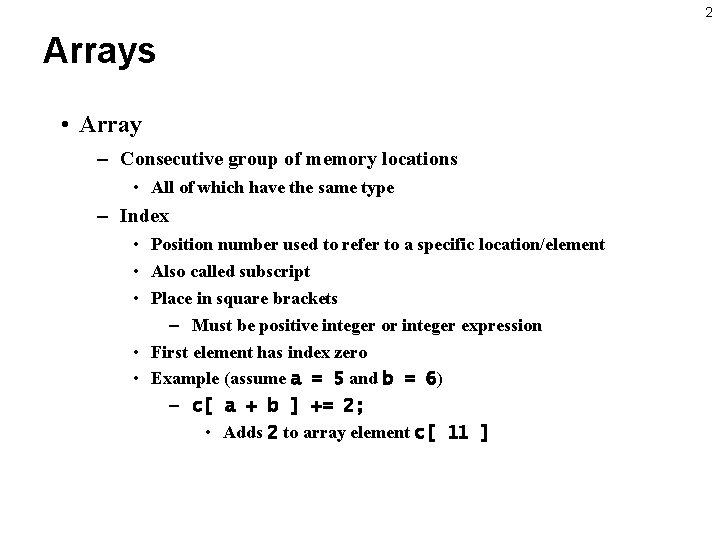
2 Arrays • Array – Consecutive group of memory locations • All of which have the same type – Index • Position number used to refer to a specific location/element • Also called subscript • Place in square brackets – Must be positive integer or integer expression • First element has index zero • Example (assume a = 5 and b = 6) – c[ a + b ] += 2; • Adds 2 to array element c[ 11 ]
3 c is the array name c has 12 elements ( c[0], c[1], … c[11] ) The value of c[0] is – 45
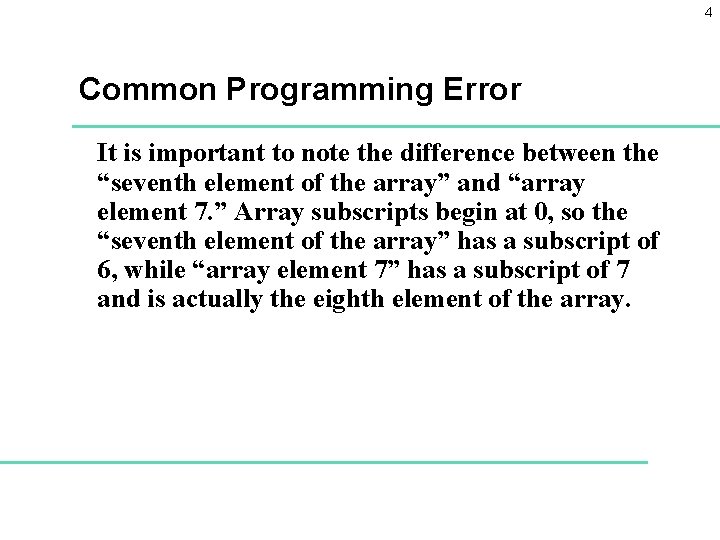
4 Common Programming Error It is important to note the difference between the “seventh element of the array” and “array element 7. ” Array subscripts begin at 0, so the “seventh element of the array” has a subscript of 6, while “array element 7” has a subscript of 7 and is actually the eighth element of the array.
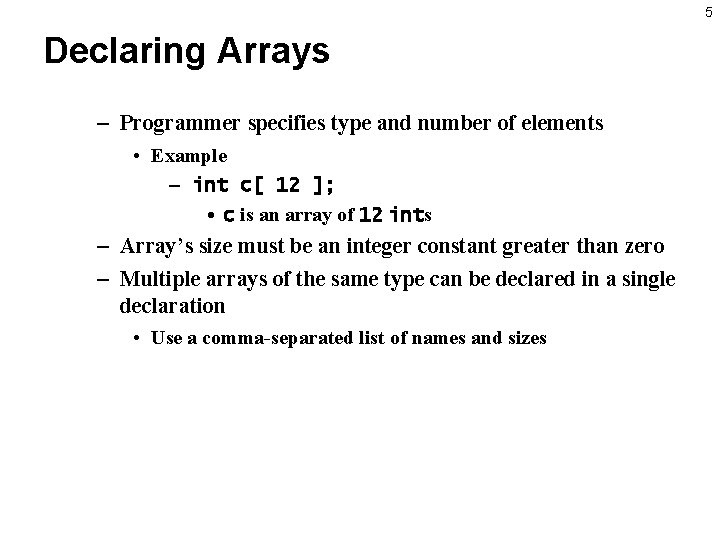
5 Declaring Arrays – Programmer specifies type and number of elements • Example – int c[ 12 ]; • c is an array of 12 ints – Array’s size must be an integer constant greater than zero – Multiple arrays of the same type can be declared in a single declaration • Use a comma-separated list of names and sizes
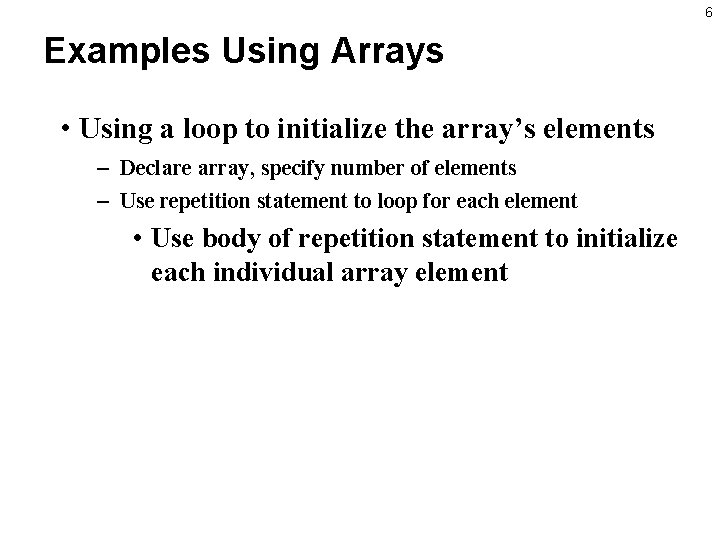
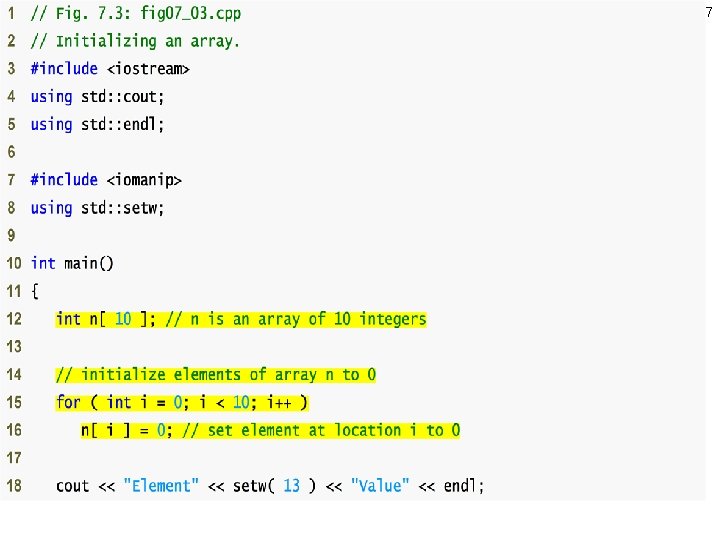
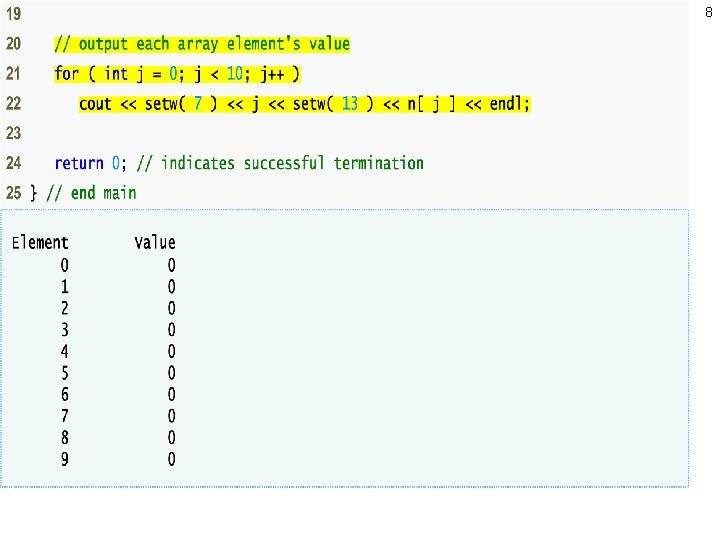
6 Examples Using Arrays • Using a loop to initialize the array’s elements – Declare array, specify number of elements – Use repetition statement to loop for each element • Use body of repetition statement to initialize each individual array element
7
8
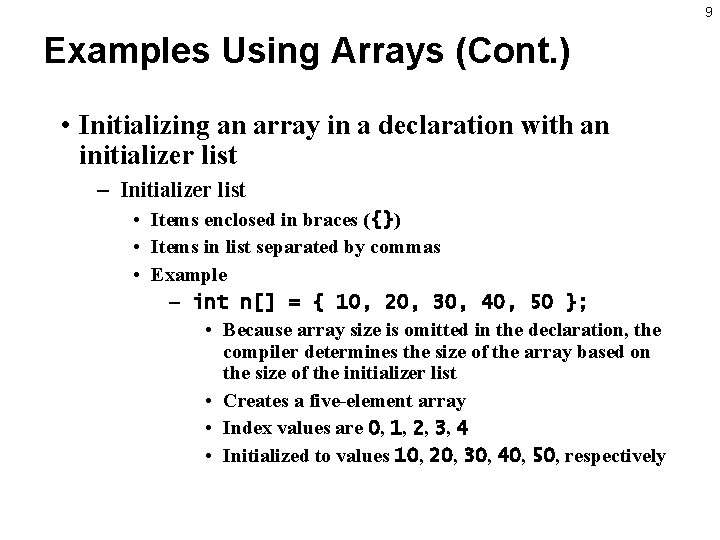
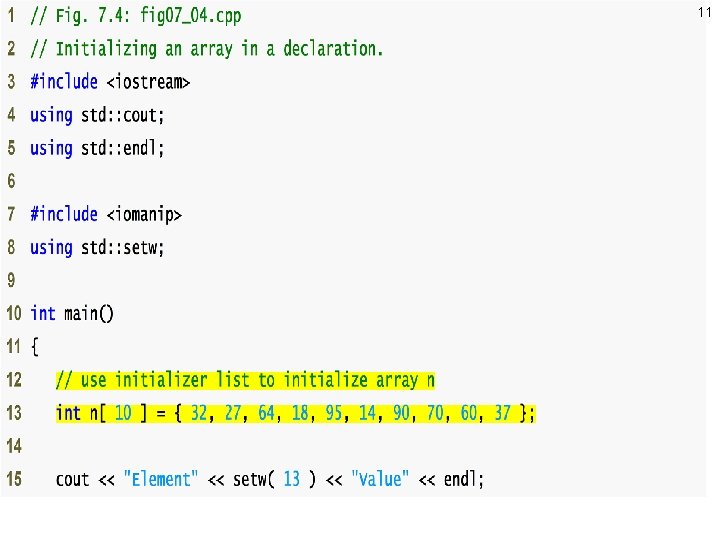
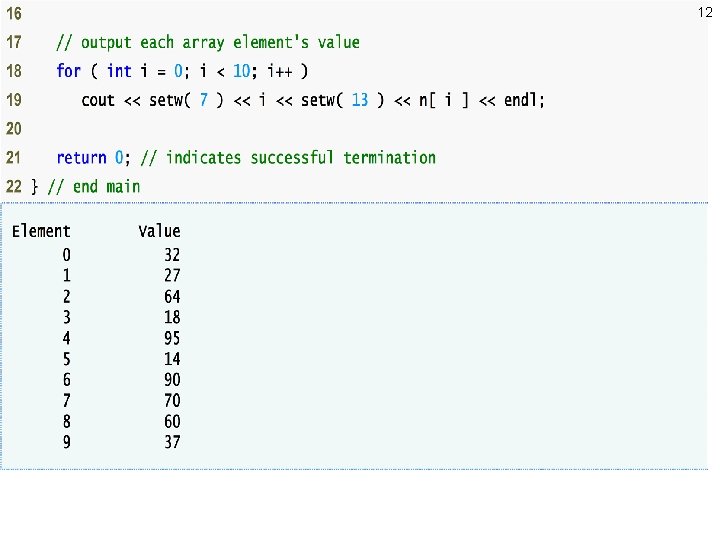
9 Examples Using Arrays (Cont. ) • Initializing an array in a declaration with an initializer list – Initializer list • Items enclosed in braces ({}) • Items in list separated by commas • Example – int n[] = { 10, 20, 30, 40, 50 }; • Because array size is omitted in the declaration, the compiler determines the size of the array based on the size of the initializer list • Creates a five-element array • Index values are 0, 1, 2, 3, 4 • Initialized to values 10, 20, 30, 40, 50, respectively
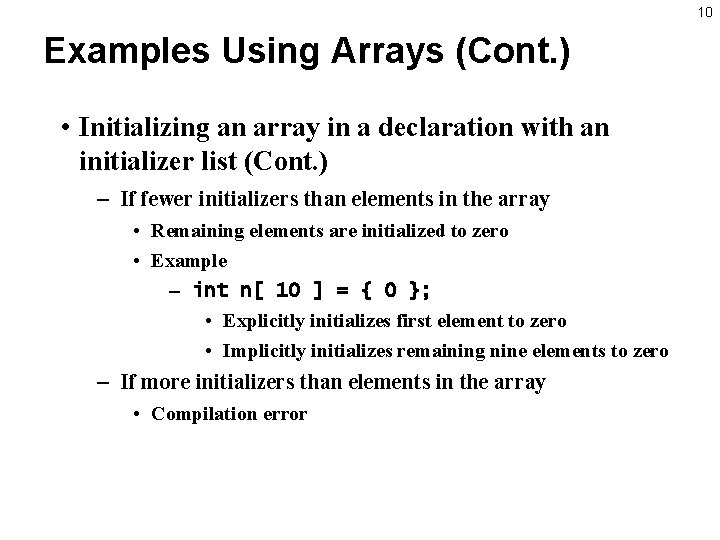
10 Examples Using Arrays (Cont. ) • Initializing an array in a declaration with an initializer list (Cont. ) – If fewer initializers than elements in the array • Remaining elements are initialized to zero • Example – int n[ 10 ] = { 0 }; • Explicitly initializes first element to zero • Implicitly initializes remaining nine elements to zero – If more initializers than elements in the array • Compilation error
11
12
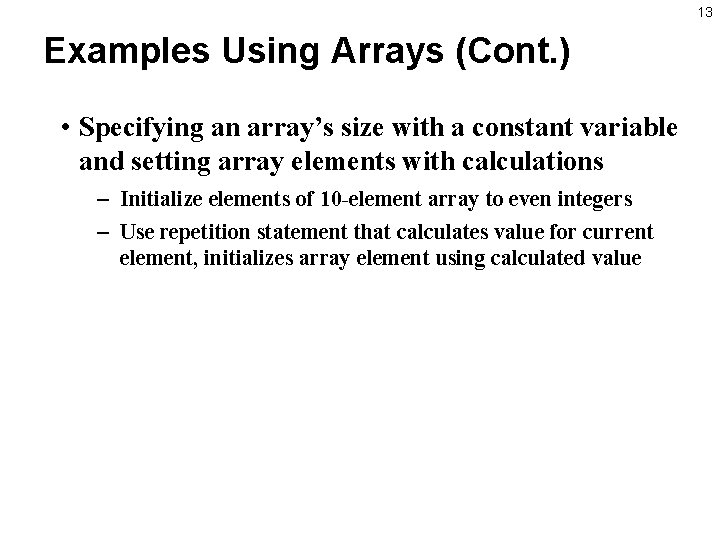
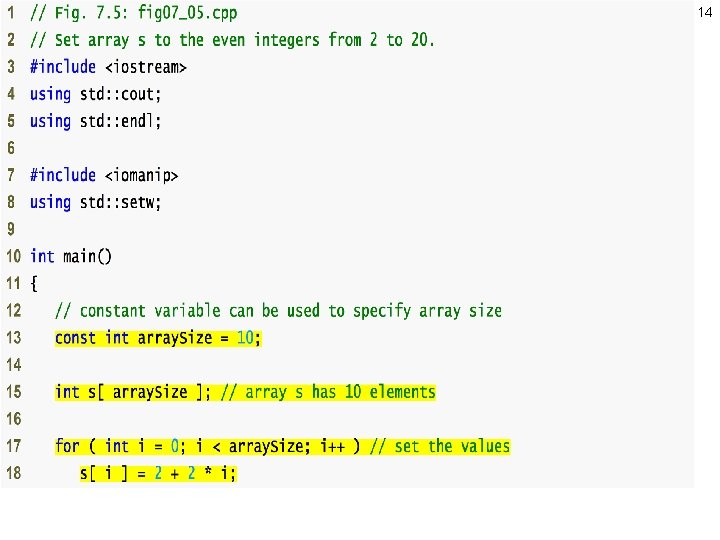
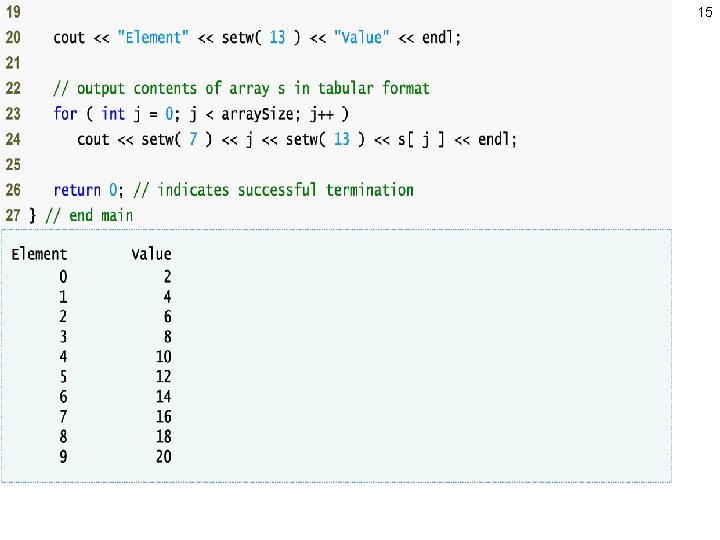
13 Examples Using Arrays (Cont. ) • Specifying an array’s size with a constant variable and setting array elements with calculations – Initialize elements of 10 -element array to even integers – Use repetition statement that calculates value for current element, initializes array element using calculated value
14
15
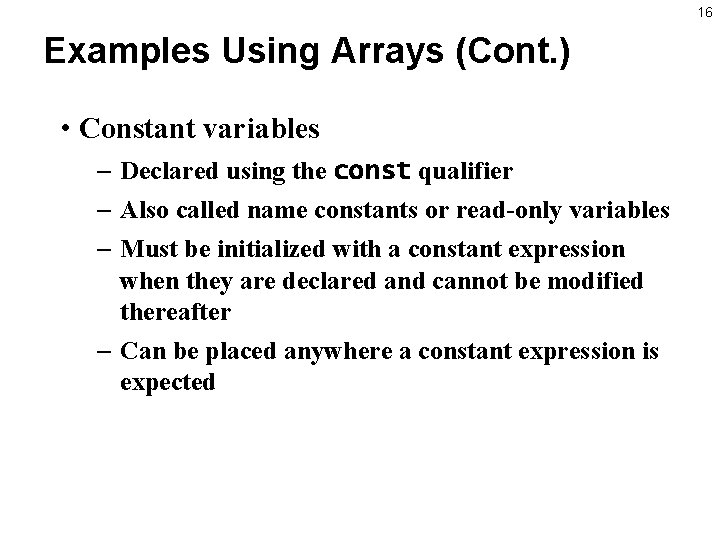
16 Examples Using Arrays (Cont. ) • Constant variables – Declared using the const qualifier – Also called name constants or read-only variables – Must be initialized with a constant expression when they are declared and cannot be modified thereafter – Can be placed anywhere a constant expression is expected
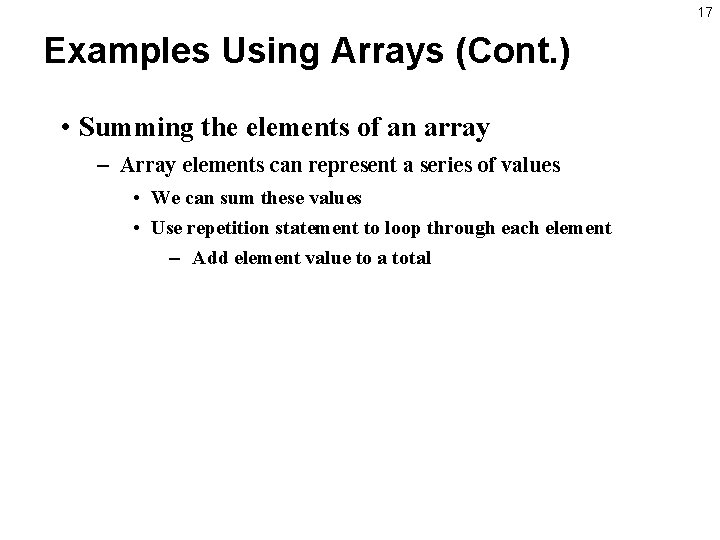
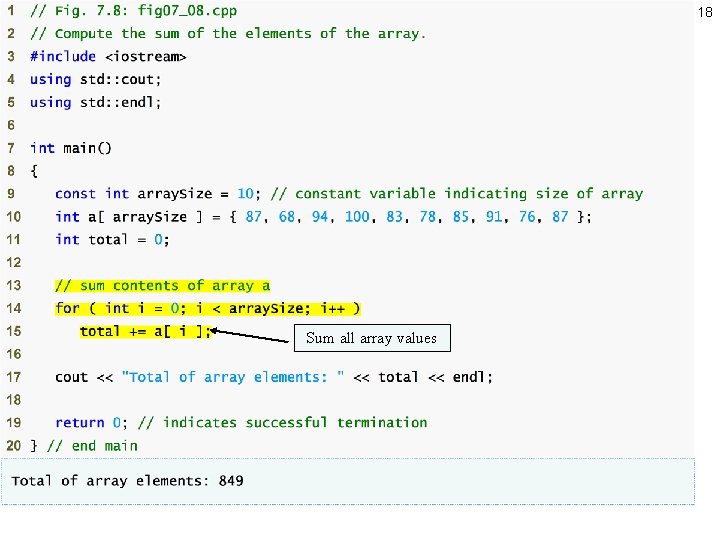
17 Examples Using Arrays (Cont. ) • Summing the elements of an array – Array elements can represent a series of values • We can sum these values • Use repetition statement to loop through each element – Add element value to a total
18 Sum all array values