
1 5 ANALYZING GRAPHS OF FUNCTIONS Copyright Cengage
- Slides: 22
1. 5 ANALYZING GRAPHS OF FUNCTIONS Copyright © Cengage Learning. All rights reserved.
What You Should Learn • Use the Vertical Line Test for functions. • Find the zeros of functions. • Determine intervals on which functions are increasing or decreasing and determine relative maximum and relative minimum values of functions. • Determine the average rate of change of a function. • Identify even and odd functions. 2
The Graph of a Function We have studied functions from an algebraic point of view. In this section, you will study functions from a graphical perspective. The graph of a function f is the collection of ordered pairs (x, f (x)) such that x is in the domain of f. 3
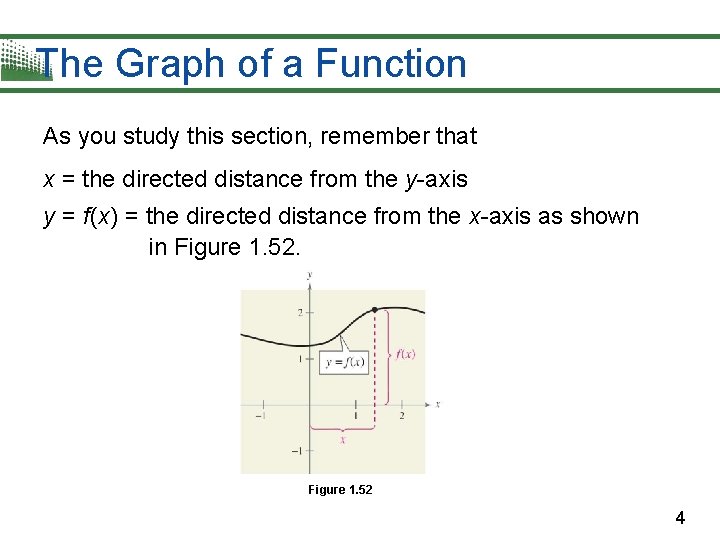
The Graph of a Function As you study this section, remember that x = the directed distance from the y-axis y = f (x) = the directed distance from the x-axis as shown in Figure 1. 52 4
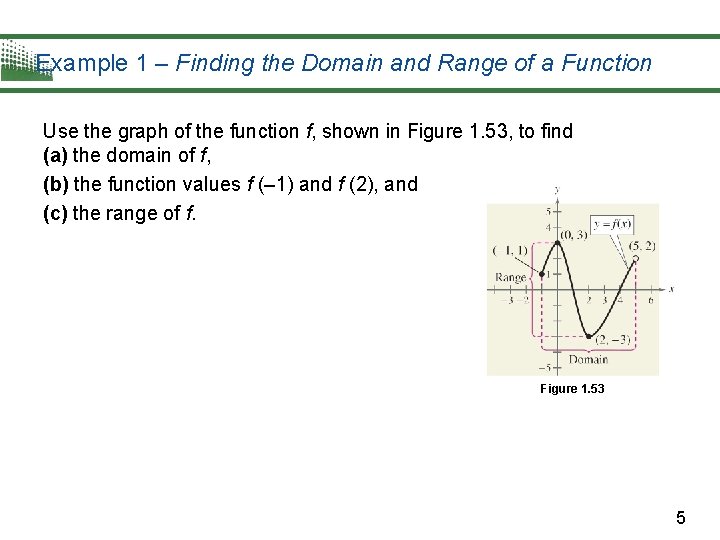
Example 1 – Finding the Domain and Range of a Function Use the graph of the function f, shown in Figure 1. 53, to find (a) the domain of f, (b) the function values f (– 1) and f (2), and (c) the range of f. Figure 1. 53 5
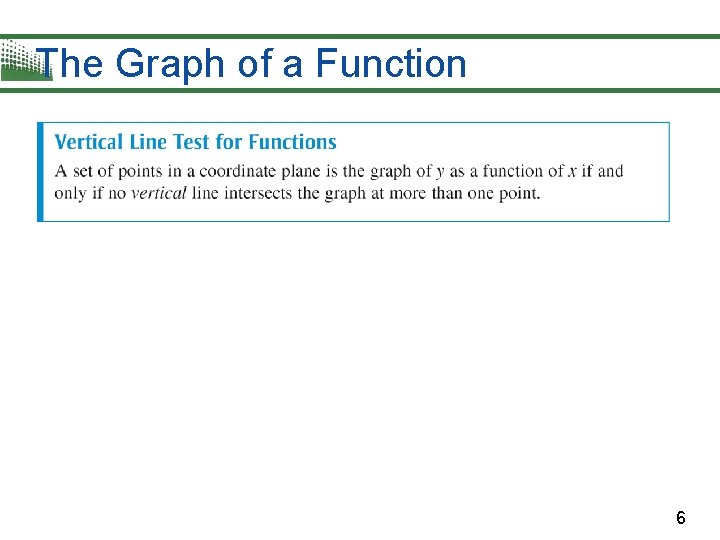
The Graph of a Function 6
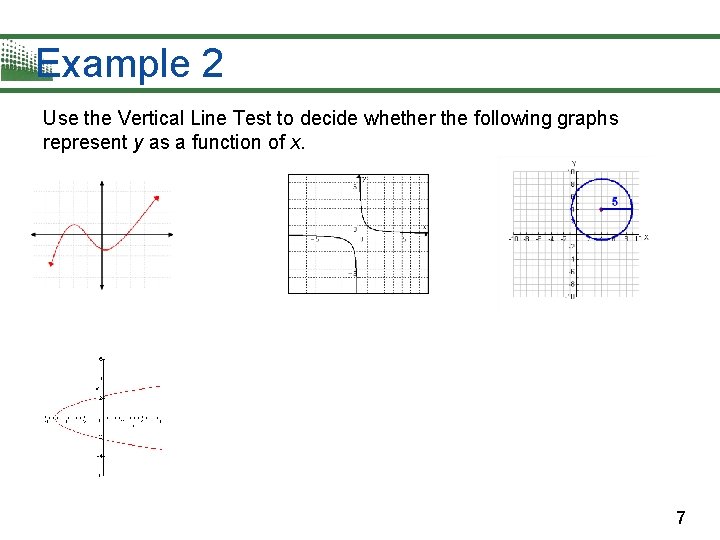
Example 2 Use the Vertical Line Test to decide whether the following graphs represent y as a function of x. 7
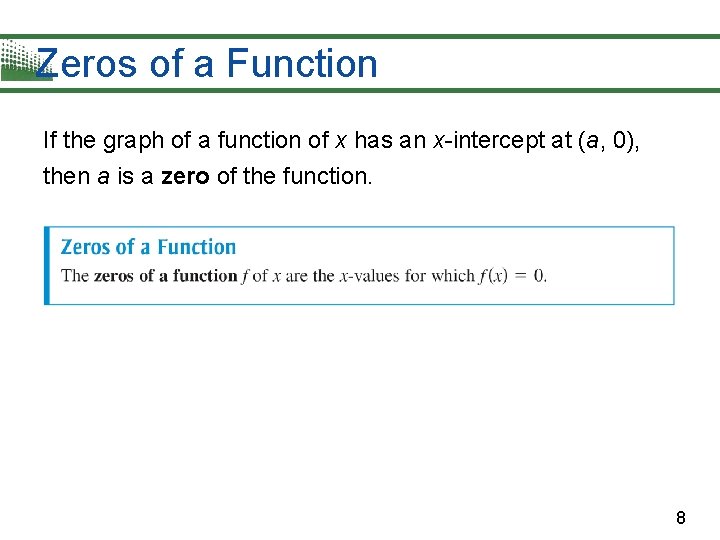
Zeros of a Function If the graph of a function of x has an x-intercept at (a, 0), then a is a zero of the function. 8
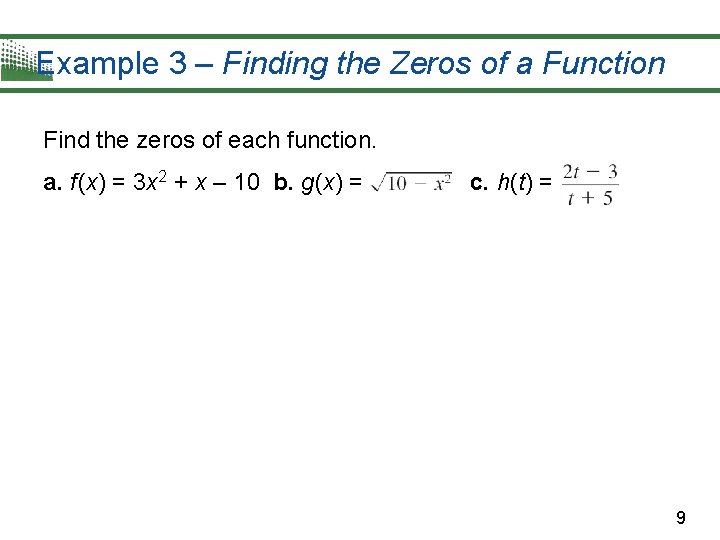
Example 3 – Finding the Zeros of a Function Find the zeros of each function. a. f (x) = 3 x 2 + x – 10 b. g(x) = c. h(t) = 9
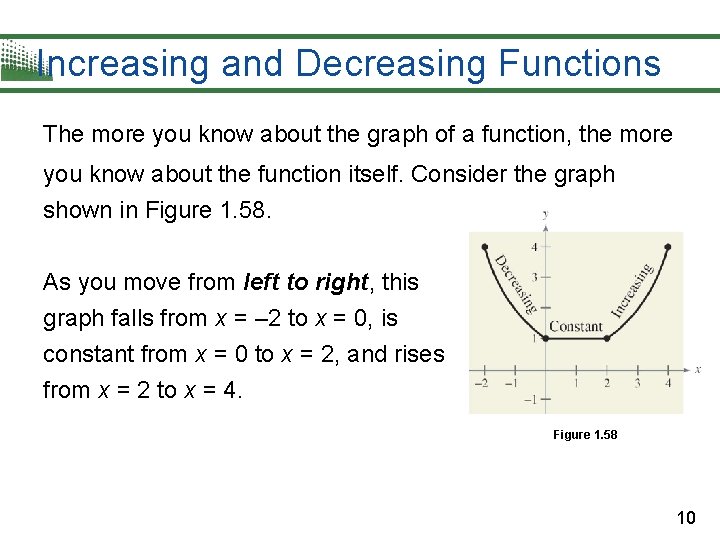
Increasing and Decreasing Functions The more you know about the graph of a function, the more you know about the function itself. Consider the graph shown in Figure 1. 58. As you move from left to right, this graph falls from x = – 2 to x = 0, is constant from x = 0 to x = 2, and rises from x = 2 to x = 4. Figure 1. 58 10
Increasing and Decreasing Functions 11
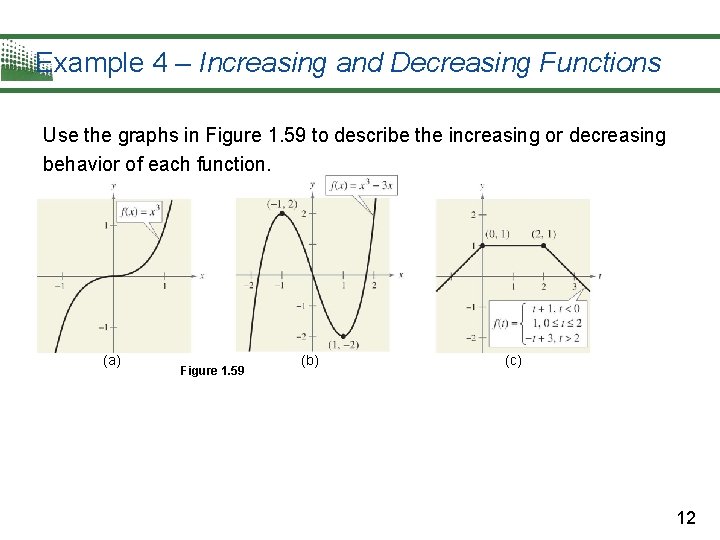
Example 4 – Increasing and Decreasing Functions Use the graphs in Figure 1. 59 to describe the increasing or decreasing behavior of each function. (a) Figure 1. 59 (b) (c) 12
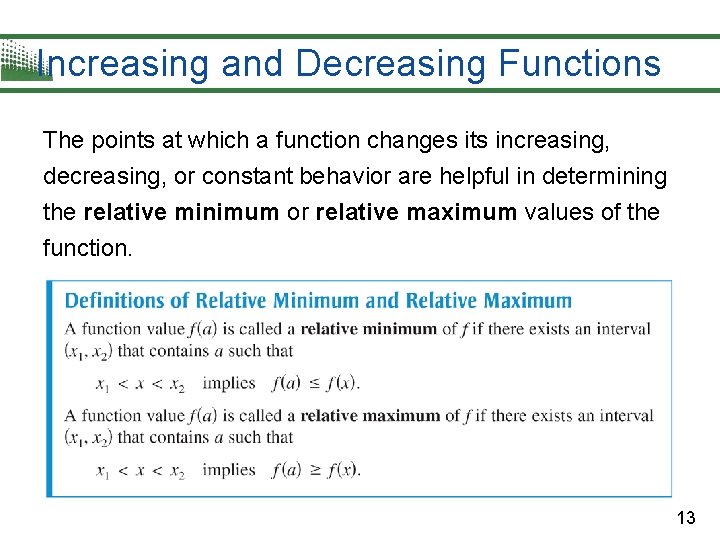
Increasing and Decreasing Functions The points at which a function changes its increasing, decreasing, or constant behavior are helpful in determining the relative minimum or relative maximum values of the function. 13
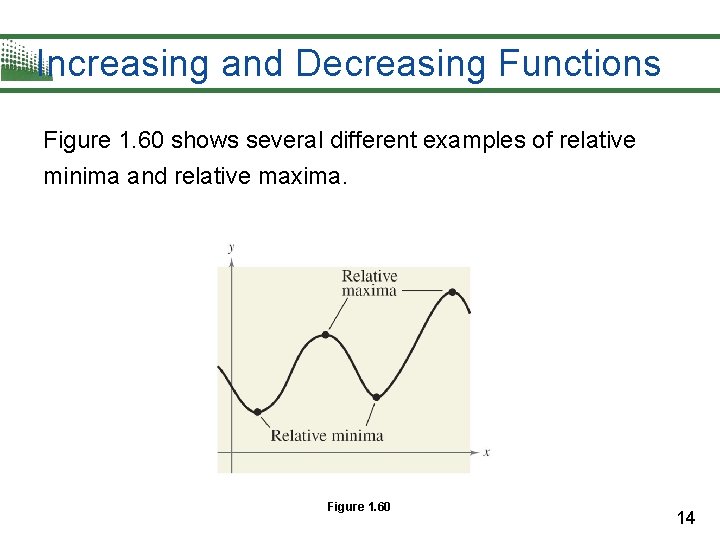
Increasing and Decreasing Functions Figure 1. 60 shows several different examples of relative minima and relative maxima. Figure 1. 60 14
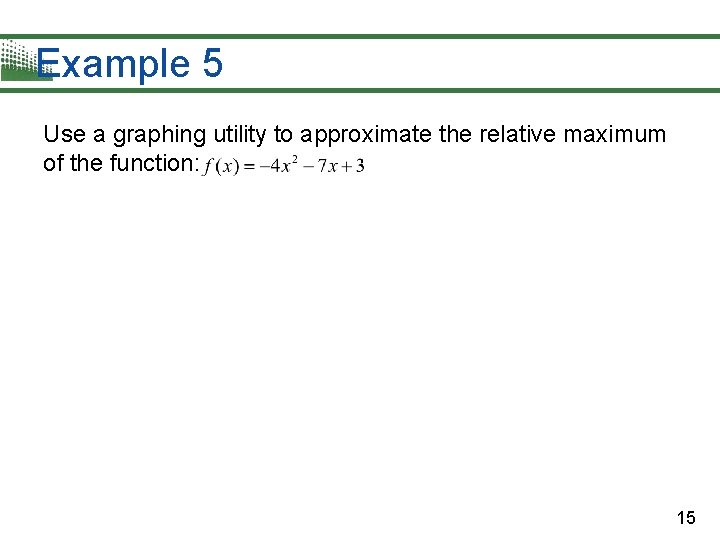
Example 5 Use a graphing utility to approximate the relative maximum of the function: 15
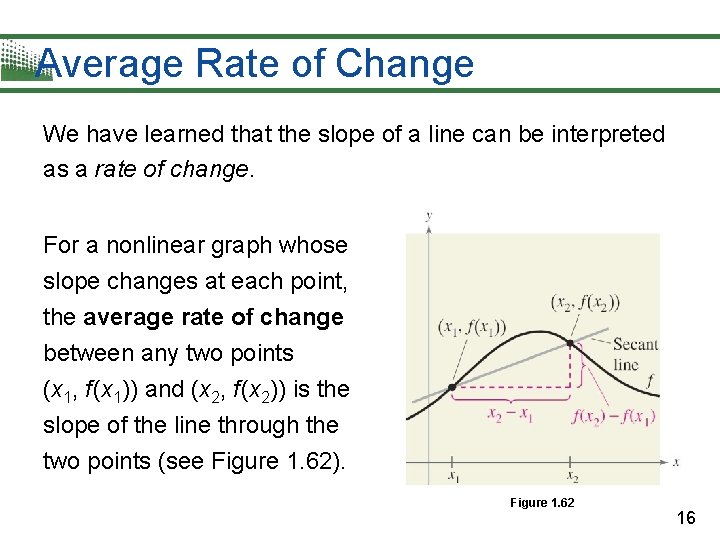
Average Rate of Change We have learned that the slope of a line can be interpreted as a rate of change. For a nonlinear graph whose slope changes at each point, the average rate of change between any two points (x 1, f (x 1)) and (x 2, f (x 2)) is the slope of the line through the two points (see Figure 1. 62). Figure 1. 62 16
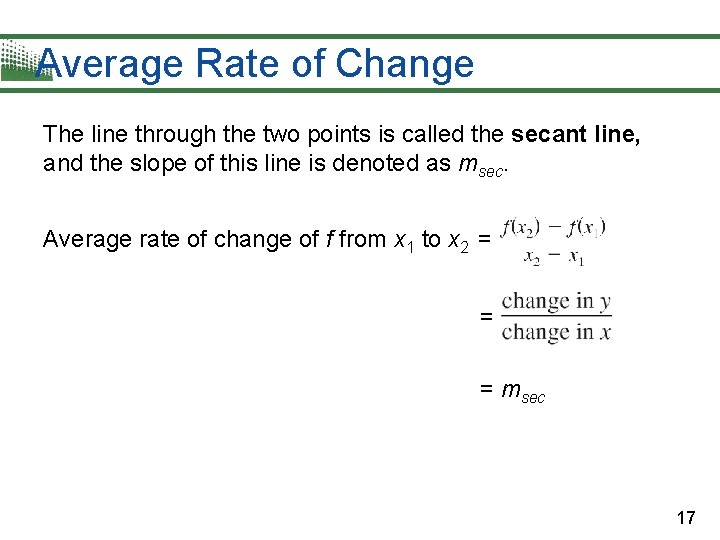
Average Rate of Change The line through the two points is called the secant line, and the slope of this line is denoted as msec. Average rate of change of f from x 1 to x 2 = = = msec 17
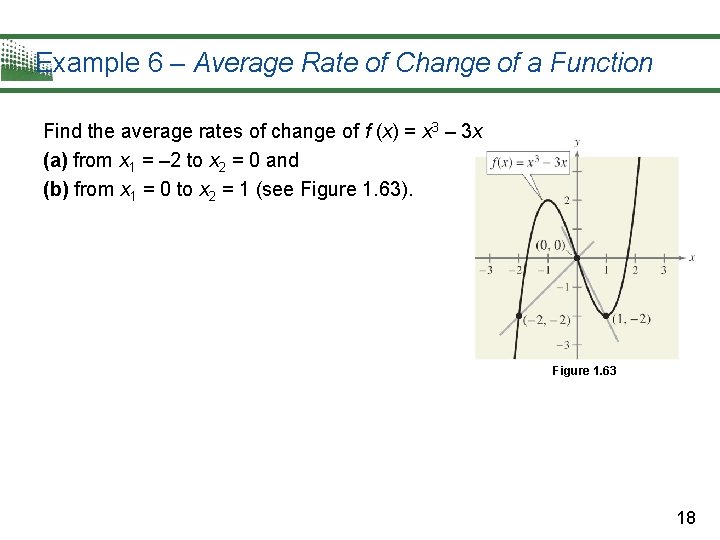
Example 6 – Average Rate of Change of a Function Find the average rates of change of f (x) = x 3 – 3 x (a) from x 1 = – 2 to x 2 = 0 and (b) from x 1 = 0 to x 2 = 1 (see Figure 1. 63). Figure 1. 63 18
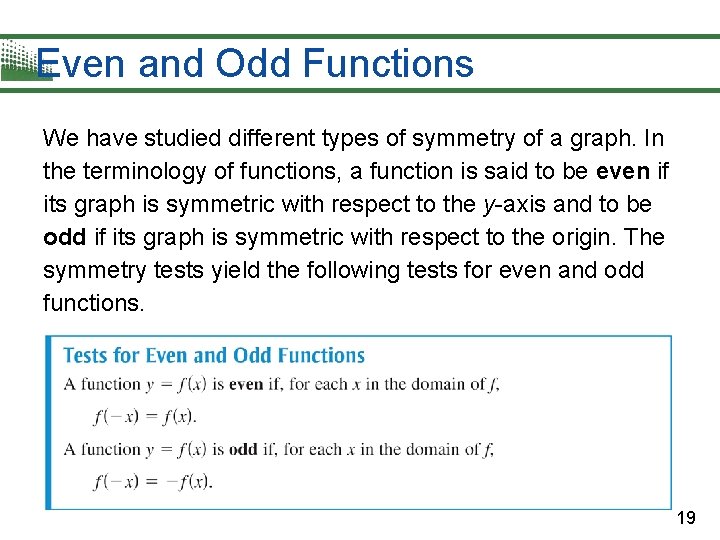
Even and Odd Functions We have studied different types of symmetry of a graph. In the terminology of functions, a function is said to be even if its graph is symmetric with respect to the y-axis and to be odd if its graph is symmetric with respect to the origin. The symmetry tests yield the following tests for even and odd functions. 19
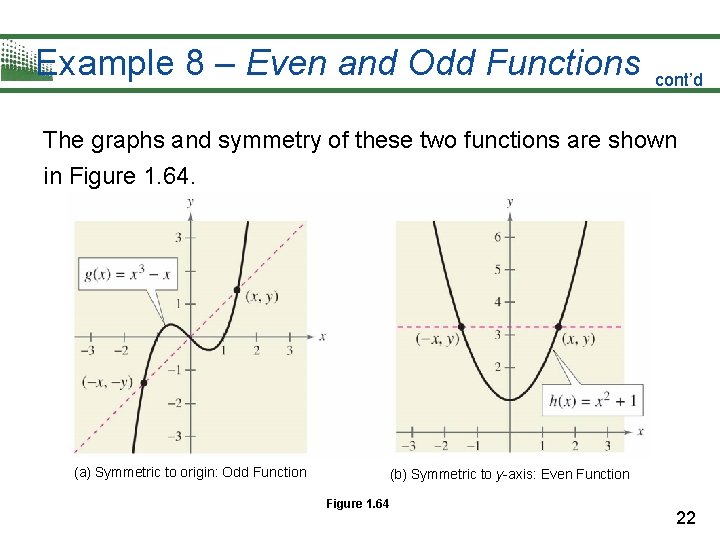
Example 8 – Even and Odd Functions a. The function g(x) = x 3 – x is ______ because ________________. 20
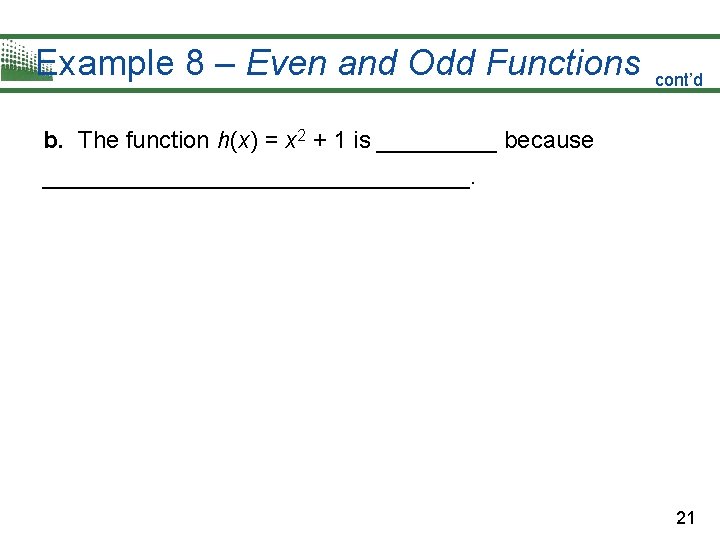
Example 8 – Even and Odd Functions cont’d b. The function h(x) = x 2 + 1 is _____ because ________________. 21
Example 8 – Even and Odd Functions cont’d The graphs and symmetry of these two functions are shown in Figure 1. 64. (a) Symmetric to origin: Odd Function (b) Symmetric to y-axis: Even Function Figure 1. 64 22