
1 5 1 Introduction Pointers Powerful but difficult
1 5. 1 Introduction • Pointers – Powerful, but difficult to master – Simulate pass by reference – Close relationship with arrays and strings
2 POINTERS & ADDRESSES C++ allows a programmer to access the address of variables. And addresses can be added, subtracted and compared. The address of a variable can be accessed with the & in front of the variable name, I. e. &temp : is the address of the var temp.
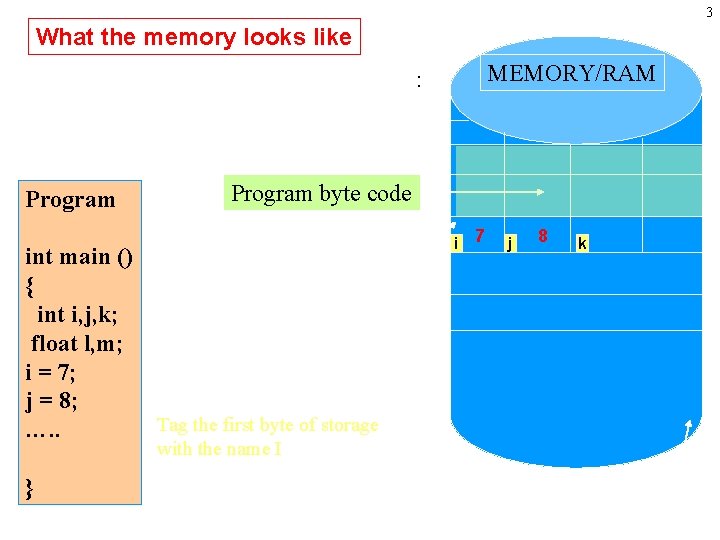
3 What the memory looks like MEMORY/RAM Address: 0 x 0001 Program int main () { int i, j, k; float l, m; i = 7; j = 8; …. . } Program byte code Variable storage space i 7 j 8 k Tells the computer to reserve enough room for an integer number Tag the first byte of storage with the name I 0 xffff

5. 2 4 Pointer Variable Declarations and Initialization • Pointer variables – Contain memory addresses as values – Normally, variable contains specific value (direct reference) – Pointers contain address of variable that has specific value count. Ptr (indirect reference) • Indirection 7 – Referencing value through pointer • Pointer declarations – * indicates variable is pointer int *my. Ptr; declares pointer to int, pointer of type int * – Multiple pointers require multiple asterisks int *my. Ptr 1, *my. Ptr 2; count 7
5. 2 Pointer Variable Declarations and Initialization • Can declare pointers to any data type • Pointer initialization – Initialized to 0, NULL, or address • 0 or NULL points to nothing 5
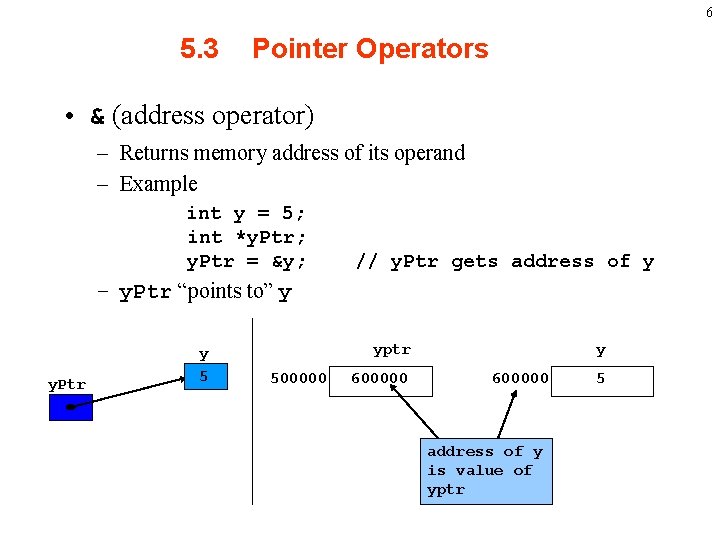
6 5. 3 Pointer Operators • & (address operator) – Returns memory address of its operand – Example int y = 5; int *y. Ptr; y. Ptr = &y; // y. Ptr gets address of y – y. Ptr “points to” y y. Ptr y 5 yptr 500000 600000 y 600000 address of y is value of yptr 5
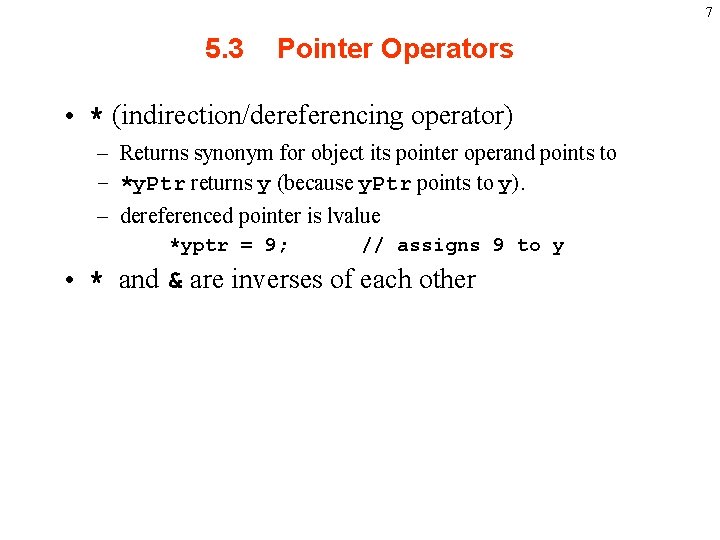
7 5. 3 Pointer Operators • * (indirection/dereferencing operator) – Returns synonym for object its pointer operand points to – *y. Ptr returns y (because y. Ptr points to y). – dereferenced pointer is lvalue *yptr = 9; // assigns 9 to y • * and & are inverses of each other
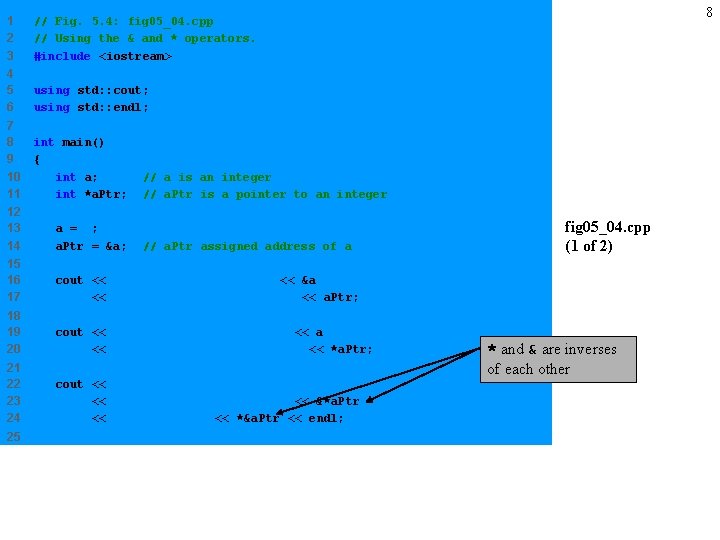
1 2 3 // Fig. 5. 4: fig 05_04. cpp // Using the & and * operators. #include <iostream> 4 5 6 using std: : cout; using std: : endl; 7 8 9 10 11 int main() { int a; int *a. Ptr; 12 13 14 a = 7; a. Ptr = &a; 15 16 17 cout << "The address of a is " << &a << "n. The value of a. Ptr is " << a. Ptr; 18 19 20 cout << "nn. The value of a is " << a << "n. The value of *a. Ptr is " << *a. Ptr; 21 22 23 24 cout << "nn. Showing that * and & are inverses of " << "each other. n&*a. Ptr = " << &*a. Ptr << "n*&a. Ptr = " << *&a. Ptr << endl; 25 8 // a is an integer // a. Ptr is a pointer to an integer // a. Ptr assigned address of a fig 05_04. cpp (1 of 2) * and & are inverses of each other
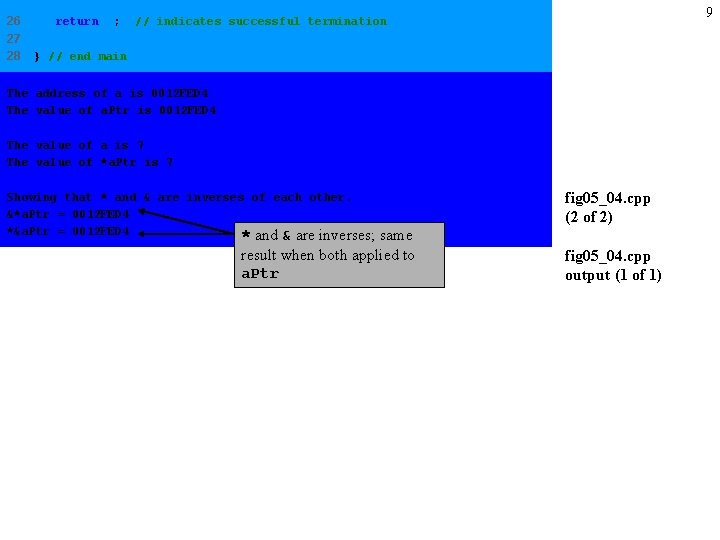
26 27 28 return 0; 9 // indicates successful termination } // end main The address of a is 0012 FED 4 The value of a. Ptr is 0012 FED 4 The value of a is 7 The value of *a. Ptr is 7 Showing that * and & are inverses of each other. &*a. Ptr = 0012 FED 4 *&a. Ptr = 0012 FED 4 * and & are inverses; same result when both applied to a. Ptr fig 05_04. cpp (2 of 2) fig 05_04. cpp output (1 of 1)
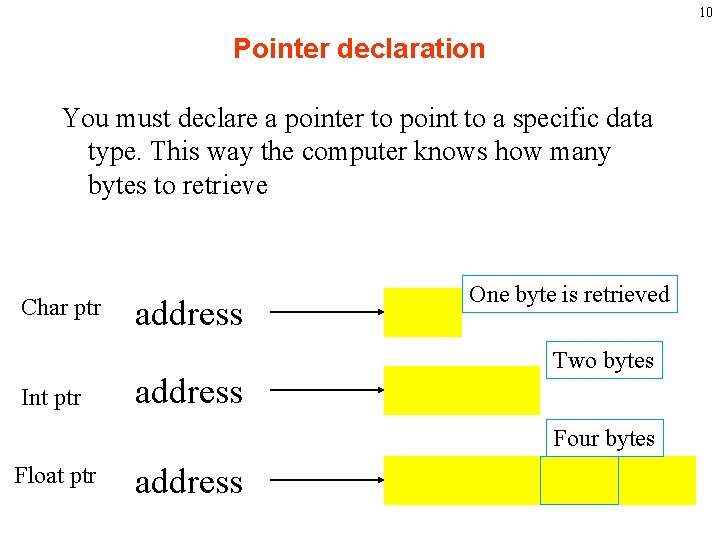
10 Pointer declaration You must declare a pointer to point to a specific data type. This way the computer knows how many bytes to retrieve Char ptr Int ptr address One byte is retrieved Two bytes Four bytes Float ptr address
11 5. 4 Calling Functions by Reference • 3 ways to pass arguments to function – Pass by value – Pass by reference with reference arguments – Pass by reference with pointer arguments • return can return one value from function • Arguments passed to function using reference arguments – Modify original values of arguments – More than one value “returned”
12 5. 4 Calling Functions by Reference • Pass by reference with pointer arguments – Simulate pass by reference • Use pointers and indirection operator – Pass address of argument using & operator – Arrays not passed with & because array name already pointer – * operator used as alias/nickname for variable inside of function
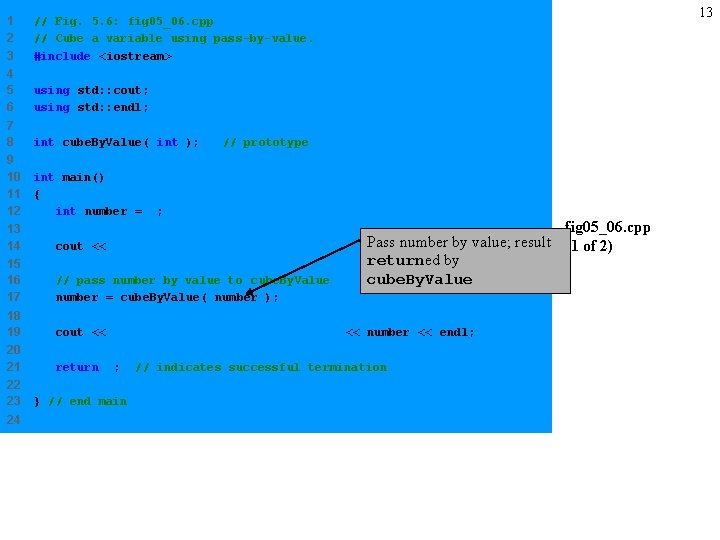
1 2 3 // Fig. 5. 6: fig 05_06. cpp // Cube a variable using pass-by-value. #include <iostream> 4 5 6 using std: : cout; using std: : endl; 7 8 int cube. By. Value( int ); 9 10 11 12 int main() { int number = 5; 13 // prototype fig 05_06. cpp Pass number by value; result << number; (1 of 2) returned by cube. By. Value 13 14 cout << "The original value of number is " 15 16 17 // pass number by value to cube. By. Value number = cube. By. Value( number ); 18 19 cout << "n. The new value of number is " << number << endl; 20 21 return 0; 22 23 24 } // end main // indicates successful termination
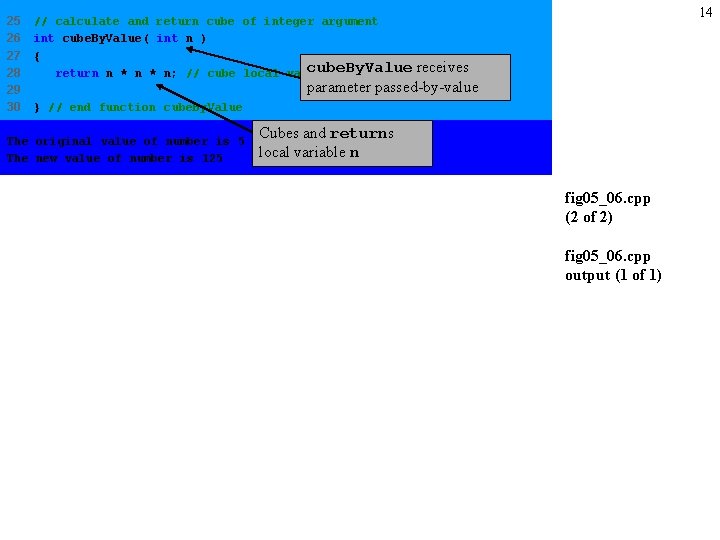
25 26 27 28 29 30 14 // calculate and return cube of integer argument int cube. By. Value( int n ) { cube. By. Value receives return n * n; // cube local variable n and return result parameter passed by value } // end function cube. By. Value The original value of number is 5 The new value of number is 125 Cubes and returns local variable n fig 05_06. cpp (2 of 2) fig 05_06. cpp output (1 of 1)
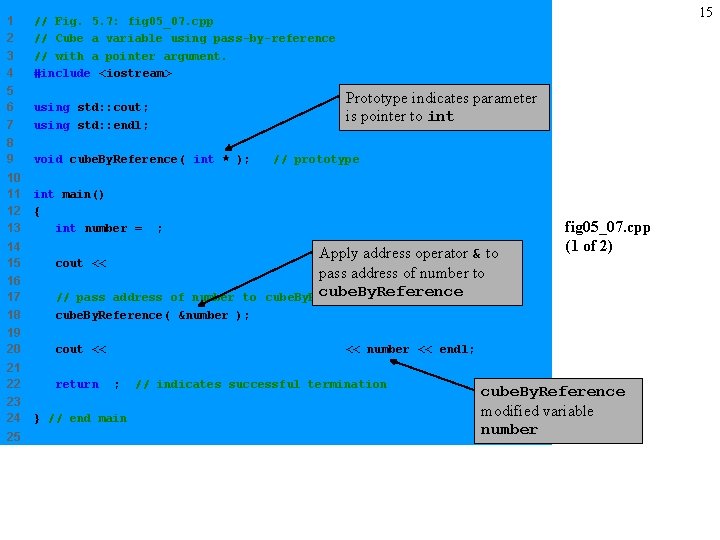
1 2 3 4 // Fig. 5. 7: fig 05_07. cpp // Cube a variable using pass-by-reference // with a pointer argument. #include <iostream> 5 6 7 using std: : cout; using std: : endl; 8 9 void cube. By. Reference( int * ); 10 11 12 13 int main() { int number = 5; 15 Prototype indicates parameter is pointer to int // prototype 14 15 cout << "The original value of number is " << number; 16 17 18 // pass address of number to cube. By. Reference( &number ); 19 20 cout << "n. The new value of number is " << number << endl; 21 22 return 0; 23 24 25 } // end main Apply address operator & to pass address of number to cube. By. Reference // indicates successful termination fig 05_07. cpp (1 of 2) cube. By. Reference modified variable number
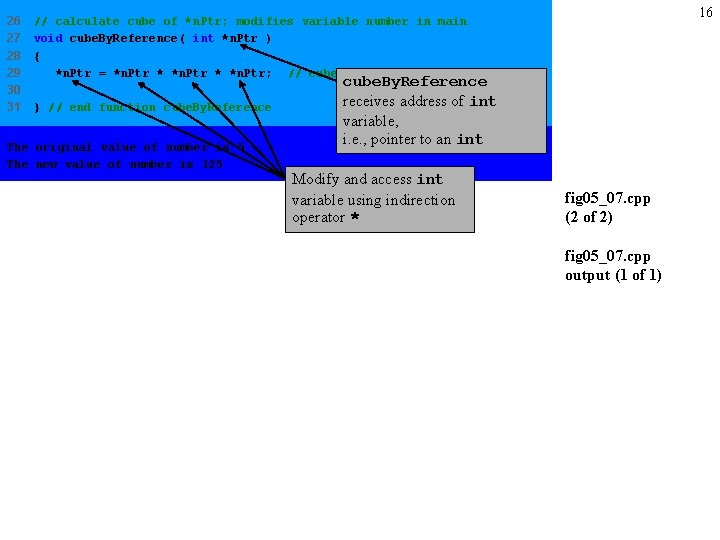
26 27 28 29 30 31 16 // calculate cube of *n. Ptr; modifies variable number in main void cube. By. Reference( int *n. Ptr ) { *n. Ptr = *n. Ptr * *n. Ptr; // cube *n. Ptr } // end function cube. By. Reference The original value of number is 5 The new value of number is 125 cube. By. Reference receives address of int variable, i. e. , pointer to an int Modify and access int variable using indirection operator * fig 05_07. cpp (2 of 2) fig 05_07. cpp output (1 of 1)
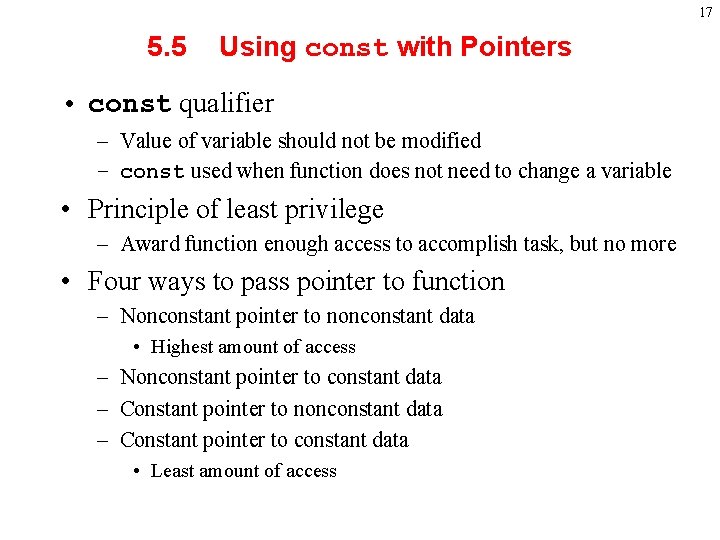
17 5. 5 Using const with Pointers • const qualifier – Value of variable should not be modified – const used when function does not need to change a variable • Principle of least privilege – Award function enough access to accomplish task, but no more • Four ways to pass pointer to function – Nonconstant pointer to nonconstant data • Highest amount of access – Nonconstant pointer to constant data – Constant pointer to nonconstant data – Constant pointer to constant data • Least amount of access
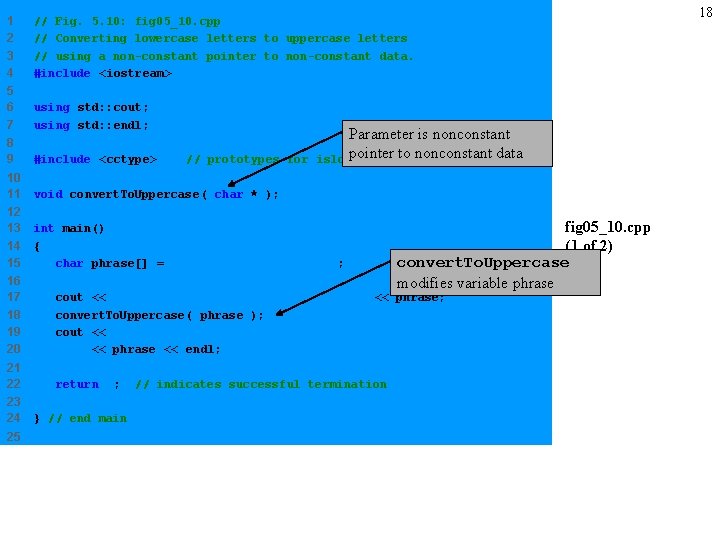
1 2 3 4 // Fig. 5. 10: fig 05_10. cpp // Converting lowercase letters to uppercase letters // using a non-constant pointer to non-constant data. #include <iostream> 5 6 7 using std: : cout; using std: : endl; 8 9 #include <cctype> 10 11 void convert. To. Uppercase( char * ); 12 13 14 15 int main() { char phrase[] = "characters and $32. 98"; // prototypes for Parameter is nonconstant pointer to nonconstant data islower and toupper fig 05_10. cpp (1 of 2) convert. To. Uppercase modifies variable phrase 16 17 18 19 20 cout << "The phrase before conversion is: " << phrase; convert. To. Uppercase( phrase ); cout << "n. The phrase after conversion is: " << phrase << endl; 21 22 return 0; 23 24 25 } // end main // indicates successful termination 18
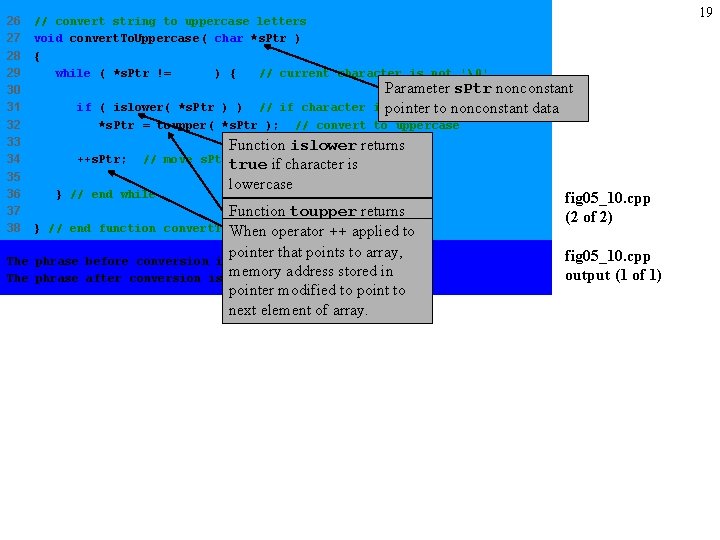
26 27 28 29 30 31 32 33 34 35 36 37 38 The 19 // convert string to uppercase letters void convert. To. Uppercase( char *s. Ptr ) { while ( *s. Ptr != '' ) { // current character is not '' Parameter s. Ptr nonconstant ispointer to nonconstant data lowercase, if ( islower( *s. Ptr ) ) // if character *s. Ptr = toupper( *s. Ptr ); // convert to uppercase Function islower returns ++s. Ptr; // move s. Ptrtrue if character is to next character in string } // end while lowercase Function toupper returns } // end function convert. To. Uppercase corresponding uppercase When operator ++ applied to character if original character pointer that points to array, phrase before conversion is: characters and $32. 98 lowercase; otherwise memory address stored in phrase after conversion is: CHARACTERS AND $32. 98 toupper returns original pointer modified to point to (uppercase) character next element of array. fig 05_10. cpp (2 of 2) fig 05_10. cpp output (1 of 1)
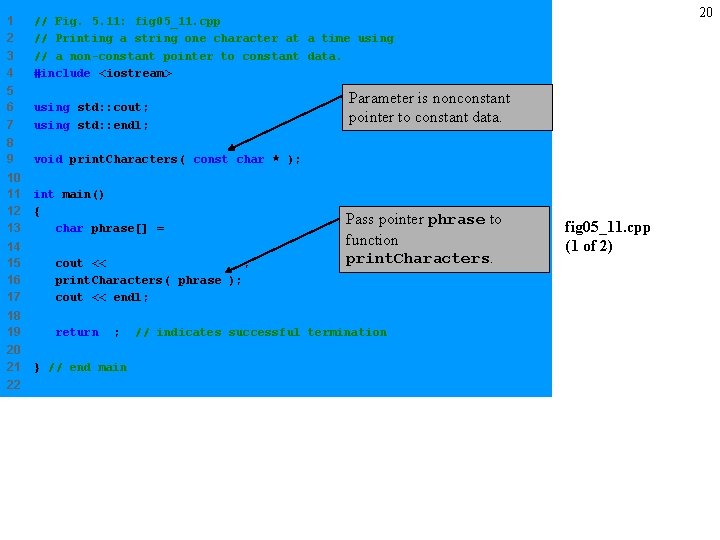
1 2 3 4 // Fig. 5. 11: fig 05_11. cpp // Printing a string one character at a time using // a non-constant pointer to constant data. #include <iostream> 5 6 7 using std: : cout; using std: : endl; 8 9 void print. Characters( const char * ); 10 11 12 13 int main() { Pass pointer phrase to char phrase[] = "print characters of a string" ; 14 15 16 17 cout << "The string is: n"; print. Characters( phrase ); cout << endl; 18 19 return 0; 20 21 22 } // end main 20 Parameter is nonconstant pointer to constant data. function print. Characters. // indicates successful termination fig 05_11. cpp (1 of 2)
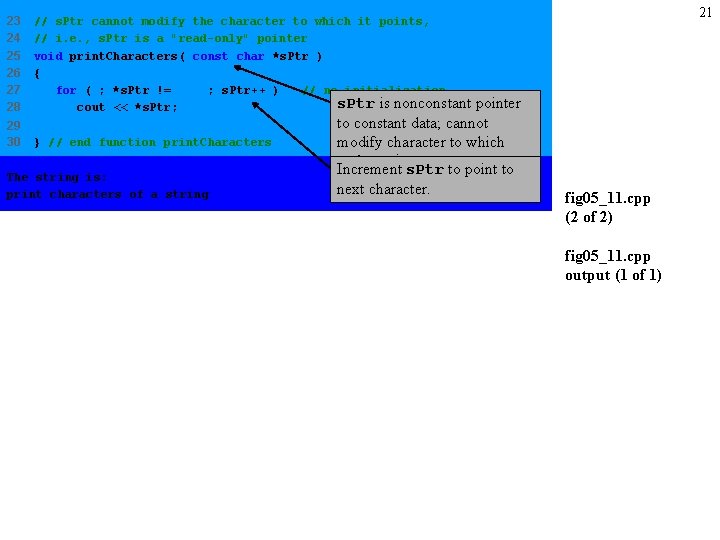
23 24 25 26 27 28 29 30 21 // s. Ptr cannot modify the character to which it points, // i. e. , s. Ptr is a "read-only" pointer void print. Characters( const char *s. Ptr ) { for ( ; *s. Ptr != ''; s. Ptr++ ) // no initialization s. Ptr is nonconstant pointer cout << *s. Ptr; } // end function print. Characters The string is: print characters of a string to constant data; cannot modify character to which s. Ptr points. Increment s. Ptr to point to next character. fig 05_11. cpp (2 of 2) fig 05_11. cpp output (1 of 1)
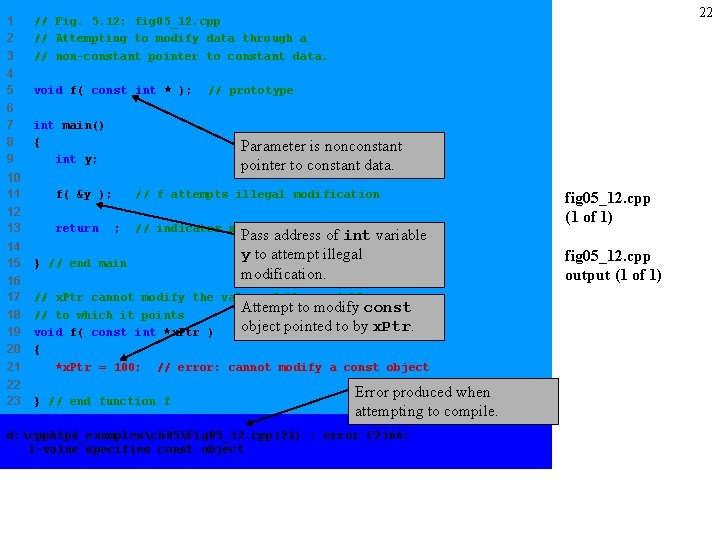
1 2 3 // Fig. 5. 12: fig 05_12. cpp // Attempting to modify data through a // non-constant pointer to constant data. 4 5 void f( const int * ); 6 7 8 9 int main() { int y; 22 // prototype Parameter is nonconstant pointer to constant data. 10 11 f( &y ); // f attempts illegal modification 12 13 return 0; // indicates successful termination Pass address of int variable y to attempt illegal modification. 14 15 } // end main 16 17 18 19 20 21 // x. Ptr cannot modify the value of the variable Attempt to modify const // to which it points object pointed to by x. Ptr. void f( const int *x. Ptr ) { *x. Ptr = 100; // error: cannot modify a const object 22 23 } // end function f Error produced when attempting to compile. d: cpphtp 4_examplesch 05Fig 05_12. cpp(21) : error C 2166: l-value specifies const object fig 05_12. cpp (1 of 1) fig 05_12. cpp output (1 of 1)
23 5. 5 Using const with Pointers • const pointers – Always point to same memory location – Default for array name – Must be initialized when declared
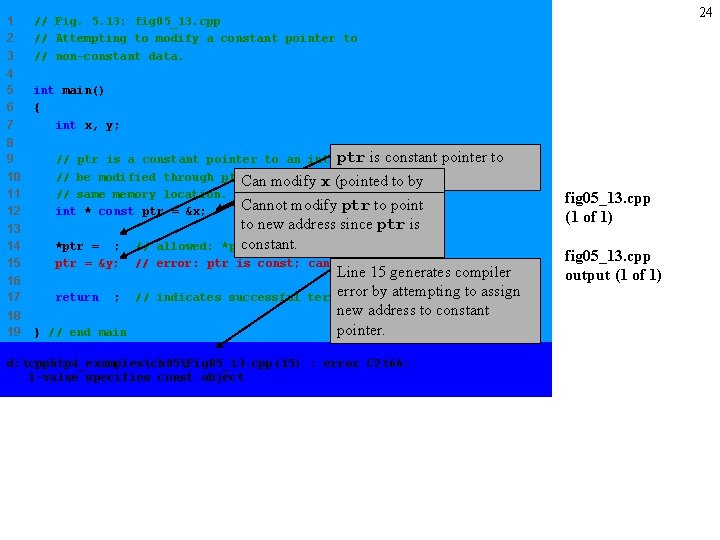
1 2 3 // Fig. 5. 13: fig 05_13. cpp // Attempting to modify a constant pointer to // non-constant data. 4 5 6 7 int main() { int x, y; 8 9 10 11 12 ptr is constant pointer to // ptr is a constant pointer to an integer that can // be modified through ptr, but ptr always points to the integer. Can modify x (pointed to by // same memory location. ptr) since x not constant. Cannot modify ptr to point * const ptr = &x; 13 14 15 *ptr = 7; ptr = &y; // allowed: // error: ptr is const; cannot assign new address 16 17 return 0; // indicates successful 18 19 } // end main to new address since ptr is constant. *ptr is not const Line 15 generates compiler error by attempting to assign termination new address to constant pointer. d: cpphtp 4_examplesch 05Fig 05_13. cpp(15) : error C 2166: l-value specifies const object 24 fig 05_13. cpp (1 of 1) fig 05_13. cpp output (1 of 1)
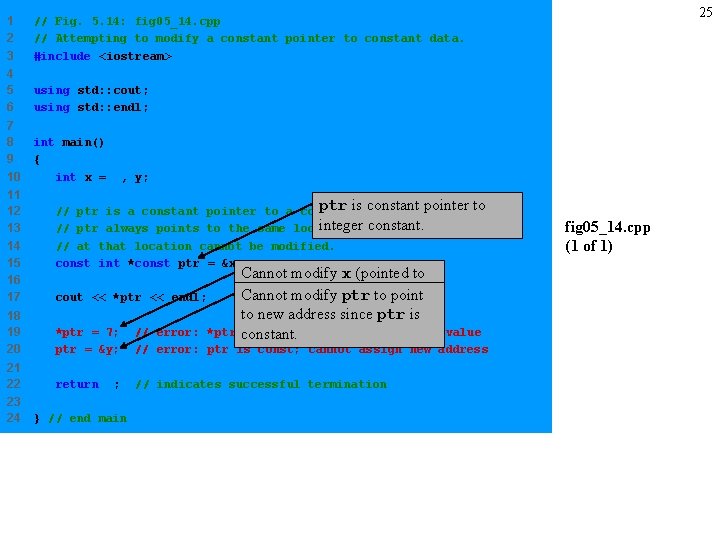
1 2 3 // Fig. 5. 14: fig 05_14. cpp // Attempting to modify a constant pointer to constant data. #include <iostream> 4 5 6 using std: : cout; using std: : endl; 7 8 9 10 int main() { int x = 5, y; 11 12 13 14 15 16 17 ptr is constant pointer to // ptr is a constant pointer to a constant integer constant. // ptr always points to the same location; the integer // at that location cannot be modified. const int *const ptr = &x; cout Cannot modify x (pointed to by ptr) since *ptr declared Cannot modify ptr to point << *ptr << endl; constant. to new address since ptr is = 7; // error: *ptr constant. is const; cannot assign new 18 19 20 *ptr = &y; value // error: ptr is const; cannot assign new address 21 22 return 0; // indicates successful termination 23 24 } // end main 25 fig 05_14. cpp (1 of 1)
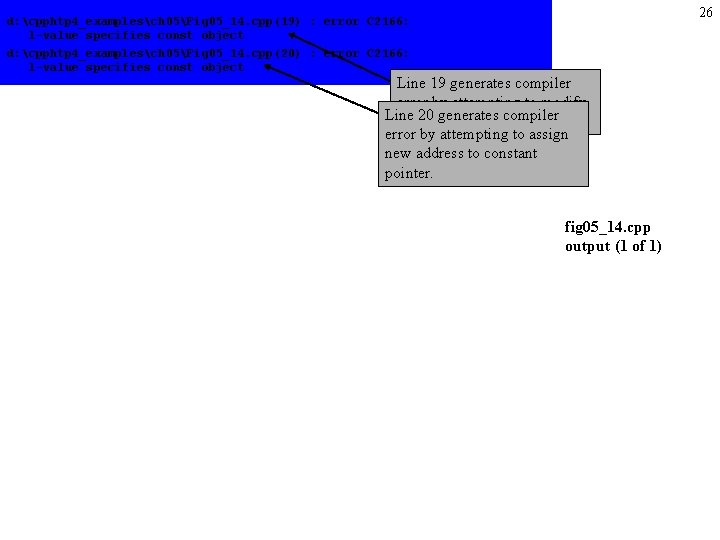
26 d: cpphtp 4_examplesch 05Fig 05_14. cpp(19) : error C 2166: l-value specifies const object d: cpphtp 4_examplesch 05Fig 05_14. cpp(20) : error C 2166: l-value specifies const object Line 19 generates compiler error by attempting to modify Line 20 generates compiler constant object. error by attempting to assign new address to constant pointer. fig 05_14. cpp output (1 of 1)
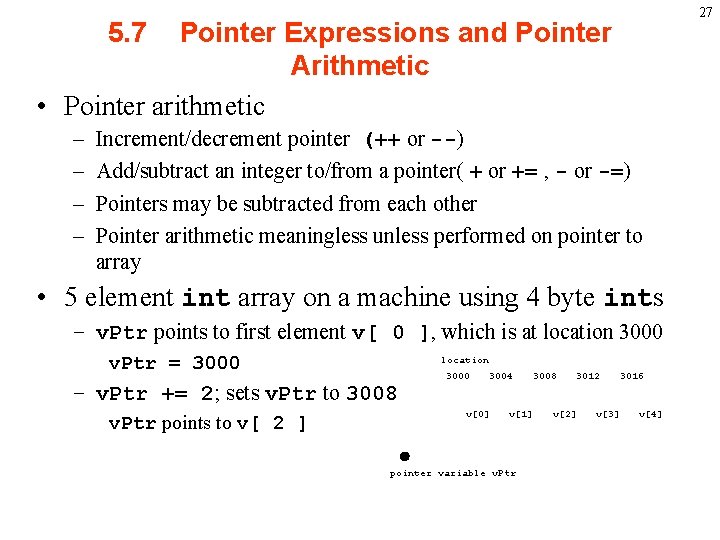
27 5. 7 Pointer Expressions and Pointer Arithmetic • Pointer arithmetic – – Increment/decrement pointer (++ or --) Add/subtract an integer to/from a pointer( + or += , - or -=) Pointers may be subtracted from each other Pointer arithmetic meaningless unless performed on pointer to array • 5 element int array on a machine using 4 byte ints – v. Ptr points to first element v[ 0 ], which is at location 3000 v. Ptr = 3000 location – v. Ptr += 2; sets v. Ptr to 3008 v. Ptr points to v[ 2 ] 3000 3004 v[0] 3008 v[1] pointer variable v. Ptr 3012 v[2] 3016 v[3] v[4]
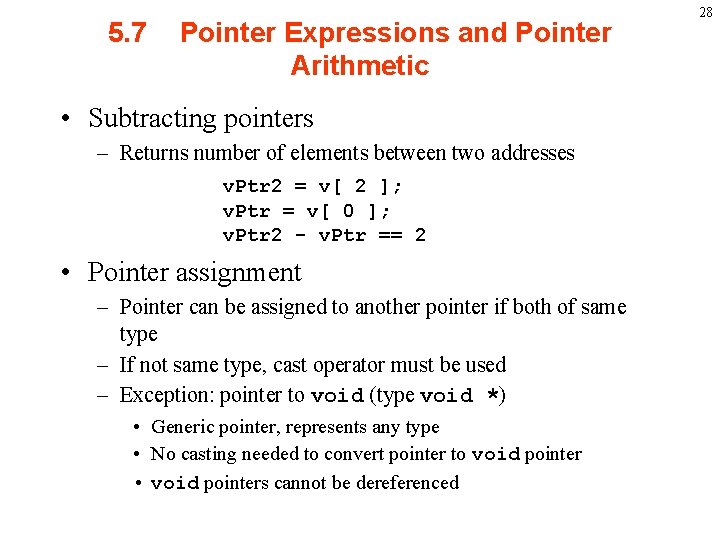
5. 7 Pointer Expressions and Pointer Arithmetic • Subtracting pointers – Returns number of elements between two addresses v. Ptr 2 = v[ 2 ]; v. Ptr = v[ 0 ]; v. Ptr 2 - v. Ptr == 2 • Pointer assignment – Pointer can be assigned to another pointer if both of same type – If not same type, cast operator must be used – Exception: pointer to void (type void *) • Generic pointer, represents any type • No casting needed to convert pointer to void pointer • void pointers cannot be dereferenced 28
5. 7 Pointer Expressions and Pointer Arithmetic • Pointer comparison – Use equality and relational operators – Comparisons meaningless unless pointers point to members of same array – Compare addresses stored in pointers – Example: could show that one pointer points to higher numbered element of array than other pointer – Common use to determine whether pointer is 0 (does not point to anything) 29
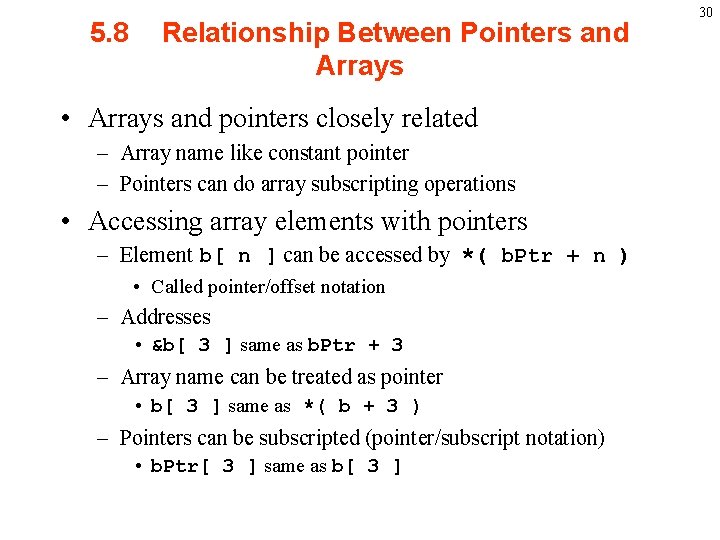
5. 8 Relationship Between Pointers and Arrays • Arrays and pointers closely related – Array name like constant pointer – Pointers can do array subscripting operations • Accessing array elements with pointers – Element b[ n ] can be accessed by *( b. Ptr + n ) • Called pointer/offset notation – Addresses • &b[ 3 ] same as b. Ptr + 3 – Array name can be treated as pointer • b[ 3 ] same as *( b + 3 ) – Pointers can be subscripted (pointer/subscript notation) • b. Ptr[ 3 ] same as b[ 3 ] 30
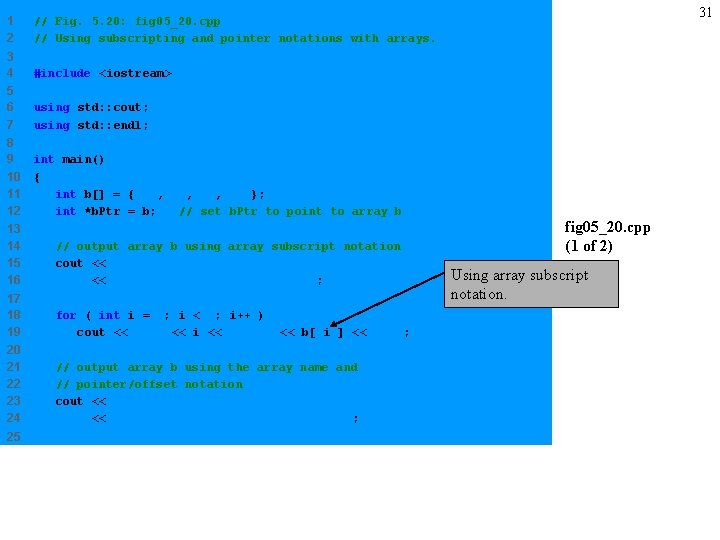
1 2 // Fig. 5. 20: fig 05_20. cpp // Using subscripting and pointer notations with arrays. 3 4 #include <iostream> 5 6 7 using std: : cout; using std: : endl; 8 9 10 11 12 int main() { int b[] = { 10, 20, 30, 40 }; int *b. Ptr = b; // set b. Ptr to point to array b 13 14 15 16 // output array b using array subscript notation cout << "Array b printed with: n" << "Array subscript notationn" ; 17 18 19 for ( int i = 0; i < 4; i++ ) cout << "b[" << i << "] = " << b[ i ] << 'n'; 20 21 22 23 24 // output array b using the array name and // pointer/offset notation cout << "n. Pointer/offset notation where " << "the pointer is the array namen" ; 25 31 fig 05_20. cpp (1 of 2) Using array subscript notation.
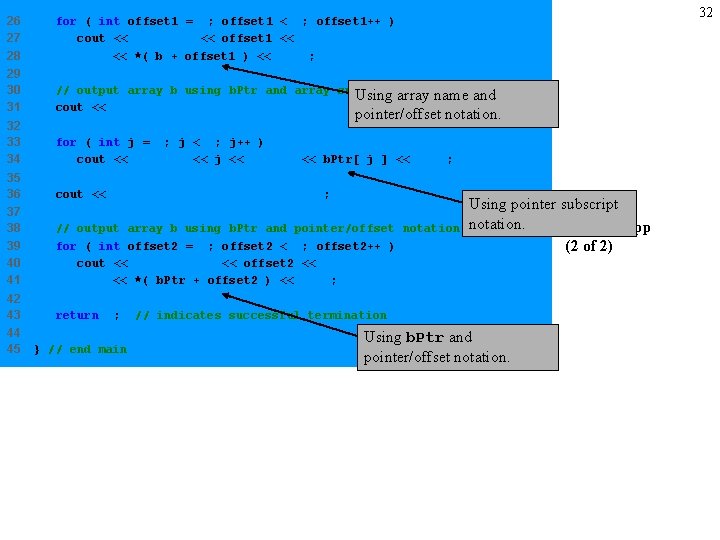
32 26 27 28 for ( int offset 1 = 0; offset 1 < 4; offset 1++ ) cout << "*(b + " << offset 1 << ") = " << *( b + offset 1 ) << 'n'; 29 30 31 // output array b using b. Ptr and array subscript notation Using array name and cout << "n. Pointer subscript notationn"; 32 33 34 for ( int j = 0; j < 4; j++ ) cout << "b. Ptr[" << j << "] = " << b. Ptr[ j ] << 'n'; 35 36 cout << "n. Pointer/offset notationn"; 37 38 39 40 41 // output array b using b. Ptr and pointer/offset notation for ( int offset 2 = 0; offset 2 < 4; offset 2++ ) cout << "*(b. Ptr + " << offset 2 << ") = " << *( b. Ptr + offset 2 ) << 'n'; 42 43 return 0; 44 45 pointer/offset notation. } // end main Using pointer subscript notation. fig 05_20. cpp (2 of 2) // indicates successful termination Using b. Ptr and pointer/offset notation.
![33 Array b printed with: Array subscript notation b[0] = 10 b[1] = 20](http://slidetodoc.com/presentation_image_h/cd54565e381cff1ef8b0e528f5ac395e/image-33.jpg "33 Array b printed with: Array subscript notation b[0] = 10 b[1] = 20")
33 Array b printed with: Array subscript notation b[0] = 10 b[1] = 20 b[2] = 30 b[3] = 40 Pointer/offset notation where the pointer is the array name *(b + 0) = 10 *(b + 1) = 20 *(b + 2) = 30 *(b + 3) = 40 Pointer b. Ptr[0] b. Ptr[1] b. Ptr[2] b. Ptr[3] subscript notation = 10 = 20 = 30 = 40 Pointer/offset notation *(b. Ptr + 0) = 10 *(b. Ptr + 1) = 20 *(b. Ptr + 2) = 30 *(b. Ptr + 3) = 40 fig 05_20. cpp output (1 of 1)
34 Implement Previous Program Add another array (call it a), and copy from b to a using pointers.
35 5. 11 Function Pointers • Pointers to functions – Contain address of function – Similar to how array name is address of first element – Function name is starting address of code that defines function • Function pointers can be – – Passed to functions Returned from functions Stored in arrays Assigned to other function pointers
36 5. 11 Function Pointers • Calling functions using pointers – Assume parameter: • bool ( *compare ) ( int, int ) – Execute function with either • ( *compare ) ( int 1, int 2 ) – Dereference pointer to function to execute OR • compare( int 1, int 2 ) – Could be confusing • User may think compare name of actual function in program
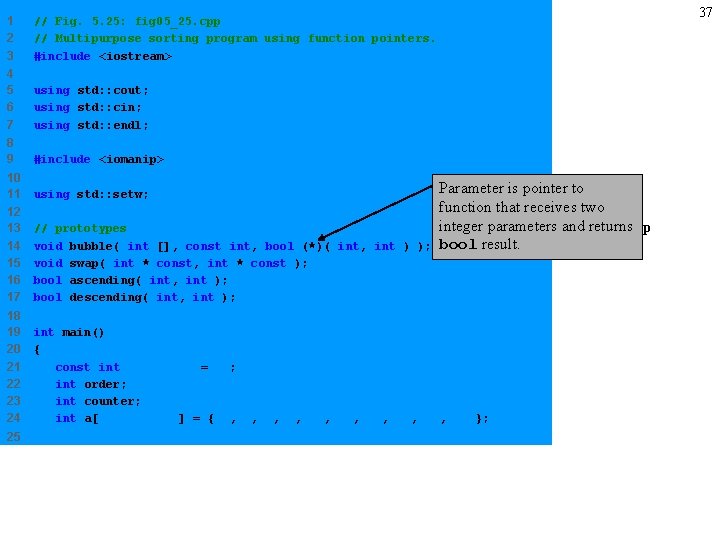
37 1 2 3 // Fig. 5. 25: fig 05_25. cpp // Multipurpose sorting program using function pointers. #include <iostream> 4 5 6 7 using std: : cout; using std: : cin; using std: : endl; 8 9 #include <iomanip> 10 11 using std: : setw; 12 13 14 15 16 17 // prototypes void bubble( int [], const int, bool (*)( int, int ) ); void swap( int * const, int * const ); bool ascending( int, int ); bool descending( int, int ); 18 19 20 21 22 23 24 int main() { const int array. Size = 10; int order; int counter; int a[ array. Size ] = { 2, 6, 4, 8, 10, 12, 89, 68, 45, 37 }; 25 Parameter is pointer to function that receives two integer parameters and returns fig 05_25. cpp bool result. (1 of 5)
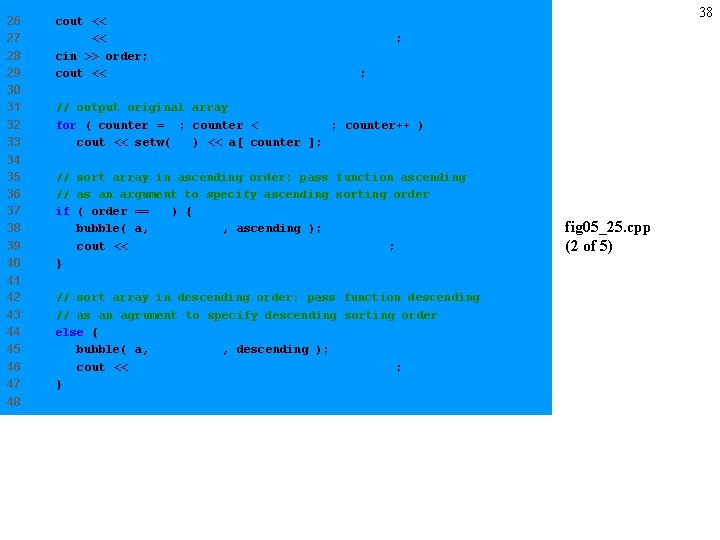
26 27 28 29 30 31 32 33 // output original array for ( counter = 0; counter < array. Size; counter++ ) cout << setw( 4 ) << a[ counter ]; 34 35 36 37 38 39 40 // sort array in ascending order; pass function ascending // as an argument to specify ascending sorting order if ( order == 1 ) { bubble( a, array. Size, ascending ); cout << "n. Data items in ascending ordern" ; } 41 42 43 44 45 46 47 // sort array in descending order; pass function descending // as an agrument to specify descending sorting order else { bubble( a, array. Size, descending ); cout << "n. Data items in descending ordern" ; } 48 38 cout << "Enter 1 to sort in ascending order, n" << "Enter 2 to sort in descending order: " ; cin >> order; cout << "n. Data items in original ordern" ; fig 05_25. cpp (2 of 5)
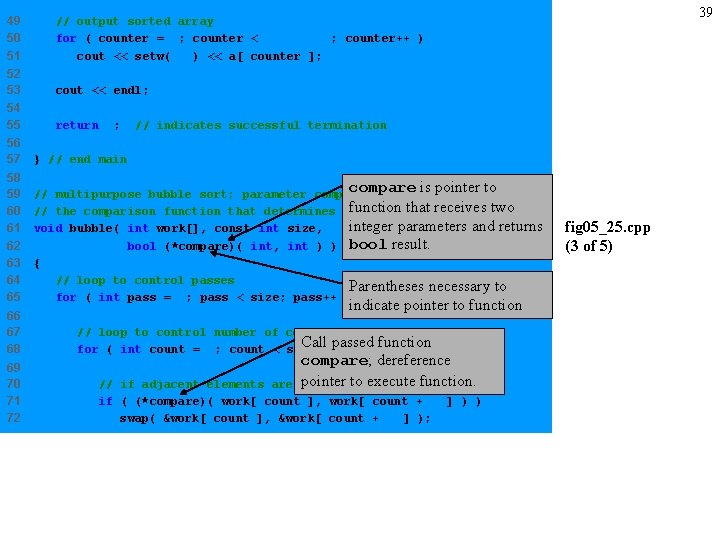
49 50 51 // output sorted array for ( counter = 0; counter < array. Size; counter++ ) cout << setw( 4 ) << a[ counter ]; 52 53 cout << endl; 54 55 return 0; // indicates successful termination 56 57 } // end main 58 59 60 61 62 63 64 65 // multipurpose bubble sort; parameter compare is a pointer to function that receives two // the comparison function that determines sorting order integer parameters and returns void bubble( int work[], const int size, bool (*compare)( int, int ) ) bool result. { // loop to control passes Parentheses necessary to for ( int pass = 1; pass < size; pass++ ) 66 67 68 69 70 71 72 39 compare is pointer to indicate pointer to function // loop to control number of comparisons per pass Call passed function for ( int count = 0; count < size - 1; count++ ) compare; dereference pointer to execute function. out of order, swap them // if adjacent elements are if ( (*compare)( work[ count ], work[ count + 1 ] ) ) swap( &work[ count ], &work[ count + 1 ] ); fig 05_25. cpp (3 of 5)
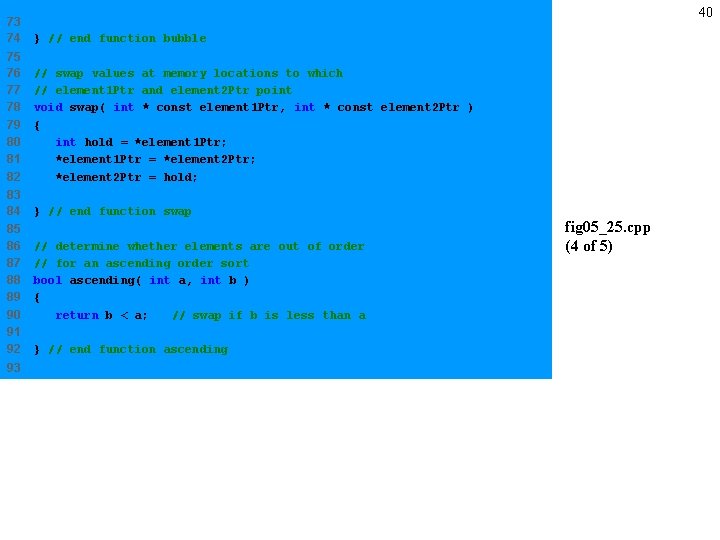
40 73 74 } // end function bubble 75 76 77 78 79 80 81 82 // swap values at memory locations to which // element 1 Ptr and element 2 Ptr point void swap( int * const element 1 Ptr, int * const element 2 Ptr ) { int hold = *element 1 Ptr; *element 1 Ptr = *element 2 Ptr; *element 2 Ptr = hold; 83 84 } // end function swap 85 86 87 88 89 90 91 92 93 // determine whether elements are out of order // for an ascending order sort bool ascending( int a, int b ) { return b < a; // swap if b is less than a } // end function ascending fig 05_25. cpp (4 of 5)
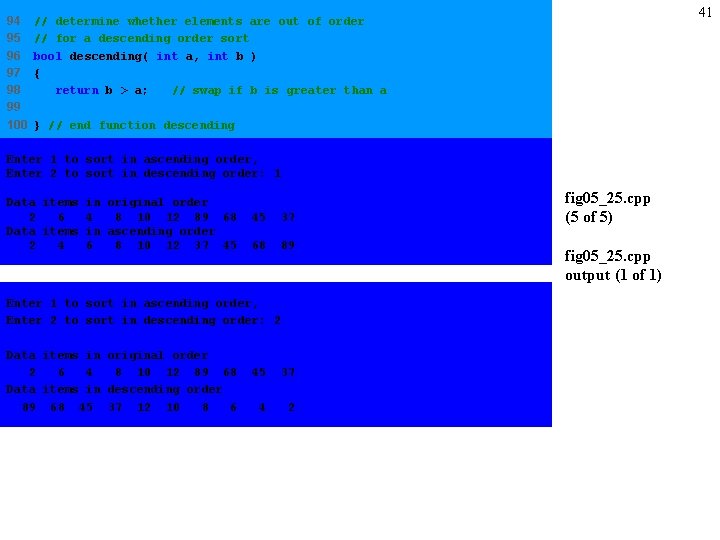
94 95 96 97 98 99 100 41 // determine whether elements are out of order // for a descending order sort bool descending( int a, int b ) { return b > a; // swap if b is greater than a } // end function descending Enter 1 to Enter 2 to Data items 2 6 Data items 2 4 sort in ascending order, sort in descending order: 1 in original order 4 8 10 12 89 68 in ascending order 6 8 10 12 37 45 45 37 68 89 Enter 1 to sort in ascending order, Enter 2 to sort in descending order: 2 Data items in original order 2 6 4 8 10 12 89 68 Data items in descending order 89 68 45 37 12 10 8 6 45 37 4 2 fig 05_25. cpp (5 of 5) fig 05_25. cpp output (1 of 1)
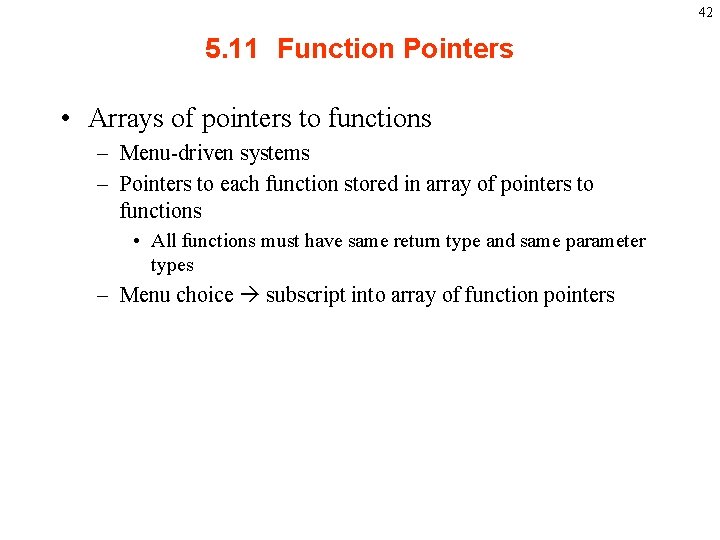
42 5. 11 Function Pointers • Arrays of pointers to functions – Menu driven systems – Pointers to each function stored in array of pointers to functions • All functions must have same return type and same parameter types – Menu choice subscript into array of function pointers
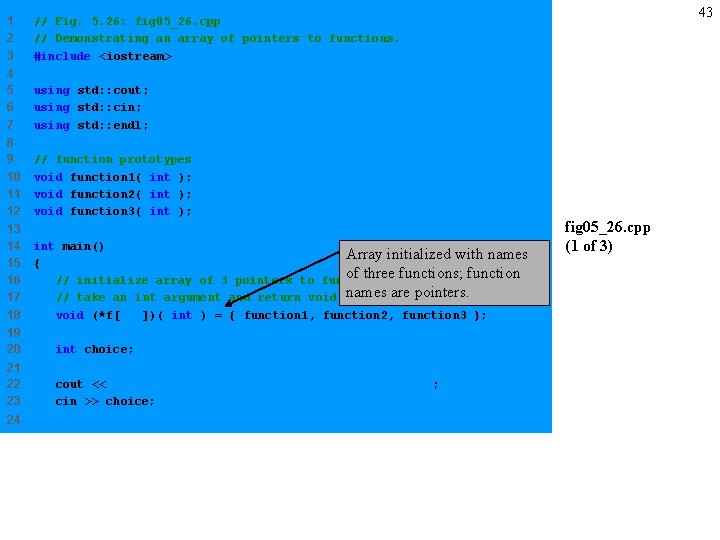
1 2 3 // Fig. 5. 26: fig 05_26. cpp // Demonstrating an array of pointers to functions. #include <iostream> 4 5 6 7 using std: : cout; using std: : cin; using std: : endl; 8 9 10 11 12 // function prototypes void function 1( int ); void function 2( int ); void function 3( int ); 13 14 15 16 17 18 int main() Array initialized with names { of three functions; function // initialize array of 3 pointers to functions that each names are pointers. // take an int argument and return void (*f[ 3 ])( int ) = { function 1, function 2, function 3 }; 19 20 int choice; 21 22 23 cout << "Enter a number between 0 and 2, 3 to end: " ; cin >> choice; 24 43 fig 05_26. cpp (1 of 3)
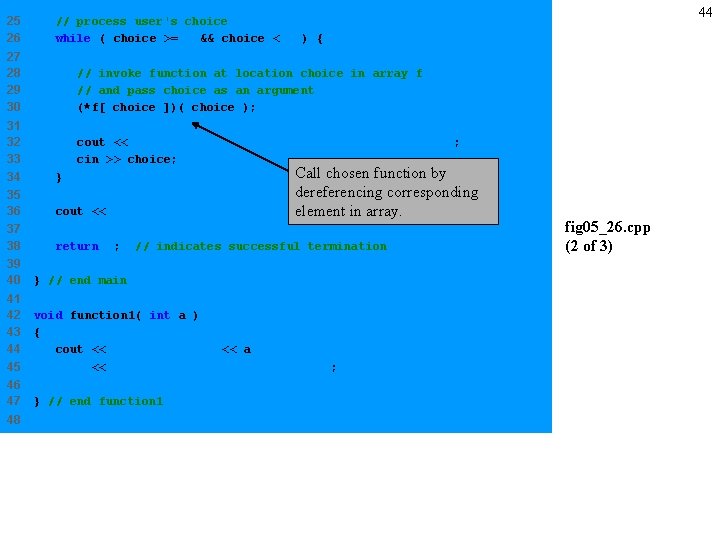
25 26 27 28 29 30 // invoke function at location choice in array f // and pass choice as an argument (*f[ choice ])( choice ); 31 32 33 34 } 35 36 cout << "Program execution 37 38 cout << "Enter a number between 0 and 2, 3 to end: " ; cin >> choice; return 0; Call chosen function by dereferencing corresponding completed. " << endl; element in array. // indicates successful termination 39 40 } // end main 41 42 43 44 45 void function 1( int a ) { cout << "You entered " << a << " so function 1 was callednn" ; 46 47 } // end function 1 48 44 // process user's choice while ( choice >= 0 && choice < 3 ) { fig 05_26. cpp (2 of 3)
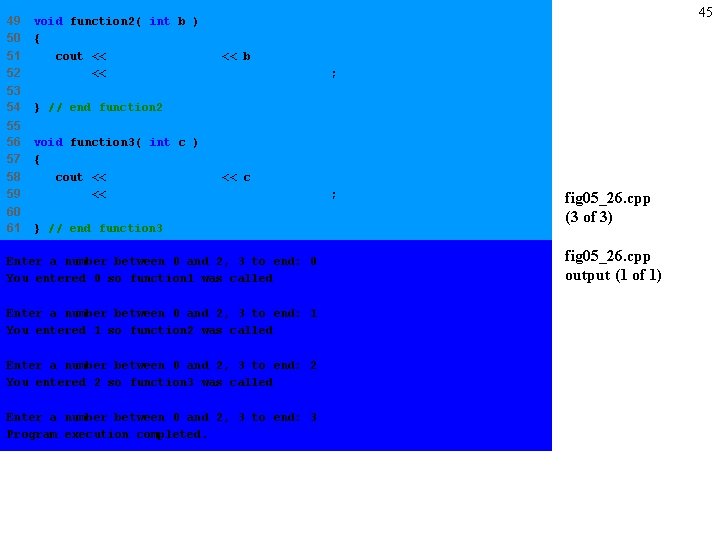
49 50 51 52 void function 2( int b ) { cout << "You entered " << b << " so function 2 was callednn" ; 53 54 } // end function 2 55 56 57 58 59 void function 3( int c ) { cout << "You entered " << c << " so function 3 was callednn" ; 60 61 } // end function 3 Enter a number between 0 and 2, 3 to end: 0 You entered 0 so function 1 was called Enter a number between 0 and 2, 3 to end: 1 You entered 1 so function 2 was called Enter a number between 0 and 2, 3 to end: 2 You entered 2 so function 3 was called Enter a number between 0 and 2, 3 to end: 3 Program execution completed. 45 fig 05_26. cpp (3 of 3) fig 05_26. cpp output (1 of 1)
46 Memory It is the job of the Operating System to • Manage the allocation of memory to processes • Keep track of what memory/addresses each process is allowed to access • Reserve portion of memory for use by the OS • Enforce protection of memory space of each process
47 • Pointer – a variable whose value is a memory address • Pointee – the value in memory whose address is stored in a pointer – the pointee is the target of the pointer. • A pointer may or may not have a target. Pointers without targets should be set to 0 or NULL.
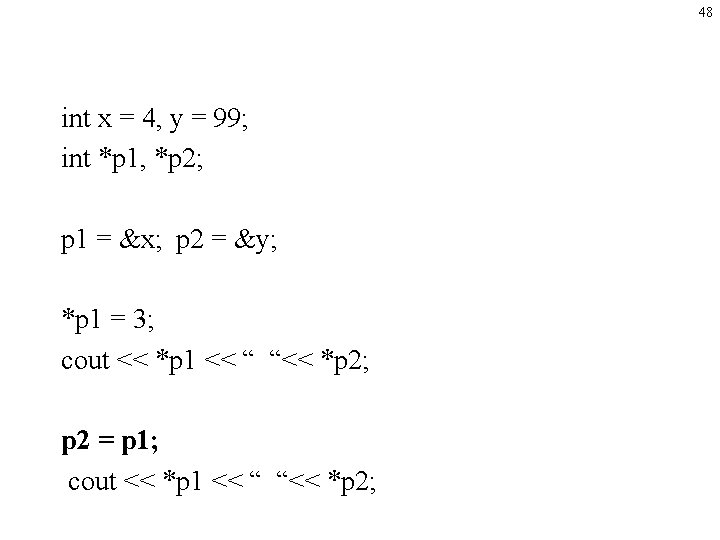
48 int x = 4, y = 99; int *p 1, *p 2; p 1 = &x; p 2 = &y; *p 1 = 3; cout << *p 1 << “ “<< *p 2; p 2 = p 1; cout << *p 1 << “ “<< *p 2;
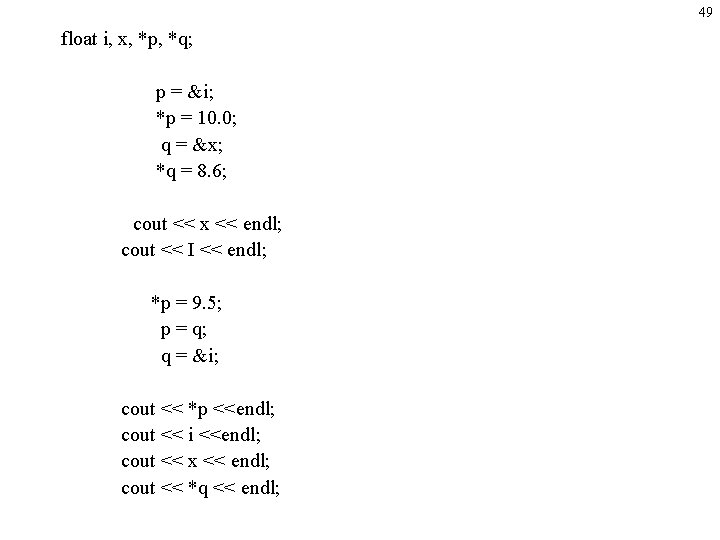
49 float i, x, *p, *q; p = &i; *p = 10. 0; q = &x; *q = 8. 6; cout << x << endl; cout << I << endl; *p = 9. 5; p = q; q = &i; cout << *p <<endl; cout << i <<endl; cout << x << endl; cout << *q << endl;
![int *p, *q, *r, *s; int a, b, c, d[10]; p = &a; q](http://slidetodoc.com/presentation_image_h/cd54565e381cff1ef8b0e528f5ac395e/image-50.jpg "int *p, *q, *r, *s; int a, b, c, d[10]; p = &a; q")
int *p, *q, *r, *s; int a, b, c, d[10]; p = &a; q = &b; *q = 98; *p = 76; q = p; cout <<*p << endl; cout << *q << endl; r = &d[0]; //note this is the same as saying r=d, which is also valid for (int i =0; i < 10; i++) r[i] = i; p = r; ++p; s= p; ++s; cout << *r << endl; cout << *q << endl; cout << *p <<endl; cout << *s <<endl; 50
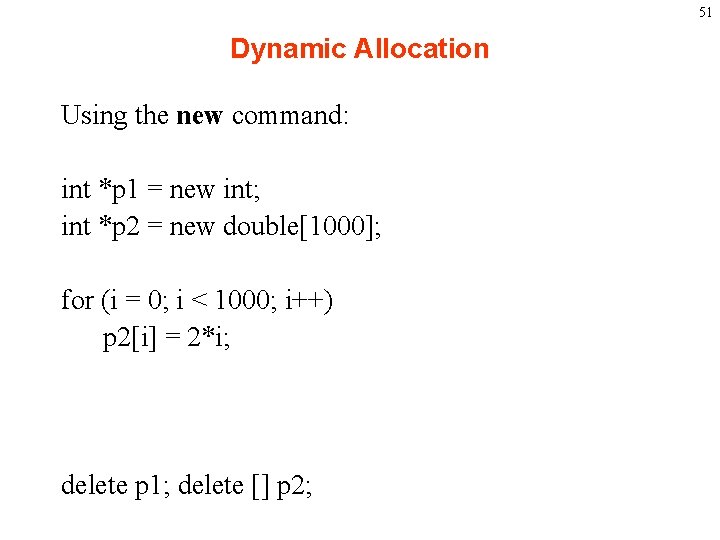
51 Dynamic Allocation Using the new command: int *p 1 = new int; int *p 2 = new double[1000]; for (i = 0; i < 1000; i++) p 2[i] = 2*i; delete p 1; delete [] p 2;
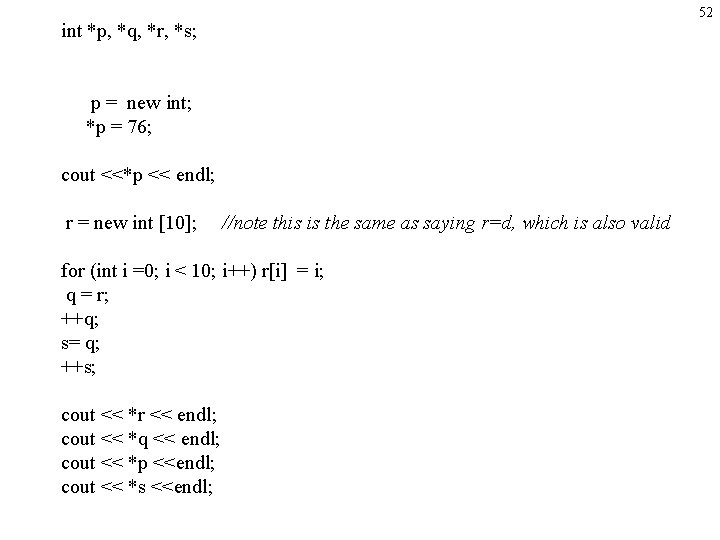
int *p, *q, *r, *s; p = new int; *p = 76; cout <<*p << endl; r = new int [10]; //note this is the same as saying r=d, which is also valid for (int i =0; i < 10; i++) r[i] = i; q = r; ++q; s= q; ++s; cout << *r << endl; cout << *q << endl; cout << *p <<endl; cout << *s <<endl; 52
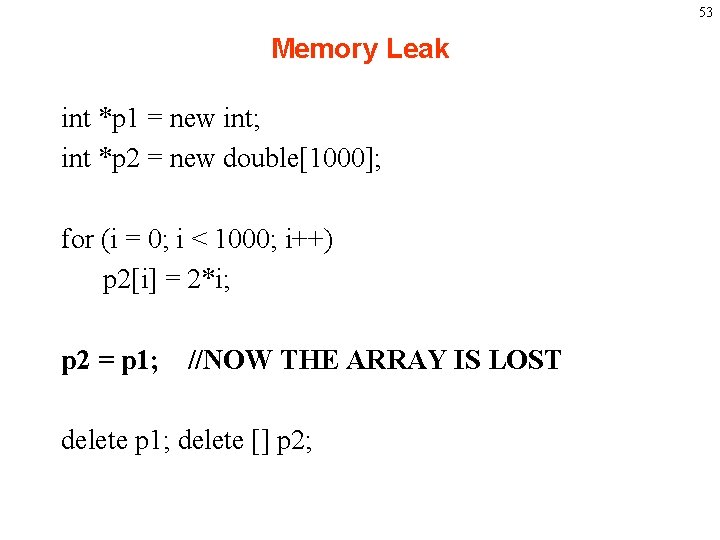
53 Memory Leak int *p 1 = new int; int *p 2 = new double[1000]; for (i = 0; i < 1000; i++) p 2[i] = 2*i; p 2 = p 1; //NOW THE ARRAY IS LOST delete p 1; delete [] p 2;
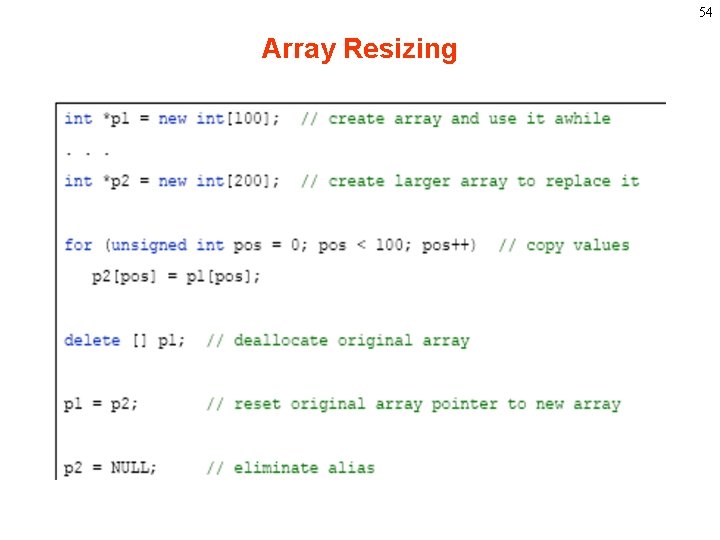
54 Array Resizing
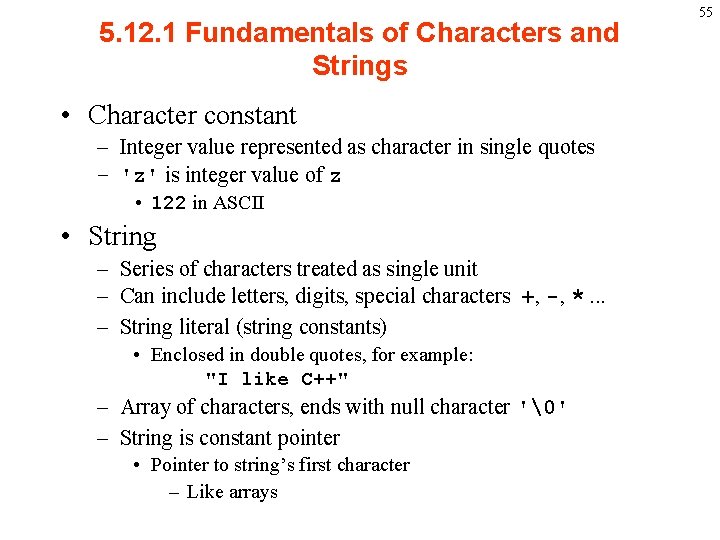
5. 12. 1 Fundamentals of Characters and Strings • Character constant – Integer value represented as character in single quotes – 'z' is integer value of z • 122 in ASCII • String – Series of characters treated as single unit – Can include letters, digits, special characters +, -, *. . . – String literal (string constants) • Enclosed in double quotes, for example: "I like C++" – Array of characters, ends with null character '' – String is constant pointer • Pointer to string’s first character – Like arrays 55
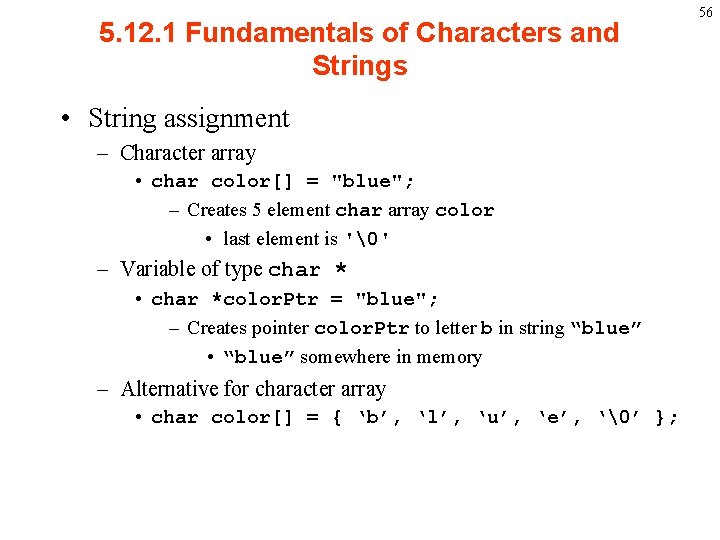
5. 12. 1 Fundamentals of Characters and Strings • String assignment – Character array • char color[] = "blue"; – Creates 5 element char array color • last element is '' – Variable of type char * • char *color. Ptr = "blue"; – Creates pointer color. Ptr to letter b in string “blue” • “blue” somewhere in memory – Alternative for character array • char color[] = { ‘b’, ‘l’, ‘u’, ‘e’, ‘’ }; 56
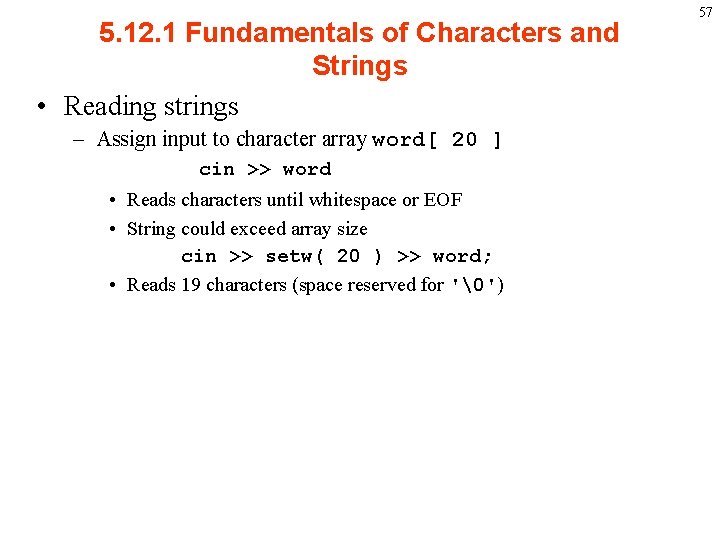
5. 12. 1 Fundamentals of Characters and Strings • Reading strings – Assign input to character array word[ 20 ] cin >> word • Reads characters until whitespace or EOF • String could exceed array size cin >> setw( 20 ) >> word; • Reads 19 characters (space reserved for '') 57
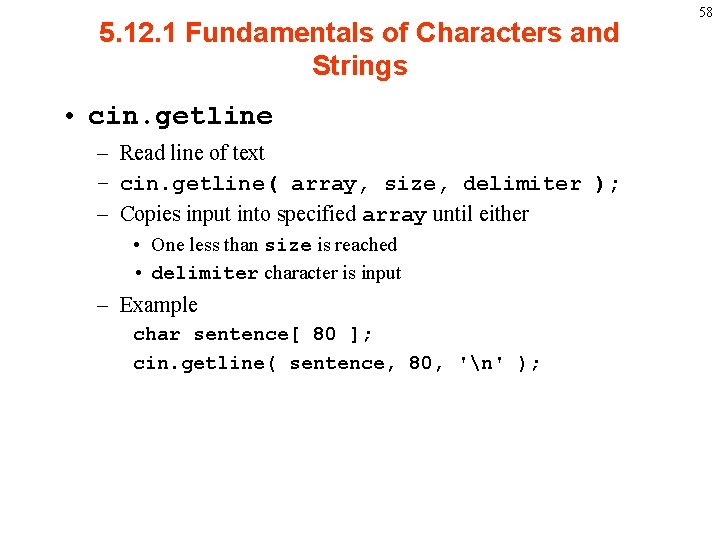
5. 12. 1 Fundamentals of Characters and Strings • cin. getline – Read line of text – cin. getline( array, size, delimiter ); – Copies input into specified array until either • One less than size is reached • delimiter character is input – Example char sentence[ 80 ]; cin. getline( sentence, 80, 'n' ); 58
5. 12. 2 String Manipulation Functions of the String-handling Library • String handling library <cstring> provides functions to – – Manipulate string data Compare strings Search strings for characters and other strings Tokenize strings (separate strings into logical pieces) 59
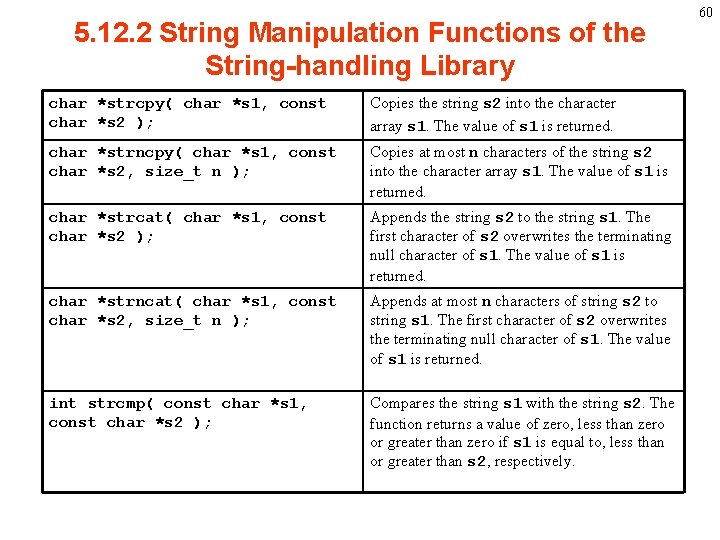
5. 12. 2 String Manipulation Functions of the String-handling Library char *strcpy( char *s 1, const char *s 2 ); Copies the string s 2 into the character array s 1. The value of s 1 is returned. char *strncpy( char *s 1, const char *s 2, size_t n ); Copies at most n characters of the string s 2 into the character array s 1. The value of s 1 is returned. char *strcat( char *s 1, const char *s 2 ); Appends the string s 2 to the string s 1. The first character of s 2 overwrites the terminating null character of s 1. The value of s 1 is returned. char *strncat( char *s 1, const char *s 2, size_t n ); Appends at most n characters of string s 2 to string s 1. The first character of s 2 overwrites the terminating null character of s 1. The value of s 1 is returned. int strcmp( const char *s 1, const char *s 2 ); Compares the string s 1 with the string s 2. The function returns a value of zero, less than zero or greater than zero if s 1 is equal to, less than or greater than s 2, respectively. 60
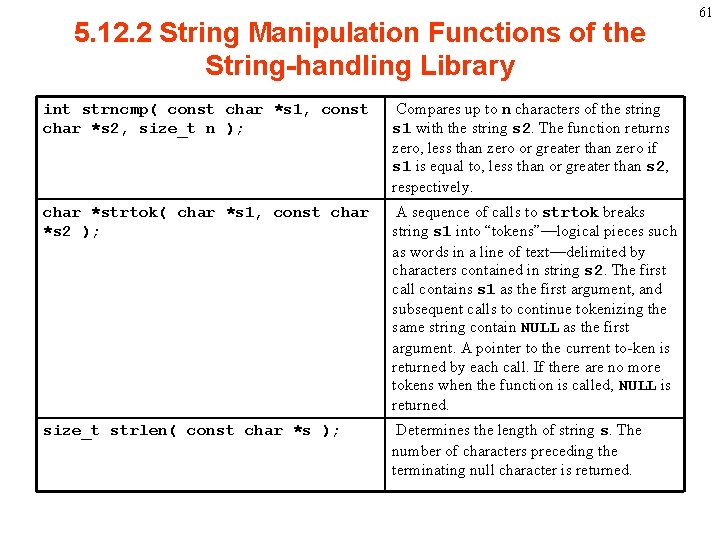
5. 12. 2 String Manipulation Functions of the String-handling Library int strncmp( const char *s 1, const char *s 2, size_t n ); Compares up to n characters of the string s 1 with the string s 2. The function returns zero, less than zero or greater than zero if s 1 is equal to, less than or greater than s 2, respectively. char *strtok( char *s 1, const char *s 2 ); A sequence of calls to strtok breaks string s 1 into “tokens”—logical pieces such as words in a line of text—delimited by characters contained in string s 2. The first call contains s 1 as the first argument, and subsequent calls to continue tokenizing the same string contain NULL as the first argument. A pointer to the current to ken is returned by each call. If there are no more tokens when the function is called, NULL is returned. size_t strlen( const char *s ); Determines the length of string s. The number of characters preceding the terminating null character is returned. 61
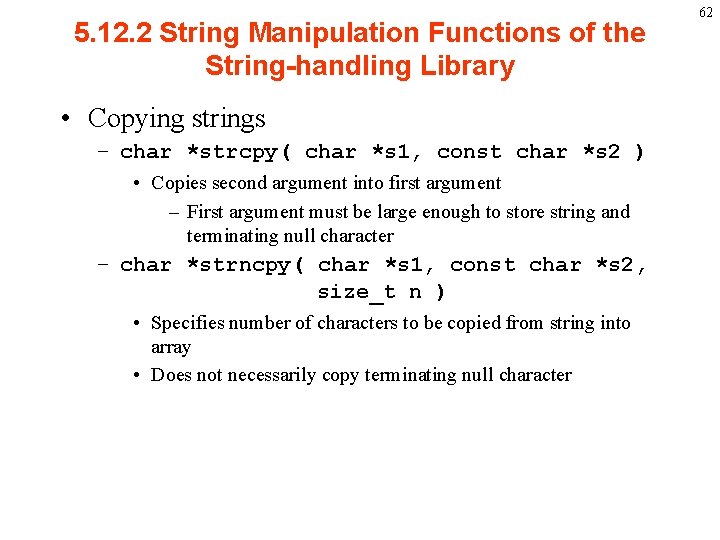
5. 12. 2 String Manipulation Functions of the String-handling Library • Copying strings – char *strcpy( char *s 1, const char *s 2 ) • Copies second argument into first argument – First argument must be large enough to store string and terminating null character – char *strncpy( char *s 1, const char *s 2, size_t n ) • Specifies number of characters to be copied from string into array • Does not necessarily copy terminating null character 62
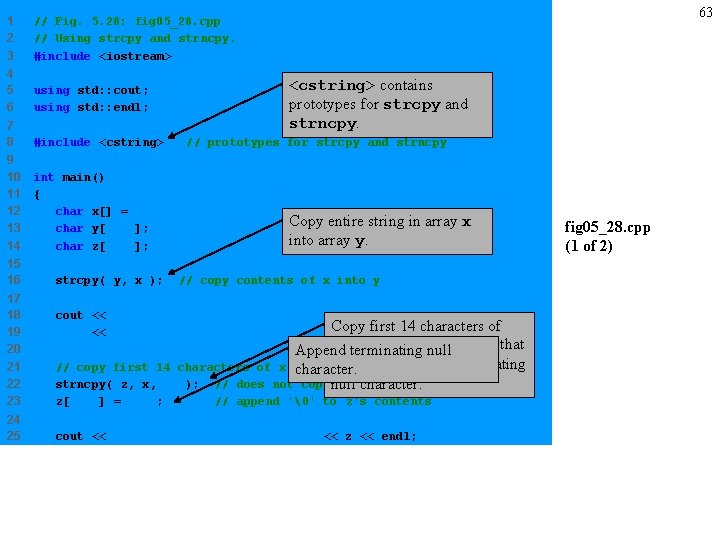
63 1 2 3 // Fig. 5. 28: fig 05_28. cpp // Using strcpy and strncpy. #include <iostream> 4 5 6 using std: : cout; using std: : endl; 7 8 #include <cstring> 9 10 11 12 13 14 int main() { char x[] = "Happy Birthday to You"; Copy entire string in array x char y[ 25 ]; into array y. char z[ 15 ]; 15 16 strcpy( y, x ); <cstring> contains prototypes for strcpy and strncpy. // prototypes for strcpy and strncpy // copy contents of x into y 17 18 19 20 21 22 23 z[ 14 ] = ''; 24 25 cout << "The string in array z is: " << z << endl; cout << "The string in array x is: " << x << "n. The string in array y is: " Copy first 14 characters of << y << 'n'; array x into array y. Note that Append terminating null // copy first 14 characters of x into zthis does not write terminating character. strncpy( z, x, 14 ); // does not copy null character // append '' to z's contents fig 05_28. cpp (1 of 2)
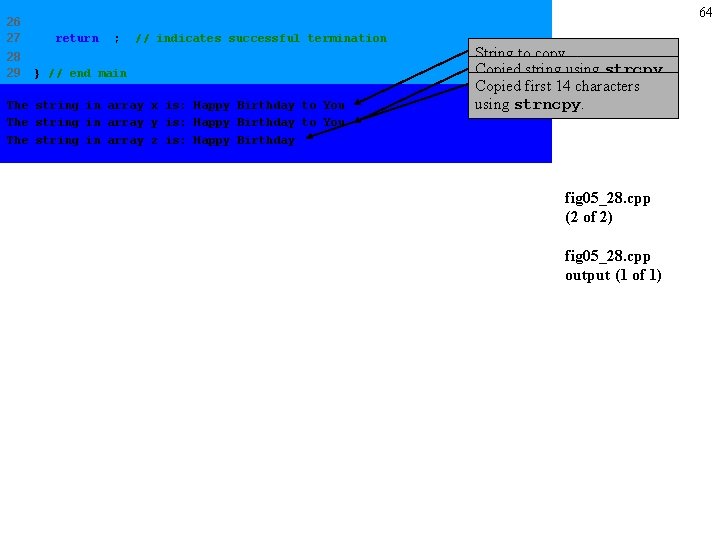
26 27 28 29 64 return 0; // indicates successful termination } // end main The string in array x is: Happy Birthday to You The string in array y is: Happy Birthday to You The string in array z is: Happy Birthday String to copy. Copied string using strcpy. Copied first 14 characters using strncpy. fig 05_28. cpp (2 of 2) fig 05_28. cpp output (1 of 1)
5. 12. 2 String Manipulation Functions of the String-handling Library • Concatenating strings – char *strcat( char *s 1, const char *s 2 ) • Appends second argument to first argument • First character of second argument replaces null character terminating first argument • Ensure first argument large enough to store concatenated result and null character – char *strncat( char *s 1, const char *s 2, size_t n ) • Appends specified number of characters from second argument to first argument • Appends terminating null character to result 65
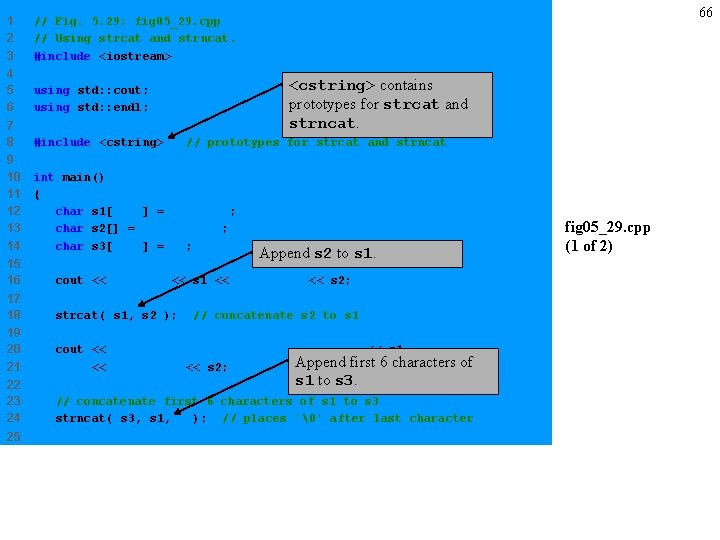
1 2 3 // Fig. 5. 29: fig 05_29. cpp // Using strcat and strncat. #include <iostream> 4 5 6 using std: : cout; using std: : endl; 7 8 #include <cstring> 9 10 11 12 13 14 int main() { char s 1[ 20 ] = "Happy "; char s 2[] = "New Year "; char s 3[ 40 ] = ""; 66 <cstring> contains prototypes for strcat and strncat. // prototypes for strcat and strncat Append s 2 to s 1. 15 16 cout << "s 1 = " << s 1 << "ns 2 = " << s 2; 17 18 strcat( s 1, s 2 ); 19 20 21 cout << "nn. After strcat(s 1, s 2): ns 1 = " << s 1 Append first 6 characters of << "ns 2 = " << s 2; 22 23 24 // concatenate first 6 characters of s 1 to s 3 strncat( s 3, s 1, 6 ); // places '' after last character 25 // concatenate s 2 to s 1 to s 3. fig 05_29. cpp (1 of 2)
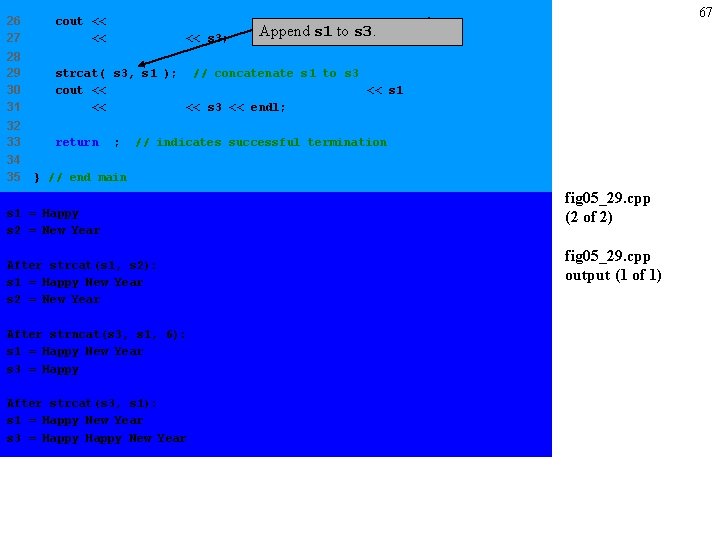
26 27 cout << "nn. After strncat(s 3, s 1, 6): ns 1 = " << s 1 Append s 1 to s 3. << "ns 3 = " << s 3; 28 29 30 31 strcat( s 3, s 1 ); // concatenate s 1 to s 3 cout << "nn. After strcat(s 3, s 1): ns 1 = " << s 1 << "ns 3 = " << s 3 << endl; 32 33 return 0; 34 35 67 // indicates successful termination } // end main s 1 = Happy s 2 = New Year After strcat(s 1, s 2): s 1 = Happy New Year s 2 = New Year After strncat(s 3, s 1, 6): s 1 = Happy New Year s 3 = Happy After strcat(s 3, s 1): s 1 = Happy New Year s 3 = Happy New Year fig 05_29. cpp (2 of 2) fig 05_29. cpp output (1 of 1)
5. 12. 2 String Manipulation Functions of the String-handling Library • Comparing strings – Characters represented as numeric codes • Strings compared using numeric codes – Character codes / character sets • ASCII – “American Standard Code for Information Interchage” • EBCDIC – “Extended Binary Coded Decimal Interchange Code” 68
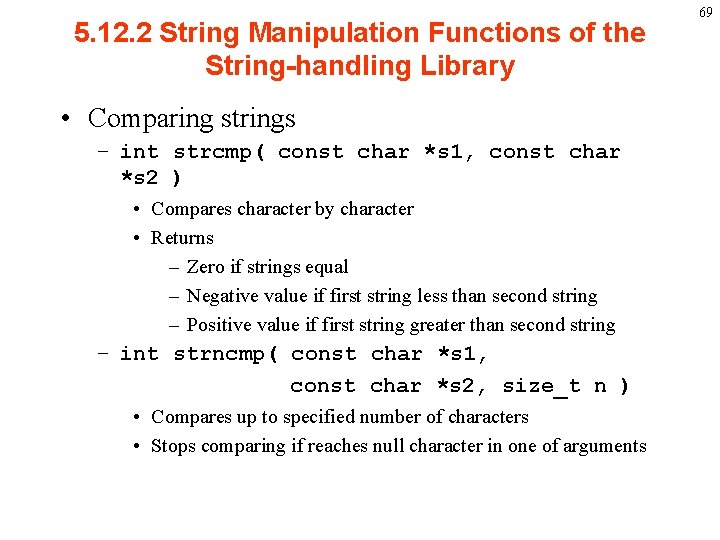
5. 12. 2 String Manipulation Functions of the String-handling Library • Comparing strings – int strcmp( const char *s 1, const char *s 2 ) • Compares character by character • Returns – Zero if strings equal – Negative value if first string less than second string – Positive value if first string greater than second string – int strncmp( const char *s 1, const char *s 2, size_t n ) • Compares up to specified number of characters • Stops comparing if reaches null character in one of arguments 69
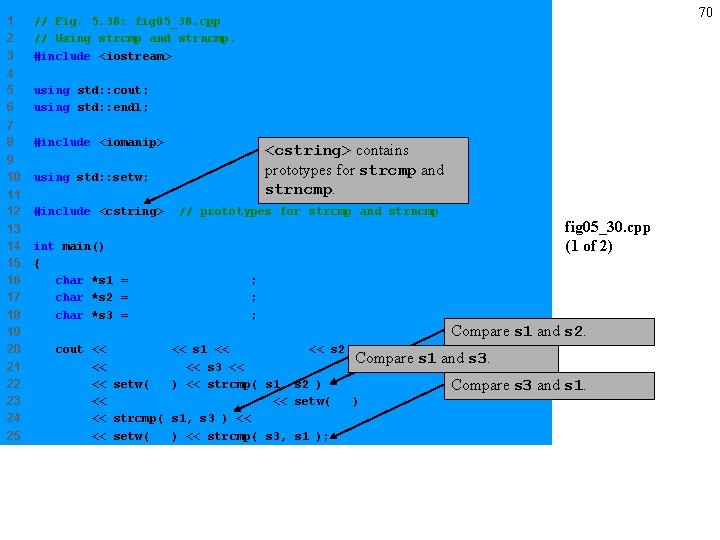
1 2 3 // Fig. 5. 30: fig 05_30. cpp // Using strcmp and strncmp. #include <iostream> 4 5 6 using std: : cout; using std: : endl; 7 8 #include <iomanip> 9 10 using std: : setw; 11 12 #include <cstring> 13 14 15 16 17 18 19 20 21 22 23 24 25 <cstring> contains prototypes for strcmp and strncmp. // prototypes for strcmp and strncmp int main() { char *s 1 = "Happy New Year"; char *s 2 = "Happy New Year"; char *s 3 = "Happy Holidays"; cout << << << 70 fig 05_30. cpp (1 of 2) Compare s 1 and s 2. "s 1 = " << s 1 << "ns 2 = " << s 2 Compare s 1 and s 3. "ns 3 = " << s 3 << "nnstrcmp(s 1, s 2) = " setw( 2 ) << strcmp( s 1, s 2 ) Compare s 3 and s 1. "nstrcmp(s 1, s 3) = " << setw( 2 ) strcmp( s 1, s 3 ) << "nstrcmp(s 3, s 1) = " setw( 2 ) << strcmp( s 3, s 1 );
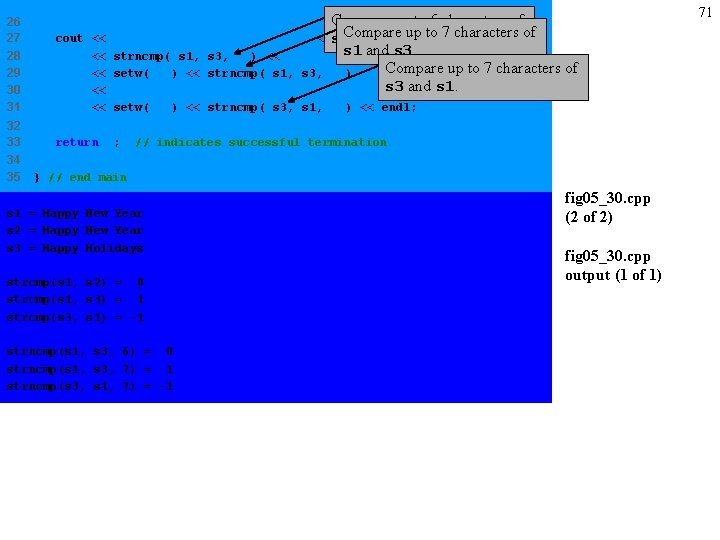
Compare up to 6 characters of Compare up to 7 characters of "nnstrncmp(s 1, s 3, 6) = " <<s 1 and s 3. setw( 2 ) s 1 and s 3. strncmp( s 1, s 3, 6 ) << "nstrncmp(s 1, s 3, 7) = " Compare up to 7 characters of setw( 2 ) << strncmp( s 1, s 3, 7 ) s 3 and s 1. "nstrncmp(s 3, s 1, 7) = " 26 27 28 29 30 31 cout << << << setw( 2 ) << strncmp( s 3, s 1, 7 ) << endl; 32 33 return 0; 34 35 // indicates successful termination } // end main s 1 = Happy New Year s 2 = Happy New Year s 3 = Happy Holidays strcmp(s 1, s 2) = 0 strcmp(s 1, s 3) = 1 strcmp(s 3, s 1) = -1 strncmp(s 1, s 3, 6) = 0 strncmp(s 1, s 3, 7) = 1 strncmp(s 3, s 1, 7) = -1 fig 05_30. cpp (2 of 2) fig 05_30. cpp output (1 of 1) 71
5. 12. 2 String Manipulation Functions of the String-handling Library • Tokenizing – Breaking strings into tokens, separated by delimiting characters – Tokens usually logical units, such as words (separated by spaces) – "This is my string" has 4 word tokens (separated by spaces) – char *strtok( char *s 1, const char *s 2 ) • Multiple calls required – First call contains two arguments, string to be tokenized and string containing delimiting characters • Finds next delimiting character and replaces with null character – Subsequent calls continue tokenizing • Call with first argument NULL 72
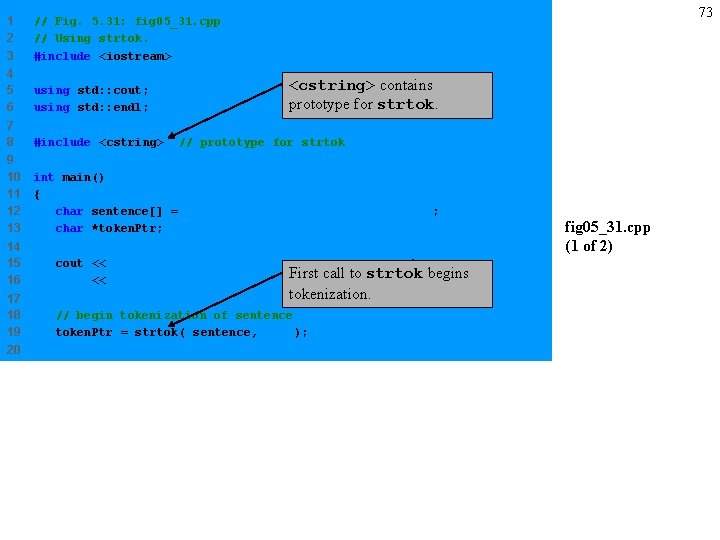
73 1 2 3 // Fig. 5. 31: fig 05_31. cpp // Using strtok. #include <iostream> 4 5 6 using std: : cout; using std: : endl; 7 8 #include <cstring> 9 10 11 12 13 int main() { char sentence[] = "This is a sentence with 7 tokens" ; char *token. Ptr; <cstring> contains prototype for strtok. // prototype for strtok 14 15 16 cout << "The string to be tokenized is: n" << sentence First call to strtok begins << "nn. The tokens are: nn"; 17 18 19 // begin tokenization of sentence token. Ptr = strtok( sentence, " " ); 20 tokenization. fig 05_31. cpp (1 of 2)
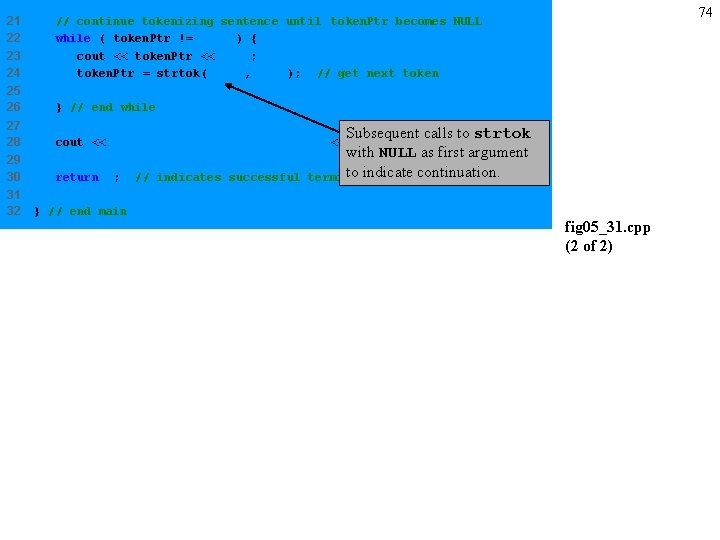
21 22 23 24 // continue tokenizing sentence until token. Ptr becomes NULL while ( token. Ptr != NULL ) { cout << token. Ptr << 'n'; token. Ptr = strtok( NULL, " " ); // get next token 25 26 } // end while 27 28 cout << "n. After strtok, sentence = " << sentence << endl; 29 30 return 0; 31 32 } // end main // indicates successful 74 Subsequent calls to strtok with NULL as first argument to indicate continuation. termination fig 05_31. cpp (2 of 2)
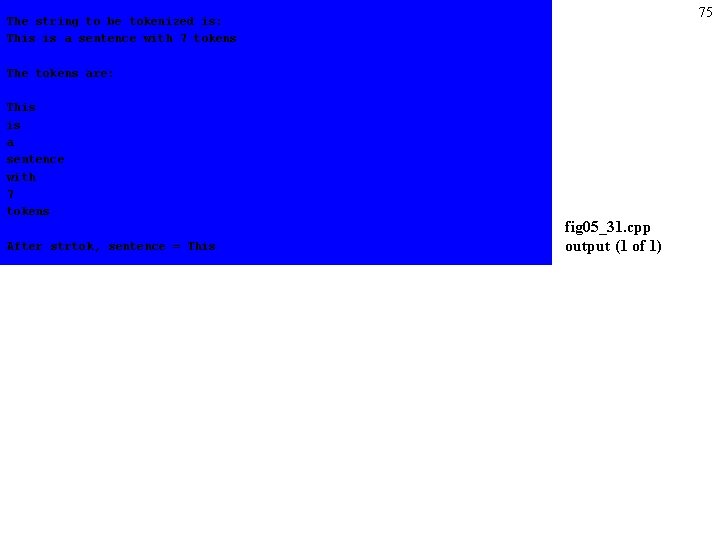
75 The string to be tokenized is: This is a sentence with 7 tokens The tokens are: This is a sentence with 7 tokens After strtok, sentence = This fig 05_31. cpp output (1 of 1)
5. 12. 2 String Manipulation Functions of the String-handling Library • Determining string lengths – size_t strlen( const char *s ) • Returns number of characters in string – Terminating null character not included in length 76
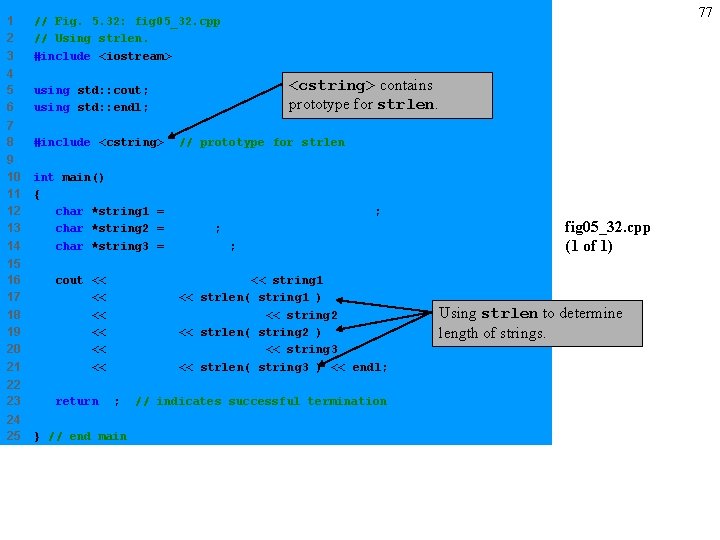
77 1 2 3 // Fig. 5. 32: fig 05_32. cpp // Using strlen. #include <iostream> 4 5 6 using std: : cout; using std: : endl; 7 8 #include <cstring> 9 10 11 12 13 14 int main() { char *string 1 = "abcdefghijklmnopqrstuvwxyz "; char *string 2 = "four"; char *string 3 = "Boston"; 15 16 17 18 19 20 21 cout << << << 22 23 return 0; 24 25 <cstring> contains prototype for strlen. // prototype for strlen "The length of "" << string 1 "" is " << strlen( string 1 ) "n. The length of "" << string 2 "" is " << strlen( string 2 ) "n. The length of "" << string 3 "" is " << strlen( string 3 ) << endl; } // end main // indicates successful termination fig 05_32. cpp (1 of 1) Using strlen to determine length of strings.
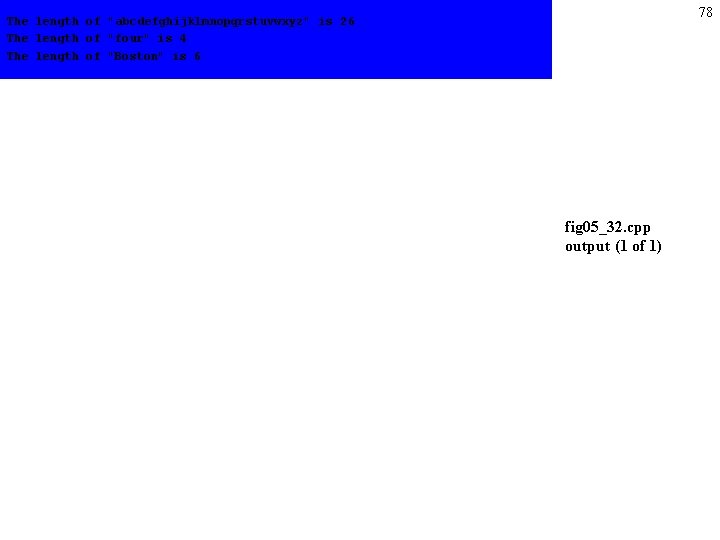
78 The length of "abcdefghijklmnopqrstuvwxyz " is 26 The length of "four" is 4 The length of "Boston" is 6 fig 05_32. cpp output (1 of 1)
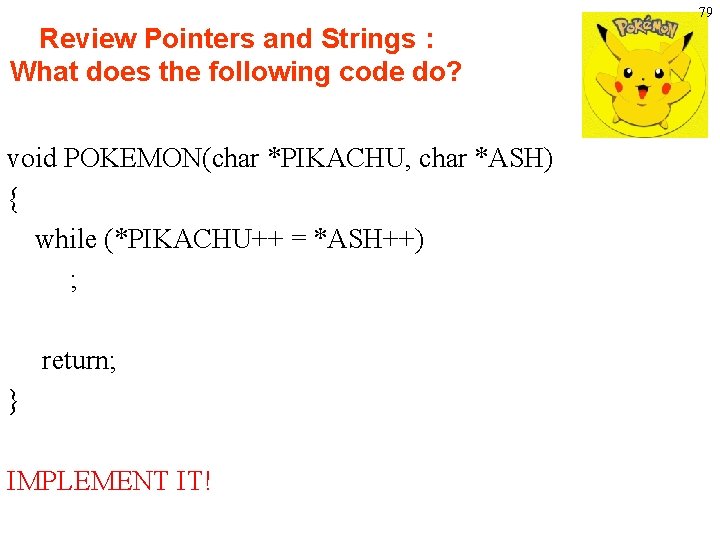
79 Review Pointers and Strings : What does the following code do? void POKEMON(char *PIKACHU, char *ASH) { while (*PIKACHU++ = *ASH++) ; return; } IMPLEMENT IT!
- Slides: 79