
1 49 Tizen Linux Kernel Sungkyunkwan University Embedded
1 49 Tizen Linux Kernel Sungkyunkwan University Embedded Software Lab. @ SKKU
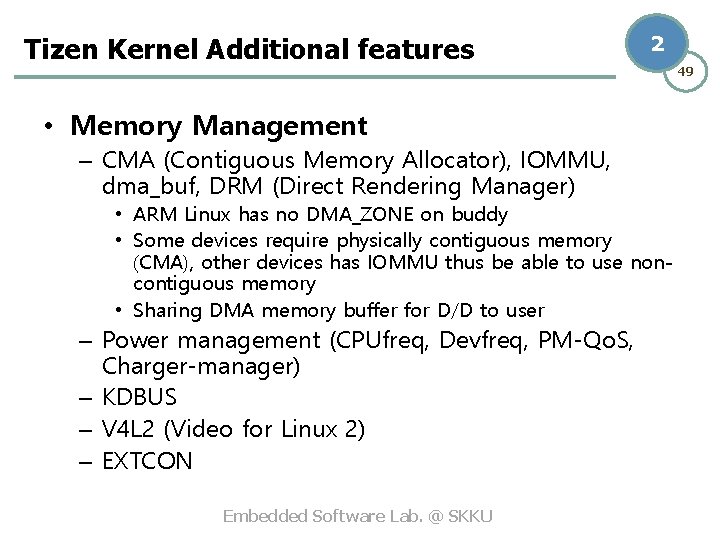
Tizen Kernel Additional features 2 • Memory Management – CMA (Contiguous Memory Allocator), IOMMU, dma_buf, DRM (Direct Rendering Manager) • ARM Linux has no DMA_ZONE on buddy • Some devices require physically contiguous memory (CMA), other devices has IOMMU thus be able to use noncontiguous memory • Sharing DMA memory buffer for D/D to user – Power management (CPUfreq, Devfreq, PM-Qo. S, Charger-manager) – KDBUS – V 4 L 2 (Video for Linux 2) – EXTCON Embedded Software Lab. @ SKKU 49
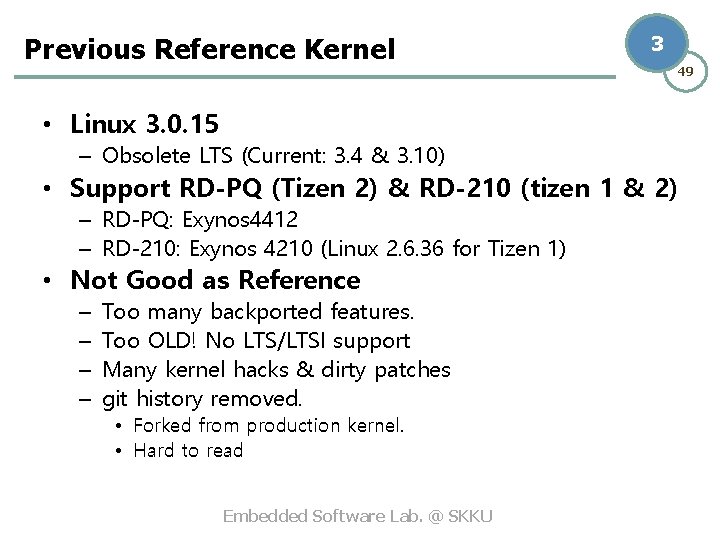
Previous Reference Kernel 3 49 • Linux 3. 0. 15 – Obsolete LTS (Current: 3. 4 & 3. 10) • Support RD-PQ (Tizen 2) & RD-210 (tizen 1 & 2) – RD-PQ: Exynos 4412 – RD-210: Exynos 4210 (Linux 2. 6. 36 for Tizen 1) • Not Good as Reference – – Too many backported features. Too OLD! No LTS/LTSI support Many kernel hacks & dirty patches git history removed. • Forked from production kernel. • Hard to read Embedded Software Lab. @ SKKU
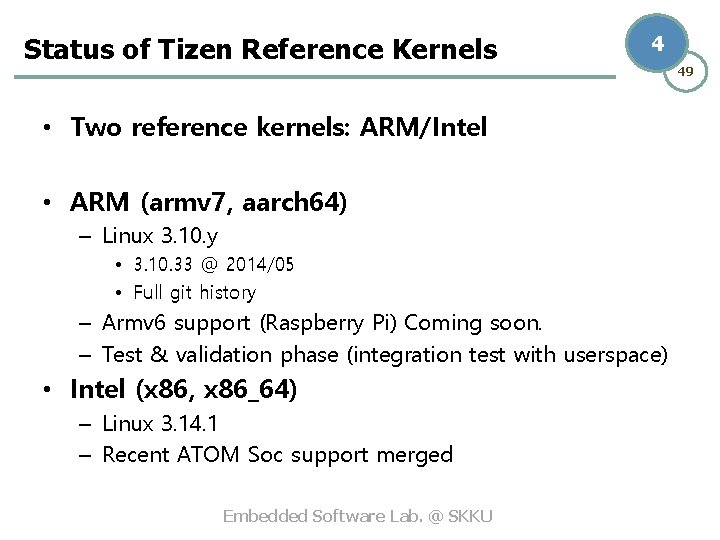
Status of Tizen Reference Kernels 4 • Two reference kernels: ARM/Intel • ARM (armv 7, aarch 64) – Linux 3. 10. y • 3. 10. 33 @ 2014/05 • Full git history – Armv 6 support (Raspberry Pi) Coming soon. – Test & validation phase (integration test with userspace) • Intel (x 86, x 86_64) – Linux 3. 14. 1 – Recent ATOM Soc support merged Embedded Software Lab. @ SKKU 49
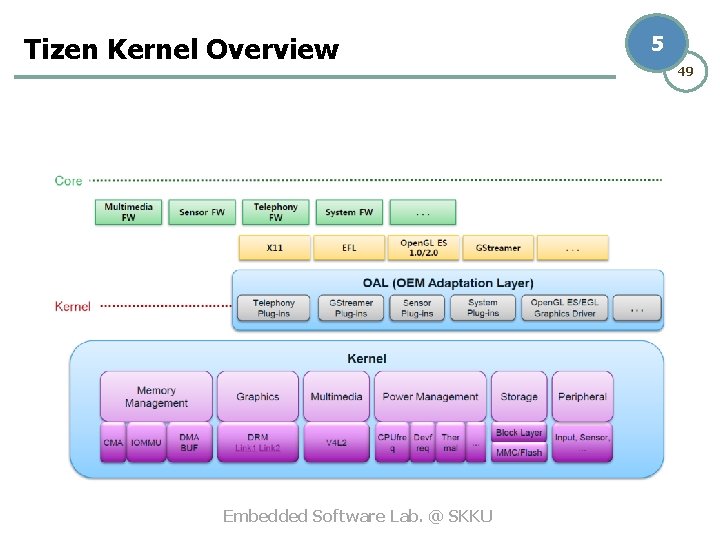
Tizen Kernel Overview Embedded Software Lab. @ SKKU 5 49
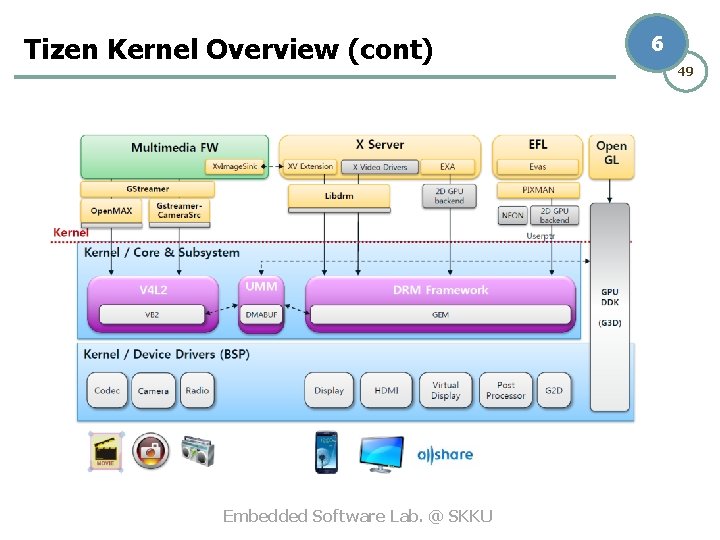
Tizen Kernel Overview (cont) Embedded Software Lab. @ SKKU 6 49
7 49 Tizen Memory Management Embedded Software Lab. @ SKKU
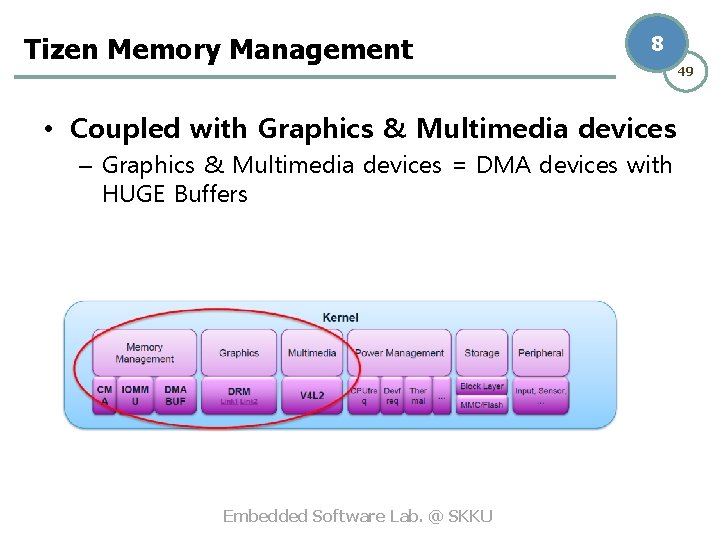
Tizen Memory Management 8 • Coupled with Graphics & Multimedia devices – Graphics & Multimedia devices = DMA devices with HUGE Buffers Embedded Software Lab. @ SKKU 49
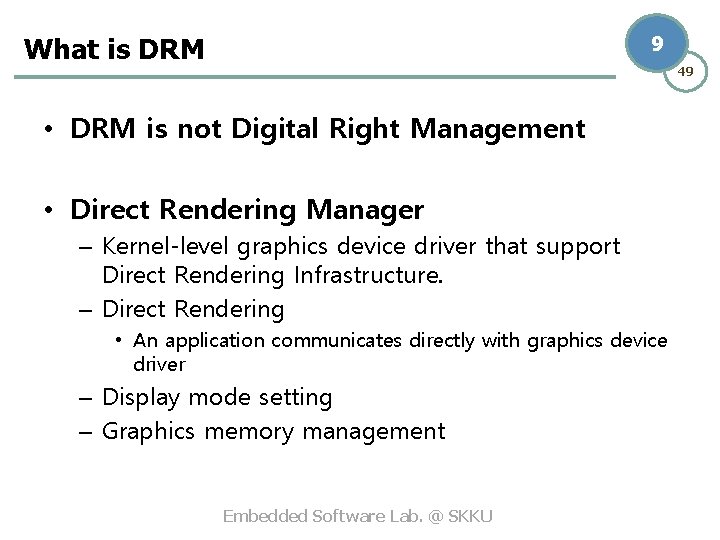
What is DRM 9 49 • DRM is not Digital Right Management • Direct Rendering Manager – Kernel-level graphics device driver that support Direct Rendering Infrastructure. – Direct Rendering • An application communicates directly with graphics device driver – Display mode setting – Graphics memory management Embedded Software Lab. @ SKKU
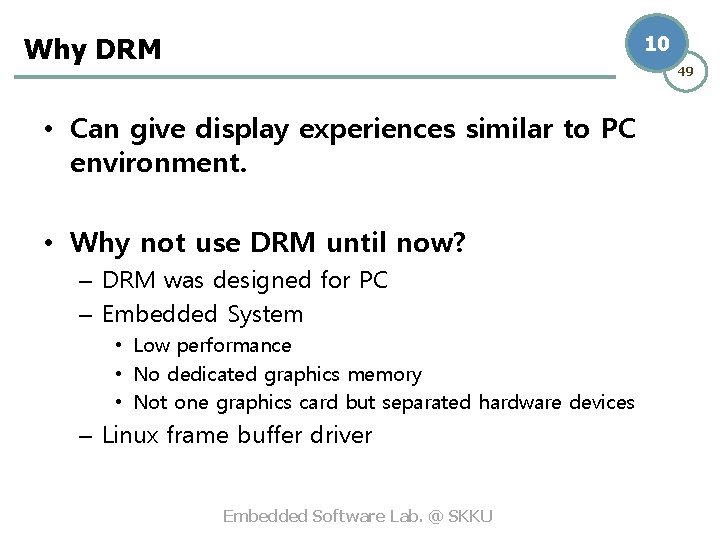
Why DRM 10 49 • Can give display experiences similar to PC environment. • Why not use DRM until now? – DRM was designed for PC – Embedded System • Low performance • No dedicated graphics memory • Not one graphics card but separated hardware devices – Linux frame buffer driver Embedded Software Lab. @ SKKU
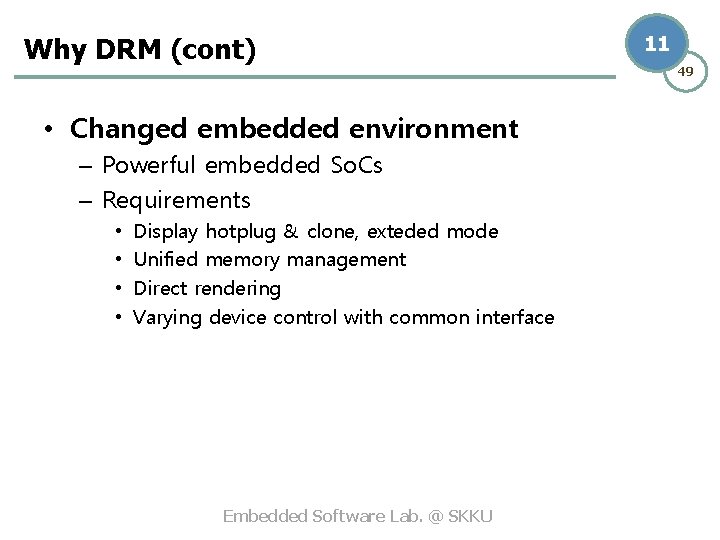
Why DRM (cont) • Changed embedded environment – Powerful embedded So. Cs – Requirements • • Display hotplug & clone, exteded mode Unified memory management Direct rendering Varying device control with common interface Embedded Software Lab. @ SKKU 11 49
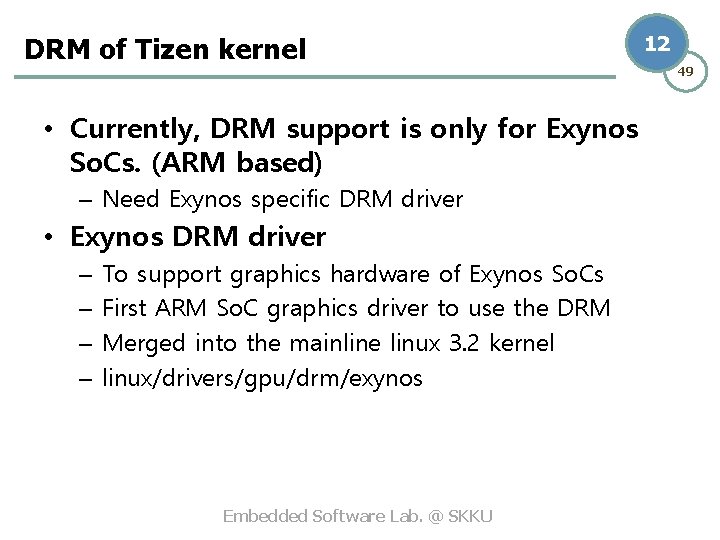
DRM of Tizen kernel • Currently, DRM support is only for Exynos So. Cs. (ARM based) – Need Exynos specific DRM driver • Exynos DRM driver – – To support graphics hardware of Exynos So. Cs First ARM So. C graphics driver to use the DRM Merged into the mainline linux 3. 2 kernel linux/drivers/gpu/drm/exynos Embedded Software Lab. @ SKKU 12 49
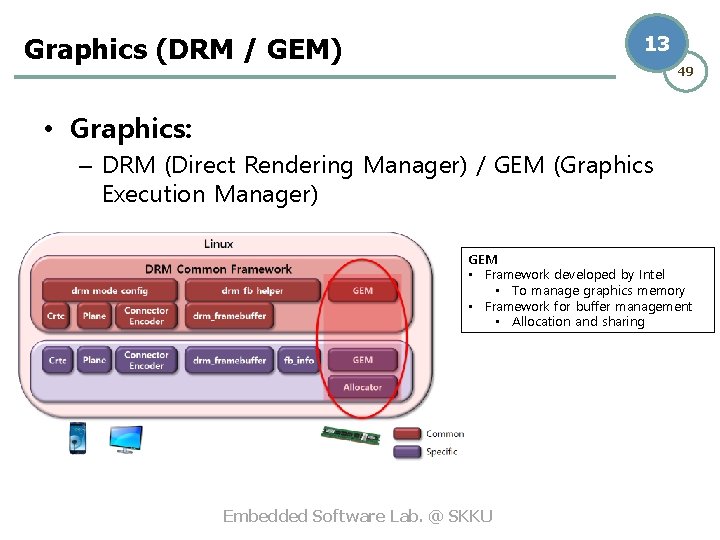
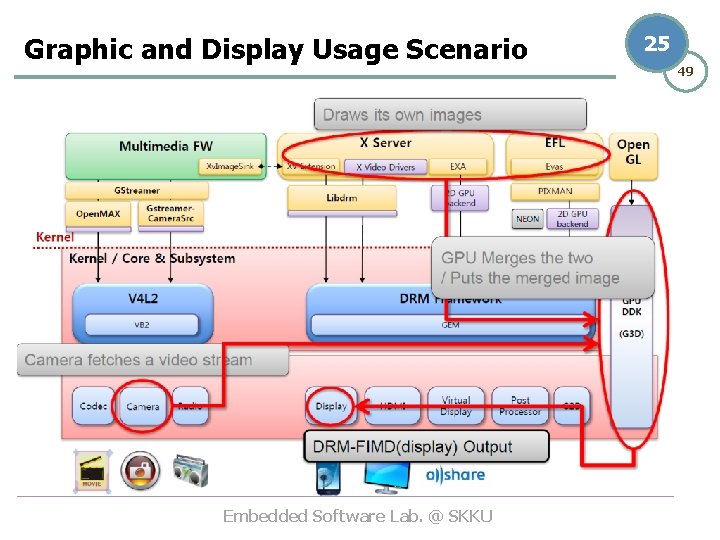
Graphics (DRM / GEM) 13 49 • Graphics: – DRM (Direct Rendering Manager) / GEM (Graphics Execution Manager) GEM • Framework developed by Intel • To manage graphics memory • Framework for buffer management • Allocation and sharing Embedded Software Lab. @ SKKU
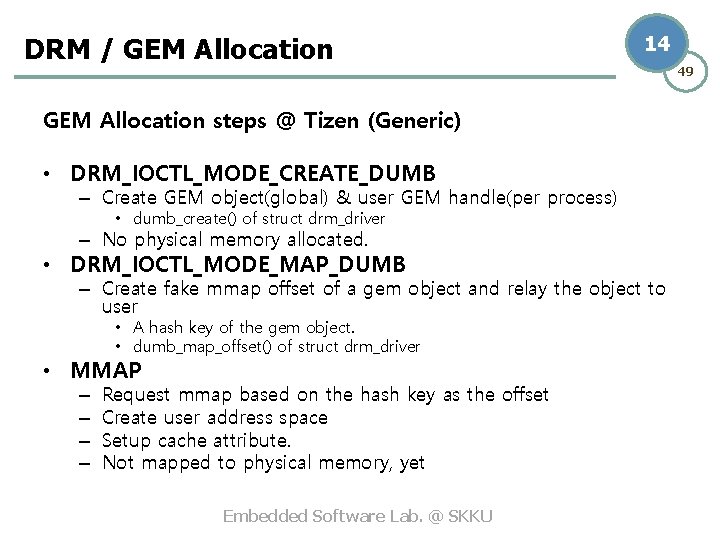
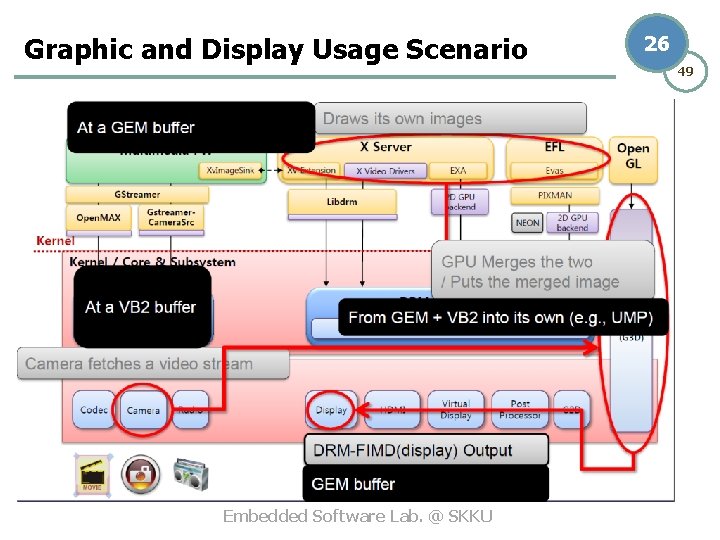
DRM / GEM Allocation 14 GEM Allocation steps @ Tizen (Generic) • DRM_IOCTL_MODE_CREATE_DUMB – Create GEM object(global) & user GEM handle(per process) • dumb_create() of struct drm_driver – No physical memory allocated. • DRM_IOCTL_MODE_MAP_DUMB – Create fake mmap offset of a gem object and relay the object to user • A hash key of the gem object. • dumb_map_offset() of struct drm_driver • MMAP – – Request mmap based on the hash key as the offset Create user address space Setup cache attribute. Not mapped to physical memory, yet Embedded Software Lab. @ SKKU 49
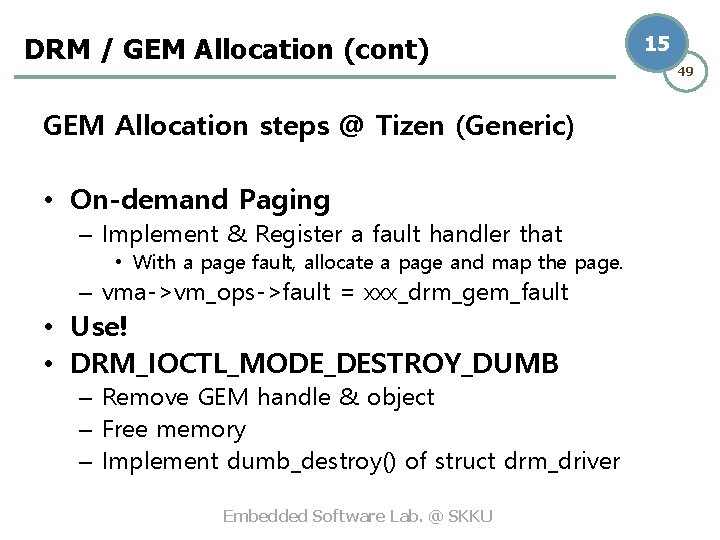
DRM / GEM Allocation (cont) GEM Allocation steps @ Tizen (Generic) • On-demand Paging – Implement & Register a fault handler that • With a page fault, allocate a page and map the page. – vma->vm_ops->fault = xxx_drm_gem_fault • Use! • DRM_IOCTL_MODE_DESTROY_DUMB – Remove GEM handle & object – Free memory – Implement dumb_destroy() of struct drm_driver Embedded Software Lab. @ SKKU 15 49
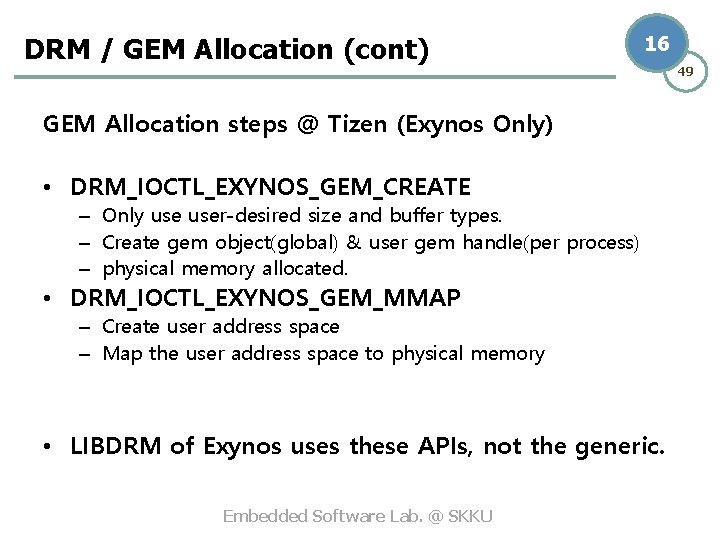
DRM / GEM Allocation (cont) 16 GEM Allocation steps @ Tizen (Exynos Only) • DRM_IOCTL_EXYNOS_GEM_CREATE – Only user-desired size and buffer types. – Create gem object(global) & user gem handle(per process) – physical memory allocated. • DRM_IOCTL_EXYNOS_GEM_MMAP – Create user address space – Map the user address space to physical memory • LIBDRM of Exynos uses these APIs, not the generic. Embedded Software Lab. @ SKKU 49
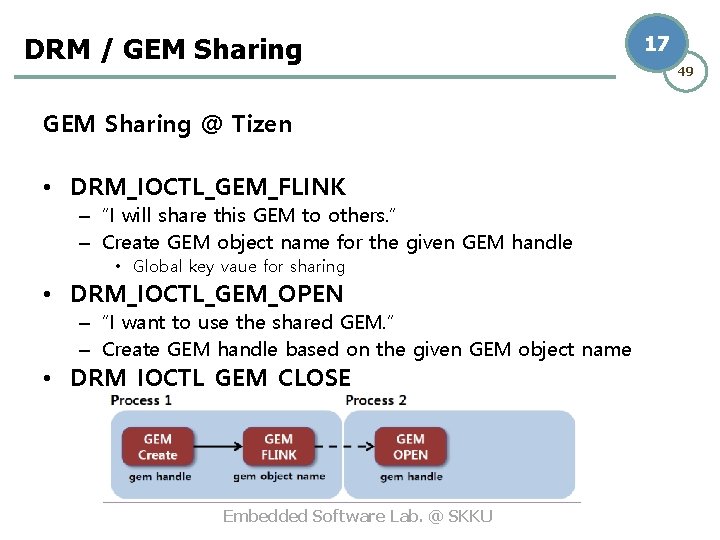
DRM / GEM Sharing @ Tizen • DRM_IOCTL_GEM_FLINK – “I will share this GEM to others. ” – Create GEM object name for the given GEM handle • Global key vaue for sharing • DRM_IOCTL_GEM_OPEN – “I want to use the shared GEM. ” – Create GEM handle based on the given GEM object name • DRM_IOCTL_GEM_CLOSE Embedded Software Lab. @ SKKU 17 49
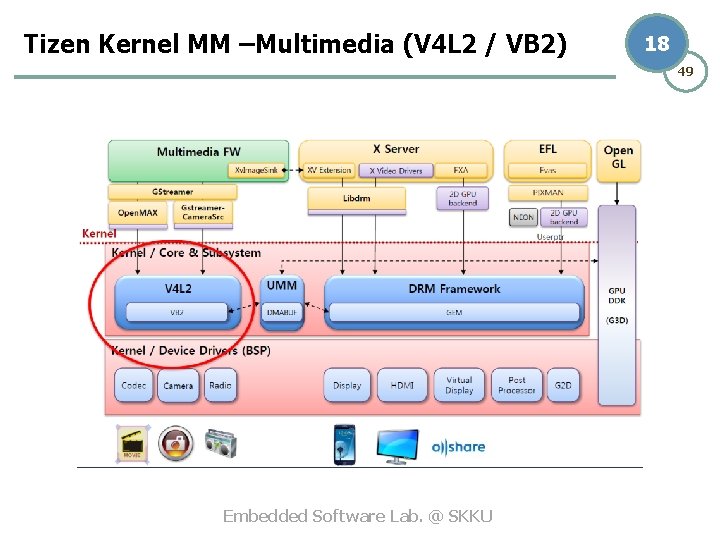
Tizen Kernel MM –Multimedia (V 4 L 2 / VB 2) 18 49 Embedded Software Lab. @ SKKU
V 4 L 2 / VB 2 19 49 • Tizen recommends to use V 4 L 2 at Tizen kernel for Multimedia devices – Video input (codec & camera) & Radio – However, as long as the kernel has. . : • Gstreamer/Open. MAX plugins • A method to share with other F/W via DMABUF of UMM • If V 4 L 2/VB 2 is used, things get easier. Embedded Software Lab. @ SKKU
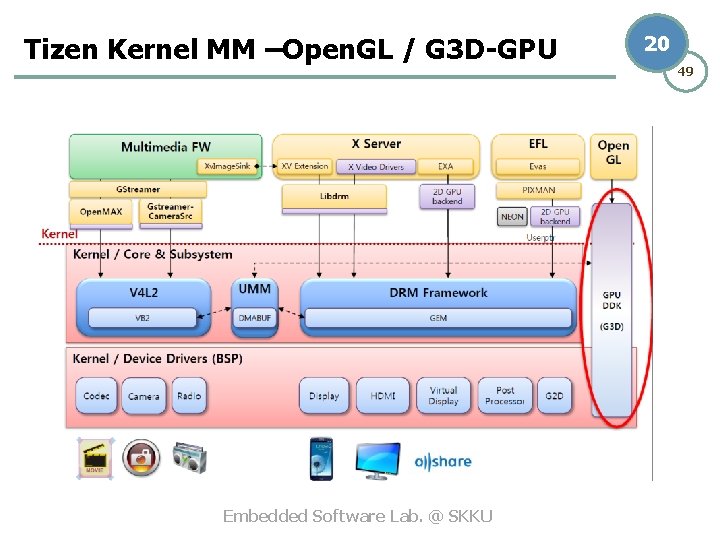
Tizen Kernel MM –Open. GL / G 3 D-GPU Embedded Software Lab. @ SKKU 20 49
Open. GL / G 3 D-GPU 21 • Most ARM So. C GPUs (MALI, SGX, …) use their own memory manager – E. g. , Exynos 4412/4210 Tizen Reference Kernel has Mali w/ UMM. • Mali DDK modified to be compatible with UMM-DMABUF. • If GPU drivers use DRM, it would be great. – (and make them GPL) Embedded Software Lab. @ SKKU 49
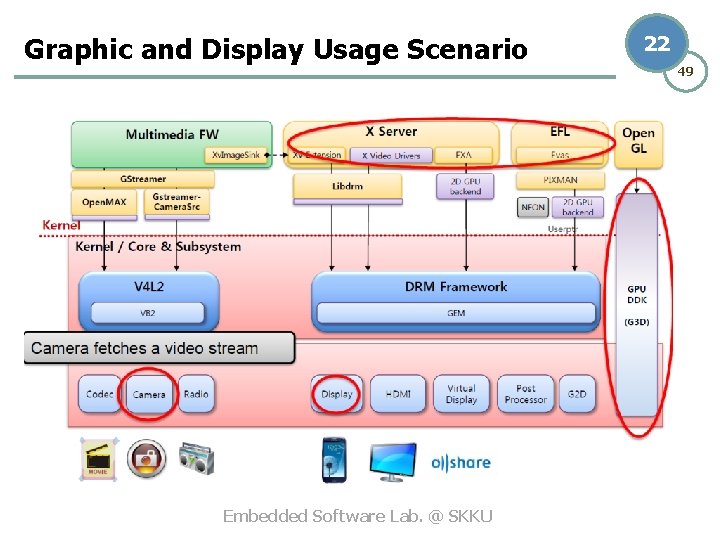
Graphic and Display Usage Scenario Embedded Software Lab. @ SKKU 22 49
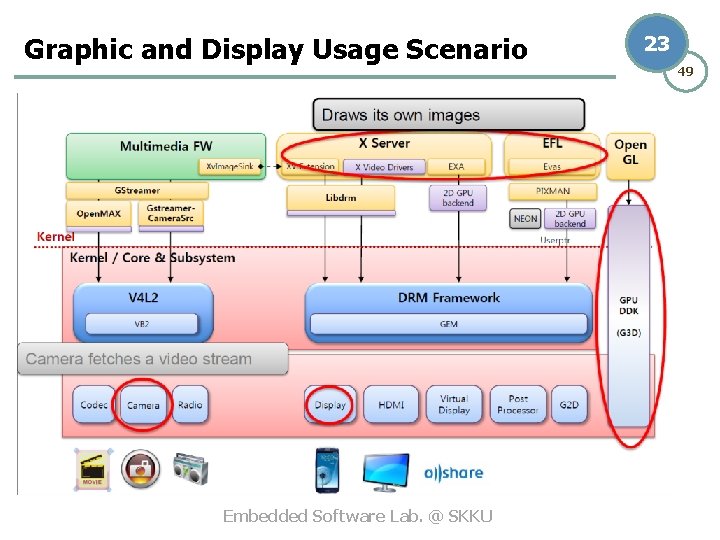
Graphic and Display Usage Scenario Embedded Software Lab. @ SKKU 23 49
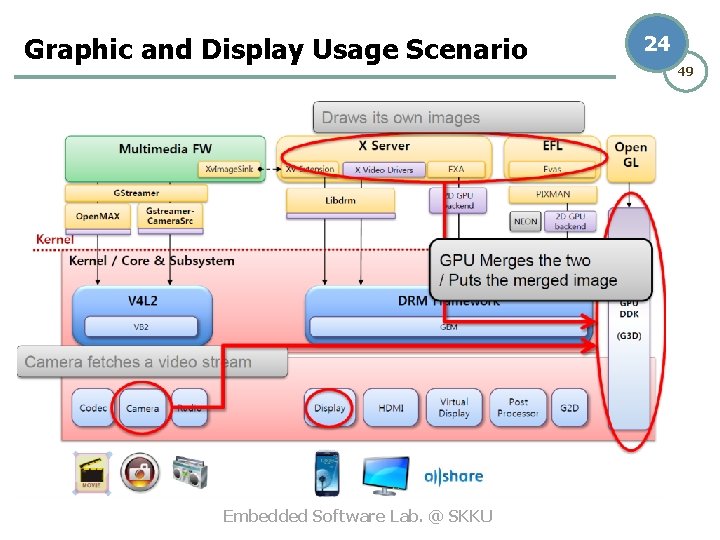
Graphic and Display Usage Scenario Embedded Software Lab. @ SKKU 24 49
Graphic and Display Usage Scenario Embedded Software Lab. @ SKKU 25 49
Graphic and Display Usage Scenario Embedded Software Lab. @ SKKU 26 49
Tizen kernel Buffer Sharing Embedded Software Lab. @ SKKU 27 49
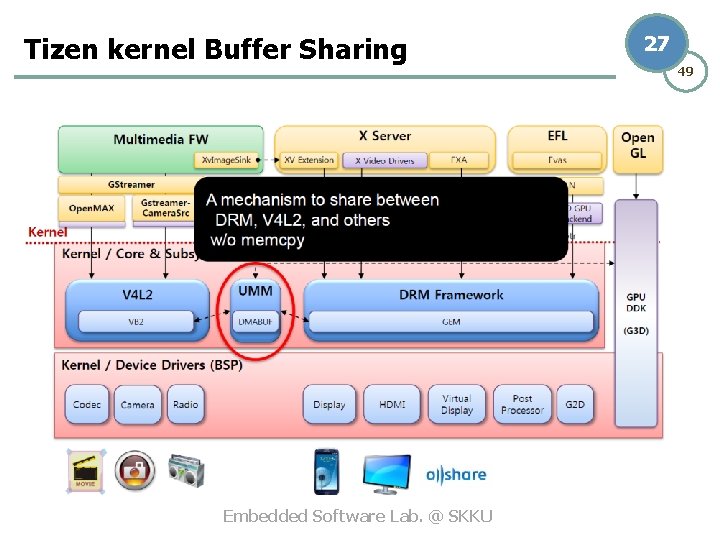
Tizen Kernel Buffer Sharing (cont) 28 • Requirement from Tizen platform and hardware – Different Memory Managers: GEM, VB 2, GPU-adhoc, … – Share buffers • w/o memcpy • From and to users • Never expose directly to users (e. g. , physical address) UMM DMABUF! Embedded Software Lab. @ SKKU 49
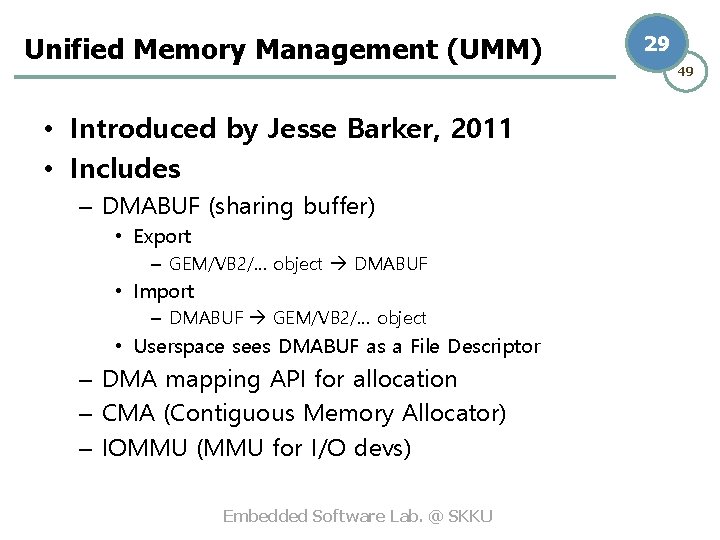
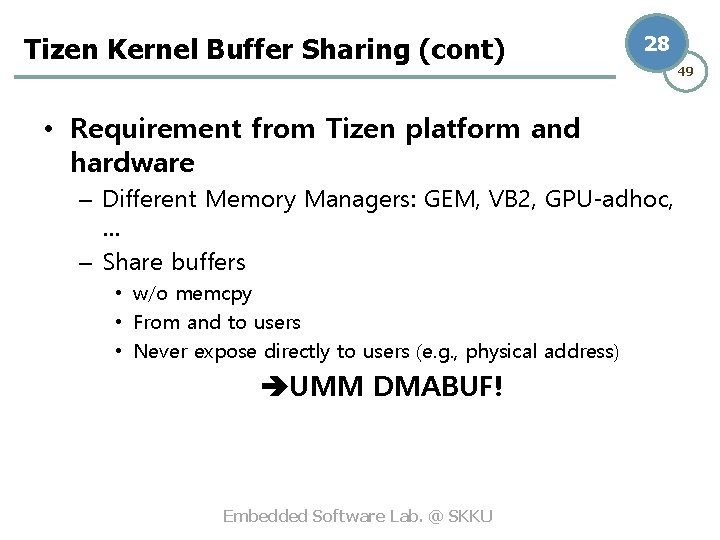
Unified Memory Management (UMM) • Introduced by Jesse Barker, 2011 • Includes – DMABUF (sharing buffer) • Export – GEM/VB 2/… object DMABUF • Import – DMABUF GEM/VB 2/… object • Userspace sees DMABUF as a File Descriptor – DMA mapping API for allocation – CMA (Contiguous Memory Allocator) – IOMMU (MMU for I/O devs) Embedded Software Lab. @ SKKU 29 49
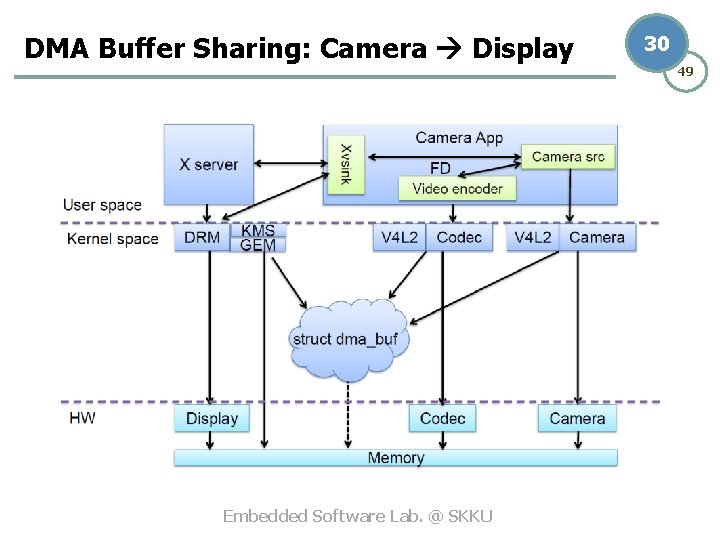
DMA Buffer Sharing: Camera Display 30 49 Embedded Software Lab. @ SKKU
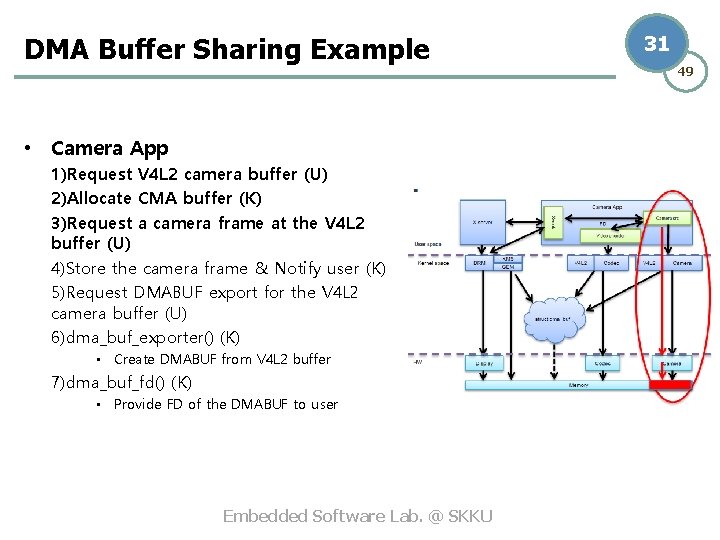
DMA Buffer Sharing Example • Camera App 1)Request V 4 L 2 camera buffer (U) 2)Allocate CMA buffer (K) 3)Request a camera frame at the V 4 L 2 buffer (U) 4)Store the camera frame & Notify user (K) 5)Request DMABUF export for the V 4 L 2 camera buffer (U) 6)dma_buf_exporter() (K) • Create DMABUF from V 4 L 2 buffer 7)dma_buf_fd() (K) • Provide FD of the DMABUF to user Embedded Software Lab. @ SKKU 31 49
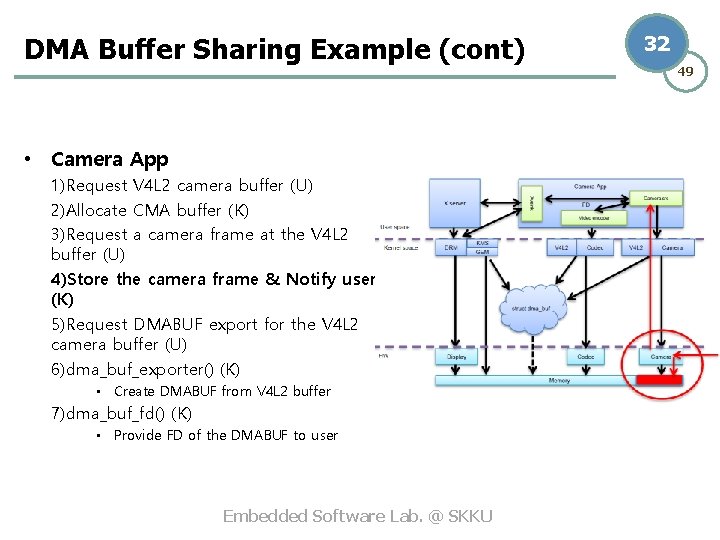
DMA Buffer Sharing Example (cont) • Camera App 1)Request V 4 L 2 camera buffer (U) 2)Allocate CMA buffer (K) 3)Request a camera frame at the V 4 L 2 buffer (U) 4)Store the camera frame & Notify user (K) 5)Request DMABUF export for the V 4 L 2 camera buffer (U) 6)dma_buf_exporter() (K) • Create DMABUF from V 4 L 2 buffer 7)dma_buf_fd() (K) • Provide FD of the DMABUF to user Embedded Software Lab. @ SKKU 32 49
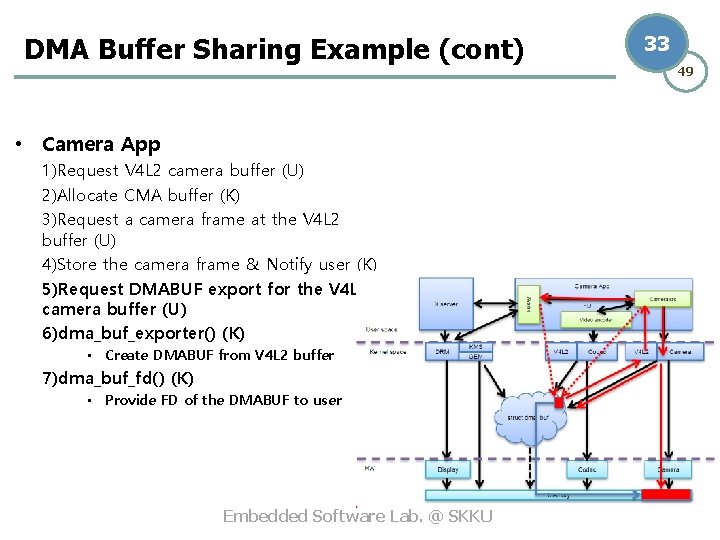
DMA Buffer Sharing Example (cont) • Camera App 1)Request V 4 L 2 camera buffer (U) 2)Allocate CMA buffer (K) 3)Request a camera frame at the V 4 L 2 buffer (U) 4)Store the camera frame & Notify user (K) 5)Request DMABUF export for the V 4 L 2 camera buffer (U) 6)dma_buf_exporter() (K) • Create DMABUF from V 4 L 2 buffer 7)dma_buf_fd() (K) • Provide FD of the DMABUF to user Embedded Software Lab. @ SKKU 33 49
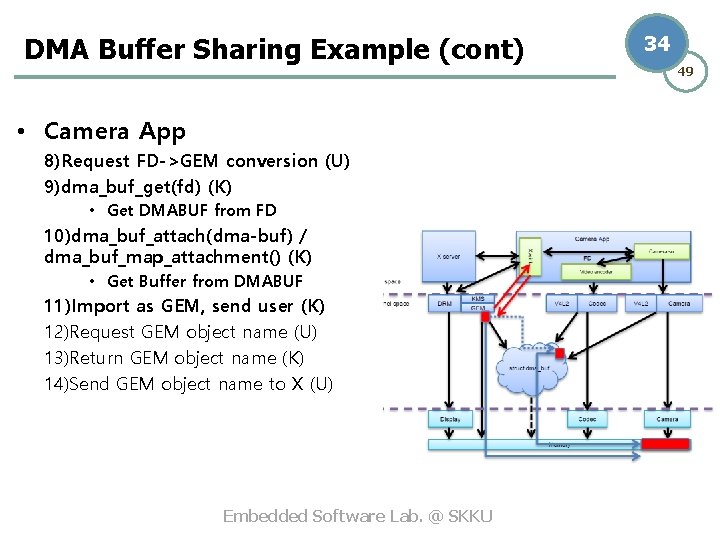
DMA Buffer Sharing Example (cont) • Camera App 8)Request FD->GEM conversion (U) 9)dma_buf_get(fd) (K) • Get DMABUF from FD 10)dma_buf_attach(dma-buf) / dma_buf_map_attachment() (K) • Get Buffer from DMABUF 11)Import as GEM, send user (K) 12)Request GEM object name (U) 13)Return GEM object name (K) 14)Send GEM object name to X (U) Embedded Software Lab. @ SKKU 34 49
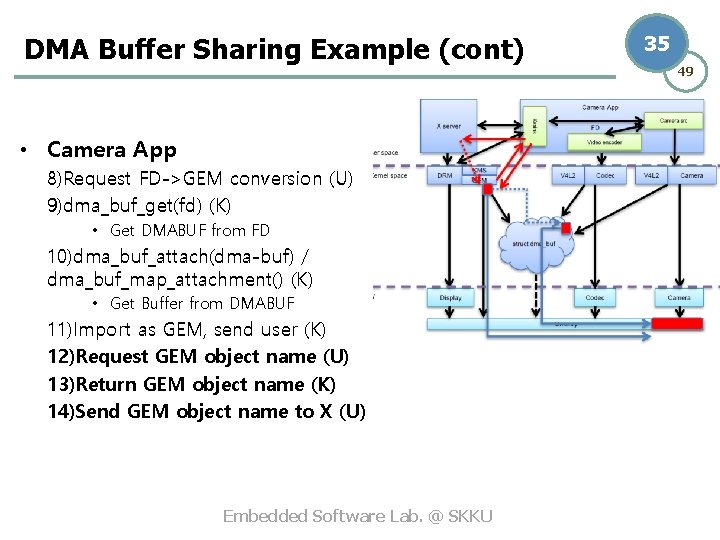
DMA Buffer Sharing Example (cont) • Camera App 8)Request FD->GEM conversion (U) 9)dma_buf_get(fd) (K) • Get DMABUF from FD 10)dma_buf_attach(dma-buf) / dma_buf_map_attachment() (K) • Get Buffer from DMABUF 11)Import as GEM, send user (K) 12)Request GEM object name (U) 13)Return GEM object name (K) 14)Send GEM object name to X (U) Embedded Software Lab. @ SKKU 35 49
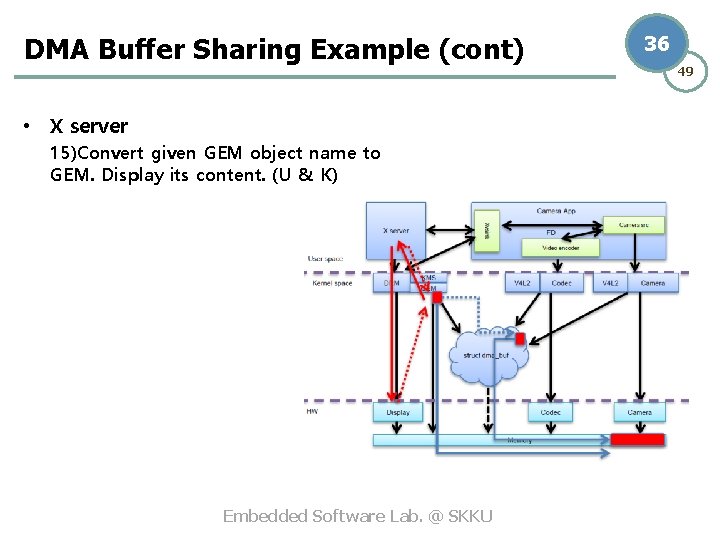
DMA Buffer Sharing Example (cont) • X server 15)Convert given GEM object name to GEM. Display its content. (U & K) Embedded Software Lab. @ SKKU 36 49
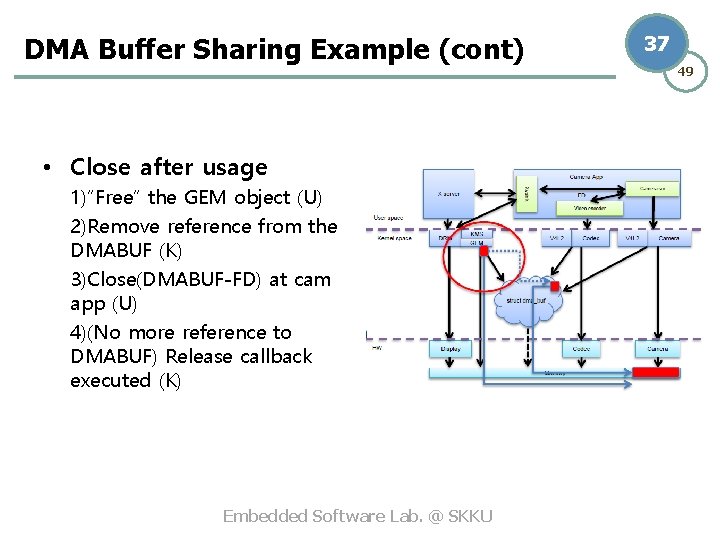
DMA Buffer Sharing Example (cont) • Close after usage 1)“Free” the GEM object (U) 2)Remove reference from the DMABUF (K) 3)Close(DMABUF-FD) at cam app (U) 4)(No more reference to DMABUF) Release callback executed (K) Embedded Software Lab. @ SKKU 37 49
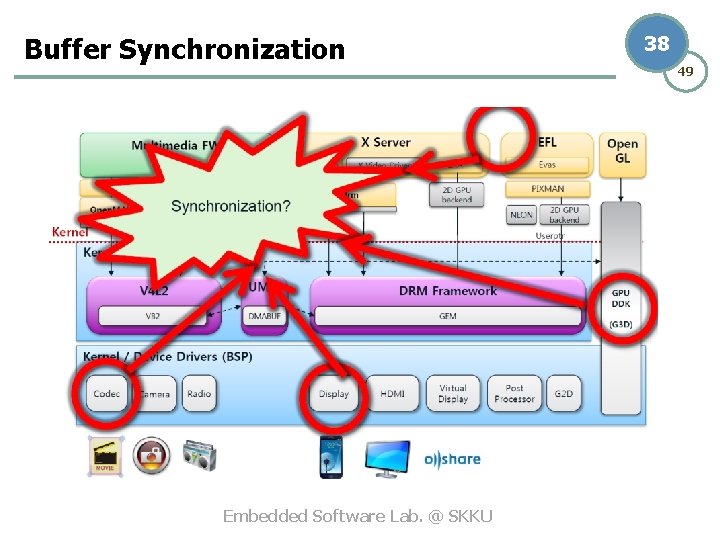
Buffer Synchronization Embedded Software Lab. @ SKKU 38 49
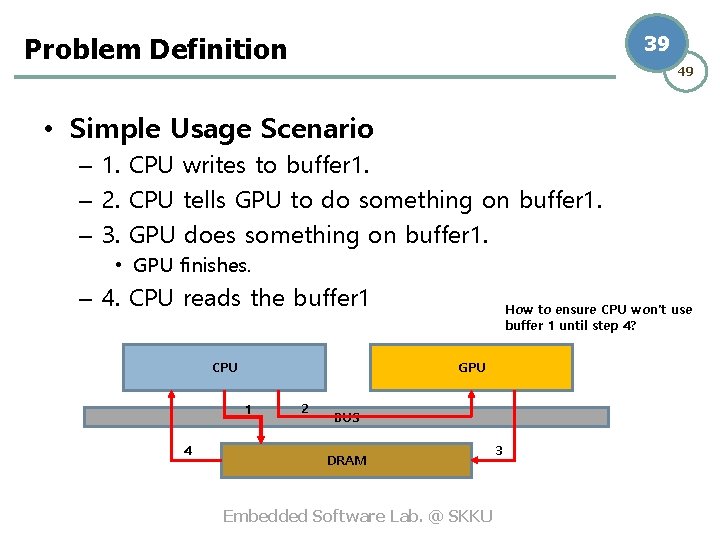
Problem Definition 39 49 • Simple Usage Scenario – 1. CPU writes to buffer 1. – 2. CPU tells GPU to do something on buffer 1. – 3. GPU does something on buffer 1. • GPU finishes. – 4. CPU reads the buffer 1 CPU GPU 1 4 How to ensure CPU won’t use buffer 1 until step 4? 2 BUS DRAM Embedded Software Lab. @ SKKU 3
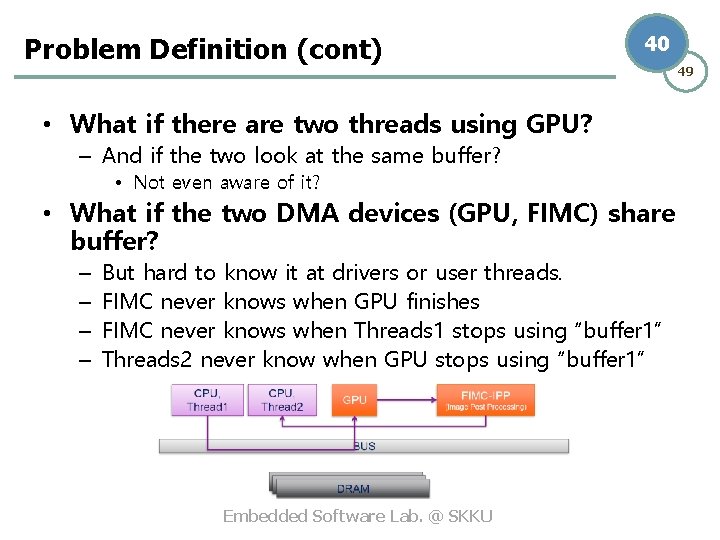
Problem Definition (cont) 40 • What if there are two threads using GPU? – And if the two look at the same buffer? • Not even aware of it? • What if the two DMA devices (GPU, FIMC) share buffer? – – But hard to know it at drivers or user threads. FIMC never knows when GPU finishes FIMC never knows when Threads 1 stops using “buffer 1” Threads 2 never know when GPU stops using “buffer 1” Embedded Software Lab. @ SKKU 49
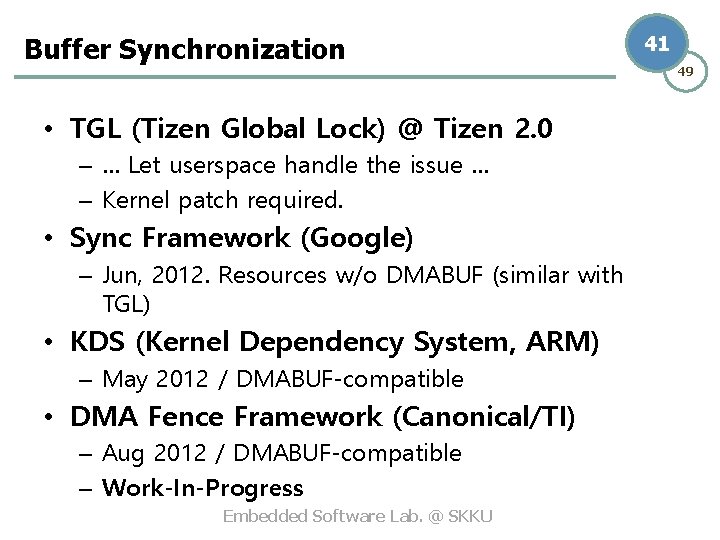
Buffer Synchronization • TGL (Tizen Global Lock) @ Tizen 2. 0 – … Let userspace handle the issue … – Kernel patch required. • Sync Framework (Google) – Jun, 2012. Resources w/o DMABUF (similar with TGL) • KDS (Kernel Dependency System, ARM) – May 2012 / DMABUF-compatible • DMA Fence Framework (Canonical/TI) – Aug 2012 / DMABUF-compatible – Work-In-Progress Embedded Software Lab. @ SKKU 41 49
42 49 K-dbus Embedded Software Lab. @ SKKU
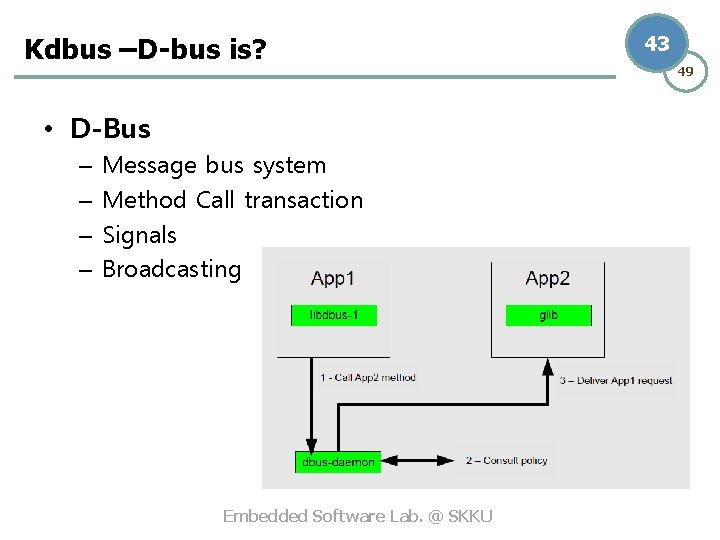
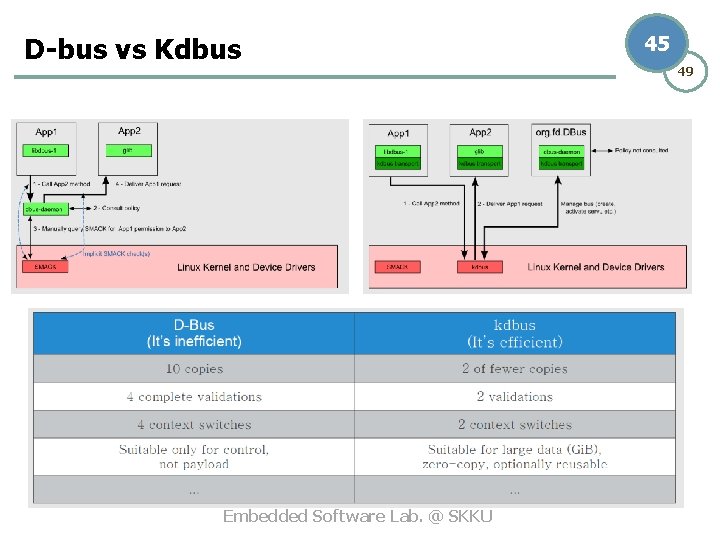
Kdbus –D-bus is? • D-Bus – – Message bus system Method Call transaction Signals Broadcasting Embedded Software Lab. @ SKKU 43 49
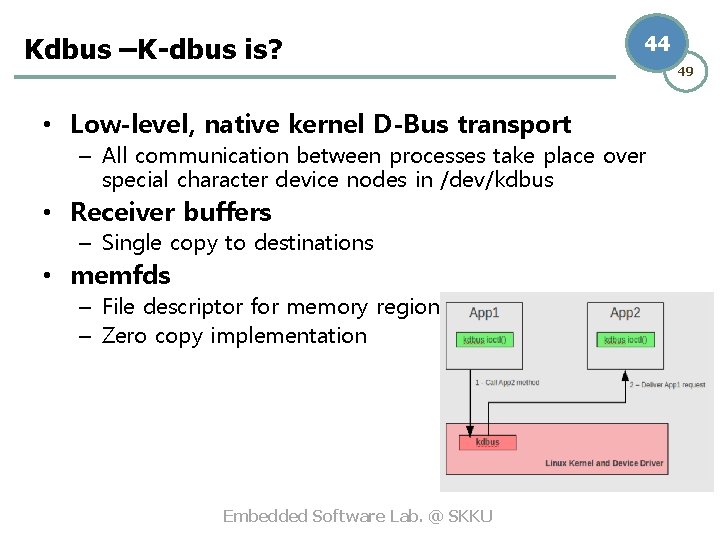
Kdbus –K-dbus is? • Low-level, native kernel D-Bus transport 44 – All communication between processes take place over special character device nodes in /dev/kdbus • Receiver buffers – Single copy to destinations • memfds – File descriptor for memory regions – Zero copy implementation Embedded Software Lab. @ SKKU 49
D-bus vs Kdbus Embedded Software Lab. @ SKKU 45 49
46 49 Others Embedded Software Lab. @ SKKU
EXTCON (External Connector) 47 • Yet Another Weird Ad-hoc Kernel Hacks Removed • Manage status of cable & ports – A port with multiple cables (docks, multi-cables, …) – A port with multiple modes (USB, HDMI, TA, …) • 3. 5 pi: stereo, stereo+mic+buttons, stereo+buttons, mono, … • Compatible with Switch – Android Switch drivers can be easily ported • Refer to Linux/Documentation (porting guide for switch driver) – Extcon drivers export both Switch and Extcon interfaces (compat mode) • In Reference Device – MUIC (USB+HDMI+TA+DOCK+…) – 3. 5 Pi Jack Embedded Software Lab. @ SKKU 49
Charger 48 49 • Charger Manager (/drivers/power/chargermanager. c) – All needed by Tizen user space are prepared – No OAL modification required • OR supply battery/charger interface with powersupply-class • Use EXTCON for Cable-Input (MUIC in mobile) – Switch class is no longer available in Linux. • Note: some SOC (state-of-charge) value is required for mobile profile. Unless, Tizen will assume that SOC is 0 Shutdown! Embedded Software Lab. @ SKKU
Power Management 49 • Recommendation For Tizen 3. 0 or later – Do not use DVFS (CPUfreq/Devfreq) min/max ABIs • PASS (Power-Aware System Service in Deviced) uses – Use (keep their standard ABIs for PASS) • CPUfreq& Devfreq(DVFS for non CPU devices if you have them) • Thermal FW – PASS gives hints to DVFS/Hotplug • based on the info from user space. • based on the other kernel ABIs (e. g. , Thermal) • highly configurable. (control knob of performance & power) Embedded Software Lab. @ SKKU 49
- Slides: 49