
1 4 The Basics of Democracy 1 4
![[ 1. 4 ] The Basics of Democracy](https://slidetodoc.com/presentation_image_h2/5e766addd8b4331d99eb1df036fd387f/image-1.jpg "[ 1. 4 ] The Basics of Democracy")
[ 1. 4 ] The Basics of Democracy
![[ 1. 4 ] The Basics of Democracy Learning Objectives • • Understand the](http://slidetodoc.com/presentation_image_h2/5e766addd8b4331d99eb1df036fd387f/image-2.jpg "[ 1. 4 ] The Basics of Democracy Learning Objectives • • Understand the")
[ 1. 4 ] The Basics of Democracy Learning Objectives • • Understand the foundations of democracy. Analyze the connections between democracy and the free enterprise system.
![[ 1. 4 ] The Basics of Democracy Key Terms • • • James](http://slidetodoc.com/presentation_image_h2/5e766addd8b4331d99eb1df036fd387f/image-3.jpg "[ 1. 4 ] The Basics of Democracy Key Terms • • • James")
[ 1. 4 ] The Basics of Democracy Key Terms • • • James Bryce Winston Churchill majority rule Compromise Oliver Wendell Holmes Theodore Roosevelt George Washington citizen free enterprise system
Foundations of Democracy What do you make of this assessment of democracy by British statesman James Bryce: “No government demands so much from the citizen as Democracy, and none gives so much back”? What does democratic government demand from you? What does it give you in return?
Foundations of Democracy • • • Worth of the Individual Equality of All Persons • Equality of opportunity • Equality before the law Majority Rule, Minority Rights • Majority will be right more often than it will be wrong and that the majority will also be right more often than any on person or small group • Majority rule must be restrained by minority rights Necessity of Compromise • Blend adjust competing views and interests Insistence upon Individual Freedom • “The right to swing my fist ends where the other man’s nose begins” ~Oliver Wendell Holmes
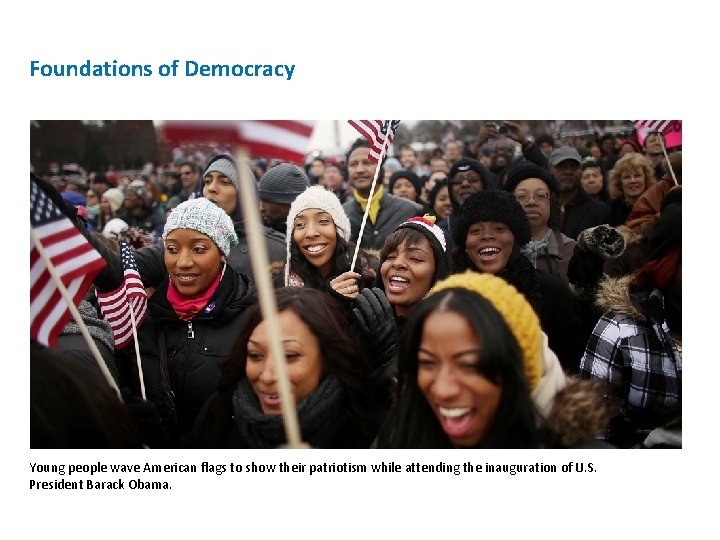
Foundations of Democracy Young people wave American flags to show their patriotism while attending the inauguration of U. S. President Barack Obama.
Responsibilities, Duties, and Obligations of Citizenship Over the centuries, any number of statesmen, philosophers, and others have told us that citizenship carries with it both duties and responsibilities. Theodore Roosevelt put that point this way in 1902: “The first requisite of a good citizen in our republic is that he should be able and willing to pull his weight. ”
Responsibilities, Duties, and Obligations of Citizenship • Being a 'Good Citizen‘ • respects and abides by the core beliefs on which democracy is based. • help serve the public good. • holds both rights and responsibilities which includes: • being informed and participating • VOTING (most basic duty) • obeying the law • paying taxes • respecting the rights of others • serving as a juror, and serving in the armed forces

Responsibilities, Duties, and Obligations of Citizenship The Texas Longhorns football team shows its patriotism during the national anthem. The national anthem expresses national pride and the duty of defending one's country during wartime.
Democracy and the Free Enterprise System The American commitment to freedom for the individual is deep-rooted, and it is as evident in the nation’s economic system as it is in the political system. The American economic system is often called the free enterprise system. It is an economic system characterized by the private ownership of capital goods; investments made by private decision, not by government directive; and success or failure determined by competition in the marketplace. The free enterprise system is based on four fundamental factors: private ownership, individual initiative, profit, and competition.
Democracy and the Free Enterprise System • • • How the System Works • Decisions made in the marketplace, not by the government • Supply and demand Government and the Free Enterprise System are both based on the concept of individual freedom and the two reinforce each other in practice. However, gov’t does play a role in the economy and serves to protect the public and preserve private industry • Anti-trust laws • Pure food and drug laws • Antipollution standards How much should government participate, regulate, promote, police, and serve? Abraham Lincoln advised • “The legitimate object of government is to do for a community of people, whatever they need to have done, but can not do, at all, or can not, so well do, for themselves—in their separate and individual capacities. ”
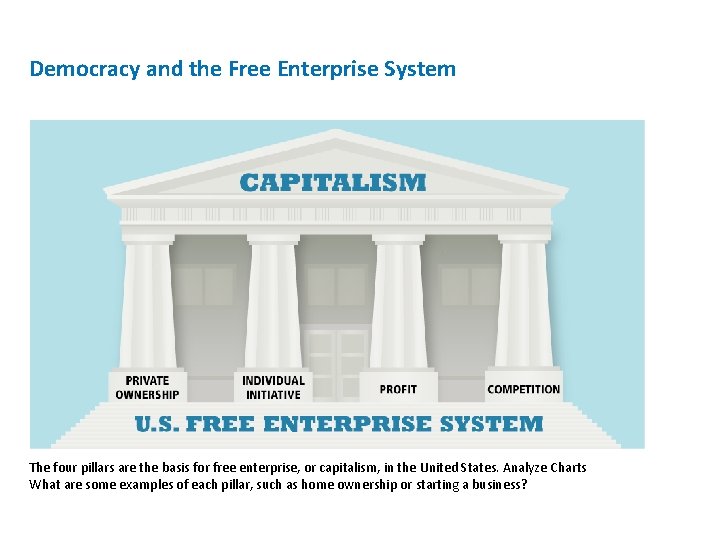
Democracy and the Free Enterprise System The four pillars are the basis for free enterprise, or capitalism, in the United States. Analyze Charts What are some examples of each pillar, such as home ownership or starting a business?
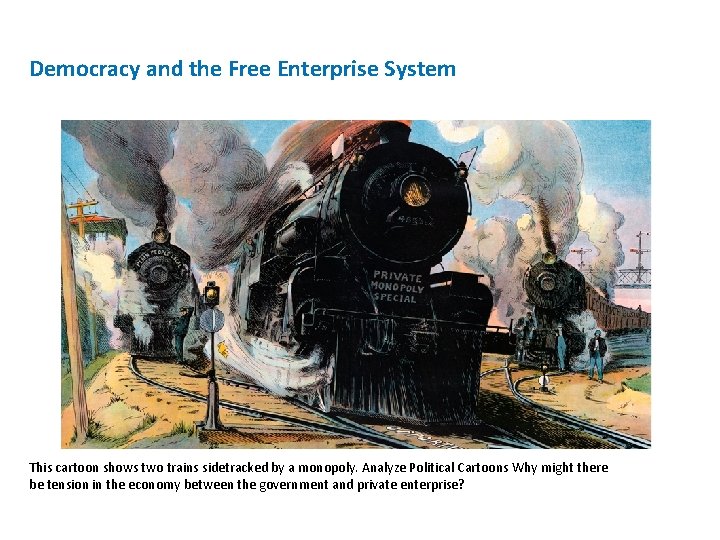
Democracy and the Free Enterprise System This cartoon shows two trains sidetracked by a monopoly. Analyze Political Cartoons Why might there be tension in the economy between the government and private enterprise?
Quiz: Foundations of Democracy Why is compromise important in a democracy? A. Compromise is needed to blend adjust competing views to find the position most acceptable to the majority. B. Compromise is needed to help ensure the equality of all persons. C. Compromise is needed to provide the largest possible degree of individual freedom. D. Compromise is needed to ensure that all citizens are satisfied with the current laws.
Quiz: Responsibilities, Duties, and Obligations of Citizenship Read the following quote from George Washington: 'The very idea of the power and right of the People to establish government presupposes the duty of every individual to obey the established Government. ' In Washington's opinion, which of the following would be required? A. B. C. D. paying taxes voting volunteering understanding government
Quiz: Democracy and the Free Enterprise System How might the government react to a downturn in the economy? A. The government might raise taxes to raise funds. B. The government might take steps to stimulate the economy. C. The government might revise antitrust laws to promote competition between businesses. D. The government might work to make certain supplies scarce to create an increase in prices.
- Slides: 16