
1 4 Staff Responsibilities and Ethics STEP 1
1. 4 | Staff Responsibilities and Ethics
STEP 1 - LEARN • Today we will discuss both ethics and laws. • View the video Critique and Feedback - the Story of Austin's Butterfly. • Discuss how the lesson in the video applies to our teamwork. • View the remainder of this presentation and take notes
BEING ETHICAL AND LEGAL • A legal action is one that follows rules that have been written down, like not stealing. • An ethical action is one that is right but has nothing to do with laws, like communicating honestly and fairly with people.
TEAMWORK • Each member of a team serves a vital role. • We all need to communicate clearly and kindly with one another. • Consistency, in attitude and behavior, is important. • Inspiration can come from any member of the group. • Openness to new ideas stimulates creativity.
Student journalists have three primary ethical and legal obligations.
1 - FAIRNESS • All reporting must be fair and unbiased. The yearbook should not be used as a platform for personal views. Both sides of a story should be told.
2 - ACCURACY • All names, quotes and information, including anything submitted by non-staffers, should be checked carefully.
3 – GOOD TASTE • Thoughtful decisions and high standards will ensure that the yearbook is free of questionable material such as: • racist or sexist remarks • ethnic slurs • crude humor • inside jokes or cruel remarks • glamorizing of illegal activities
LIBEL • A type of speech not protected under the U. S. Constitution. • Libel is printed and is: • Is false • Words or pictures • Identifies the person • Harms a person’s reputation
AT FAULT FOR LIBEL A journalist can be considered “at fault” for libel if: A private citizen (like a student) • Can prove that writer did not verify accuracy of information. A public figure (like a celebrity) • Can prove that the writer knew the information was false. • Or prove that the writer acted in a reckless disregard for the truth.
AT FAULT FOR LIBEL • Both the writer and the editor, even if they are under 18 and minors, are considered responsible and can be sued in a libel case.
Truth is a defense against a charge of libel.
“I was making a joke” is not a defense.
COPYRIGHT, TRADEMARK AND FAIR USE
COPYRIGHT • Intellectual property, art and book covers cannot be used by others. • Most images found on the internet are copyrighted. • Yearbook staffs must get permission from the owner.
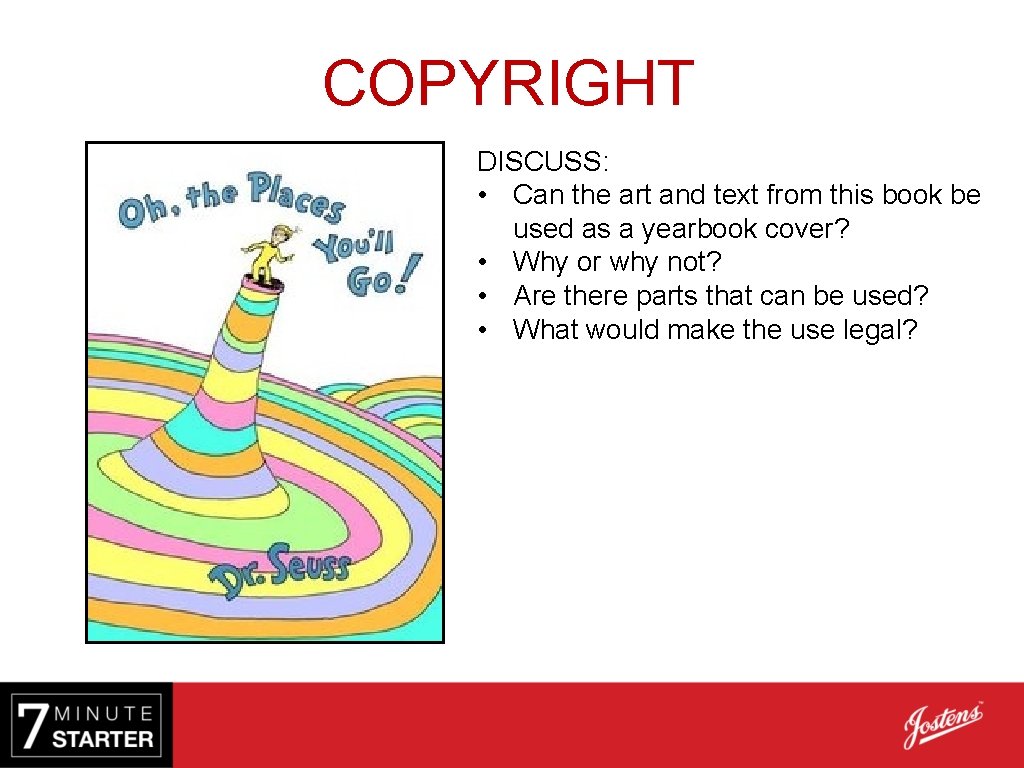
COPYRIGHT DISCUSS: • Can the art and text from this book be used as a yearbook cover? • Why or why not? • Are there parts that can be used? • What would make the use legal?
COPYRIGHT LAW PROTECTS • Song lyrics • Currency • Literary works • Cartoon characters • Artwork • Movie characters • Photographs • TV characters • Music • Websites • Videos • Website screen shots • Maps • Computer software • Stamps • Corporate logos • Games
FAIR USE • A person may use someone else’s photo, music, artwork or text as long as it is being used for educational purposes. • The use of the work must not diminish it in any way • The heart of the work may not be used • Creator must not lose money as a result of use • Fair use does not cover the use of that work in student newspapers or yearbooks. • The work can only be used within school walls, like for a report or presentation.
TRADEMARK • Titles, phrases and slogans can be trademark protected. • This means they cannot be used for commercial purposes by anyone else.
STEP 2 – PRACTICE • Work individually or in groups to determine how you would handle the situations on Handout 1. 4 – You be the Judge.
STEP 3 – USE • Throughout this term, we will be both ethical and legal in all actions regarding this publication.
- Slides: 21