
1 4 Sets Definition 1 A set is
- Slides: 26
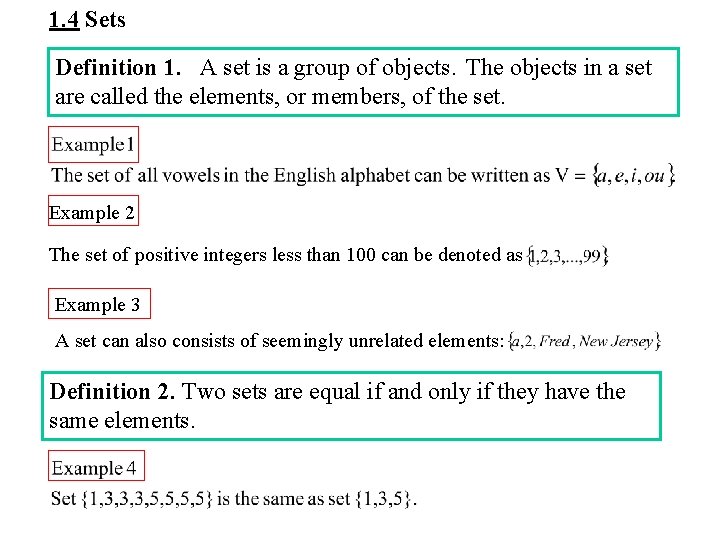
1. 4 Sets Definition 1. A set is a group of objects.The objects in a set are called the elements, or members, of the set. Example 2 The set of positive integers less than 100 can be denoted as Example 3 A set can also consists of seemingly unrelated elements: Definition 2. Two sets are equal if and only if they have the same elements.
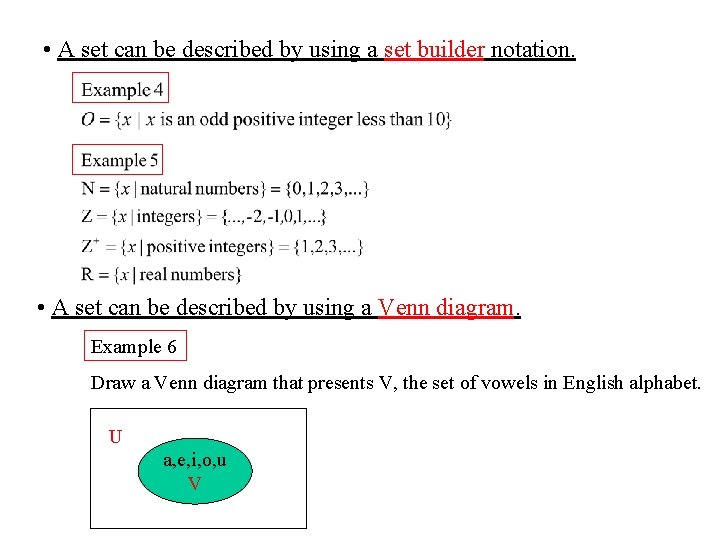
• A set can be described by using a set builder notation. • A set can be described by using a Venn diagram. Example 6 Draw a Venn diagram that presents V, the set of vowels in English alphabet. U a, e, i, o, u V
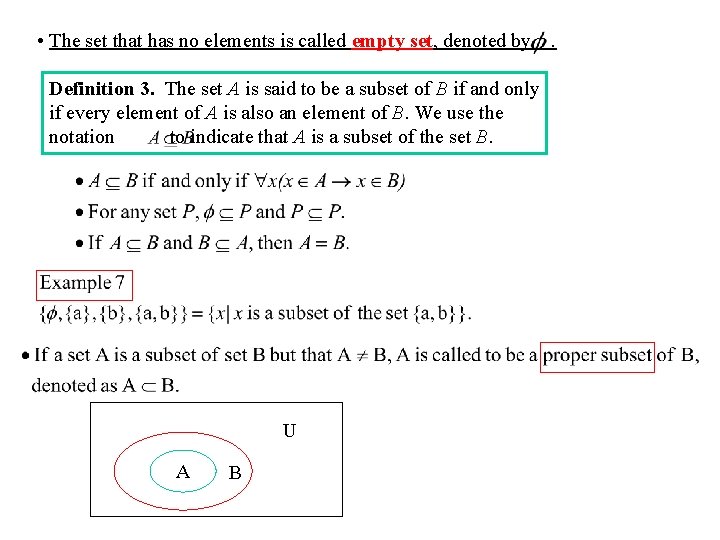
• The set that has no elements is called empty set, denoted by. Definition 3. The set A is said to be a subset of B if and only if every element of A is also an element of B. We use the notation to indicate that A is a subset of the set B. U A B
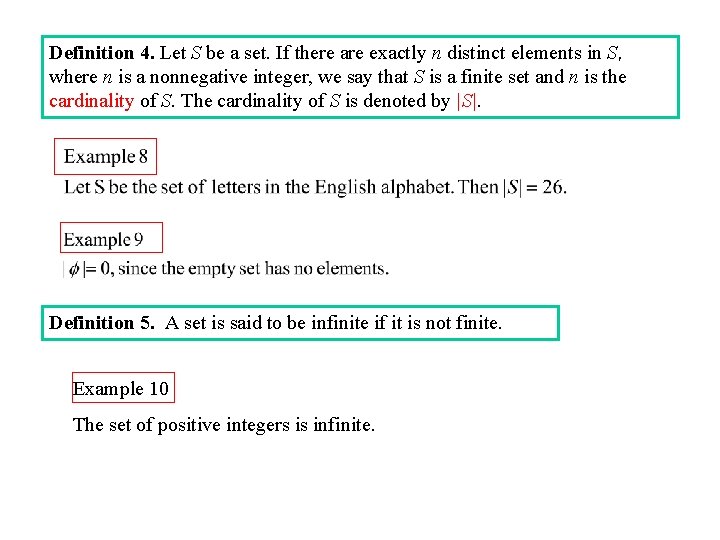
Definition 4. Let S be a set. If there are exactly n distinct elements in S, where n is a nonnegative integer, we say that S is a finite set and n is the cardinality of S. The cardinality of S is denoted by |S|. Definition 5. A set is said to be infinite if it is not finite. Example 10 The set of positive integers is infinite.
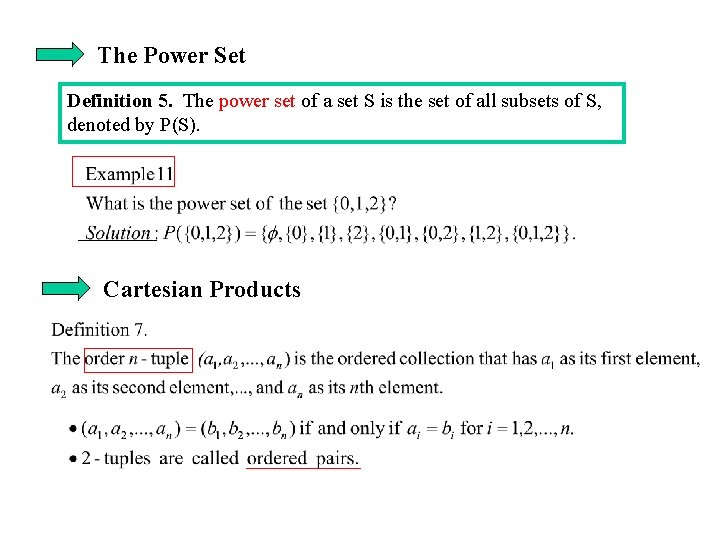
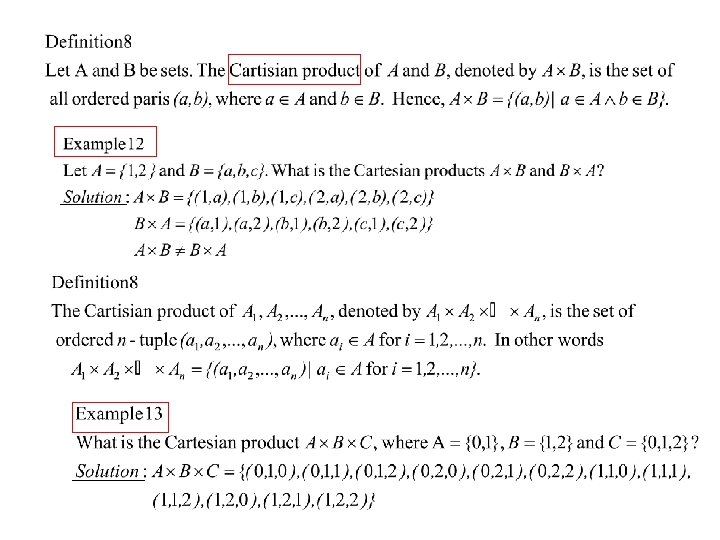
The Power Set Definition 5. The power set of a set S is the set of all subsets of S, denoted by P(S). Cartesian Products
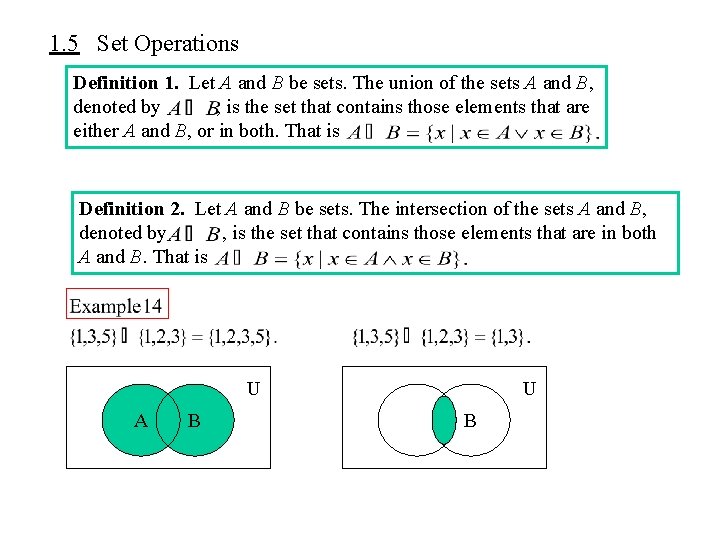
1. 5 Set Operations Definition 1. Let A and B be sets. The union of the sets A and B, denoted by , is the set that contains those elements that are either A and B, or in both. That is Definition 2. Let A and B be sets. The intersection of the sets A and B, denoted by , is the set that contains those elements that are in both A and B. That is U A B U B
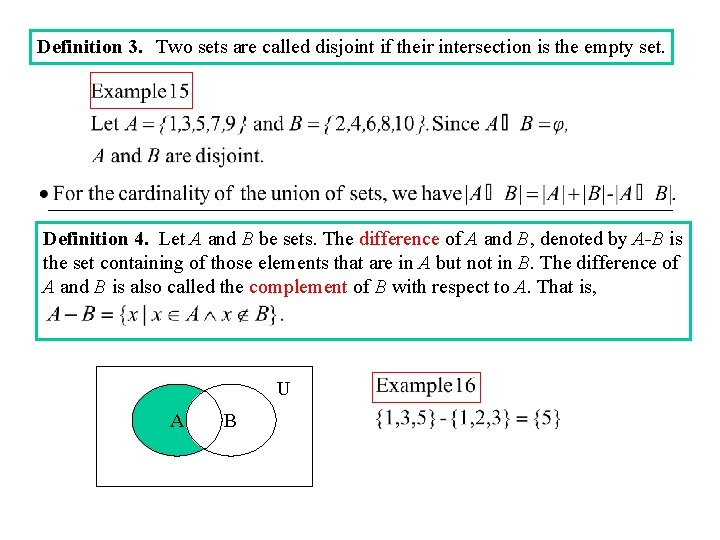
Definition 3. Two sets are called disjoint if their intersection is the empty set. Definition 4. Let A and B be sets. The difference of A and B, denoted by A-B is the set containing of those elements that are in A but not in B. The difference of A and B is also called the complement of B with respect to A. That is, U A B
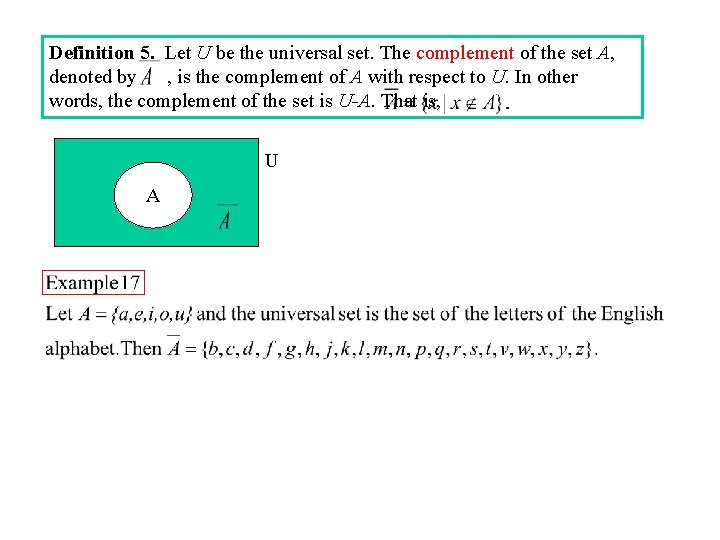
Definition 5. Let U be the universal set. The complement of the set A, denoted by , is the complement of A with respect to U. In other words, the complement of the set is U-A. That is, U A
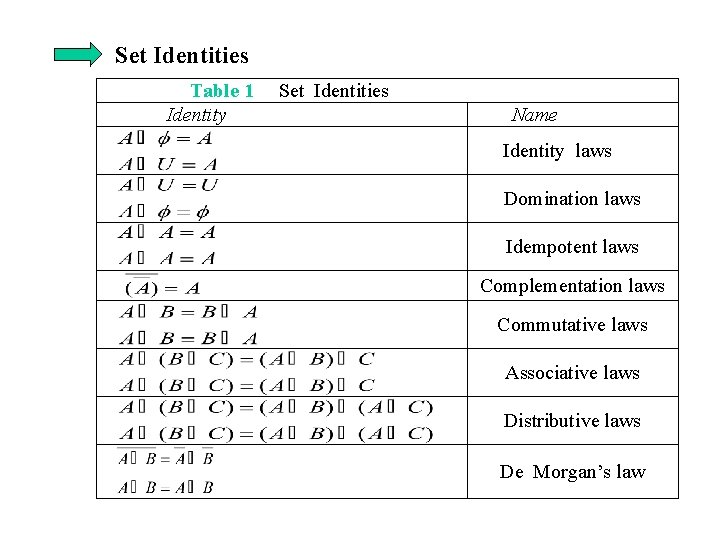
Set Identities Table 1 Identity Set Identities Name Identity laws Domination laws Idempotent laws Complementation laws Commutative laws Associative laws Distributive laws De Morgan’s law
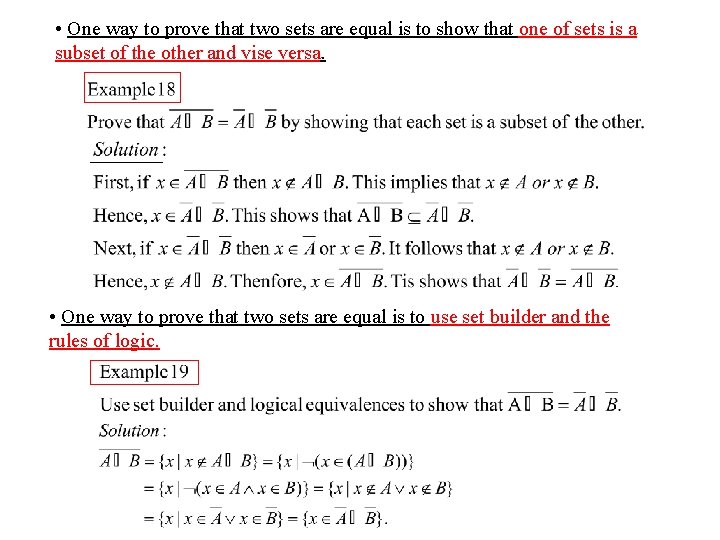
• One way to prove that two sets are equal is to show that one of sets is a subset of the other and vise versa. • One way to prove that two sets are equal is to use set builder and the rules of logic.
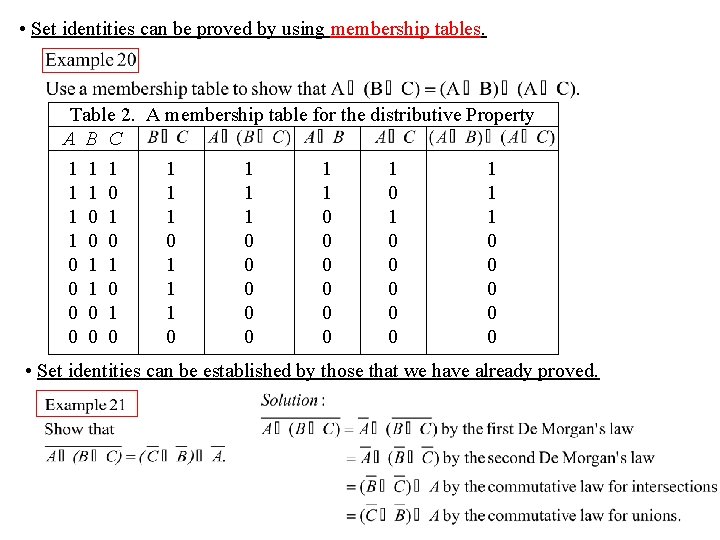
• Set identities can be proved by using membership tables. Table 2. A membership table for the distributive Property A B C 1 1 1 1 1 0 1 1 1 0 0 0 0 1 1 1 0 0 0 1 1 0 0 0 • Set identities can be established by those that we have already proved.
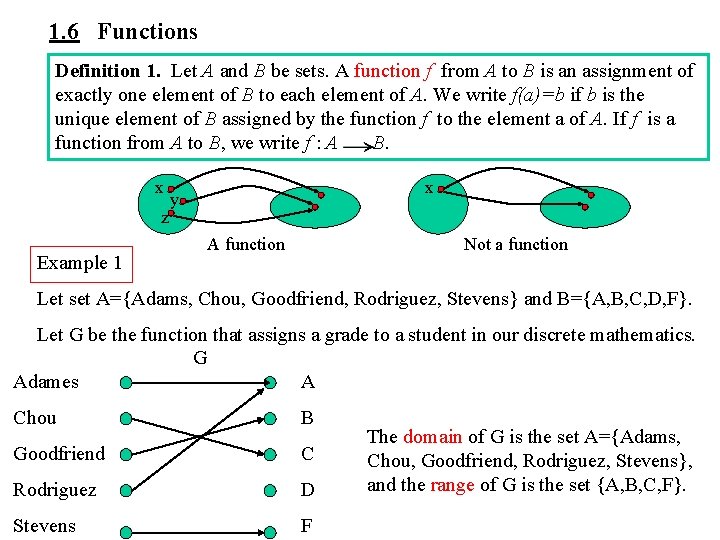
1. 6 Functions Definition 1. Let A and B be sets. A function f from A to B is an assignment of exactly one element of B to each element of A. We write f(a)=b if b is the unique element of B assigned by the function f to the element a of A. If f is a function from A to B, we write f : A B. x z Example 1 x y A function Not a function Let set A={Adams, Chou, Goodfriend, Rodriguez, Stevens} and B={A, B, C, D, F}. Let G be the function that assigns a grade to a student in our discrete mathematics. G Adames A Chou B Goodfriend C Rodriguez D Stevens F The domain of G is the set A={Adams, Chou, Goodfriend, Rodriguez, Stevens}, and the range of G is the set {A, B, C, F}.
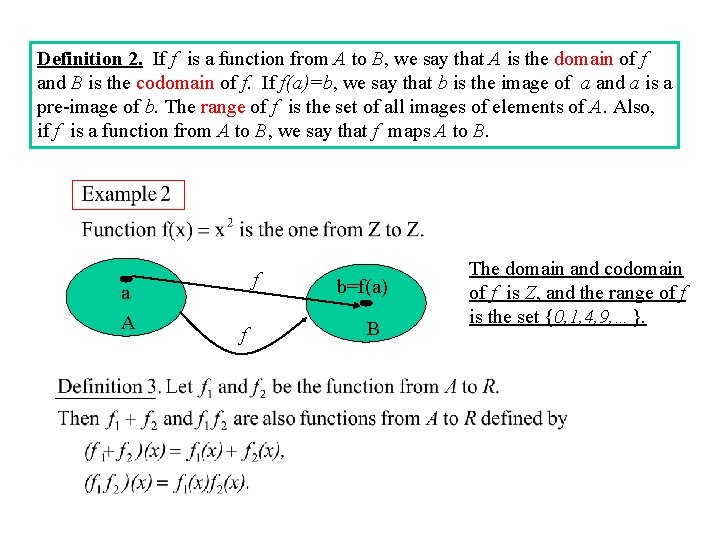
Definition 2. If f is a function from A to B, we say that A is the domain of f and B is the codomain of f. If f(a)=b, we say that b is the image of a and a is a pre-image of b. The range of f is the set of all images of elements of A. Also, if f is a function from A to B, we say that f maps A to B. a A f f b=f(a) B The domain and codomain of f is Z, and the range of f is the set {0, 1, 4, 9, …}.
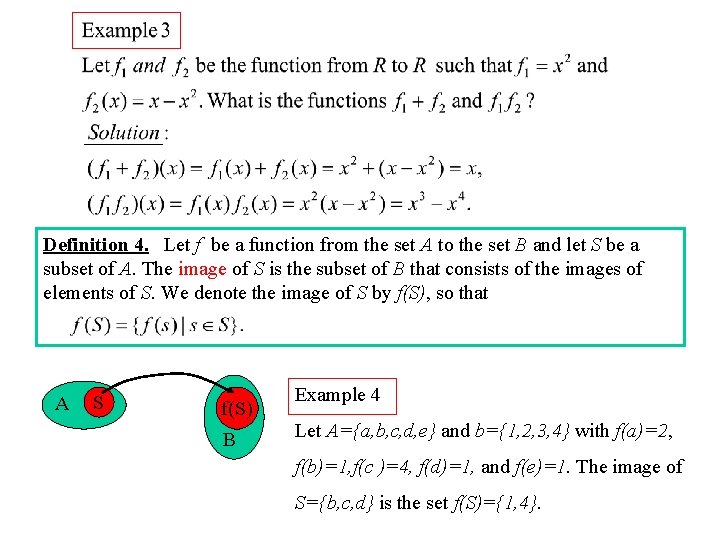
Definition 4. Let f be a function from the set A to the set B and let S be a subset of A. The image of S is the subset of B that consists of the images of elements of S. We denote the image of S by f(S), so that A S f(S) B Example 4 Let A={a, b, c, d, e} and b={1, 2, 3, 4} with f(a)=2, f(b)=1, f(c )=4, f(d)=1, and f(e)=1. The image of S={b, c, d} is the set f(S)={1, 4}.
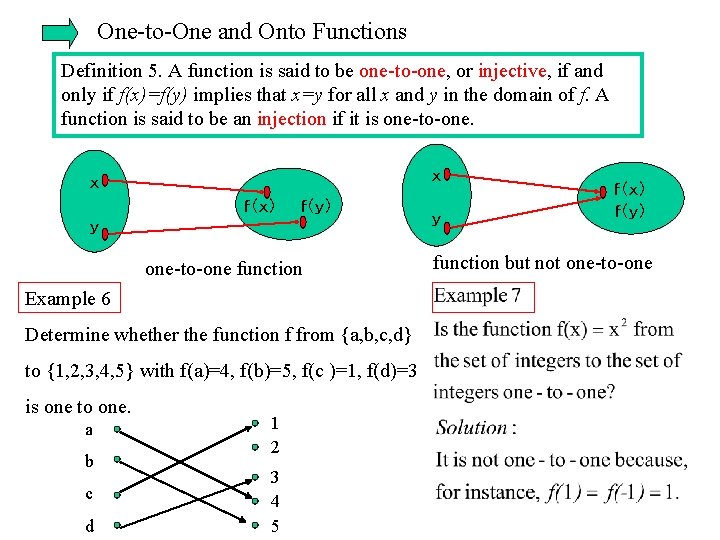
One-to-One and Onto Functions Definition 5. A function is said to be one-to-one, or injective, if and only if f(x)=f(y) implies that x=y for all x and y in the domain of f. A function is said to be an injection if it is one-to-one. x x f(x) f(y) y one-to-one function Example 6 Determine whether the function f from {a, b, c, d} to {1, 2, 3, 4, 5} with f(a)=4, f(b)=5, f(c )=1, f(d)=3 is one to one. a b c d 1 2 3 4 5 y f(x) f(y) function but not one-to-one
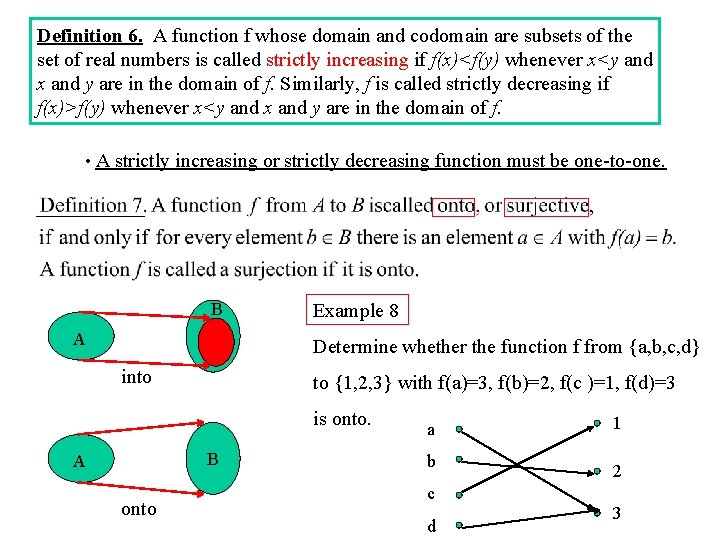
Definition 6. A function f whose domain and codomain are subsets of the set of real numbers is called strictly increasing if f(x)<f(y) whenever x<y and x and y are in the domain of f. Similarly, f is called strictly decreasing if f(x)>f(y) whenever x<y and x and y are in the domain of f. • A strictly increasing or strictly decreasing function must be one-to-one. B A Example 8 Determine whether the function f from {a, b, c, d} into to {1, 2, 3} with f(a)=3, f(b)=2, f(c )=1, f(d)=3 is onto. B A onto a b c d 1 2 3
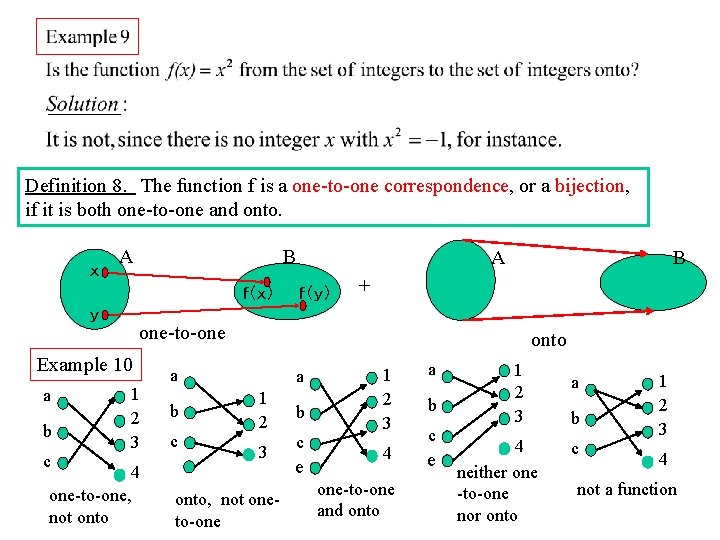
Definition 8. The function f is a one-to-one correspondence, or a bijection, if it is both one-to-one and onto. x A B f(x) y b c f(y) B + one-to-one Example 10 a A 1 2 3 4 one-to-one, not onto a b c a 1 2 3 onto, not oneto-one b c e 1 2 3 4 one-to-one and onto a b c e 1 2 3 4 neither one -to-one nor onto a b c 1 2 3 4 not a function
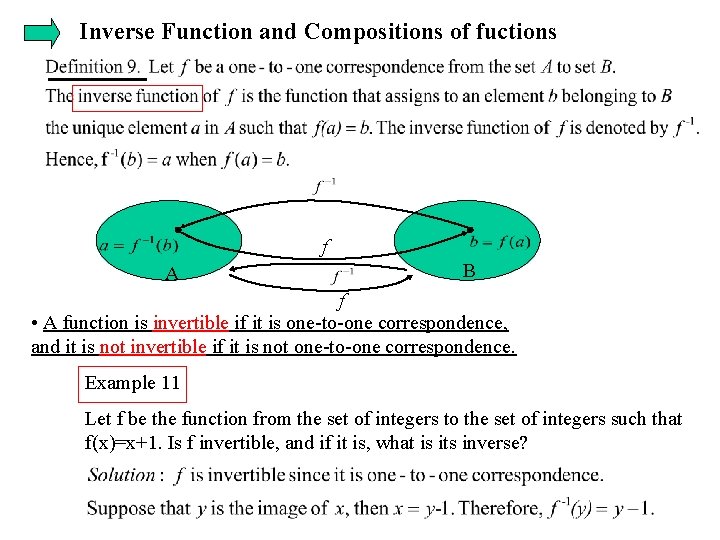
Inverse Function and Compositions of fuctions f A B f • A function is invertible if it is one-to-one correspondence, and it is not invertible if it is not one-to-one correspondence. Example 11 Let f be the function from the set of integers to the set of integers such that f(x)=x+1. Is f invertible, and if it is, what is its inverse?
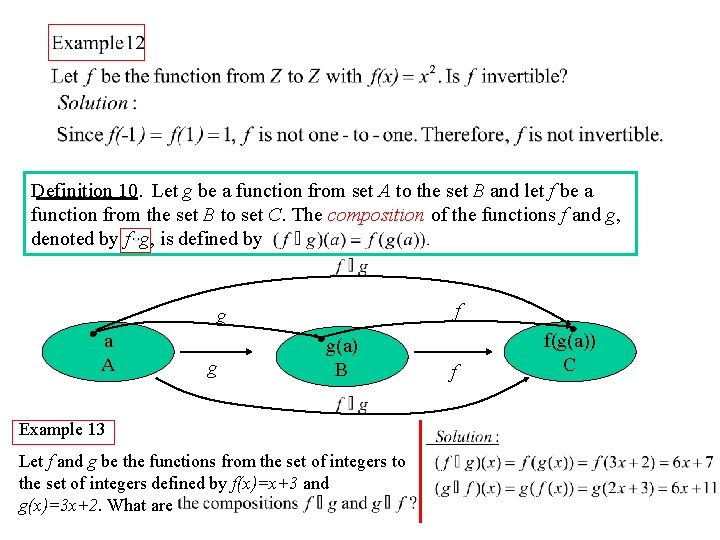
Definition 10.Let g be a function from set A to the set B and let f be a function from the set B to set C. The composition of the functions f and g, denoted by f g, is defined by f g a A g g(a) B Example 13 Let f and g be the functions from the set of integers to the set of integers defined by f(x)=x+3 and g(x)=3 x+2. What are f f(g(a)) C
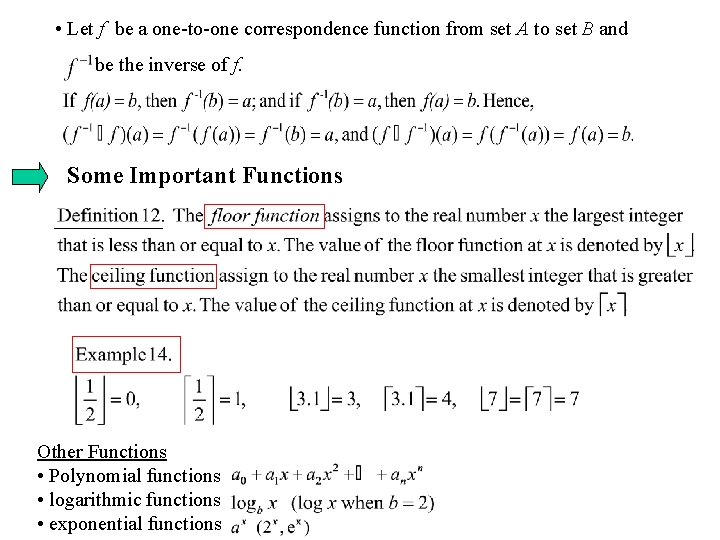
• Let f be a one-to-one correspondence function from set A to set B and be the inverse of f. Some Important Functions Other Functions • Polynomial functions • logarithmic functions • exponential functions
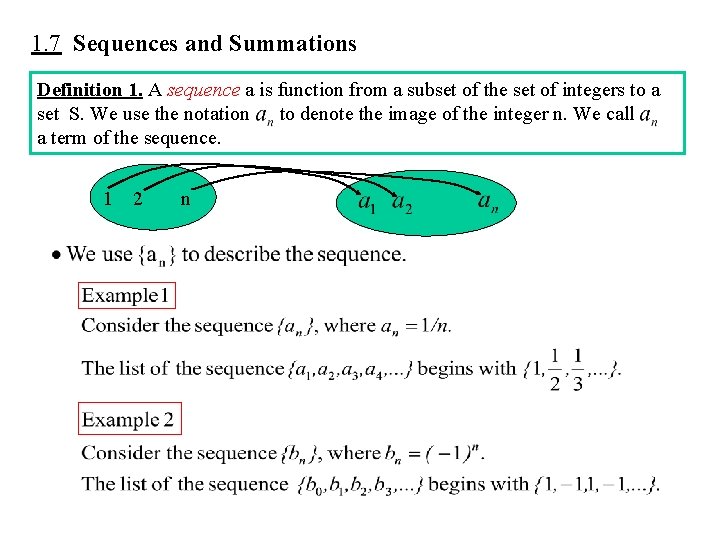
1. 7 Sequences and Summations Definition 1. A sequence a is function from a subset of the set of integers to a set S. We use the notation to denote the image of the integer n. We call a term of the sequence. 1 2 n
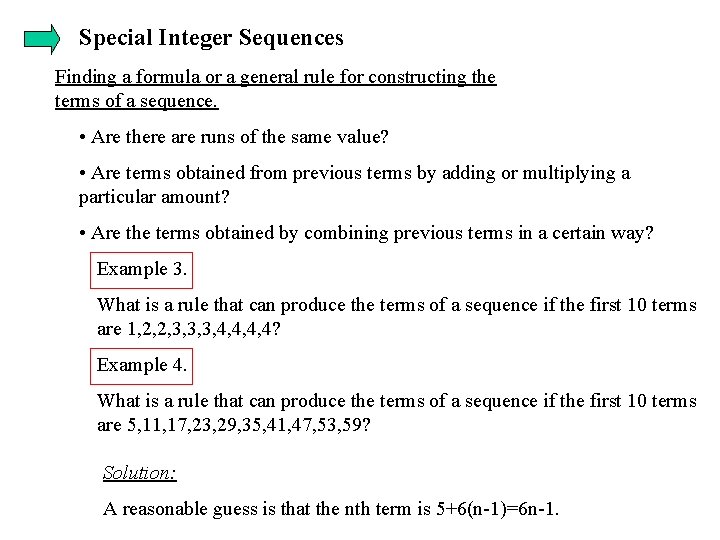
Special Integer Sequences Finding a formula or a general rule for constructing the terms of a sequence. • Are there are runs of the same value? • Are terms obtained from previous terms by adding or multiplying a particular amount? • Are the terms obtained by combining previous terms in a certain way? Example 3. What is a rule that can produce the terms of a sequence if the first 10 terms are 1, 2, 2, 3, 3, 3, 4, 4? Example 4. What is a rule that can produce the terms of a sequence if the first 10 terms are 5, 11, 17, 23, 29, 35, 41, 47, 53, 59? Solution: A reasonable guess is that the nth term is 5+6(n-1)=6 n-1.
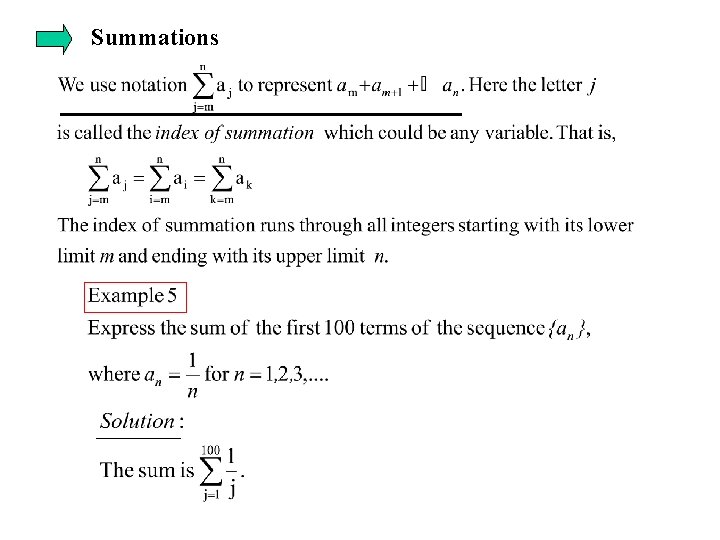
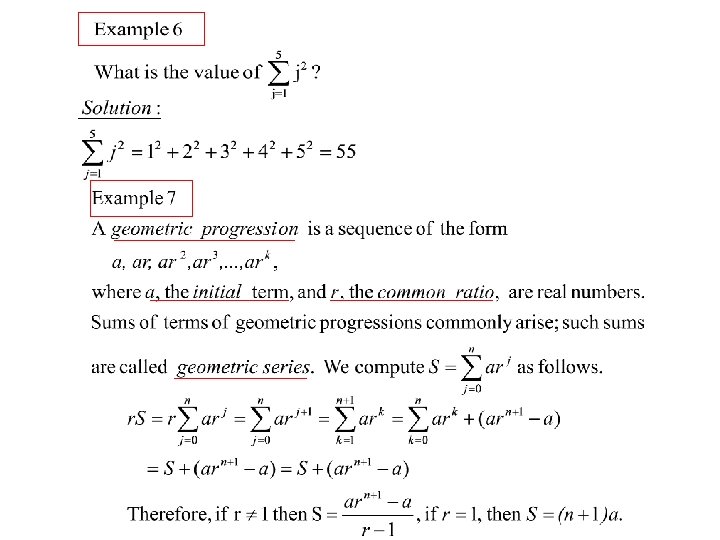
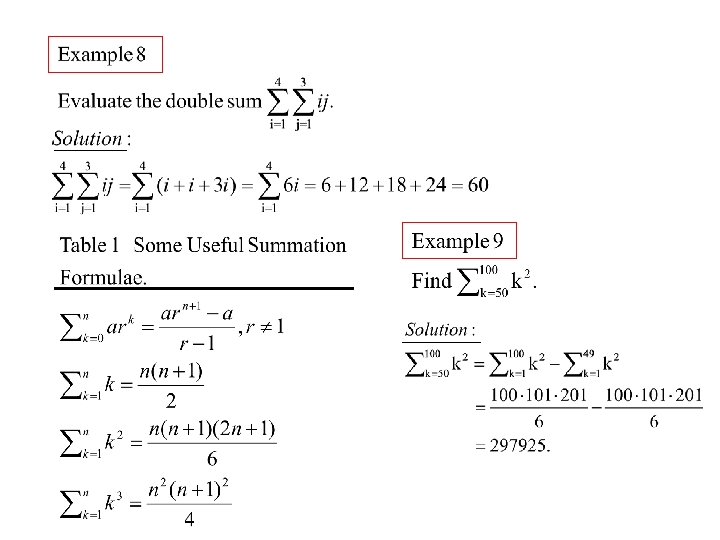
Summations