
1 4 Principles of the Australian parliamentary system
- Slides: 6
1. 4 – Principles of the Australian parliamentary system 1
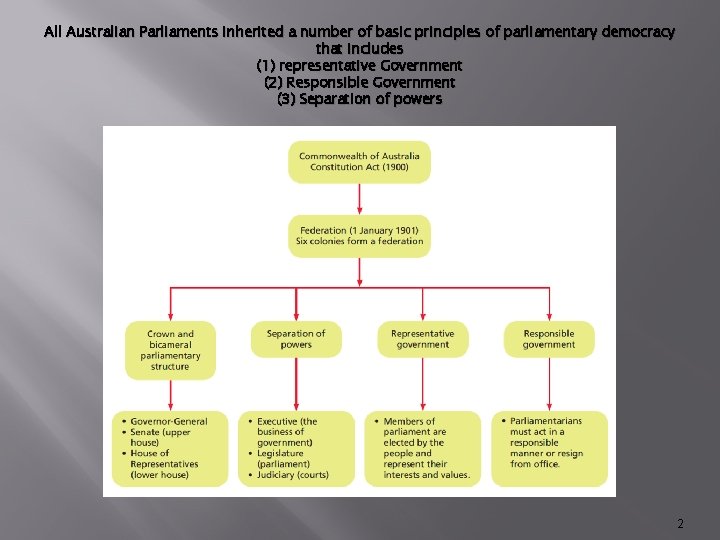
All Australian Parliaments inherited a number of basic principles of parliamentary democracy that includes (1) representative Government (2) Responsible Government (3) Separation of powers 2
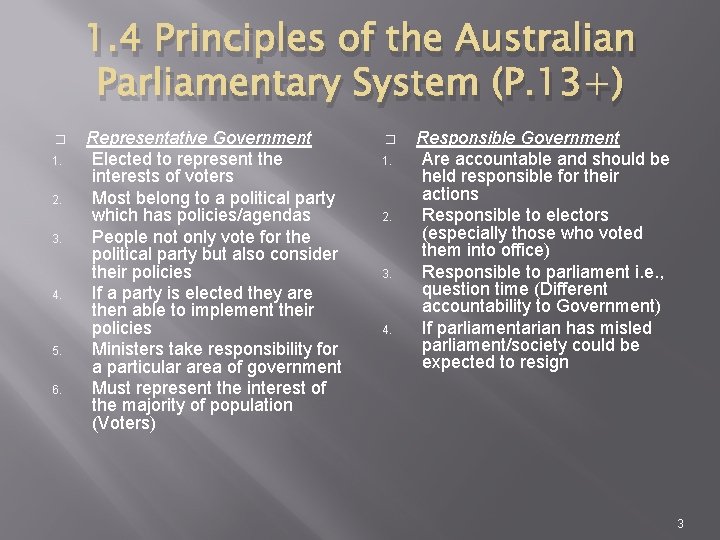
1. 4 Principles of the Australian Parliamentary System (P. 13+) � 1. 2. 3. 4. 5. 6. Representative Government Elected to represent the interests of voters Most belong to a political party which has policies/agendas People not only vote for the political party but also consider their policies If a party is elected they are then able to implement their policies Ministers take responsibility for a particular area of government Must represent the interest of the majority of population (Voters) � 1. 2. 3. 4. Responsible Government Are accountable and should be held responsible for their actions Responsible to electors (especially those who voted them into office) Responsible to parliament i. e. , question time (Different accountability to Government) If parliamentarian has misled parliament/society could be expected to resign 3
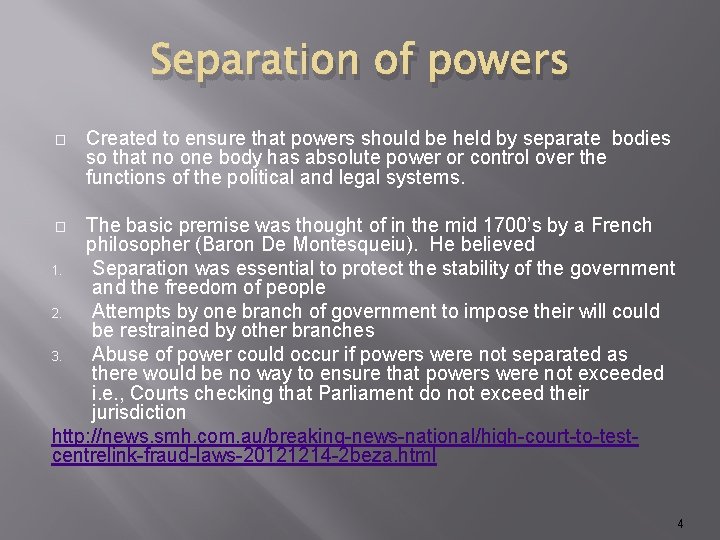
Separation of powers � Created to ensure that powers should be held by separate bodies so that no one body has absolute power or control over the functions of the political and legal systems. The basic premise was thought of in the mid 1700’s by a French philosopher (Baron De Montesqueiu). He believed 1. Separation was essential to protect the stability of the government and the freedom of people 2. Attempts by one branch of government to impose their will could be restrained by other branches 3. Abuse of power could occur if powers were not separated as there would be no way to ensure that powers were not exceeded i. e. , Courts checking that Parliament do not exceed their jurisdiction http: //news. smh. com. au/breaking-news-national/high-court-to-testcentrelink-fraud-laws-20121214 -2 beza. html � 4
Separation of powers � 1. 2. 3. The constitution makes provision for separation of powers. These are; Executive Power – The power to administer the laws and manage the business of government. In practice this is carried out by the Prime Minister and Senior Ministers Legislative Power – The power to make laws, which resides with the parliament Judicial Power – The power given to courts and tribunals to enforce the law and settle disputes. Independent and separate from the legislative and executive powers. 5
Your turn � Complete questions 1 – 7 (Page 16) 6