
1 4 Economic Theories Role of Economic Systems
- Slides: 10
1. 4 – Economic Theories
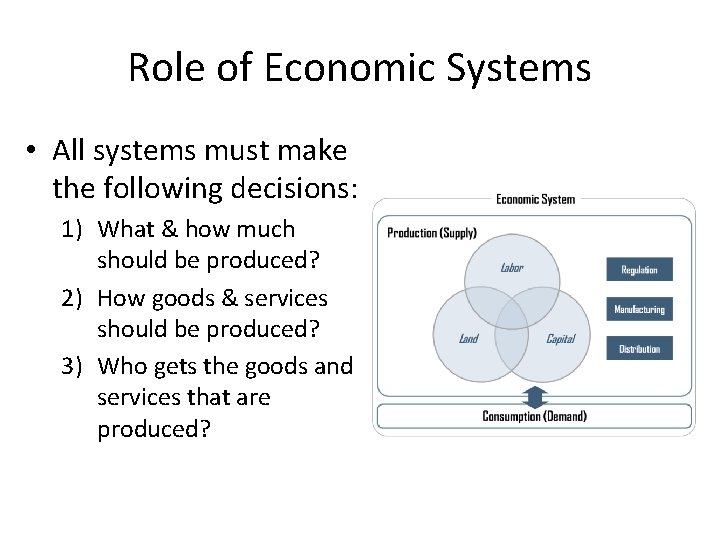
Role of Economic Systems • All systems must make the following decisions: 1) What & how much should be produced? 2) How goods & services should be produced? 3) Who gets the goods and services that are produced?
• Capitalism = system that emphasizes freedom of choice & offers incentives • 5 Main characteristics: 1) Private ownership & control of property/resources 2) Free enterprise 3) Competition among businesses 4) Freedom of choice 5) Possibility of Profits Capitalism
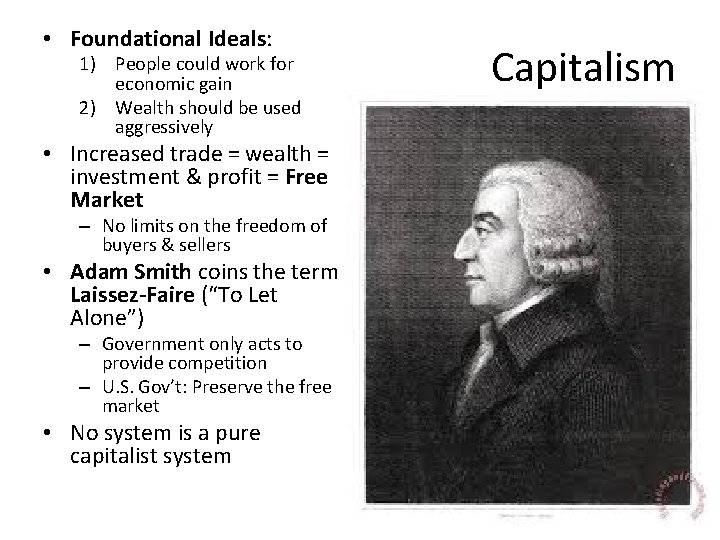
• Foundational Ideals: 1) People could work for economic gain 2) Wealth should be used aggressively • Increased trade = wealth = investment & profit = Free Market – No limits on the freedom of buyers & sellers • Adam Smith coins the term Laissez-Faire (“To Let Alone”) – Government only acts to provide competition – U. S. Gov’t: Preserve the free market • No system is a pure capitalist system Capitalism
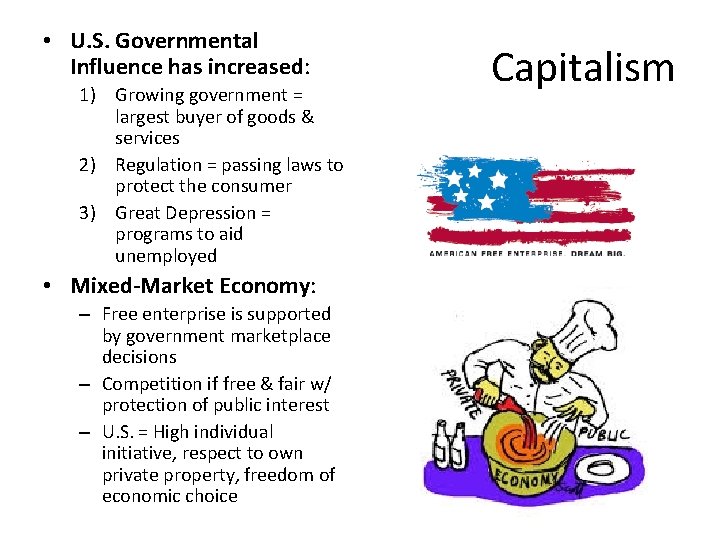
• U. S. Governmental Influence has increased: 1) Growing government = largest buyer of goods & services 2) Regulation = passing laws to protect the consumer 3) Great Depression = programs to aid unemployed • Mixed-Market Economy: – Free enterprise is supported by government marketplace decisions – Competition if free & fair w/ protection of public interest – U. S. = High individual initiative, respect to own private property, freedom of economic choice Capitalism
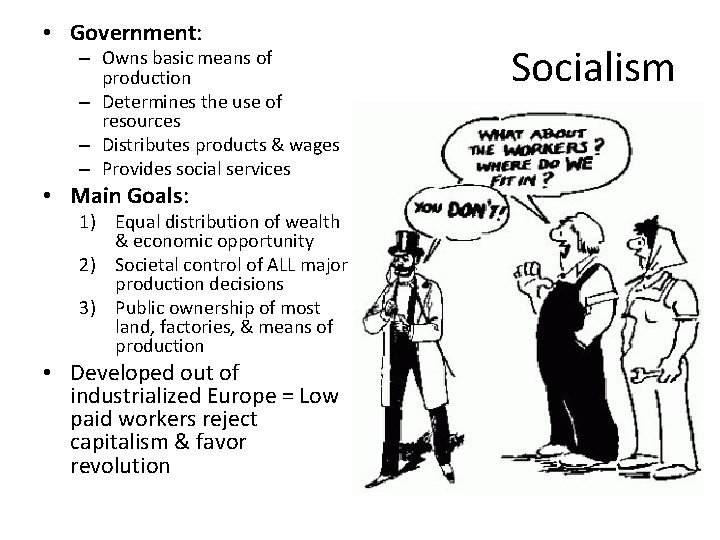
• Government: – Owns basic means of production – Determines the use of resources – Distributes products & wages – Provides social services • Main Goals: 1) Equal distribution of wealth & economic opportunity 2) Societal control of ALL major production decisions 3) Public ownership of most land, factories, & means of production • Developed out of industrialized Europe = Low paid workers reject capitalism & favor revolution Socialism
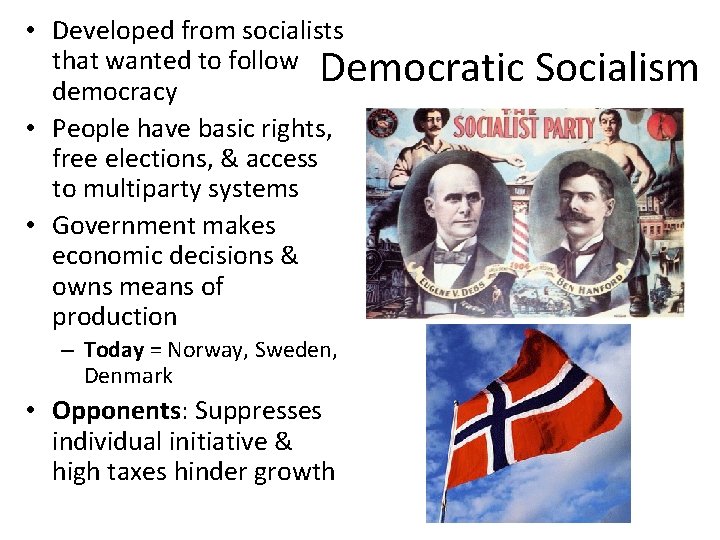
• Developed from socialists that wanted to follow Democratic democracy • People have basic rights, free elections, & access to multiparty systems • Government makes economic decisions & owns means of production – Today = Norway, Sweden, Denmark • Opponents: Suppresses individual initiative & high taxes hinder growth Socialism
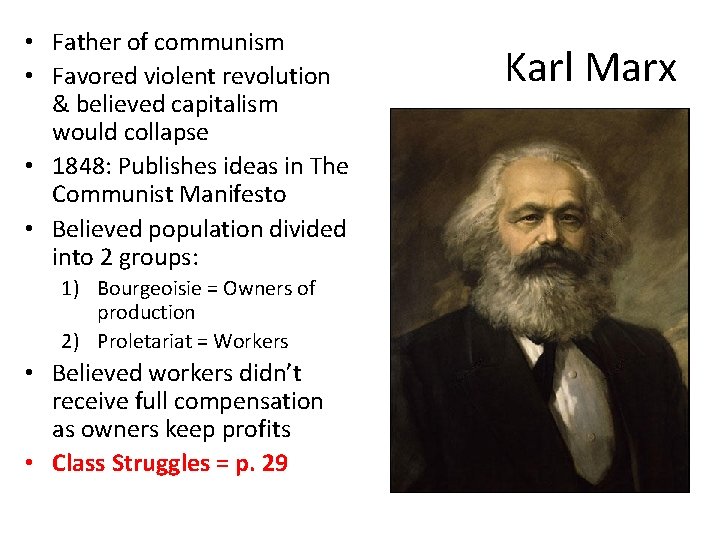
• Father of communism • Favored violent revolution & believed capitalism would collapse • 1848: Publishes ideas in The Communist Manifesto • Believed population divided into 2 groups: 1) Bourgeoisie = Owners of production 2) Proletariat = Workers • Believed workers didn’t receive full compensation as owners keep profits • Class Struggles = p. 29 Karl Marx
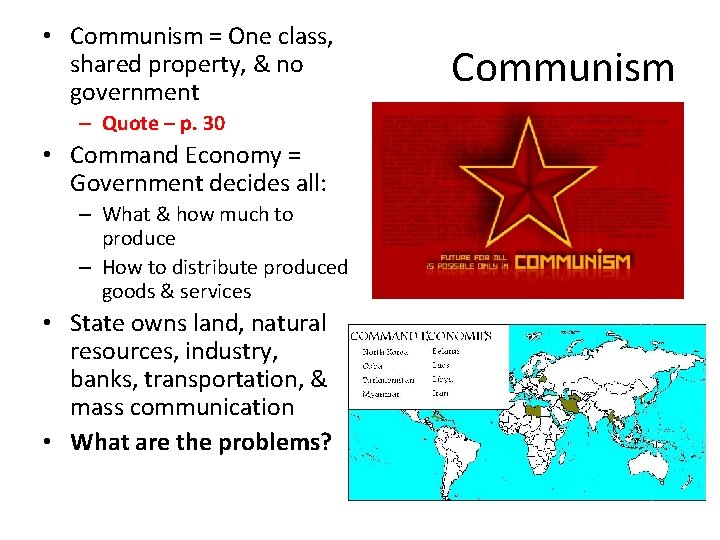
• Communism = One class, shared property, & no government – Quote – p. 30 • Command Economy = Government decides all: – What & how much to produce – How to distribute produced goods & services • State owns land, natural resources, industry, banks, transportation, & mass communication • What are the problems? Communism
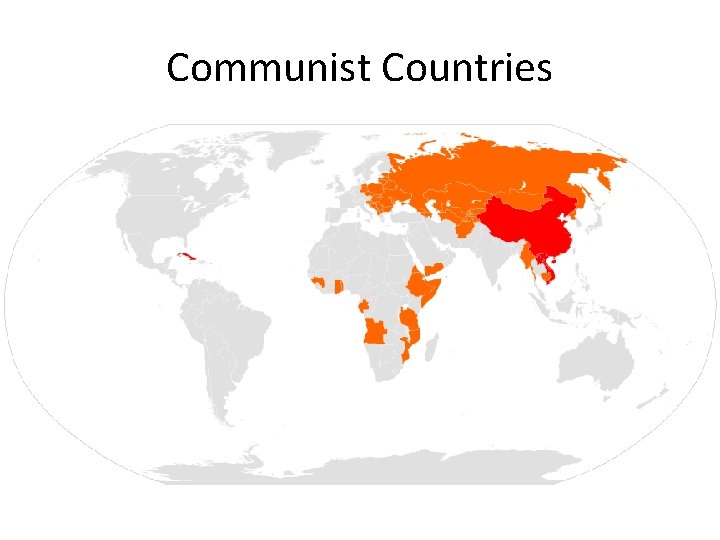
Communist Countries