
1 4 6 Energy Flow Need to know

- Slides: 46
1. 4. 6 Energy Flow
Need to know Name the sun as the primary source of energy. Name feeding as the pathway of energy flow. Present a grazing food chain. Present a food web. Construct a pyramid of numbers. 2
What is an ecosystem? a community of living organisms interacting with one another and their non-living environment within a particular area, e. g. woodland, etc. 3
Energy Flow Ecosystems are unable to function unless there is a constant input of energy from an external source. Where does this energy come from? The Sun 4
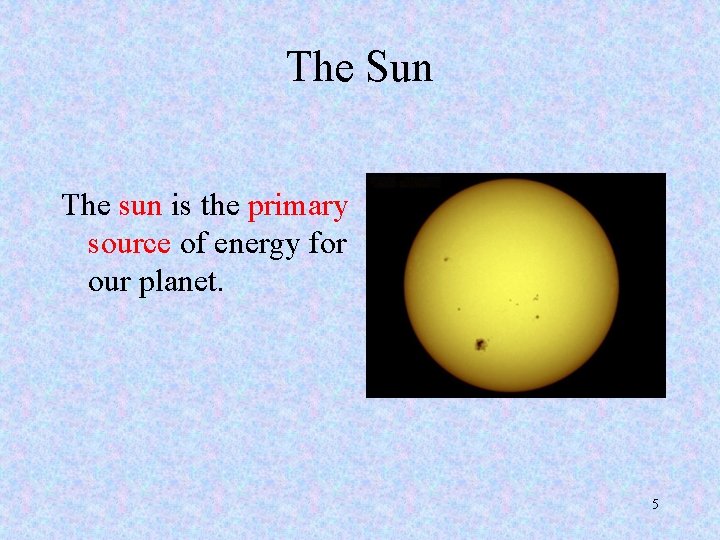
The Sun The sun is the primary source of energy for our planet. 5
Energy Flow is the pathway of energy transfer from one organism to the next in an ecosystem due to feeding, e. g. along a food chain Feeding allows energy to flow from one organism to another in an ecosystem. 6
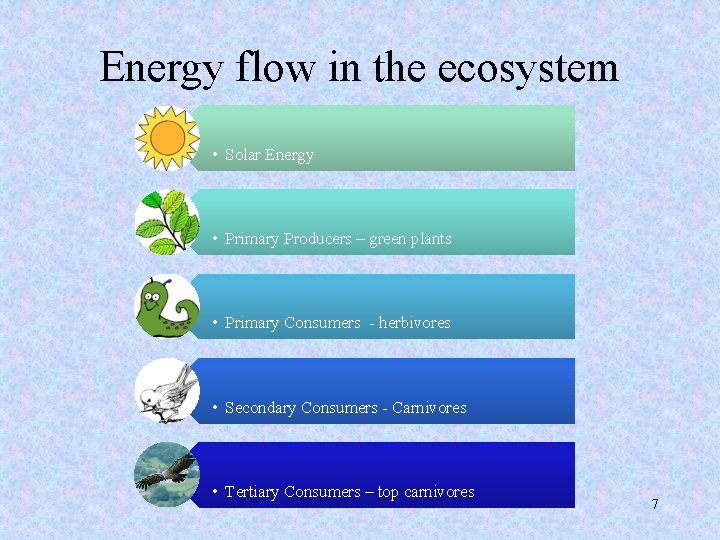
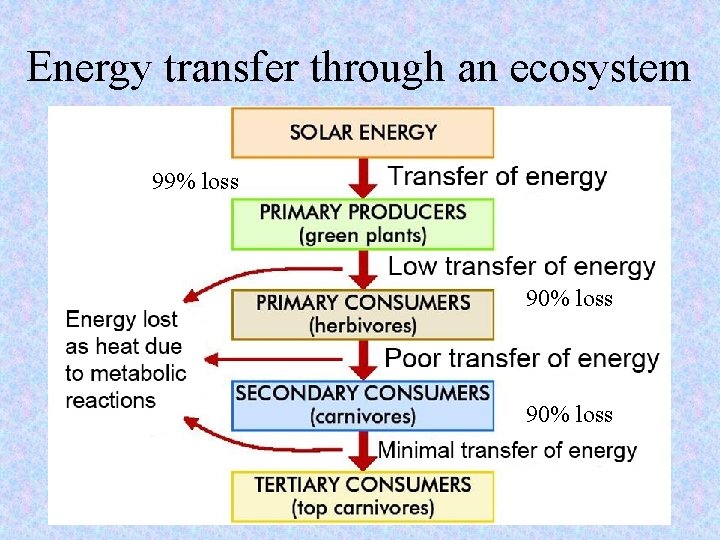
Energy flow in the ecosystem • Solar Energy • Primary Producers – green plants • Primary Consumers - herbivores • Secondary Consumers - Carnivores • Tertiary Consumers – top carnivores 7
Food Chain Is a flow diagram that begins with a plant and shows how food/energy is passed through a series of organisms in a community. Each organism feeds on the one before it. A food chain ends when there is not enough energy to support another organism. An example of a food chain: grass rabbit fox. 8
Learning check What is meant by primary source? Main source What is the primary source of energy? The sun 9
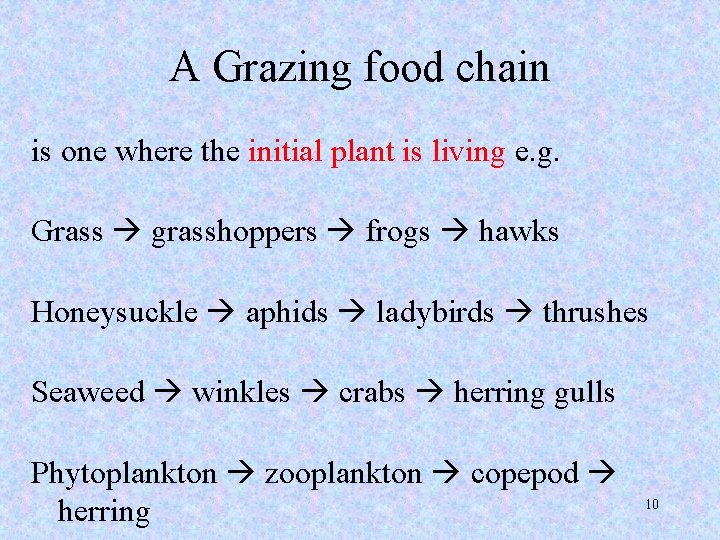
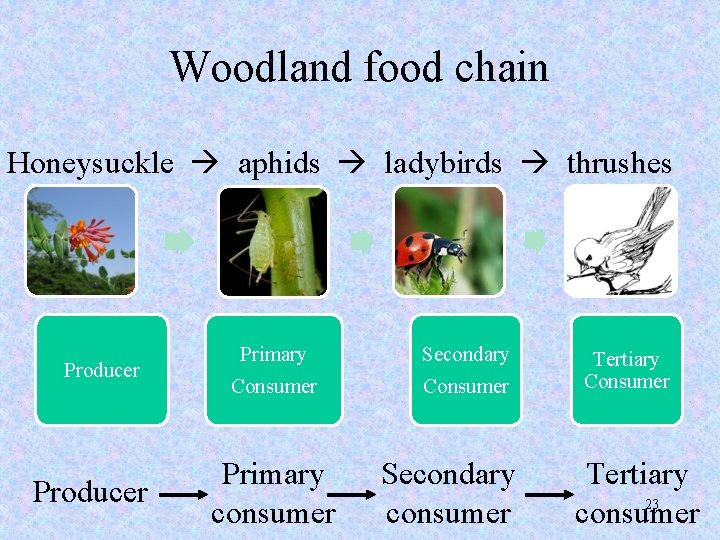
A Grazing food chain is one where the initial plant is living e. g. Grass grasshoppers frogs hawks Honeysuckle aphids ladybirds thrushes Seaweed winkles crabs herring gulls Phytoplankton zooplankton copepod herring 10
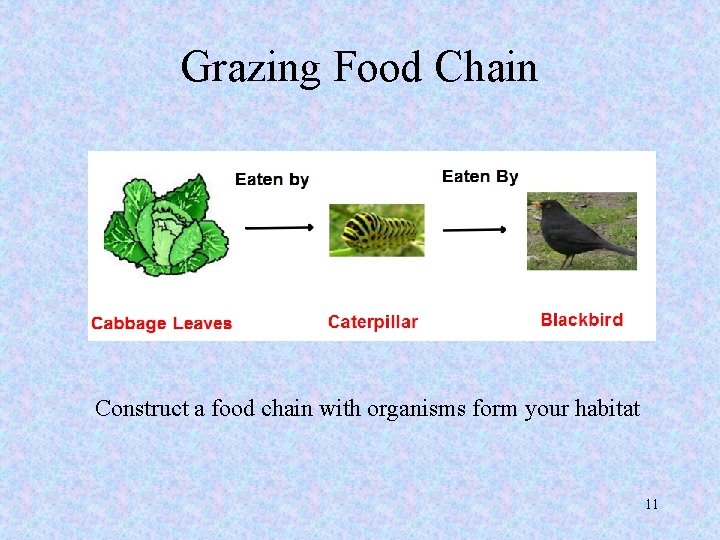
Grazing Food Chain Construct a food chain with organisms form your habitat 11
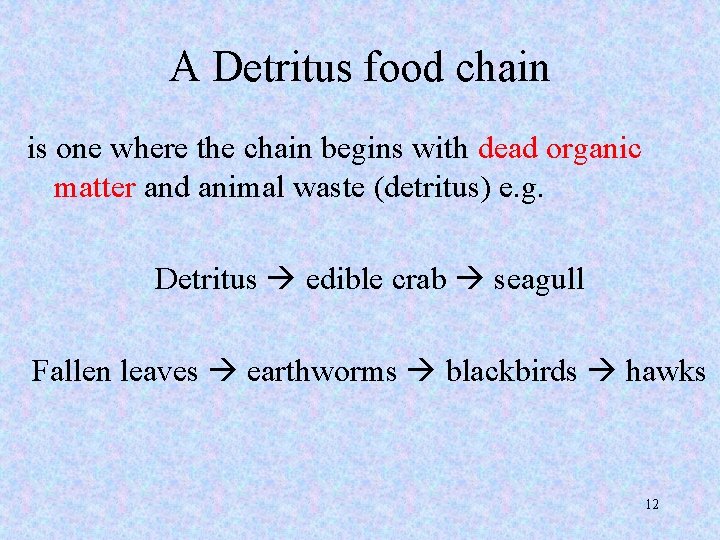
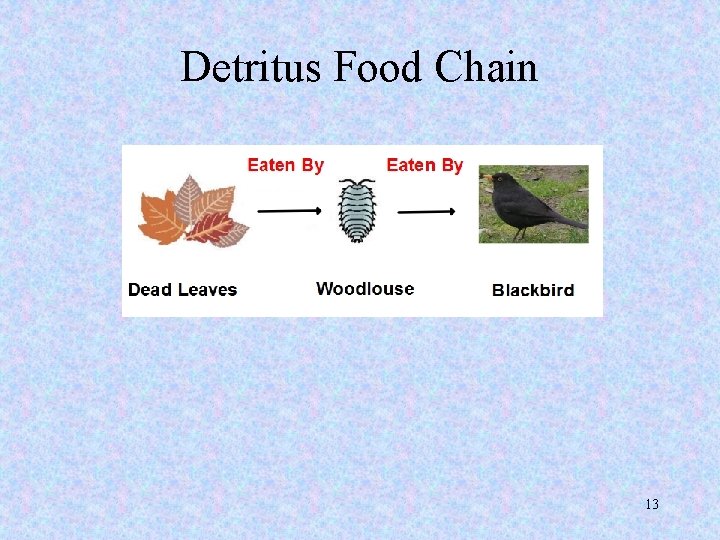
A Detritus food chain is one where the chain begins with dead organic matter and animal waste (detritus) e. g. Detritus edible crab seagull Fallen leaves earthworms blackbirds hawks 12
Detritus Food Chain 13
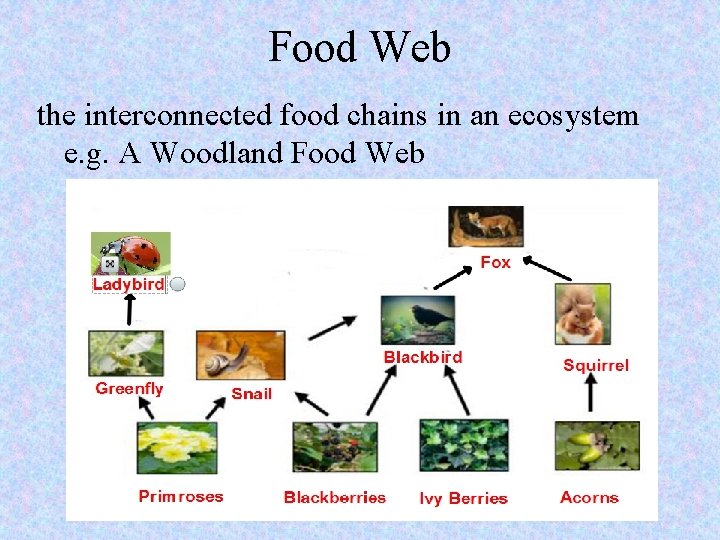
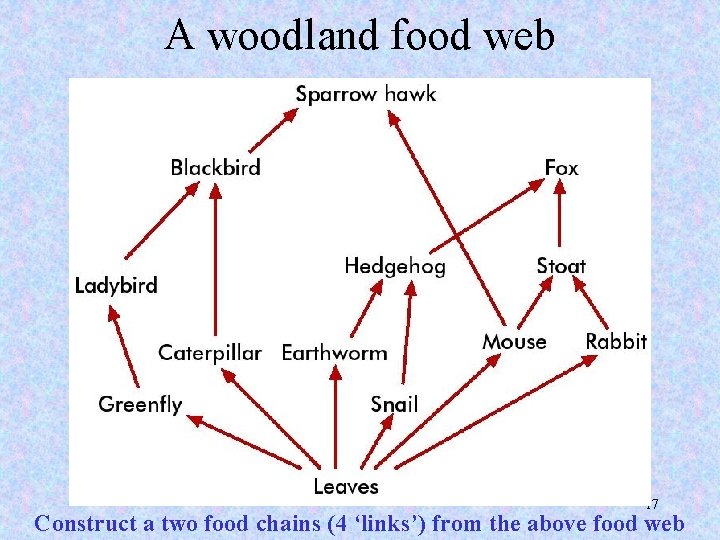
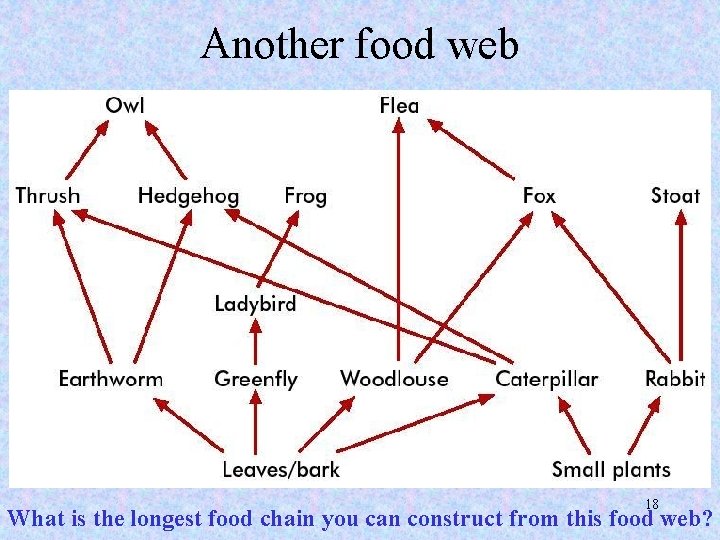
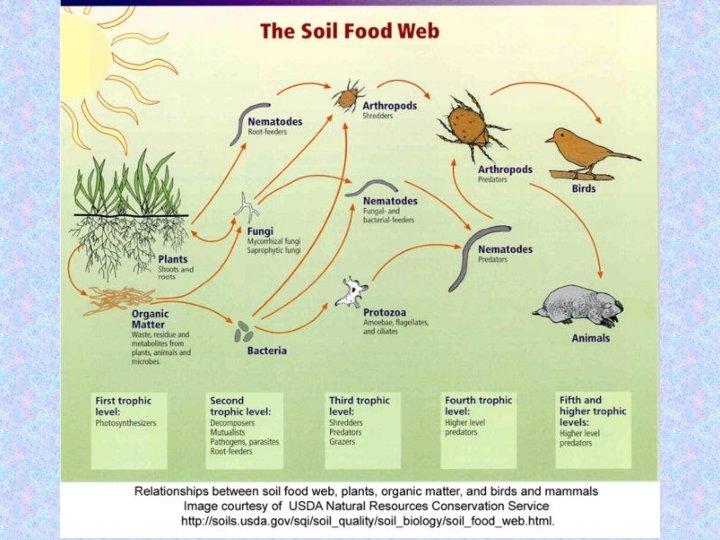
Food Web This is a chart showing all the feeding connections in the habitat/ecosystem. Constructed by showing the links between all the interconnecting food chains in the habitat. 14
Food Web the interconnected food chains in an ecosystem e. g. A Woodland Food Web 15
Learning check Energy flow/transfer through an ecosystem is achieved by … Feeding 16
A woodland food web 17 Construct a two food chains (4 ‘links’) from the above food web
Another food web 18 What is the longest food chain you can construct from this food web?
Learning check What is meant by a Grazing food chain? • is a food chain where the initial plant is living Give an example 1. 2. 3. 4. Grass grasshoppers frogs hawks Honeysuckle aphids ladybirds thrushes Seaweed winkles crabs herring gulls Phytoplankton zooplankton copepod herring 19
20
Producers are organisms capable of making their own food by photosynthesis, e. g. green plants. Primary producers are the first members of a food chain 21
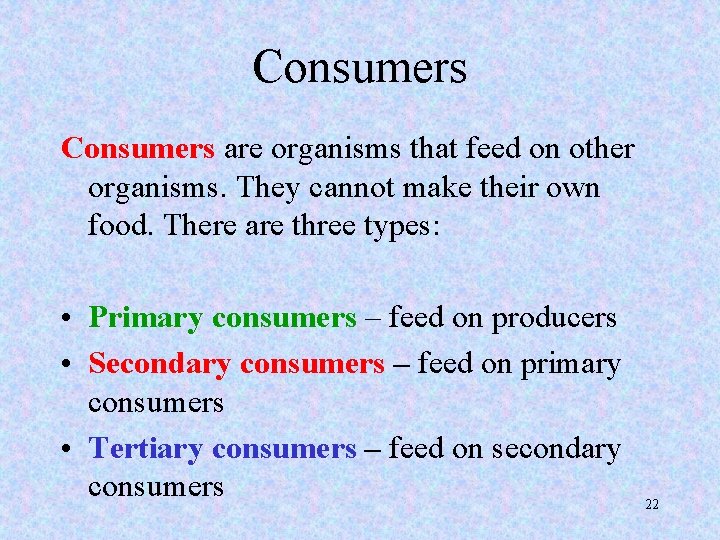
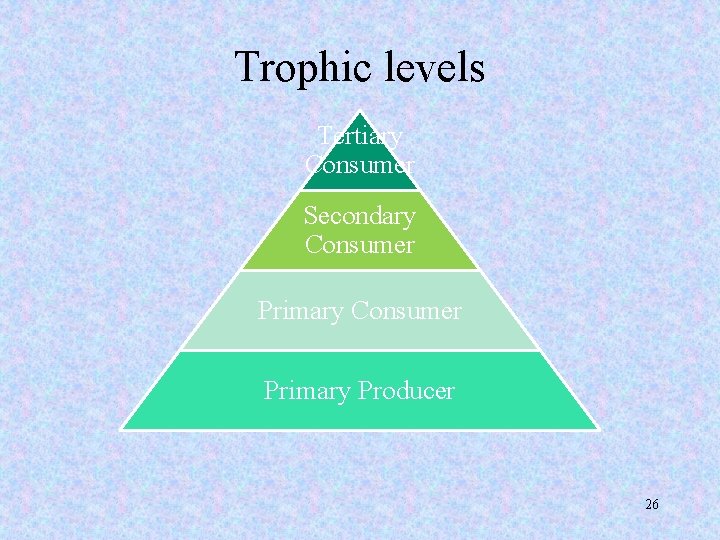
Consumers are organisms that feed on other organisms. They cannot make their own food. There are three types: • Primary consumers – feed on producers • Secondary consumers – feed on primary consumers • Tertiary consumers – feed on secondary consumers 22
Woodland food chain Honeysuckle aphids ladybirds thrushes Producer Primary Consumer Primary consumer Secondary Consumer Secondary consumer Tertiary Consumer Tertiary 23 consumer
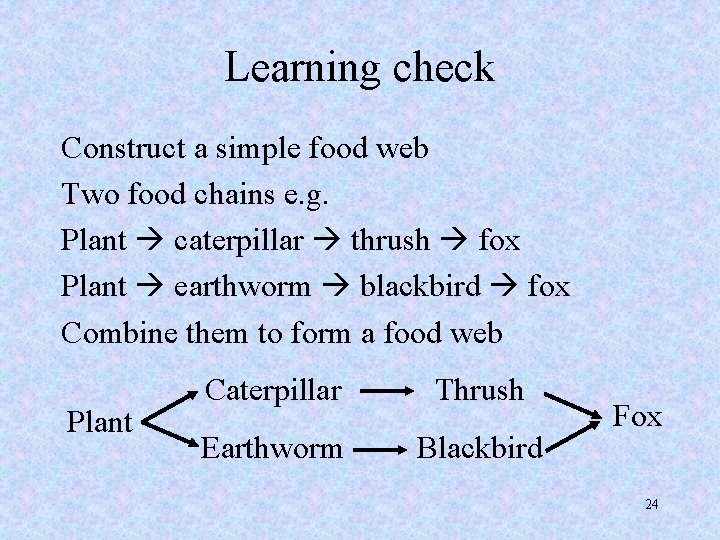
Learning check Construct a simple food web Two food chains e. g. Plant caterpillar thrush fox Plant earthworm blackbird fox Combine them to form a food web Plant Caterpillar Thrush Earthworm Blackbird Fox 24
Trophic Level This refers to the position of an organism in a food chain. Plants are at the 1 st trophic level (T 1) and Herbivores occupy the 2 nd trophic level (T 2). Carnivores that eat herbivores are at the 3 rd trophic level (T 3). The 4 th trophic level (T 4) is often occupied by the top carnivore. 25
Trophic levels Tertiary Consumer Secondary Consumer Primary Producer 26
Learning check Explain the following terms: • Producer • organism capable of making its own food by photosynthesis • Consumer • organism that feeds on other organisms – cannot make their own food • Primary Consumer • organism that feeds on producers • Secondary Consumer • organism that feeds on primary consumers • Tertiary Consumer • organism that feeds on secondary consumers 27
Learning check What is meant by trophic level? This refers to the position of an organism in a food chain. T 1 = 1 st trophic level = Plants T 2 = 2 nd trophic level = Herbivores T 3 = 3 rd trophic level = Carnivores T 4 = 4 th trophic level = (T 4) Top Carnivore. 28
Pyramid of Numbers - Need to know • Explain the limitations of use regarding the size of organisms • State two inferences (conclusions) that can be made regarding the shape of the pyramid e. g. large tree or parasites • Explain the energy loss shown in the pyramid 29
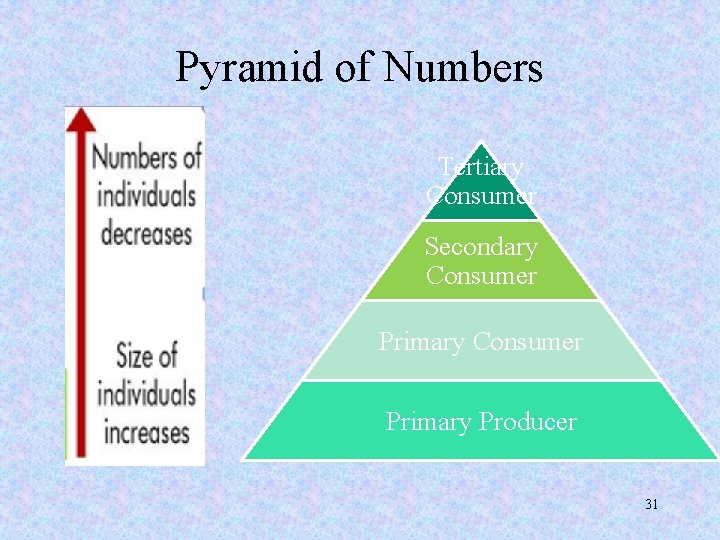
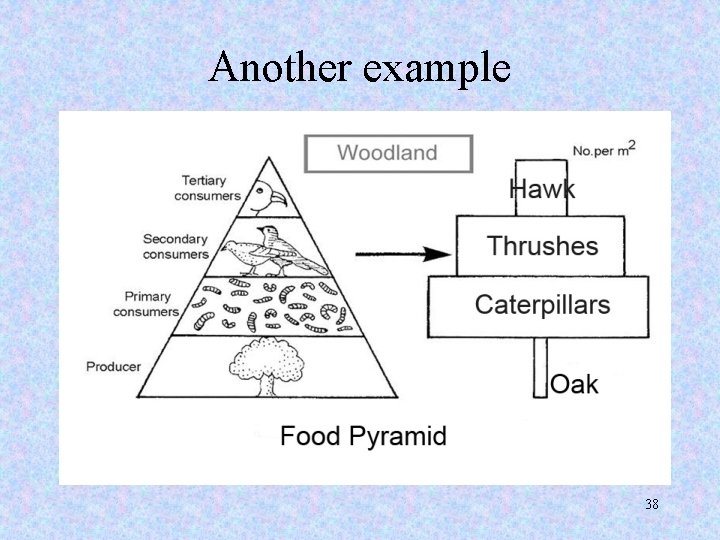
Pyramid of Numbers A diagram that represents the numbers of organisms at each trophic level in a food chain. Bottom layer is the largest and represents a very large number of primary producers The next layer smaller and represents a smaller number of primary consumers The next layer – the no. of secondary consumers The uppermost layer where there may be only one tertiary consumer 30
Pyramid of Numbers Tertiary Consumer Secondary Consumer Primary Producer 31
To construct a pyramid of numbers 1. Count the primary producers and place them at the base of the pyramid 2. Count each consumer and include them according to their status (primary or secondary consumer) in the pyramid 3. The apex of the pyramid should include tertiary or top carnivores 4. Draw the pyramid so that the area/volume of each level is proportional to the number 32 of organisms found
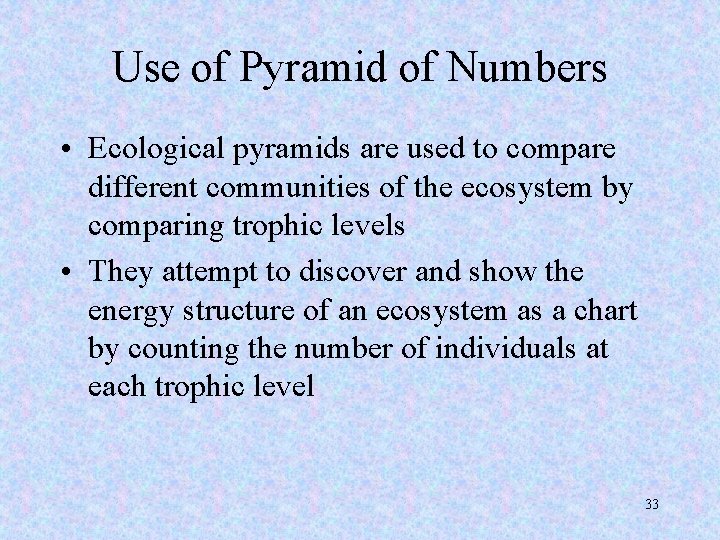
Use of Pyramid of Numbers • Ecological pyramids are used to compare different communities of the ecosystem by comparing trophic levels • They attempt to discover and show the energy structure of an ecosystem as a chart by counting the number of individuals at each trophic level 33
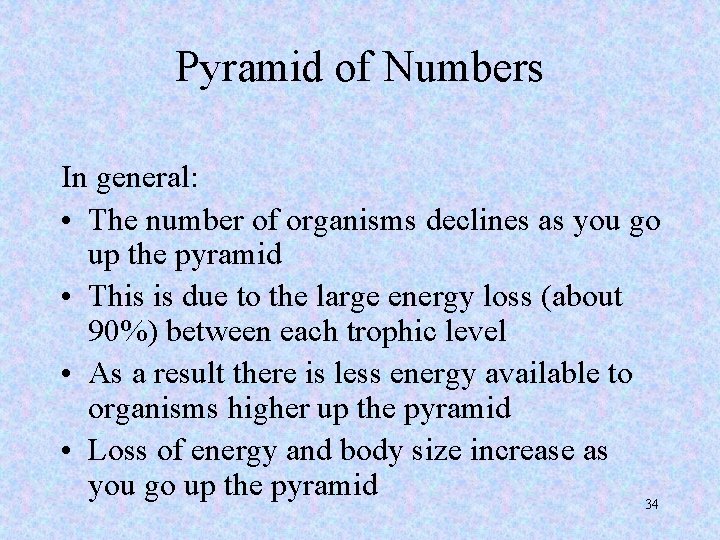
Pyramid of Numbers In general: • The number of organisms declines as you go up the pyramid • This is due to the large energy loss (about 90%) between each trophic level • As a result there is less energy available to organisms higher up the pyramid • Loss of energy and body size increase as you go up the pyramid 34
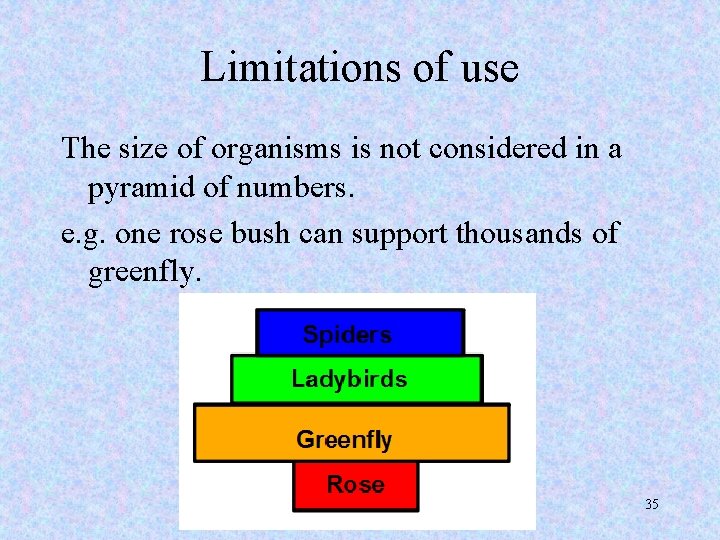
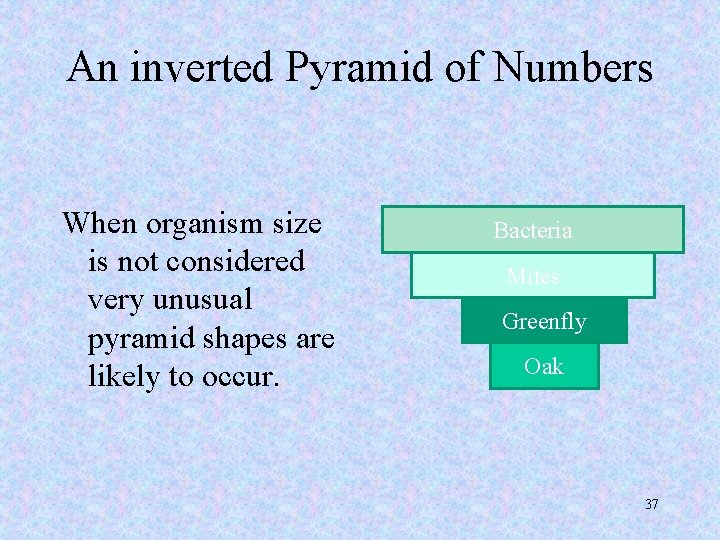
Limitations of use The size of organisms is not considered in a pyramid of numbers. e. g. one rose bush can support thousands of greenfly. 35
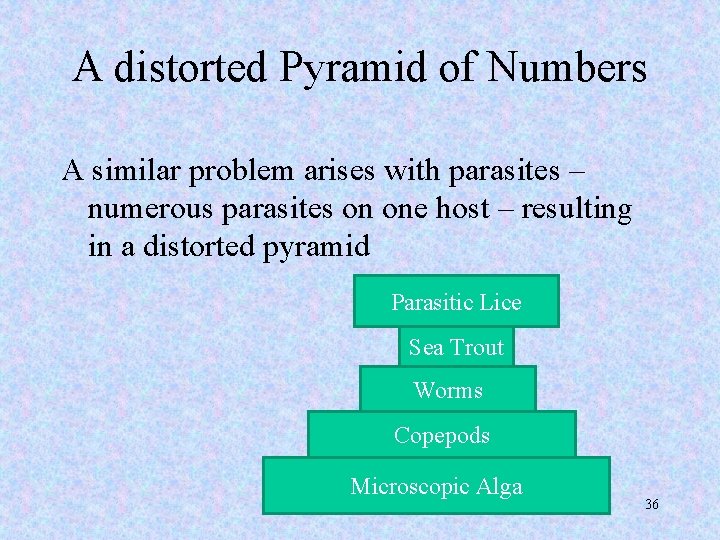
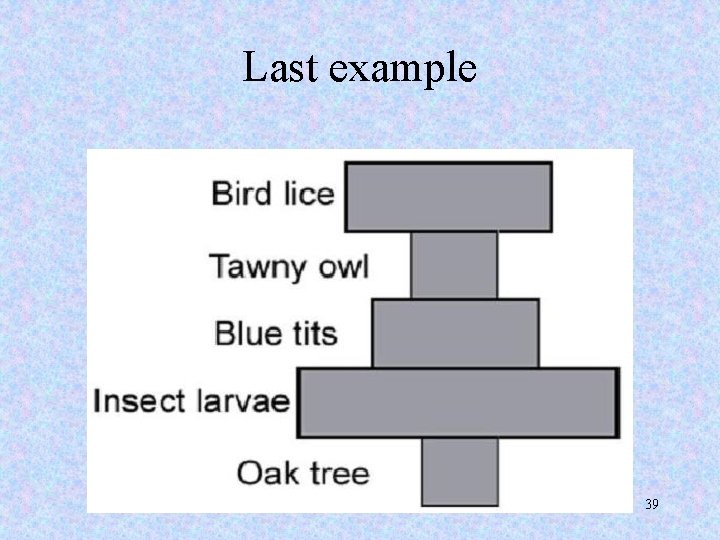
A distorted Pyramid of Numbers A similar problem arises with parasites – numerous parasites on one host – resulting in a distorted pyramid Parasitic Lice Sea Trout Worms Copepods Microscopic Alga 36
An inverted Pyramid of Numbers When organism size is not considered very unusual pyramid shapes are likely to occur. Bacteria Mites Greenfly Oak 37
Another example 38
Last example 39
Learning check What are Pyramids of Numbers used for? • They are used to compare different communities of the ecosystem by comparing trophic levels • They attempt to discover and show the energy structure of an ecosystem as a chart by counting the number of individuals at each trophic level. 40
Energy Transfer This is the flow of energy into the ecosystem from the sun; and within the ecosystem through the different trophic levels along food chains, and finally out of the ecosystem into the atmosphere as heat loss due to respiration. 41
Energy transfer through an ecosystem 99% loss 90% loss 42
Energy loss in a Food Chain or Ecosystem From the previous slide we can see that only about 10% of the energy in an organism is transferred when one member of a food chain is eaten by the next The large energy loss from one trophic level to the next explains why food chains contain no more than four or five levels Each trophic level contains less energy than the previous one 43
Learning check Can you explain the energy loss through an ecosystem? Only about 10% of the energy in an organism is transferred when one member of a food chain is eaten by the next This explains why food chains contain no more than four or five levels Each trophic level contains less energy than the previous one 44
Learning check Construct a pyramid of numbers and explain its use. Construct: 1. … 2. … 3. … 4. … Use: attempts to show the energy structure of an ecosystem as a chart by counting the number of individuals at each trophic level 45
END 46