
1 4 16 Do Now Obtain a white
1 -4 -16 Do Now • Obtain a white board for your group • Fill beaker at your table with about 130 -140 m. L of water • When I put dye in, use whiteboard to record your observations about what is happening • In your group, come up with an explanation about WHY you think this is happening Chapter menu Resources Copyright © by Holt, Rinehart and Winston. All rights reserved.
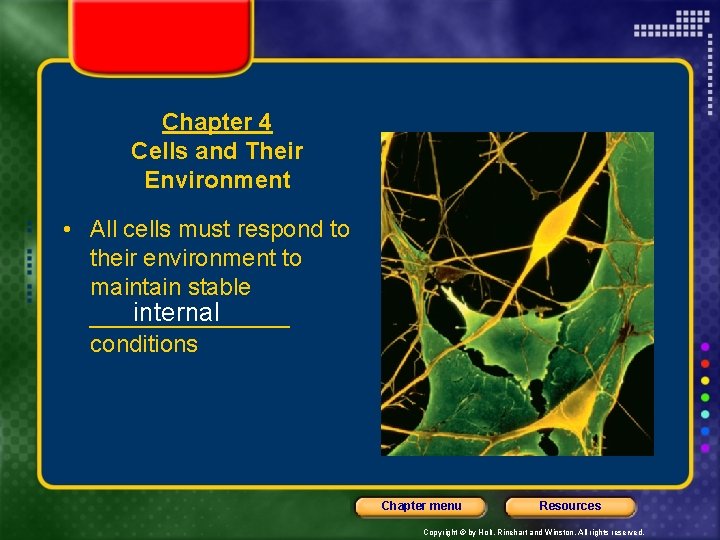
Chapter 4 Cells and Their Environment • All cells must respond to their environment to maintain stable internal ________ conditions Chapter menu Resources Copyright © by Holt, Rinehart and Winston. All rights reserved.
Chapter 4 Section 1 Passive Transport Objectives • Relate concentration gradients, diffusion, and equilibrium. • Predict the direction of water movement into and out of cells. • Describe the importance of ion channels in passive transport. • Identify the role of carrier proteins in facilitated diffusion. Chapter menu Resources Copyright © by Holt, Rinehart and Winston. All rights reserved.
Chapter 4 Section 2 Active Transport Objectives • Compare active transport with passive transport. • Describe the importance of the sodium-potassium pump. • Distinguish between endocytosis and exocytosis. • Identify three ways that receptor proteins can change the activity of a cell. Chapter menu Resources Copyright © by Holt, Rinehart and Winston. All rights reserved.
New Vocabulary • • • Passive transport Concentration gradient Equilibrium Diffusion Osmosis Hypertonic solution Hypotonic solution Isotonic solution Ion channel • • Carrier protein Facilitated diffusion Active transport Endocytosis Exocytosis Phagocytosis Pinocytosis Chapter menu Resources Copyright © by Holt, Rinehart and Winston. All rights reserved.
• One way cells maintain homeostasis is to control the movement of substances across their cell membrane ________ – When this process does not use energy, it is called passivetransport _______ – When this process does use energy, it is called active ______ transport Chapter menu Resources Copyright © by Holt, Rinehart and Winston. All rights reserved.
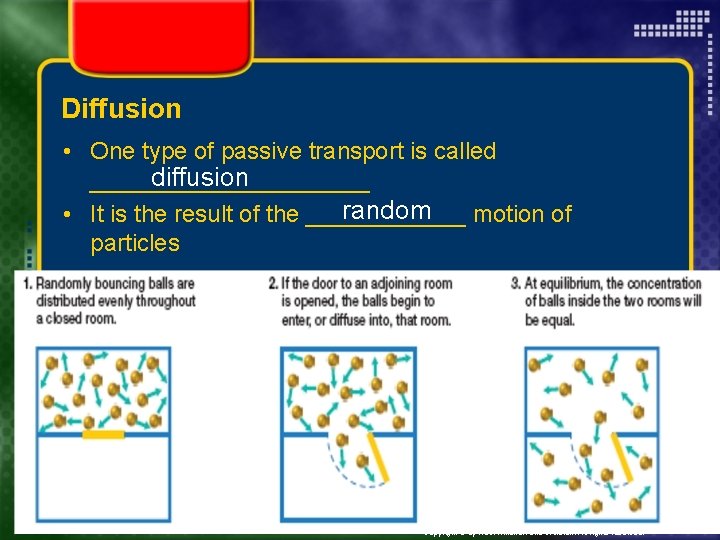
Diffusion • One type of passive transport is called diffusion ___________ random • It is the result of the ______ motion of particles Chapter menu Resources Copyright © by Holt, Rinehart and Winston. All rights reserved.
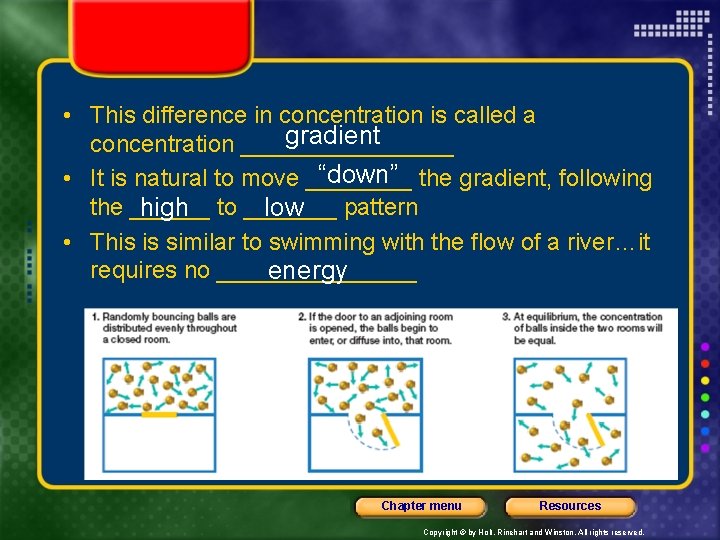
• This difference in concentration is called a gradient concentration ________ “down” the gradient, following • It is natural to move ____ the ______ pattern high to _______ low • This is similar to swimming with the flow of a river…it requires no ________ energy Chapter menu Resources Copyright © by Holt, Rinehart and Winston. All rights reserved.
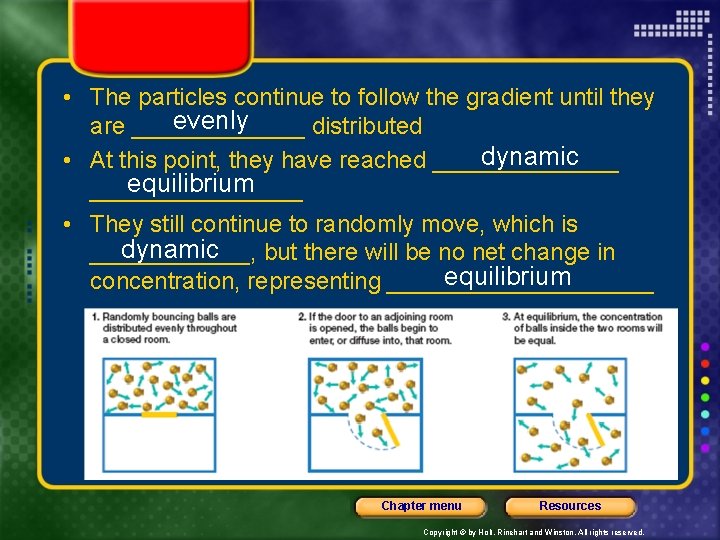
• The particles continue to follow the gradient until they evenly are _______ distributed dynamic • At this point, they have reached _______ equilibrium ________ • They still continue to randomly move, which is dynamic ______, but there will be no net change in equilibrium concentration, representing __________ Chapter menu Resources Copyright © by Holt, Rinehart and Winston. All rights reserved.
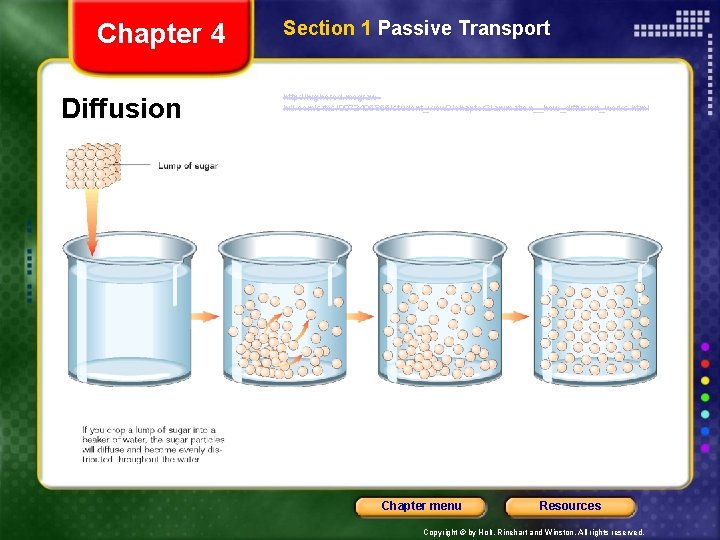
Chapter 4 Diffusion Section 1 Passive Transport http: //highered. mcgrawhill. com/sites/0072495855/student_view 0/chapter 2/animation__how_diffusion_works. html Chapter menu Resources Copyright © by Holt, Rinehart and Winston. All rights reserved.
• Sometimes particles in a solution, called solutes ______, diffuse across a semi-permeable membrane dialysis – This process is called ________ – Kidneys usually carryout dialysis, by filtering ______ out of our blood toxins – If kidney failure occurs, a patient will receive machine dialysis treatment with a ________ Chapter menu Resources Copyright © by Holt, Rinehart and Winston. All rights reserved.
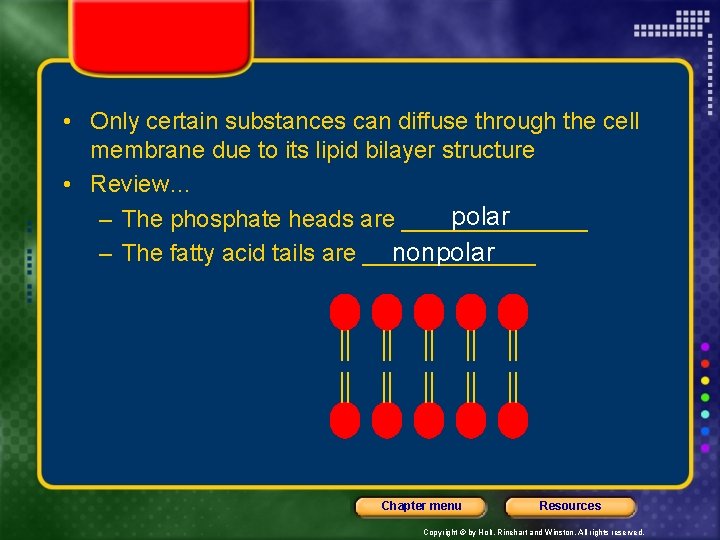
• Only certain substances can diffuse through the cell membrane due to its lipid bilayer structure • Review… polar – The phosphate heads are _______ nonpolar – The fatty acid tails are _______ Chapter menu Resources Copyright © by Holt, Rinehart and Winston. All rights reserved.
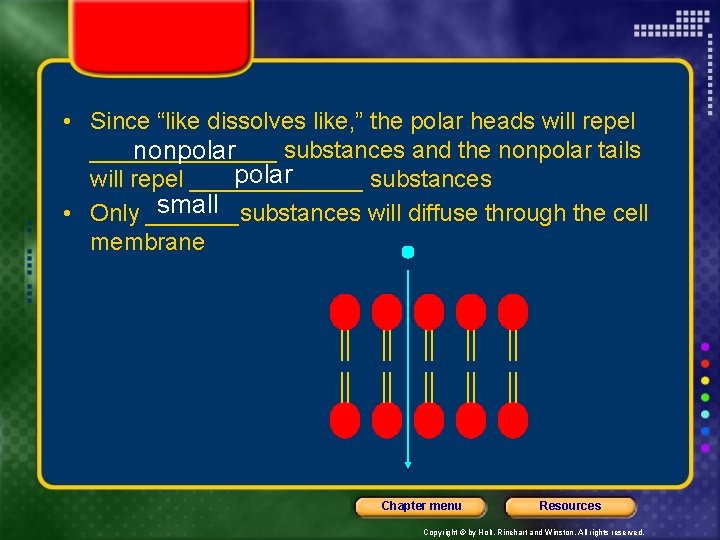
• Since “like dissolves like, ” the polar heads will repel _______ substances and the nonpolar tails nonpolar will repel _______ substances small • Only _______substances will diffuse through the cell membrane Chapter menu Resources Copyright © by Holt, Rinehart and Winston. All rights reserved.
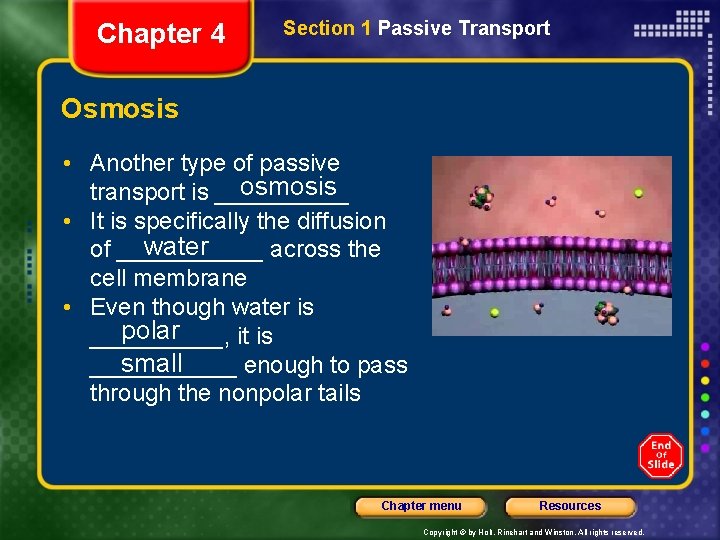
Chapter 4 Section 1 Passive Transport Osmosis • Another type of passive osmosis transport is _____ • It is specifically the diffusion water of ______ across the cell membrane • Even though water is polar _____, it is small ______ enough to pass through the nonpolar tails Chapter menu Resources Copyright © by Holt, Rinehart and Winston. All rights reserved.
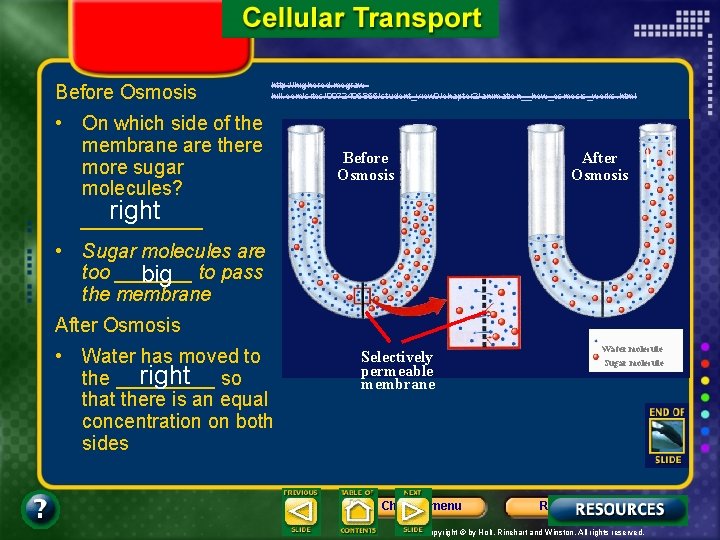
Before Osmosis http: //highered. mcgrawhill. com/sites/0072495855/student_view 0/chapter 2/animation__how_osmosis_works. html • On which side of the membrane are there more sugar molecules? Before Osmosis After Osmosis right ______ • Sugar molecules are too _______ big to pass the membrane After Osmosis • Water has moved to right so the _____ that there is an equal concentration on both sides Water molecule Selectively permeable membrane Chapter menu Sugar molecule Resources Copyright © by Holt, Rinehart and Winston. All rights reserved.
• There are three types of solutions that will affect how water diffuses into or out of the cell hypotonic – ________ solution hypertonic solution – ________ isotonic – ________ solution Chapter menu Resources Copyright © by Holt, Rinehart and Winston. All rights reserved.
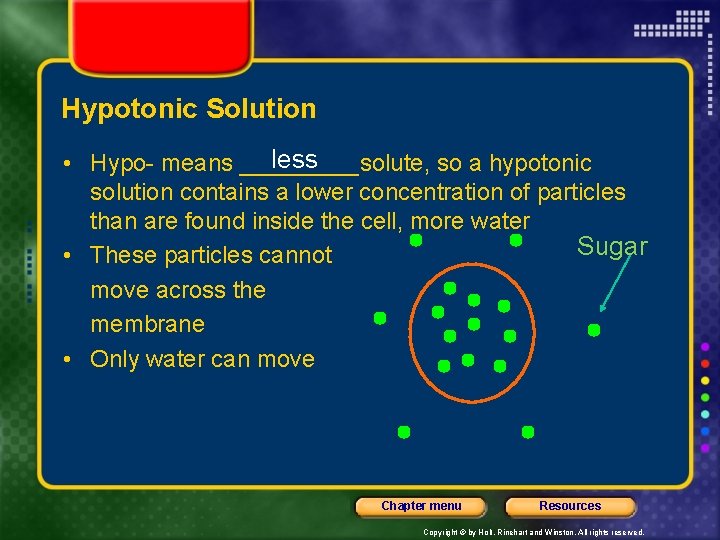
Hypotonic Solution less • Hypo- means _____solute, so a hypotonic solution contains a lower concentration of particles than are found inside the cell, more water Sugar • These particles cannot move across the membrane • Only water can move Chapter menu Resources Copyright © by Holt, Rinehart and Winston. All rights reserved.
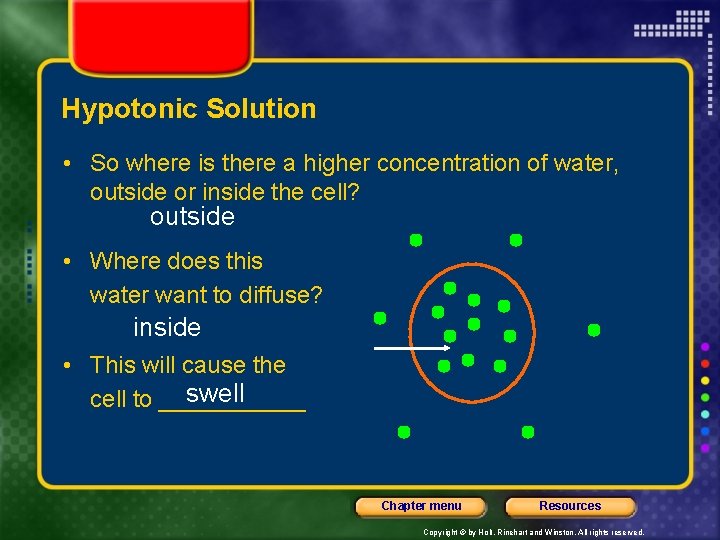
Hypotonic Solution • So where is there a higher concentration of water, outside or inside the cell? outside • Where does this water want to diffuse? inside • This will cause the swell cell to ______ Chapter menu Resources Copyright © by Holt, Rinehart and Winston. All rights reserved.
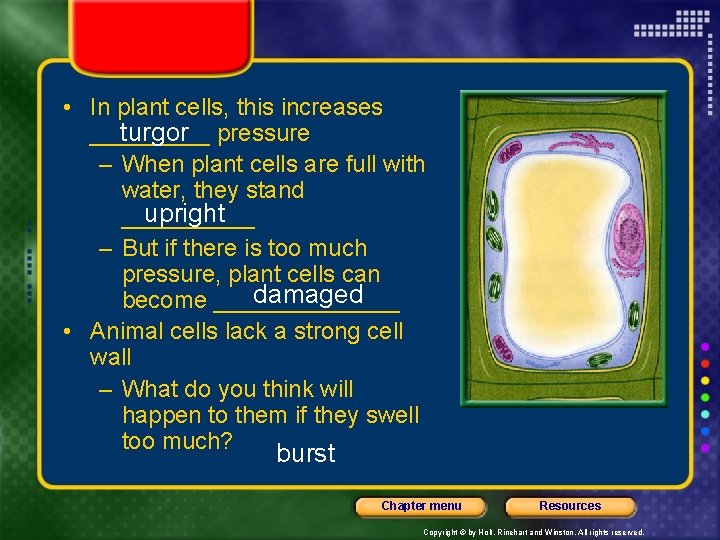
• In plant cells, this increases _____ turgor pressure – When plant cells are full with water, they stand upright _____ – But if there is too much pressure, plant cells can damaged become _______ • Animal cells lack a strong cell wall – What do you think will happen to them if they swell too much? burst Chapter menu Resources Copyright © by Holt, Rinehart and Winston. All rights reserved.
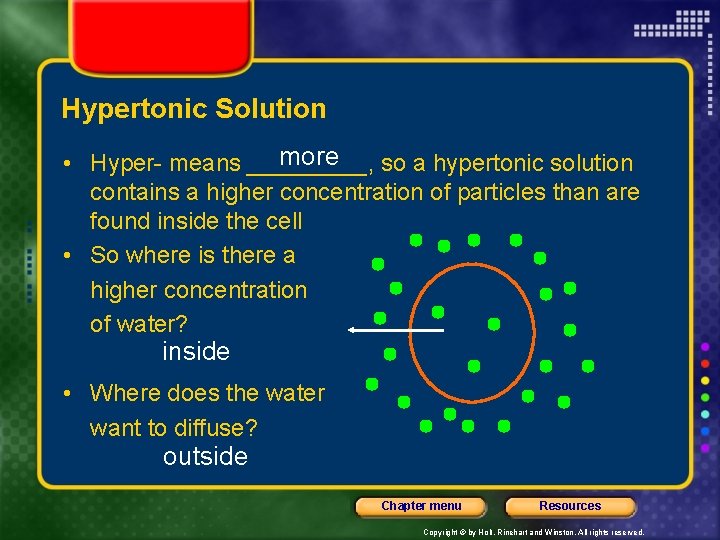
Hypertonic Solution more • Hyper- means _____, so a hypertonic solution contains a higher concentration of particles than are found inside the cell • So where is there a higher concentration of water? inside • Where does the water want to diffuse? outside Chapter menu Resources Copyright © by Holt, Rinehart and Winston. All rights reserved.
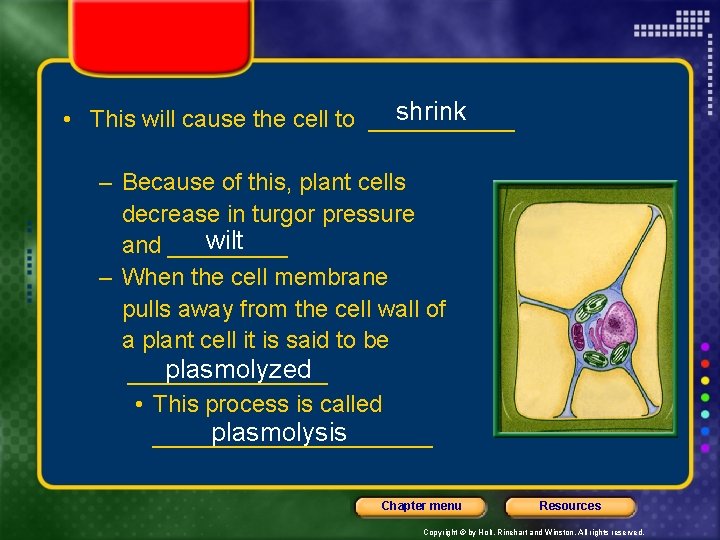
shrink • This will cause the cell to ______ – Because of this, plant cells decrease in turgor pressure wilt and _____ – When the cell membrane pulls away from the cell wall of a plant cell it is said to be plasmolyzed ________ • This process is called plasmolysis ___________ Chapter menu Resources Copyright © by Holt, Rinehart and Winston. All rights reserved.
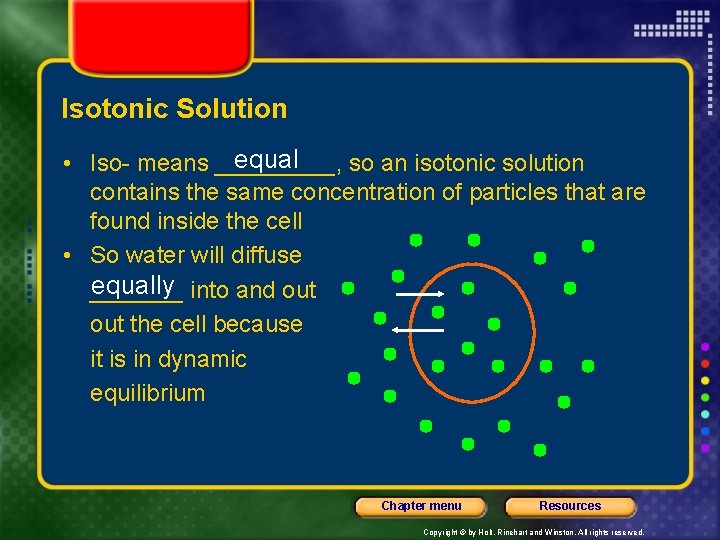
Isotonic Solution equal • Iso- means _____, so an isotonic solution contains the same concentration of particles that are found inside the cell • So water will diffuse equally into and out _______ out the cell because it is in dynamic equilibrium Chapter menu Resources Copyright © by Holt, Rinehart and Winston. All rights reserved.
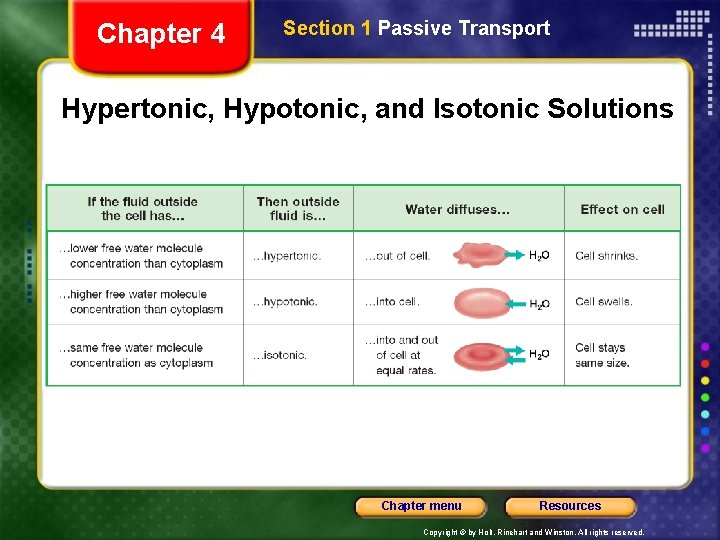
Chapter 4 Section 1 Passive Transport Hypertonic, Hypotonic, and Isotonic Solutions Chapter menu Resources Copyright © by Holt, Rinehart and Winston. All rights reserved.
Chapter 4 Section 1 Passive Transport Diffusion Through Ion Channels charges • Ions have ______, so they are attracted by polar ______ molecules but repelled by nonpolar molecules ______ – Therefore they can’t pass through the _____ tails • An ion channel is a transport protein with a ____ pore or opening through which ions can polar pass. Chapter menu Resources Copyright © by Holt, Rinehart and Winston. All rights reserved.
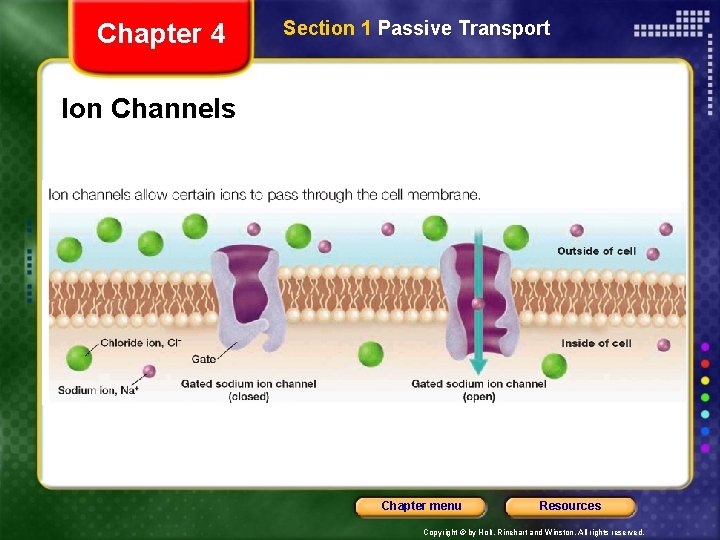
Chapter 4 Section 1 Passive Transport Ion Channels Chapter menu Resources Copyright © by Holt, Rinehart and Winston. All rights reserved.
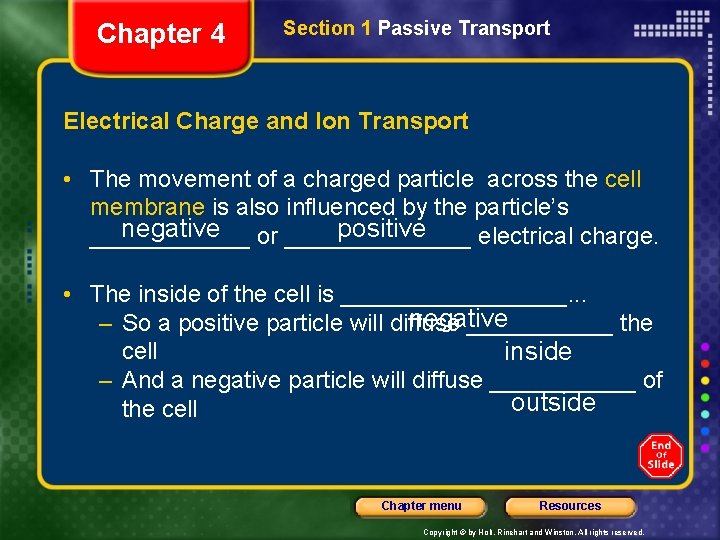
Chapter 4 Section 1 Passive Transport Electrical Charge and Ion Transport • The movement of a charged particle across the cell membrane is also influenced by the particle’s negative or _______ positive ______ electrical charge. • The inside of the cell is _________. . . negative – So a positive particle will diffuse ______ the cell inside – And a negative particle will diffuse ______ of outside the cell Chapter menu Resources Copyright © by Holt, Rinehart and Winston. All rights reserved.
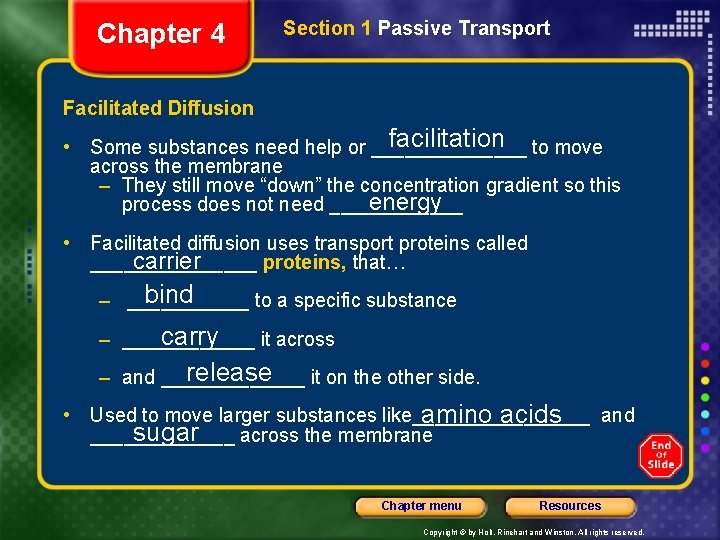
Chapter 4 Section 1 Passive Transport Facilitated Diffusion facilitation to move • Some substances need help or _______ across the membrane – They still move “down” the concentration gradient so this energy process does not need ______ • Facilitated diffusion uses transport proteins called ________ proteins, that… carrier bind – ______ to a specific substance carry – ______ it across release it on the other side. – and _______ • Used to move larger substances like________ amino acids and sugar _______ across the membrane Chapter menu Resources Copyright © by Holt, Rinehart and Winston. All rights reserved.
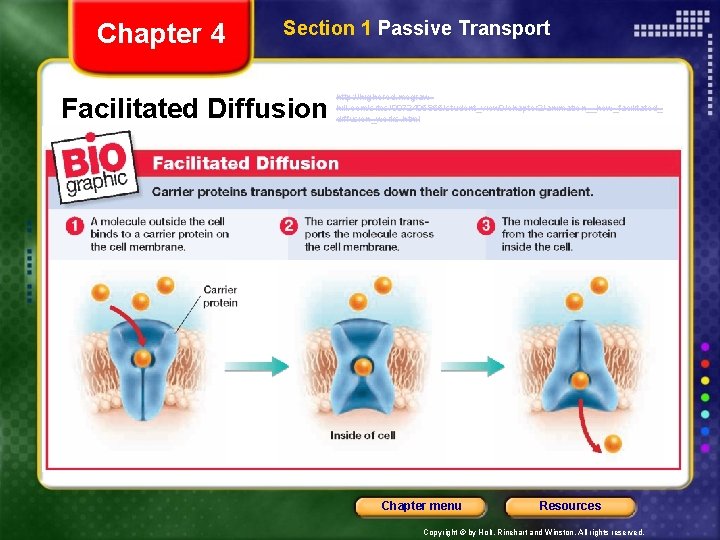
Chapter 4 Section 1 Passive Transport Facilitated Diffusion http: //highered. mcgrawhill. com/sites/0072495855/student_view 0/chapter 2/animation__how_facilitated_ diffusion_works. html Chapter menu Resources Copyright © by Holt, Rinehart and Winston. All rights reserved.
Question 1 • What does it mean when particles move “down” a concentration gradient? They move from a high concentration to a low concentration Chapter menu Resources Copyright © by Holt, Rinehart and Winston. All rights reserved.
Question 2 • Which type of solution makes cells shrink? hypertonic Chapter menu Resources Copyright © by Holt, Rinehart and Winston. All rights reserved.
Question 3 • Is the pore of an ion channel polar or nonpolar? polar Chapter menu Resources Copyright © by Holt, Rinehart and Winston. All rights reserved.
Question 4 • What is the charge inside a cell? negative Chapter menu Resources Copyright © by Holt, Rinehart and Winston. All rights reserved.
Question 5 • What kind of transport proteins are involved in facilitated diffusion? carrier proteins Chapter menu Resources Copyright © by Holt, Rinehart and Winston. All rights reserved.
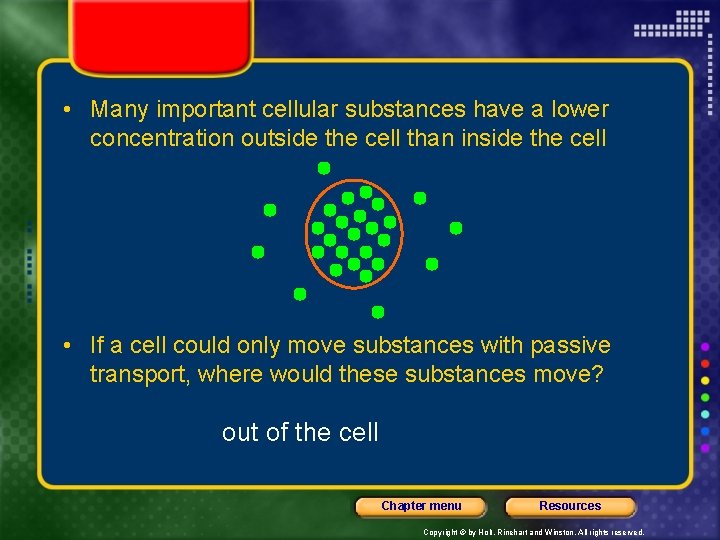
• Many important cellular substances have a lower concentration outside the cell than inside the cell • If a cell could only move substances with passive transport, where would these substances move? out of the cell Chapter menu Resources Copyright © by Holt, Rinehart and Winston. All rights reserved.
Chapter 4 Section 2 Active Transport Movement Against a Concentration Gradient • To move certain substances into the cell, they must have a way to move substances _____ against the concentration gradient… low high – That is from a _____ to ______ concentration energy – This type of transport requires ______ so it active is called _______ transport • Most often, the energy needed for active transport is supplied directly or indirectly by _____. ATP Chapter menu Resources Copyright © by Holt, Rinehart and Winston. All rights reserved.
carrier • Some active transport processes use _____ proteins, like those used in facilitated diffusion • So let’s review… – A carrier protein… binds • _____ to a substance carries it across the membrane • _____ releases it on the other side • _____ • However, in active transport, carrier proteins move low high substances from a ____ to _____ “pump” concentration, acting like a membrane _____ Chapter menu Resources Copyright © by Holt, Rinehart and Winston. All rights reserved.
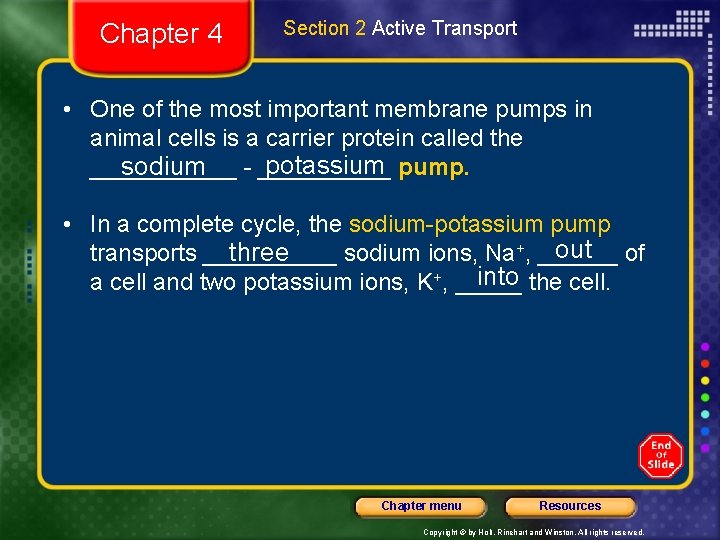
Chapter 4 Section 2 Active Transport • One of the most important membrane pumps in animal cells is a carrier protein called the potassium pump. ______ sodium - _____ • In a complete cycle, the sodium-potassium pump out of transports _____ sodium ions, Na+, ______ three into the cell. a cell and two potassium ions, K+, _____ Chapter menu Resources Copyright © by Holt, Rinehart and Winston. All rights reserved.
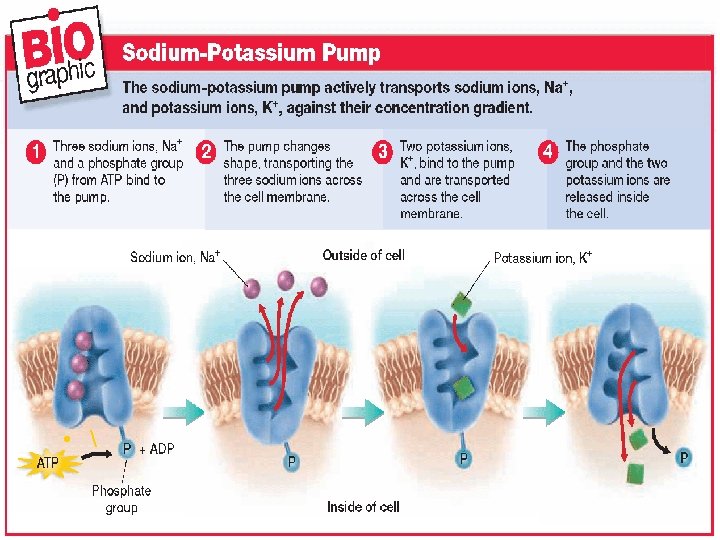
Chapter 4 Section 2 Active Transport • Chapter menu Resources Copyright © by Holt, Rinehart and Winston. All rights reserved.
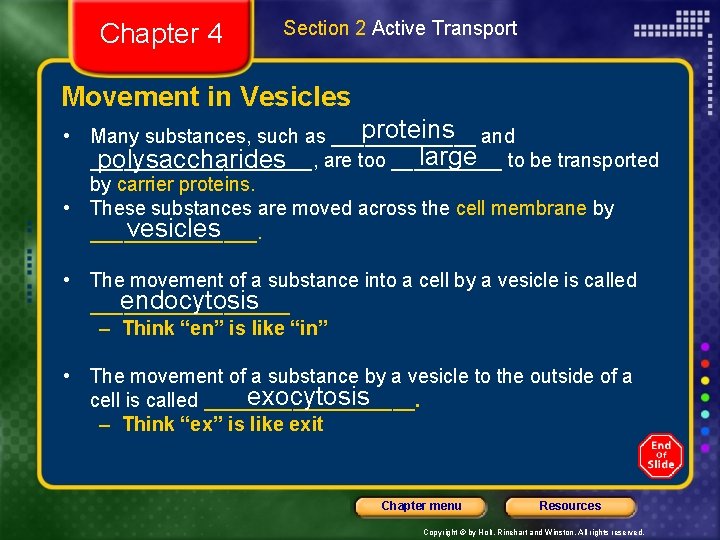
Chapter 4 Section 2 Active Transport Movement in Vesicles proteins and • Many substances, such as _______ large to be transported __________, polysaccharides are too _____ by carrier proteins. • These substances are moved across the cell membrane by vesicles ________. • The movement of a substance into a cell by a vesicle is called endocytosis _________ – Think “en” is like “in” • The movement of a substance by a vesicle to the outside of a exocytosis cell is called __________. – Think “ex” is like exit Chapter menu Resources Copyright © by Holt, Rinehart and Winston. All rights reserved.
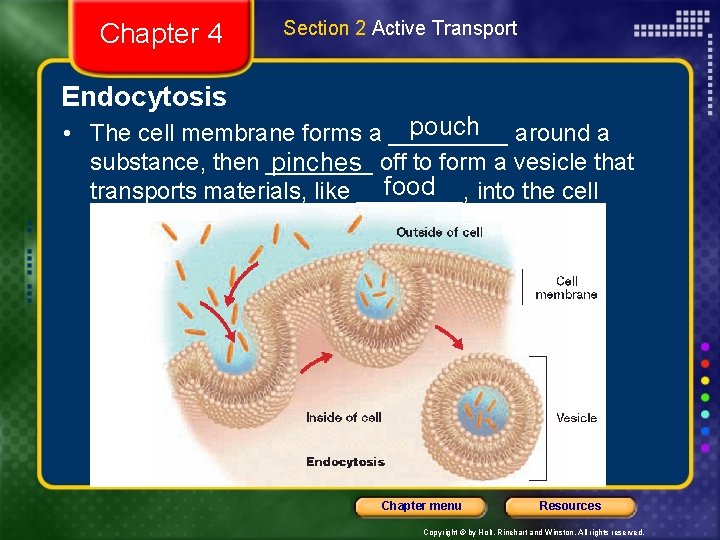
Chapter 4 Section 2 Active Transport Endocytosis pouch around a • The cell membrane forms a _____ substance, then ____ pinches off to form a vesicle that food transports materials, like ____, into the cell Chapter menu Resources Copyright © by Holt, Rinehart and Winston. All rights reserved.
• There are two types of endocytosis solid – Phagocytosis = engulfing _____ particles like food • http: //highered. mcgrawhill. com/sites/0072495855/student_view 0/chapt er 2/animation__phagocytosis. html – Pinocytosis = engulfing ______ particles liquid Chapter menu Resources Copyright © by Holt, Rinehart and Winston. All rights reserved.
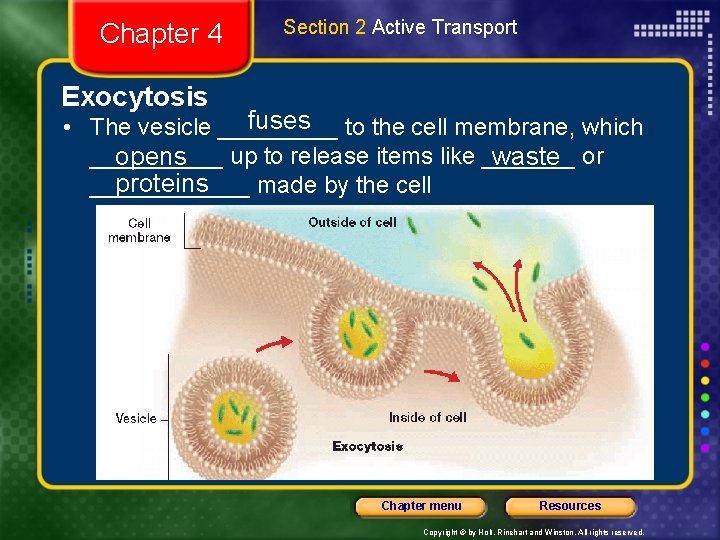
Chapter 4 Section 2 Active Transport Exocytosis fuses to the cell membrane, which • The vesicle __________ up to release items like _______ opens waste or proteins ______ made by the cell Chapter menu Resources Copyright © by Holt, Rinehart and Winston. All rights reserved.
Think About It… • How do cells know when to open carrier proteins or turn their pumps on? Chapter menu Resources Copyright © by Holt, Rinehart and Winston. All rights reserved.
Chapter 4 Section 2 Active Transport Membrane Receptor Proteins communicate with each other to • Cells must _______ coordinate your growth, metabolism, and other activities signal • To do so, some cells release ______ molecules that carry information or ________________ to nearby cells messages • Cells can receive the messages because the cell membrane contains specialized proteins, called receptor _______ proteins, that bind to these signal molecules. Chapter menu Resources Copyright © by Holt, Rinehart and Winston. All rights reserved.
Chapter 4 Section 2 Active Transport • When signal molecules bind to receptor proteins, they may cause three different changes in the cell… permeability – Changes in ____________ second – Triggering the formation of a _____ messenger _______ enzymes – Activating ________: When a signal molecule binds to the receptor protein, the receptor protein may act as an enzyme, speeding up chemical reactions inside the cell. Chapter menu Resources Copyright © by Holt, Rinehart and Winston. All rights reserved.
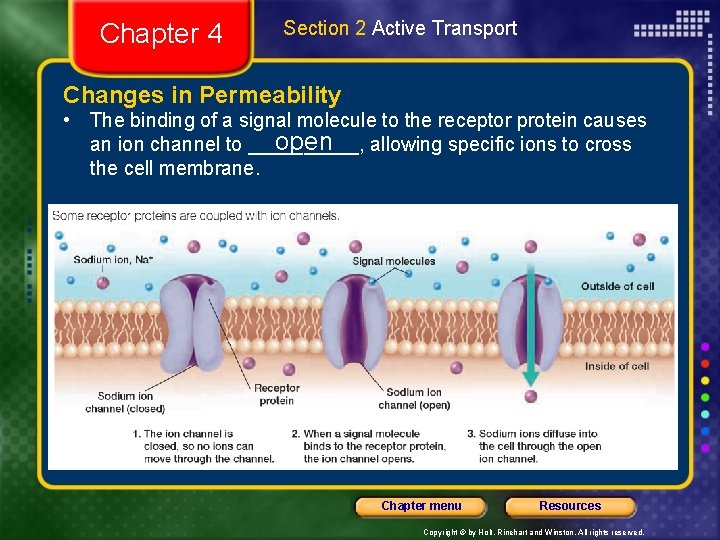
Chapter 4 Section 2 Active Transport Changes in Permeability • The binding of a signal molecule to the receptor protein causes open allowing specific ions to cross an ion channel to _____, the cell membrane. Chapter menu Resources Copyright © by Holt, Rinehart and Winston. All rights reserved.
Question 1 • Which molecule provides energy for active transport to occur? A. chlorophyll B. ATP C. Carbon dioxide D. Signal molecule Chapter menu Resources Copyright © by Holt, Rinehart and Winston. All rights reserved.
Question 3 • Which substance would a cell take in through endocytosis? A. Sodium ions B. polysaccharides C. Amino acids D. monosaccharides Chapter menu Resources Copyright © by Holt, Rinehart and Winston. All rights reserved.
Question 4 • What type of membrane protein interacts with signal molecules? A. Cell surface marker B. Receptor protein C. Transport protein D. enzymes Chapter menu Resources Copyright © by Holt, Rinehart and Winston. All rights reserved.
Question 5 Which type of transport may occur in dead cells…passive or active? passive Chapter menu Resources Copyright © by Holt, Rinehart and Winston. All rights reserved.
- Slides: 50