
1 30 ENVIRONMENT OF CARE PATHOGEN SURVIVAL BACTERIA
1
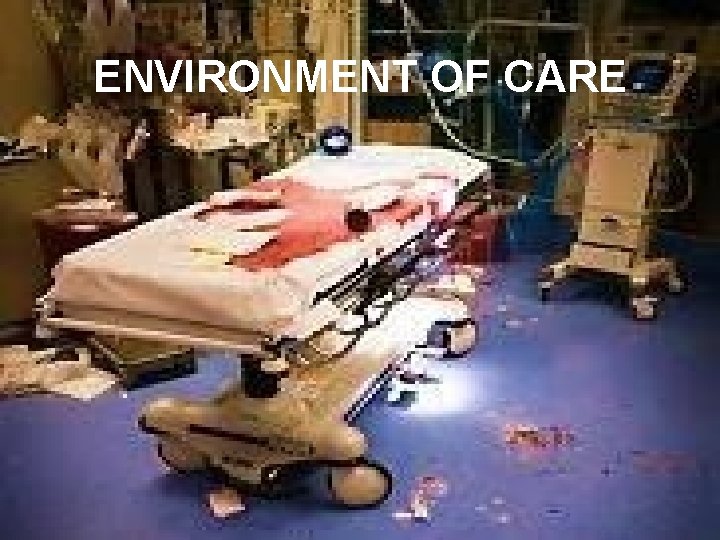
30 ENVIRONMENT OF CARE
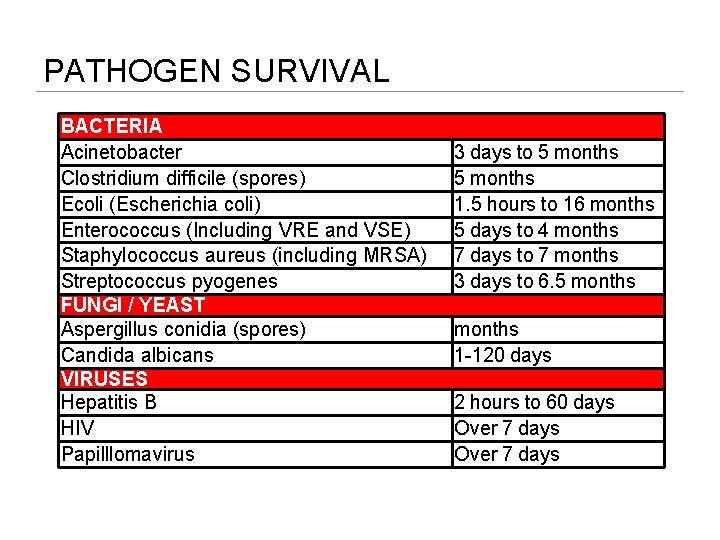
PATHOGEN SURVIVAL BACTERIA Acinetobacter Clostridium difficile (spores) Ecoli (Escherichia coli) Enterococcus (Including VRE and VSE) Staphylococcus aureus (including MRSA) Streptococcus pyogenes FUNGI / YEAST Aspergillus conidia (spores) Candida albicans VIRUSES Hepatitis B HIV Papilllomavirus 3 days to 5 months 1. 5 hours to 16 months 5 days to 4 months 7 days to 7 months 3 days to 6. 5 months 1 -120 days 2 hours to 60 days Over 7 days
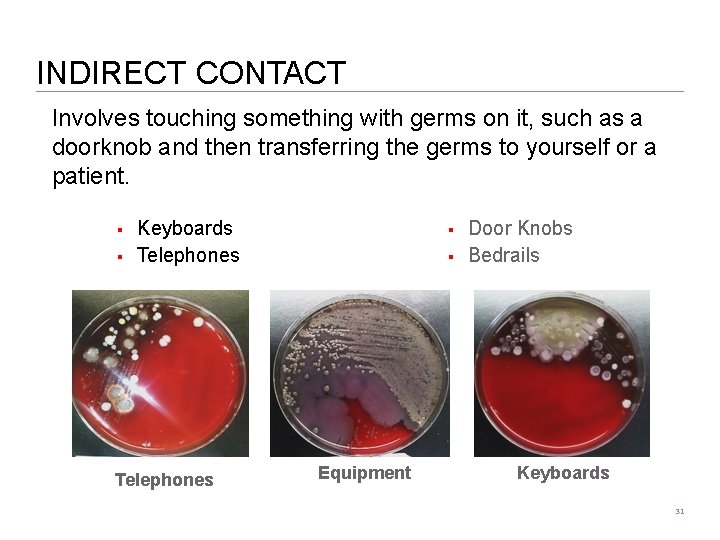
INDIRECT CONTACT Involves touching something with germs on it, such as a doorknob and then transferring the germs to yourself or a patient. Keyboards Telephones Equipment Door Knobs Bedrails Keyboards 31
CLEAN VS. CONTAMINATED Linen carts remain covered at all times Keep contaminated linen off floor & chairs Items removed from a clean area are considered contaminated Used equipment is always considered contaminated return to Central Supply for decontamination OR ensure item is cleaned before reuse 32

CLEAN VS. CONTAMINATED Items removed from a clean area are considered CONTAMINATED Including: Linen Supplies Equipment PPE Food Patients in isolation should be provided with Disposable Items Dedicated Equipment
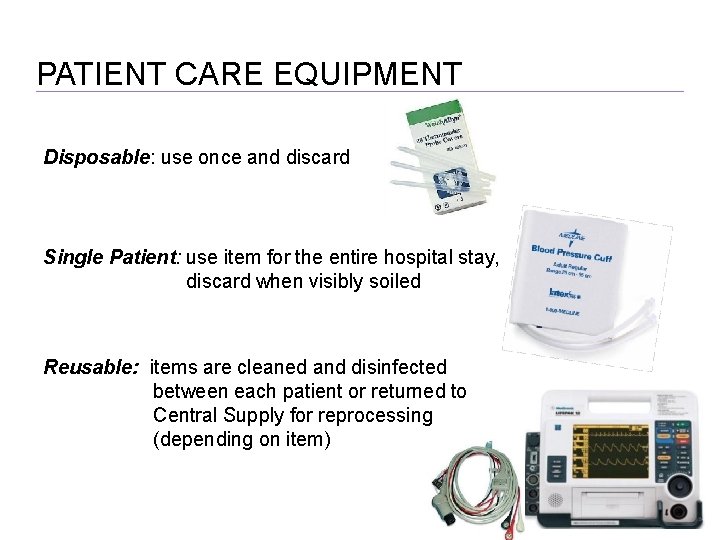
PATIENT CARE EQUIPMENT Disposable: use once and discard Single Patient: use item for the entire hospital stay, discard when visibly soiled Reusable: items are cleaned and disinfected between each patient or returned to Central Supply for reprocessing (depending on item) 34
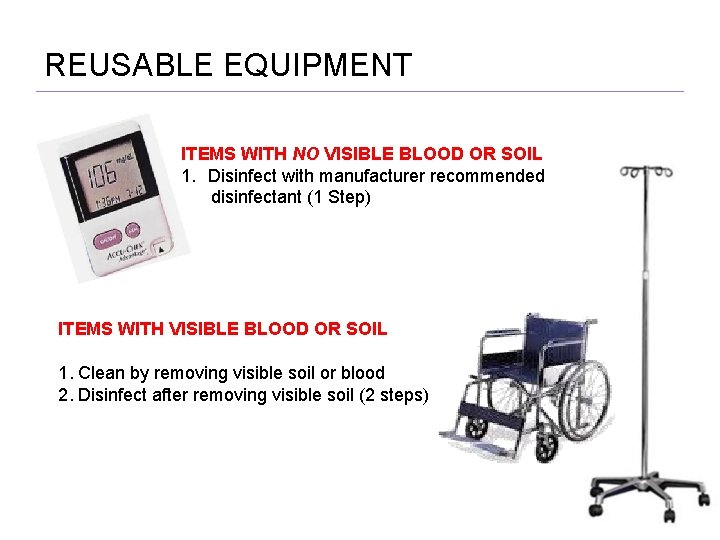
REUSABLE EQUIPMENT ITEMS WITH NO VISIBLE BLOOD OR SOIL 1. Disinfect with manufacturer recommended disinfectant (1 Step) ITEMS WITH VISIBLE BLOOD OR SOIL 1. Clean by removing visible soil or blood 2. Disinfect after removing visible soil (2 steps) 35
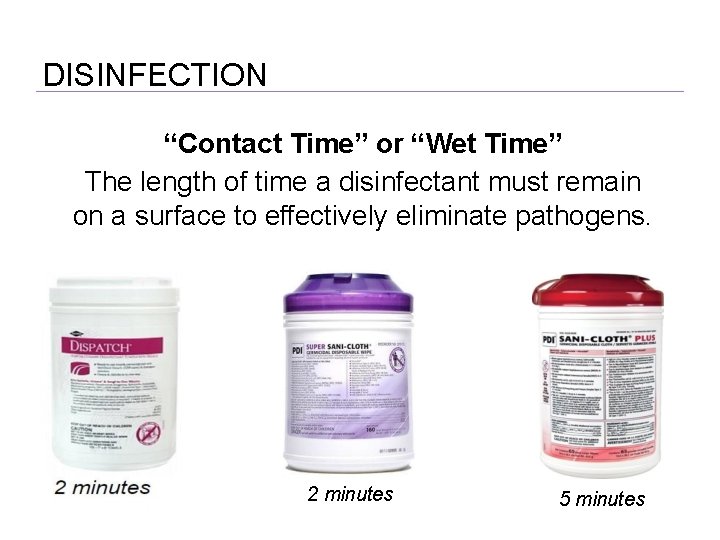
DISINFECTION “Contact Time” or “Wet Time” The length of time a disinfectant must remain on a surface to effectively eliminate pathogens. 2 minutes 5 minutes
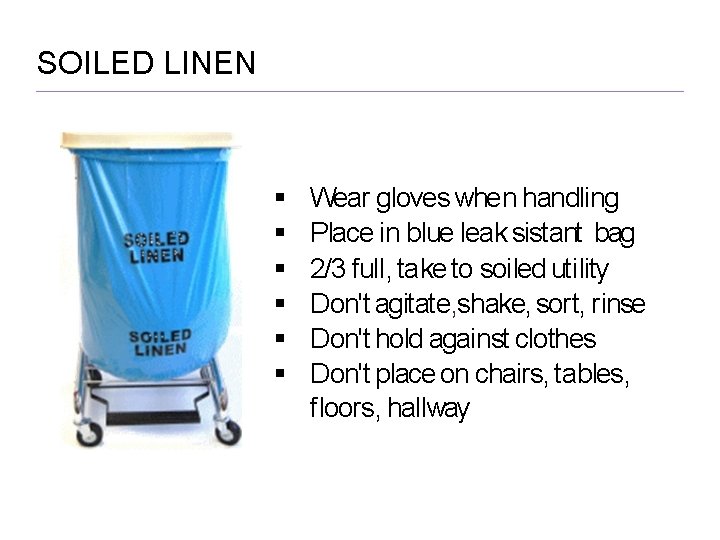
SOILED LINEN Wear gloves when handling Place in blue leak sistant bag 2/3 full, take to soiled utility Don't agitate, shake, sort, rinse Don't hold against clothes Don't place on chairs, tables, floors, hallway
NO SPECIAL HANDLING REQUIRED CDC states that detergent with the temperature of the water and drying cycle is sufficient to kill bacteria and viruses.
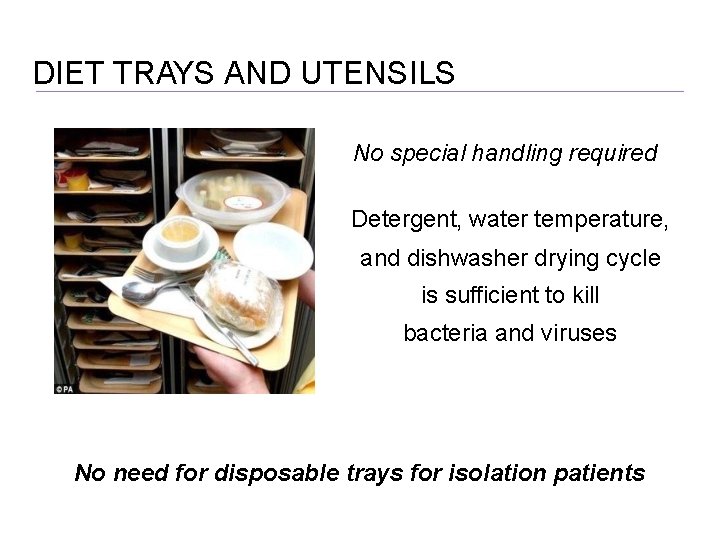
DIET TRAYS AND UTENSILS No special handling required Detergent, water temperature, and dishwasher drying cycle is sufficient to kill bacteria and viruses No need for disposable trays for isolation patients

MEDICAL WASTE 40
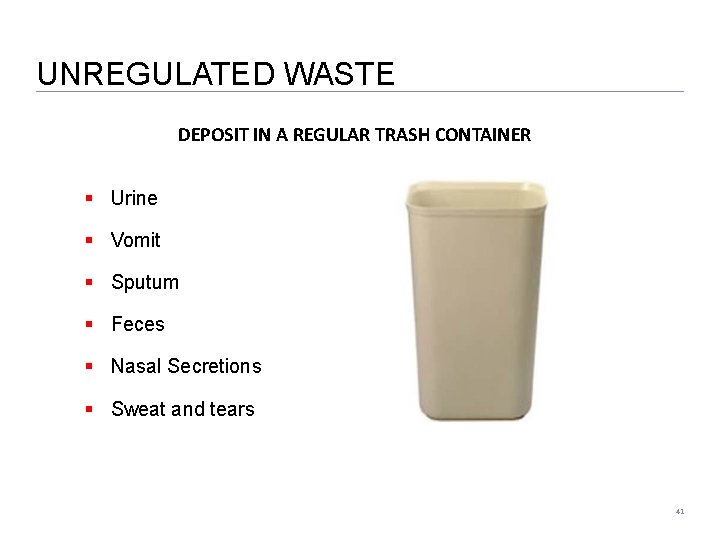
UNREGULATED WASTE DEPOSIT IN A REGULAR TRASH CONTAINER Urine Vomit Sputum Feces Nasal Secretions Sweat and tears 41
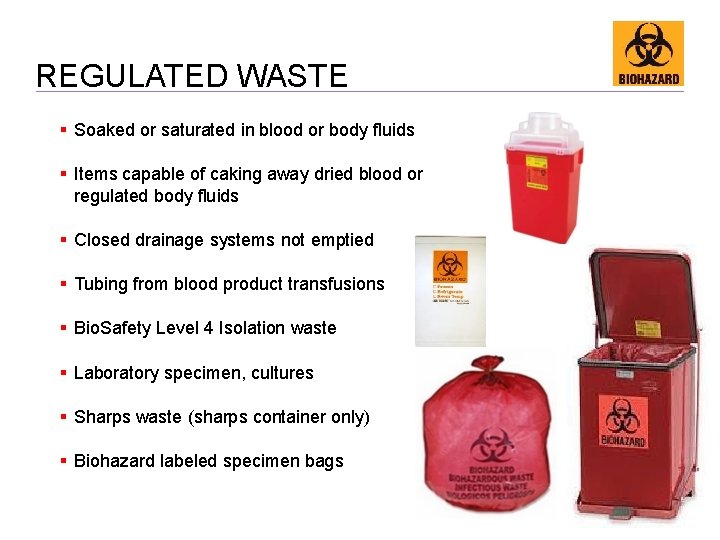
REGULATED WASTE Soaked or saturated in blood or body fluids Items capable of caking away dried blood or regulated body fluids Closed drainage systems not emptied Tubing from blood product transfusions Bio. Safety Level 4 Isolation waste Laboratory specimen, cultures Sharps waste (sharps container only) Biohazard labeled specimen bags 42
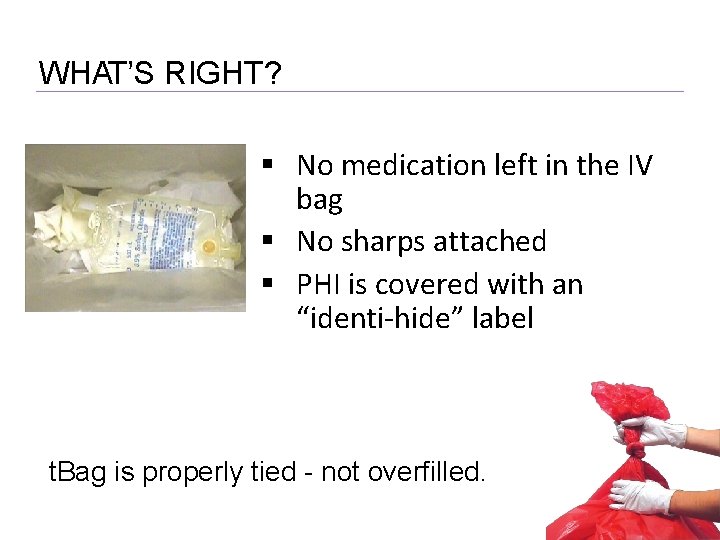
WHAT’S RIGHT? No medication left in the IV bag No sharps attached PHI is covered with an “identi-hide” label t. Bag is properly tied - not overfilled.
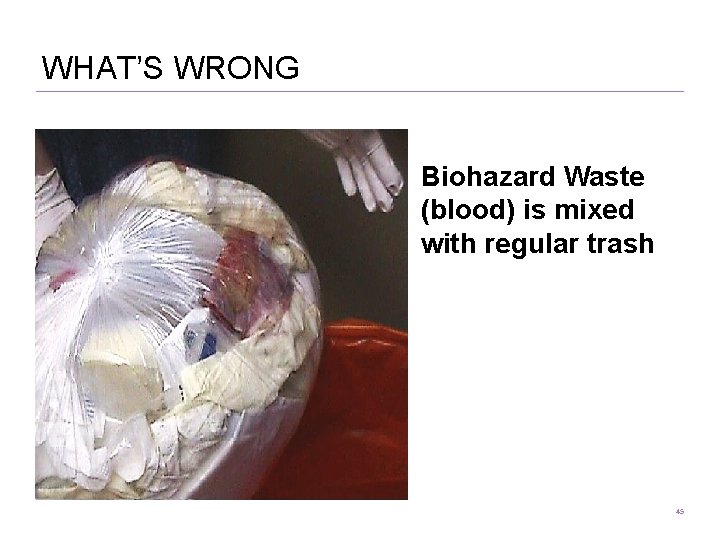
WHAT’S WRONG Biohazard Waste (blood) is mixed with regular trash 45
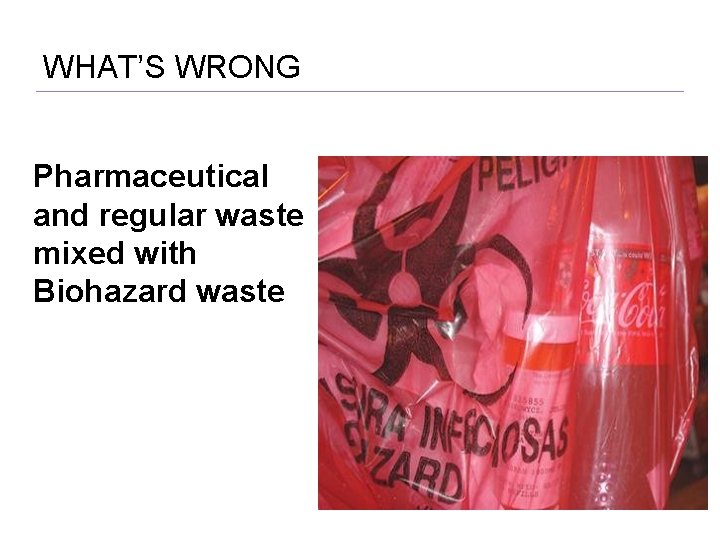
WHAT’S WRONG Pharmaceutical and regular waste mixed with Biohazard waste
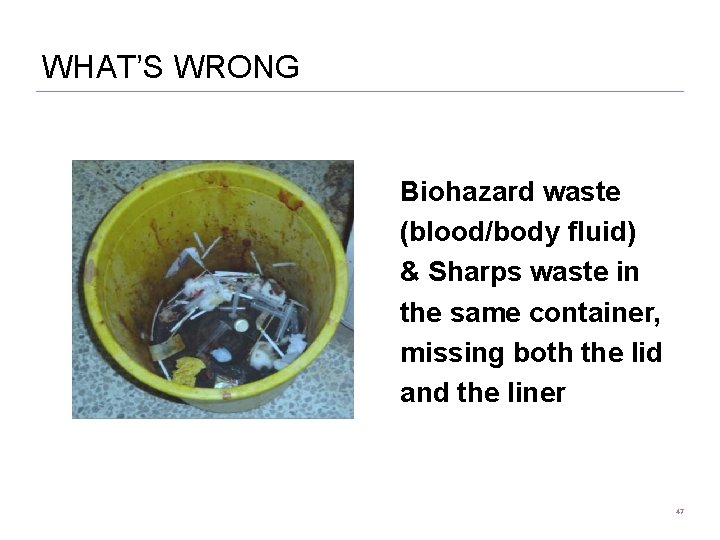
WHAT’S WRONG Biohazard waste (blood/body fluid) & Sharps waste in the same container, missing both the lid and the liner 47
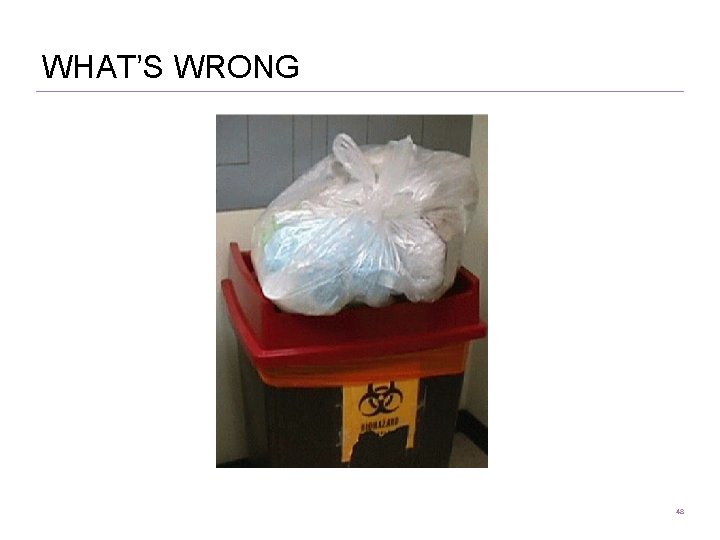
WHAT’S WRONG 48
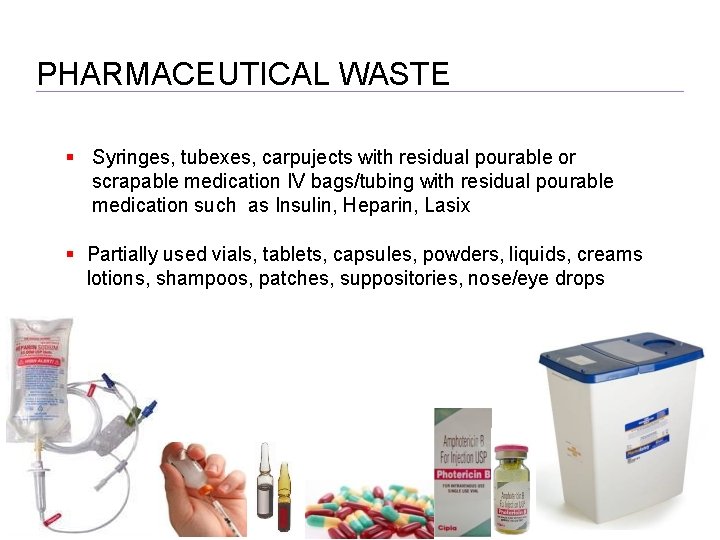
PHARMACEUTICAL WASTE Syringes, tubexes, carpujects with residual pourable or scrapable medication IV bags/tubing with residual pourable medication such as Insulin, Heparin, Lasix Partially used vials, tablets, capsules, powders, liquids, creams lotions, shampoos, patches, suppositories, nose/eye drops 49
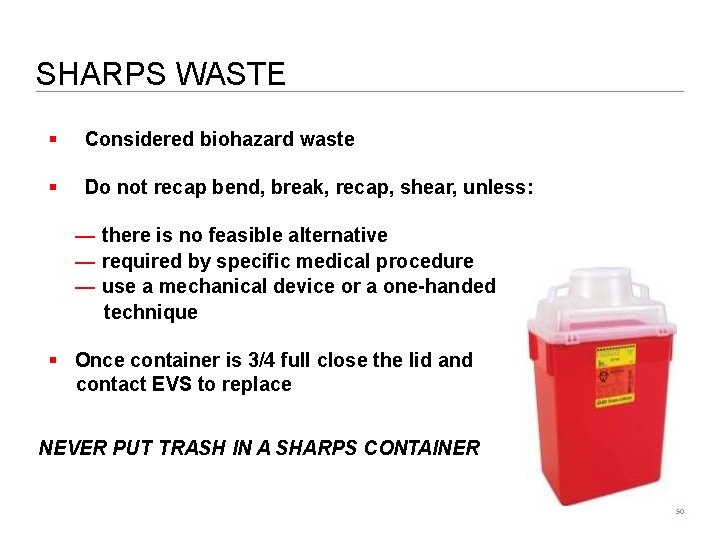
SHARPS WASTE Considered biohazard waste Do not recap bend, break, recap, shear, unless: — there is no feasible alternative — required by specific medical procedure — use a mechanical device or a one-handed technique Once container is 3/4 full close the lid and contact EVS to replace NEVER PUT TRASH IN A SHARPS CONTAINER 50
REFERENCES Jane D. Siegel, MD; Emily Rhinehart, RN MPH CIC; Marguerite Jackson, Ph. D; Linda Chiarello, RN MS; the Healthcare Infection Control Practices Advisory Committee (2007). Guideline for Isolation Precautions: Preventing Transmission of Infectious Agents in Healthcare Settings. http: //www. cdc. gov/hicpac/pdf/isolation/Isolation 2007. pdf Chiarello L, Jackson M, Rhinehart E, Siegel JD, and the Healthcare Infection Control Practices Advisory Committee (HICPAC) (2006). Management of Multidrug-Resistant Organisms In Healthcare Settings. http: //www. cdc. gov/hicpac/pdf/MDROGuideline 2006. pdf William A. Rutala, Ph. D. , M. P. H. , David J. Weber, M. D. , M. P. H. , and the Healthcare Infection Control Practices Advisory Committee (HICPAC) (2008) Guideline for Disinfection and Sterilization in Healthcare Facilities, Centers for Disease Control and Prevention. http: //www. cdc. gov/hicpac/pdf/guidelines/Disinfection_Nov_2008. pdf Lynne Sehulster, Ph. D. , Raymond Y. W. Chinn, M. D. , Center for Disease Control and Prevention / Healthcare Infection Control Practices Advisory Committee (HICPAC) (2003), Guidelines for Environmental Infection Control in Health-Care Facilities http: //www. cdc. gov/mmwr/preview/mmwrhtml/rr 5210 a 1. htm 53
- Slides: 23