
1 3 Types of the Syllable in English
1. 3 Types of the Syllable in English 1. 3. 1 Open Vs. Closed Syllables are divided into open and closed according to the ending of the syllable. Yule (2006: 47) distinguishes two types of syllables, namely open syllables, which have an onset and nucleus, but no coda, as in me, to, no, etc. ; and closed syllables, which occur in the cases when a coda is present, such as hit, kill, send, etc.
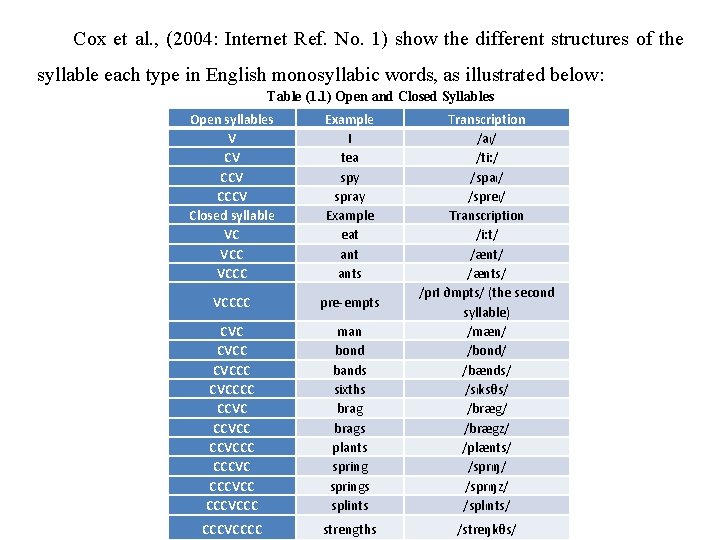
Cox et al. , (2004: Internet Ref. No. 1) show the different structures of the syllable each type in English monosyllabic words, as illustrated below: Table (1. 1) Open and Closed Syllables Open syllables V CV CCCV Closed syllable VC VCCC Example I tea spy spray Example eat ants VCCCC pre-empts CVCCCC CCVCCC CCCVCCC man bond bands sixths brags plants springs splints Transcription /a. I/ /ti: / /spa. I/ /spre. I/ Transcription /i: t/ /ænts/ /pr. I ∂mpts/ (the second syllable) /mæn/ /bond/ /bænds/ /s. Iksθs/ /brægz/ /plænts/ /spr. Iŋz/ /spl. Ints/ CCCVCCCC strengths /streŋkθs/
1. 3. 2 Simple Vs complex syllables To start with, a simple syllable can be defined as "a syllable with a vowel or a vowel accompanied by a single consonant or a vowel followed and preceded by a single consonant". All other kinds of syllables can be thought of as complex syllables, such as a syllable with consonant clusters in the onset and/or the coda (Cox et. al. , 2004: 1).
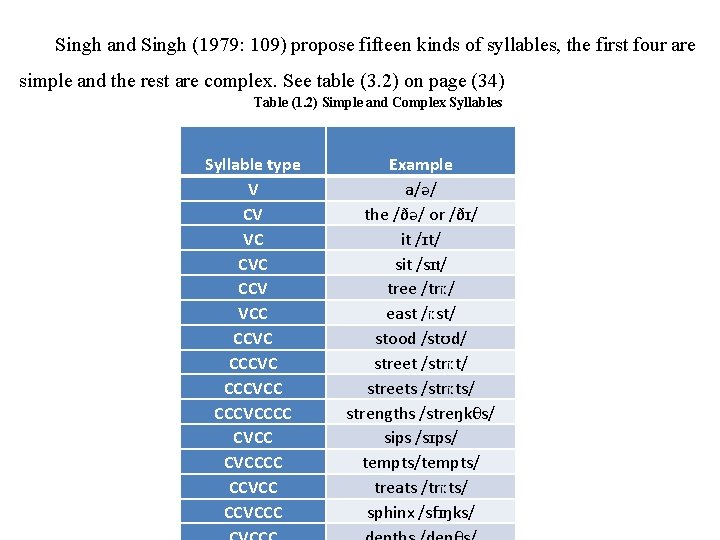
Singh and Singh (1979: 109) propose fifteen kinds of syllables, the first four are simple and the rest are complex. See table (3. 2) on page (34) Table (1. 2) Simple and Complex Syllables Syllable type V CV VC CCV VCC CCVC CCCVCCCC CVCCCC CCVCCC Example a/ə/ the /ðə/ or /ðɪ/ it /ɪt/ sit /sɪt/ tree /triː/ east /iːst/ stood /stʊd/ street /striːt/ streets /striːts/ strengths /streŋkθs/ sips /sɪps/ tempts/ treats /triːts/ sphinx /sfɪŋks/
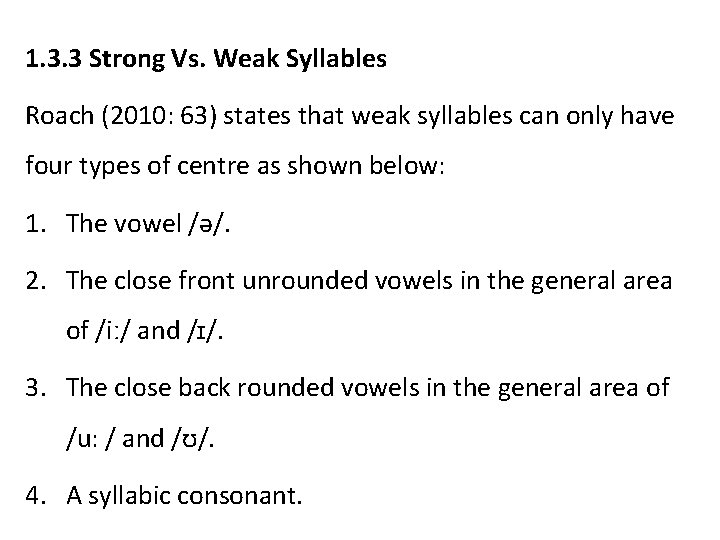
1. 3. 3 Strong Vs. Weak Syllables Roach (2010: 63) states that weak syllables can only have four types of centre as shown below: 1. The vowel /ə/. 2. The close front unrounded vowels in the general area of /iː/ and /ɪ/. 3. The close back rounded vowels in the general area of /u: / and /ʊ/. 4. A syllabic consonant.
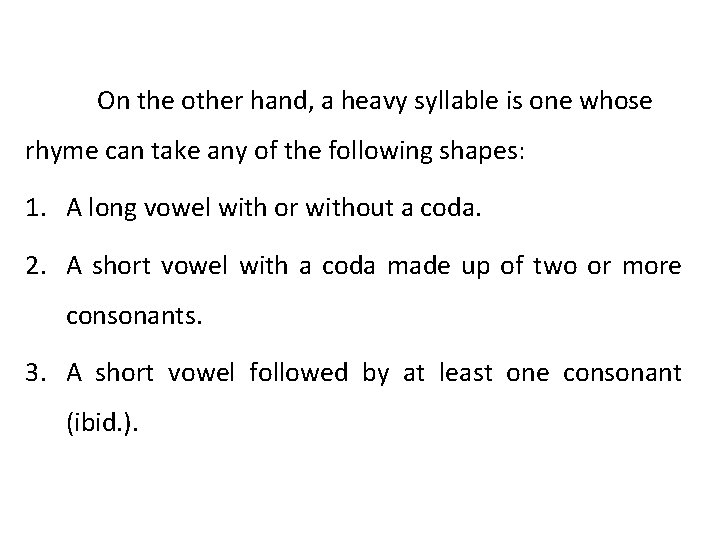
On the other hand, a heavy syllable is one whose rhyme can take any of the following shapes: 1. A long vowel with or without a coda. 2. A short vowel with a coda made up of two or more consonants. 3. A short vowel followed by at least one consonant (ibid. ).
- Slides: 6