
1 3 Stokes theorems Boundaries differentials Flux Flow
§ 1. 3 Stokes’ theorems: Boundaries; differentials; Flux, Flow, &Substance Christopher Crawford PHY 311 2014 -01 -29
Outline • Regions – what you integrate over Boundary operator : boundaries vs. cycles Boundary of a boundary and converse • Flow, Flux, and Substance integrals – visualization of FTVC’s Water analogy: the velocity field Flow sheets, flux tubes, substances boxes Relation to sources: gradient, curl, divergence – FTVC’s • Differentials – small chunks of Flow, Flux, Subst Calculation of gradient, curl, divergence Generalized formulas for curvilinear coordinates • Poincaré lemma – analog of : exact vs. closed Vector identities stemming from and converse • Generalized Stokes’ theorem – a geometric duality Pictures of FTVC, Stokes’ Gauss’ theorems, proof by induction 2
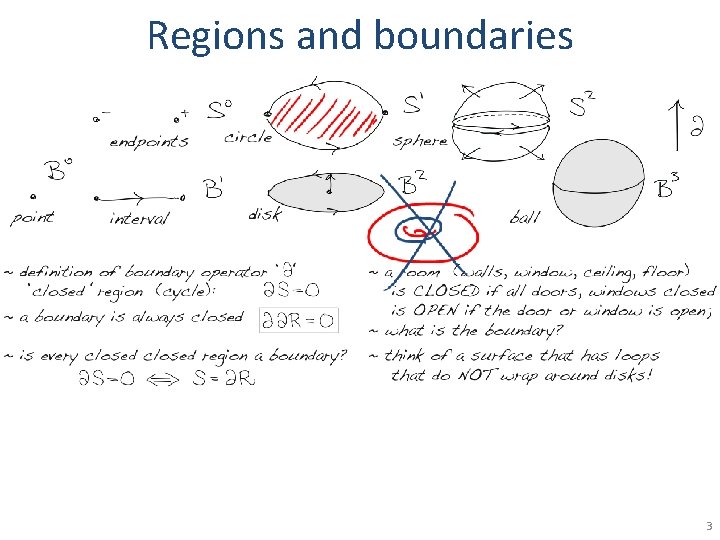
Regions and boundaries 3
![Velocity field: flux, flow, [and fish] 4](http://slidetodoc.com/presentation_image_h2/4907b584faa1d30d60a7307abacba07e/image-4.jpg "Velocity field: flux, flow, [and fish] 4")
Velocity field: flux, flow, [and fish] 4
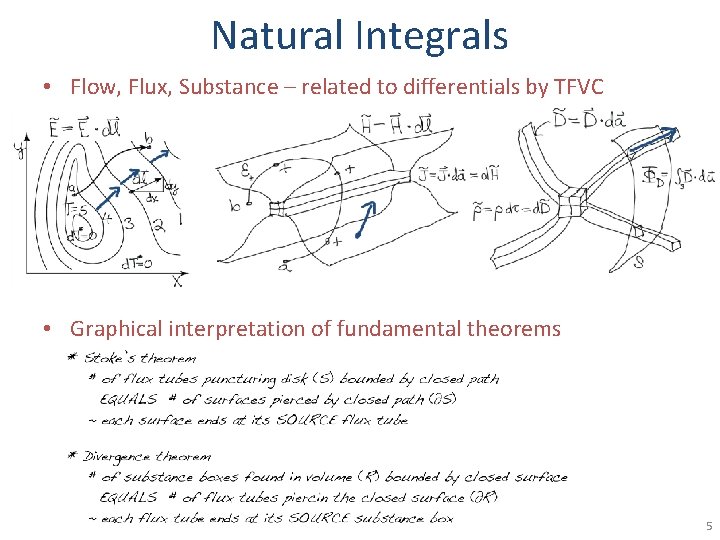
Natural Integrals • Flow, Flux, Substance – related to differentials by TFVC • Graphical interpretation of fundamental theorems 5
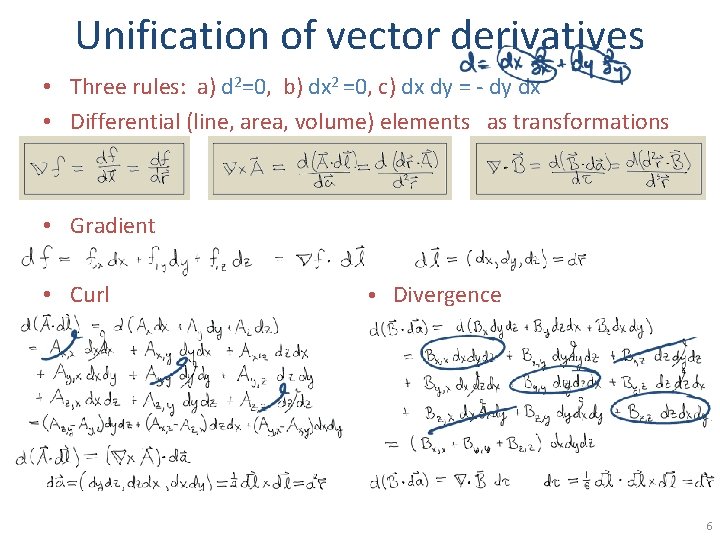
Unification of vector derivatives • Three rules: a) d 2=0, b) dx 2 =0, c) dx dy = - dy dx • Differential (line, area, volume) elements as transformations • Gradient • Curl Divergence 6
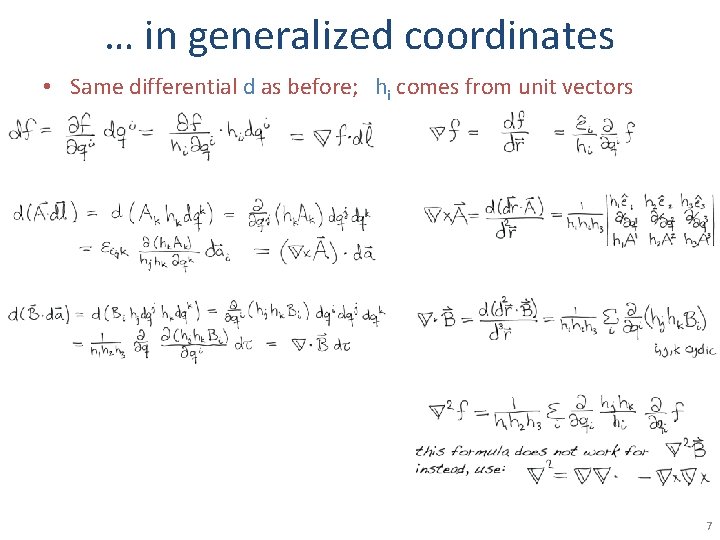
… in generalized coordinates • Same differential d as before; hi comes from unit vectors 7
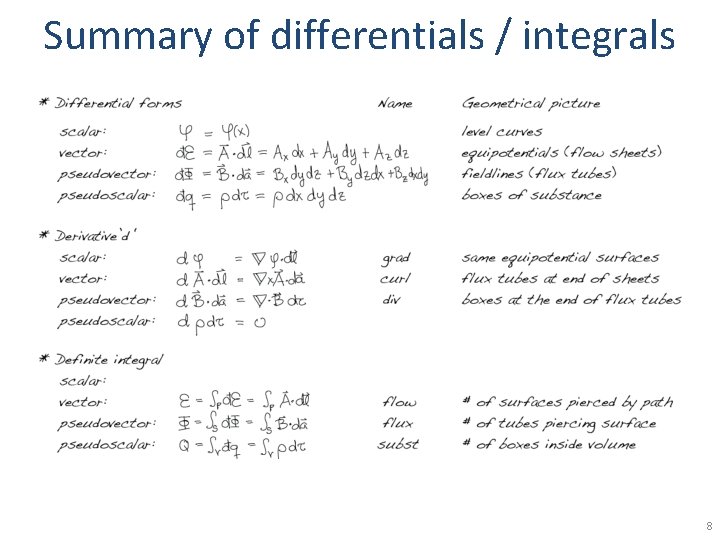
Summary of differentials / integrals 8
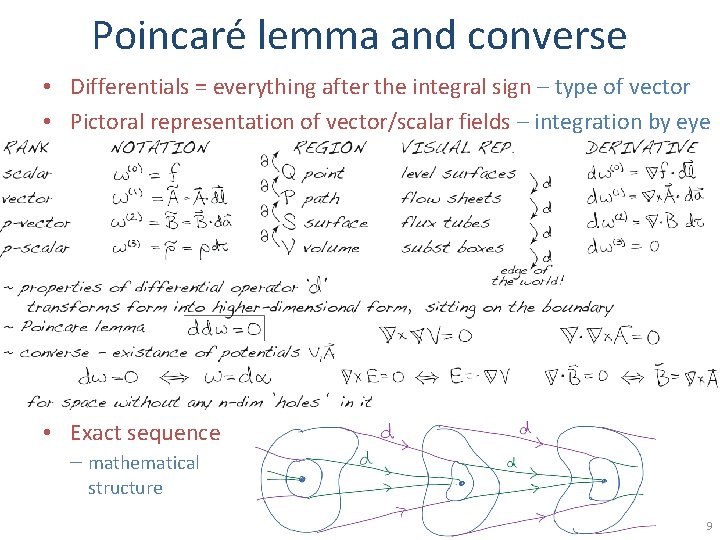
Poincaré lemma and converse • Differentials = everything after the integral sign – type of vector • Pictoral representation of vector/scalar fields – integration by eye • Exact sequence – mathematical structure 9
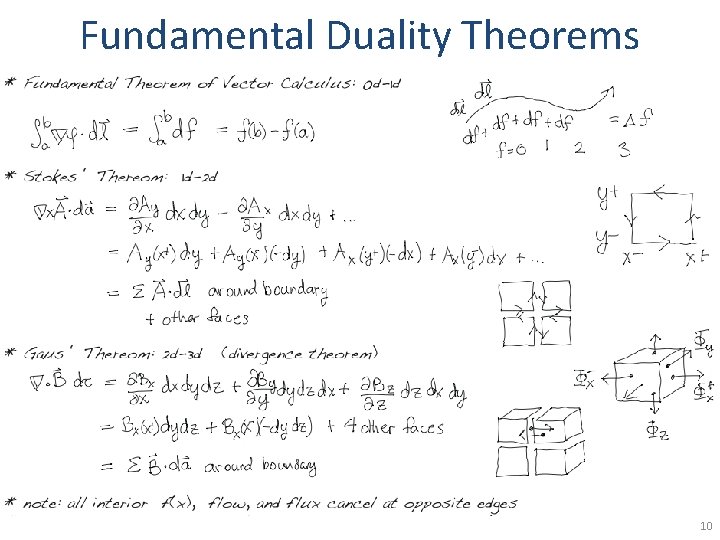
Fundamental Duality Theorems 10
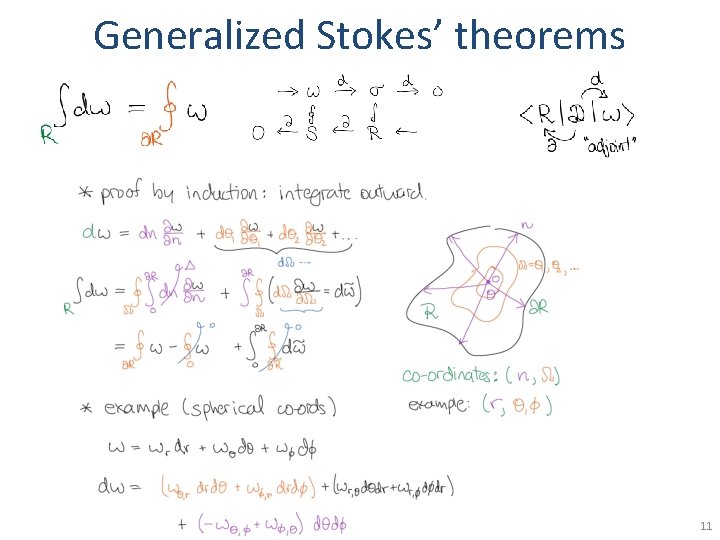
Generalized Stokes’ theorems 11
- Slides: 11