
1 3 Real Numbers Essential Questions 1How do
1. 3 Real Numbers Essential Questions: 1)How do you classify numbers? 2) What are counterexamples? 3) How do you compare numbers?
• Real numbers can be classified according to their characteristics: – Natural Numbers are the counting numbers: 1, 2, 3… – Whole Numbers are the natural numbers and zero: 0, 1, 2, 3, … – Integers are the positives and negatives: …, -3, -2, -1, 0, 1, 2, 3, …
• Rational numbers are numbers that can be expressed in the form where a and b are both integers and b≠ 0 • When expressed as a decimal, a rational number is either a terminating decimal or a repeating decimal. • A terminating decimal has a finite number of digits after the decimal point (ex. 1. 25, 2. 75, and 4. 0) • A repeating decimal has a block of one or more digits after the decimal point that repeat continuously (where all digits are not zeros). • Irrational numbers are all numbers that are not rational. • 0. 1010010000100000… • Pi • e
Rational & Irrational • Rational Numbers: all regular numbers, decimals, and fractions • Irrational Numbers: all other numbers (numbers that don’t repeat and continue forever)
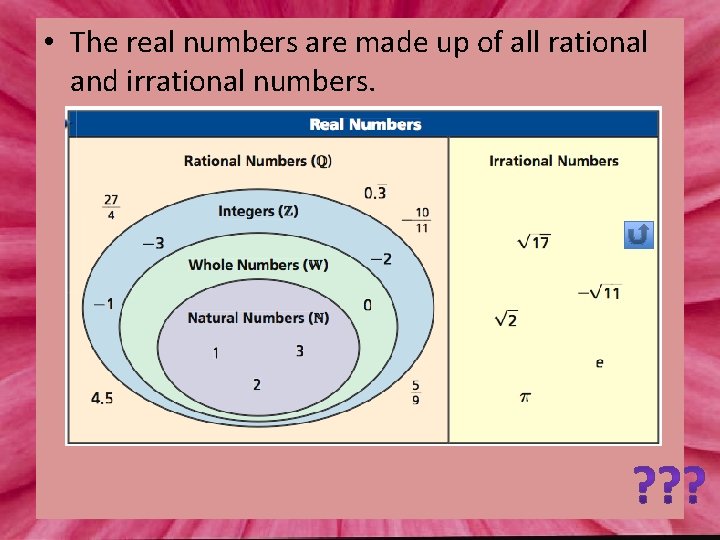
• The real numbers are made up of all rational and irrational numbers.

Brace Map: Whole-Part
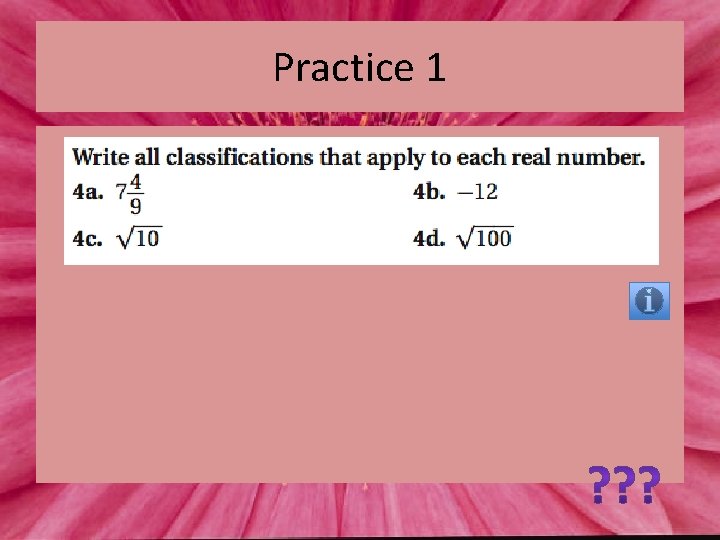
Practice 1
Proving something False • Any example that proves a statement false is a counterexample. – For instance: All whole numbers are natural numbers. • This FALSE. Zero is a counterexample.
Practice 2 • Determine if the statement is true or false. Use a counterexample to prove it is false. A) All whole numbers are integers. B) No fractions are whole numbers.
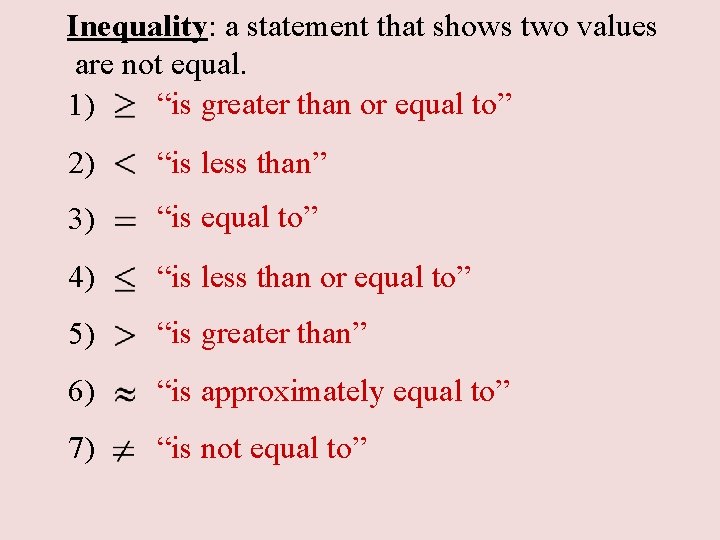
Inequality: a statement that shows two values are not equal. “is greater than or equal to” 1) 2) “is less than” 3) “is equal to” 4) “is less than or equal to” 5) “is greater than” 6) “is approximately equal to” 7) “is not equal to”
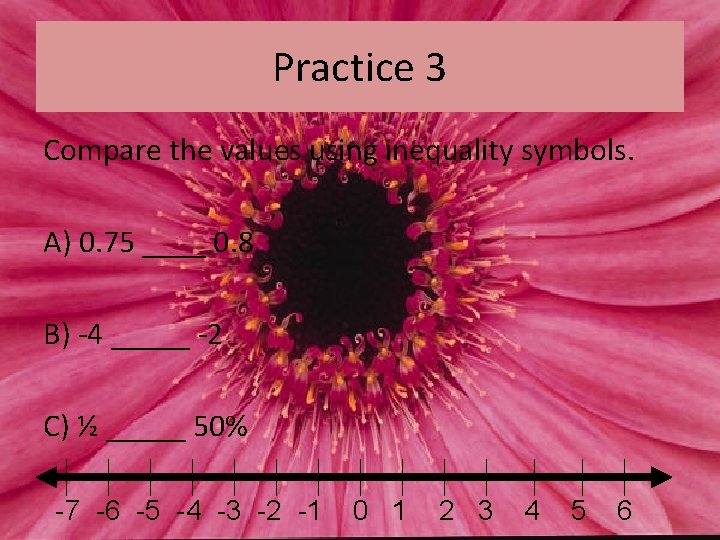
Practice 3 Compare the values using inequality symbols. A) 0. 75 ____ 0. 8 B) -4 _____ -2 C) ½ _____ 50% -7 -6 -5 -4 -3 -2 -1 0 1 2 3 4 5 6
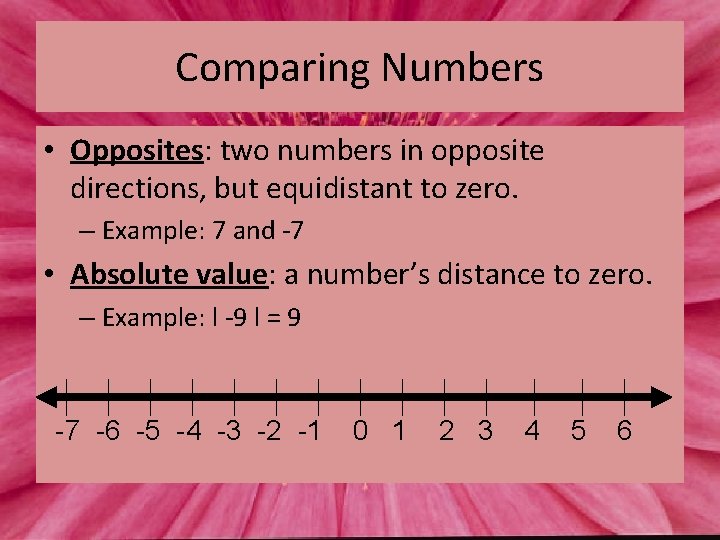
Comparing Numbers • Opposites: two numbers in opposite directions, but equidistant to zero. – Example: 7 and -7 • Absolute value: a number’s distance to zero. – Example: l -9 l = 9 -7 -6 -5 -4 -3 -2 -1 0 1 2 3 4 5 6
Practice 4 • Find the opposite of 33. • Find the absolute value of -17.
Summary Answer the essential questions in complete sentences. 1)How do you classify numbers? 2) What are counterexamples? 3) How do you compare numbers? • STUDY QUESTIONS: Write 1 -4 study questions in the left column to help study and explain the notes.
- Slides: 14