
1 3 Present tense of ser Subject pronouns
1. 3 Present tense of ser Subject pronouns ANTE TODO § In order to use verbs, you will need to learn about subject pronouns. § A subject pronoun replaces the name or title of a person or thing and acts as the subject of a verb. § In both Spanish and English, subject pronouns are divided into three groups: first person, second person, and third person.
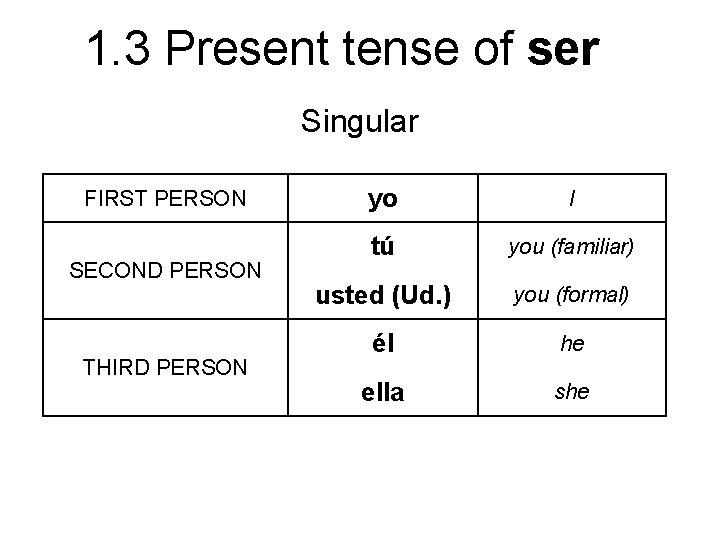
1. 3 Present tense of ser Singular FIRST PERSON SECOND PERSON THIRD PERSON yo I tú you (familiar) usted (Ud. ) you (formal) él he ella she
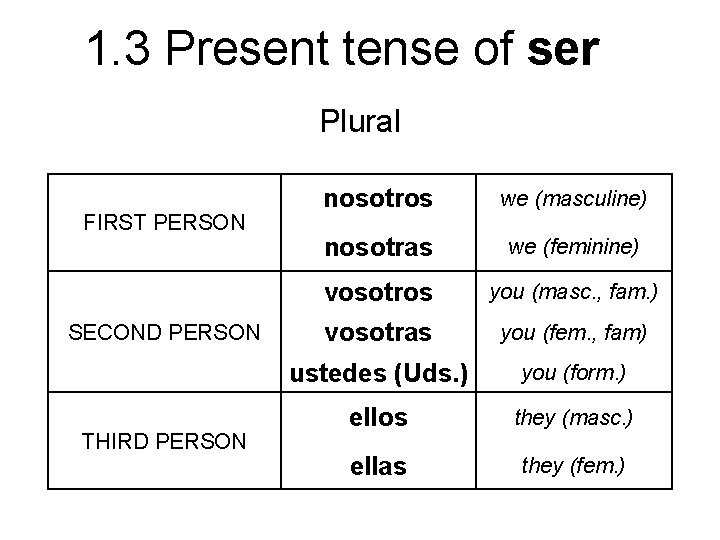
1. 3 Present tense of ser Plural FIRST PERSON SECOND PERSON THIRD PERSON nosotros we (masculine) nosotras we (feminine) vosotros you (masc. , fam. ) vosotras you (fem. , fam) ustedes (Uds. ) you (form. ) ellos they (masc. ) ellas they (fem. )
1. 3 Present tense of ser Subject pronouns § Spanish has two subject pronouns that mean you (singular). § Use tú when addressing a friend, a family member, or a child you know well. § Use usted to address a person with whom you have a formal or more distant relationship, such as a superior at work, a professor, or an older person.
1. 3 Present tense of ser Subject pronouns § The masculine plural forms nosotros, vosotros, and ellos refer to a group of males or to a group of males and females. § The feminine plural forms nosotras, vosotras, and ellas can refer only to groups made up exclusively of females.
1. 3 Present tense of ser Subject pronouns § There is no Spanish equivalent of the English subject pronoun it. Generally it is not expressed in Spanish. Es un problema. Es una computadora. It’s a problem. It’s a computer.
1. 3 Present tense of ser The verb ser (to be) § Ser is an irregular verb, which means its forms don’t follow the regular patterns that most verbs follow. § You need to memorize the forms which will appear in the charts.
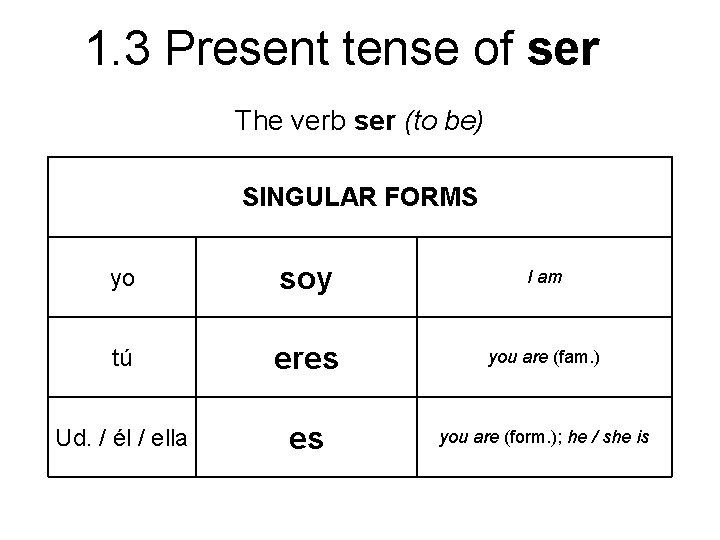
1. 3 Present tense of ser The verb ser (to be) SINGULAR FORMS yo soy I am tú eres you are (fam. ) Ud. / él / ella es you are (form. ); he / she is
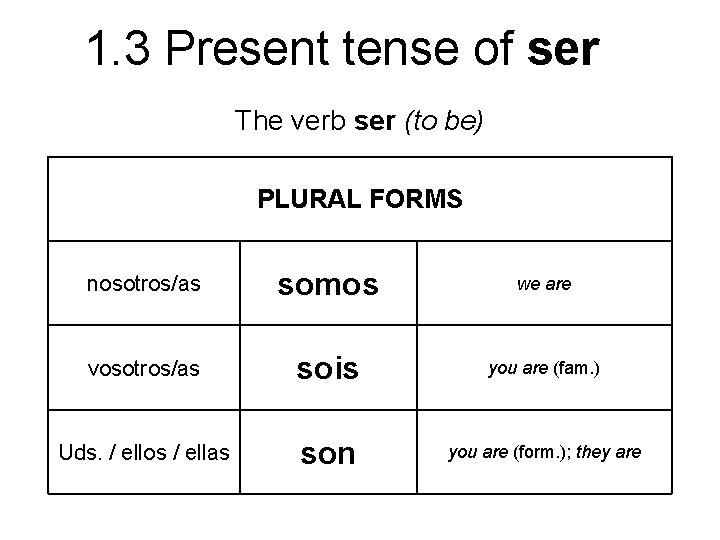
1. 3 Present tense of ser The verb ser (to be) PLURAL FORMS nosotros/as somos we are vosotros/as sois you are (fam. ) Uds. / ellos / ellas son you are (form. ); they are
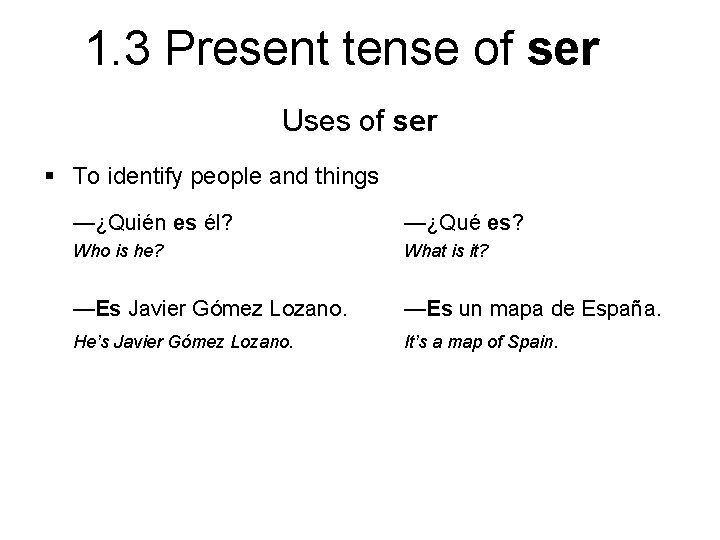
1. 3 Present tense of ser Uses of ser § To identify people and things —¿Quién es él? —¿Qué es? Who is he? What is it? —Es Javier Gómez Lozano. —Es un mapa de España. It’s a map of Spain. He’s Javier Gómez Lozano.
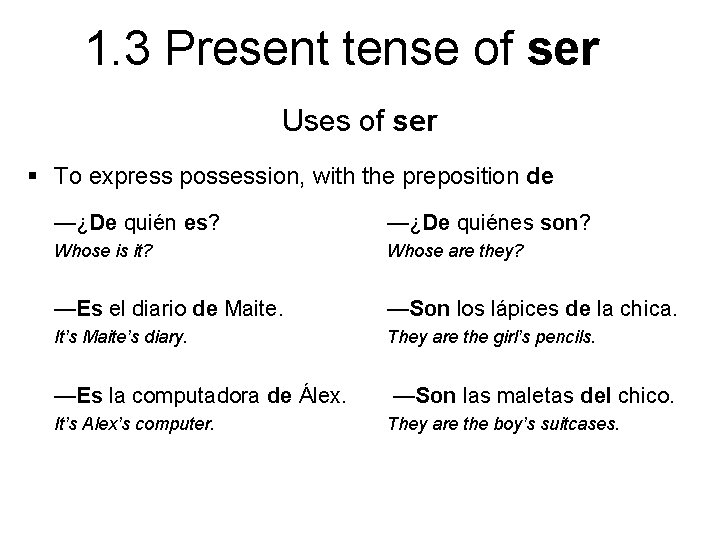
1. 3 Present tense of ser Uses of ser § To express possession, with the preposition de —¿De quién es? —¿De quiénes son? Whose is it? Whose are they? —Es el diario de Maite. —Son los lápices de la chica. It’s Maite’s diary. They are the girl’s pencils. —Es la computadora de Álex. It’s Alex’s computer. —Son las maletas del chico. They are the boy’s suitcases.
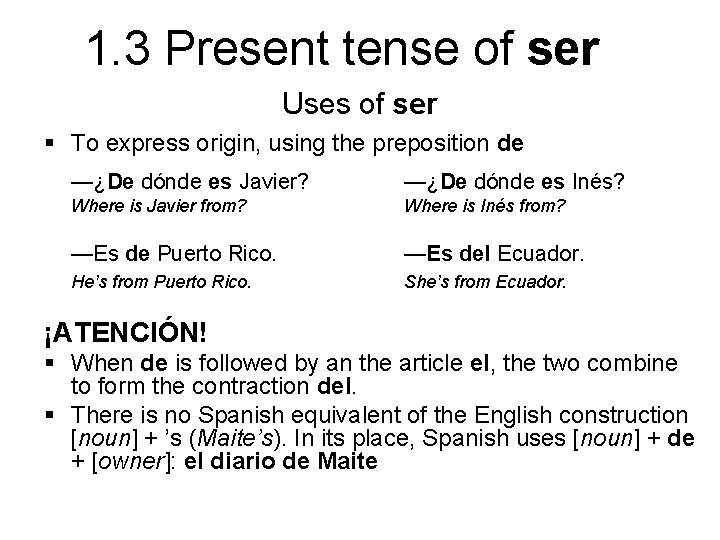
1. 3 Present tense of ser Uses of ser § To express origin, using the preposition de —¿De dónde es Javier? —¿De dónde es Inés? Where is Javier from? Where is Inés from? —Es de Puerto Rico. —Es del Ecuador. He’s from Puerto Rico. She’s from Ecuador. ¡ATENCIÓN! § When de is followed by an the article el, the two combine to form the contraction del. § There is no Spanish equivalent of the English construction [noun] + ’s (Maite’s). In its place, Spanish uses [noun] + de + [owner]: el diario de Maite
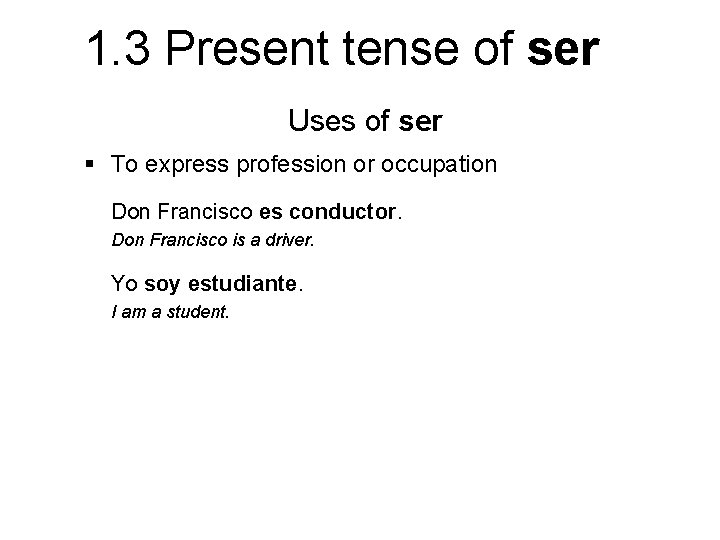
1. 3 Present tense of ser Uses of ser § To express profession or occupation Don Francisco es conductor. Don Francisco is a driver. Yo soy estudiante. I am a student.
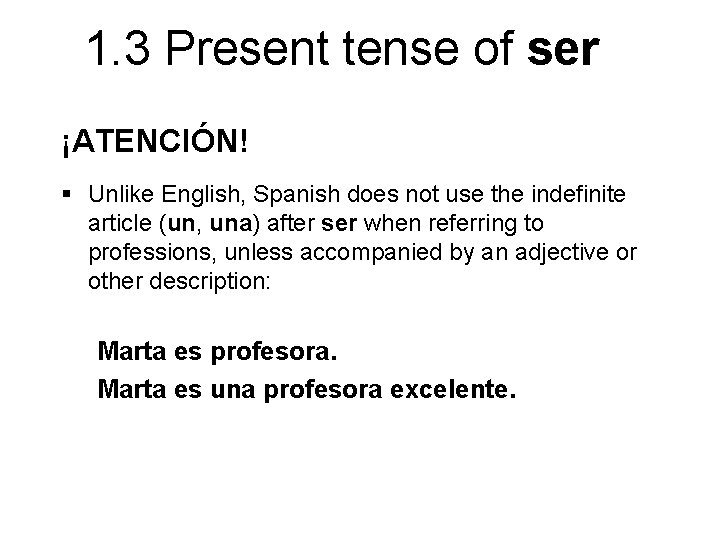
1. 3 Present tense of ser ¡ATENCIÓN! § Unlike English, Spanish does not use the indefinite article (un, una) after ser when referring to professions, unless accompanied by an adjective or other description: Marta es profesora. Marta es una profesora excelente.
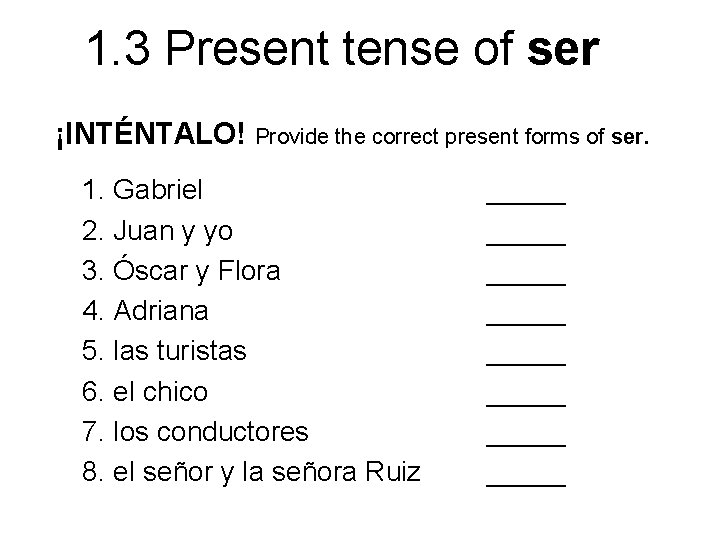
1. 3 Present tense of ser ¡INTÉNTALO! Provide the correct present forms of ser. 1. Gabriel 2. Juan y yo 3. Óscar y Flora 4. Adriana 5. las turistas 6. el chico 7. los conductores 8. el señor y la señora Ruiz _____ _____
- Slides: 15