
1 3 Frequency of inspection with various track
- Slides: 31
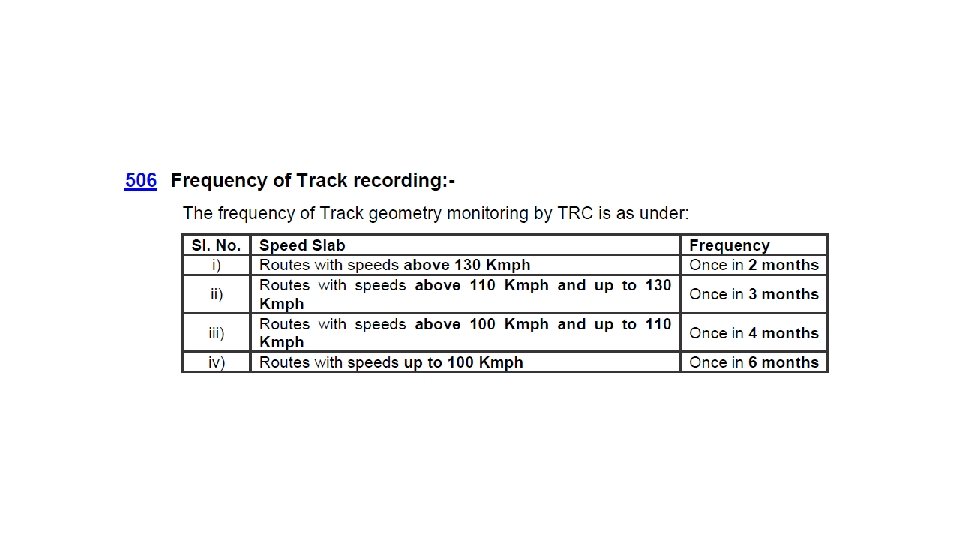
1. 3 Frequency of inspection with various track recording modes (TRC, OMS, Oscillograph car), Periods- 4
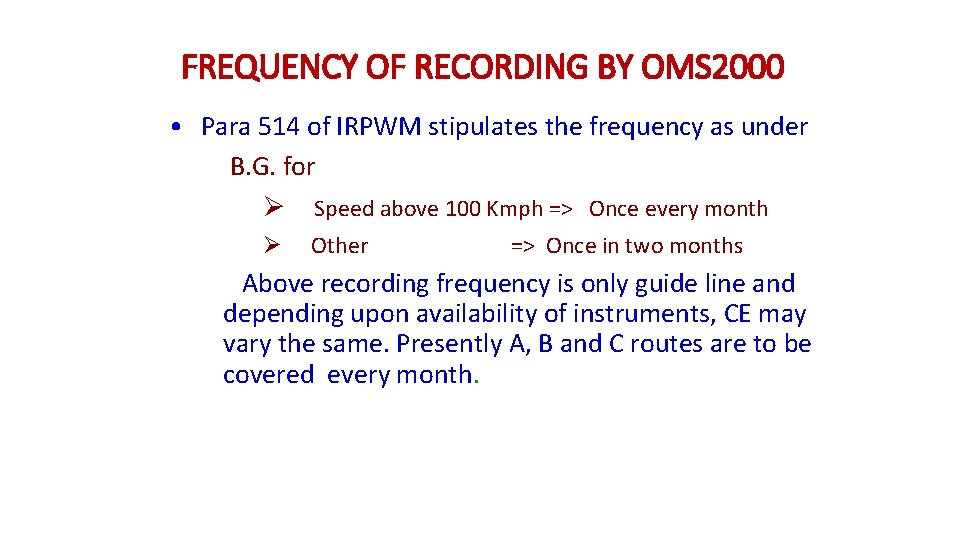
FREQUENCY OF RECORDING BY OMS 2000 • Para 514 of IRPWM stipulates the frequency as under B. G. for Ø Speed above 100 Kmph => Once every month Ø Other => Once in two months Above recording frequency is only guide line and depending upon availability of instruments, CE may vary the same. Presently A, B and C routes are to be covered every month.
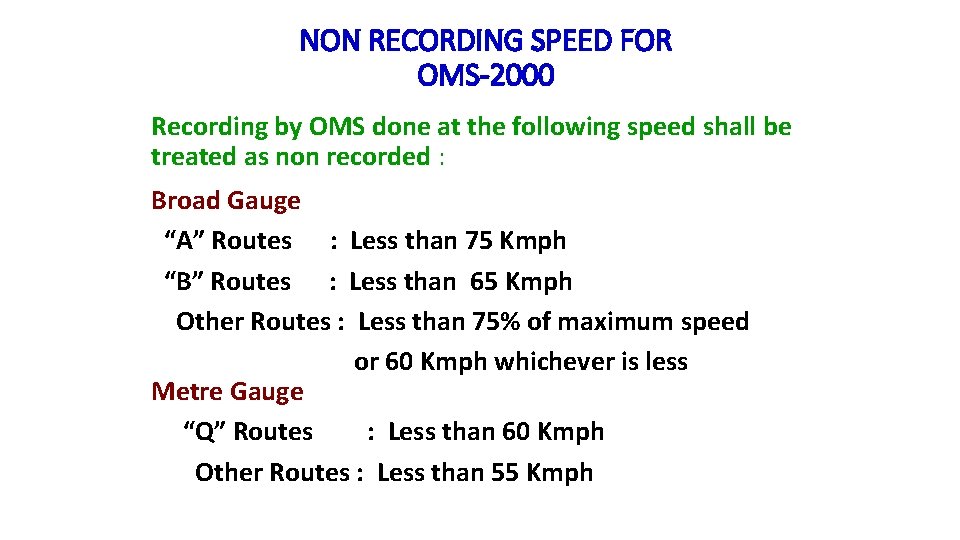
NON RECORDING SPEED FOR OMS-2000 Recording by OMS done at the following speed shall be treated as non recorded : Broad Gauge “A” Routes : Less than 75 Kmph “B” Routes : Less than 65 Kmph Other Routes : Less than 75% of maximum speed or 60 Kmph whichever is less Metre Gauge “Q” Routes : Less than 60 Kmph Other Routes : Less than 55 Kmph
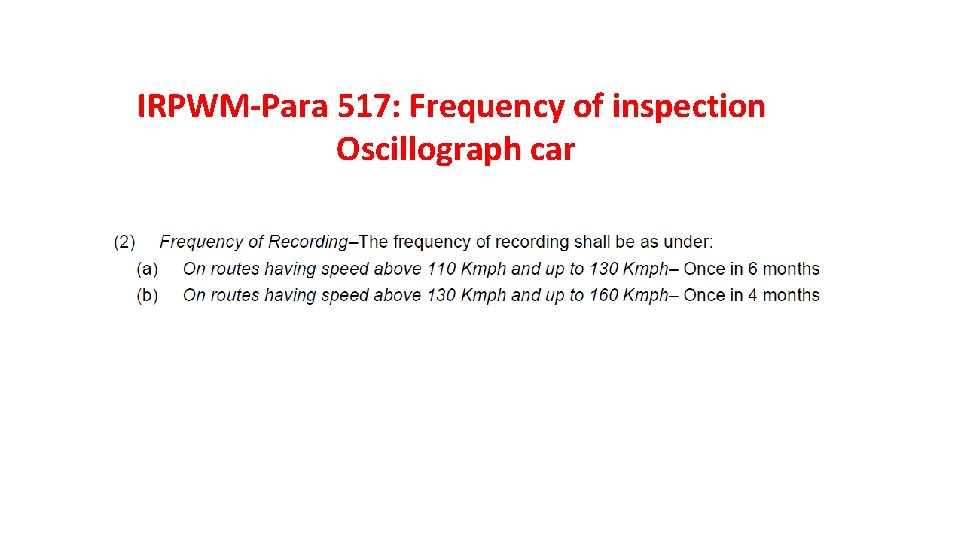
IRPWM-Para 517: Frequency of inspection Oscillograph car
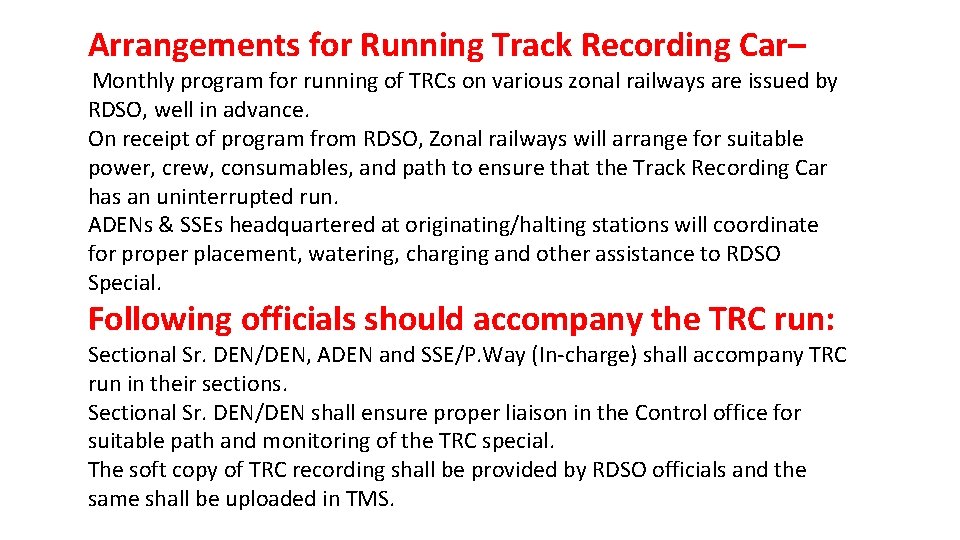
Arrangements for Running Track Recording Car– Monthly program for running of TRCs on various zonal railways are issued by RDSO, well in advance. On receipt of program from RDSO, Zonal railways will arrange for suitable power, crew, consumables, and path to ensure that the Track Recording Car has an uninterrupted run. ADENs & SSEs headquartered at originating/halting stations will coordinate for proper placement, watering, charging and other assistance to RDSO Special. Following officials should accompany the TRC run: Sectional Sr. DEN/DEN, ADEN and SSE/P. Way (In-charge) shall accompany TRC run in their sections. Sectional Sr. DEN/DEN shall ensure proper liaison in the Control office for suitable path and monitoring of the TRC special. The soft copy of TRC recording shall be provided by RDSO officials and the same shall be uploaded in TMS.
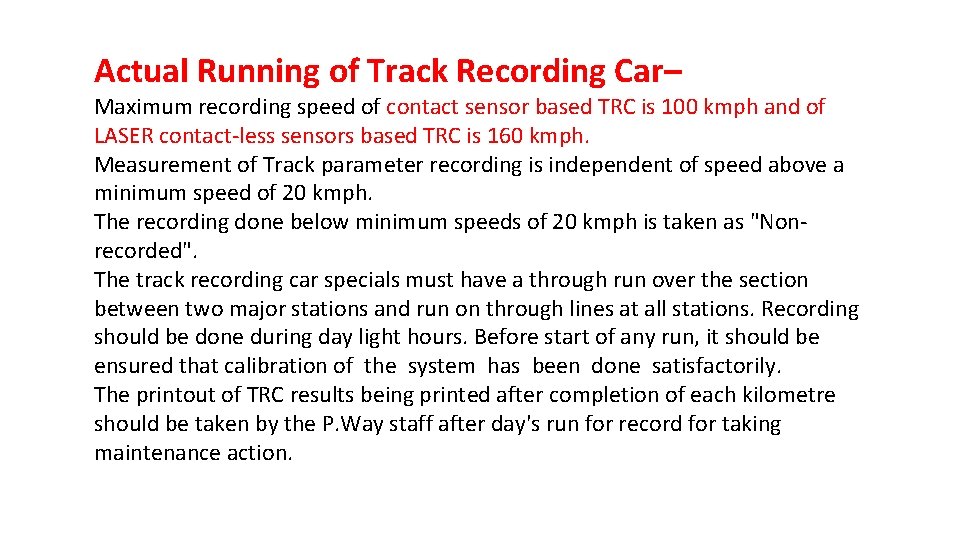
Actual Running of Track Recording Car– Maximum recording speed of contact sensor based TRC is 100 kmph and of LASER contact-less sensors based TRC is 160 kmph. Measurement of Track parameter recording is independent of speed above a minimum speed of 20 kmph. The recording done below minimum speeds of 20 kmph is taken as "Nonrecorded". The track recording car specials must have a through run over the section between two major stations and run on through lines at all stations. Recording should be done during day light hours. Before start of any run, it should be ensured that calibration of the system has been done satisfactorily. The printout of TRC results being printed after completion of each kilometre should be taken by the P. Way staff after day's run for record for taking maintenance action.
Actual Running of Track Recording Car– Maximum recording speed of contact sensor based TRC is 100 kmph and of LASER contact-less sensors based TRC is 160 kmph. Measurement of Track parameter recording is independent of speed above a minimum speed of 20 kmph. The recording done below minimum speeds of 20 kmph is taken as "Nonrecorded". The track recording car specials must have a through run over the section between two major stations and run on through lines at all stations. Recording should be done during day light hours. Before start of any run, it should be ensured that calibration of the system has been done satisfactorily. The printout of TRC results being printed after completion of each kilometre should be taken by the P. Way staff after day's run for record for taking maintenance action.
Railway Board’s instructions regarding running of Track Monitoring Cars Ref : 1. Para 609, 610 of IRPWM 2. Rly. Bd’s letter No. 90/Track-III/Tk/72 dated 09/07/1990 3. Rly. Bd’s letter No. 92/Chg-II/34/TRC dated 15. 10. 92 4. Rly. Bd’s letter No. 92/Chg-II/34/TRC dated 24. 02. 93 i) ii) Programme of TRCs to reach RLys at least 2 weeks in advance. Arrangement of suitable power/path from optg to be done by the engg branch of the zonal railways. iii) AEN & PWIs of the originating and halting stations are responsible for proper placement, watering, charging and other assistance to RDSO Special. iv) H. S. D. Oil for the generators of the recording specials to be arranged by Engineering Department of division as per requirement given by RDSO in advance. 9
Railway Board’s instructions regarding running of Track Monitoring Cars The monitoring special shall be accompanied by the following officers from the Railway and Division – a) Group ‘A’ route: Railway – The territorial HOD or any other SAG/JAG officer nominated by CE/CTE Division – Sectional Sr. DEN/DEN, AEN & PWI b) Other than Group ‘A’ route: Railway – A officer from track modernization cell not below the rank of SS/JA Grade Division – Sectional Sr. DEN/DEN, AEN & PWI vi) One nominated Sr. DEN/DEN at Divisional Headquarters shall ensure that there is proper liaison in the control office to ensure suitable path for the monitoring special v) 10
Railway Board’s instructions regarding running of Track Monitoring Cars… Contd. . vii) Any special requirement as indicated by RDSO should also be taken care of by the railway / division. viii) The operating staff at the starting/halting station shall ensure the following: a) The TRC is properly attached as the last vehicle with window trailing. b) The TRC is placed on level track adjacent to the platform line at least one hour before the scheduled departure for calibration of the TRC. c) Rough shunting of TRC is not permitted. At the starting and destination stations, the TRCs should only be placed in the saloon sliding. 11
Actions to be taken in event of non-running of TRC/Oscillograph Car on Rajdhani Route 1. CRS/Eastern Circle’s letter No. 549 dated 08/07/1980 2. CRS/Western Circle’s letter No. 30 -5/20/886 dated 05/08/1980 3. CRS/Central Circle’s letter No. 374 dated 20/05/1988 A. Track Recording Car i)fails to run the TRC with in 3 months of the date of the last run. Locomotive inspection on Rajdhani Express by J. A. Grade officer nominated by CE/CTE. A monitoring report and a safety certificate to be issued. The CE/CTE to issue an order permitting the continuation of speed of Rajdhani Express for the 4 th month. A copy of the same original certificate to be sent to CRS for records. 12
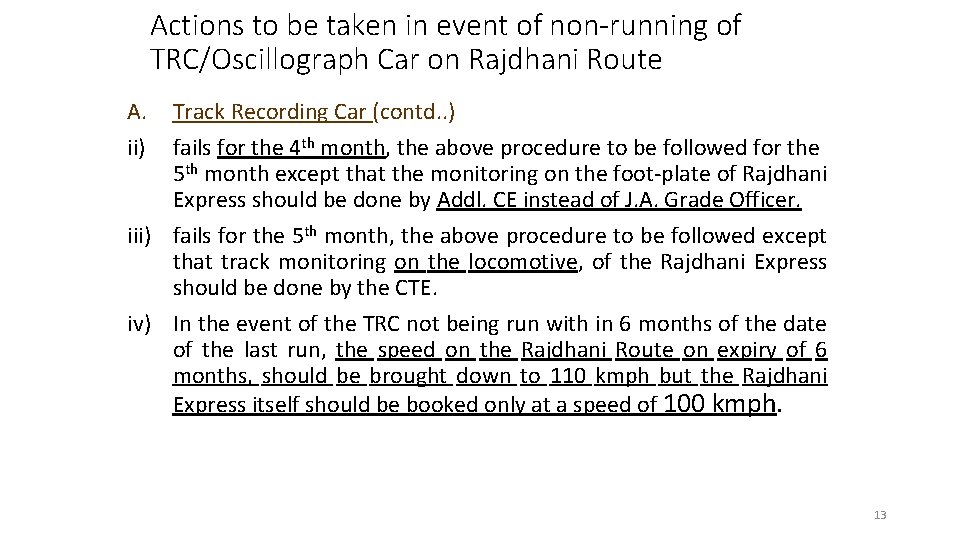
Actions to be taken in event of non-running of TRC/Oscillograph Car on Rajdhani Route A. ii) Track Recording Car (contd. . ) fails for the 4 th month, the above procedure to be followed for the 5 th month except that the monitoring on the foot-plate of Rajdhani Express should be done by Addl. CE instead of J. A. Grade Officer. iii) fails for the 5 th month, the above procedure to be followed except that track monitoring on the locomotive, of the Rajdhani Express should be done by the CTE. iv) In the event of the TRC not being run with in 6 months of the date of the last run, the speed on the Rajdhani Route on expiry of 6 months, should be brought down to 110 kmph but the Rajdhani Express itself should be booked only at a speed of 100 kmph. 13
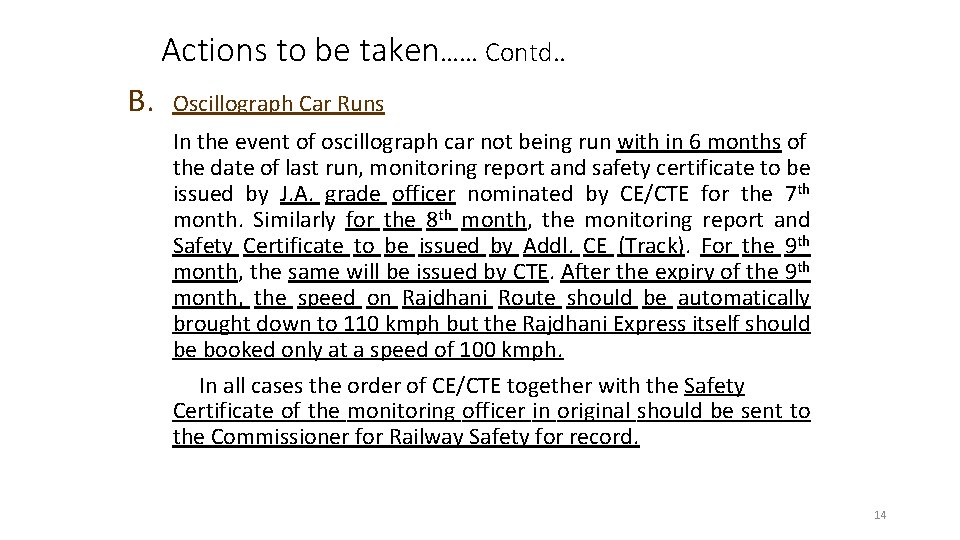
Actions to be taken…… Contd. . B. Oscillograph Car Runs In the event of oscillograph car not being run with in 6 months of the date of last run, monitoring report and safety certificate to be issued by J. A. grade officer nominated by CE/CTE for the 7 th month. Similarly for the 8 th month, the monitoring report and Safety Certificate to be issued by Addl. CE (Track). For the 9 th month, the same will be issued by CTE. After the expiry of the 9 th month, the speed on Rajdhani Route should be automatically brought down to 110 kmph but the Rajdhani Express itself should be booked only at a speed of 100 kmph. In all cases the order of CE/CTE together with the Safety Certificate of the monitoring officer in original should be sent to the Commissioner for Railway Safety for record. 14
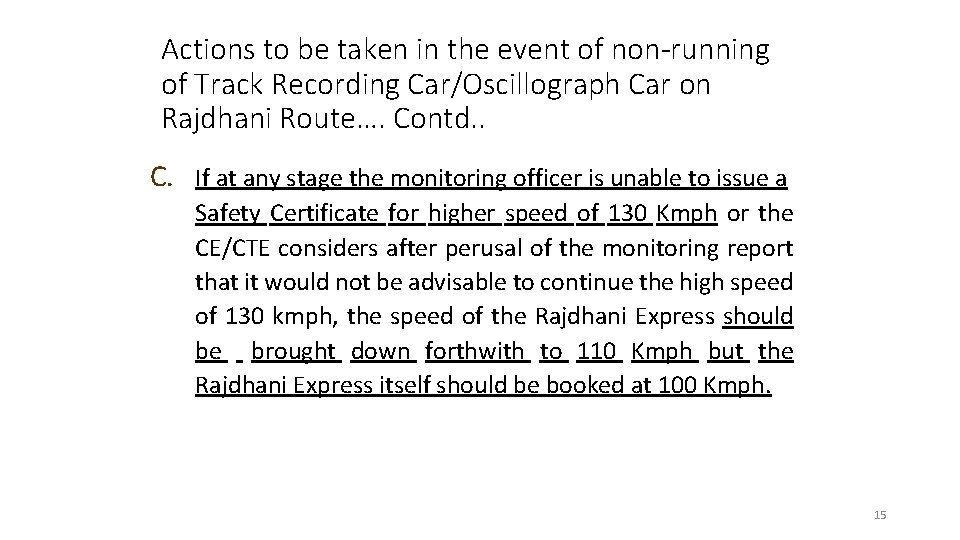
Actions to be taken in the event of non-running of Track Recording Car/Oscillograph Car on Rajdhani Route…. Contd. . C. If at any stage the monitoring officer is unable to issue a Safety Certificate for higher speed of 130 Kmph or the CE/CTE considers after perusal of the monitoring report that it would not be advisable to continue the high speed of 130 kmph, the speed of the Rajdhani Express should be brought down forthwith to 110 Kmph but the Rajdhani Express itself should be booked at 100 Kmph. 15
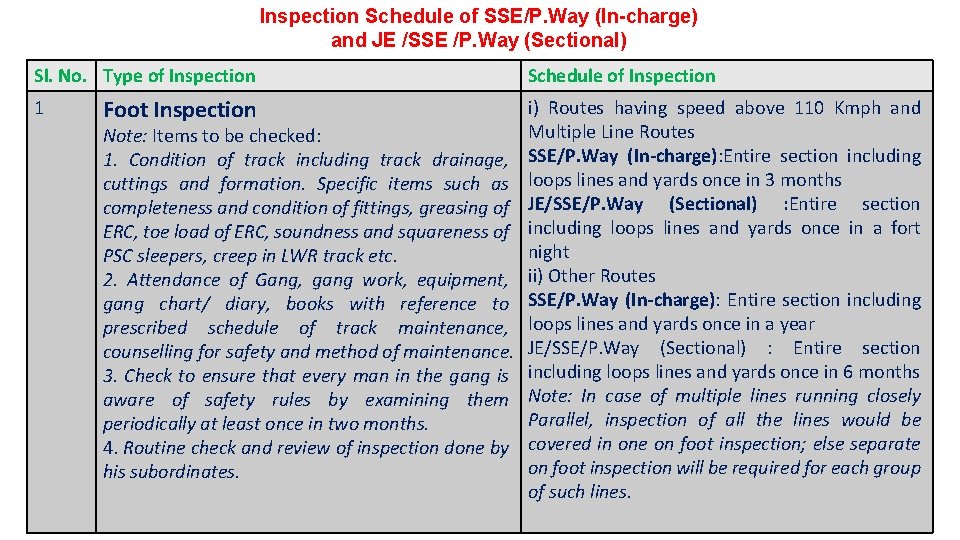
Inspection Schedule of SSE/P. Way (In-charge) and JE /SSE /P. Way (Sectional) Sl. No. Type of Inspection 1 Foot Inspection Note: Items to be checked: 1. Condition of track including track drainage, cuttings and formation. Specific items such as completeness and condition of fittings, greasing of ERC, toe load of ERC, soundness and squareness of PSC sleepers, creep in LWR track etc. 2. Attendance of Gang, gang work, equipment, gang chart/ diary, books with reference to prescribed schedule of track maintenance, counselling for safety and method of maintenance. 3. Check to ensure that every man in the gang is aware of safety rules by examining them periodically at least once in two months. 4. Routine check and review of inspection done by his subordinates. Schedule of Inspection i) Routes having speed above 110 Kmph and Multiple Line Routes SSE/P. Way (In-charge): Entire section including loops lines and yards once in 3 months JE/SSE/P. Way (Sectional) : Entire section including loops lines and yards once in a fort night ii) Other Routes SSE/P. Way (In-charge): Entire section including loops lines and yards once in a year JE/SSE/P. Way (Sectional) : Entire section including loops lines and yards once in 6 months Note: In case of multiple lines running closely Parallel, inspection of all the lines would be covered in one on foot inspection; else separate on foot inspection will be required for each group of such lines.
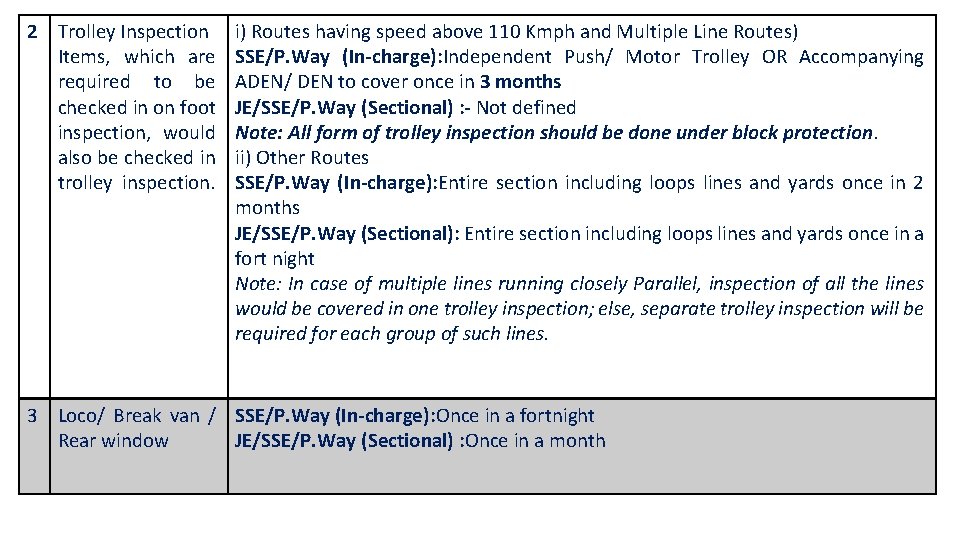
2 Trolley Inspection Items, which are required to be checked in on foot inspection, would also be checked in trolley inspection. i) Routes having speed above 110 Kmph and Multiple Line Routes) SSE/P. Way (In-charge): Independent Push/ Motor Trolley OR Accompanying ADEN/ DEN to cover once in 3 months JE/SSE/P. Way (Sectional) : - Not defined Note: All form of trolley inspection should be done under block protection. ii) Other Routes SSE/P. Way (In-charge): Entire section including loops lines and yards once in 2 months JE/SSE/P. Way (Sectional): Entire section including loops lines and yards once in a fort night Note: In case of multiple lines running closely Parallel, inspection of all the lines would be covered in one trolley inspection; else, separate trolley inspection will be required for each group of such lines. 3 Loco/ Break van / SSE/P. Way (In-charge): Once in a fortnight Rear window JE/SSE/P. Way (Sectional) : Once in a month
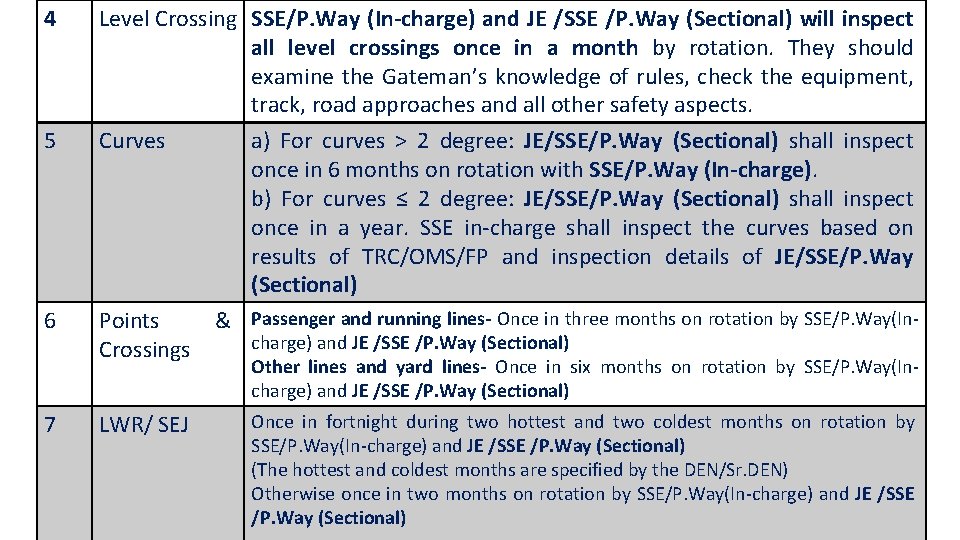
4 5 6 Level Crossing SSE/P. Way (In-charge) and JE /SSE /P. Way (Sectional) will inspect all level crossings once in a month by rotation. They should examine the Gateman’s knowledge of rules, check the equipment, track, road approaches and all other safety aspects. Curves a) For curves > 2 degree: JE/SSE/P. Way (Sectional) shall inspect once in 6 months on rotation with SSE/P. Way (In-charge). b) For curves ≤ 2 degree: JE/SSE/P. Way (Sectional) shall inspect once in a year. SSE in-charge shall inspect the curves based on results of TRC/OMS/FP and inspection details of JE/SSE/P. Way (Sectional) Points & Passenger and running lines- Once in three months on rotation by SSE/P. Way(Incharge) and JE /SSE /P. Way (Sectional) Crossings Other lines and yard lines- Once in six months on rotation by SSE/P. Way(Incharge) and JE /SSE /P. Way (Sectional) 7 LWR/ SEJ Once in fortnight during two hottest and two coldest months on rotation by SSE/P. Way(In-charge) and JE /SSE /P. Way (Sectional) (The hottest and coldest months are specified by the DEN/Sr. DEN) Otherwise once in two months on rotation by SSE/P. Way(In-charge) and JE /SSE /P. Way (Sectional)
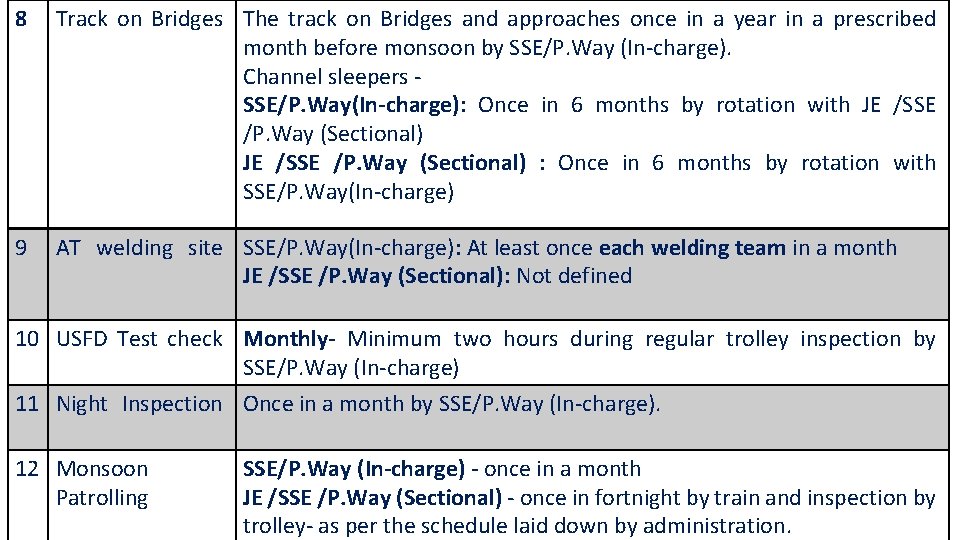
8 Track on Bridges The track on Bridges and approaches once in a year in a prescribed month before monsoon by SSE/P. Way (In-charge). Channel sleepers SSE/P. Way(In-charge): Once in 6 months by rotation with JE /SSE /P. Way (Sectional) : Once in 6 months by rotation with SSE/P. Way(In-charge) 9 AT welding site SSE/P. Way(In-charge): At least once each welding team in a month JE /SSE /P. Way (Sectional): Not defined 10 USFD Test check Monthly- Minimum two hours during regular trolley inspection by SSE/P. Way (In-charge) 11 Night Inspection Once in a month by SSE/P. Way (In-charge). 12 Monsoon Patrolling SSE/P. Way (In-charge) - once in a month JE /SSE /P. Way (Sectional) - once in fortnight by train and inspection by trolley- as per the schedule laid down by administration.
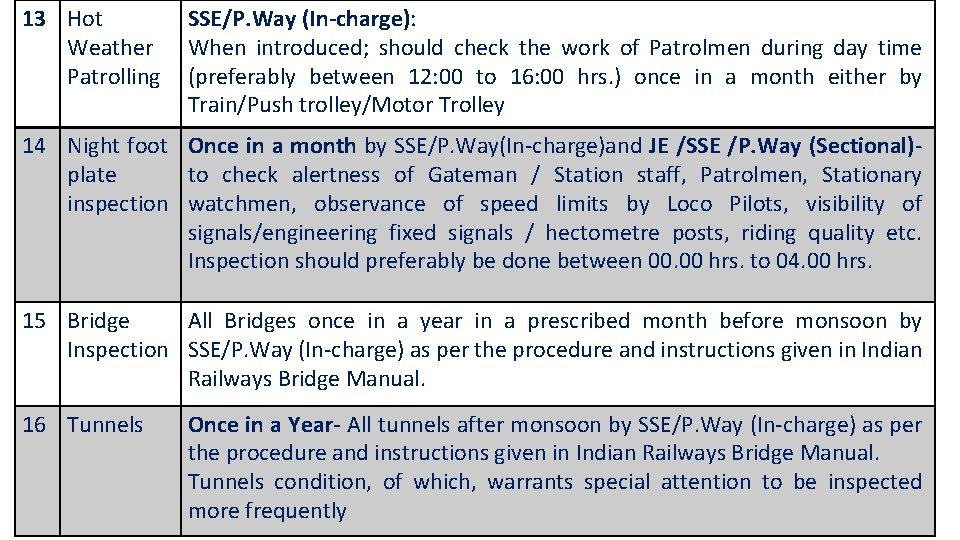
13 Hot Weather Patrolling SSE/P. Way (In-charge): When introduced; should check the work of Patrolmen during day time (preferably between 12: 00 to 16: 00 hrs. ) once in a month either by Train/Push trolley/Motor Trolley 14 Night foot Once in a month by SSE/P. Way(In-charge)and JE /SSE /P. Way (Sectional)plate to check alertness of Gateman / Station staff, Patrolmen, Stationary inspection watchmen, observance of speed limits by Loco Pilots, visibility of signals/engineering fixed signals / hectometre posts, riding quality etc. Inspection should preferably be done between 00. 00 hrs. to 04. 00 hrs. 15 Bridge All Bridges once in a year in a prescribed month before monsoon by Inspection SSE/P. Way (In-charge) as per the procedure and instructions given in Indian Railways Bridge Manual. 16 Tunnels Once in a Year- All tunnels after monsoon by SSE/P. Way (In-charge) as per the procedure and instructions given in Indian Railways Bridge Manual. Tunnels condition, of which, warrants special attention to be inspected more frequently
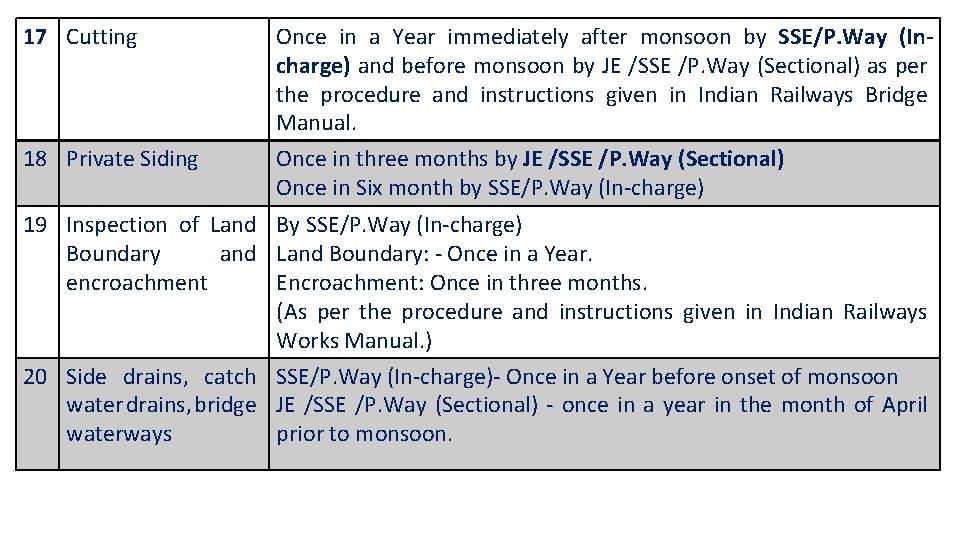
17 Cutting 18 Private Siding Once in a Year immediately after monsoon by SSE/P. Way (Incharge) and before monsoon by JE /SSE /P. Way (Sectional) as per the procedure and instructions given in Indian Railways Bridge Manual. Once in three months by JE /SSE /P. Way (Sectional) Once in Six month by SSE/P. Way (In-charge) 19 Inspection of Land By SSE/P. Way (In-charge) Boundary and Land Boundary: - Once in a Year. encroachment Encroachment: Once in three months. (As per the procedure and instructions given in Indian Railways Works Manual. ) 20 Side drains, catch SSE/P. Way (In-charge)- Once in a Year before onset of monsoon water drains, bridge JE /SSE /P. Way (Sectional) - once in a year in the month of April waterways prior to monsoon.
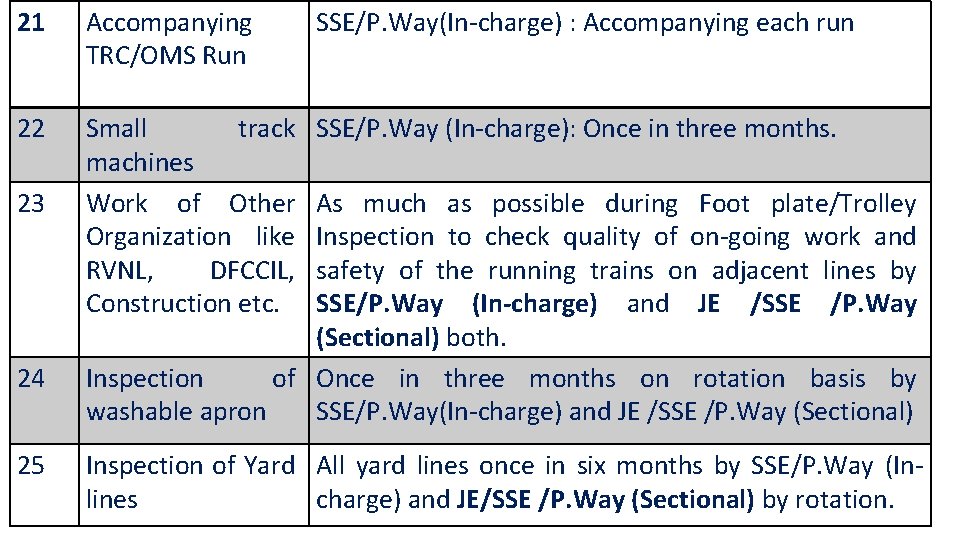
21 Accompanying TRC/OMS Run SSE/P. Way(In-charge) : Accompanying each run 22 Small track machines Work of Other Organization like RVNL, DFCCIL, Construction etc. SSE/P. Way (In-charge): Once in three months. 23 24 25 As much as possible during Foot plate/Trolley Inspection to check quality of on-going work and safety of the running trains on adjacent lines by SSE/P. Way (In-charge) and JE /SSE /P. Way (Sectional) both. Inspection of Once in three months on rotation basis by washable apron SSE/P. Way(In-charge) and JE /SSE /P. Way (Sectional) Inspection of Yard All yard lines once in six months by SSE/P. Way (Inlines charge) and JE/SSE /P. Way (Sectional) by rotation.
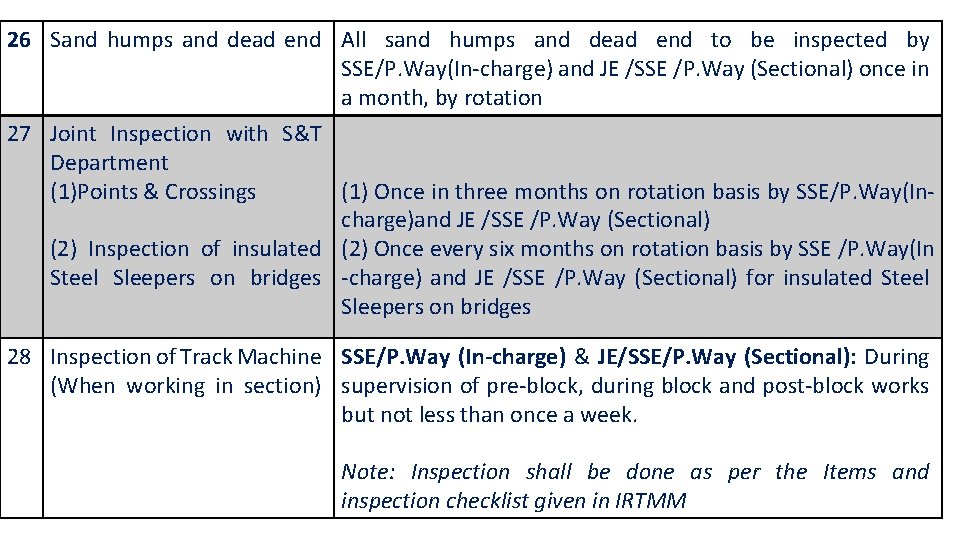
26 Sand humps and dead end All sand humps and dead end to be inspected by SSE/P. Way(In-charge) and JE /SSE /P. Way (Sectional) once in a month, by rotation 27 Joint Inspection with S&T Department (1)Points & Crossings (1) Once in three months on rotation basis by SSE/P. Way(Incharge)and JE /SSE /P. Way (Sectional) (2) Inspection of insulated (2) Once every six months on rotation basis by SSE /P. Way(In Steel Sleepers on bridges -charge) and JE /SSE /P. Way (Sectional) for insulated Steel Sleepers on bridges 28 Inspection of Track Machine SSE/P. Way (In-charge) & JE/SSE/P. Way (Sectional): During (When working in section) supervision of pre-block, during block and post-block works but not less than once a week. Note: Inspection shall be done as per the Items and inspection checklist given in IRTMM
Recap Items to be inspected during Push trolley, motor trolley, on foot & footplate inspection
On foot inspection • Condition of track including track drainage, cuttings and formation. Specific items such as completeness and condition of fittings, greasing of ERC, toe load of ERC, soundness and squareness of PSC sleepers, creep in LWR track etc. • Attendance of Gang, gang work, equipment, gang chart/ diary, books with reference to prescribed schedule of track maintenance, counselling for safety and method of maintenance. • Check to ensure that every man in the gang is aware of safety rules by examining them periodically at least once in two months. • Routine check and review of inspection done by his subordinates.
On foot inspection • Note: In case of multiple lines running closely Parallel, inspection of all the lines would be covered in one on foot inspection; else separate on foot inspection will be required for each group of such lines. (a) Devote sustained attention to Permanent way as regards safety, smooth running, economy and neatness. (b) Be vigilant to locate faults/irregularities in the Permanent Way and ensure prompt remedy. (c) Observe the behaviour of track under passing trains to detect inadequate packing during routine inspections.
On trolley inspection • Trolley Inspection • Items, which are required to be checked in on foot inspection, would also be checked in trolley inspection. • They should examine the Gateman’s knowledge of rules, check the equipment, track, road approaches and all other safety aspects.
On foot plate inspection • Travel on the footplate of Engine /Rear brake-van/last Vehicle of fast trains, take down notes of bad running locations, and get them rectified. • (e) Immediately bring the defects, which are beyond powers of remedy, to the notice of SSE/P. Way (In-charge) and obtain advice. • (f) Ensure timely removal / cutting of trees in proximity to and liable to foul the track during a storm.
On foot plate inspection • Night foot plate: check alertness of Gateman / Station staff, Patrolmen, Stationary watchmen, observance of speed limits by Loco Pilots, visibility of signals/engineering fixed signals / hectometre posts, riding quality etc. Inspection should preferably be done between 00. 00 hrs. to 04. 00 hrs. • As much as possible during Foot plate/Trolley Inspection to check quality of on-going work and safety of the running trains on adjacent lines by SSE/P. Way (In-charge) and JE /SSE /P. Way (Sectional) both.
To Study Various Report and be given to Trainees for interpretation and conculsion
Thanks