1 3 Early Definitions Postulates Four Parts of

- Slides: 7
1. 3 Early Definitions & Postulates Four Parts of a Mathematical System* 1. Undefined terms 2. vocabulary 2. Defined terms 3. Axioms or postulates principles 4. Theorems 5. * Examples are Algebra, Geometry, Calculus 12/3/2020 1
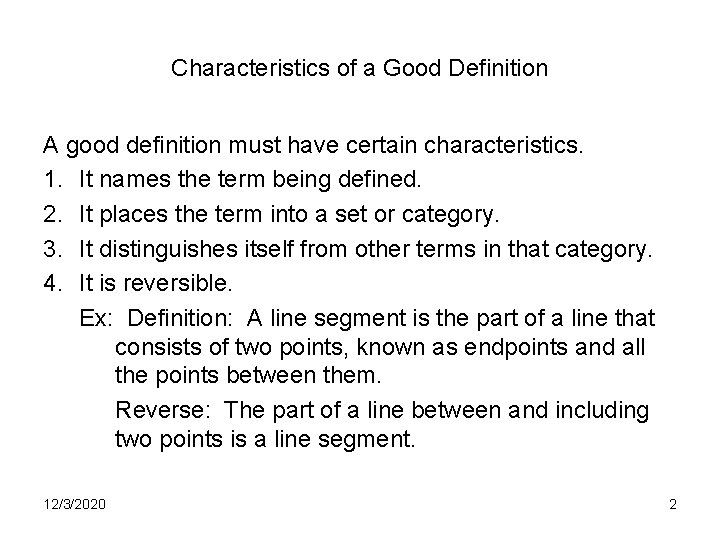
Characteristics of a Good Definition A good definition must have certain characteristics. 1. It names the term being defined. 2. It places the term into a set or category. 3. It distinguishes itself from other terms in that category. 4. It is reversible. Ex: Definition: A line segment is the part of a line that consists of two points, known as endpoints and all the points between them. Reverse: The part of a line between and including two points is a line segment. 12/3/2020 2
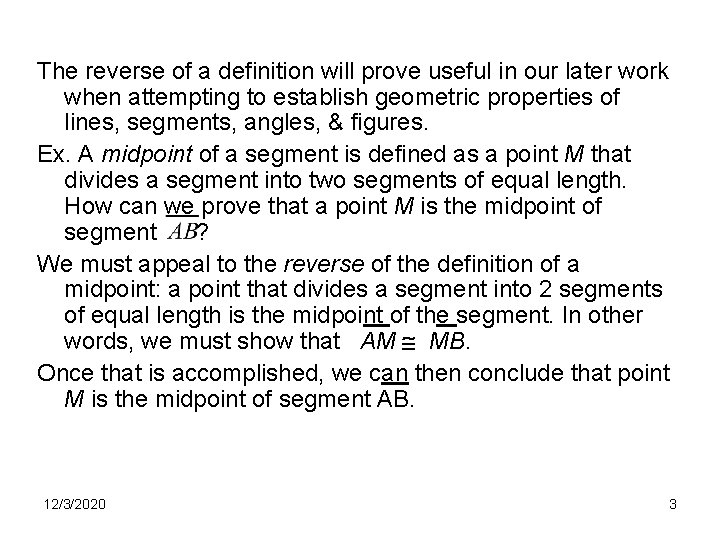
The reverse of a definition will prove useful in our later work when attempting to establish geometric properties of lines, segments, angles, & figures. Ex. A midpoint of a segment is defined as a point M that divides a segment into two segments of equal length. How can we prove that a point M is the midpoint of segment ? We must appeal to the reverse of the definition of a midpoint: a point that divides a segment into 2 segments of equal length is the midpoint of the segment. In other words, we must show that AM MB. Once that is accomplished, we can then conclude that point M is the midpoint of segment AB. 12/3/2020 3
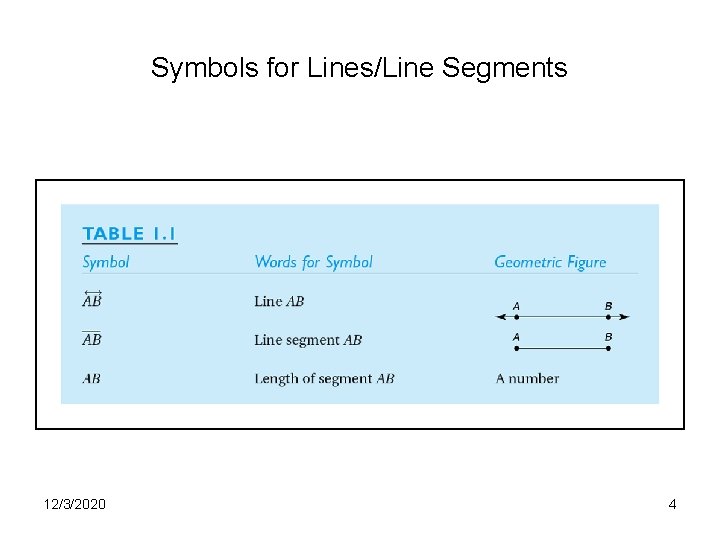
Symbols for Lines/Line Segments 12/3/2020 4
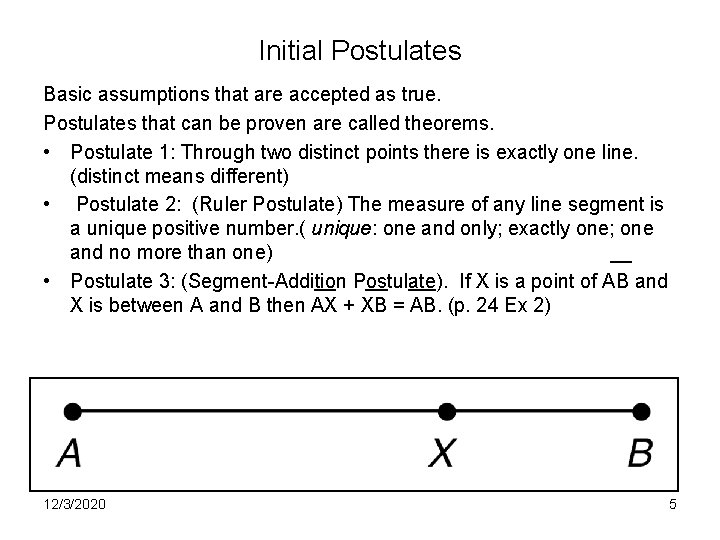
Initial Postulates Basic assumptions that are accepted as true. Postulates that can be proven are called theorems. • Postulate 1: Through two distinct points there is exactly one line. (distinct means different) • Postulate 2: (Ruler Postulate) The measure of any line segment is a unique positive number. ( unique: one and only; exactly one; one and no more than one) __ • Postulate 3: (Segment-Addition Postulate). If X is a point of AB and X is between A and B then AX + XB = AB. (p. 24 Ex 2) 12/3/2020 5
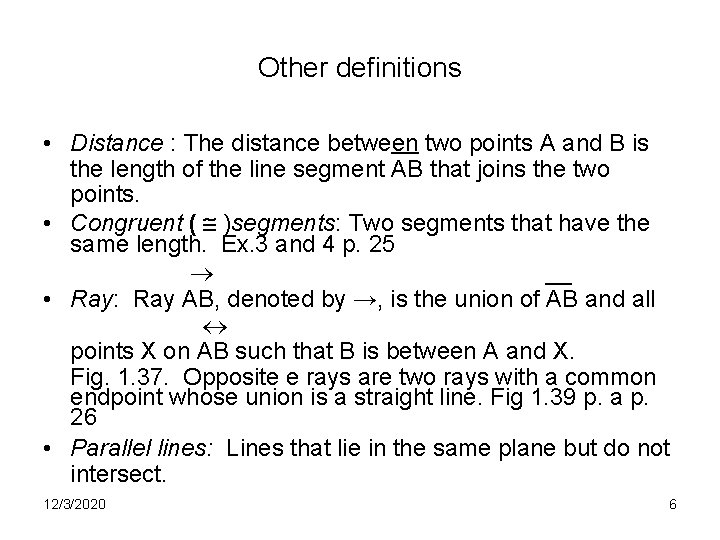
Other definitions • Distance : The distance between two points A and B is the length of the line segment AB that joins the two points. • Congruent ( )segments: Two segments that have the same length. Ex. 3 and 4 p. 25 __ • Ray: Ray AB, denoted by →, is the union of AB and all points X on AB such that B is between A and X. Fig. 1. 37. Opposite e rays are two rays with a common endpoint whose union is a straight line. Fig 1. 39 p. a p. 26 • Parallel lines: Lines that lie in the same plane but do not intersect. 12/3/2020 6
More Postulates • Postulate 4: If two lines intersect, they intersect at a point. • Postulate 5: Through three non-collinear points, there is exactly one plane. Fig 1. 42 p. 27 • Postulate 6: If two distinct planes intersect, then their intersection is a line. Fig 1. 44 p. 27 • Postulate 7: Given two distinct points in a plane, the line containing these points also lies in the plane. • Theorems are postulates which can be proven. • Theorem 1. 3. 1: The midpoint of a line segment is unique. – Note: Numbering system for Theorems in this book is Chapter. Section. Order 12/3/2020 7