
1 3 Data governance Global perspectives June 22
1. 3 Data & governance: Global perspectives June 22, 2017 @ Data Power 2017 Big Data Authoritarianism and Social Governance: China’s Social Credit System and Its Impacts Claire Lee, Ph. D. Assistant Professor Department of Chinese Studies Inha University Incheon, South Korea Departments of Sociology and Asian Studies University of Massachusetts Boston, MA, United States 2017 © Dr Claire Lee
01 Introduction Contents • Introduction • Context, literature review, framework • Data and methods • Analysis • Conclusion 2017 © Dr Claire Lee
The Dilemma of China’s Soft Power and Networked Authoritarianism China’s Social Governance and Governmentality Cyberspace
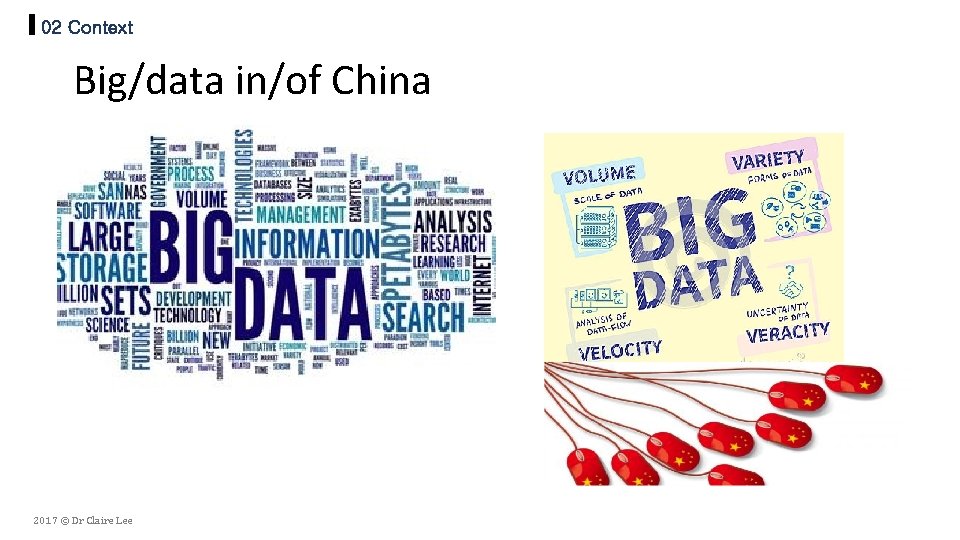
02 Context Big/data in/of China 2017 © Dr Claire Lee

01 Introduction 2017 © Dr Claire Lee
Big data authoritarianism Aim & Research question • How social governance is merited with and is programmed with the use of big data and how big data turns into an apparatus of an authoritarian state? • How does the Chinese government’s use of social credit system influence individual’s everyday life?
02 Context & Literature review Social credit system as big data and social governance in China On social credit system Constructing the society under Xi Jinping • As this is a new phenomenon and system, only non-academic sources are available. • A way and tool of dealing with social problems 2017 © Dr Claire Lee • From social management (shehui guanli) to social governance (shehui zhili) as China’s governmentality (Jeffreys & Sigley 2009; Lee 2017)
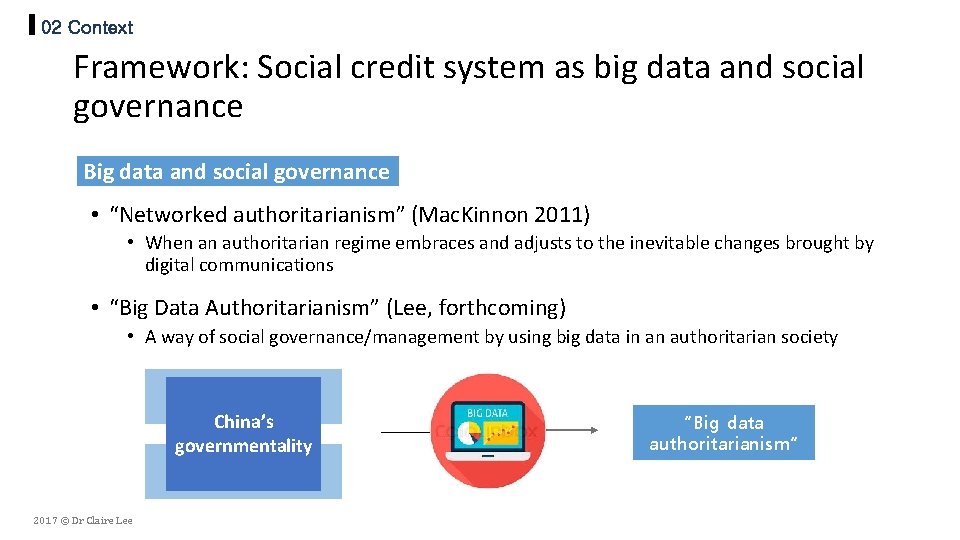
02 Context Framework: Social credit system as big data and social governance Big data and social governance • “Networked authoritarianism” (Mac. Kinnon 2011) • When an authoritarian regime embraces and adjusts to the inevitable changes brought by digital communications • “Big Data Authoritarianism” (Lee, forthcoming) • A way of social governance/management by using big data in an authoritarian society Govermentality (Foucault 1977) China’s governmentality Social governance 2017 © Dr Claire Lee “Big data authoritarianism”
03 China’s social credit system Social credit system (社会信用体系): Historical trajectory • History • 1999: the concept was first introduced (Han 2016) • 2014: The Chinese central government outlined a relevant policy with an aim of expanding it to the rest of China by 2020. The Planning Outline for the Construction of a Social Credit System (2014 -2020) • Concerted efforts at the central and local governments for developing the system • As a program with a plan of officially introducing it by the year 2020, more than 30 local governments have already started to collect personal information to evaluate and save credit scores based on Chinese citizens’ financial, social, and civic activities. 2017 © Dr Claire Lee
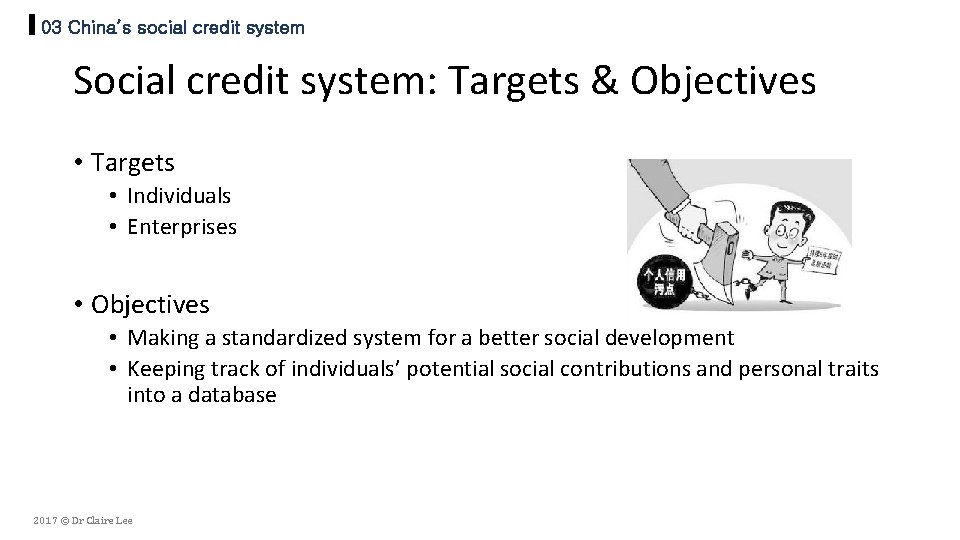
03 China’s social credit system Social credit system: Targets & Objectives • Targets • Individuals • Enterprises • Objectives • Making a standardized system for a better social development • Keeping track of individuals’ potential social contributions and personal traits into a database 2017 © Dr Claire Lee
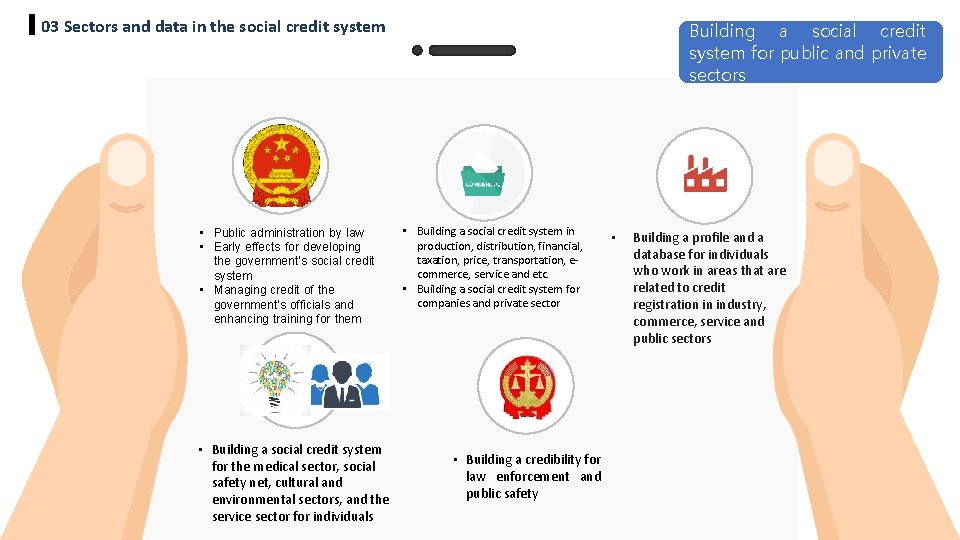
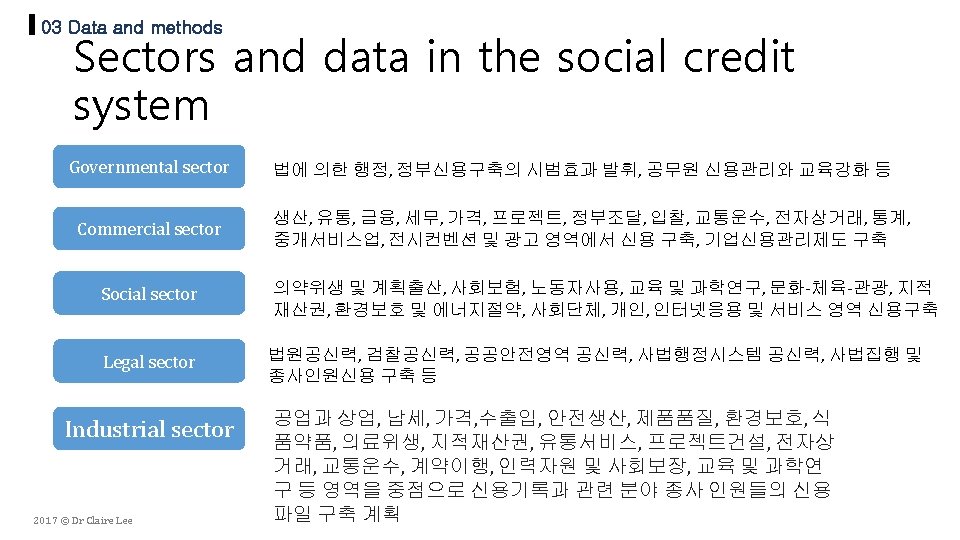
03 Sectors and data in the social credit system • Public administration by law • Early effects for developing the government’s social credit system • Managing credit of the government’s officials and enhancing training for them • Building a social credit system for the medical sector, social safety net, cultural and environmental sectors, and the service sector for individuals Building a social credit system for public and private sectors • Building a social credit system in production, distribution, financial, taxation, price, transportation, ecommerce, service and etc. • Building a social credit system for companies and private sector • Building a credibility for law enforcement and public safety • Building a profile and a database for individuals who work in areas that are related to credit registration in industry, commerce, service and public sectors
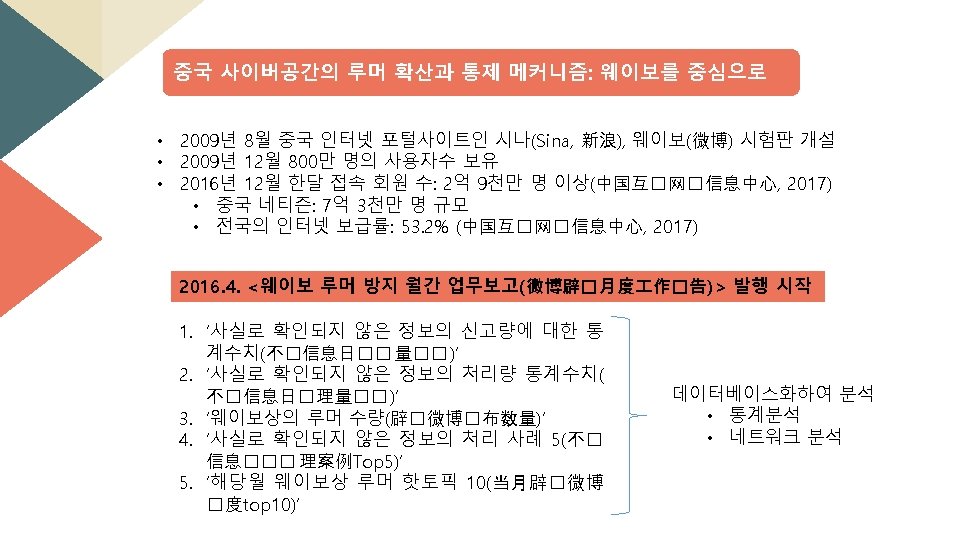
03 China’s social credit system Social credit system: What to collect • Credit, money, criminal records • Social media records • Individuals / friends/ family (Social network matters!) Collaboration: Companies w Government 2017 © Dr Claire Lee Government
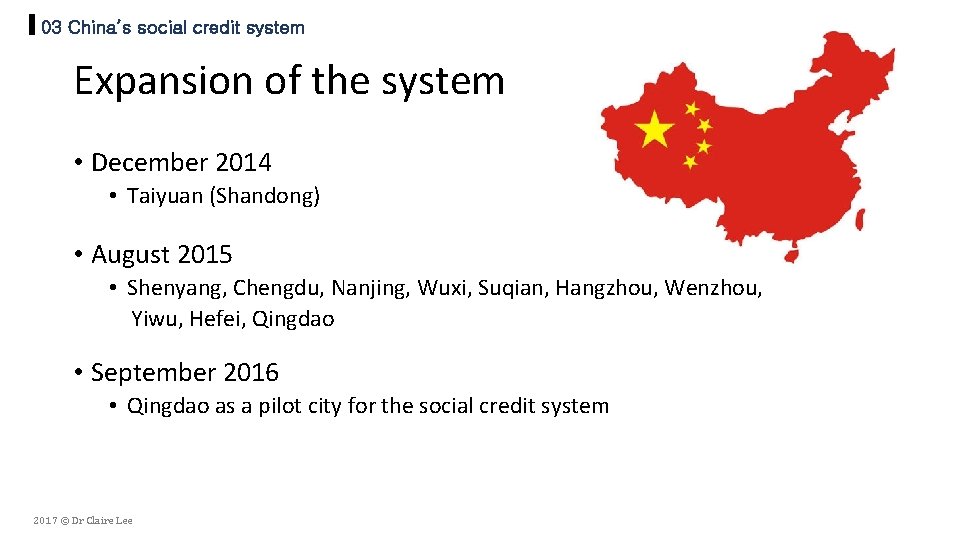
03 China’s social credit system Expansion of the system • December 2014 • Taiyuan (Shandong) • August 2015 • Shenyang, Chengdu, Nanjing, Wuxi, Suqian, Hangzhou, Wenzhou, Yiwu, Hefei, Qingdao • September 2016 • Qingdao as a pilot city for the social credit system 2017 © Dr Claire Lee
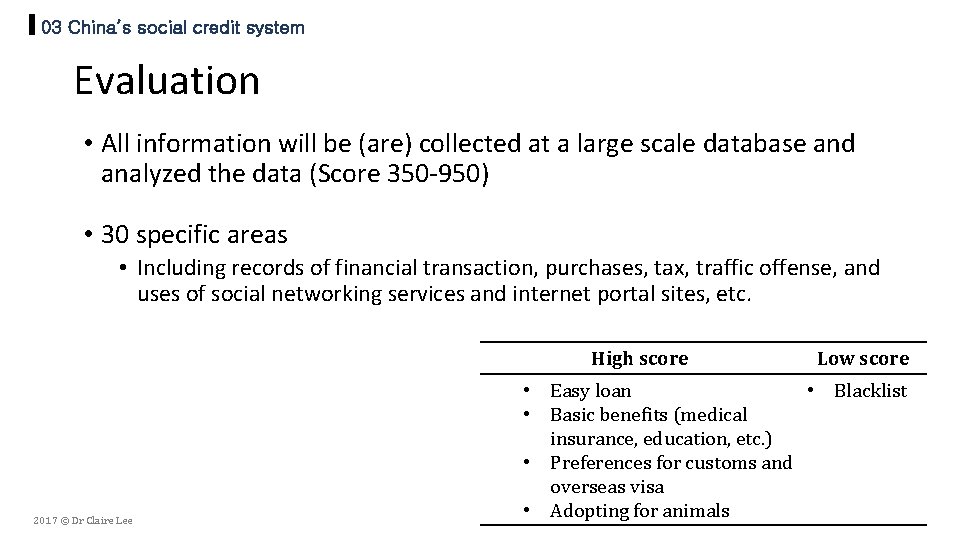
03 China’s social credit system Evaluation • All information will be (are) collected at a large scale database and analyzed the data (Score 350 -950) • 30 specific areas • Including records of financial transaction, purchases, tax, traffic offense, and uses of social networking services and internet portal sites, etc. High score 2017 © Dr Claire Lee Low score • Easy loan • Blacklist • Basic benefits (medical insurance, education, etc. ) • Preferences for customs and overseas visa • Adopting for animals
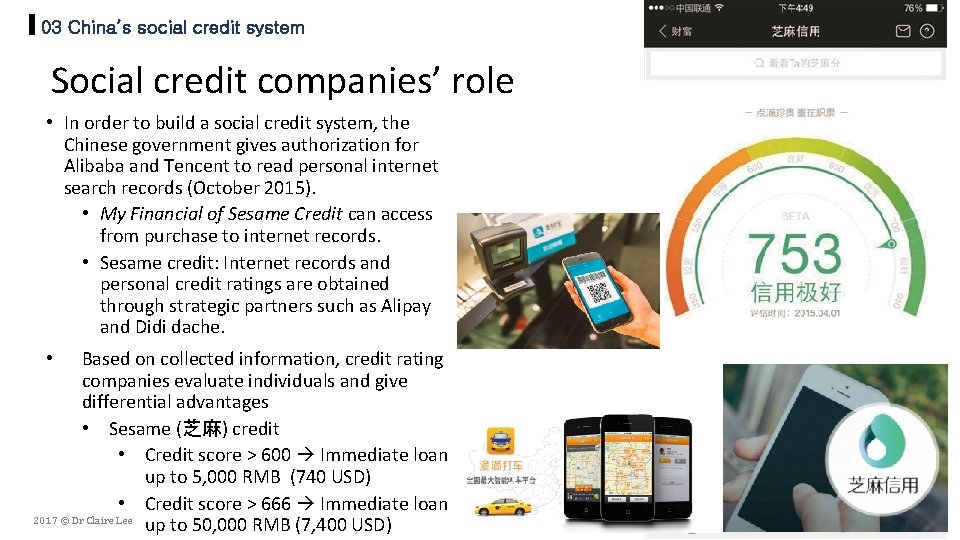
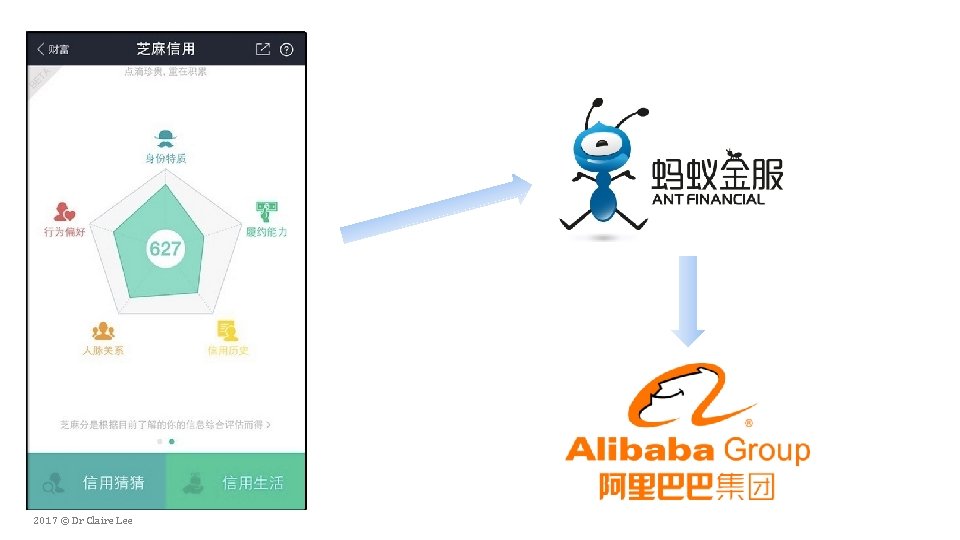
03 China’s social credit system Social credit companies’ role • In order to build a social credit system, the Chinese government gives authorization for Alibaba and Tencent to read personal internet search records (October 2015). • My Financial of Sesame Credit can access from purchase to internet records. • Sesame credit: Internet records and personal credit ratings are obtained through strategic partners such as Alipay and Didi dache. Based on collected information, credit rating companies evaluate individuals and give differential advantages • Sesame (芝麻) credit • Credit score > 600 Immediate loan up to 5, 000 RMB (740 USD) • Credit score > 666 Immediate loan 2017 © Dr Claire Lee up to 50, 000 RMB (7, 400 USD) •
2017 © Dr Claire Lee
03 China’s social credit system A social credit system for • Credit-related legal system • Sectoral and local credit system • Credit information classification and standard system • Unified social credit code system 2017 © Dr Claire Lee
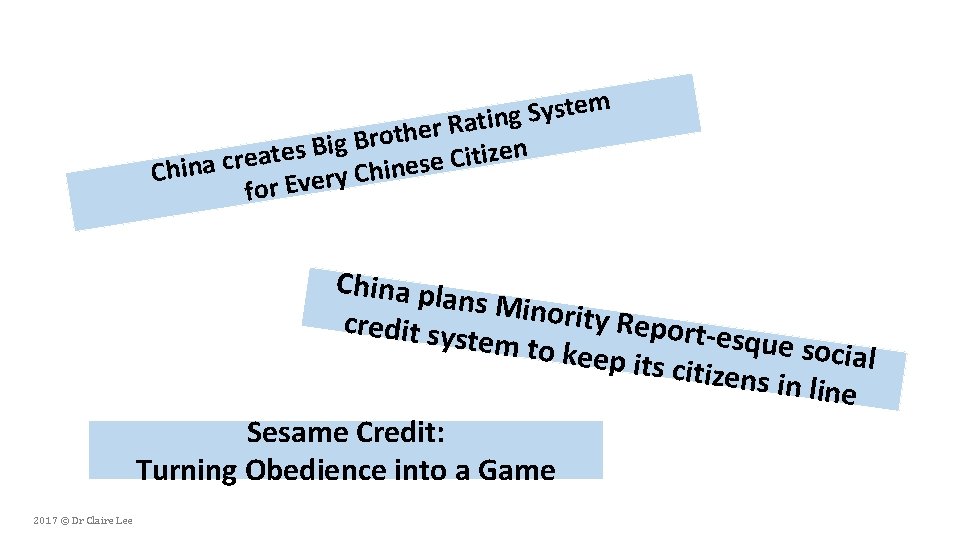
m e t s y S g n ti a R r e h t ro B g i B n s e e z t i t a i e C r c e s e n i h China C y for Ever China pla ns Minor ity Repor credit sys t-esque s tem to ke ocial ep its citi zens in li ne Sesame Credit: Turning Obedience into a Game 2017 © Dr Claire Lee
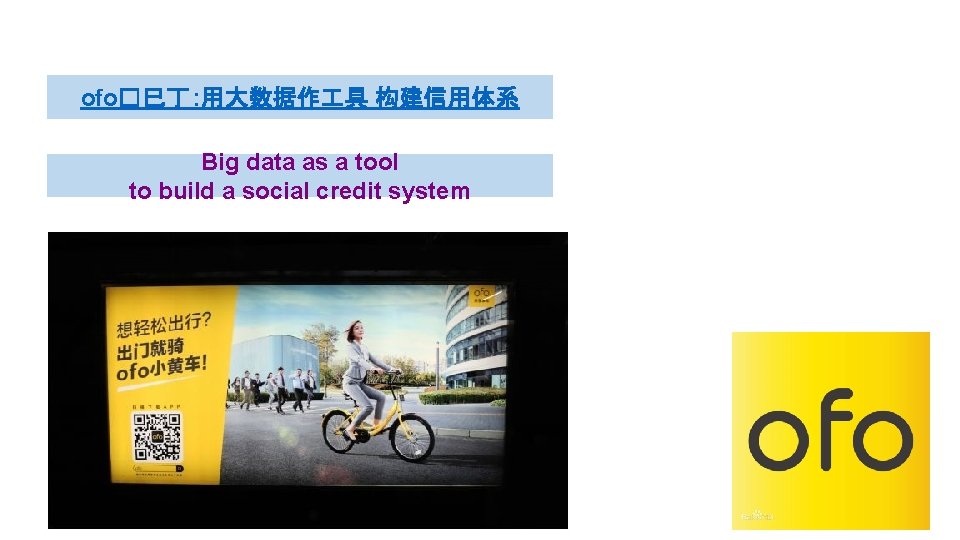
ofo�巳丁 : 用大数据作 具 构建信用体系 Big data as a tool to build a social credit system
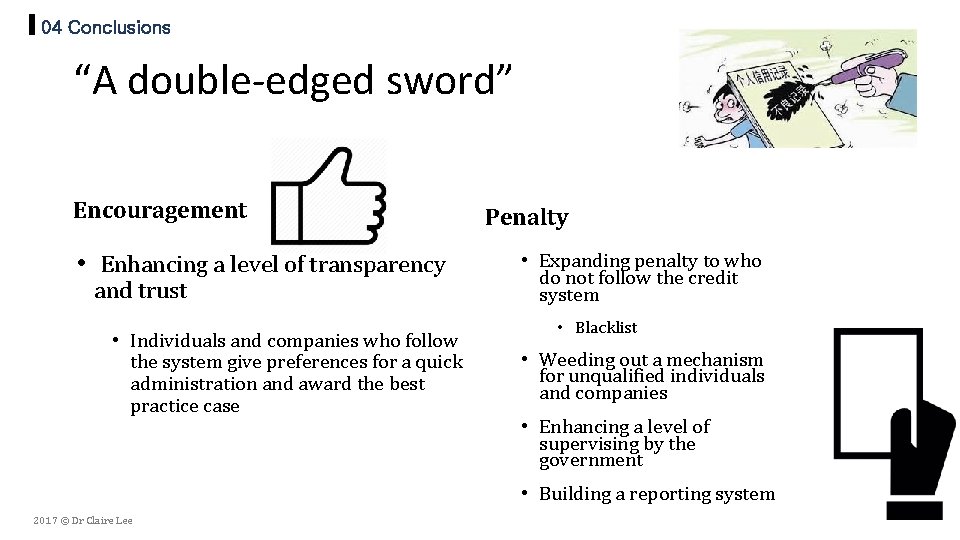
04 Conclusions “A double-edged sword” Encouragement • Enhancing a level of transparency and trust • Individuals and companies who follow the system give preferences for a quick administration and award the best practice case Penalty • Expanding penalty to who do not follow the credit system • Blacklist • Weeding out a mechanism for unqualified individuals and companies • Enhancing a level of supervising by the government • Building a reporting system 2017 © Dr Claire Lee
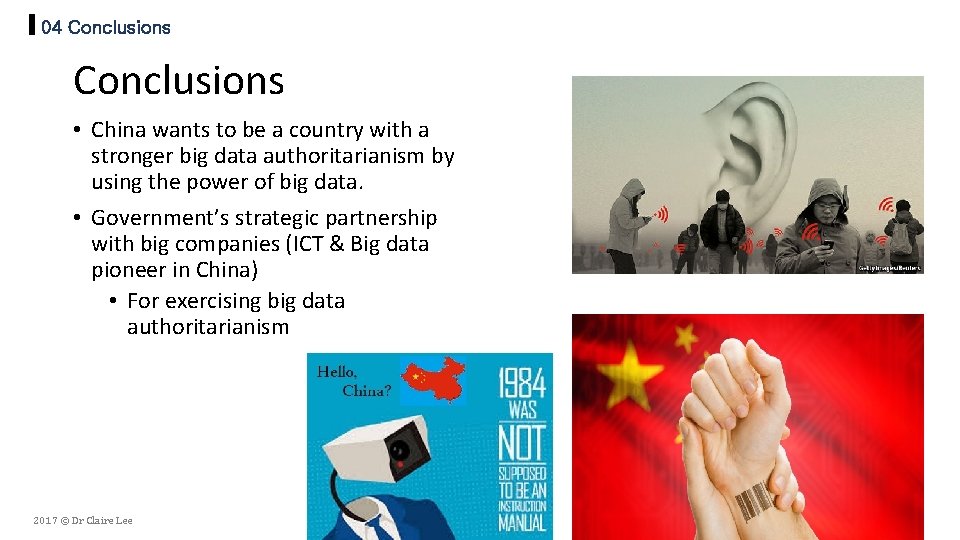
04 Conclusions • China wants to be a country with a stronger big data authoritarianism by using the power of big data. • Government’s strategic partnership with big companies (ICT & Big data pioneer in China) • For exercising big data authoritarianism 2017 © Dr Claire Lee

Thank you! e e L n geu n u e S ire a l C. Dr. kr c a. a @inh om il. c lee claire lee@gma ese r i a l c dr HOMEPAGE drclairselee. wordpress. com IL E-MA 2017 © Dr Claire Lee

03 Data and methods Regional models
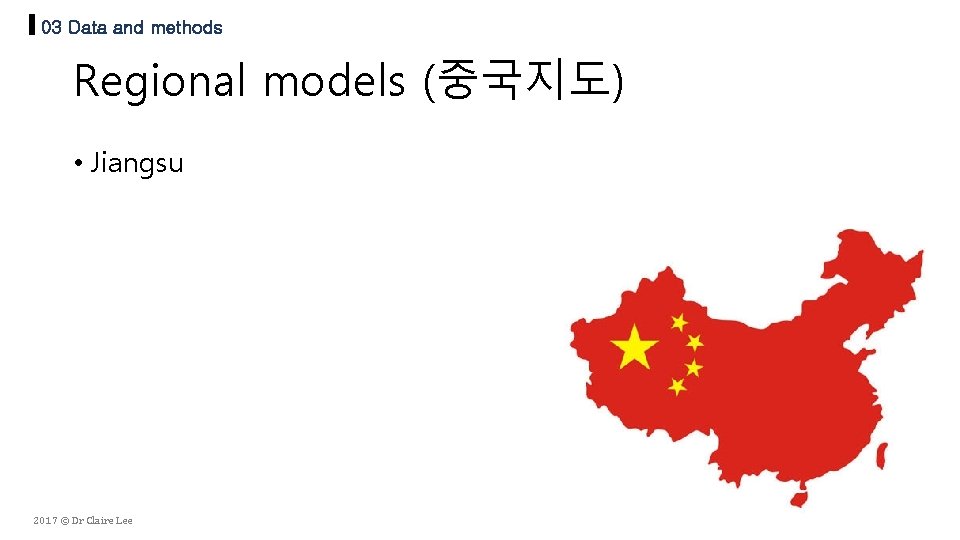
03 Data and methods Regional models (중국지도) • Jiangsu 2017 © Dr Claire Lee
03 China’s social credit system Data and methods • Policies • Microblogs (Weibo) • Media • How social governance is merited with and is programmed with the use of big data and how big data turns into an apparatus of an authoritarian state 2017 © Dr Claire Lee
Abstract • How does the Chinese government’s use of social credit system influence individual’s everyday life? How do Chinese citizens response to the new program? This study explores the social consequences of a recently introduced social credit system in China. • In Xi Jinping’s administration, managing society became an important part of the Chinese government’s policy as well as increasingly gained scholarly attention. The discourse on the society was centered on the introduction of idea of social management (shehui guanli) and later social governance (shehui zhili). • Against this backdrop, this paper juxtaposes the idea of “social governance” with China’s use of big data by using a case study of social credit system. Since the Chinese central government has published The Planning Outline for the Construction of a Social Credit System (2014 -2020), both the central and local governments have put efforts on developing the system. As a program with a plan of officially introducing it by the year 2020, more than thirty local governments have already started to collect personal information to evaluate and save credit scores based on Chinese citizens’ financial, social, and civic activities. Based on the analyses of policies, microblogs (Weibo), and media, this study shows how social governance is merited with and is programmed with the use of big data and how big data turns into an apparatus of an authoritarian state. This paper also provides an implication for China to be a country with a stronger big data authoritarianism by using the power of big data.
02 Context Consider read the following refs
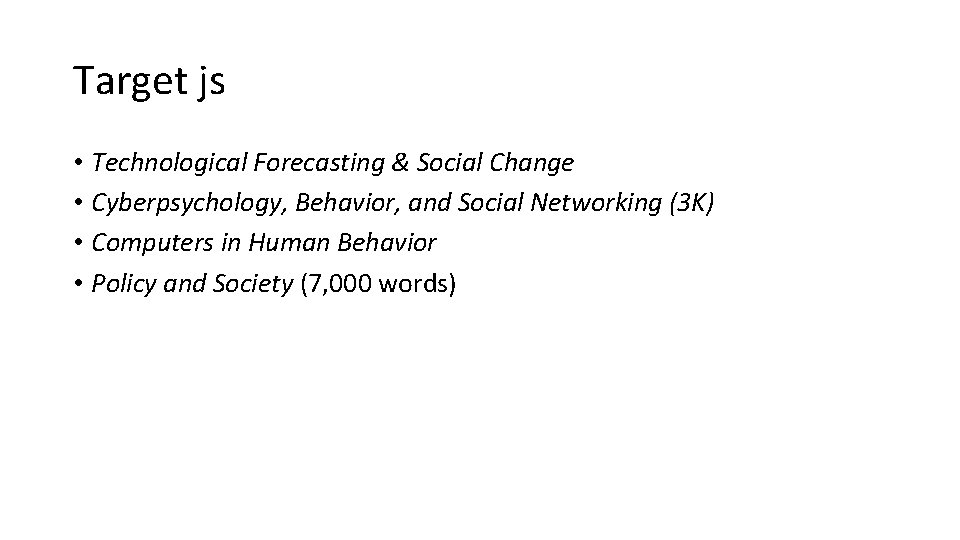
Target js • Technological Forecasting & Social Change • Cyberpsychology, Behavior, and Social Networking (3 K) • Computers in Human Behavior • Policy and Society (7, 000 words)
- Slides: 33