
1 3 Communication skills Periods 2 EFFECTIVE COMMUNICATION
- Slides: 53
1. 3 Communication skills. Periods- 2
EFFECTIVE COMMUNICATION SKILLS
Objectives • Define and understand communication and the communication process • List and overcome the filters/barriers in a communication process • Practice active listening • Tips to improve verbal and non verbal communication
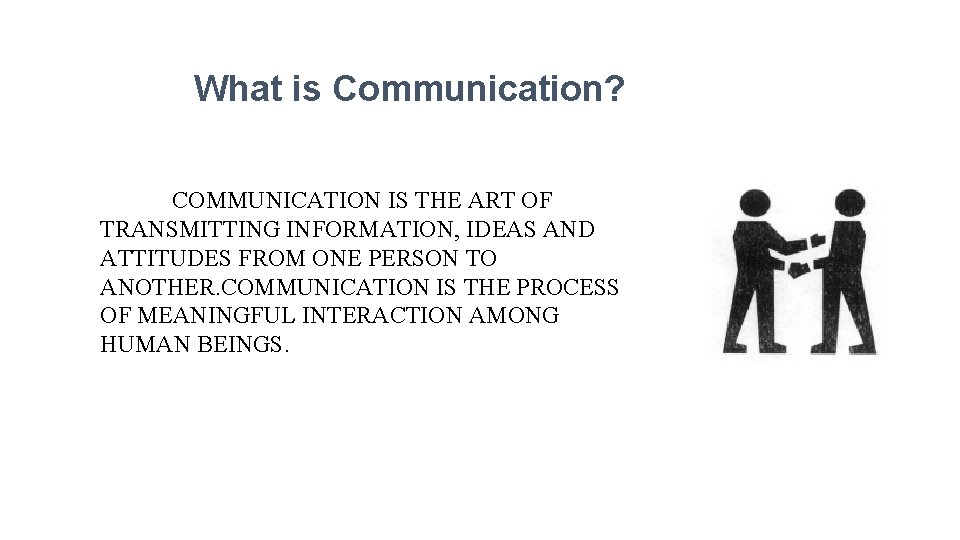
What is Communication? COMMUNICATION IS THE ART OF TRANSMITTING INFORMATION, IDEAS AND ATTITUDES FROM ONE PERSON TO ANOTHER. COMMUNICATION IS THE PROCESS OF MEANINGFUL INTERACTION AMONG HUMAN BEINGS.
What is Communication? ITS ESSENCES : ¬PERSONAL PROCESS ¬OCCURS BETWEEN PEOPLE ¬INVOLVES CHANGE IN BEHAVIOUR ¬MEANS TO INFLUENCE OTHERS ¬EXPRESSION OF THOUGHTS AND EMOTIONS THROUGH WORDS & ACTIONS. ¬TOOLS FOR CONTROLLING AND MOTIVATING PEOPLE. ¬IT IS A SOCIAL AND EMOTIONAL PROCESS.
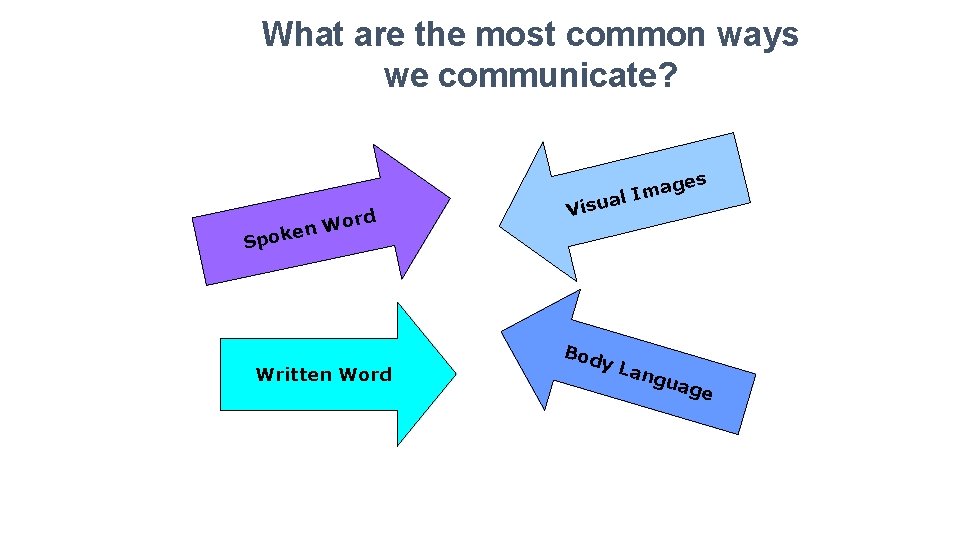
What are the most common ways we communicate? es rd o W en Spok Written Word ag m I al Visu Bod y La ngu age
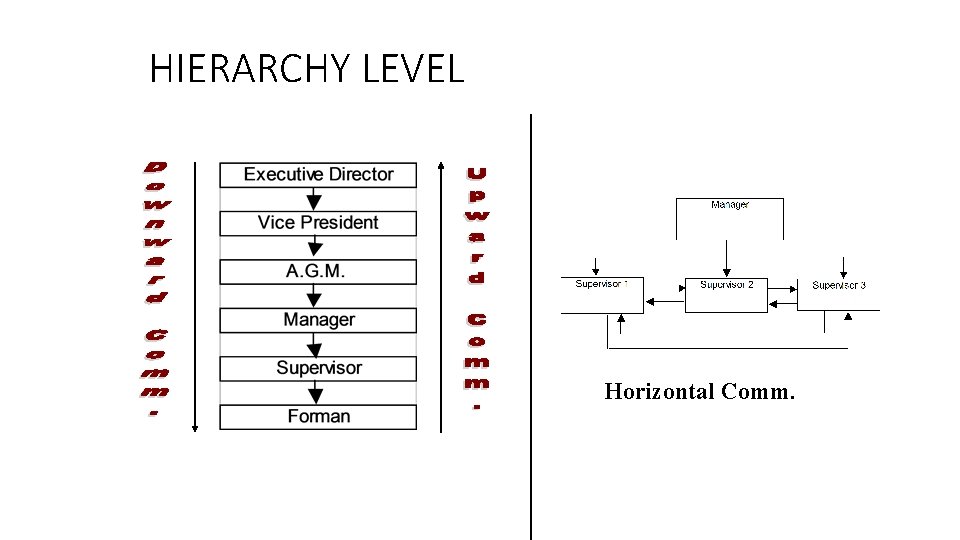
Types of Communication Downwards Communication : Highly Directive, from Senior to subordinates, to assign duties, give instructions, to inform to offer feed back, approval to highlight problems etc. Upwards Communications : It is non directive in nature from down below, to give feedback, to inform about progress/problems, seeking approvals. Lateral or Horizontal Communication: Among colleagues, peers at same level for information sharing for coordination, to save time.
Types of Communication In modern business environment communication extends beyond written or spoken words to listened word. Visual dimension added by T. V. , computers has given to new meaning to communication. COMMUNICATION NETWORKS Formal Network : Virtually vertical as per chain go command within the hierarchy. Informal Network : Free to move in any direction may skip formal chain of command. Likely to satisfy social and emotional needs and also can facilitate task accomplishment.
HIERARCHY LEVEL Horizontal Comm.
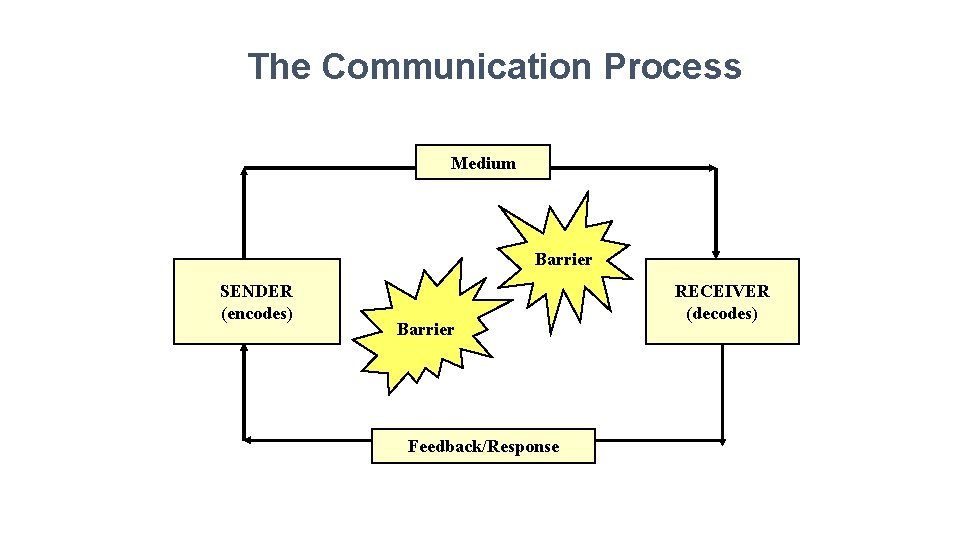
The Communication Process Medium Barrier SENDER (encodes) Barrier Feedback/Response RECEIVER (decodes)
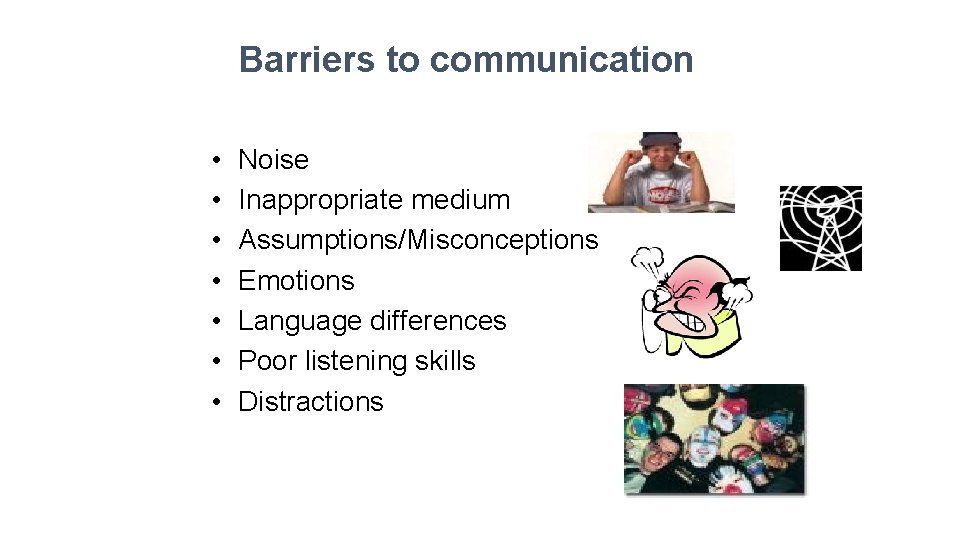
Barriers to communication • • Noise Inappropriate medium Assumptions/Misconceptions Emotions Language differences Poor listening skills Distractions
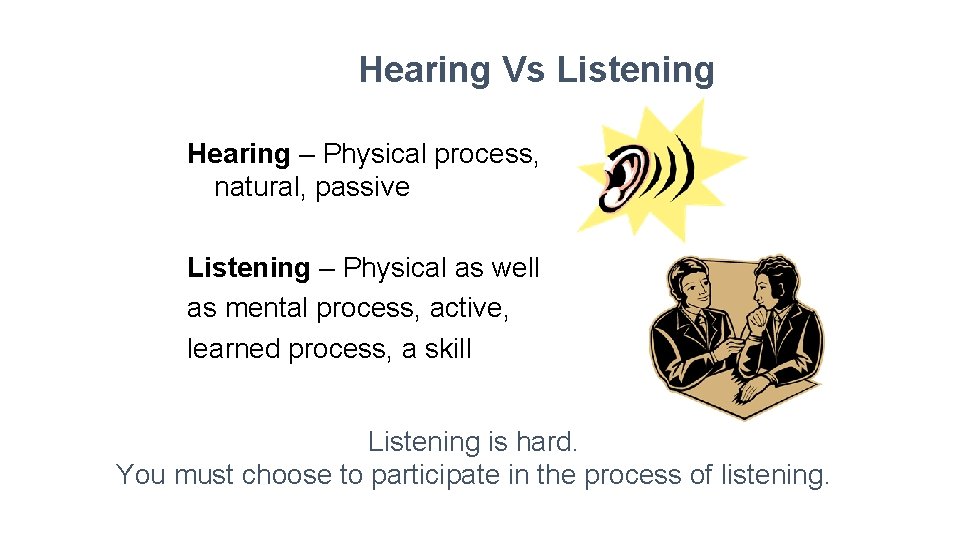
Hearing Vs Listening Hearing – Physical process, natural, passive Listening – Physical as well as mental process, active, learned process, a skill Listening is hard. You must choose to participate in the process of listening.
VALUE OF LISTENING ¬ Listening to others is an elegant art. ¬ Good listening reflects courtesy and good manners. ¬ Listening carefully to the instructions of superiors improve competence and performance. ¬ The result of poor listening skill could be disastrous in business, employment and social relations. ¬Good listening can eliminate a number of imaginary grievances of employees. ¬Good listening skill can improve social relations and conversation. ¬Listening is a positive activity rather than a passive or negative activity.
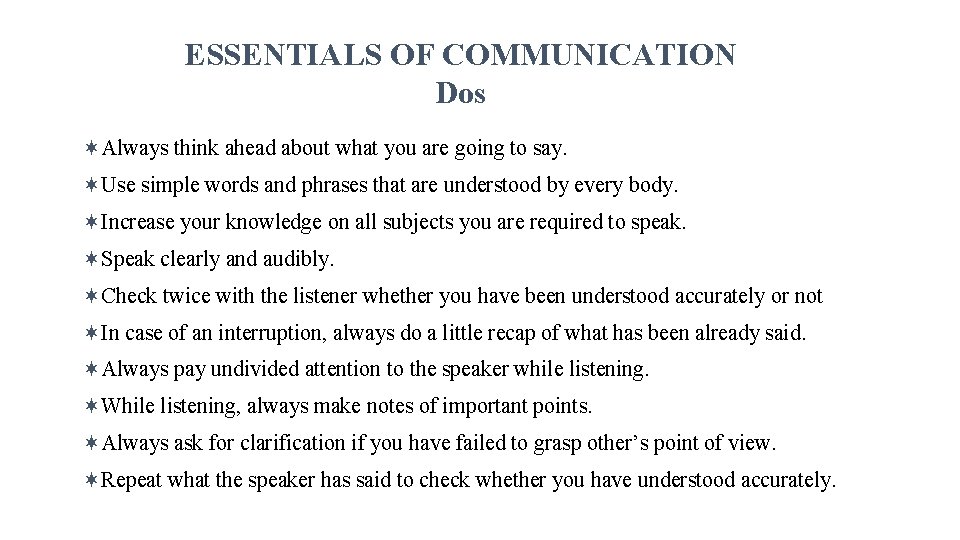
ESSENTIALS OF COMMUNICATION Dos ¬Always think ahead about what you are going to say. ¬Use simple words and phrases that are understood by every body. ¬Increase your knowledge on all subjects you are required to speak. ¬Speak clearly and audibly. ¬Check twice with the listener whether you have been understood accurately or not ¬In case of an interruption, always do a little recap of what has been already said. ¬Always pay undivided attention to the speaker while listening. ¬While listening, always make notes of important points. ¬Always ask for clarification if you have failed to grasp other’s point of view. ¬Repeat what the speaker has said to check whether you have understood accurately.
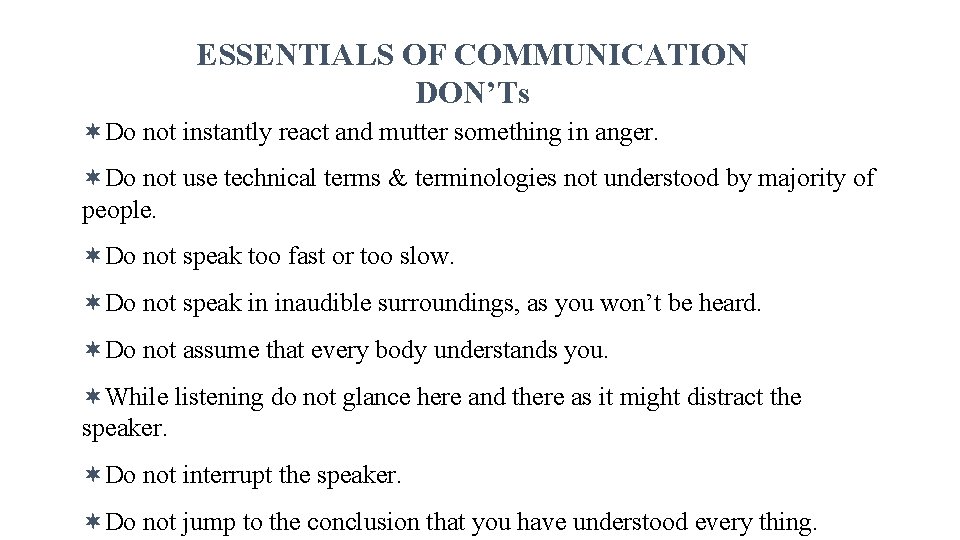
ESSENTIALS OF COMMUNICATION DON’Ts ¬Do not instantly react and mutter something in anger. ¬Do not use technical terms & terminologies not understood by majority of people. ¬Do not speak too fast or too slow. ¬Do not speak in inaudible surroundings, as you won’t be heard. ¬Do not assume that every body understands you. ¬While listening do not glance here and there as it might distract the speaker. ¬Do not interrupt the speaker. ¬Do not jump to the conclusion that you have understood every thing.
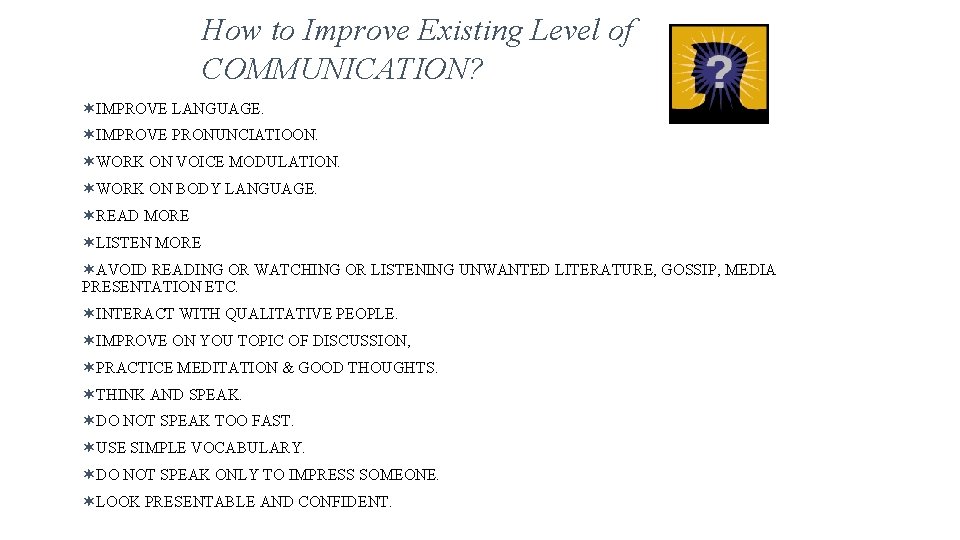
How to Improve Existing Level of COMMUNICATION? ¬IMPROVE LANGUAGE. ¬IMPROVE PRONUNCIATIOON. ¬WORK ON VOICE MODULATION. ¬WORK ON BODY LANGUAGE. ¬READ MORE ¬LISTEN MORE ¬AVOID READING OR WATCHING OR LISTENING UNWANTED LITERATURE, GOSSIP, MEDIA PRESENTATION ETC. ¬INTERACT WITH QUALITATIVE PEOPLE. ¬IMPROVE ON YOU TOPIC OF DISCUSSION, ¬PRACTICE MEDITATION & GOOD THOUGHTS. ¬THINK AND SPEAK. ¬DO NOT SPEAK TOO FAST. ¬USE SIMPLE VOCABULARY. ¬DO NOT SPEAK ONLY TO IMPRESS SOMEONE. ¬LOOK PRESENTABLE AND CONFIDENT.
Improving Body Language Tips • • • Keep appropriate distance Touch only when appropriate Take care of your appearance Be aware - people may give false cues Maintain eye contact Smile genuinely
Success for YOU… …in the new global and diverse workplace requires excellent communication skills!
Body Language
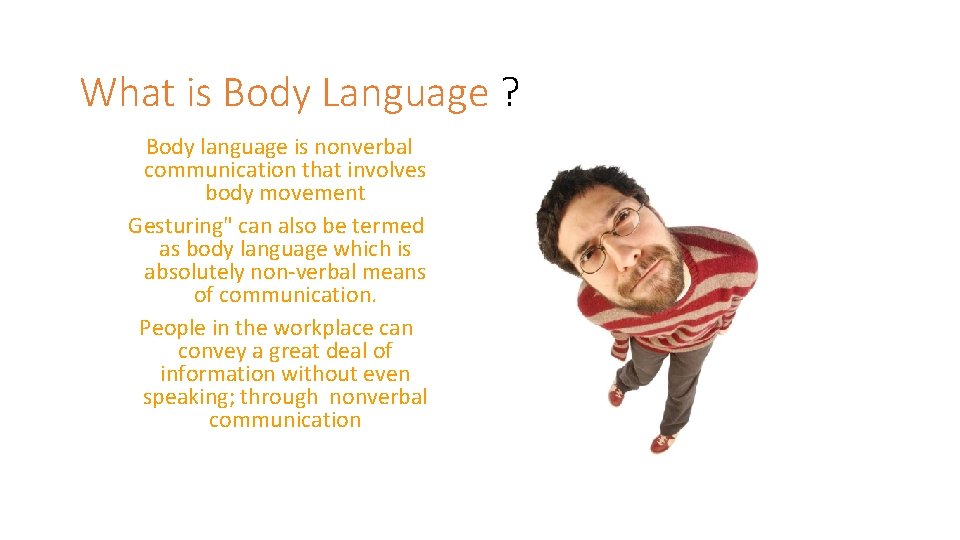
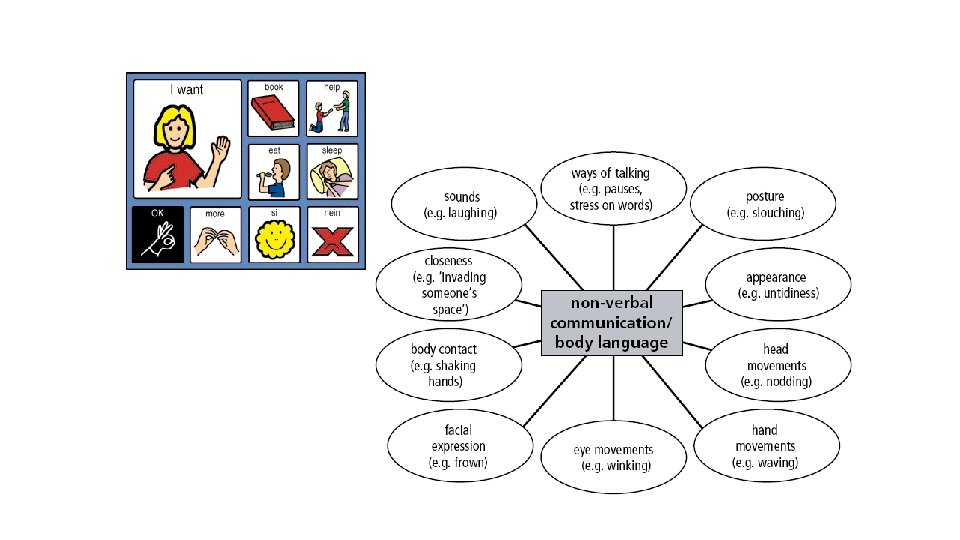
What is Body Language ? Body language is nonverbal communication that involves body movement Gesturing" can also be termed as body language which is absolutely non-verbal means of communication. People in the workplace can convey a great deal of information without even speaking; through nonverbal communication
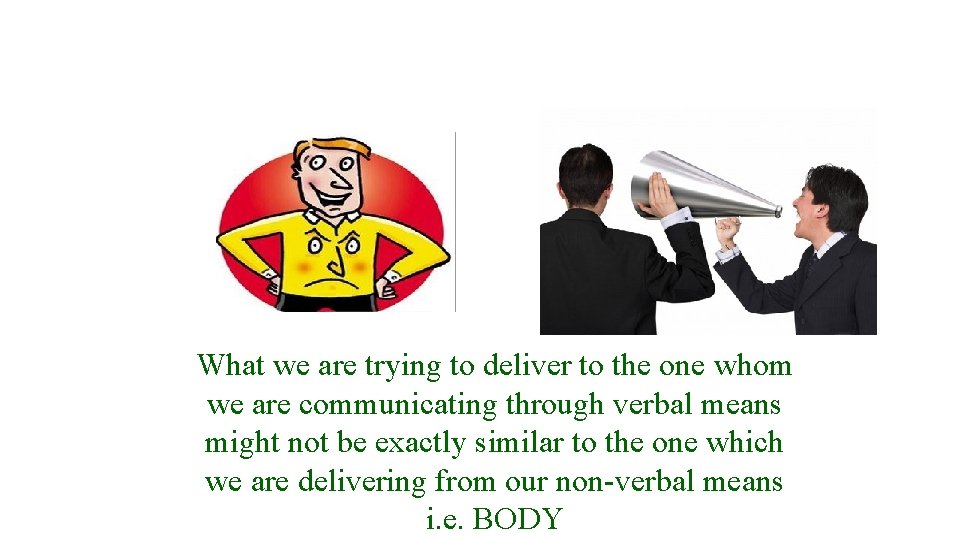
What we are trying to deliver to the one whom we are communicating through verbal means might not be exactly similar to the one which we are delivering from our non-verbal means i. e. BODY
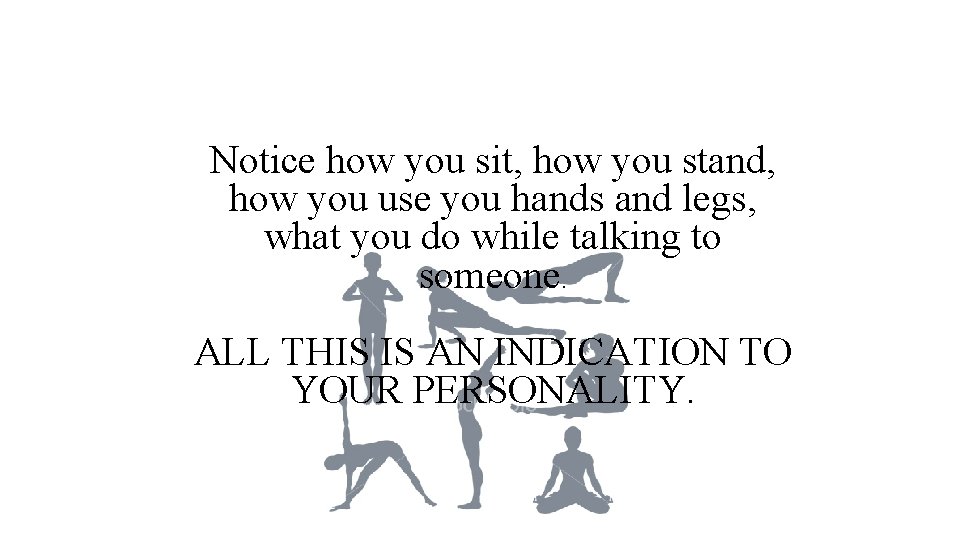
Notice how you sit, how you stand, how you use you hands and legs, what you do while talking to someone. ALL THIS IS AN INDICATION TO YOUR PERSONALITY.
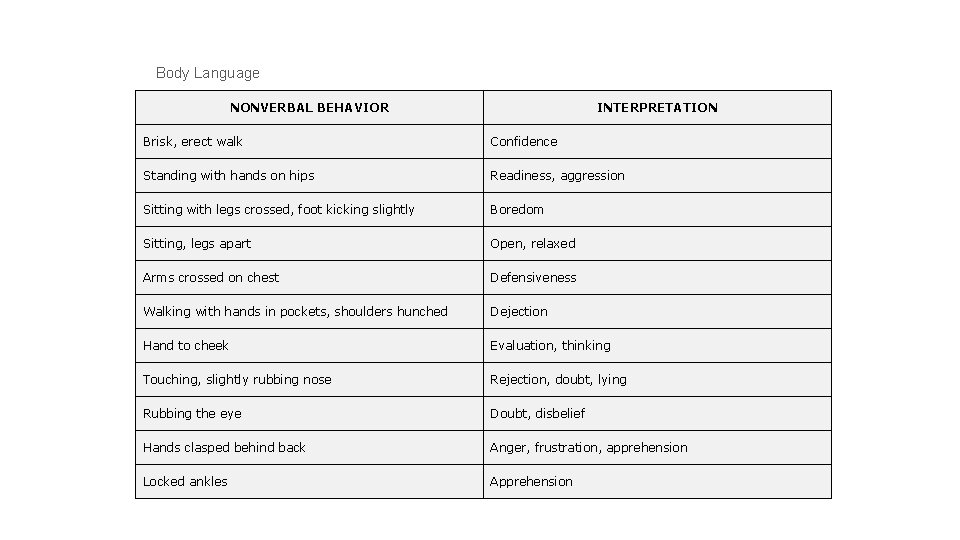
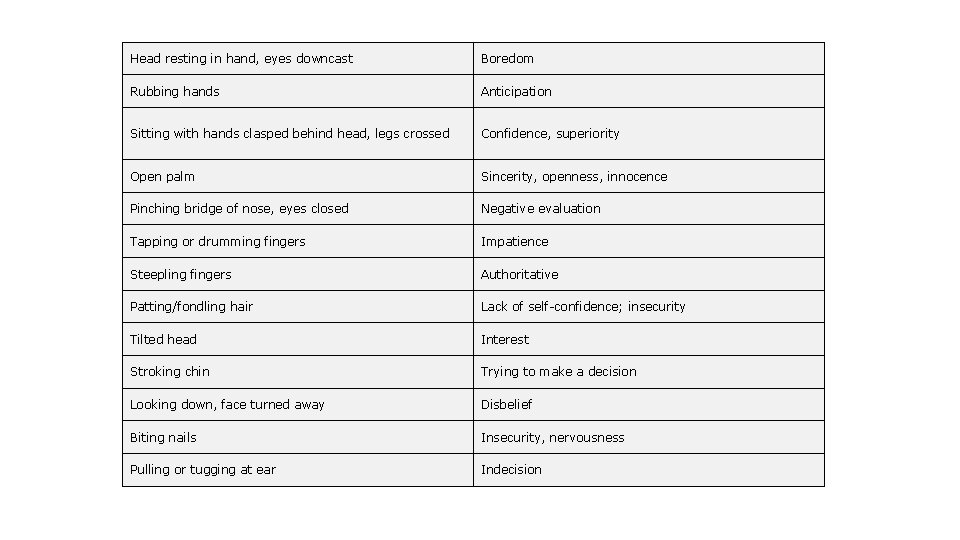
Body Language NONVERBAL BEHAVIOR INTERPRETATION Brisk, erect walk Confidence Standing with hands on hips Readiness, aggression Sitting with legs crossed, foot kicking slightly Boredom Sitting, legs apart Open, relaxed Arms crossed on chest Defensiveness Walking with hands in pockets, shoulders hunched Dejection Hand to cheek Evaluation, thinking Touching, slightly rubbing nose Rejection, doubt, lying Rubbing the eye Doubt, disbelief Hands clasped behind back Anger, frustration, apprehension Locked ankles Apprehension
Head resting in hand, eyes downcast Boredom Rubbing hands Anticipation Sitting with hands clasped behind head, legs crossed Confidence, superiority Open palm Sincerity, openness, innocence Pinching bridge of nose, eyes closed Negative evaluation Tapping or drumming fingers Impatience Steepling fingers Authoritative Patting/fondling hair Lack of self-confidence; insecurity Tilted head Interest Stroking chin Trying to make a decision Looking down, face turned away Disbelief Biting nails Insecurity, nervousness Pulling or tugging at ear Indecision
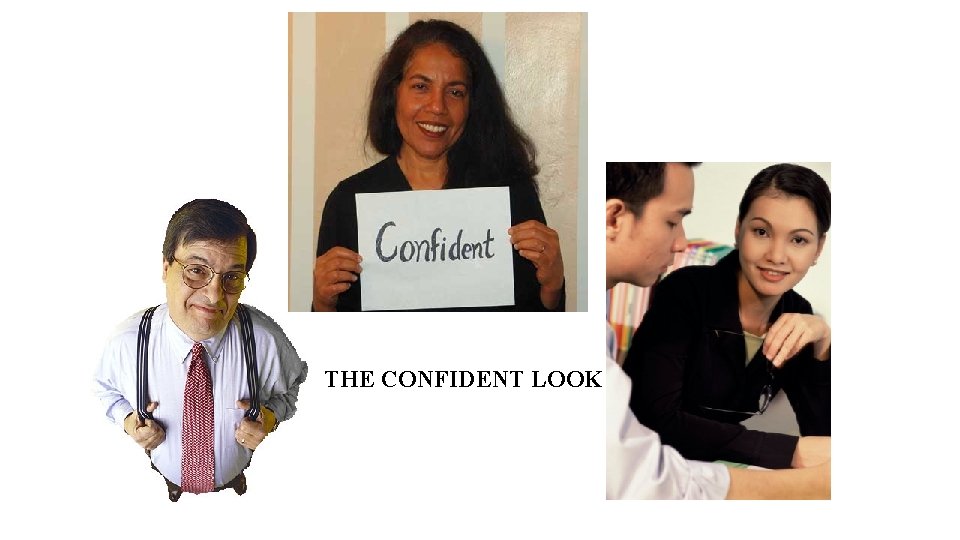
THE CONFIDENT LOOK
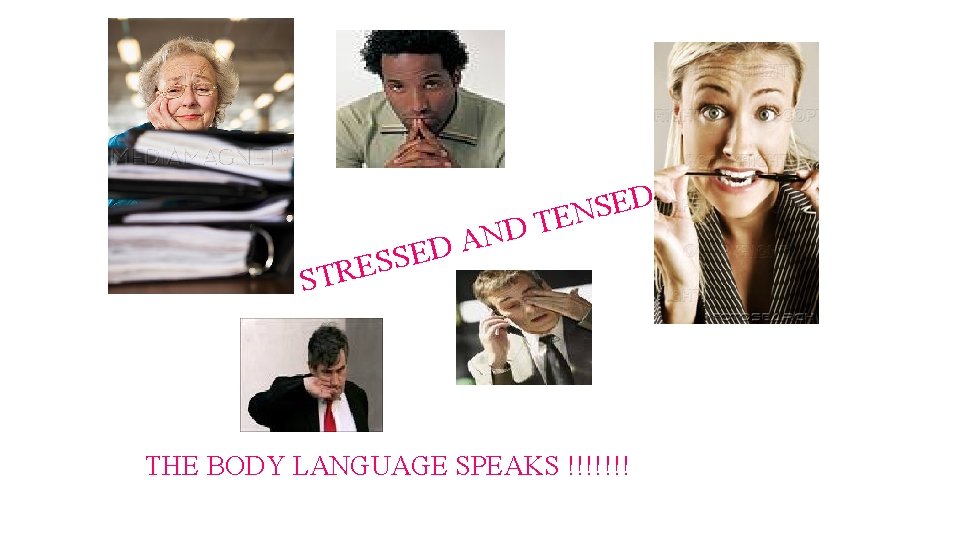
S S E R ST D N A ED D E S TEN THE BODY LANGUAGE SPEAKS !!!!!!!
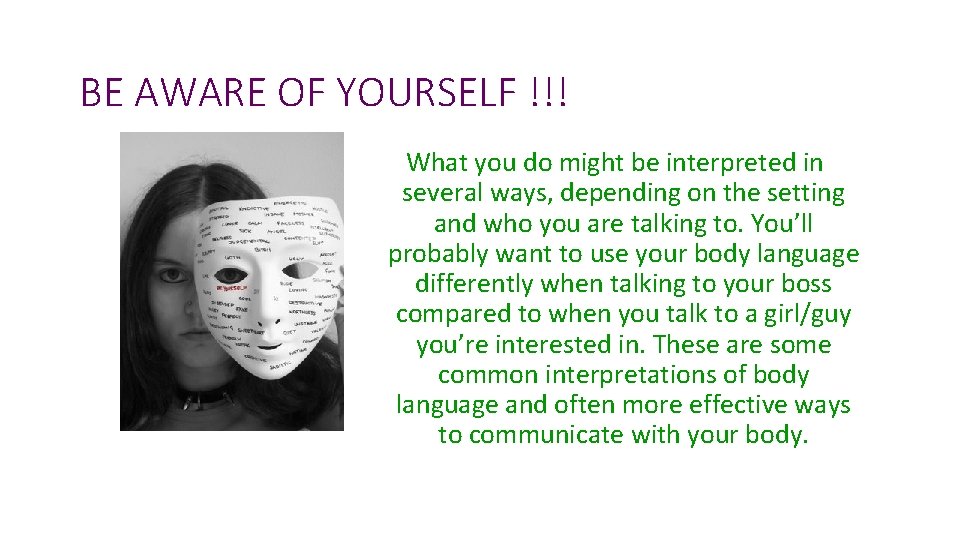
BE AWARE OF YOURSELF !!! What you do might be interpreted in several ways, depending on the setting and who you are talking to. You’ll probably want to use your body language differently when talking to your boss compared to when you talk to a girl/guy you’re interested in. These are some common interpretations of body language and often more effective ways to communicate with your body.
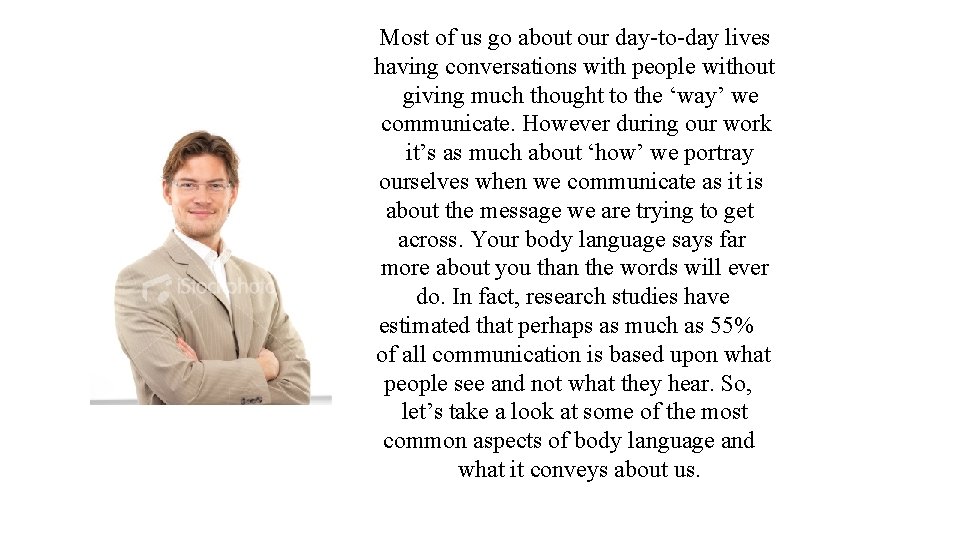
Most of us go about our day-to-day lives having conversations with people without giving much thought to the ‘way’ we communicate. However during our work it’s as much about ‘how’ we portray ourselves when we communicate as it is about the message we are trying to get across. Your body language says far more about you than the words will ever do. In fact, research studies have estimated that perhaps as much as 55% of all communication is based upon what people see and not what they hear. So, let’s take a look at some of the most common aspects of body language and what it conveys about us.
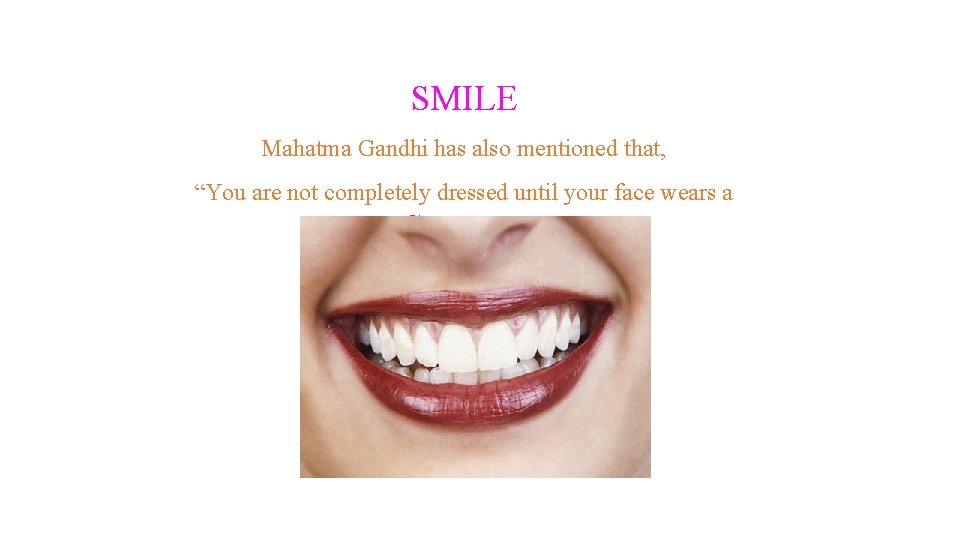
SMILE Mahatma Gandhi has also mentioned that, “You are not completely dressed until your face wears a SMILE ".
Get up in the morning, look yourself on the mirror, smile and say "GOOD MORNING" to your inner psychic. Always remember that, there is another human being inside you so we oftenl say something like "SELF RESPECT" don’t we? After then give a good positive smile and again say "GOOD MORNING " to the LORD who created you, thank to your mom dad for giving you life. See that your face always glows with smile although you are sad or happy because, the one who can smile in hard times will never be in grief.
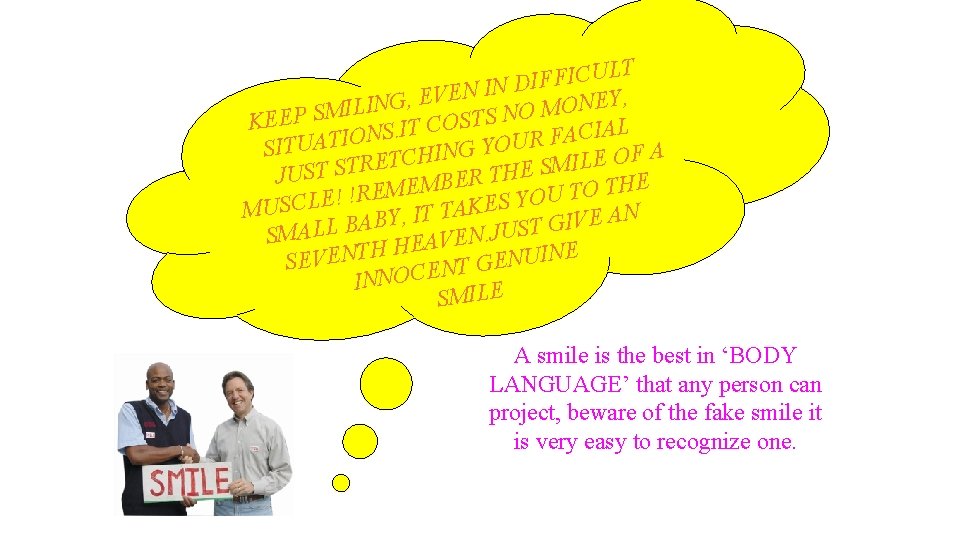
T L U C I F F DI N E V Y, , E E G N N I O L I M M NO S T S KEEP S O C AL IT I. S C N A F O I R T OU Y SITUA G A N I F H O C E T L E I R SM E H T JUST ST R E MB HE T E M O E T R ! U ! YO S E K A MUSCLE T AN , IT E Y V B I A G B T L US J. N SMAL E V A HE H T N INE E U V N E SE G T N E C O N IN SMILE A smile is the best in ‘BODY LANGUAGE’ that any person can project, beware of the fake smile it is very easy to recognize one.
üDo’s and the Don'ts How do I know as to what I am doing is right or not ……. . ? ? OR What is My Body Language like !!!!! Let us find out.
Don’t cross your arms or legs You have probably already heard you shouldn’t cross your arms as it might make you seem defensive or guarded. This goes for your legs too. Keep your arms and legs open.
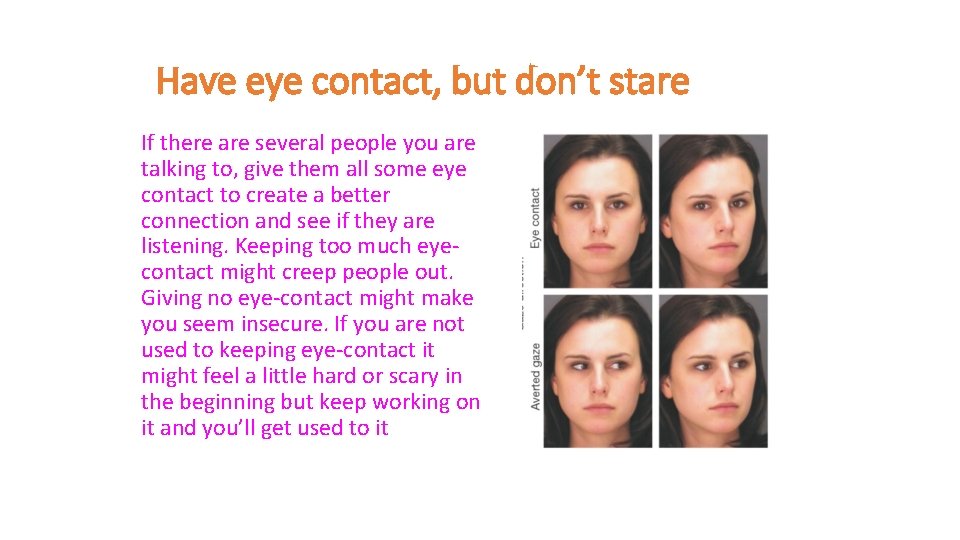
Have eye contact, but don’t stare If there are several people you are talking to, give them all some eye contact to create a better connection and see if they are listening. Keeping too much eyecontact might creep people out. Giving no eye-contact might make you seem insecure. If you are not used to keeping eye-contact it might feel a little hard or scary in the beginning but keep working on it and you’ll get used to it
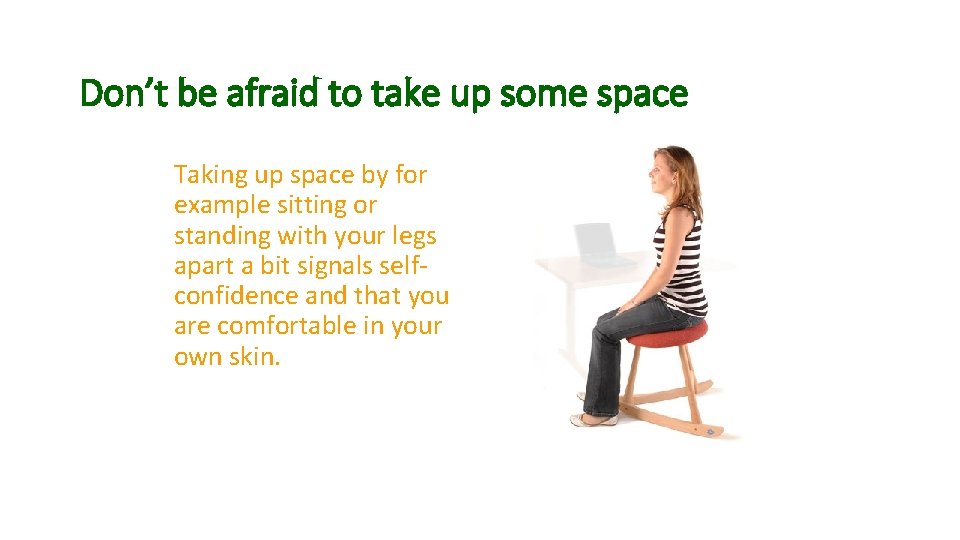
Don’t be afraid to take up some space Taking up space by for example sitting or standing with your legs apart a bit signals selfconfidence and that you are comfortable in your own skin.
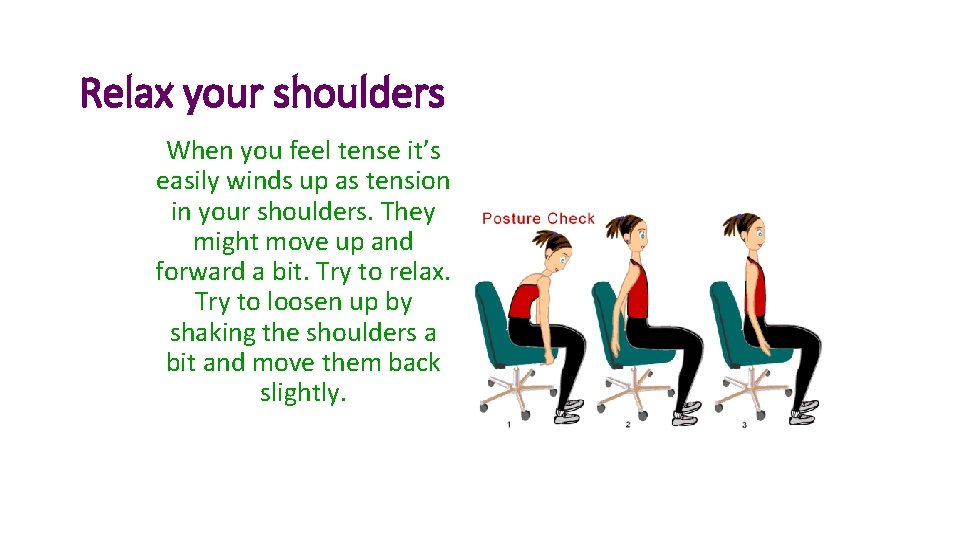
Relax your shoulders When you feel tense it’s easily winds up as tension in your shoulders. They might move up and forward a bit. Try to relax. Try to loosen up by shaking the shoulders a bit and move them back slightly.
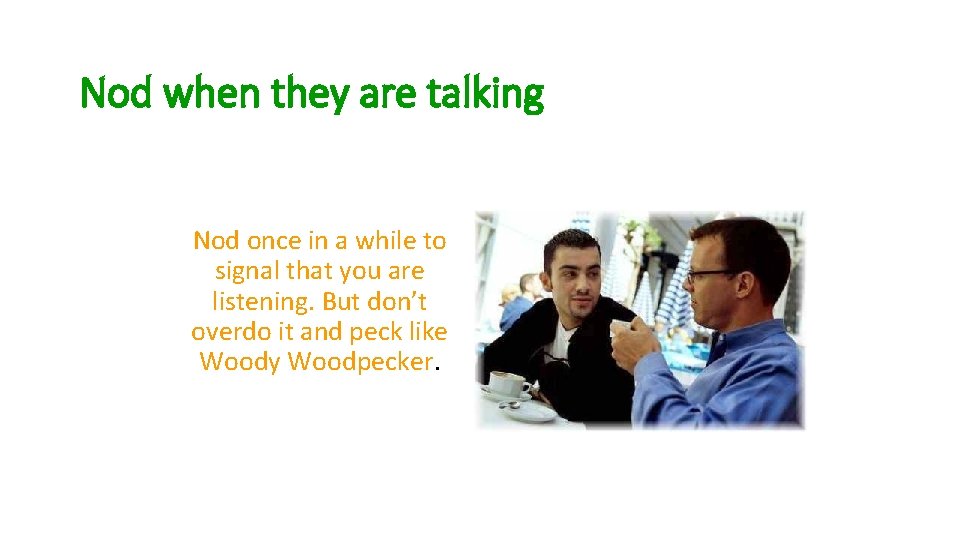
Nod when they are talking Nod once in a while to signal that you are listening. But don’t overdo it and peck like Woody Woodpecker.
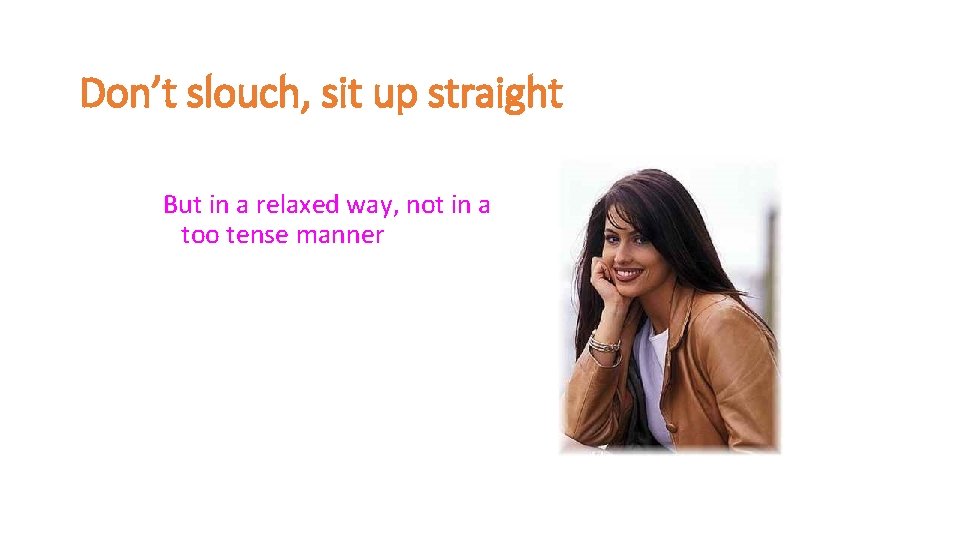
Don’t slouch, sit up straight But in a relaxed way, not in a too tense manner
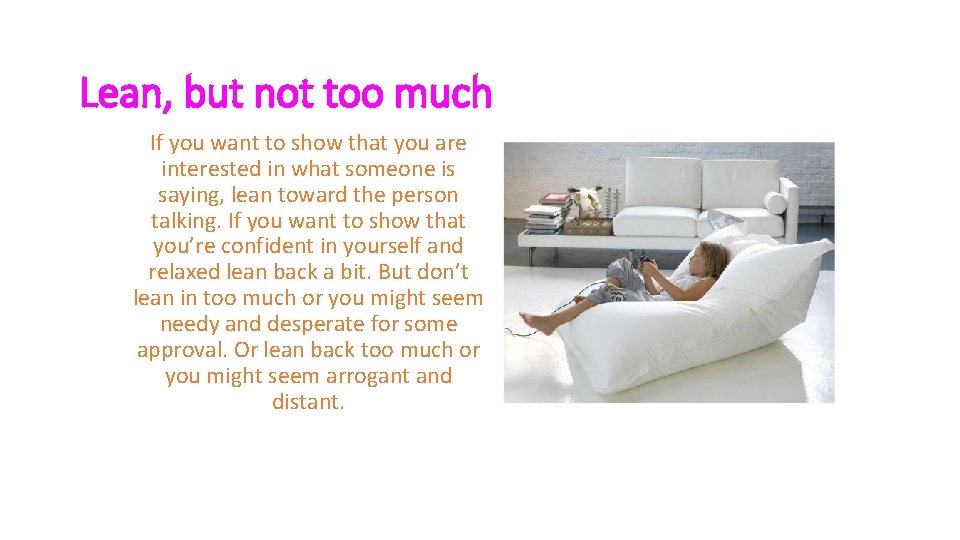
Lean, but not too much If you want to show that you are interested in what someone is saying, lean toward the person talking. If you want to show that you’re confident in yourself and relaxed lean back a bit. But don’t lean in too much or you might seem needy and desperate for some approval. Or lean back too much or you might seem arrogant and distant.
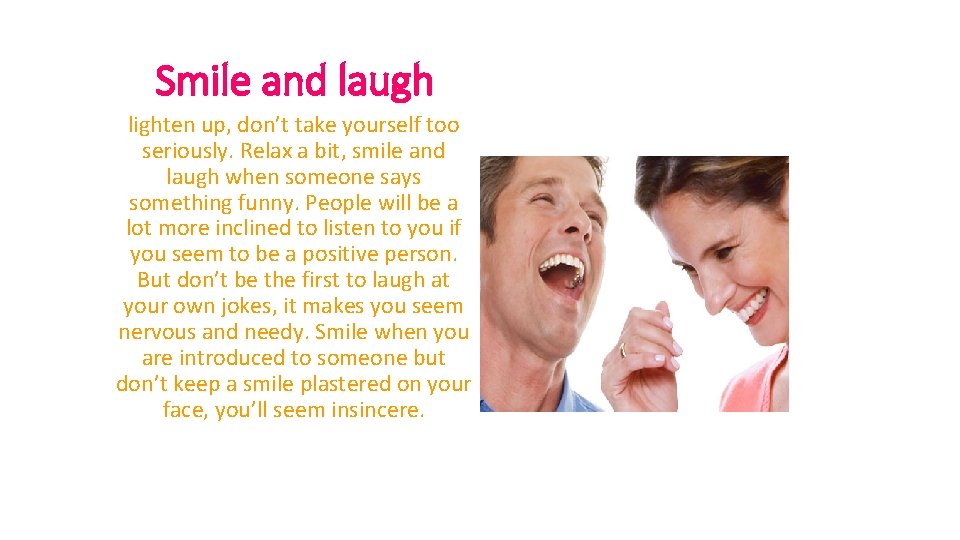
Smile and laugh lighten up, don’t take yourself too seriously. Relax a bit, smile and laugh when someone says something funny. People will be a lot more inclined to listen to you if you seem to be a positive person. But don’t be the first to laugh at your own jokes, it makes you seem nervous and needy. Smile when you are introduced to someone but don’t keep a smile plastered on your face, you’ll seem insincere.
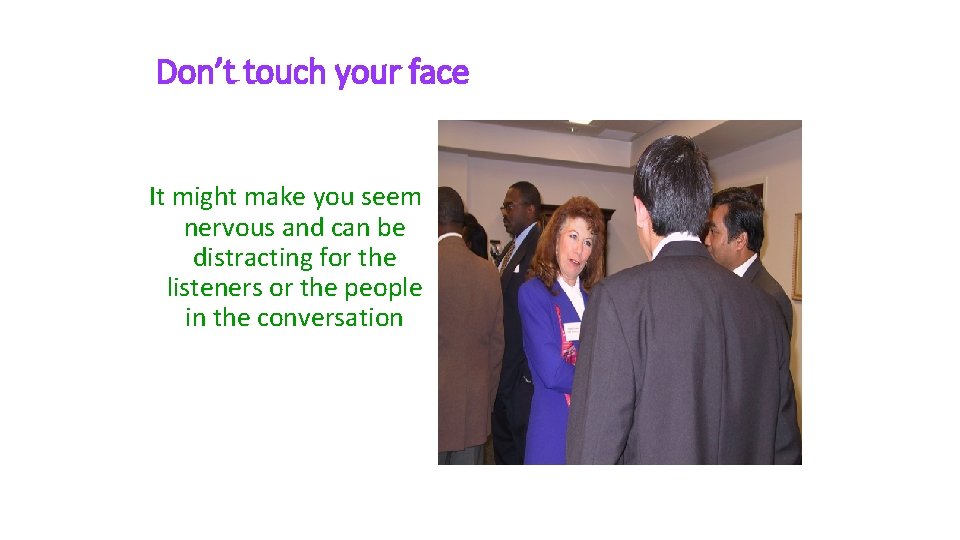
Don’t touch your face It might make you seem nervous and can be distracting for the listeners or the people in the conversation
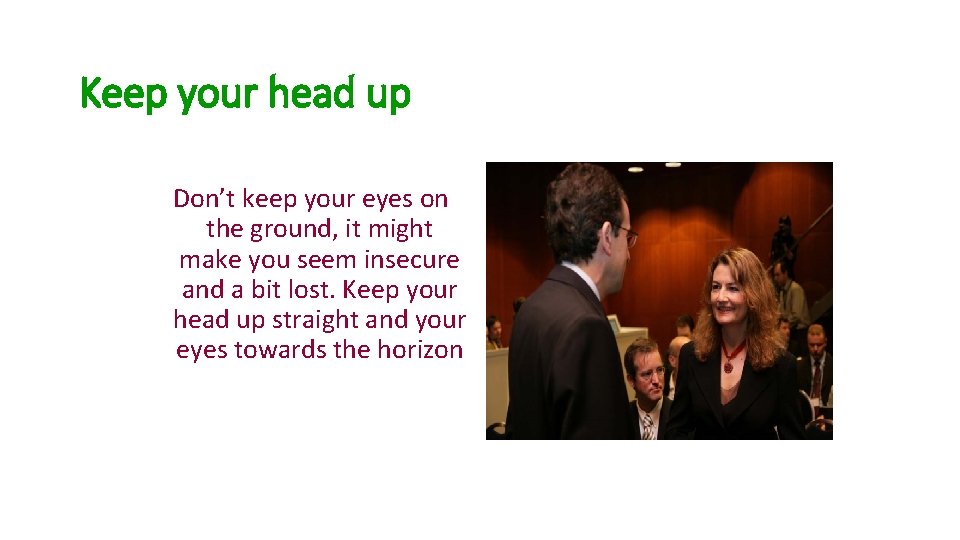
Keep your head up Don’t keep your eyes on the ground, it might make you seem insecure and a bit lost. Keep your head up straight and your eyes towards the horizon
Slow down a bit This goes for many things. Walking slower not only makes you seem more calm and confident, it will also make you feel less stressed. If someone addresses you, don’t snap you’re neck in their direction, turn it a bit more slowly instead.
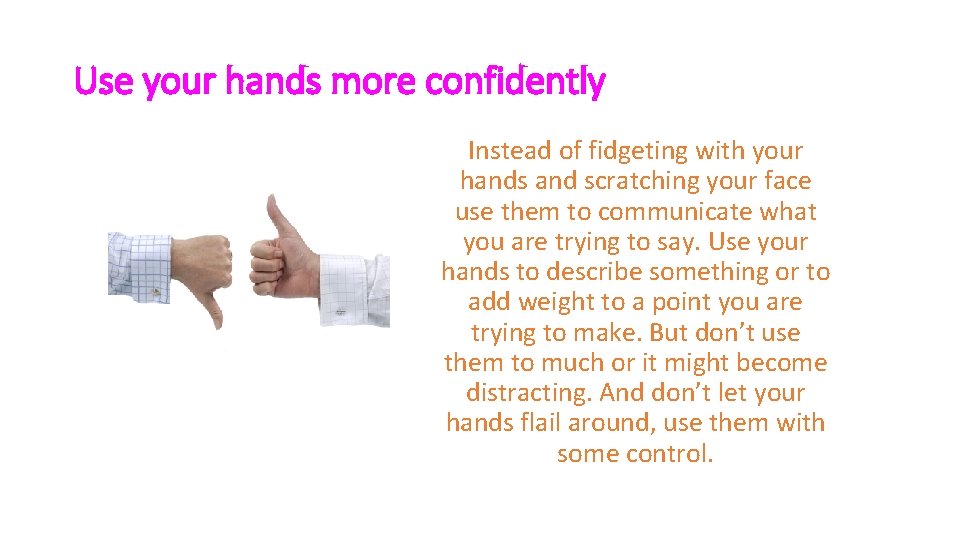
Use your hands more confidently Instead of fidgeting with your hands and scratching your face use them to communicate what you are trying to say. Use your hands to describe something or to add weight to a point you are trying to make. But don’t use them to much or it might become distracting. And don’t let your hands flail around, use them with some control.
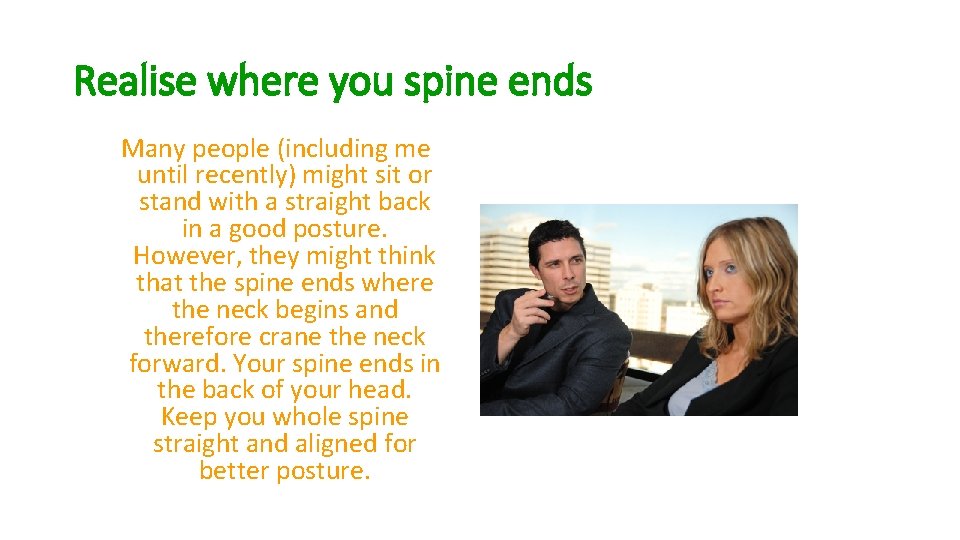
Realise where you spine ends Many people (including me until recently) might sit or stand with a straight back in a good posture. However, they might think that the spine ends where the neck begins and therefore crane the neck forward. Your spine ends in the back of your head. Keep you whole spine straight and aligned for better posture.
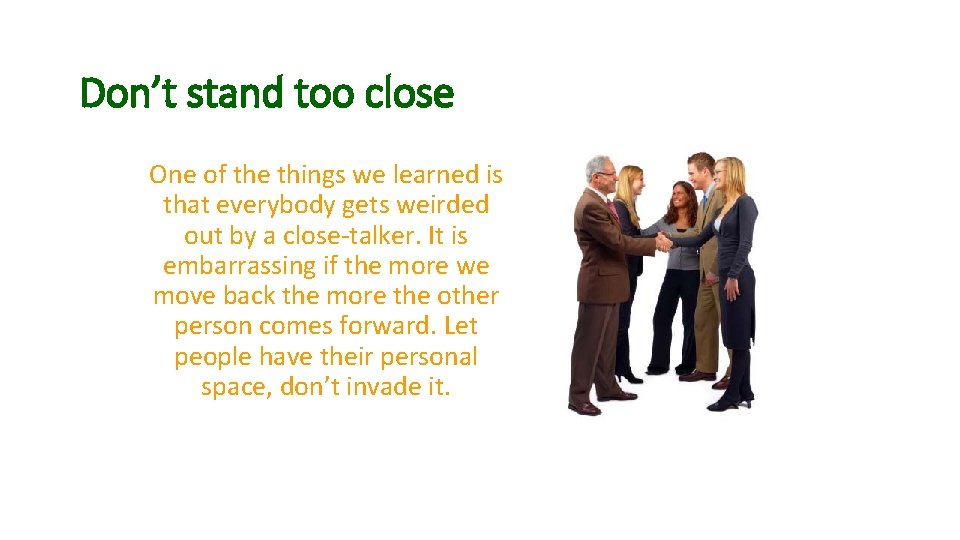
Don’t stand too close One of the things we learned is that everybody gets weirded out by a close-talker. It is embarrassing if the more we move back the more the other person comes forward. Let people have their personal space, don’t invade it.
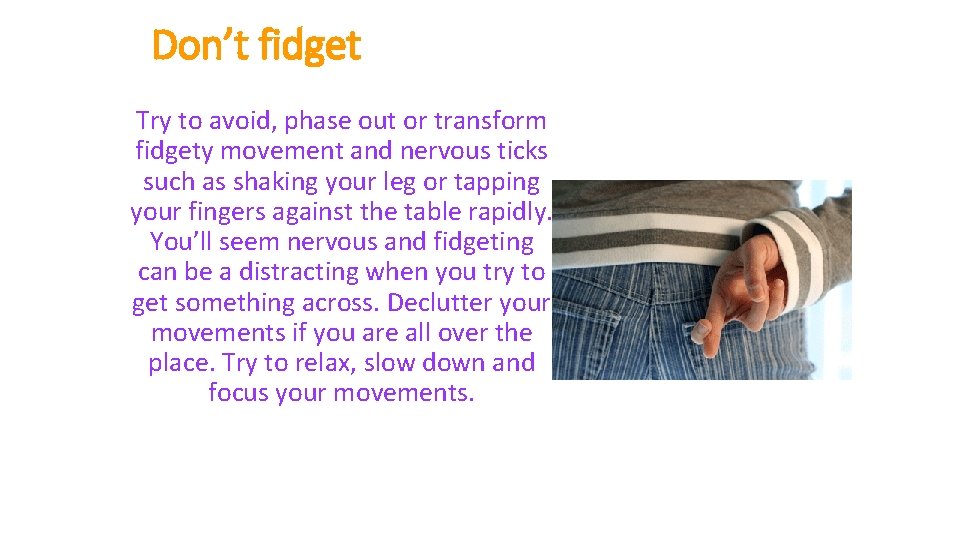
Don’t fidget Try to avoid, phase out or transform fidgety movement and nervous ticks such as shaking your leg or tapping your fingers against the table rapidly. You’ll seem nervous and fidgeting can be a distracting when you try to get something across. Declutter your movements if you are all over the place. Try to relax, slow down and focus your movements.
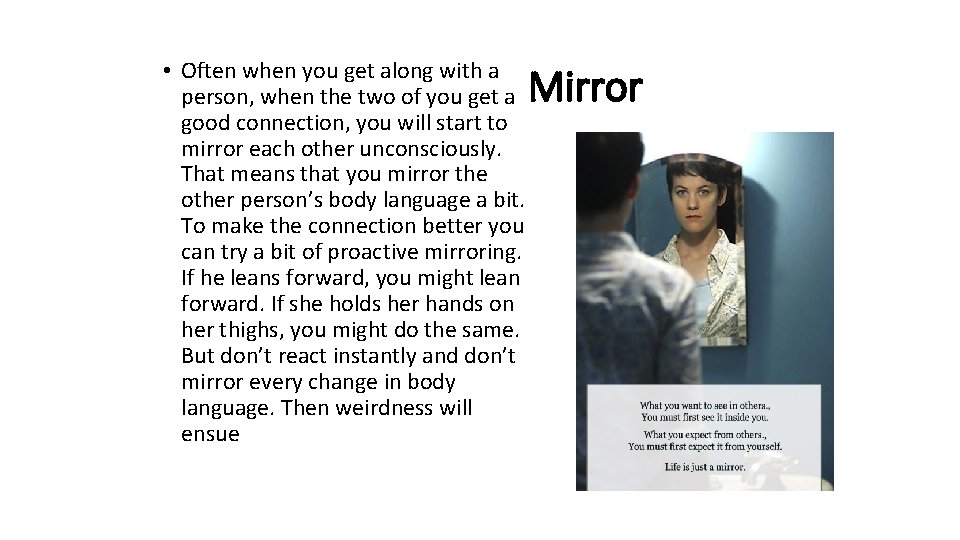
• Often when you get along with a person, when the two of you get a good connection, you will start to mirror each other unconsciously. That means that you mirror the other person’s body language a bit. To make the connection better you can try a bit of proactive mirroring. If he leans forward, you might lean forward. If she holds her hands on her thighs, you might do the same. But don’t react instantly and don’t mirror every change in body language. Then weirdness will ensue Mirror
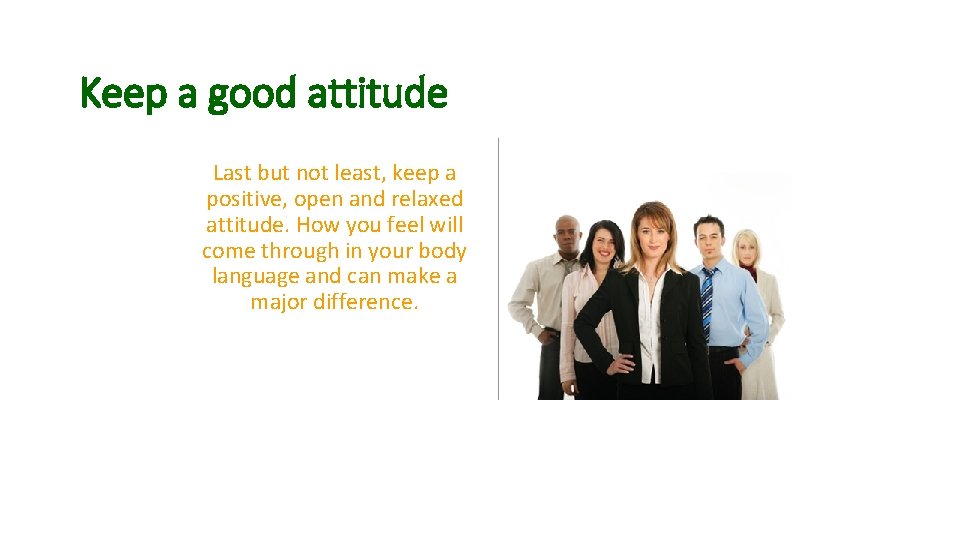
Keep a good attitude Last but not least, keep a positive, open and relaxed attitude. How you feel will come through in your body language and can make a major difference.
You can change your body language but as all new habits it takes a while. Especially things like keeping you head up might take time to correct if you have spent thousands of days looking at your feet. And if you try and change to many things at once it might become confusing and feel overwhelming.
Take a couple of these body language bits to work on every day for three to four weeks. By then they should have developed into new habits and something you’ll do without even thinking about it. If not, keep on until it sticks. Then take another couple of things you’d like to change and work on them.
Questions