
1 3 Accountability to Affected People AAP in
1. 3 Accountability to Affected People (AAP) in Humanitarian Coordination
Objectives of the Session In this session we will look at: The main concepts around AAP Key AAP policies and standards for clusters Specific Nutrition Cluster AAP guidance
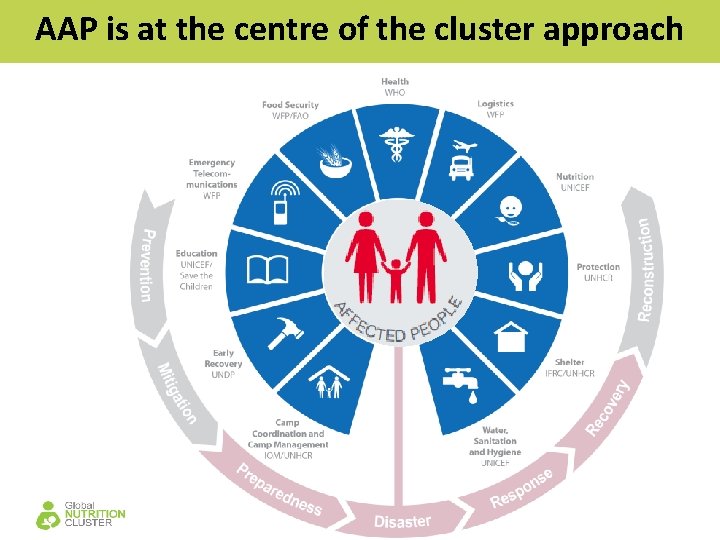
AAP is at the centre of the cluster approach
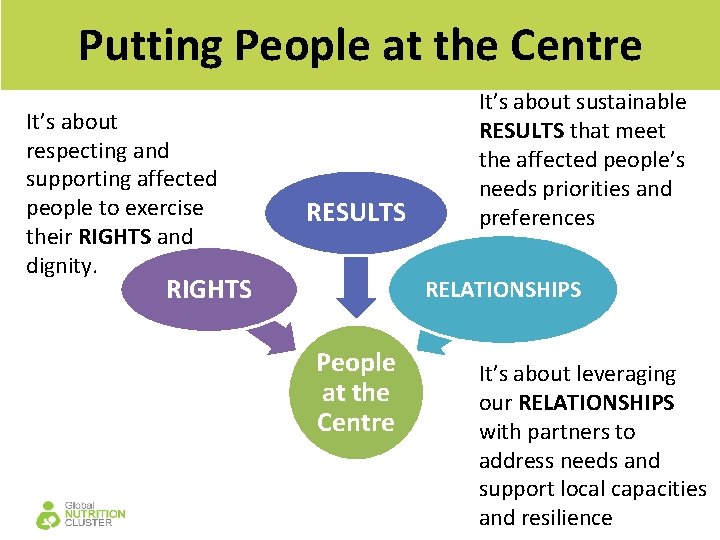
Putting People at the Centre It’s about respecting and supporting affected people to exercise their RIGHTS and dignity. RESULTS RIGHTS It’s about sustainable RESULTS that meet the affected people’s needs priorities and preferences RELATIONSHIPS People at the Centre It’s about leveraging our RELATIONSHIPS with partners to address needs and support local capacities and resilience

Collective accountability Evolution of the humanitarian system has been towards greater collective accountability RESULTS RIGHTS Shared responsibility to protect the RIGHTS and dignity of affected people, including the right to access, protection, quality, coordinated responses, participation and two-way communication. Shared responsibility to work towards for timely, relevant, appropriate, RESULTS that maximise coverage and minimise gaps. RELATIONSHIPS People at the Centre Shared responsibility to promote effective and equitable RELATIONSHIPS between communities, aid provider and local national actors.

Humanitarian Principles Humanity Neutrality Impartiality Independence Human suffering must be addressed wherever it is found. The purpose of humanitarian action is to protect life and heath and ensure respect for human beings. Humanitarian actors must not take sides in hostilities or engage in controversies of a political, racial, religious or idealogical nature. Humanitarian action must be carried out on the basis on need along, giving priority to the most urgent cases of distress and making no distinctions on the base of nationality, race, gender, religious belief, class or political opinions. Humanitarian action must be autonomous from the political, economic, military or other objectives that any actor may hold with regard to areas where humanitarian action is being implemented.
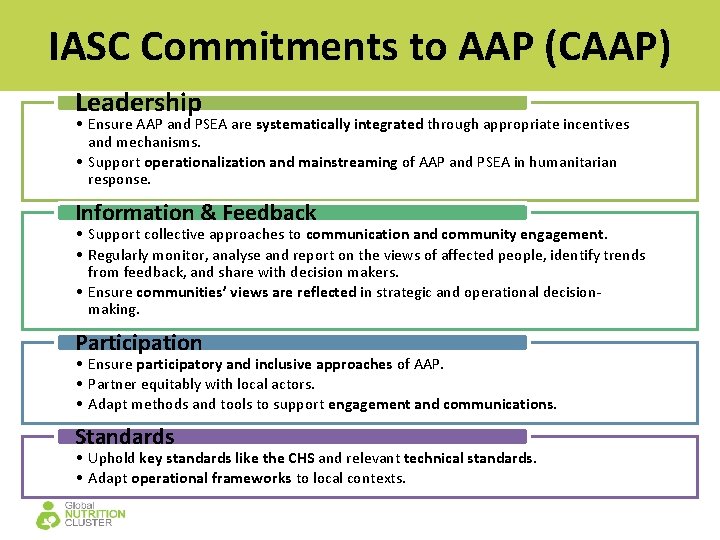
IASC Commitments to AAP (CAAP) Leadership • Ensure AAP and PSEA are systematically integrated through appropriate incentives and mechanisms. • Support operationalization and mainstreaming of AAP and PSEA in humanitarian response. Information & Feedback • Support collective approaches to communication and community engagement. • Regularly monitor, analyse and report on the views of affected people, identify trends from feedback, and share with decision makers. • Ensure communities’ views are reflected in strategic and operational decisionmaking. Participation • Ensure participatory and inclusive approaches of AAP. • Partner equitably with local actors. • Adapt methods and tools to support engagement and communications. Standards • Uphold key standards like the CHS and relevant technical standards. • Adapt operational frameworks to local contexts.

Core Humanitarian Standard for quality and accountability • • • Launched in 2014 and endorsed by many stakeholders in sector Provides a common framework to consolidate technical, quality (like Sphere) and accountability standards Built around 9 Commitments with Key Actions and Organizational Responsibilities
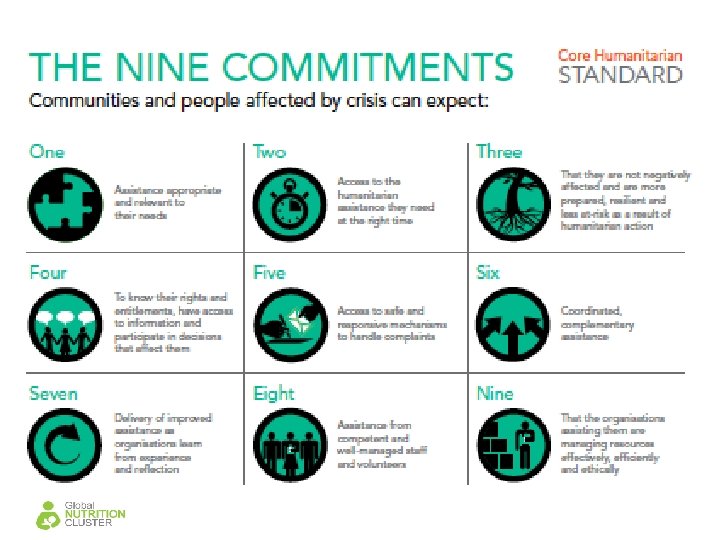
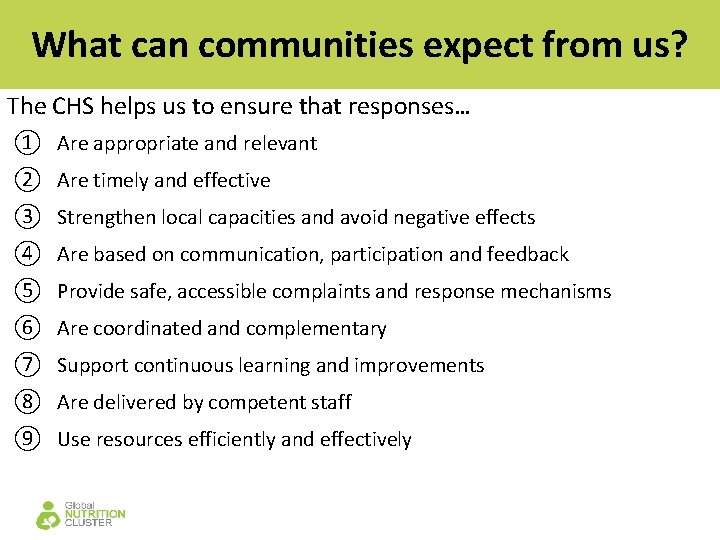
What can communities expect from us? The CHS helps us to ensure that responses… ① Are appropriate and relevant ② Are timely and effective ③ Strengthen local capacities and avoid negative effects ④ Are based on communication, participation and feedback ⑤ Provide safe, accessible complaints and response mechanisms ⑥ Are coordinated and complementary ⑦ Support continuous learning and improvements ⑧ Are delivered by competent staff ⑨ Use resources efficiently and effectively
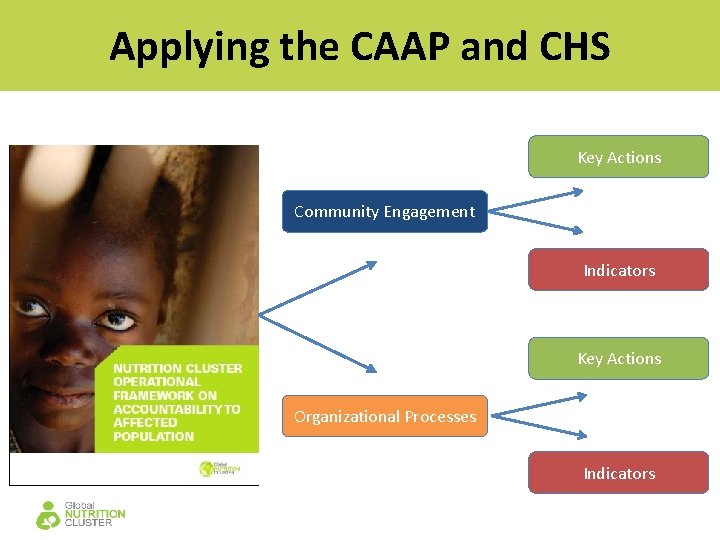
Applying the CAAP and CHS Key Actions Community Engagement Indicators Key Actions Organizational Processes Indicators
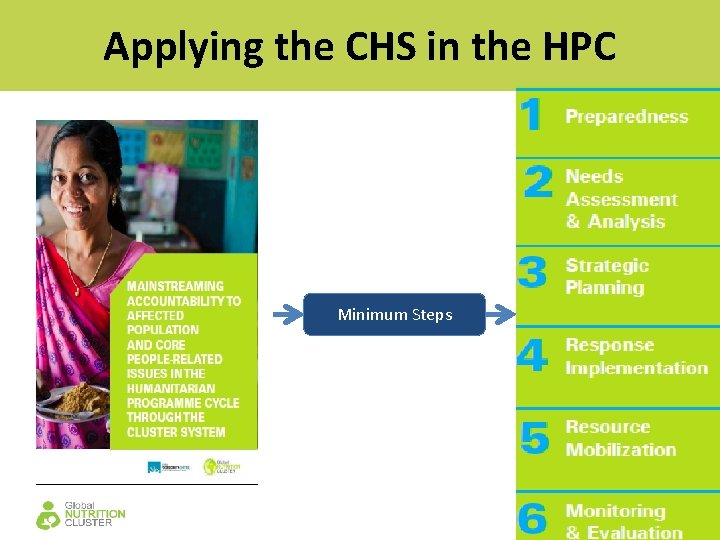
Applying the CHS in the HPC Minimum Steps
Group work In your group: • Looking at your allocated CHS commitment • Consider 3 ways working in coordination can support better AAP (rights and results) in Nutrition • You have 10 min and then 2 min each to present to the whole group
Key Messages Accountability is the collective responsibility of all aid actors to ensure results, rights and relationships Humanitarian Principles underline the work of clusters and are a key component of our collective accountability The IASC CAAP and the Core Humanitarian Standard provide a common framework for AAP Additional Nutrition Cluster guidance reinforces collective approaches to AAP in nutrition in emergencies
- Slides: 14