
1 3 2 Homework Finish questions on the







- Slides: 84
1. 3. 2.
Homework • Finish questions on the lab paper • TEST on TUESDAY!
Good Afternoon! FIND YOUR NEW SEAT! • Warm Up: 1. 2. 3. 4. Describe a hydration shell. Explain why a molecule lacking a charge would not mix with water. What types of substances are acids? What type of substances are bases? What type of bond holds the hydrogen to the oxygen on one water molecule? • Today: – TEST – Articles
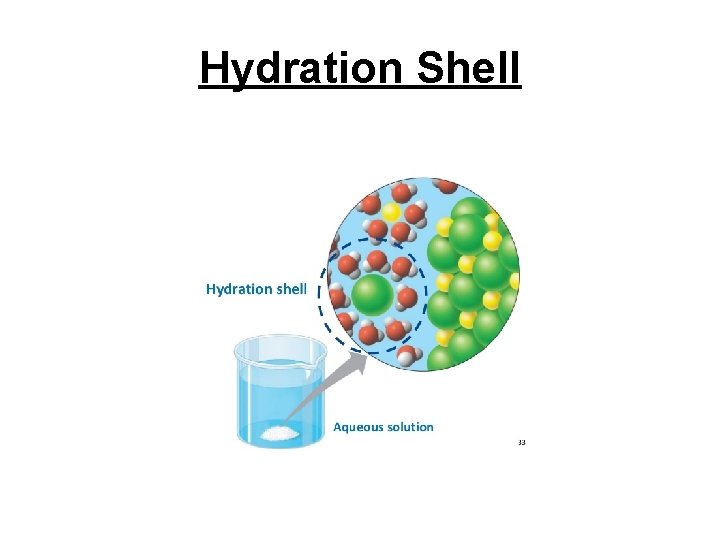
Hydration Shell
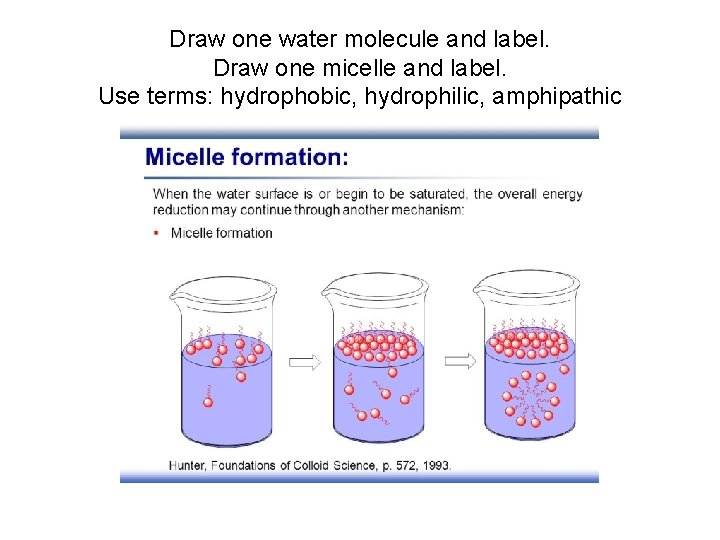
Draw one water molecule and label. Draw one micelle and label. Use terms: hydrophobic, hydrophilic, amphipathic
7 th Lab Groups 1: Tahjae, Joshua, Sela, Tabatha, Sudie 2: Damani, Michaela, Nia. Ja, Kaitlyn 3: Sydney, Jenna, Malcolm, Carrie, Lailah 4: Shelby, Madison, Emily, Christopher 5: Sarah, Mickiya, Elisha, Devon 6: Julien, Desiree, Megan, Shantel 7: Darian, Hailey, Alexis, Kayla T.
5 th Lab Groups 1: Trystan, Ivan, Rhiannon, Sydney 2: Kylie, Matthew, Patrick, Brandon , Christopher 3: Logan, Taylor, Adrian, Hailey, Derek 4: Lacey, Alexandria, Jasmine, Carter T. 5: Caleb, Maurice, Taiquan, Nathan, Daniele 6: Carter H. , Shanice, Jaylyn, Emil, Kacine 7: Rebecca, Rashel, Damon, Sheyanne
Good Afternoon • You will need your book today. • Place homework on your desk. – Acid/Base worksheet – Internet assignment • Please answer the following questions in your notebook: 1. Why is water a “polar” molecule? 2. Distinguish between an acid and a base. 3. We know that pure water is supposed to have a ph of 7. Why is water sometimes a little more acidic or basic than that?
Warm Up Questions 1. Why is water a “polar” molecule? 2. Distinguish between an acid and a base. 3. We know that pure water is supposed to have a ph of 7. Why is water sometimes a little more acidic or basic than that?
Good Afternoon! • Warm Up: List as many facts about water as you can! • Pass forward your lab reports. I’ll collect them after the bell. If you still have questions we will talk after the notes. • Today: – Properties of Water notes – Video (5 minutes) – Class work
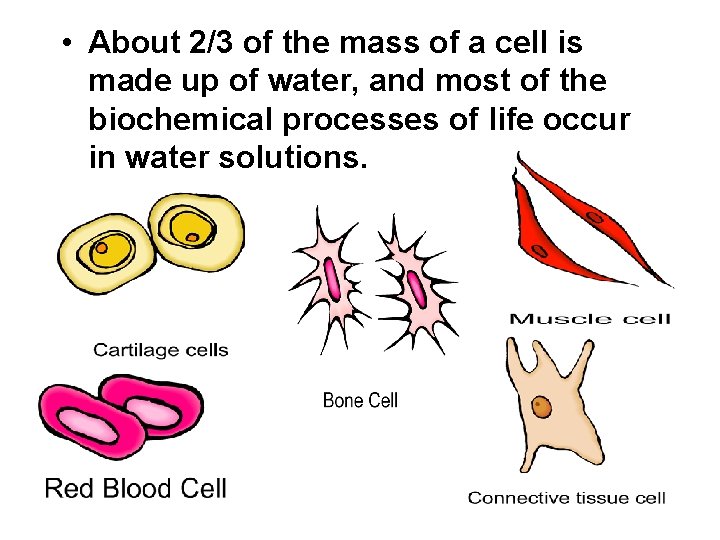
• About 2/3 of the mass of a cell is made up of water, and most of the biochemical processes of life occur in water solutions.
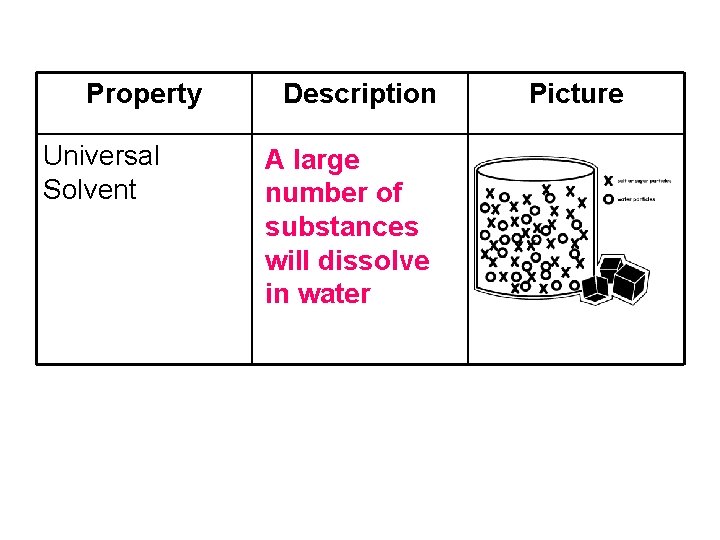
Solvent the substance that does the dissolving. (liquid) Solute the substance that is dissolved. (solid) A large number of substances will dissolve in water.
Property Universal Solvent Description A large number of substances will dissolve in water Picture
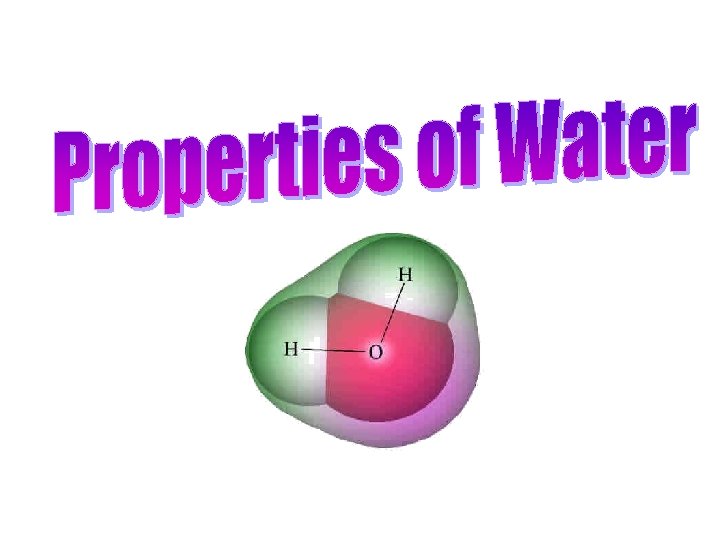
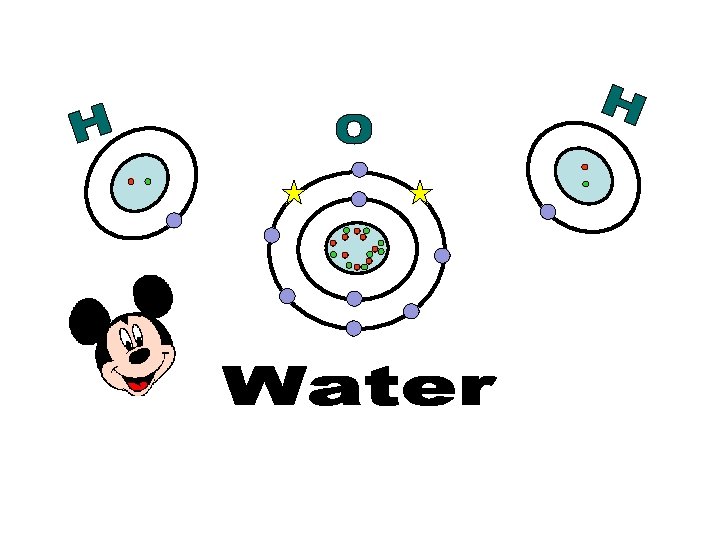
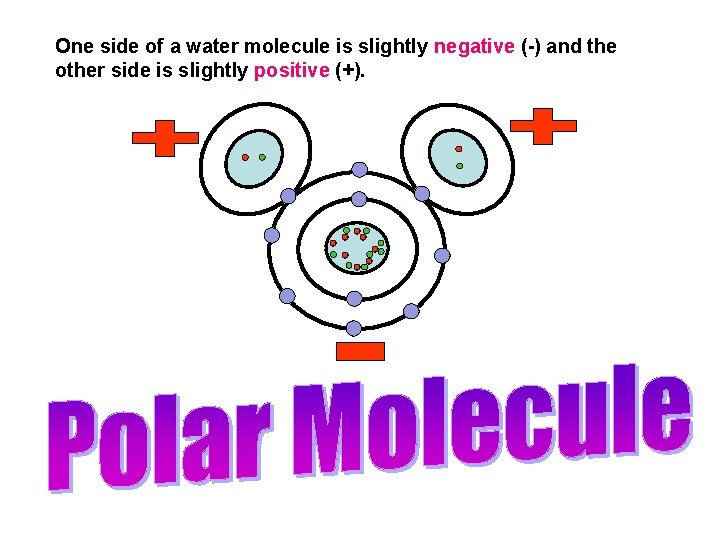
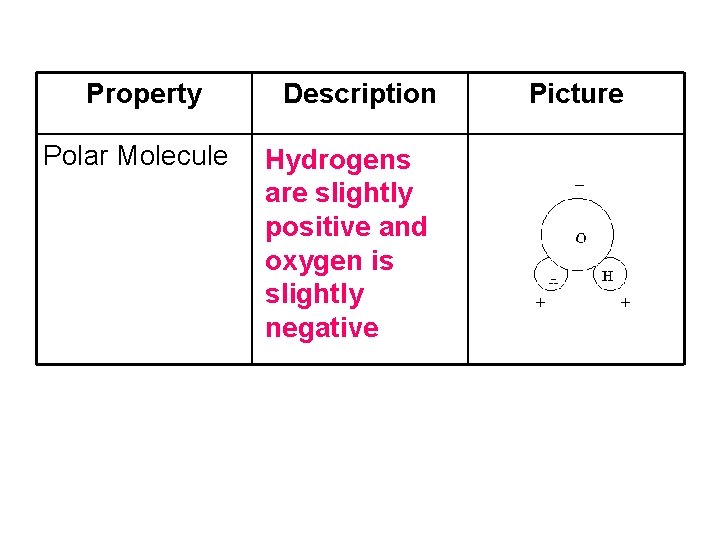
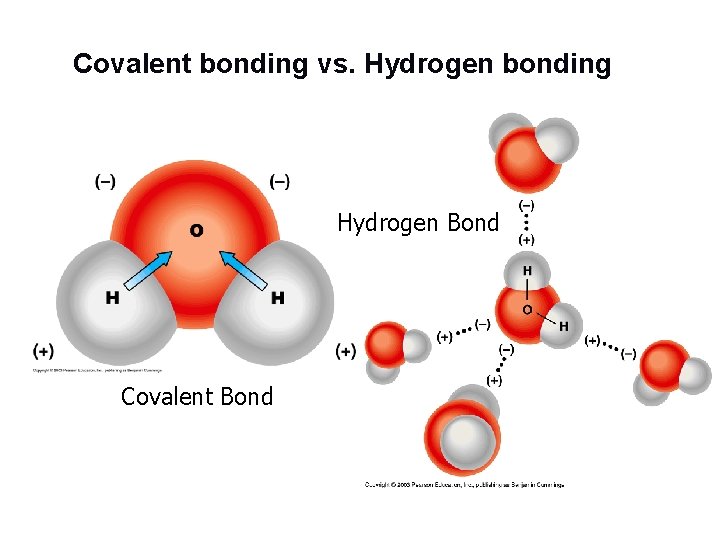
One side of a water molecule is slightly negative (-) and the other side is slightly positive (+).
Property Polar Molecule Description Hydrogens are slightly positive and oxygen is slightly negative Picture
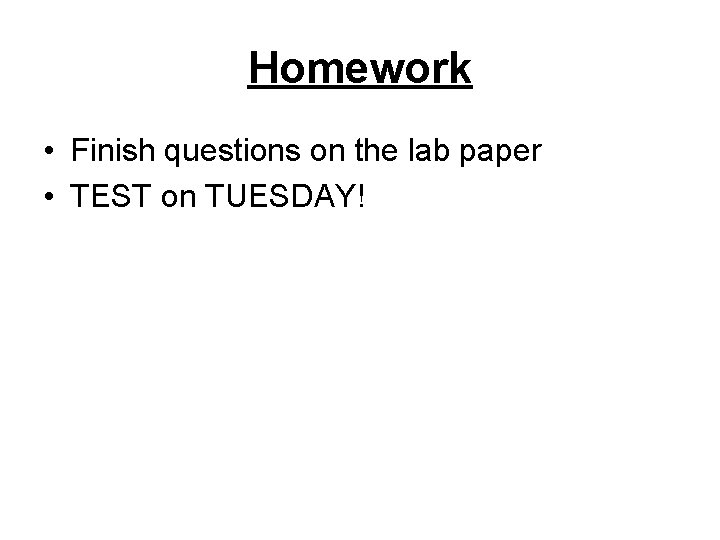
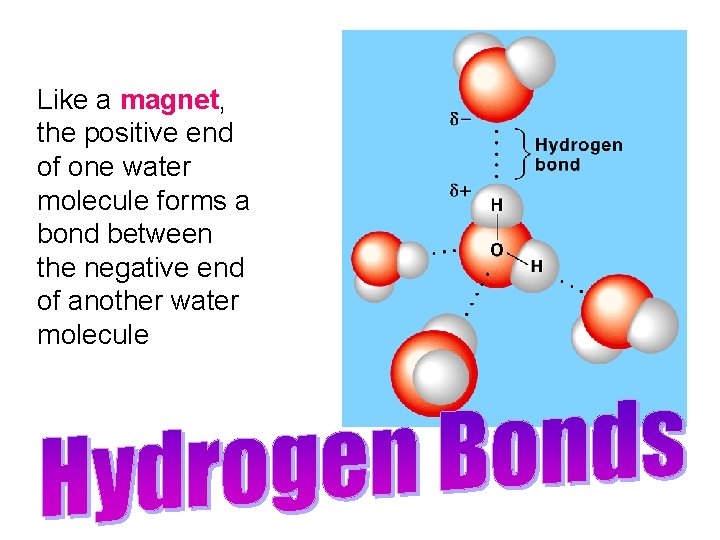
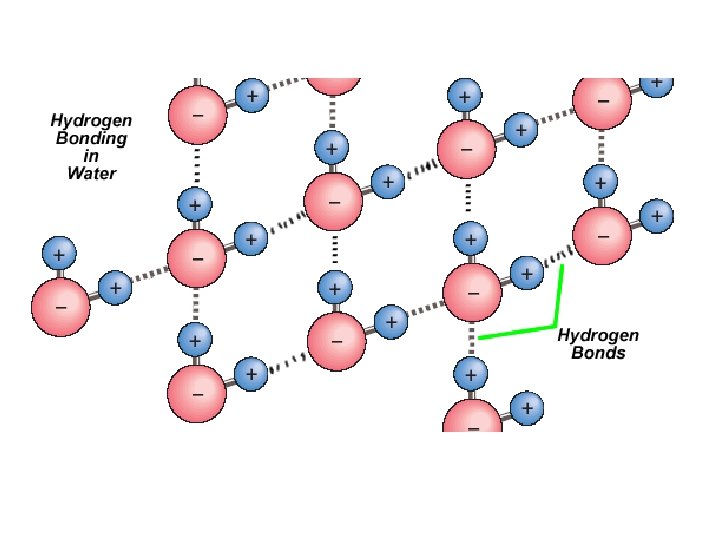
Like a magnet, the positive end of one water molecule forms a bond between the negative end of another water molecule
Covalent bonding vs. Hydrogen bonding Hydrogen Bond Covalent Bond
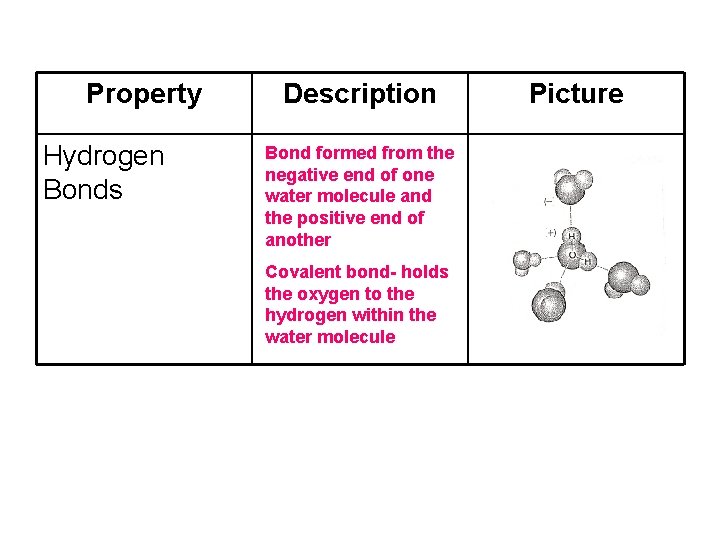
Property Hydrogen Bonds Description Bond formed from the negative end of one water molecule and the positive end of another Covalent bond- holds the oxygen to the hydrogen within the water molecule Picture
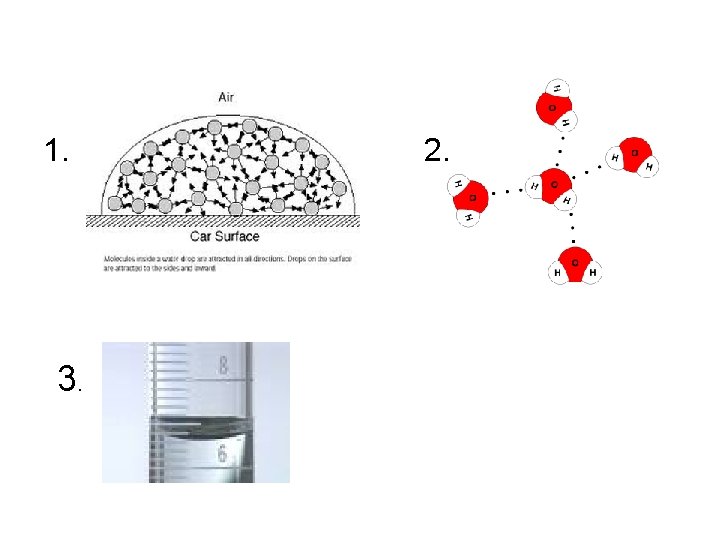
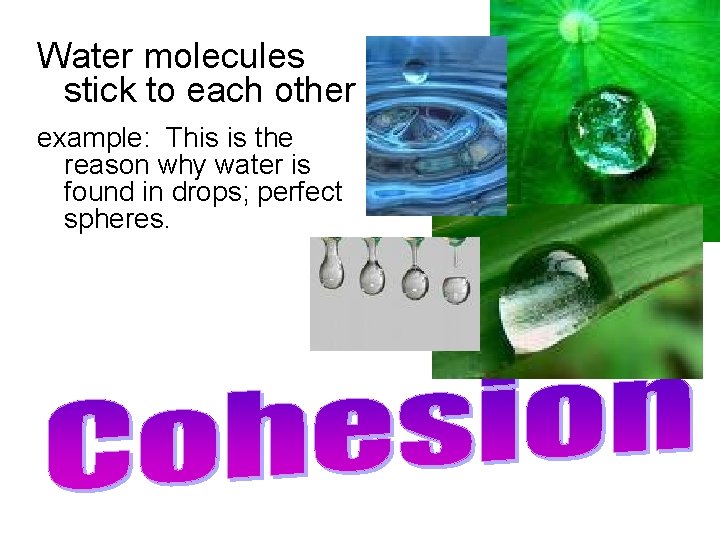
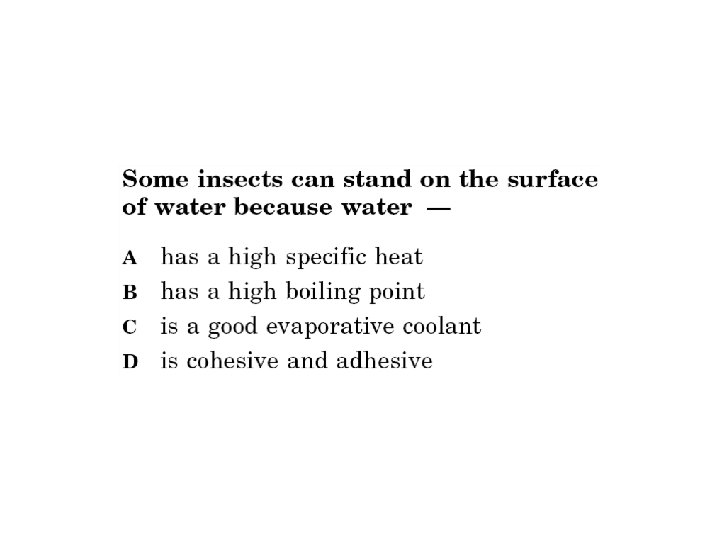
Water molecules stick to each other example: This is the reason why water is found in drops; perfect spheres.
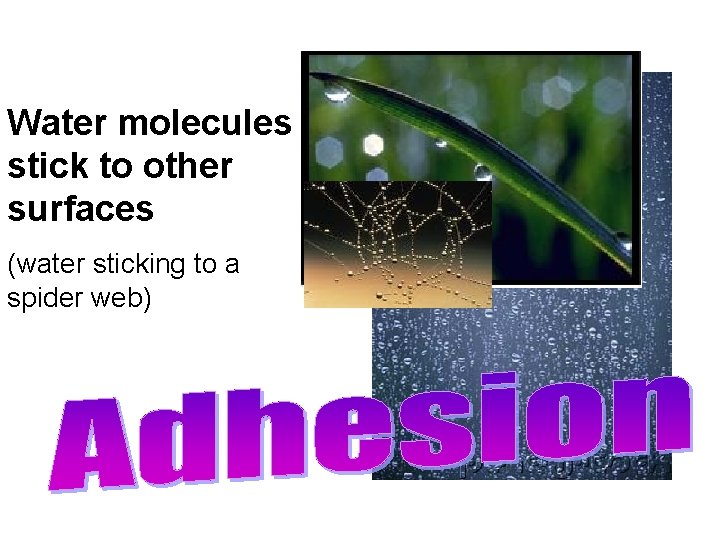
Water molecules stick to other surfaces (water sticking to a spider web)
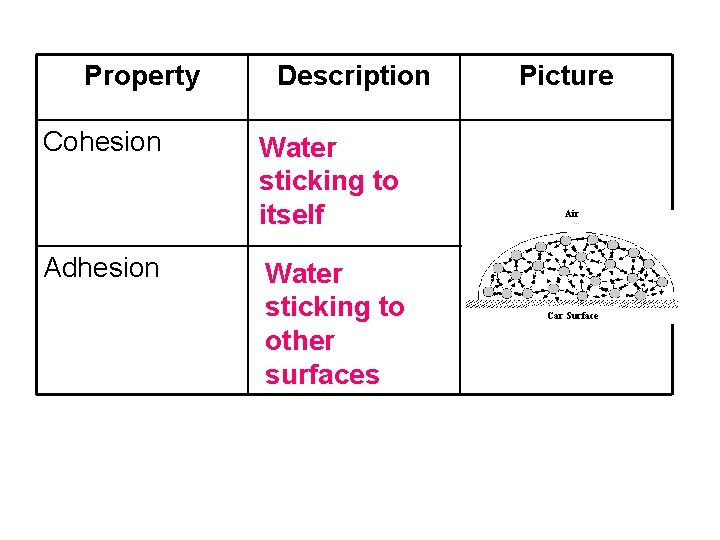
Property Cohesion Adhesion Description Water sticking to itself Water sticking to other surfaces Picture Air Car Surface
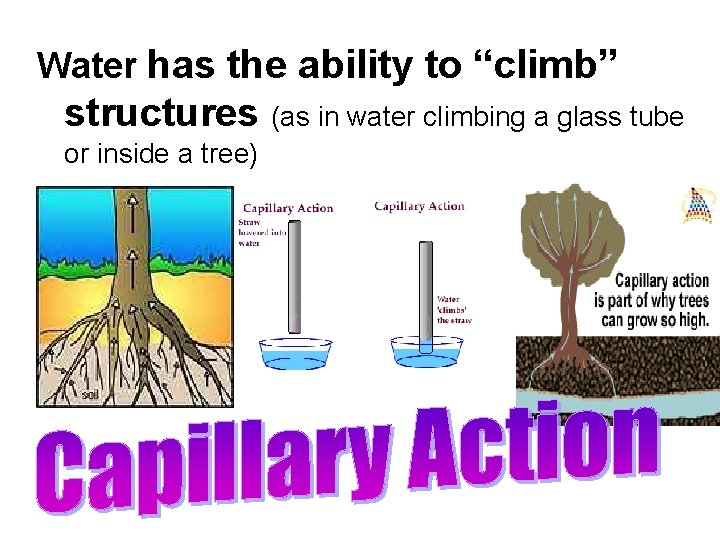
Water has the ability to “climb” structures (as in water climbing a glass tube or inside a tree)
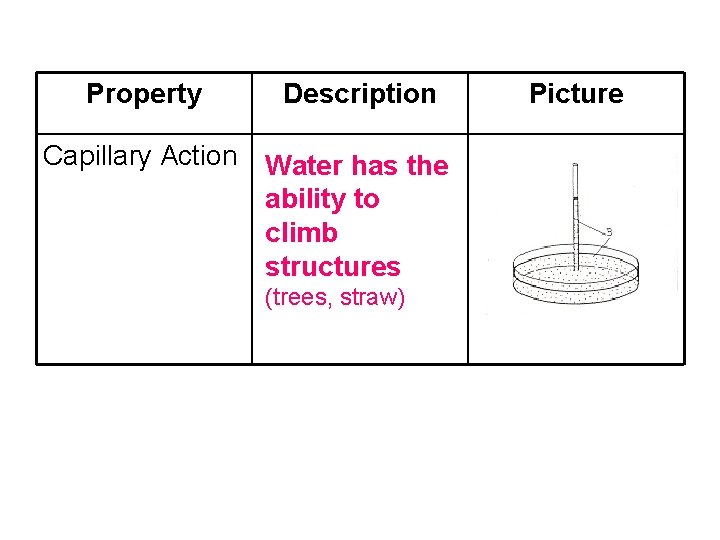
Property Description Capillary Action Water has the ability to climb structures (trees, straw) Picture
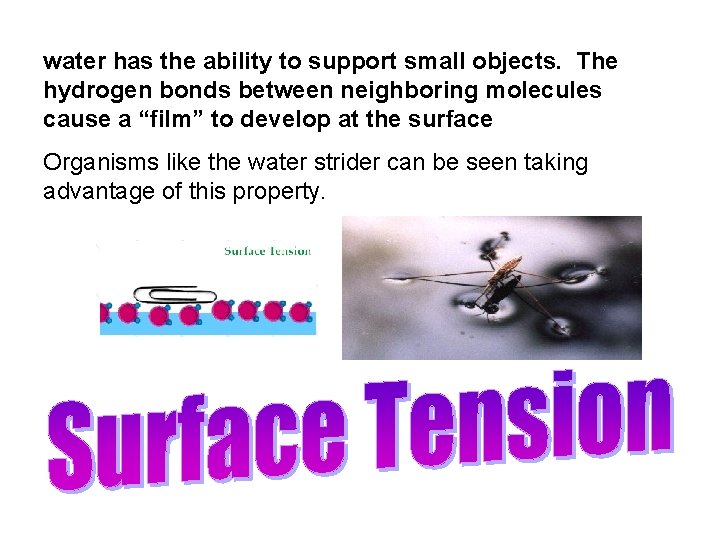
water has the ability to support small objects. The hydrogen bonds between neighboring molecules cause a “film” to develop at the surface Organisms like the water strider can be seen taking advantage of this property.
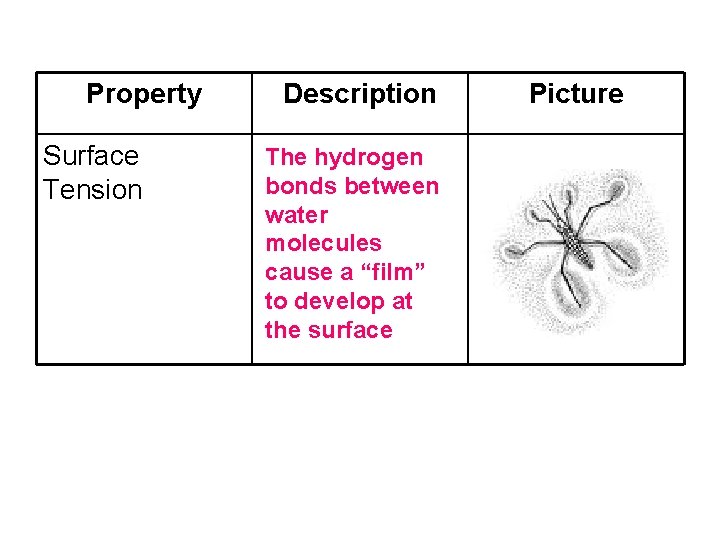
Property Surface Tension Description The hydrogen bonds between water molecules cause a “film” to develop at the surface Picture
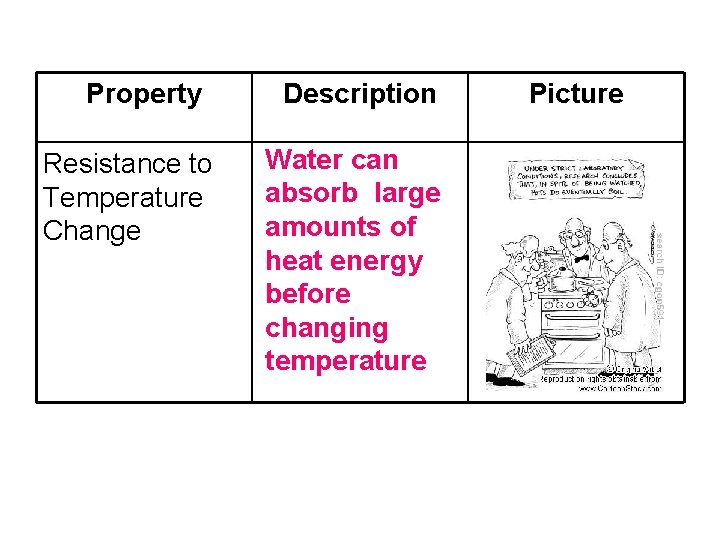
• Water is able to absorb a large amount of heat energy before it changes temperature.
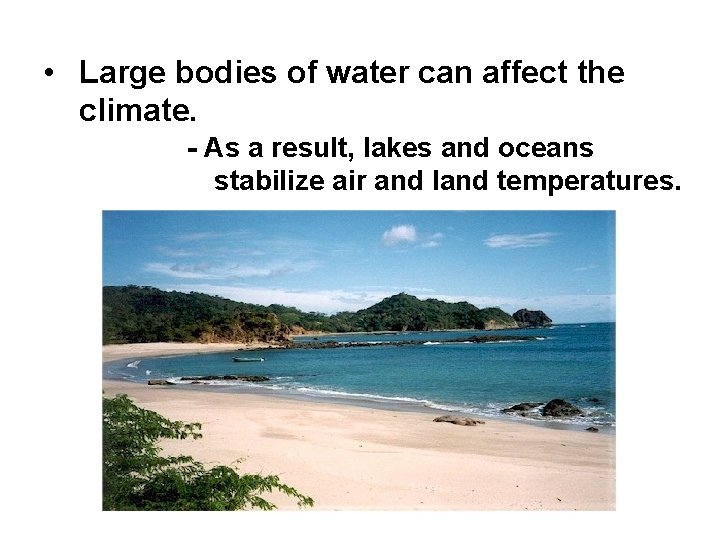
• Large bodies of water can affect the climate. - As a result, lakes and oceans stabilize air and land temperatures.
Property Resistance to Temperature Change Description Water can absorb large amounts of heat energy before changing temperature Picture
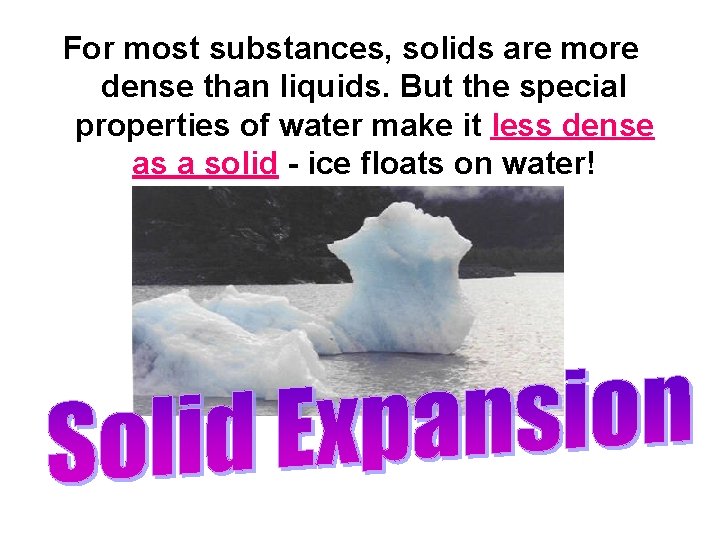
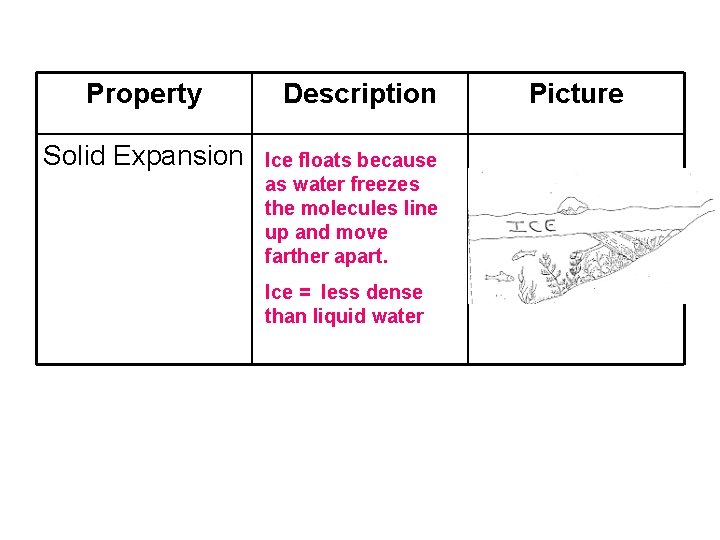
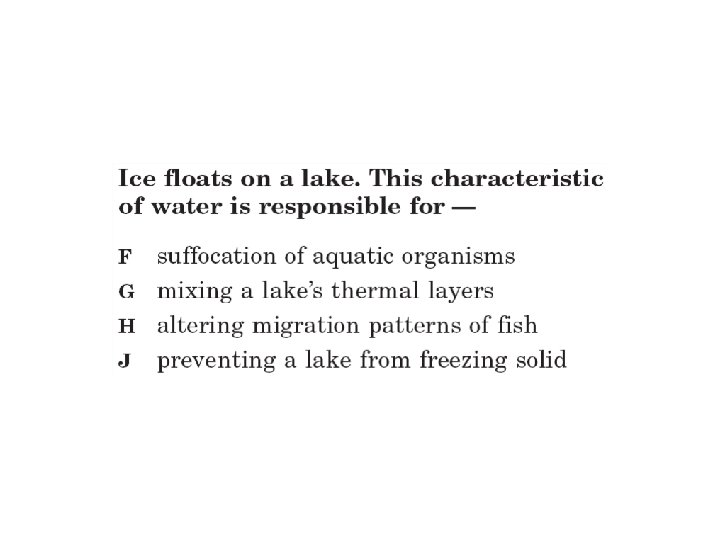
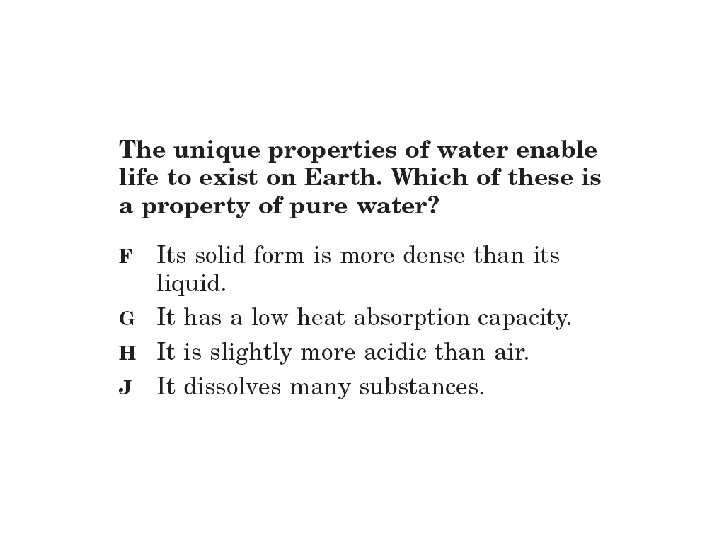
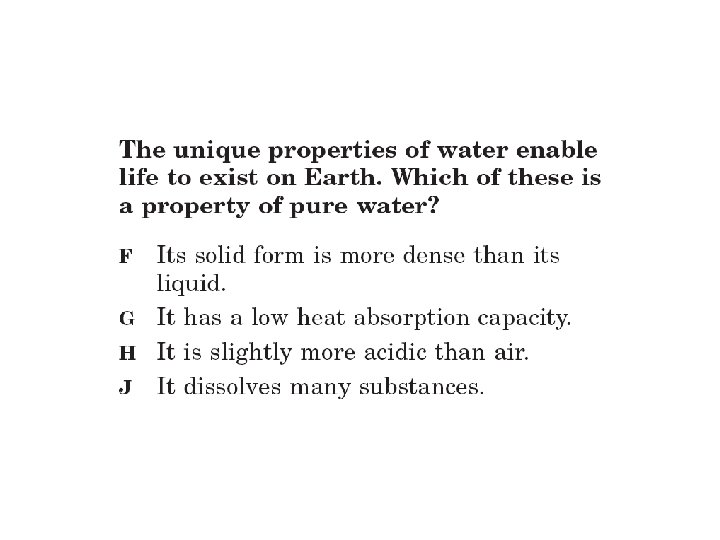
For most substances, solids are more dense than liquids. But the special properties of water make it less dense as a solid - ice floats on water!
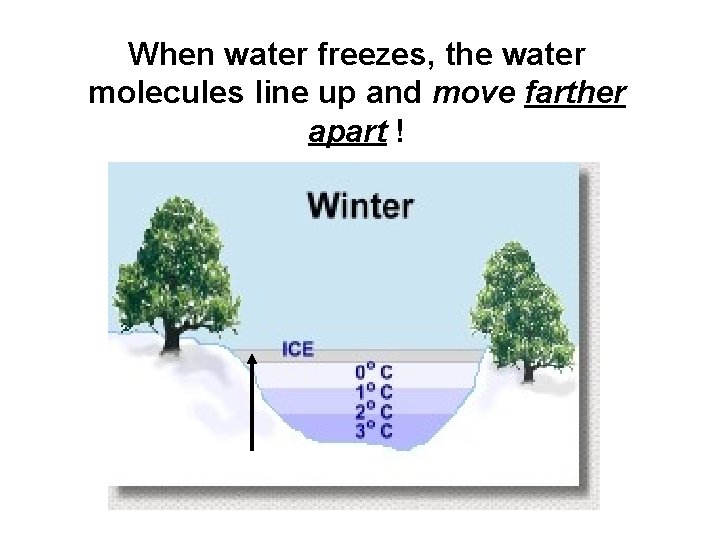
When water freezes, the water molecules line up and move farther apart !
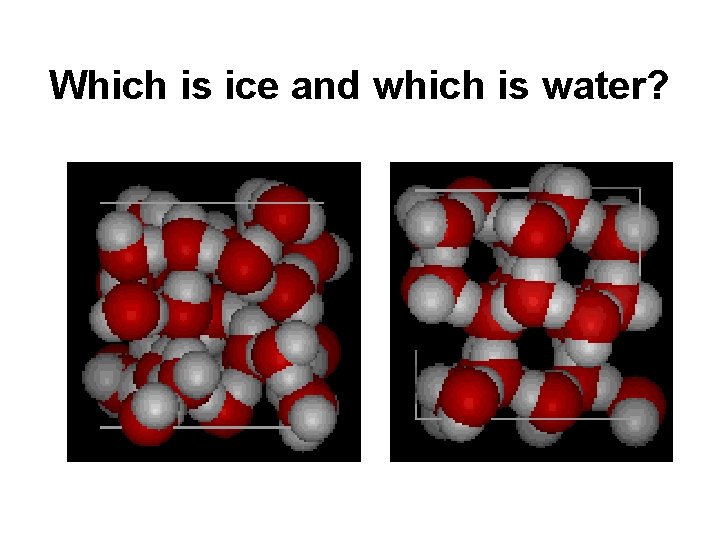
Which is ice and which is water?
Property Description Solid Expansion Ice floats because as water freezes the molecules line up and move farther apart. Ice = less dense than liquid water Picture
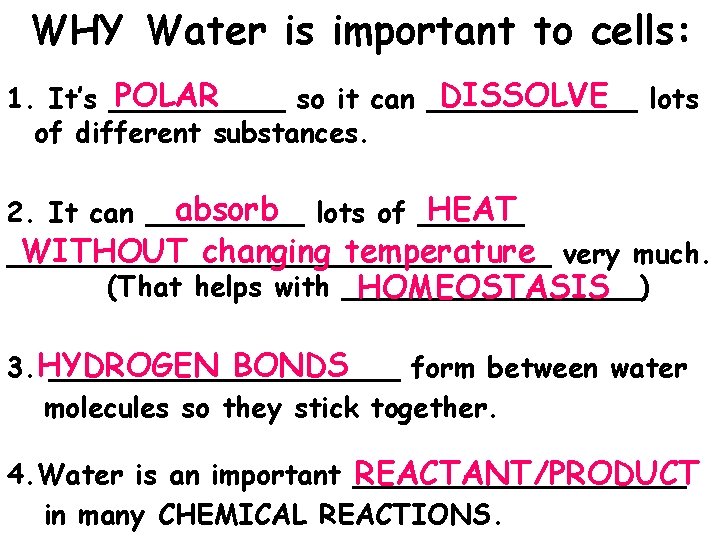
WHY Water is important to cells: POLAR DISSOLVE lots 1. It’s _____ so it can ______ of different substances. absorb lots of ______ HEAT 2. It can _____ WITHOUT changing temperature very much. ________________ (That helps with _________) HOMEOSTASIS BONDS 3. HYDROGEN __________ form between water molecules so they stick together. 4. Water is an important __________ REACTANT/PRODUCT in many CHEMICAL REACTIONS.
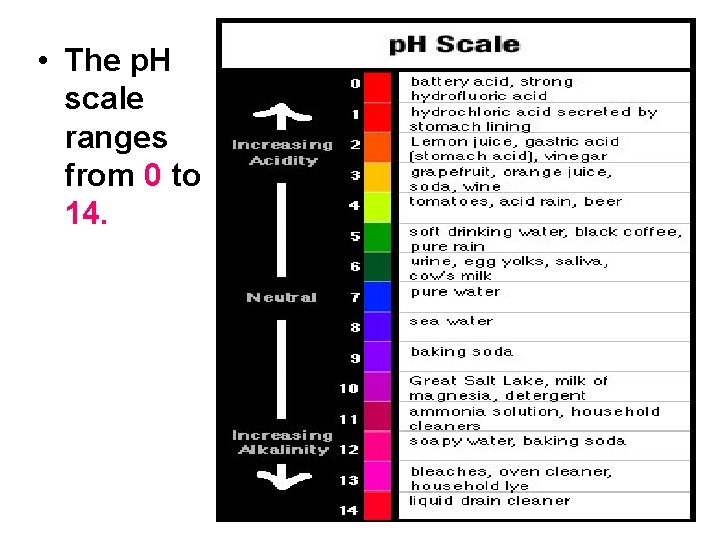
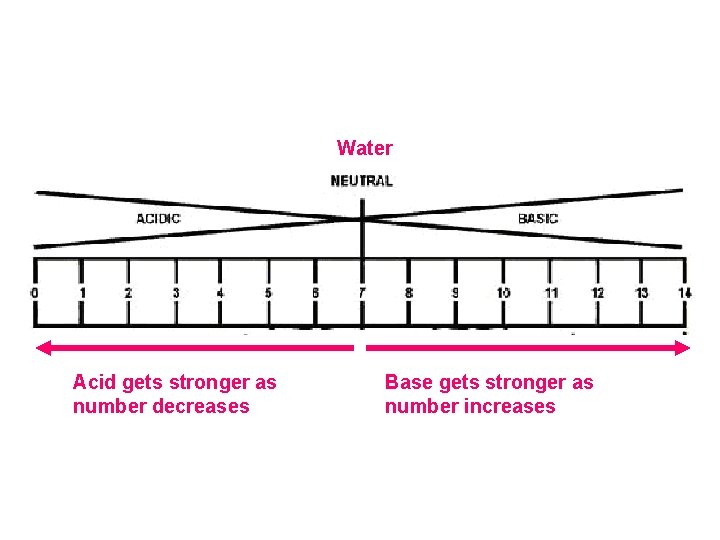
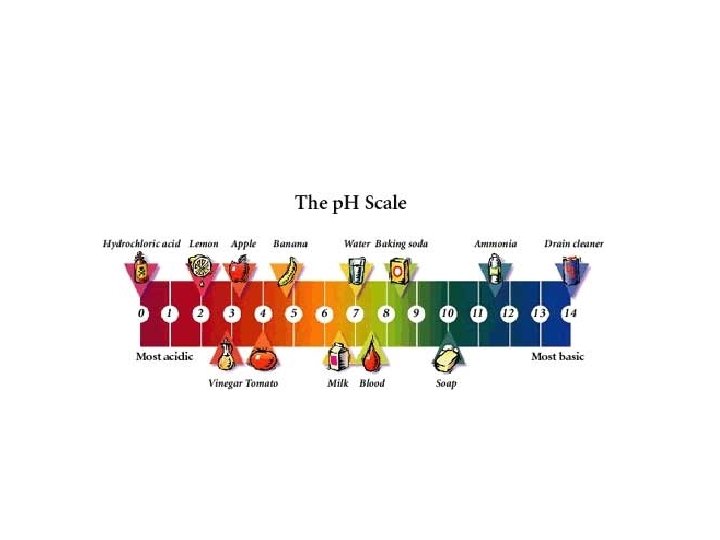
• The p. H scale ranges from 0 to 14.
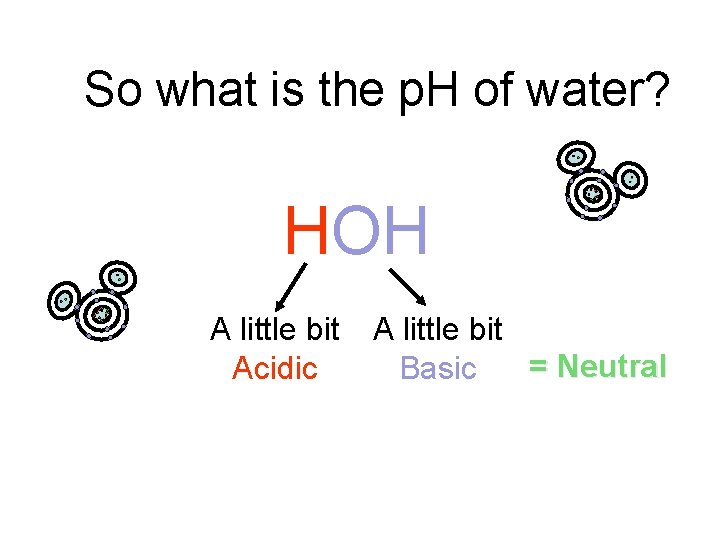
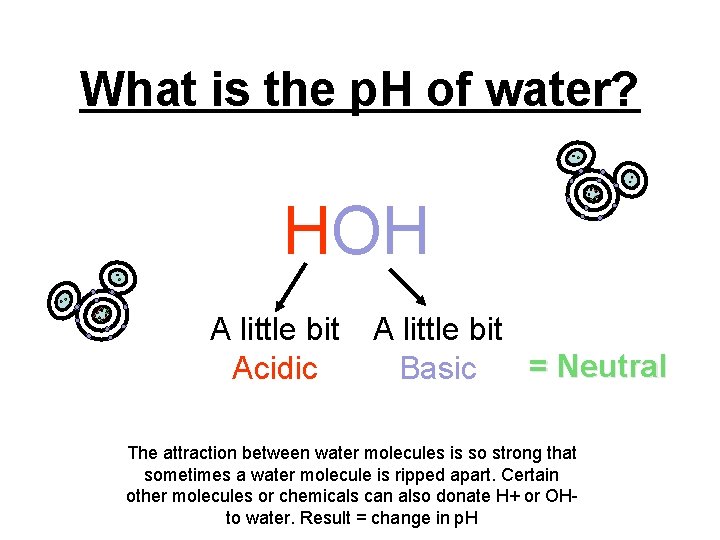
So what is the p. H of water? HOH A little bit Acidic A little bit = Neutral Basic
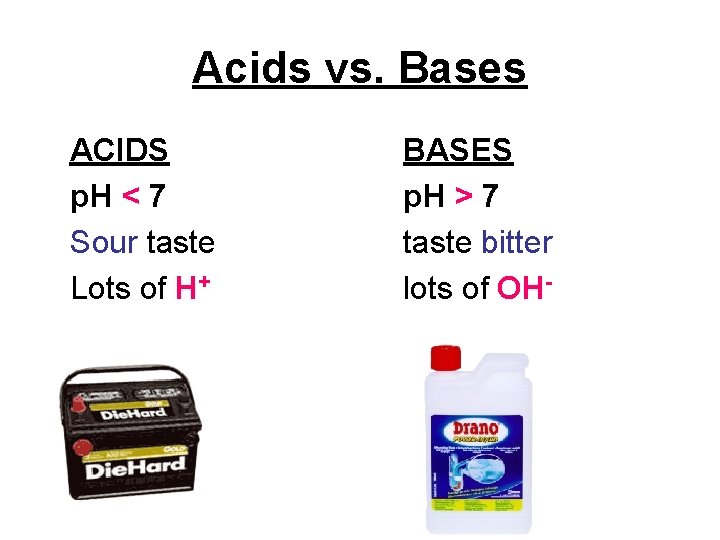
Acids vs. Bases ACIDS p. H < 7 Sour taste Lots of H+ BASES p. H > 7 taste bitter lots of OH-
Water Acid gets stronger as number decreases Base gets stronger as number increases
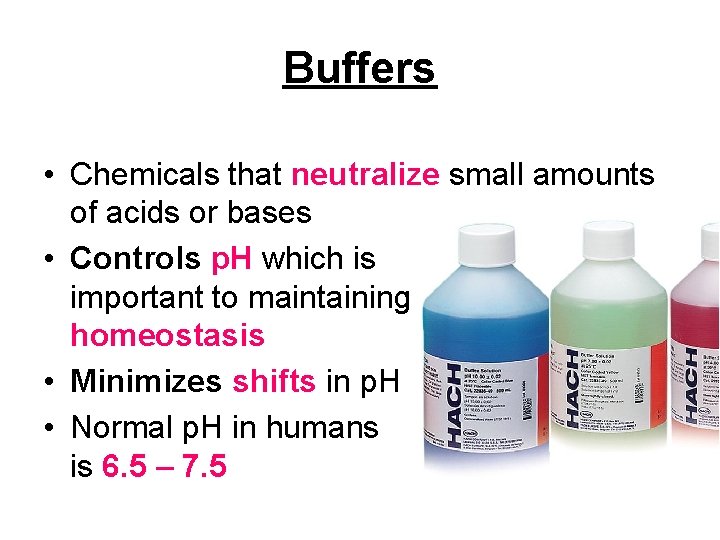
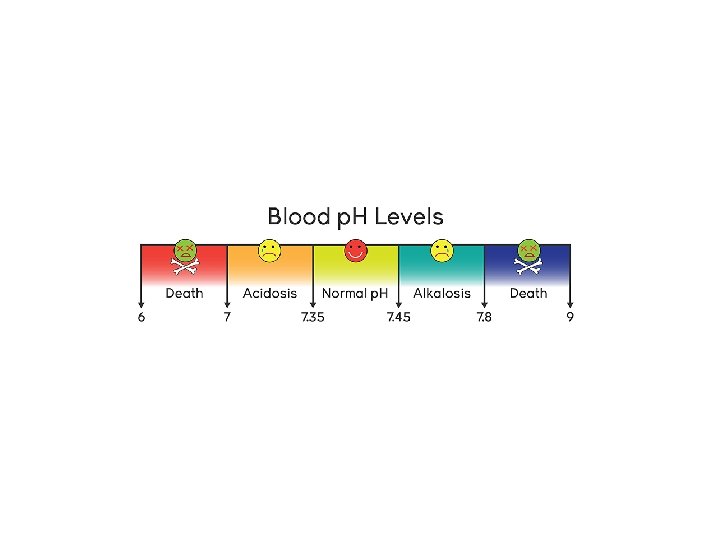
Buffers • Chemicals that neutralize small amounts of acids or bases • Controls p. H which is important to maintaining homeostasis • Minimizes shifts in p. H • Normal p. H in humans is 6. 5 – 7. 5
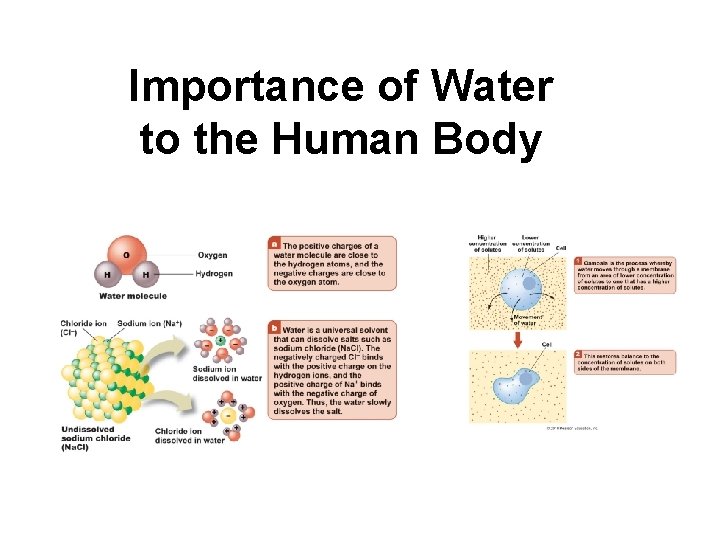
Importance of Water to the Human Body
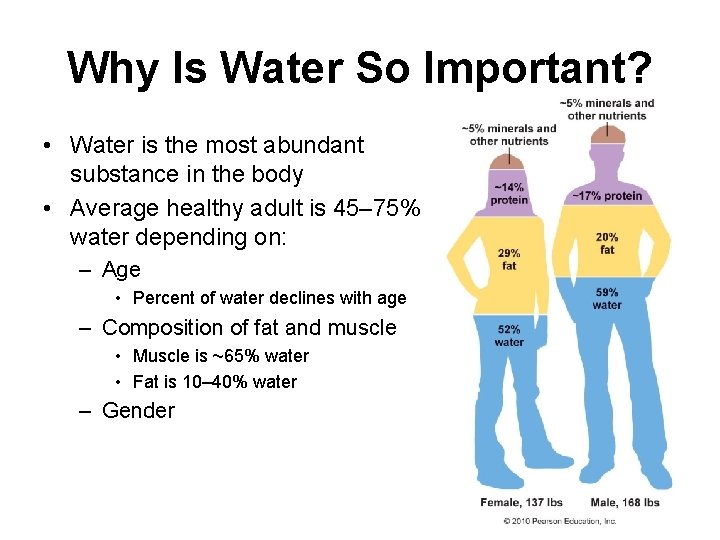
Why Is Water So Important? • Water is the most abundant substance in the body • Average healthy adult is 45– 75% water depending on: – Age • Percent of water declines with age – Composition of fat and muscle • Muscle is ~65% water • Fat is 10– 40% water – Gender
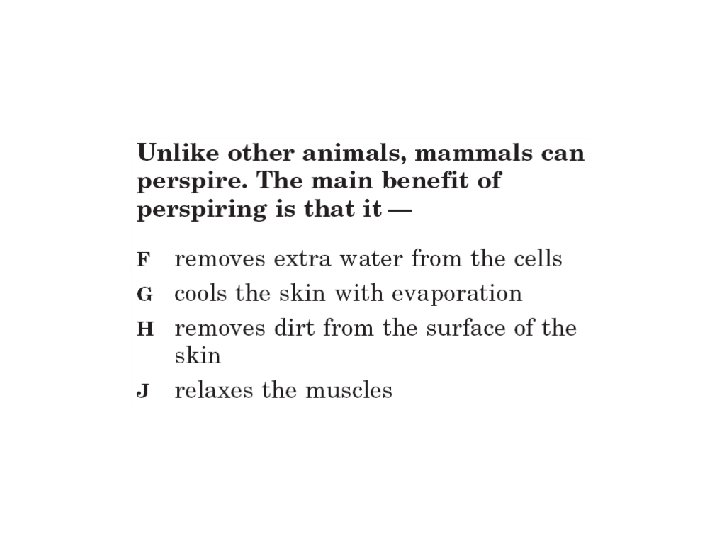
Functions of Water in the Body • Polarity allows it to attract charged particles in solutions and dissolve a variety of other polar substances: – Important to digestion • Helps transport dissolved nutrients and other substances throughout the body • Blood is composed of water and red blood cells – Water allows blood to transport oxygen, nutrients, and hormones to cells – Water helps transport waste products away from cells to be excreted • Lubricates joints, sensitive eye tissues, mouth, and intestinal tract • Provides a protective cushion, bathing certain organs with fluid • Provides a structural component to cells
Functions of Water in the Body • Water is essential for most chemical reactions in the body (metabolism): – During digestion water hydrolyzes the bonds holding together • Carbohydrate molecules • Protein molecules • Fat molecules – Water is formed when new materials are synthesized through the combination of smaller molecules. (condensation reaction)
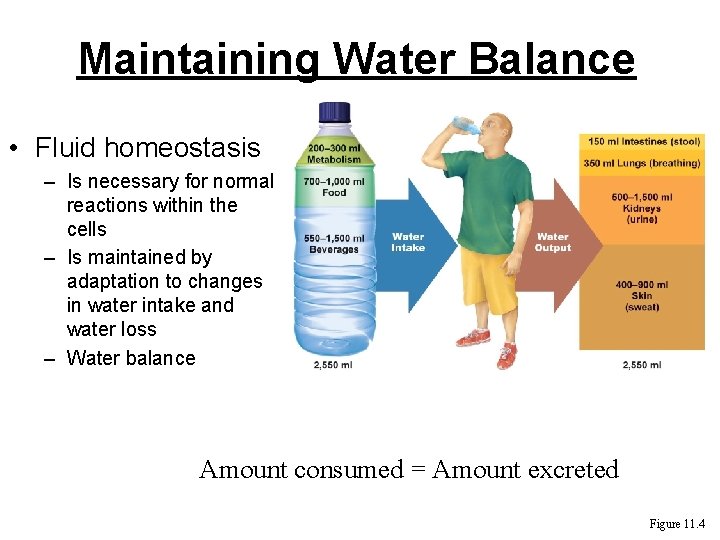
Maintaining Water Balance • Fluid homeostasis – Is necessary for normal reactions within the cells – Is maintained by adaptation to changes in water intake and water loss – Water balance Amount consumed = Amount excreted Figure 11. 4
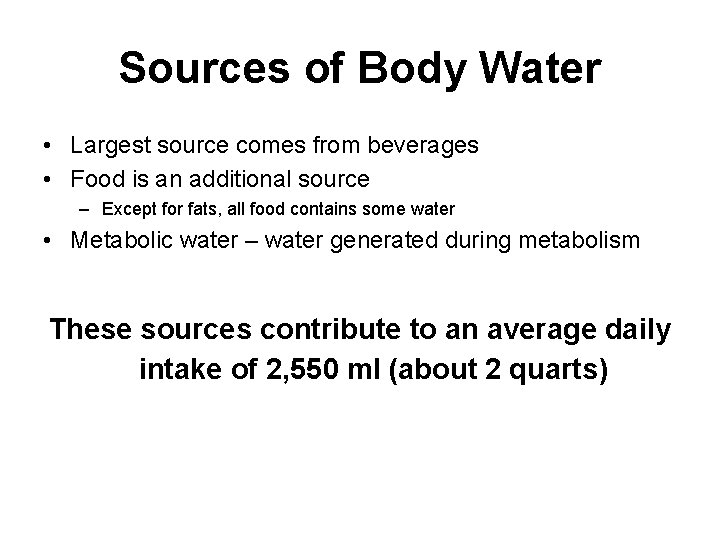
Sources of Body Water • Largest source comes from beverages • Food is an additional source – Except for fats, all food contains some water • Metabolic water – water generated during metabolism These sources contribute to an average daily intake of 2, 550 ml (about 2 quarts)
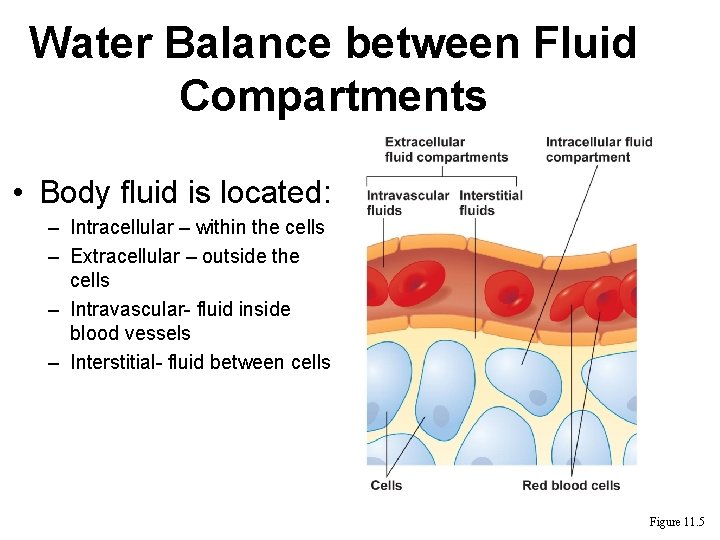
Water Balance between Fluid Compartments • Body fluid is located: – Intracellular – within the cells – Extracellular – outside the cells – Intravascular- fluid inside blood vessels – Interstitial- fluid between cells Figure 11. 5
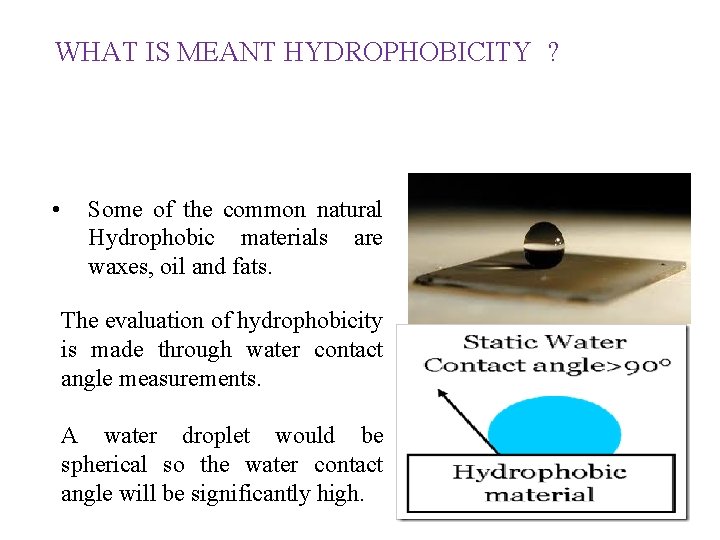
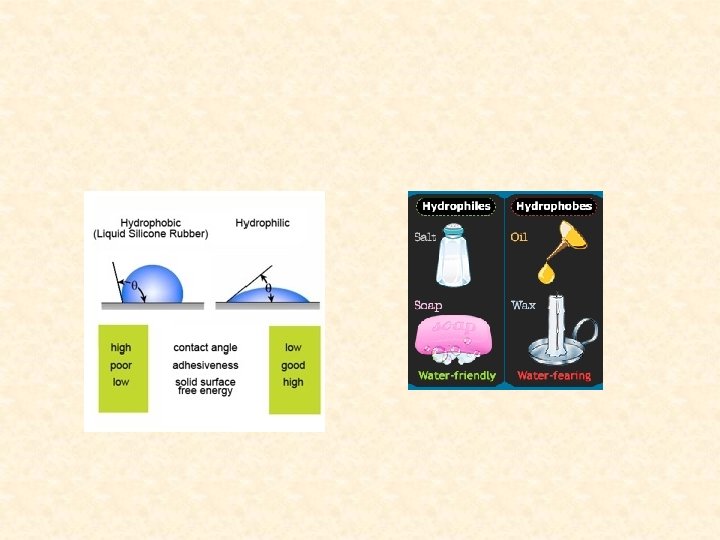
WHAT IS MEANT HYDROPHOBICITY ? • Some of the common natural Hydrophobic materials are waxes, oil and fats. The evaluation of hydrophobicity is made through water contact angle measurements. A water droplet would be spherical so the water contact angle will be significantly high.
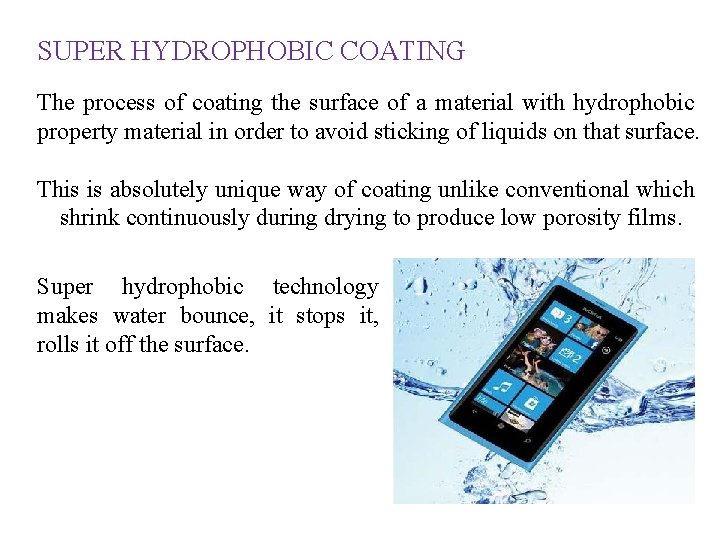
SUPER HYDROPHOBIC COATING The process of coating the surface of a material with hydrophobic property material in order to avoid sticking of liquids on that surface. This is absolutely unique way of coating unlike conventional which shrink continuously during drying to produce low porosity films. Super hydrophobic technology makes water bounce, it stops it, rolls it off the surface.
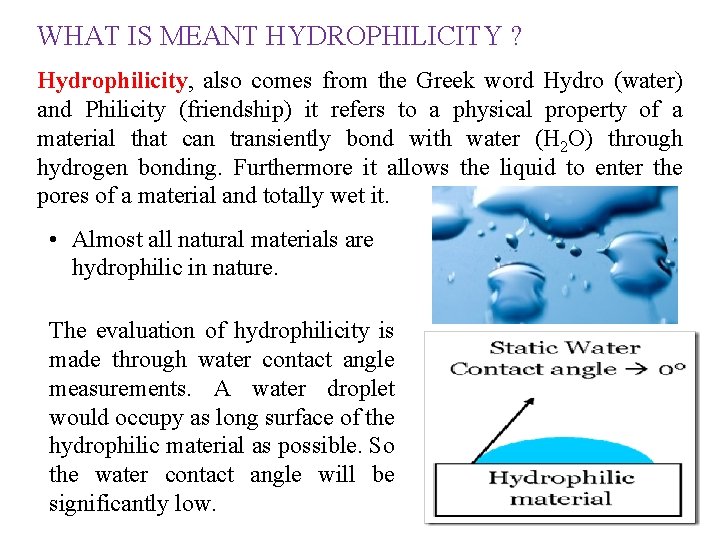
WHAT IS MEANT HYDROPHILICITY ? Hydrophilicity, also comes from the Greek word Hydro (water) and Philicity (friendship) it refers to a physical property of a material that can transiently bond with water (H 2 O) through hydrogen bonding. Furthermore it allows the liquid to enter the pores of a material and totally wet it. • Almost all natural materials are hydrophilic in nature. The evaluation of hydrophilicity is made through water contact angle measurements. A water droplet would occupy as long surface of the hydrophilic material as possible. So the water contact angle will be significantly low.
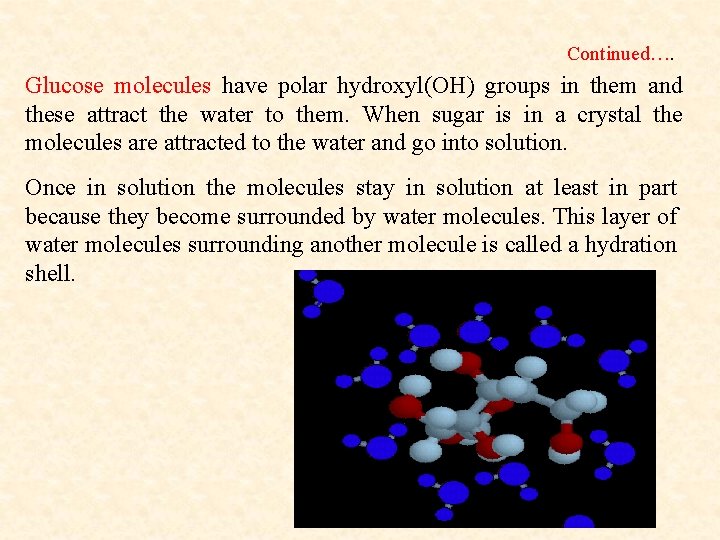
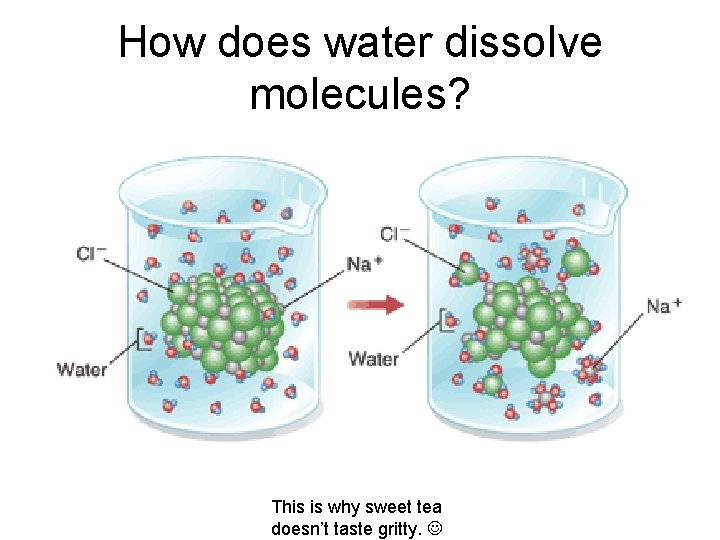
Continued…. Glucose molecules have polar hydroxyl(OH) groups in them and these attract the water to them. When sugar is in a crystal the molecules are attracted to the water and go into solution. Once in solution the molecules stay in solution at least in part because they become surrounded by water molecules. This layer of water molecules surrounding another molecule is called a hydration shell.
How does water dissolve molecules? This is why sweet tea doesn’t taste gritty.
Good Afternoon! 1. 2. You will need a sheet of paper and a pen/pencil for your warm up. You have a water quiz today!
Good Morning Lab is postponed until tomorrow. Today: • p. H worksheet • Water Dissociation packet
Good Afternoon! Warm Up: Begin writing these questions and your answers in your notebook as soon as you are seated. 1. 2. 3. 4. 5. Why is water considered a “polar” molecule? Differentiate between cohesion and adhesion. Capillary action is made possible by what other two properties of water? Define hydrophobic and hydrophilic. Would table salt be considered hydrophobic? Today: – – – Notes x 2! (We need to play catch up. ) Video class work
What is the p. H of water? HOH A little bit Acidic A little bit = Neutral Basic The attraction between water molecules is so strong that sometimes a water molecule is ripped apart. Certain other molecules or chemicals can also donate H+ or OHto water. Result = change in p. H
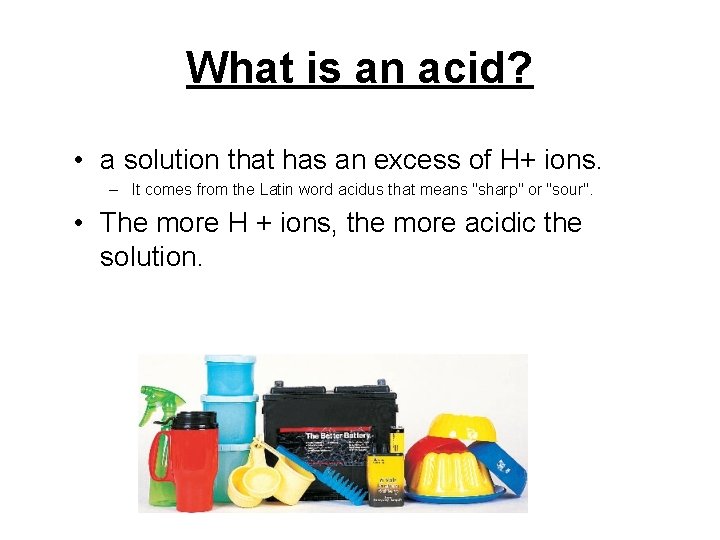
What is an acid? • a solution that has an excess of H+ ions. – It comes from the Latin word acidus that means "sharp" or "sour". • The more H + ions, the more acidic the solution.
What is a base? • • a solution that has an excess of OH- ions. Another word for base is alkali. Bitter taste Bases are substances that can accept hydrogen ions. • Lots of –OH (hydroxide)
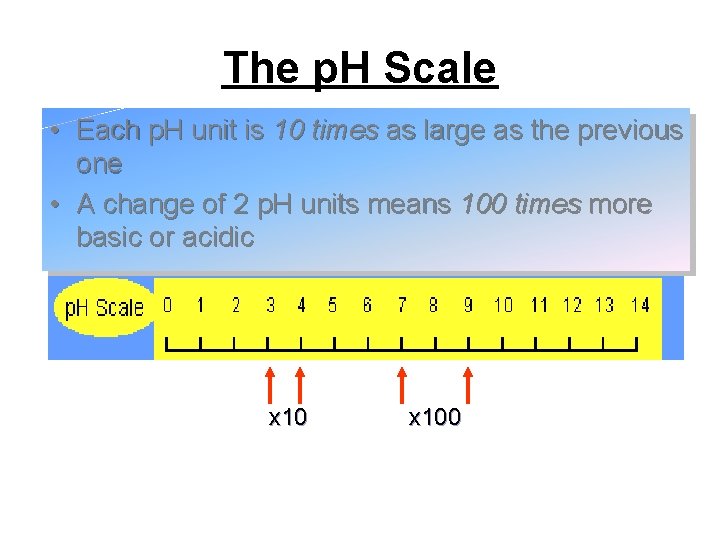
The p. H Scale • Each p. H unit is 10 times as large as the previous one • A change of 2 p. H units means 100 times more basic or acidic x 100
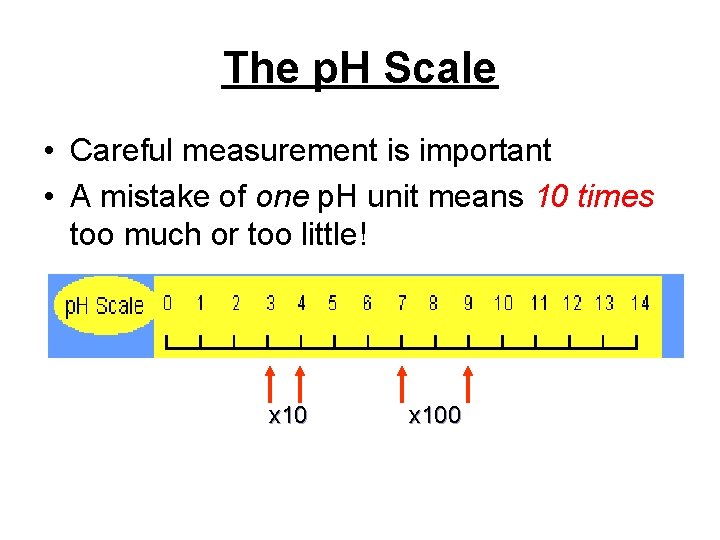
The p. H Scale • Careful measurement is important • A mistake of one p. H unit means 10 times too much or too little! x 100
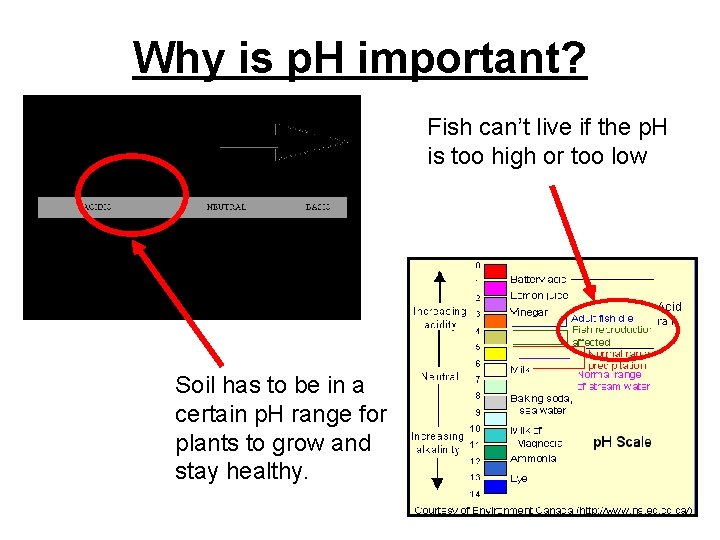
Why is p. H important? Fish can’t live if the p. H is too high or too low Soil has to be in a certain p. H range for plants to grow and stay healthy.
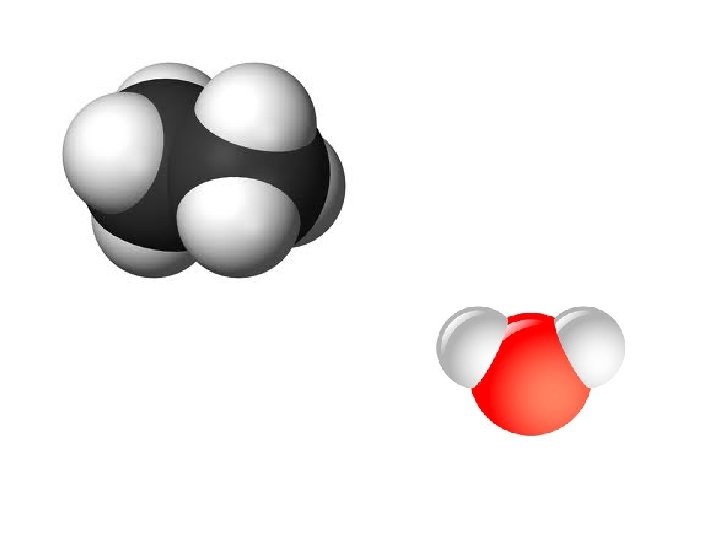
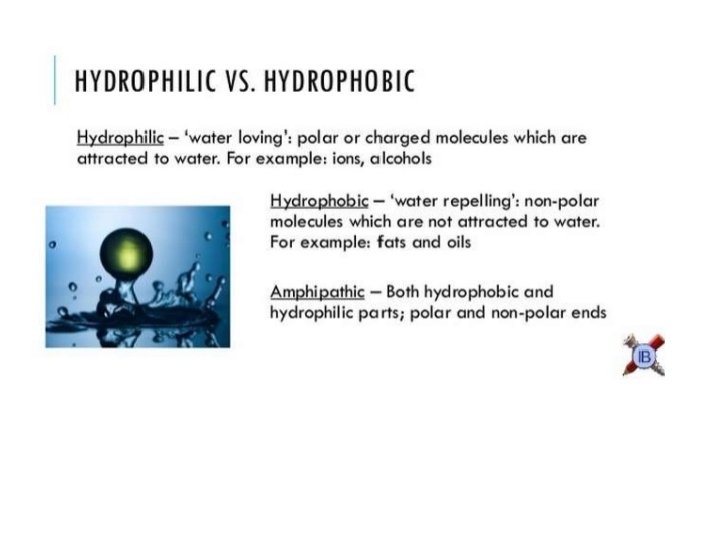
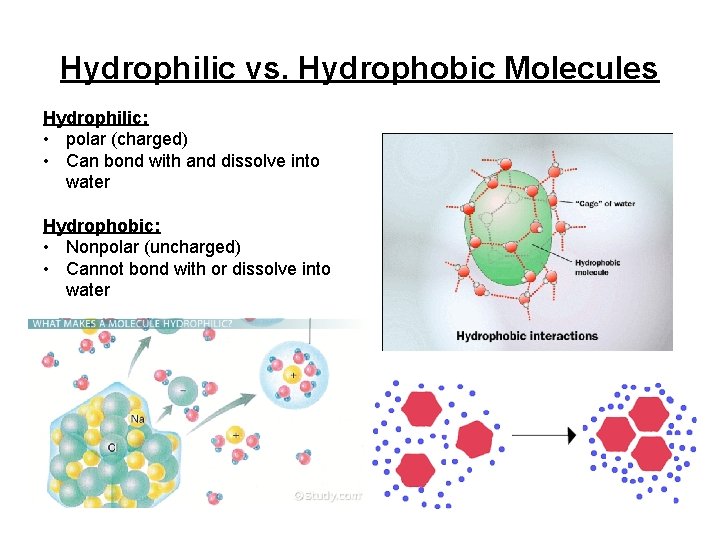
Hydrophilic vs. Hydrophobic Molecules Hydrophilic: • polar (charged) • Can bond with and dissolve into water Hydrophobic: • Nonpolar (uncharged) • Cannot bond with or dissolve into water
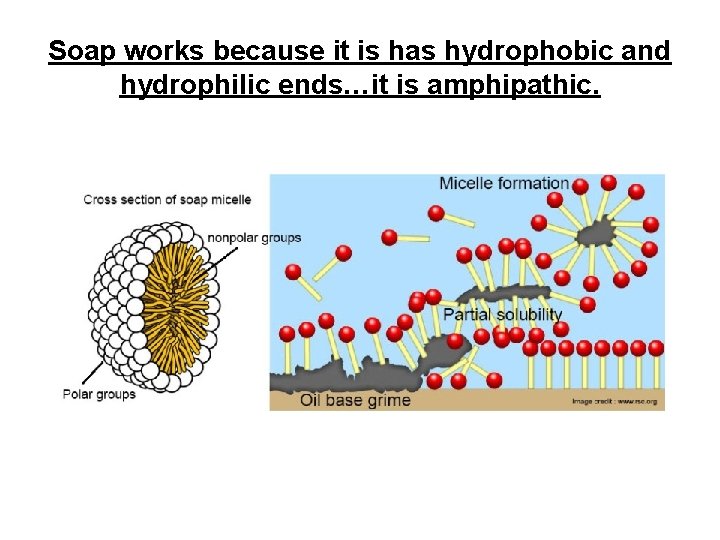
Soap works because it is has hydrophobic and hydrophilic ends…it is amphipathic.
Homework • Read pages 26 -29 in your book for clarification • Quiz Wednesday – Two days of notes • Table • Human body • Notes from today – WS we went over today – Review WS you’re doing now
Homework • Read pages 26 -29 in your textbook before next class. • Study your notes • QUIZ next class