
1 2 Why is insurance important to Have

- Slides: 28
1. 2. Why is insurance important to Have? What factors Impact the cost of insurance? (Risk, peril, Risk management, insurance, premium, deductible, policy , claim, loss, beneficiary, coverage, Types of insurance (auto, Home, life, health, renters) liability, comprehensive, collision, uninsured, law of large numbers)
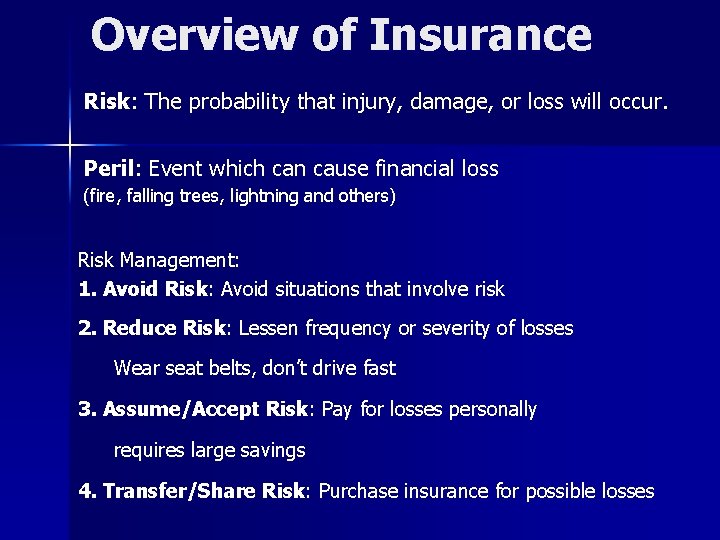
Overview of Insurance Risk: The probability that injury, damage, or loss will occur. Peril: Event which can cause financial loss (fire, falling trees, lightning and others) Risk Management: 1. Avoid Risk: Avoid situations that involve risk 2. Reduce Risk: Lessen frequency or severity of losses Wear seat belts, don’t drive fast 3. Assume/Accept Risk: Pay for losses personally requires large savings 4. Transfer/Share Risk: Purchase insurance for possible losses
Insurance Basics Insurance: A way to guarantee your financial protection against various risks Insurance Policy: Contract detailing premium, deductible, and coverage limits in the event of a loss. Policy Holder: A consumer who purchases the policy Beneficiary: A person eligible to receive benefits under an insurance policy
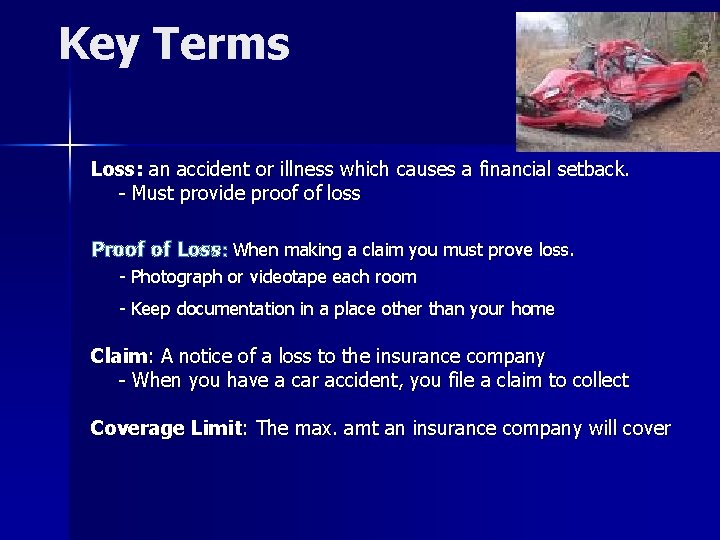
Key Terms Loss: an accident or illness which causes a financial setback. - Must provide proof of loss Proof of Loss: When making a claim you must prove loss. - Photograph or videotape each room - Keep documentation in a place other than your home Claim: A notice of a loss to the insurance company - When you have a car accident, you file a claim to collect Coverage Limit: The max. amt an insurance company will cover
Cost of Insurance Premium: Fee paid to be covered under specified terms Deductible: The portion of the loss you pay before insurance company pays remaining cost Law of Large Numbers: Insurance companies protect themselves against financial loss by spreading the risk of costly claims among many customers over many years
Types of Insurance Property: Provides protection against most risks to property, such as fire, theft and some weather damage Liability: Provides protection from claims arising from injuries or damage to other people or property. Auto: protects against loss in event of an incident involving a vehicle they own. Covering property, liability, and medical. Health: Form of protection that eases the financial burden people may experience as a result of illness or injury.
Types of Insurance Life: provides a monetary benefit to a decedent's family or other designated beneficiary in lump sum or annuity (regular payments) Disability: Provides regular income when an employee is unable to work due to pregnancy, a non-work-related accident or an illness. Homeowner’s : combines property and liability insurance to protect home. (Typically covers: Burglary, fire, wind, smoke, water, vandalism) Renter’s: protects insured from loss of the contents of the dwelling rather than the dwelling itself
Teen crash rates drop 40% 6 months after getting license n 70% chance of an individual getting in an accident in first 3 years of driving- (Insurance Education Foundation) n Automobile Insurance: Arrangement between individual and insurer to protect against risk from auto accidents
Factors of Insurance Rates • Age: (Younger =expensive) • Gender: Males under 25 • Good student discount • Multiple car/drivers policies • Cost of repairs • • Vehicle Use/mileage Place of Residence/cities Marital status Type/Age of car (theft) Driving Record Long-time customers Credit Score
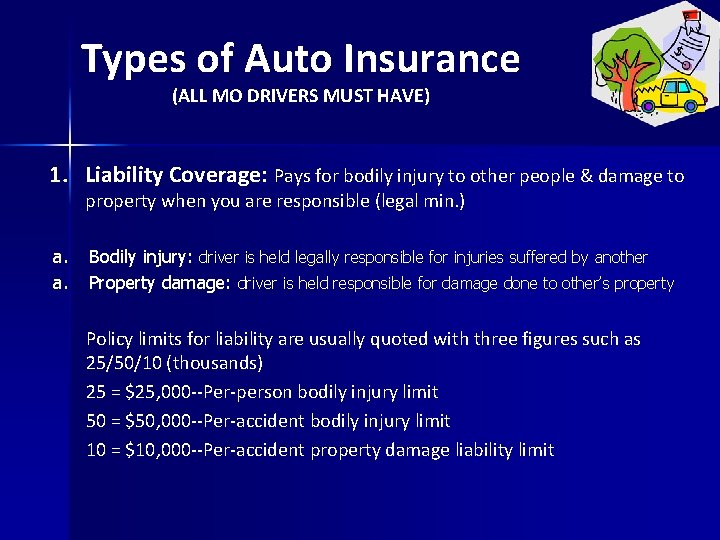
Types of Auto Insurance (ALL MO DRIVERS MUST HAVE) 1. Liability Coverage: Pays for bodily injury to other people & damage to property when you are responsible (legal min. ) a. a. Bodily injury: driver is held legally responsible for injuries suffered by another Property damage: driver is held responsible for damage done to other’s property Policy limits for liability are usually quoted with three figures such as 25/50/10 (thousands) 25 = $25, 000 --Per-person bodily injury limit 50 = $50, 000 --Per-accident bodily injury limit 10 = $10, 000 --Per-accident property damage liability limit
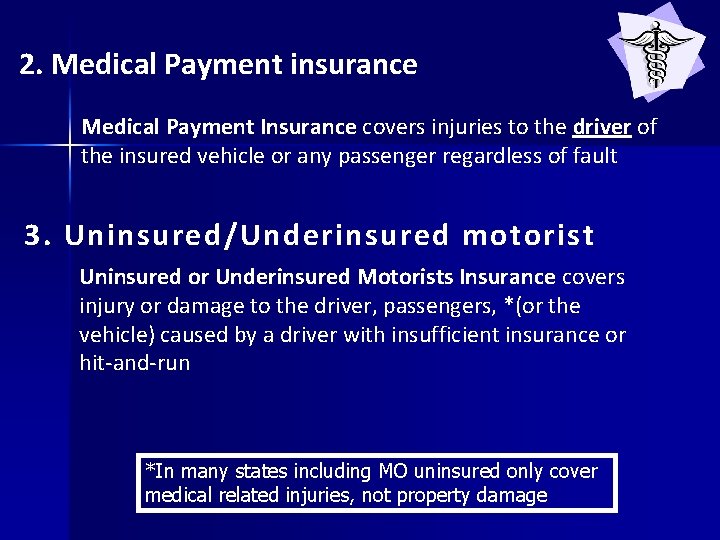
2. Medical Payment insurance Medical Payment Insurance covers injuries to the driver of the insured vehicle or any passenger regardless of fault 3. Uninsured/Underinsured motorist Uninsured or Underinsured Motorists Insurance covers injury or damage to the driver, passengers, *(or the vehicle) caused by a driver with insufficient insurance or hit-and-run *In many states including MO uninsured only cover medical related injuries, not property damage
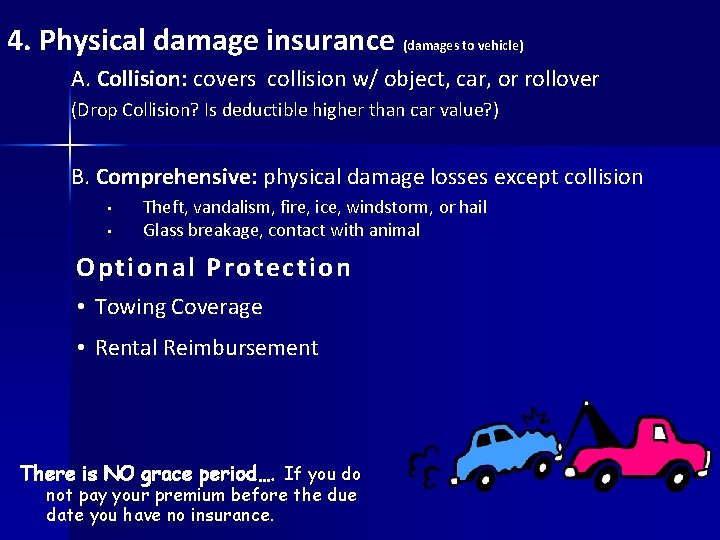
4. Physical damage insurance (damages to vehicle) A. Collision: covers collision w/ object, car, or rollover (Drop Collision? Is deductible higher than car value? ) B. Comprehensive: physical damage losses except collision • • Theft, vandalism, fire, ice, windstorm, or hail Glass breakage, contact with animal Optional Protection • Towing Coverage • Rental Reimbursement There is NO grace period…. If you do not pay your premium before the due date you have no insurance.
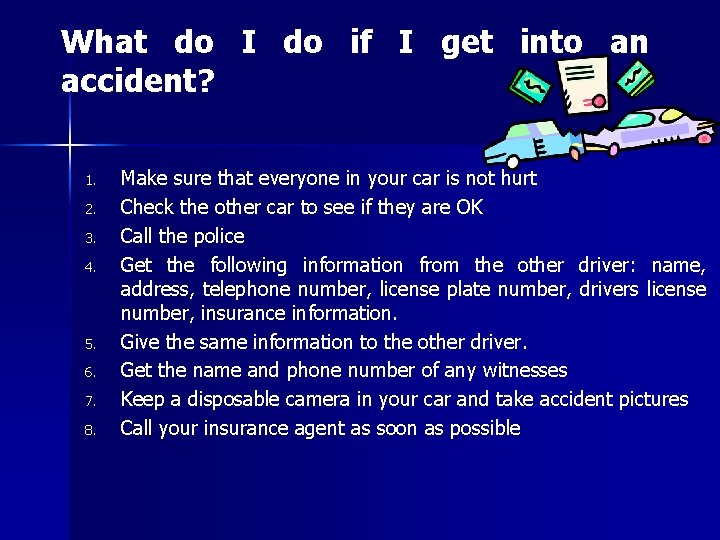
What do I do if I get into an accident? 1. 2. 3. 4. 5. 6. 7. 8. Make sure that everyone in your car is not hurt Check the other car to see if they are OK Call the police Get the following information from the other driver: name, address, telephone number, license plate number, drivers license number, insurance information. Give the same information to the other driver. Get the name and phone number of any witnesses Keep a disposable camera in your car and take accident pictures Call your insurance agent as soon as possible
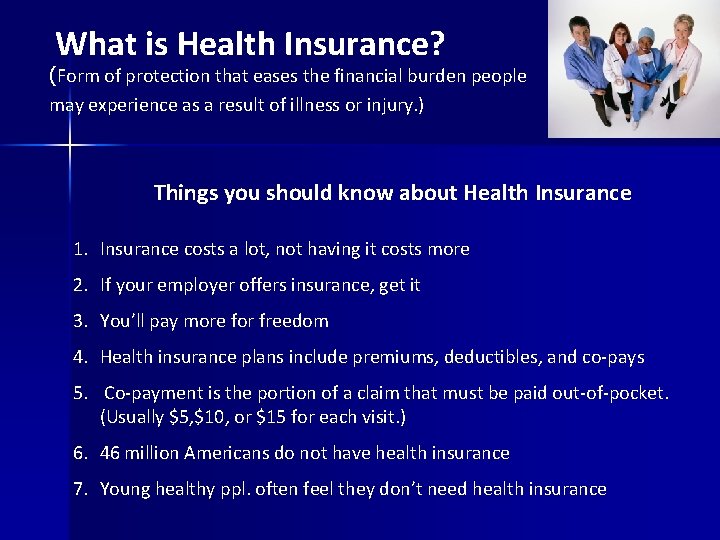
What is Health Insurance? Healththat. Insurance: Thepeople Basics (Form of protection eases the financial burden may experience as a result of illness or injury. ) Things you should know about Health Insurance 1. Insurance costs a lot, not having it costs more 2. If your employer offers insurance, get it 3. You’ll pay more for freedom 4. Health insurance plans include premiums, deductibles, and co-pays 5. Co-payment is the portion of a claim that must be paid out-of-pocket. (Usually $5, $10, or $15 for each visit. ) 6. 46 million Americans do not have health insurance 7. Young healthy ppl. often feel they don’t need health insurance
Health Insurance: The Basics Health Insurance Law of Large Numbers: Health insurance companies protect themselves against financial loss by spreading the risk of costly claims among many customers over many years Pre-existing Conditions: The more likely that people need health insurance, the more likely they are to seek it. An insurer may refuse to cover treatment if the condition existed prior to enrolling in a health insurance plan Fee for service vs. Pay deductible 1 st costs Then pay coinsurance (20%) Pay for each service Use any Dr. you find File claims Managed Care Use Dr. ’s in network to limit Pay co-pay per visit May/may not have deductible Preventative care included Don’t have to file claims
Type of Health Insurance (Government Provided) • Medical assistance for eligible individuals/ families w/ low incomes & disabilities • Nation’s largest health insurance program (39 million Americans) • Largest group covered by Medicare is people over the age 65 Medicare Medicaid All ppl. 65 & older. Younger based on disability Income based, all ages eligible Disabled, orphaned $50 / month Many have $0, some pay spend down amt. Paid by Federal Government State Government Co-payment yes Not usually Who is eligible Premium MEDICARE TYPES PART A What it covers What it costs PART B Covers % of hospital bills Non-hospital expenses Free if you have paid into Medicare for 10 years Small premium, deductible, & co-pay
Type of Health Insurance (Managed Care) Managed Care (HMO & PPO): Provide health care services at a lower cost through network. Members agree to certain restrictions which help lower the cost Health Maintenance Organization (HMO): Healthcare network of doctors that provide comprehensive healthcare to a group for a flat monthly rate Preferred Provider Organization (PPO): Healthcare network of doctors that provide comprehensive healthcare to a group • Combine features of HMOs and fee-for-service plans COBRA: If an employee loses their job they are covered for a set period of time. (18 months)
Individual Plans Health Insurance: The Basics People who are self-employed, or whose company does not offer health insurance as a benefit, can buy health insurance directly from an insurance company Advantages: • Personalized/customized policy • Discounts for healthier people Disadvantages: • Can be denied coverage • W/ pre-existing conditions, it will be very expensive to cover
Life Insurance Provides a monetary benefit to a decedent's family or other designated beneficiary in lump sum or annuity (regular payments) n n n Pay off mortgage or debts Accumulate savings Establish a regular income for survivors/children Term Life or Whole Life?
Types of Life Insurance n Term Life insurance – Provides protection against loss of life for only a specified term or period of time. – Could be for 1, 5, 10, or 20 years – If you stop paying your coverage stops. Renewable Term insurance Coverage ends, renewable w/ higher premiums Conversion Term Allows you to change from term to permanent coverage. w/ higher premiums.
Whole life insurance Is a permanent policy for which you pay a specified premium each year for the rest of your life. The insurance company pays a set amount after you die. n Limited Policy: pay for set number of years, the insurance stays until death n Variable life: premiums are placed in stocks and are paid an amount depending on how market does. n Universal life: part of premium is put into an account and you can borrow against it.
Disability Insurance Provides regular income when an employee is unable to work due to pregnancy, a non-work-related accident or an illness. n Single greatest asset is potential earning power n Pays income if policy holder gets sick and can’t work n Limited to 2/3 gross income. Why? Worker’s Compensation: If your disability is a result of an accident or illness on the job.
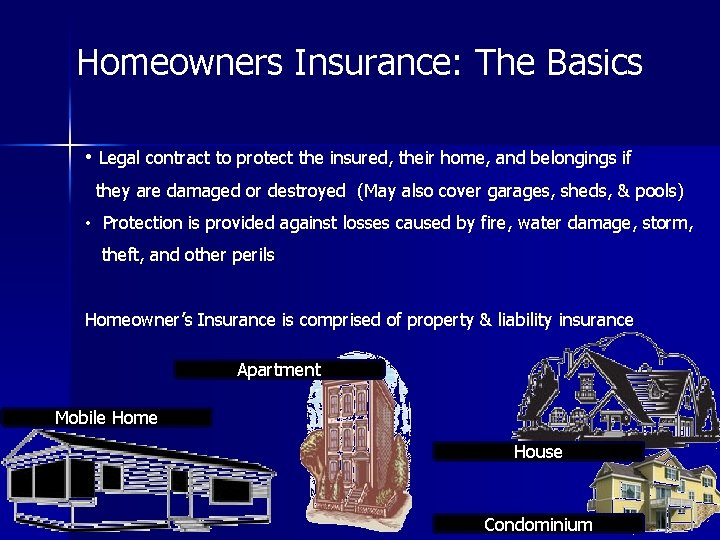
Homeowners Insurance: The Basics • Legal contract to protect the insured, their home, and belongings if they are damaged or destroyed (May also cover garages, sheds, & pools) • Protection is provided against losses caused by fire, water damage, storm, theft, and other perils Homeowner’s Insurance is comprised of property & liability insurance Apartment Mobile Home House Condominium
Homeowners Insurance: The Basics Items that are excluded or limited on a Homeowners Policy • Boats • ATV’s • Jewelry • Art Insurer can opt to purchase coverage on unique items Certain natural disasters in areas prone to them are also excluded from standard coverage
Renters Insurance Protects individuals who live in a house, mobile home, condominium, or apartment that is owned by another person Protects against: ü Theft ü Loss of personal property If you’re headed to college… n If you’re living in a dorm, check your parent’s policy. Most homeowner’s policies will cover items away from the home, up to a certain dollar amount.
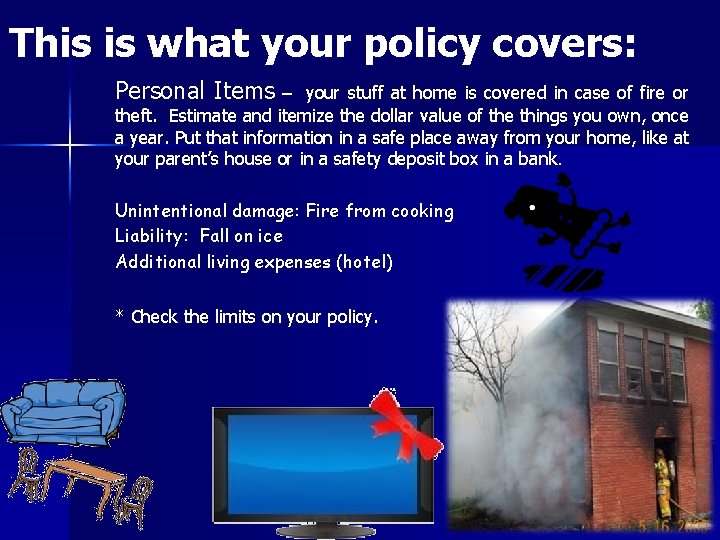
This is what your policy covers: Personal Items – your stuff at home is covered in case of fire or theft. Estimate and itemize the dollar value of the things you own, once a year. Put that information in a safe place away from your home, like at your parent’s house or in a safety deposit box in a bank. Unintentional damage: Fire from cooking Liability: Fall on ice Additional living expenses (hotel) * Check the limits on your policy.
Small Claims Can Hurt – The severity of a claim does not matter to some insurance companies, simply the number of claims. – Most insurance companies will look at your claims record for the previous 5 years. – Many companies will not insure those who have had 2 -3 claims in 3 years, no matter the amount of these claims.
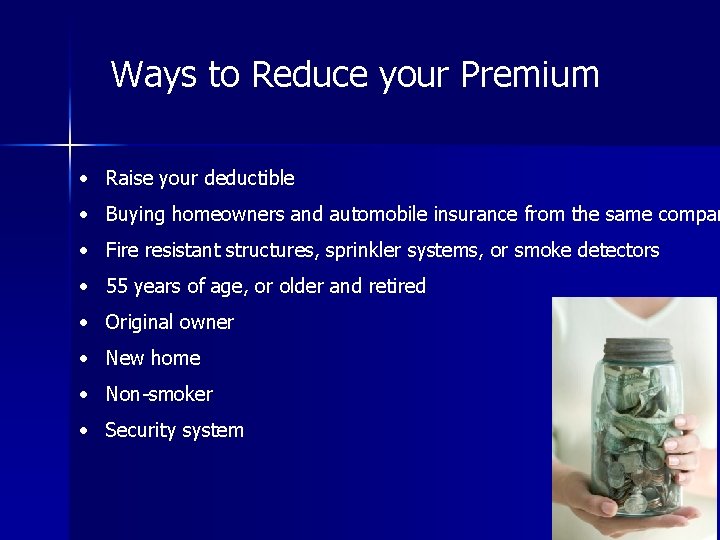
Ways to Reduce your Premium • Raise your deductible • Buying homeowners and automobile insurance from the same compan • Fire resistant structures, sprinkler systems, or smoke detectors • 55 years of age, or older and retired • Original owner • New home • Non-smoker • Security system