
1 2 Using Conceptual Frameworks to Inform TOC


- Slides: 29
1. 2 Using Conceptual Frameworks to Inform TOC Data Collection and Analysis
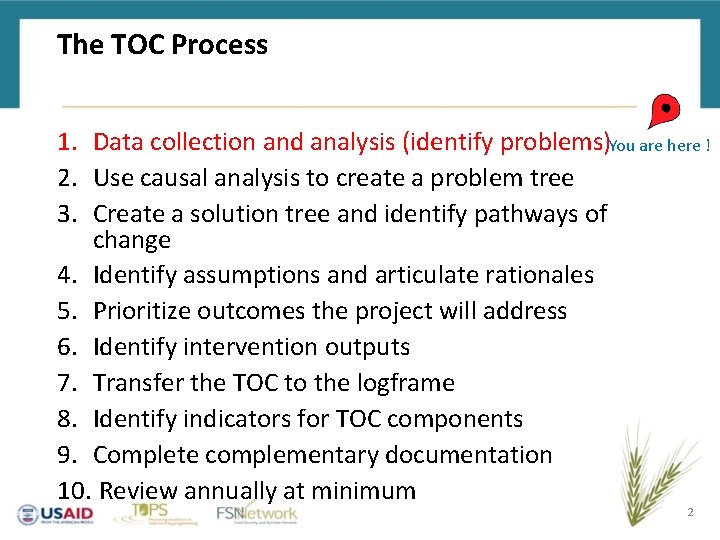
The TOC Process 1. Data collection and analysis (identify problems)You are here ! 2. Use causal analysis to create a problem tree 3. Create a solution tree and identify pathways of change 4. Identify assumptions and articulate rationales 5. Prioritize outcomes the project will address 6. Identify intervention outputs 7. Transfer the TOC to the logframe 8. Identify indicators for TOC components 9. Complete complementary documentation 10. Review annually at minimum 2
Purpose of Conceptual Frameworks • A conceptual framework is an analytical tool used to make conceptual distinctions and organize ideas. • Strong conceptual frameworks capture real factors and processes in an abstract way that is intuitive and easy to apply. • Conceptual frameworks are particularly useful as organizing devices for data collection and analysis. 3
Conceptual Frameworks and Theories of Change • Conceptual frameworks promote comprehensive data collection and holistic problem analysis necessary to inform the development of a strong TOC. • They help us to ensure we are collecting the right kind of information that will allow us to carry out rigorous and thorough causal analysis. • They help us identify what we know and what we don’t know. 4
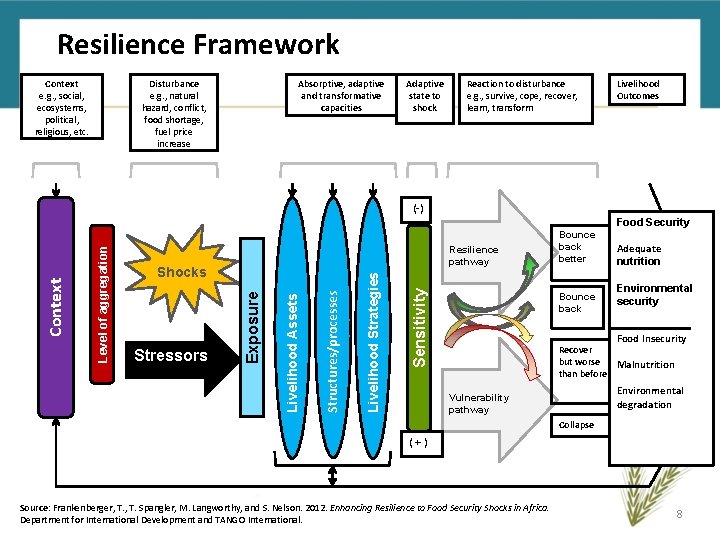
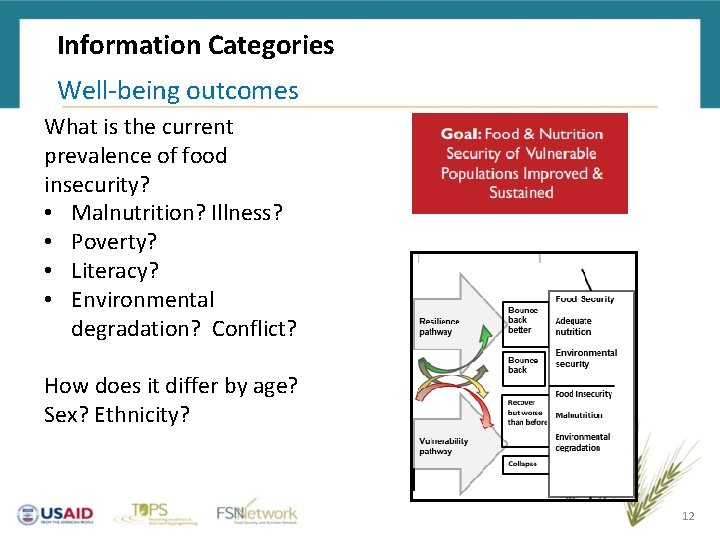
Resilience Framework Context e. g. , social, ecosystems, political, religious, etc. Disturbance e. g. , natural hazard, conflict, food shortage, fuel price increase Absorptive, adaptive and transformative capacities Adaptive state to shock Reaction to disturbance e. g. , survive, cope, recover, learn, transform Livelihood Outcomes (-) Sensitivity Structures/processes Stressors Livelihood Assets Shocks Livelihood Strategies Resilience pathway Exposure Level of aggregation Context Food Security Bounce back better Bounce back Adequate nutrition Environmental security Food Insecurity Recover but worse Malnutrition than before Environmental degradation Vulnerability pathway Collapse (+) Source: Frankenberger, T. Spangler, M. Langworthy, and S. Nelson. 2012. Enhancing Resilience to Food Security Shocks in Africa. Department for International Development and TANGO International. 8
FFP Strategic Results Framework Source: Office of Food for Peace. 2016 -2025 Food Assistance and Food Security Strategy 8
What information do we need to collect to inform TOC development? Comprehensive data collection and analysis is necessary for TOC development Yet…… • Often there is so much information out there it is hard to know what to collect and when to stop. To help prioritize: Create a list of information categories based on conceptual framework components. • Identify several key questions for each category. 7
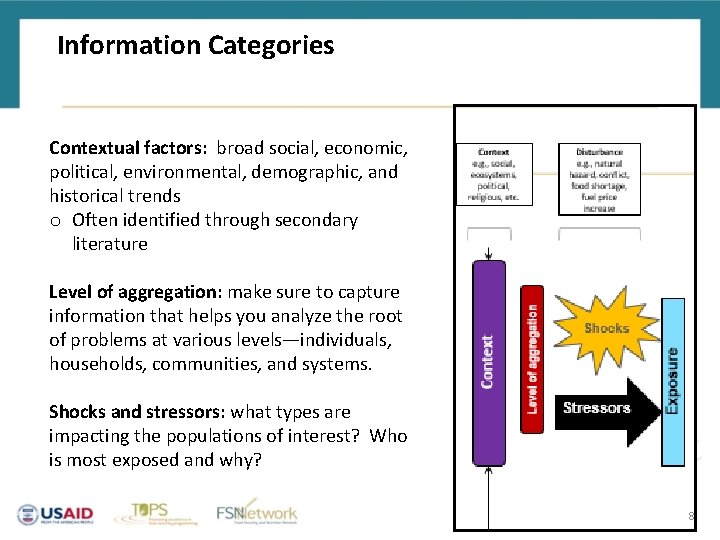
Information Categories Contextual factors: broad social, economic, political, environmental, demographic, and historical trends o Often identified through secondary literature Level of aggregation: make sure to capture information that helps you analyze the root of problems at various levels—individuals, households, communities, and systems. Shocks and stressors: what types are impacting the populations of interest? Who is most exposed and why? 8
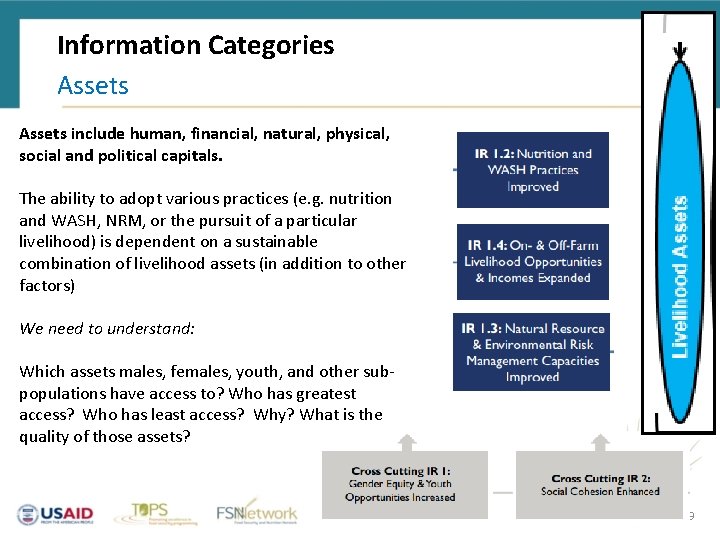
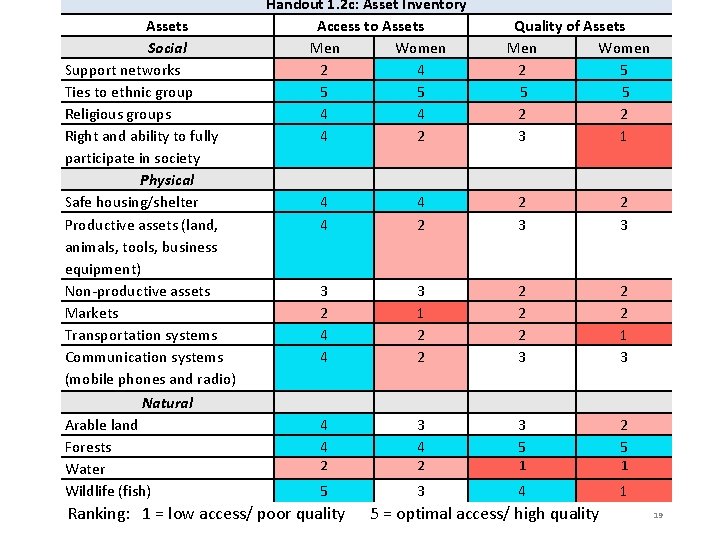
Information Categories Assets include human, financial, natural, physical, social and political capitals. The ability to adopt various practices (e. g. nutrition and WASH, NRM, or the pursuit of a particular livelihood) is dependent on a sustainable combination of livelihood assets (in addition to other factors) We need to understand: Which assets males, females, youth, and other subpopulations have access to? Who has greatest access? Who has least access? Why? What is the quality of those assets? 9
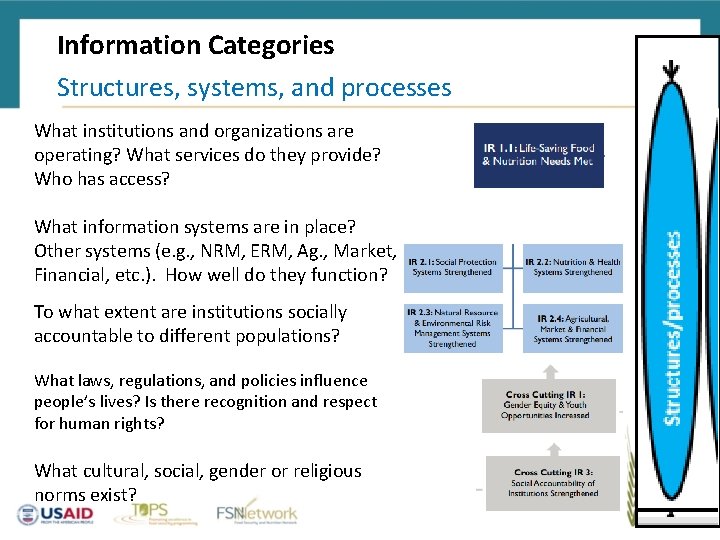
Information Categories Structures, systems, and processes What institutions and organizations are operating? What services do they provide? Who has access? What information systems are in place? Other systems (e. g. , NRM, ERM, Ag. , Market, Financial, etc. ). How well do they function? To what extent are institutions socially accountable to different populations? What laws, regulations, and policies influence people’s lives? Is there recognition and respect for human rights? What cultural, social, gender or religious norms exist? 10
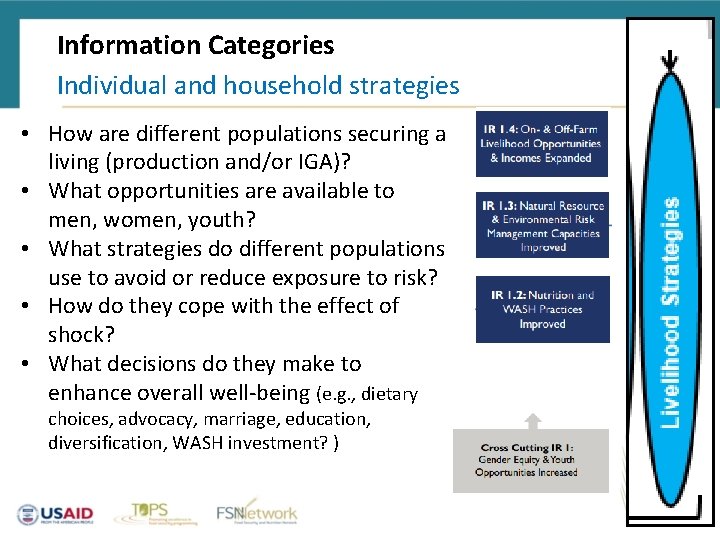
Information Categories Individual and household strategies • How are different populations securing a living (production and/or IGA)? • What opportunities are available to men, women, youth? • What strategies do different populations use to avoid or reduce exposure to risk? • How do they cope with the effect of shock? • What decisions do they make to enhance overall well-being (e. g. , dietary choices, advocacy, marriage, education, diversification, WASH investment? ) 11
Information Categories Well-being outcomes What is the current prevalence of food insecurity? • Malnutrition? Illness? • Poverty? • Literacy? • Environmental degradation? Conflict? How does it differ by age? Sex? Ethnicity? 12
Organizing and Analyzing Data
What is data interpretation? • Attaching meaning and significance to the analysis, explaining descriptive patterns, and looking for relationships and linkages among descriptive units. • Often called dynamic analysis - is more inductive than descriptive analysis. • Identifies important changes, differences, and trends regarding people’s level of risk. • Prepares you for identifying distinct target populations within the TOC. 14
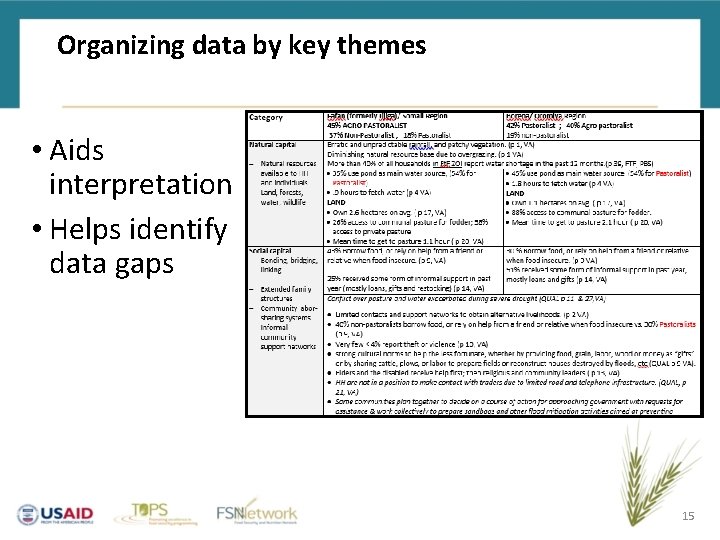
Organizing data by key themes • Aids interpretation • Helps identify data gaps 15
16
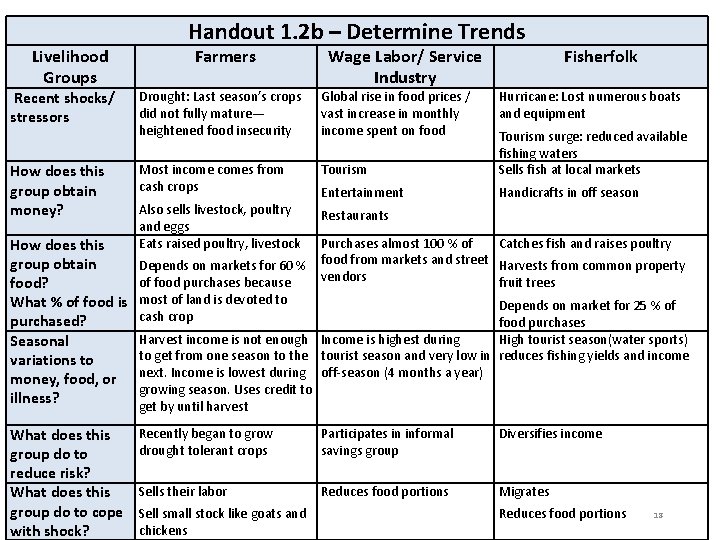
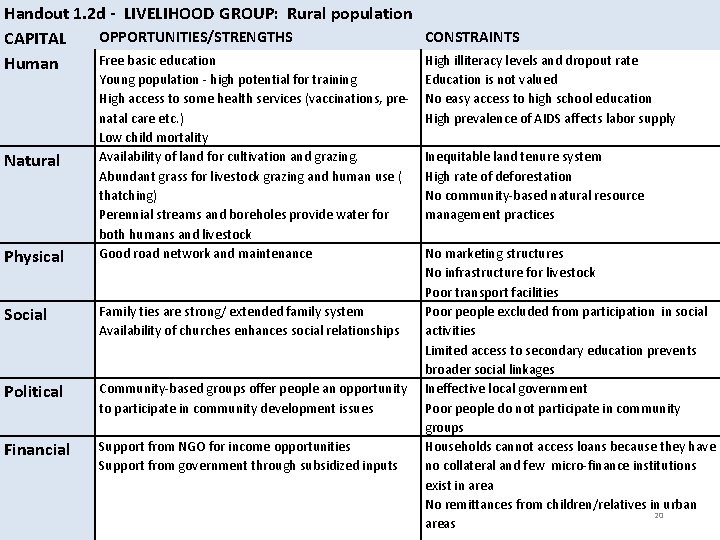
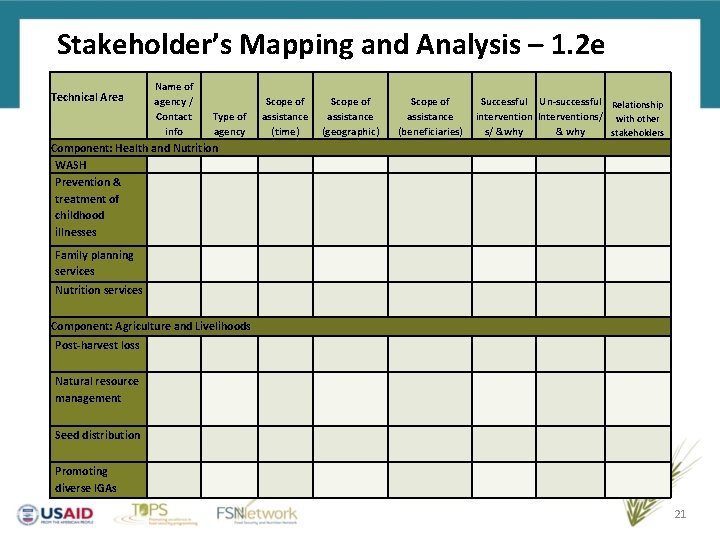
Data Interpretation: Several options to organize data for additional interpretation • Create livelihood portfolios for different groups (Tool 1. 2. b) • Determine access to and quality of assets available to different groups (i. e. , men and women) (Tool 1. 2 c) • Consider opportunities and constraints based on livelihood capitals (Tool 1. 2 d) structures/ processes, livelihood strategies, resilience capacities • Consider activities of other actors (Tool 1. 2 e) 17
Livelihood Groups Recent shocks/ stressors How does this group obtain money? How does this group obtain food? What % of food is purchased? Seasonal variations to money, food, or illness? What does this group do to reduce risk? What does this group do to cope with shock? Handout 1. 2 b – Determine Trends Farmers Wage Labor/ Service Industry Fisherfolk Drought: Last season’s crops did not fully mature— heightened food insecurity Global rise in food prices / vast increase in monthly income spent on food Most incomes from cash crops Tourism surge: reduced available fishing waters Sells fish at local markets Also sells livestock, poultry and eggs Eats raised poultry, livestock Entertainment Handicrafts in off season Restaurants Depends on markets for 60 % of food purchases because most of land is devoted to cash crop Hurricane: Lost numerous boats and equipment Purchases almost 100 % of Catches fish and raises poultry food from markets and street Harvests from common property vendors fruit trees Depends on market for 25 % of food purchases Harvest income is not enough Income is highest during High tourist season(water sports) to get from one season to the tourist season and very low in reduces fishing yields and income next. Income is lowest during off-season (4 months a year) growing season. Uses credit to get by until harvest Recently began to grow drought tolerant crops Participates in informal savings group Diversifies income Sells their labor Reduces food portions Migrates Sell small stock like goats and chickens Reduces food portions 18
Assets Social Support networks Ties to ethnic group Religious groups Right and ability to fully participate in society Physical Safe housing/shelter Productive assets (land, animals, tools, business equipment) Non-productive assets Markets Transportation systems Communication systems (mobile phones and radio) Natural Arable land Forests Water Wildlife (fish) Handout 1. 2 c: Asset Inventory Access to Assets Men Women 2 4 5 5 4 4 4 2 Quality of Assets Men Women 2 5 5 5 2 2 3 1 4 4 4 2 2 3 3 2 4 4 3 1 2 2 2 3 2 2 1 3 4 4 3 5 2 2 1 1 5 3 4 1 Ranking: 1 = low access/ poor quality 5 = optimal access/ high quality 19
Handout 1. 2 d - LIVELIHOOD GROUP: Rural population OPPORTUNITIES/STRENGTHS CONSTRAINTS CAPITAL Free basic education High illiteracy levels and dropout rate Human Natural Physical Young population - high potential for training High access to some health services (vaccinations, prenatal care etc. ) Low child mortality Availability of land for cultivation and grazing. Abundant grass for livestock grazing and human use ( thatching) Perennial streams and boreholes provide water for both humans and livestock Good road network and maintenance Social Family ties are strong/ extended family system Availability of churches enhances social relationships Political Community-based groups offer people an opportunity to participate in community development issues Financial Support from NGO for income opportunities Support from government through subsidized inputs Education is not valued No easy access to high school education High prevalence of AIDS affects labor supply Inequitable land tenure system High rate of deforestation No community-based natural resource management practices No marketing structures No infrastructure for livestock Poor transport facilities Poor people excluded from participation in social activities Limited access to secondary education prevents broader social linkages Ineffective local government Poor people do not participate in community groups Households cannot access loans because they have no collateral and few micro-finance institutions exist in area No remittances from children/relatives in urban 20 areas
Stakeholder’s Mapping and Analysis – 1. 2 e Technical Area Name of agency / Contact info Type of agency Scope of assistance (time) Scope of assistance (geographic) Scope of assistance (beneficiaries) Successful Un-successful Relationship intervention Interventions/ with other s/ &why & why stakeholders Component: Health and Nutrition WASH Prevention & treatment of childhood illnesses Family planning services Nutrition services Component: Agriculture and Livelihoods Post-harvest loss Natural resource management Seed distribution Promoting diverse IGAs 21
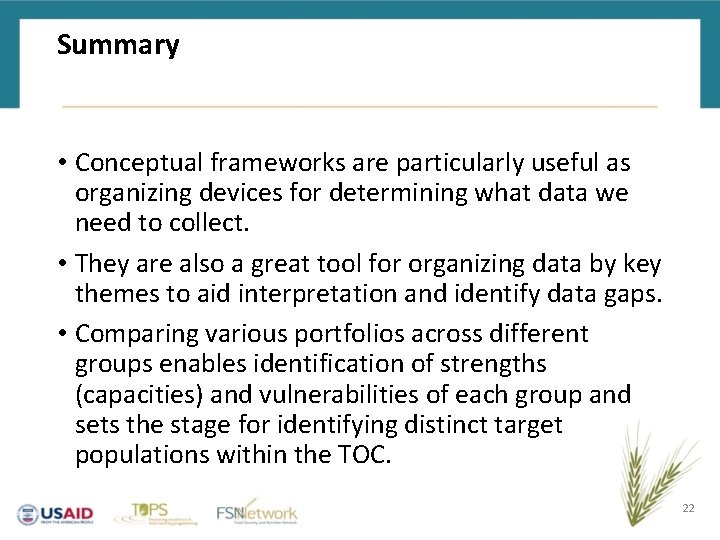
Summary • Conceptual frameworks are particularly useful as organizing devices for determining what data we need to collect. • They are also a great tool for organizing data by key themes to aid interpretation and identify data gaps. • Comparing various portfolios across different groups enables identification of strengths (capacities) and vulnerabilities of each group and sets the stage for identifying distinct target populations within the TOC. 22
SMALL GROUP ACTIVITY 1. 2 Preliminary analysis
Small Group Activity 1. 2 • Divide into small groups, 6 -8 participants each, with diverse technical representation • Designate group members to fill various roles • Review the data set and the key questions (Handout 1. 2 c) • Use Tool 1. 2 a on your USB to organize relevant findings in the data set. You may also use other tools on USB • Make note of data gaps on flipchart • Use organized data to answer key questions (Handout 1. 2 c) 24
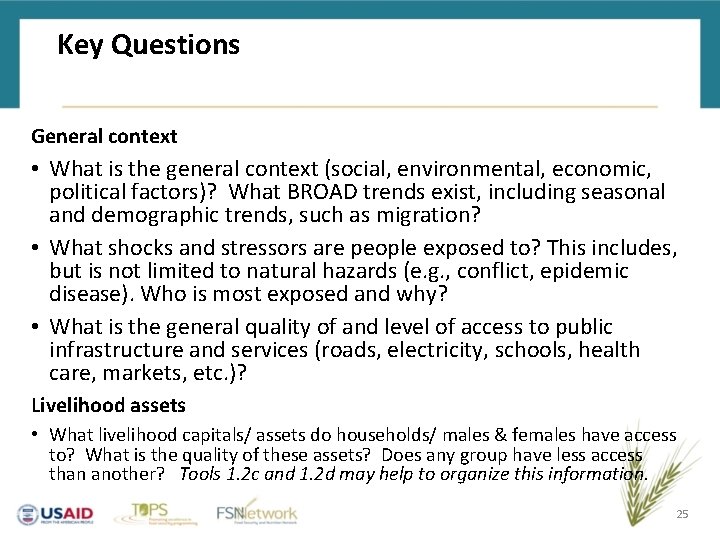
Key Questions General context • What is the general context (social, environmental, economic, political factors)? What BROAD trends exist, including seasonal and demographic trends, such as migration? • What shocks and stressors are people exposed to? This includes, but is not limited to natural hazards (e. g. , conflict, epidemic disease). Who is most exposed and why? • What is the general quality of and level of access to public infrastructure and services (roads, electricity, schools, health care, markets, etc. )? Livelihood assets • What livelihood capitals/ assets do households/ males & females have access to? What is the quality of these assets? Does any group have less access than another? Tools 1. 2 c and 1. 2 d may help to organize this information. 25
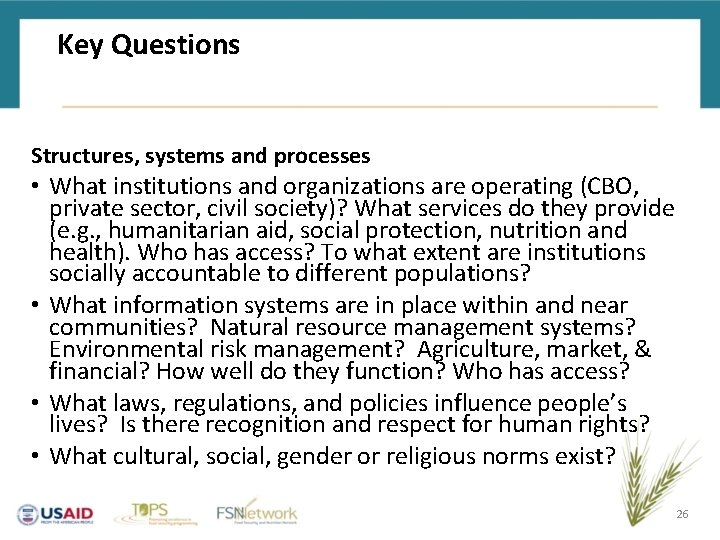
Key Questions Structures, systems and processes • What institutions and organizations are operating (CBO, private sector, civil society)? What services do they provide (e. g. , humanitarian aid, social protection, nutrition and health). Who has access? To what extent are institutions socially accountable to different populations? • What information systems are in place within and near communities? Natural resource management systems? Environmental risk management? Agriculture, market, & financial? How well do they function? Who has access? • What laws, regulations, and policies influence people’s lives? Is there recognition and respect for human rights? • What cultural, social, gender or religious norms exist? 26
Key Questions Risk management and coping strategies • What preventative measures are different populations using to avoid or reduce exposure to risk? • How do different populations cope with the effect of shock? Are they using appropriate coping strategies to avoid permanent, negative impact? Household actions/ livelihood strategies • How do households secure a living? What opportunities are available to men, women, youth? • What strategies are men, women, youth and households using to enhance overall well-being (e. g. , advocacy, marriage, education, and diversification)? • How do households invest / maximize available assets (tangible and intangible)? • To what extent are the distinct populations adopting recommended nutrition practices? Recommended WASH practices? Recommended agricultural practices? 27
Key Questions Summarize well-being outcomes • Which outcomes are most challenged and why? • Which outcomes are least challenged and why? 28
Preliminary analysis • How do existing institutions and organizations directly influence individual, household, and community wellbeing? • To what extent do governance mechanisms, policies and regulations, infrastructure, gender and cultural norms, community networks, collective action efforts, and formal and informal social protection mechanisms constitute an enabling environment for systemic change? • Are individuals and households able to make proactive and informed choices that allow for an effective response to changing environmental, climatic, social, political, and economic conditions? Why or why not? 29