
1 2 U 2 Eukaryotes have a compartmentalized
- Slides: 11
1. 2. U 2 Eukaryotes have a compartmentalized cell structure.
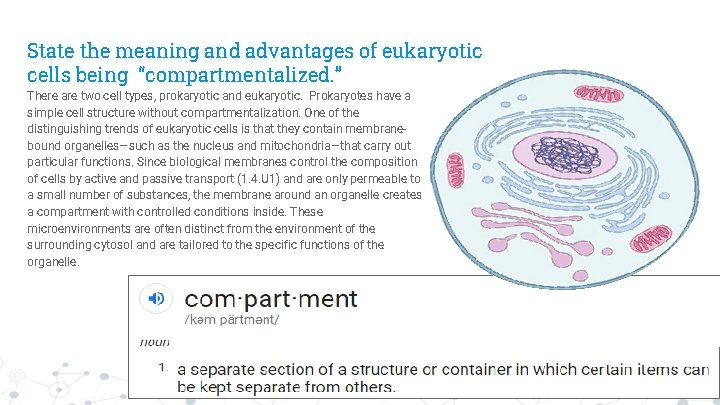
State the meaning and advantages of eukaryotic cells being “compartmentalized. ” There are two cell types, prokaryotic and eukaryotic. Prokaryotes have a simple cell structure without compartmentalization. One of the distinguishing trends of eukaryotic cells is that they contain membranebound organelles—such as the nucleus and mitochondria—that carry out particular functions. Since biological membranes control the composition of cells by active and passive transport (1. 4. U 1) and are only permeable to a small number of substances, the membrane around an organelle creates a compartment with controlled conditions inside. These microenvironments are often distinct from the environment of the surrounding cytosol and are tailored to the specific functions of the organelle.
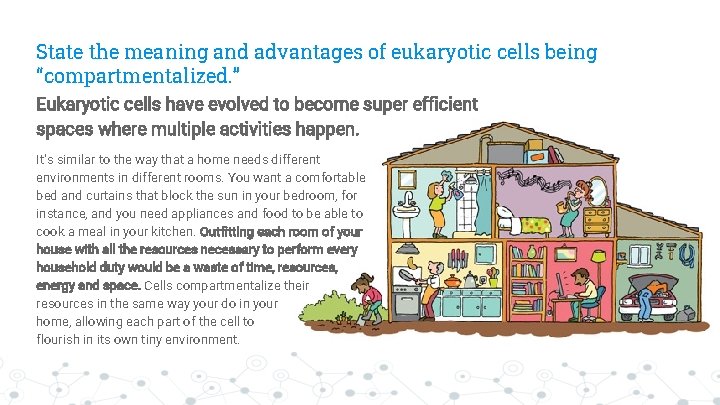
State the meaning and advantages of eukaryotic cells being “compartmentalized. ” Eukaryotic cells have evolved to become super efficient spaces where multiple activities happen. It’s similar to the way that a home needs different environments in different rooms. You want a comfortable bed and curtains that block the sun in your bedroom, for instance, and you need appliances and food to be able to cook a meal in your kitchen. Outfitting each room of your house with all the resources necessary to perform every household duty would be a waste of time, resources, energy and space. Cells compartmentalize their resources in the same way your do in your home, allowing each part of the cell to flourish in its own tiny environment.
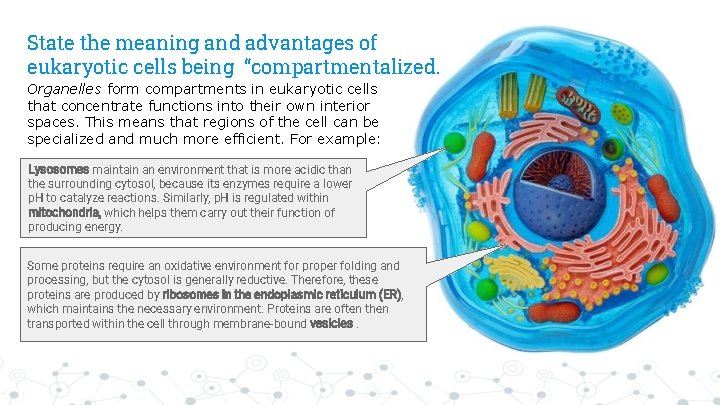
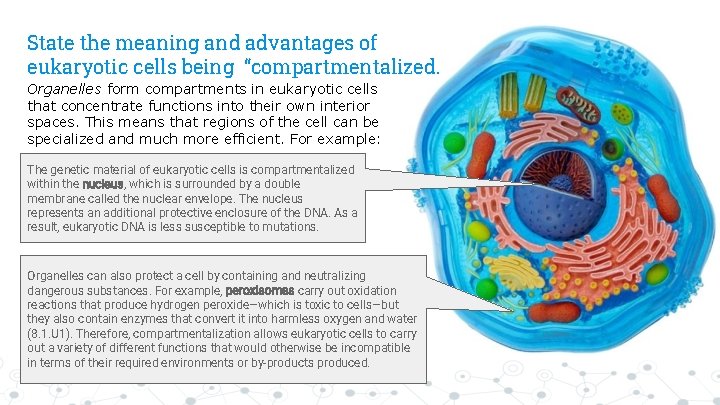
State the meaning and advantages of eukaryotic cells being “compartmentalized. Organelles form compartments in eukaryotic cells that concentrate functions into their own interior spaces. This means that regions of the cell can be specialized and much more efficient. For example: Lysosomes maintain an environment that is more acidic than the surrounding cytosol, because its enzymes require a lower p. H to catalyze reactions. Similarly, p. H is regulated within mitochondria, which helps them carry out their function of producing energy. Some proteins require an oxidative environment for proper folding and processing, but the cytosol is generally reductive. Therefore, these proteins are produced by ribosomes in the endoplasmic reticulum (ER), which maintains the necessary environment. Proteins are often then transported within the cell through membrane-bound vesicles.
State the meaning and advantages of eukaryotic cells being “compartmentalized. Organelles form compartments in eukaryotic cells that concentrate functions into their own interior spaces. This means that regions of the cell can be specialized and much more efficient. For example: The genetic material of eukaryotic cells is compartmentalized within the nucleus, which is surrounded by a double membrane called the nuclear envelope. The nucleus represents an additional protective enclosure of the DNA. As a result, eukaryotic DNA is less susceptible to mutations. Organelles can also protect a cell by containing and neutralizing dangerous substances. For example, peroxisomes carry out oxidation reactions that produce hydrogen peroxide—which is toxic to cells—but they also contain enzymes that convert it into harmless oxygen and water (8. 1. U 1). Therefore, compartmentalization allows eukaryotic cells to carry out a variety of different functions that would otherwise be incompatible in terms of their required environments or by-products produced.
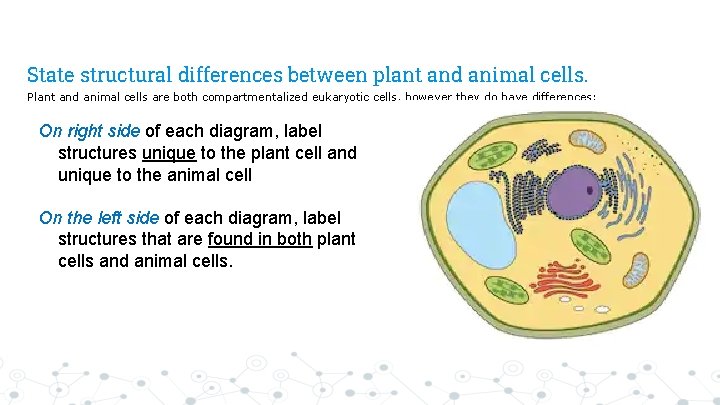
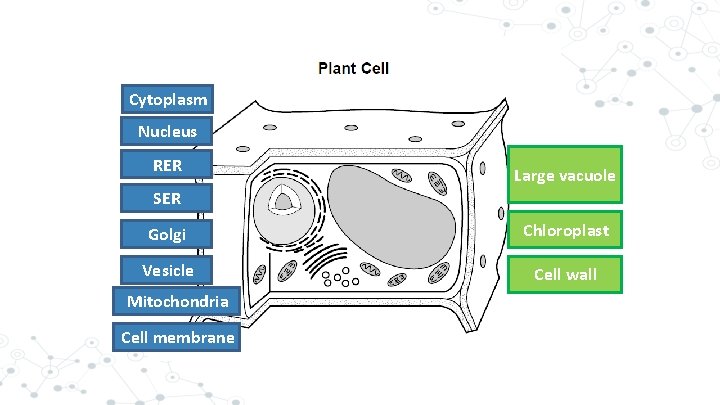
State structural differences between plant and animal cells. Plant and animal cells are both compartmentalized eukaryotic cells, however they do have differences: On right side of each diagram, label structures unique to the plant cell and unique to the animal cell On the left side of each diagram, label structures that are found in both plant cells and animal cells.
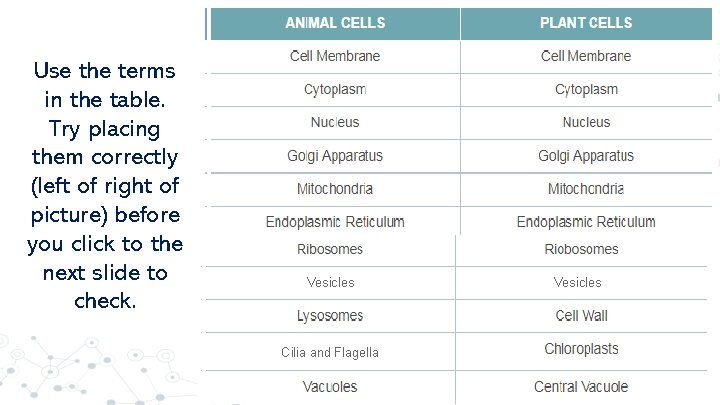
Use the terms in the table. Try placing them correctly (left of right of picture) before you click to the next slide to check. Vesicles Ciliaand and. Flagella Vesicles
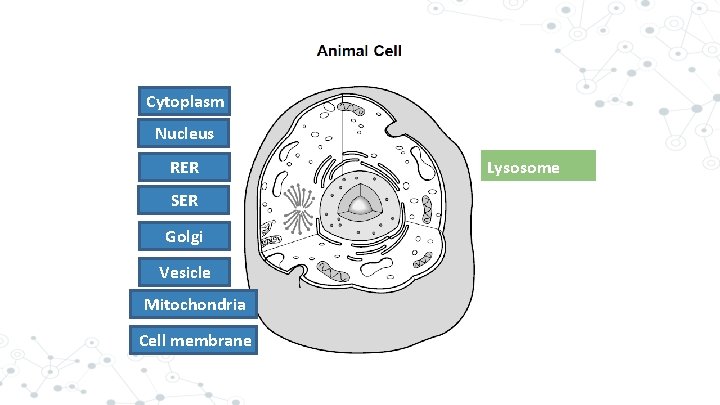
Cytoplasm Nucleus RER SER Golgi Vesicle Mitochondria Cell membrane Lysosome
Cytoplasm Nucleus RER Large vacuole SER Golgi Chloroplast Vesicle Cell wall Mitochondria Cell membrane
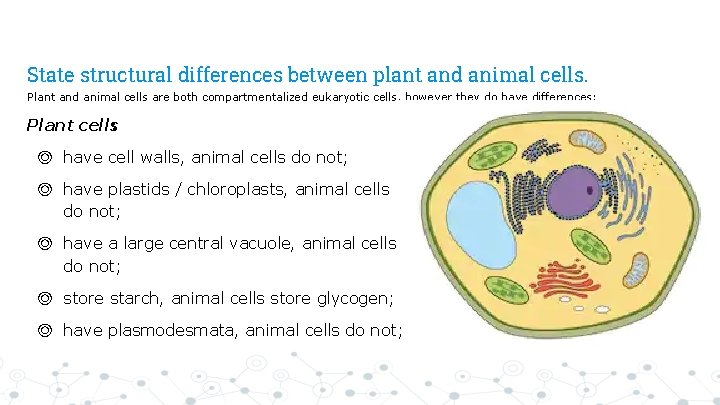
State structural differences between plant and animal cells. Plant and animal cells are both compartmentalized eukaryotic cells, however they do have differences: Plant cells : ◎ have cell walls, animal cells do not; ◎ have plastids / chloroplasts, animal cells do not; ◎ have a large central vacuole, animal cells do not; ◎ store starch, animal cells store glycogen; ◎ have plasmodesmata, animal cells do not;
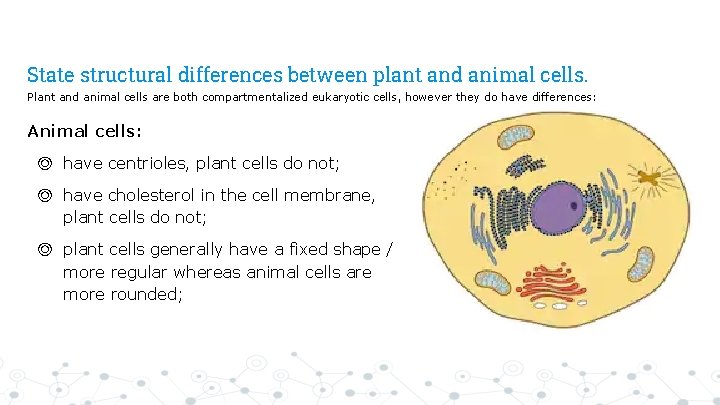
State structural differences between plant and animal cells. Plant and animal cells are both compartmentalized eukaryotic cells, however they do have differences: Animal cells: ◎ have centrioles, plant cells do not; ◎ have cholesterol in the cell membrane, plant cells do not; ◎ plant cells generally have a fixed shape / more regular whereas animal cells are more rounded;