
1 2 S 2 Drawings of the ultrastructure

- Slides: 8
1. 2. S 2 Drawings of the ultrastructure of eukaryotic cells based on electron micrographs.
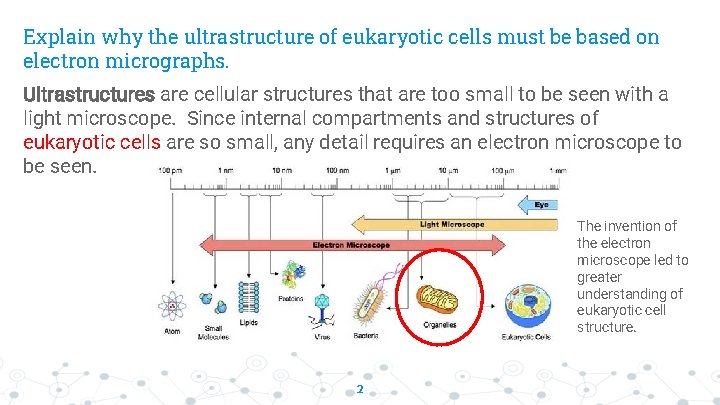
Explain why the ultrastructure of eukaryotic cells must be based on electron micrographs. Ultrastructures are cellular structures that are too small to be seen with a light microscope. Since internal compartments and structures of eukaryotic cells are so small, any detail requires an electron microscope to be seen. The invention of the electron microscope led to greater understanding of eukaryotic cell structure. 2
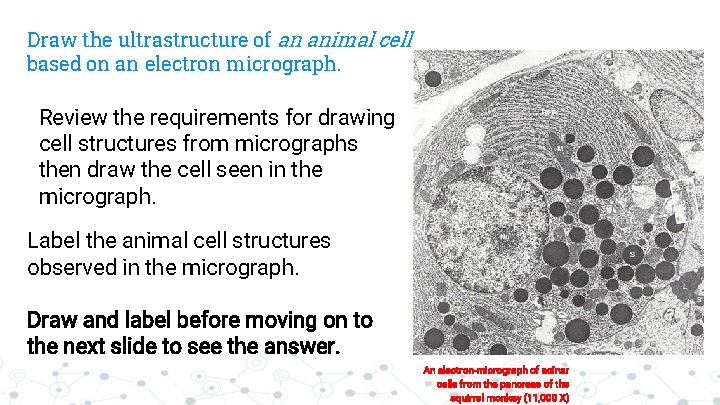
Draw the ultrastructure of an animal cell based on an electron micrograph. Review the requirements for drawing cell structures from micrographs then draw the cell seen in the micrograph. Label the animal cell structures observed in the micrograph. Draw and label before moving on to the next slide to see the answer. An electron-micrograph of acinar cells from the pancreas of the squirrel monkey (11, 000 X)
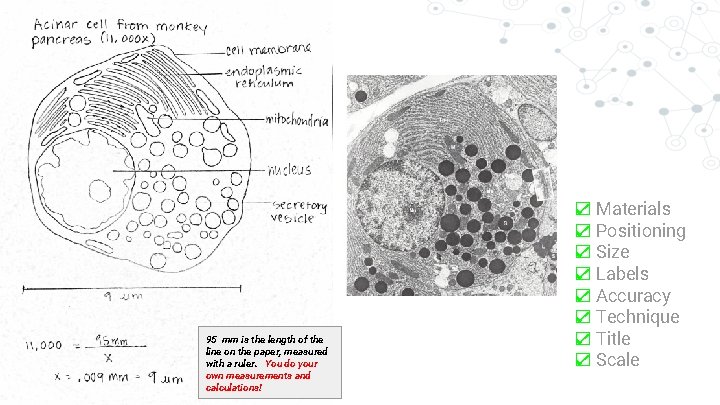
95 mm is the length of the line on the paper, measured with a ruler. You do your own measurements and calculations! ☑ Materials ☑ Positioning ☑ Size ☑ Labels ☑ Accuracy ☑ Technique ☑ Title ☑ Scale
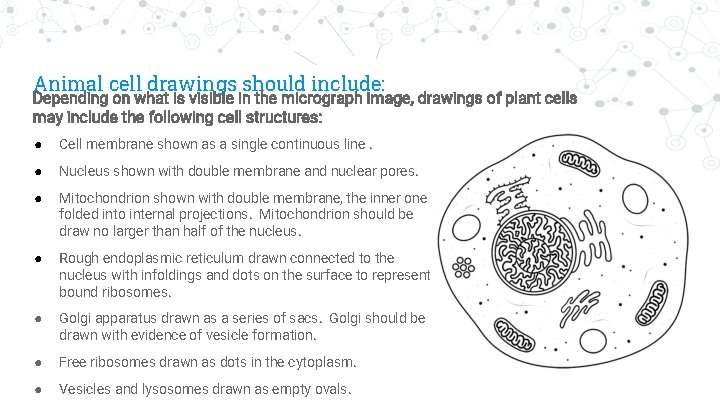
Animal cell drawings should include: “ Depending on what is visible in the micrograph image, drawings of plant cells may include the following cell structures: ● Cell membrane shown as a single continuous line. ● Nucleus shown with double membrane and nuclear pores. ● Mitochondrion shown with double membrane, the inner one folded into internal projections. Mitochondrion should be draw no larger than half of the nucleus. ● Rough endoplasmic reticulum drawn connected to the nucleus with infoldings and dots on the surface to represent bound ribosomes. ● Golgi apparatus drawn as a series of sacs. Golgi should be drawn with evidence of vesicle formation. ● Free ribosomes drawn as dots in the cytoplasm. ● Vesicles and lysosomes drawn as empty ovals.
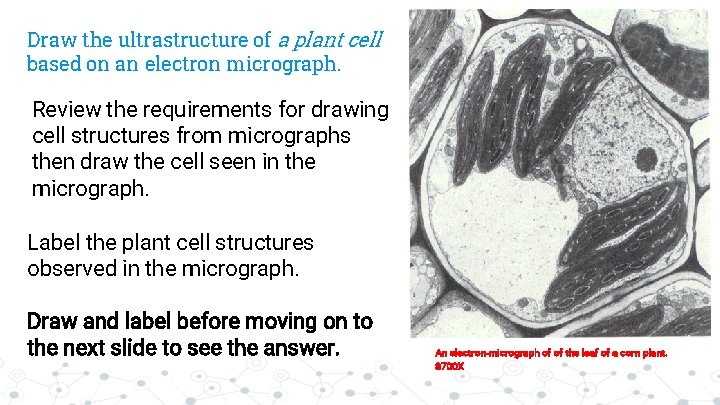
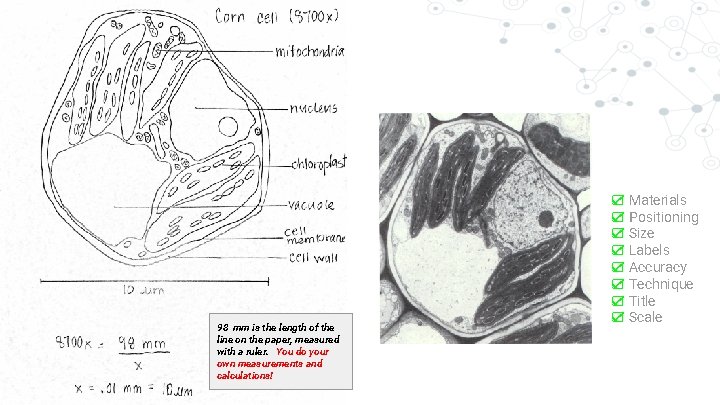
Draw the ultrastructure of a plant cell based on an electron micrograph. Review the requirements for drawing cell structures from micrographs then draw the cell seen in the micrograph. Label the plant cell structures observed in the micrograph. Draw and label before moving on to the next slide to see the answer. An electron-micrograph of of the leaf of a corn plant. 8700 X
98 mm is the length of the line on the paper, measured with a ruler. You do your own measurements and calculations! ☑ Materials ☑ Positioning ☑ Size ☑ Labels ☑ Accuracy ☑ Technique ☑ Title ☑ Scale
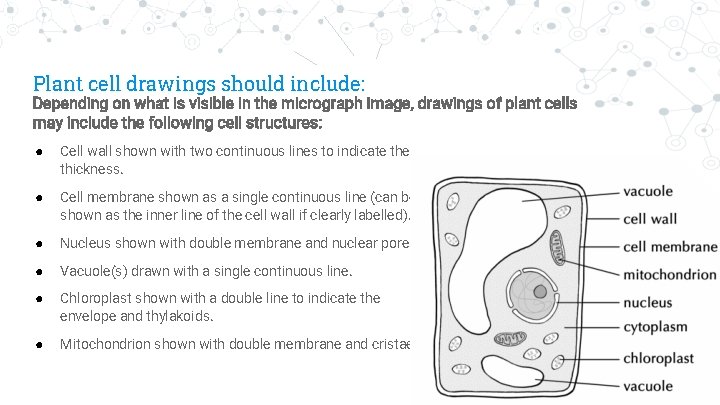
Plant cell drawings should include: “ Depending on what is visible in the micrograph image, drawings of plant cells may include the following cell structures: ● Cell wall shown with two continuous lines to indicate thickness. ● Cell membrane shown as a single continuous line (can be shown as the inner line of the cell wall if clearly labelled). ● Nucleus shown with double membrane and nuclear pores. ● Vacuole(s) drawn with a single continuous line. ● Chloroplast shown with a double line to indicate the envelope and thylakoids. ● Mitochondrion shown with double membrane and cristae.