
1 2 Resources From waste via reuse to
- Slides: 12
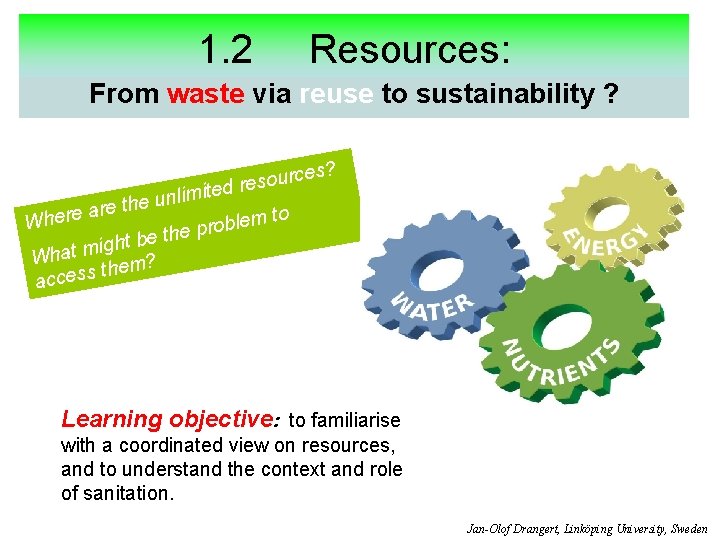
1. 2 Resources: From waste via reuse to sustainability ? es? urc o s e r d imite l n u e h are t e r e h em to l W b o r p the e b t h ig What m em? th s s e c c a energy Learning objective: to familiarise with a coordinated view on resources, and to understand the context and role of sanitation. Jan-Olof Drangert, Linköping University, Sweden
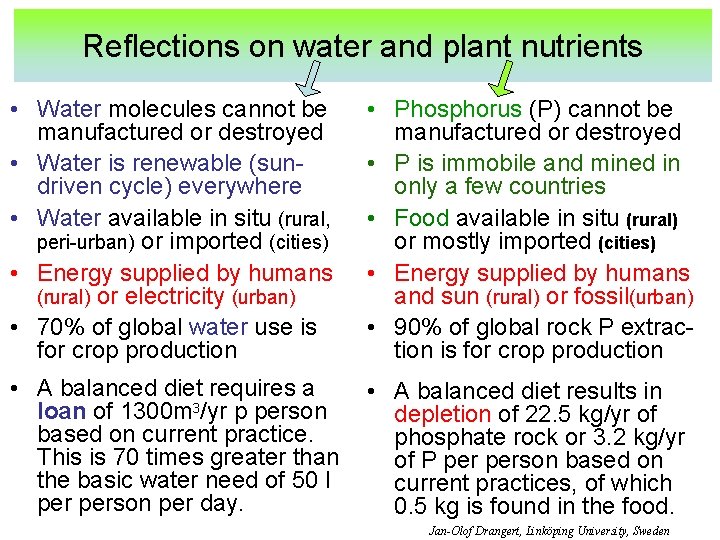
Reflections on water and plant nutrients • Water molecules cannot be manufactured or destroyed • Water is renewable (sundriven cycle) everywhere • Water available in situ (rural, peri-urban) or imported (cities) • Energy supplied by humans (rural) or electricity (urban) • 70% of global water use is for crop production • Phosphorus (P) cannot be manufactured or destroyed • P is immobile and mined in only a few countries • Food available in situ (rural) or mostly imported (cities) • Energy supplied by humans and sun (rural) or fossil(urban) • 90% of global rock P extraction is for crop production • A balanced diet requires a loan of 1300 m 3/yr p person based on current practice. This is 70 times greater than the basic water need of 50 l person per day. • A balanced diet results in depletion of 22. 5 kg/yr of phosphate rock or 3. 2 kg/yr of P person based on current practices, of which 0. 5 kg is found in the food. Jan-Olof Drangert, Linköping University, Sweden
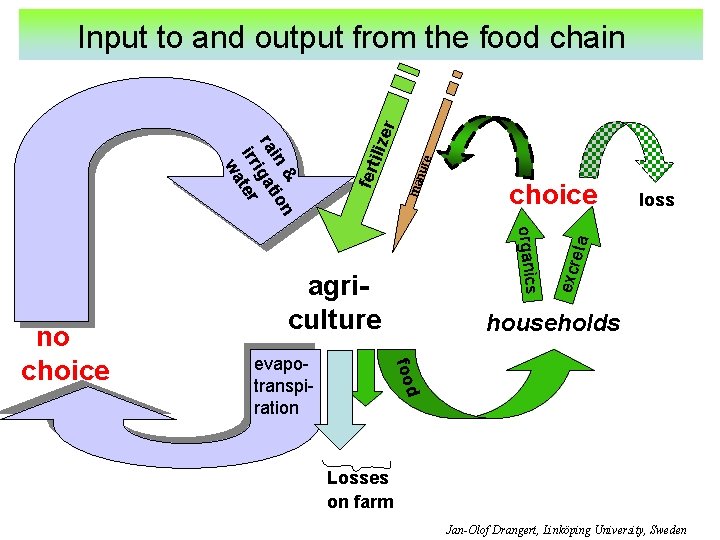
ure loss eta organics agriculture households d foo evapotranspiration choice excr man & n in io ra igat irr ter wa no choice fert ilize r Input to and output from the food chain Losses on farm Jan-Olof Drangert, Linköping University, Sweden
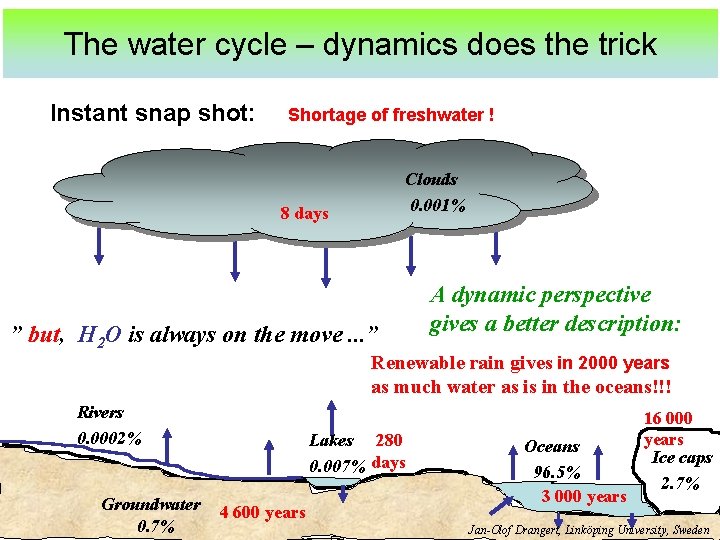
The water cycle – dynamics does the trick Instant snap shot: Shortage of freshwater ! Clouds 0. 001% 8 days ” but, H 2 O is always on the move. . . ” A dynamic perspective gives a better description: Renewable rain gives in 2000 years as much water as is in the oceans!!! Rivers 0. 0002% Groundwater 0. 7% Lakes 280 0. 007% days 4 600 years Oceans 96. 5% 3 000 years 16 000 years Ice caps 2. 7% Jan-Olof Drangert, Linköping University, Sweden
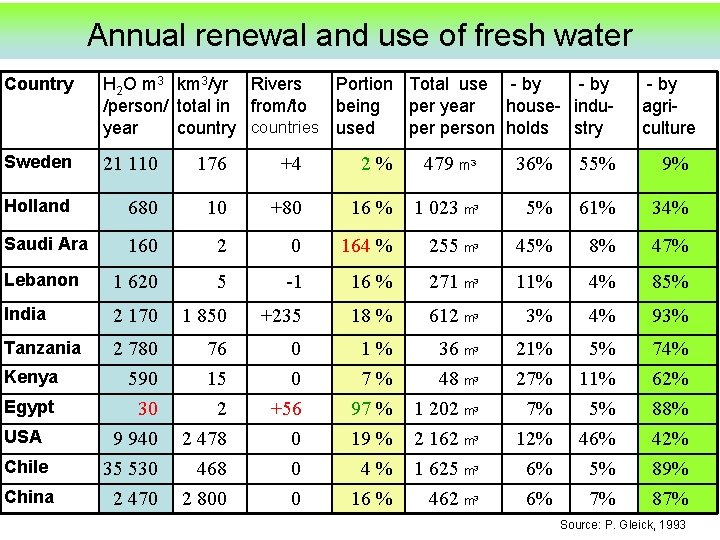
Annual renewal and use of fresh water Country H 2 O m 3 km 3/yr Rivers Portion Total use - by /person/ total in from/to being per year house- induyear country countries used person holds stry Sweden 21 110 176 +4 2% 479 m 3 36% 55% 9% Holland 680 10 +80 16 % 1 023 m 3 5% 61% 34% Saudi Ara 160 2 0 164 % 255 m 3 45% 8% 47% Lebanon 1 620 5 -1 16 % 271 m 3 11% 4% 85% India 2 170 1 850 +235 18 % 612 m 3 3% 4% 93% 2 780 590 30 9 940 35 530 2 470 76 15 2 2 478 468 2 800 0 0 +56 0 0 0 1% 7% 97 % 19 % 4% 16 % 36 m 48 m 1 202 m 2 162 m 1 625 m 462 m 21% 27% 7% 12% 6% 6% 5% 11% 5% 46% 5% 7% 74% 62% 88% 42% 89% 87% Tanzania Kenya Egypt USA Chile China 3 3 3 - by agriculture Source: P. Gleick, 1993
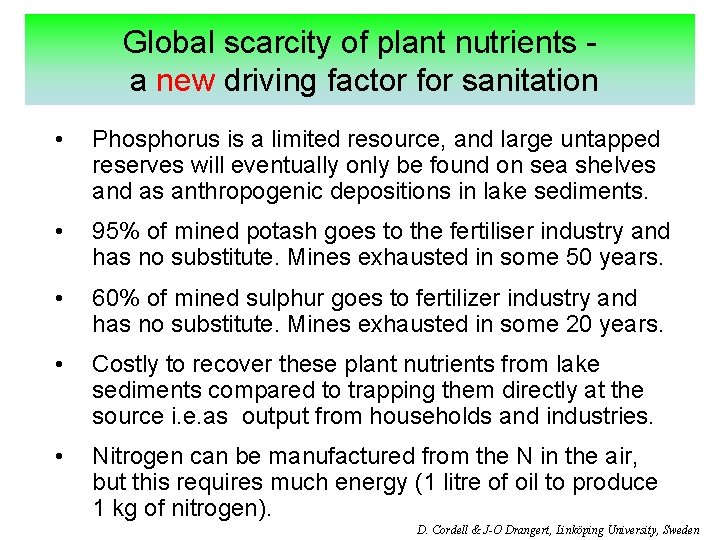
Global scarcity of plant nutrients a new driving factor for sanitation • Phosphorus is a limited resource, and large untapped reserves will eventually only be found on sea shelves and as anthropogenic depositions in lake sediments. • 95% of mined potash goes to the fertiliser industry and has no substitute. Mines exhausted in some 50 years. • 60% of mined sulphur goes to fertilizer industry and has no substitute. Mines exhausted in some 20 years. • Costly to recover these plant nutrients from lake sediments compared to trapping them directly at the source i. e. as output from households and industries. • Nitrogen can be manufactured from the N in the air, but this requires much energy (1 litre of oil to produce 1 kg of nitrogen). D. Cordell & J-O Drangert, Linköping University, Sweden
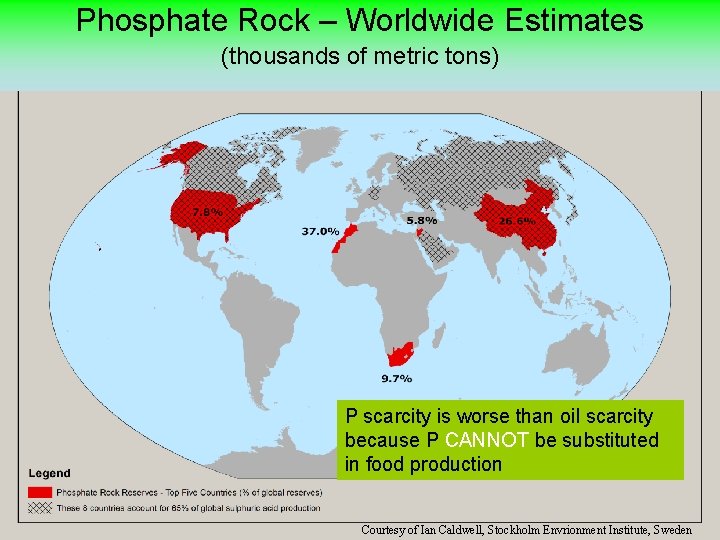
Phosphate Rock – Worldwide Estimates (thousands of metric tons) P scarcity is worse than oil scarcity because P CANNOT be substituted in food production Courtesy of Ian Caldwell, Stockholm Envrionment Institute, Sweden
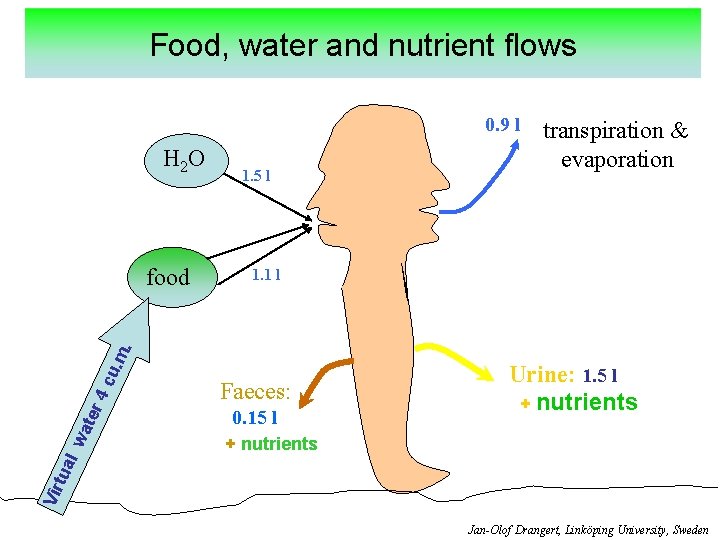
Food, water and nutrient flows 0. 9 l H 2 O 1. 1 l Faeces: 0. 15 l Urine: 1. 5 l + nutrients Vir tua l w ate r 4 cu. m. food 1. 5 l transpiration & evaporation Jan-Olof Drangert, Linköping University, Sweden
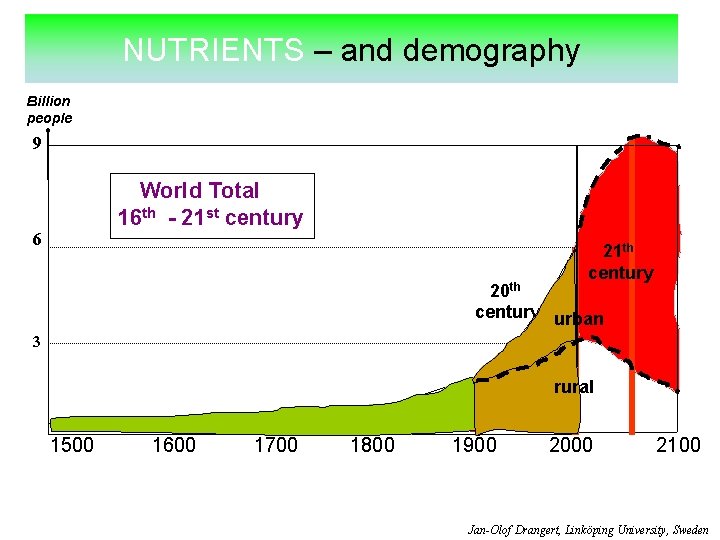
NUTRIENTS – and demography Billion people 9 World Total 16 th - 21 st century 6 21 th century 20 th century urban 3 rural 1500 1600 1700 1800 1900 2000 2100 Jan-Olof Drangert, Linköping University, Sweden
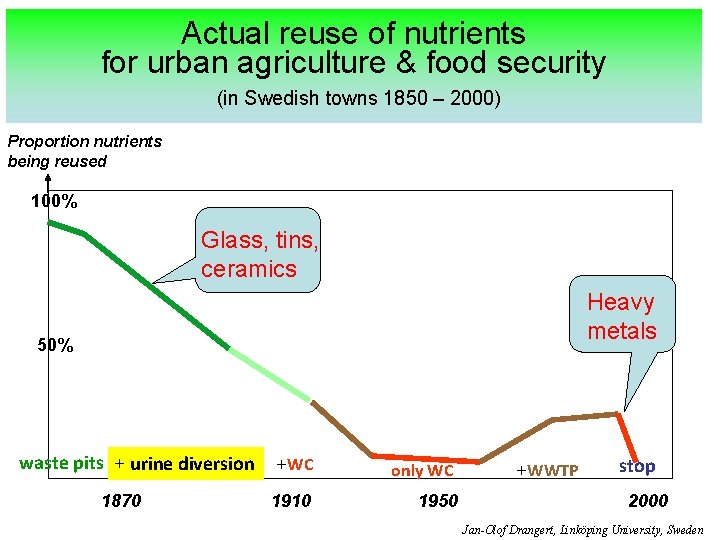
Actual reuse of nutrients for urban agriculture & food security (in Swedish towns 1850 – 2000) Proportion nutrients being reused 100% Glass, tins, ceramics Heavy metals 50% waste pits + urine diversion 1870 +WC only WC 1910 1950 +WWTP stop 2000 Jan-Olof Drangert, Linköping University, Sweden
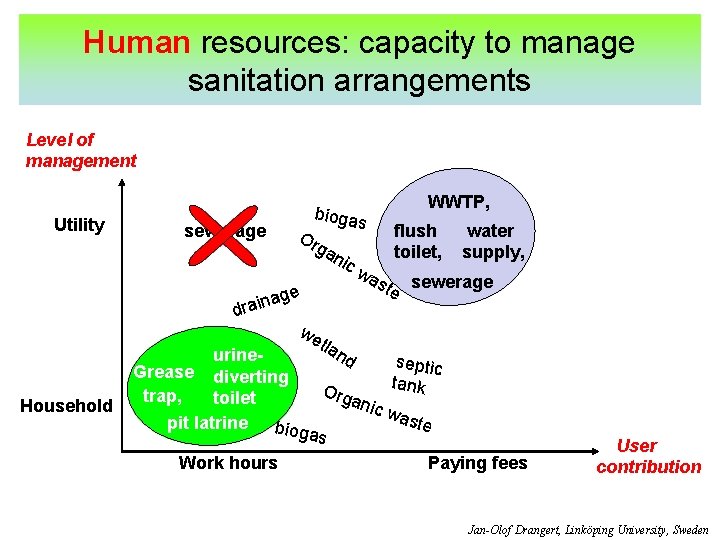
Human resources: capacity to manage sanitation arrangements Level of management Utility Household WWTP, bioga s sewerage flush water Or ga toilet, supply, nic wa ste sewerage e nag i a r d we tla nd urineseptic Grease diverting tank O r trap, g toilet anic was te pit latrine bio gas Work hours Paying fees User contribution Jan-Olof Drangert, Linköping University, Sweden
”Manpower blindness”: driver of new responsibility sharing Our pre-conceived views play a role • We tend to account only for what is done by governments and projects in water and sanitation • What is done by residents and small entrepreneurs is rarely appreciated, if at all recognized (blindness) • Yet, many urbanites survive thanks to such local initiatives • Here, we pledge that both kinds of activities are needed to solve current sanitation problems Jan-Olof Drangert, Linköping University, Sweden