
1 2 Given vectors a b and c
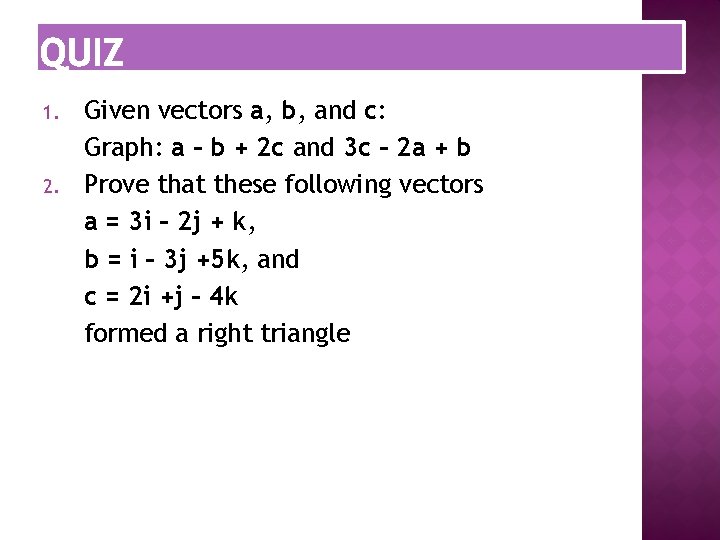
1. 2. Given vectors a, b, and c: Graph: a – b + 2 c and 3 c – 2 a + b Prove that these following vectors a = 3 i – 2 j + k, b = i – 3 j +5 k, and c = 2 i +j – 4 k formed a right triangle


Line Equation How to determine the equation of l passing through P(x 0, y 0, z 0) parallel a vector v? z l P(x 0, y 0, z 0) a r 0 r Q(x, y, z) Let Q(x, y, z) is an arbitrary point on l, suppose r 0 and r are positional vetors posisi of P and Q. If a is the representation of The rule of the addition of vectors v defined: x r = r 0 + a y Because a and v are parallel, there exist t so that a = tv r = r 0 + tv The equation of line vector

If v = a, b, c , r = x, y, z and r 0 = x 0, y 0, z 0 , then the implication of the equation is x= x 0 + ta, y = y 0 + tb, z = z 0 + tc which is called parametric equation of a line passing through P(x 0, y 0, z 0) by vector v = a, b, c. By solving t from the parametric equation, we get Which is called symmetrical equation of a line passing through P(x 0, y 0, z 0) by vector v = a, b, c.
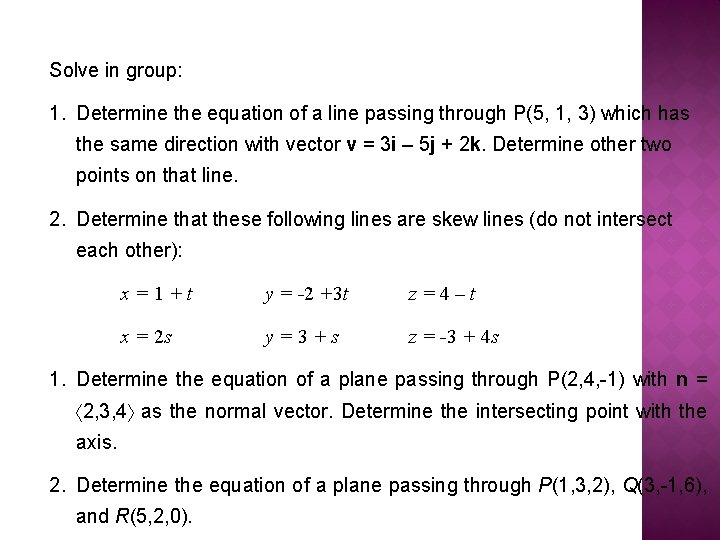
Solve in group: 1. Determine the equation of a line passing through P(5, 1, 3) which has the same direction with vector v = 3 i – 5 j + 2 k. Determine other two points on that line. 2. Determine that these following lines are skew lines (do not intersect each other): x=1+t y = -2 +3 t z=4–t x = 2 s y=3+s z = -3 + 4 s 1. Determine the equation of a plane passing through P(2, 4, -1) with n = 2, 3, 4 as the normal vector. Determine the intersecting point with the axis. 2. Determine the equation of a plane passing through P(1, 3, 2), Q(3, -1, 6), and R(5, 2, 0).
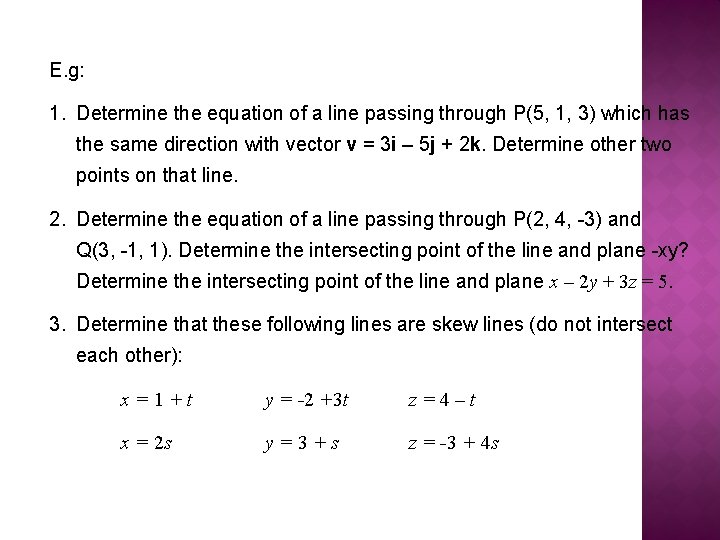
E. g: 1. Determine the equation of a line passing through P(5, 1, 3) which has the same direction with vector v = 3 i – 5 j + 2 k. Determine other two points on that line. 2. Determine the equation of a line passing through P(2, 4, -3) and Q(3, -1, 1). Determine the intersecting point of the line and plane -xy? Determine the intersecting point of the line and plane x – 2 y + 3 z = 5. 3. Determine that these following lines are skew lines (do not intersect each other): x=1+t y = -2 +3 t z=4–t x = 2 s y=3+s z = -3 + 4 s

Plane equation A plane in three dimensions determined by a point P(x 0, y 0, z 0) and a vector n which is perpendicular to the plane (normal vector). z n plane, let r 0 and r are positional Q(x, y, z) r Let Q(x, y, z) is an arbitrary point in a vectors of P and Q. Vector r – r 0 can r – r 0 P(x 0, y 0, z 0) r 0 be determined by Normal vector n perpendicular to every x y vector on that particularly r – r 0 therefore n (r – r 0) = 0 The equation of vector from a plane,

If n = a, b, c , r = x, y, z and r 0 = x 0, y 0, z 0 , therefore the equation can be: a(x – x 0) + b(y – y 0) + c(z – z 0) = 0 This equation is called scalar equation of a plane passing through P(x 0, y 0, z 0) with n = a, b, c as the normal vector. The equation can be written as this following linear equation. ax + by + cz + d = 0

E. g: 1. Determine the equation of a plane passing through P(2, 4, -1) with n = 2, 3, 4 as the normal vector. Determine the intersecting point with the axis. 2. Determine the equation of a plane passing through P(1, 3, 2), Q(3, -1, 6), and R(5, 2, 0). 3. Determine the intersecting point of lines x = 2 + 3 t, y = -4 t, z = 5 + t which intersect 4 x + 5 y – 2 z = 18. 4. Determine the angle between x + y + z = 1 and x – 2 y + 3 z = 1. And, determine the equation of intersecting lines of those two planes.
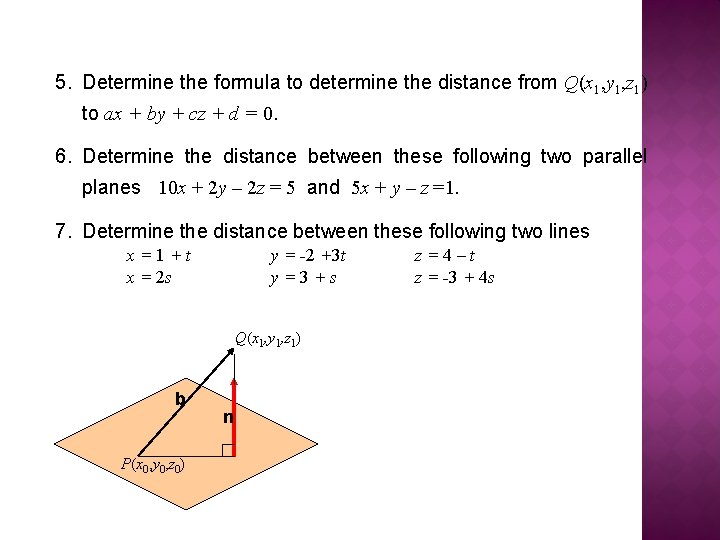
5. Determine the formula to determine the distance from Q(x 1, y 1, z 1) to ax + by + cz + d = 0. 6. Determine the distance between these following two parallel planes 10 x + 2 y – 2 z = 5 and 5 x + y – z =1. 7. Determine the distance between these following two lines x=1+t x = 2 s y = -2 +3 t y=3+s Q(x 1, y 1, z 1) b P(x 0, y 0, z 0) n z=4–t z = -3 + 4 s
- Slides: 10