
1 2 Estimation Graphs and Mathematical Models 2010
- Slides: 14
1. 2 Estimation, Graphs and Mathematical Models © 2010 Pearson Prentice Hall. All rights reserved. 1
Objectives 1. Use estimation techniques to arrive at an approximate answer to a problem. 2. Apply estimation techniques to information given by graphs. 3. Develop mathematical models that estimate relationships between variables. © 2010 Pearson Prentice Hall. All rights reserved. 2
Estimation The process of arriving at an approximate answer to a question. Methods of Estimation • Rounding Numbers • Using Graphs • Using Mathematical Models © 2010 Pearson Prentice Hall. All rights reserved. 3
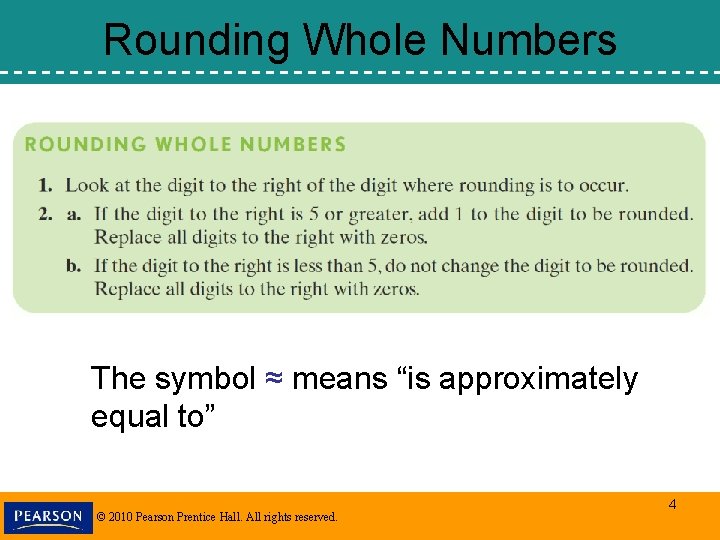
Rounding Whole Numbers The symbol ≈ means “is approximately equal to” © 2010 Pearson Prentice Hall. All rights reserved. 4
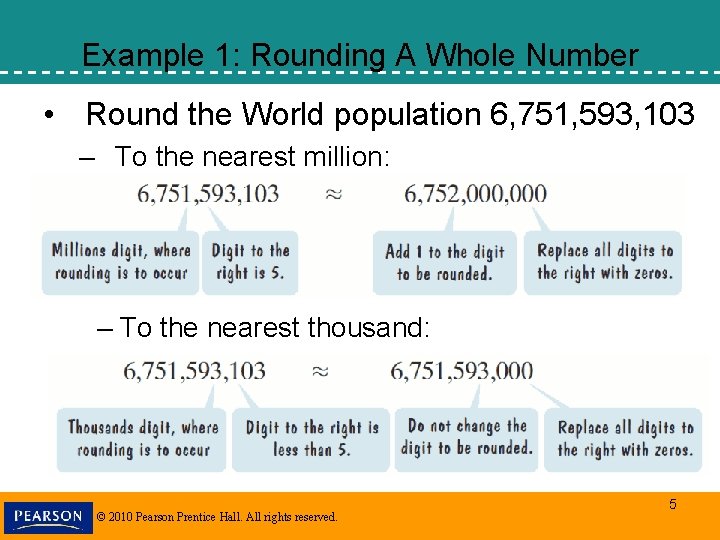
Example 1: Rounding A Whole Number • Round the World population 6, 751, 593, 103 – To the nearest million: – To the nearest thousand: © 2010 Pearson Prentice Hall. All rights reserved. 5
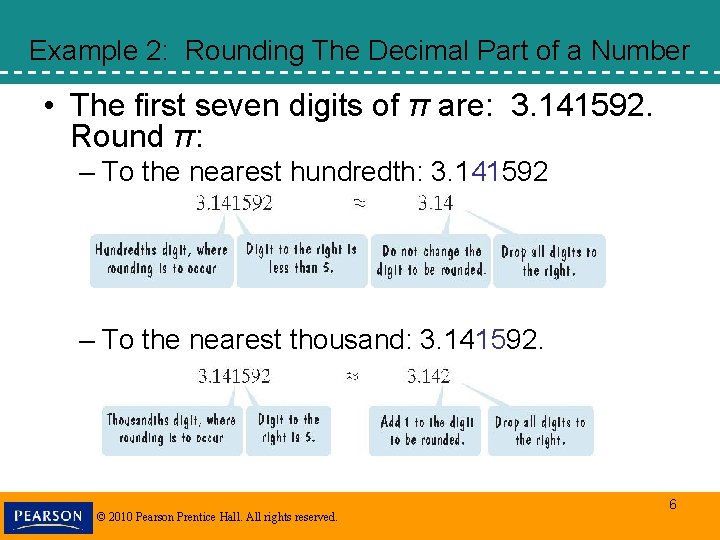
Example 2: Rounding The Decimal Part of a Number • The first seven digits of π are: 3. 141592. Round π: – To the nearest hundredth: 3. 141592 – To the nearest thousand: 3. 141592. © 2010 Pearson Prentice Hall. All rights reserved. 6
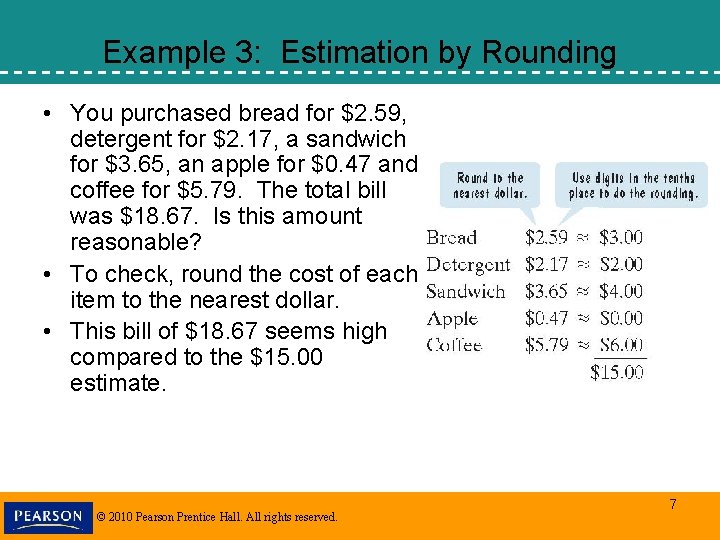
Example 3: Estimation by Rounding • You purchased bread for $2. 59, detergent for $2. 17, a sandwich for $3. 65, an apple for $0. 47 and coffee for $5. 79. The total bill was $18. 67. Is this amount reasonable? • To check, round the cost of each item to the nearest dollar. • This bill of $18. 67 seems high compared to the $15. 00 estimate. © 2010 Pearson Prentice Hall. All rights reserved. 7
Estimation with Graphs: Bar Graphs • Bar graphs use a vertical or horizontal bar to represent each item. • The length of the bar determines the amount. • We can use bar graphs to make predictions. © 2010 Pearson Prentice Hall. All rights reserved. 8
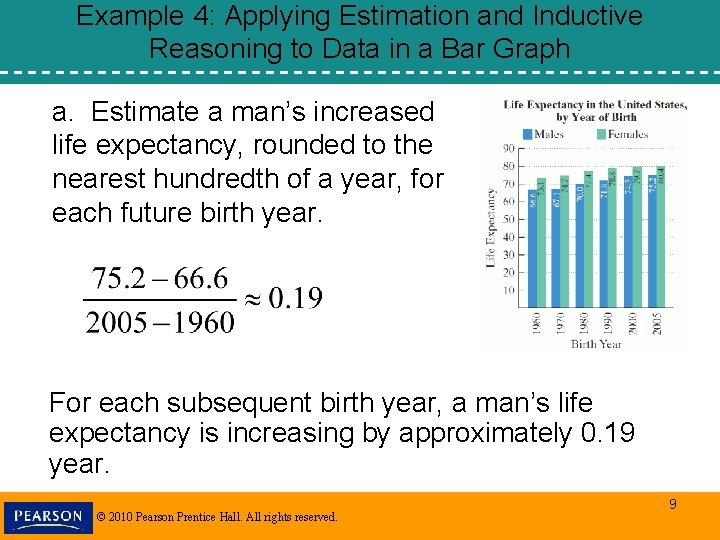
Example 4: Applying Estimation and Inductive Reasoning to Data in a Bar Graph a. Estimate a man’s increased life expectancy, rounded to the nearest hundredth of a year, for each future birth year. For each subsequent birth year, a man’s life expectancy is increasing by approximately 0. 19 year. © 2010 Pearson Prentice Hall. All rights reserved. 9
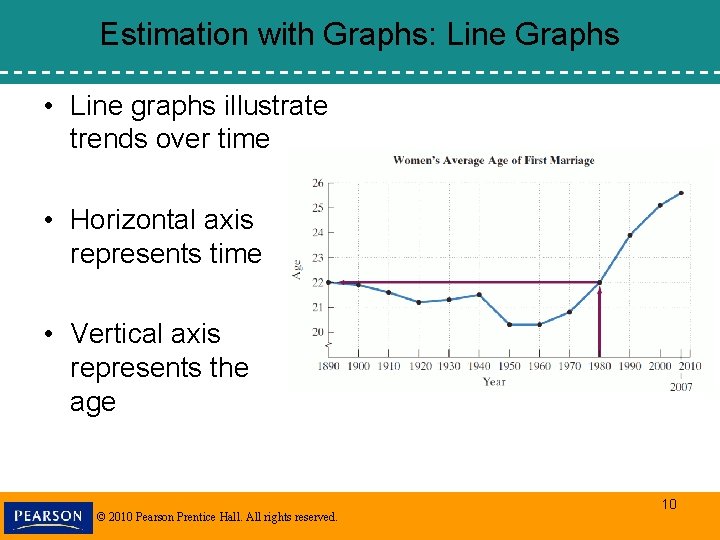
Estimation with Graphs: Line Graphs • Line graphs illustrate trends over time • Horizontal axis represents time • Vertical axis represents the age © 2010 Pearson Prentice Hall. All rights reserved. 10
Estimation with Mathematical Models • The process of finding formulas to describe realworld phenomena. © 2010 Pearson Prentice Hall. All rights reserved. 11
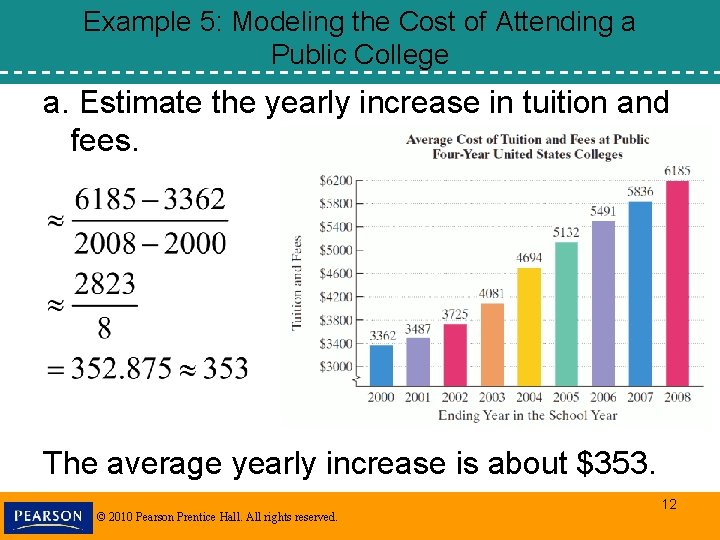
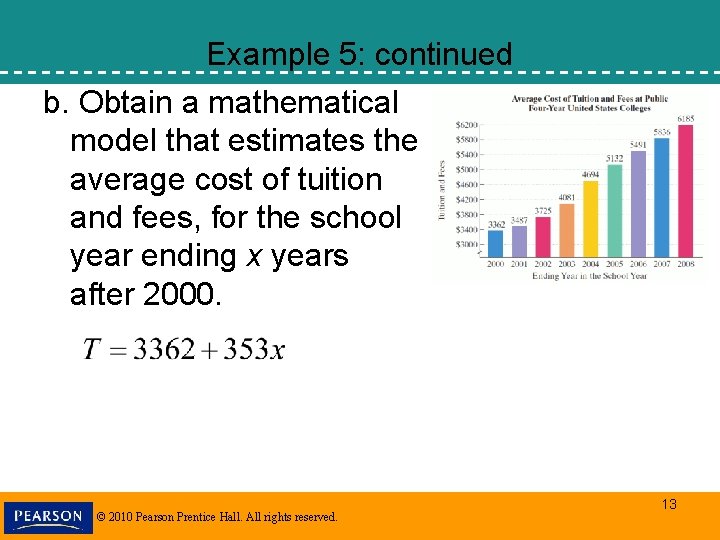
Example 5: Modeling the Cost of Attending a Public College a. Estimate the yearly increase in tuition and fees. The average yearly increase is about $353. © 2010 Pearson Prentice Hall. All rights reserved. 12
Example 5: continued b. Obtain a mathematical model that estimates the average cost of tuition and fees, for the school year ending x years after 2000. © 2010 Pearson Prentice Hall. All rights reserved. 13
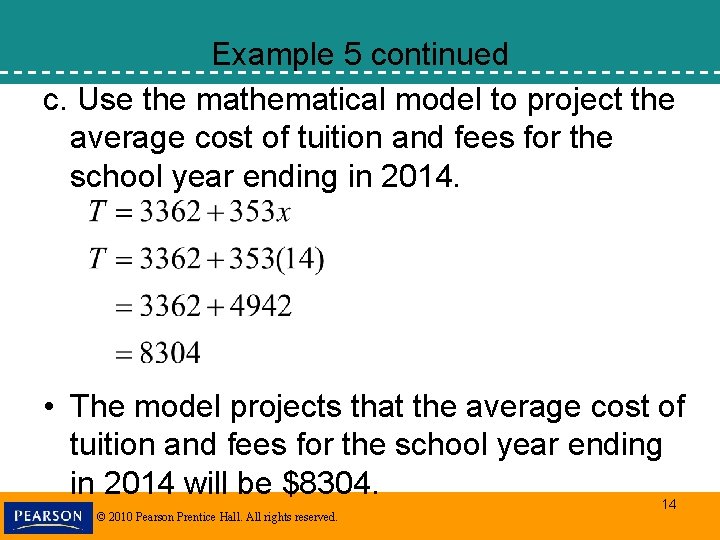
Example 5 continued c. Use the mathematical model to project the average cost of tuition and fees for the school year ending in 2014. • The model projects that the average cost of tuition and fees for the school year ending in 2014 will be $8304. 14 © 2010 Pearson Prentice Hall. All rights reserved.