
1 2 Chemistry and You chemistry What is
- Slides: 56
1. 2 Chemistry and You > chemistry What is it? 1
1. 2 Chemistry and You > • Learning Targets: I can…… describe what is studied in chemistry describe 5 branches of chemistry describe 3 reasons to study chemistry 2
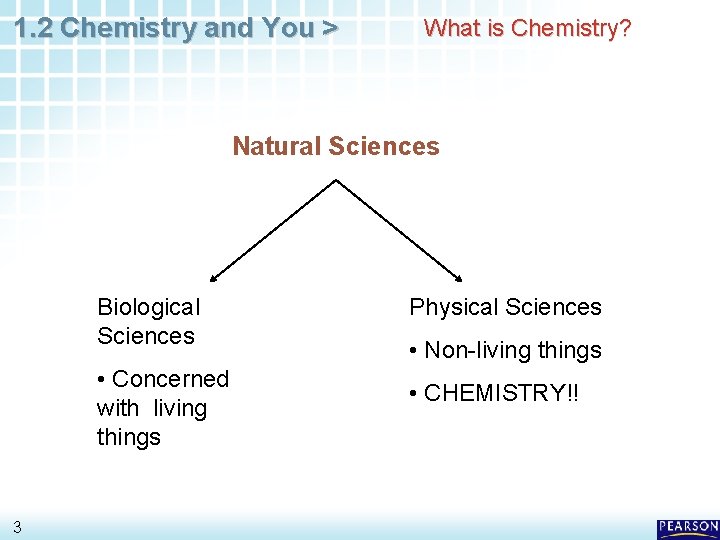
1. 2 Chemistry and You > What is Chemistry? Natural Sciences Biological Sciences • Concerned with living things 3 Physical Sciences • Non-living things • CHEMISTRY!!
1. 2 Chemistry and You > Chemistry Study of composition, structure, and properties of substances and the changes they undergo 4 Copyright © Pearson Education, Inc. , or its affiliates. All Rights Reserved.
1. 2 Chemistry and You > Chemistry is the study of …. § What matter is made of § how matter and energy change during chemical reactions – Examples of chemical reactions Ølighting a match Ødigesting food to release energy ØCorroded metal ØRaw egg to cooked egg 5
1. 2 Chemistry and You > Types of Chemistry Research Pure Chemistry – Basic research – Mainly for Increasing knowledge Applied Chemistry – Solve a problem – Directed toward a practical goal 6
1. 2 Chemistry and You > What are Branches of Chemistry? • Organic chemistry – study matter that contains the element carbon • Inorganic chemistry – study matter that does not contain the element carbon (non-carbon) • Biochemistry – bio = life, chemical processes in living things • Physical chemistry – mechanism of chemical reactions, rates, energy changes during chemical reaction • Analytical chemistry – analyze examine parts – composition – pollutants ppm, ppb 7
1. 2 Chemistry and You > What are Big Ideas or Common Themes in Chemistry? Central science – chemistry overlaps with all other sciences Electrons and the structure of atoms- the arrangement of electrons on atoms determines how they react with one another Bonding and Interactions– most elements exist in compounds – the chemical bonds influence their properties Reactions – chemical reactions involve processes in which reactants form products 8
1. 2 Chemistry and You > What are Big Ideas or Common Themes in Chemistry? Kinetic theory - particles of matter are in constant motion which determines their state, solid, liquid, gas Mole and Quantifying Matter- mole the unit used by chemists for specifying an amount of matter Matter and energy- the energy changes that occur during chemical reactions Carbon Chemistry- there are over 10 million carbon- containing compounds! 9
1. 2 Chemistry and You > Why Study Chemistry? Chemistry can be useful in: 1. explaining the natural world. 2. preparing people for career opportunities 3. producing informed citizens. 10 Copyright © Pearson Education, Inc. , or its affiliates. All Rights Reserved.
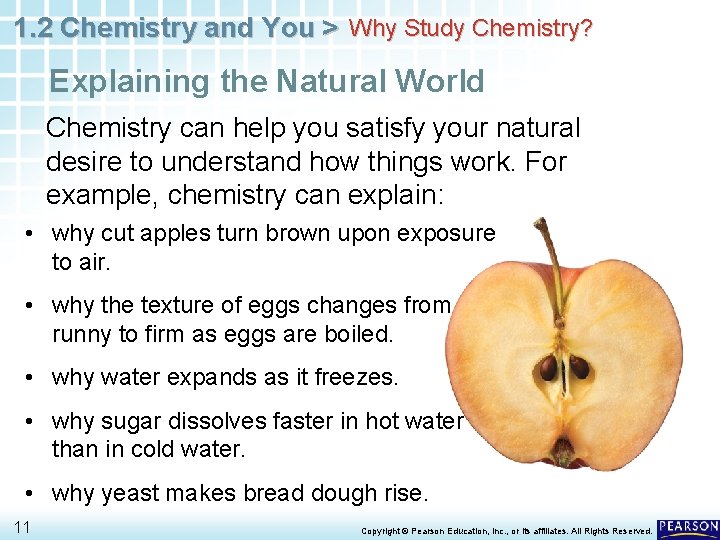
1. 2 Chemistry and You > Why Study Chemistry? Explaining the Natural World Chemistry can help you satisfy your natural desire to understand how things work. For example, chemistry can explain: • why cut apples turn brown upon exposure to air. • why the texture of eggs changes from runny to firm as eggs are boiled. • why water expands as it freezes. • why sugar dissolves faster in hot water than in cold water. • why yeast makes bread dough rise. 11 Copyright © Pearson Education, Inc. , or its affiliates. All Rights Reserved.
1. 2 Chemistry and You > Why Study Chemistry? Preparing for a Career Chemists contribute to society in many ways. You do not need to have the word chemist in your job title to benefit from understanding chemistry. • A reporter may be asked to interview a chemist to gather background for a story. 12 Copyright © Pearson Education, Inc. , or its affiliates. All Rights Reserved.
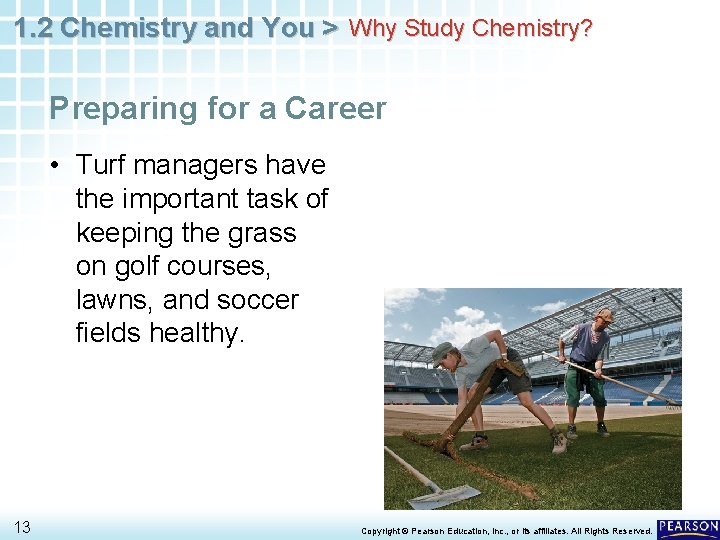
1. 2 Chemistry and You > Why Study Chemistry? Preparing for a Career • Turf managers have the important task of keeping the grass on golf courses, lawns, and soccer fields healthy. 13 Copyright © Pearson Education, Inc. , or its affiliates. All Rights Reserved.
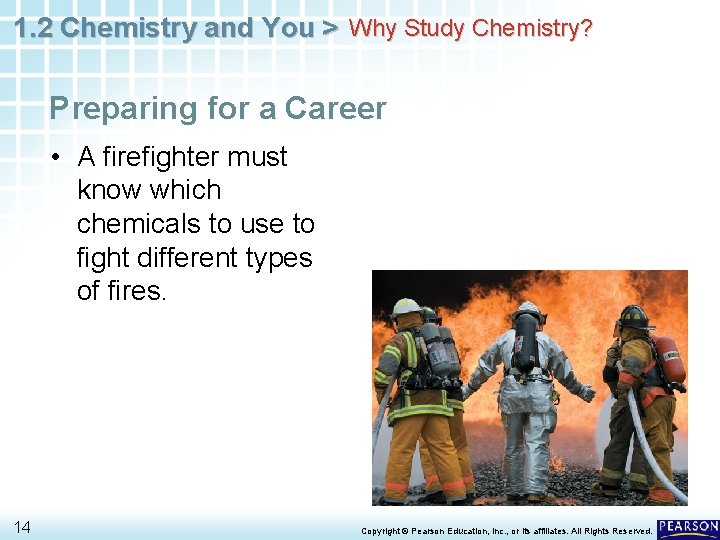
1. 2 Chemistry and You > Why Study Chemistry? Preparing for a Career • A firefighter must know which chemicals to use to fight different types of fires. 14 Copyright © Pearson Education, Inc. , or its affiliates. All Rights Reserved.
1. 2 Chemistry and You > Why Study Chemistry? Being an Informed Citizen • Voting • Petitions • Funding Industry, private foundations, and the federal and state government all provide funds for scientific research. • Space exploration research could not take place without federal funding. • NASA research has led to the development of many items used on Earth. These include smoke detectors, scratchresistant plastic lenses, heart monitors, and flat-screen televisions. 15 • What if all the money spent on space exploration was used to find a cure for cancer? Copyright © Pearson Education, Inc. , or its affiliates. All Rights Reserved.
1. 2 Chemistry and You > Why Study Chemistry? Being an Informed Citizen When it comes to scientific research, there is no one correct answer. • However, knowledge of chemistry and other sciences can help you evaluate the data presented, arrive at an informed opinion, and take appropriate action. 16 Copyright © Pearson Education, Inc. , or its affiliates. All Rights Reserved.
1. 2 Chemistry and You > Which of the following careers would require some understanding of chemistry? A. Chef (raise right hand) B. Doctor (raise left hand) C. Farmer (stand up) D. all of the above (just sit there) 17 Copyright © Pearson Education, Inc. , or its affiliates. All Rights Reserved.
1. 2 Chemistry and You > Which of the following careers would require some understanding of chemistry? A. chef B. doctor C. farmer D. all of the above 18 Copyright © Pearson Education, Inc. , or its affiliates. All Rights Reserved.
1. 2 Chemistry and You > Chemistry, Technology, and Society What are some outcomes of modern research in chemistry? • Technology is the means by which a society provides its members with those things needed and desired. Many basic items you use every day, such as the sneakers you wear or the cereal you eat, are products of technology. 19 Copyright © Pearson Education, Inc. , or its affiliates. All Rights Reserved.
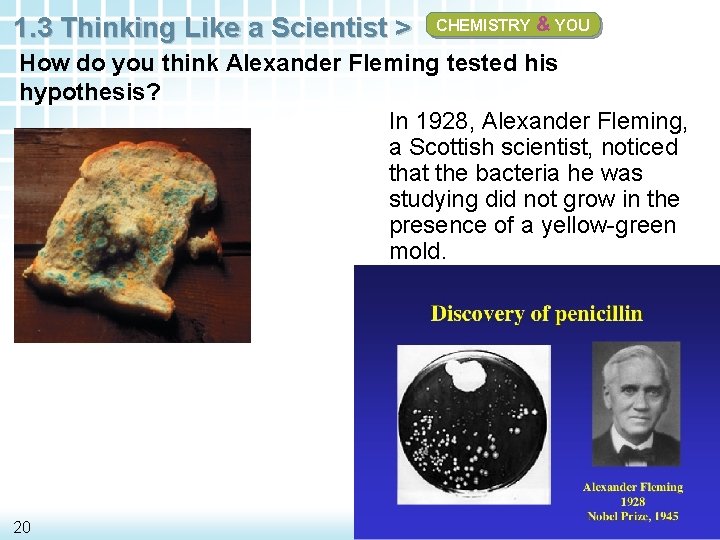
1. 3 Thinking Like a Scientist > CHEMISTRY & YOU How do you think Alexander Fleming tested his hypothesis? In 1928, Alexander Fleming, a Scottish scientist, noticed that the bacteria he was studying did not grow in the presence of a yellow-green mold. 20 Copyright © Pearson Education, Inc. , or its affiliates. All Rights Reserved.
1. 3 Thinking Like a Scientist > The Scientific Method The scientific method is a logical, systematic approach to the solution of a scientific problem. 21 Copyright © Pearson Education, Inc. , or its affiliates. All Rights Reserved.
1. 3 Thinking Like a Scientist > The Scientific Method Steps in the scientific method include making observations, proposing and testing hypotheses, and developing theories. 22 Copyright © Pearson Education, Inc. , or its affiliates. All Rights Reserved.
1. 3 Thinking Like a Scientist > The Scientific Method Making Observations can be: Quantitative – involve numbers OR Qualitative – not involving numbers Suppose you try to turn on a flashlight and you notice that it does not light. Is this a qualitative or quantitative observation? 23 Copyright © Pearson Education, Inc. , or its affiliates. All Rights Reserved.
1. 3 Thinking Like a Scientist > The Scientific Method Testing Hypotheses If you guess that the batteries in a flashlight are dead, you are making a hypothesis. • A hypothesis is a proposed explanation for an observation. 24 Copyright © Pearson Education, Inc. , or its affiliates. All Rights Reserved.
1. 3 Thinking Like a Scientist > The Scientific Method Testing Hypotheses Replacing the batteries is an experiment, a procedure that is used to test a hypothesis. 25 Copyright © Pearson Education, Inc. , or its affiliates. All Rights Reserved.
1. 3 Thinking Like a Scientist > The Scientific Method Testing Hypotheses • The variable that you change during an experiment is the independent variable, also called the manipulated variable. • The variable that is observed during the experiment is the dependent variable, also called the responding variable. 26 Copyright © Pearson Education, Inc. , or its affiliates. All Rights Reserved.
1. 3 Thinking Like a Scientist > The Scientific Method Testing Hypotheses For the results of an experiment to be accepted, the experiment must produce the same result no matter how many times it is repeated, or by whom. This is why scientists are expected to publish a description of their procedures along with their results. 27 Copyright © Pearson Education, Inc. , or its affiliates. All Rights Reserved.
1. 3 Thinking Like a Scientist > The Scientific Method Testing Hypotheses Sometimes the experiment a scientist must perform to test a hypothesis is difficult or impossible. • For example, atoms and molecules, which are some of the smallest units of matter, cannot be easily seen. • A model is a representation of an object or event. • Chemists may use models to study chemical reactions and processes. 28 Copyright © Pearson Education, Inc. , or its affiliates. All Rights Reserved.
1. 3 Thinking Like a Scientist > The Scientific Method Developing Theories Once a hypothesis meets the test of repeated experimentation, it may be raised to a higher level of ideas. It may become a theory. • A theory is a well-tested explanation for a broad set of observations. 29 Copyright © Pearson Education, Inc. , or its affiliates. All Rights Reserved.
1. 3 Thinking Like a Scientist > The Scientific Method Scientific Laws A scientific law is a concise statement that summarizes the results of many observations and experiments. • A scientific law states what happens, it doesn’t try to explain the relationship it describes. • A scientific theory explains why things occur. 30 Copyright © Pearson Education, Inc. , or its affiliates. All Rights Reserved.
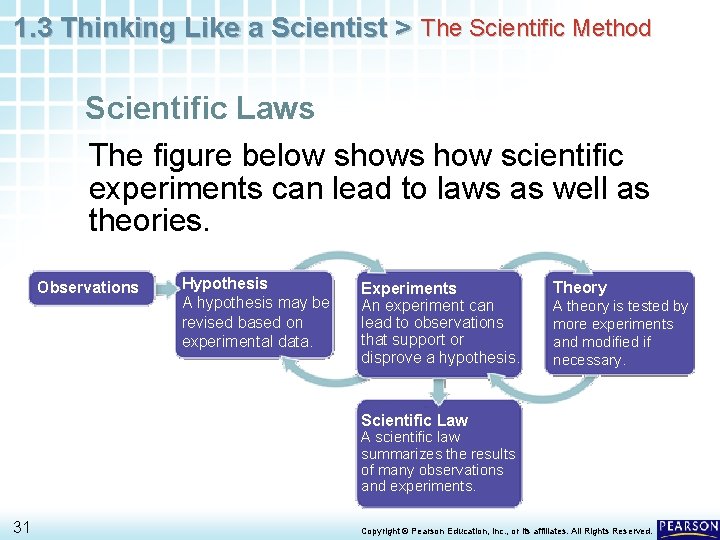
1. 3 Thinking Like a Scientist > The Scientific Method Scientific Laws The figure below shows how scientific experiments can lead to laws as well as theories. Observations Hypothesis A hypothesis may be revised based on experimental data. Experiments An experiment can lead to observations that support or disprove a hypothesis. Theory A theory is tested by more experiments and modified if necessary. Scientific Law A scientific law summarizes the results of many observations and experiments. 31 Copyright © Pearson Education, Inc. , or its affiliates. All Rights Reserved.
1. 3 Thinking Like a Scientist > Parts of the scientific method observation – which generates a question. Flashlight doesn’t turn on Question – what is wrong with the flashlight? Infer-(prediction) that batteries, lightbulb not working Hypothesis – (written as an “If … “then” …. . statement) “If the batteries are replaced with new ones, then the flashlight will work. ” Experiment – test of the hypothesis – replace the batteries in the flashlight and see if it works. Independent variable (manipulated variable) – different batteries Dependent variable (responding variable) - light working or not 32
1. 3 Thinking Like a Scientist > What is a hypothesis? A. information obtained from an experiment B. a proposed explanation for observations C. a concise statement that summarizes the results of many experiments D. a thoroughly tested model 33 Copyright © Pearson Education, Inc. , or its affiliates. All Rights Reserved.
1. 3 Thinking Like a Scientist > What is a hypothesis? A. information obtained from an experiment B. a proposed explanation for observations C. a concise statement that summarizes the results of many experiments D. a thoroughly tested model 34 Copyright © Pearson Education, Inc. , or its affiliates. All Rights Reserved.
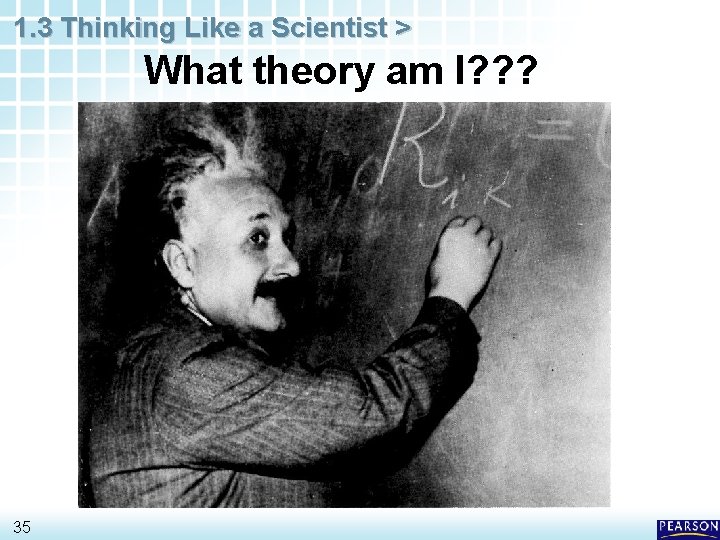
1. 3 Thinking Like a Scientist > What theory am I? ? ? 35
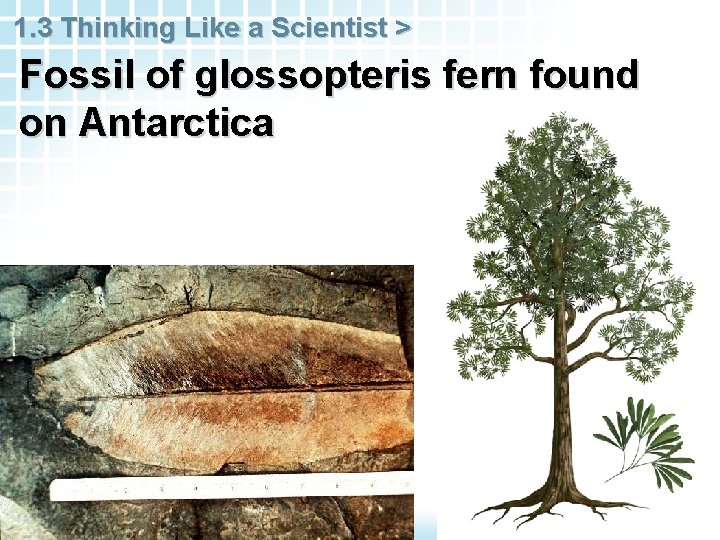
1. 3 Thinking Like a Scientist > Fossil of glossopteris fern found on Antarctica 36
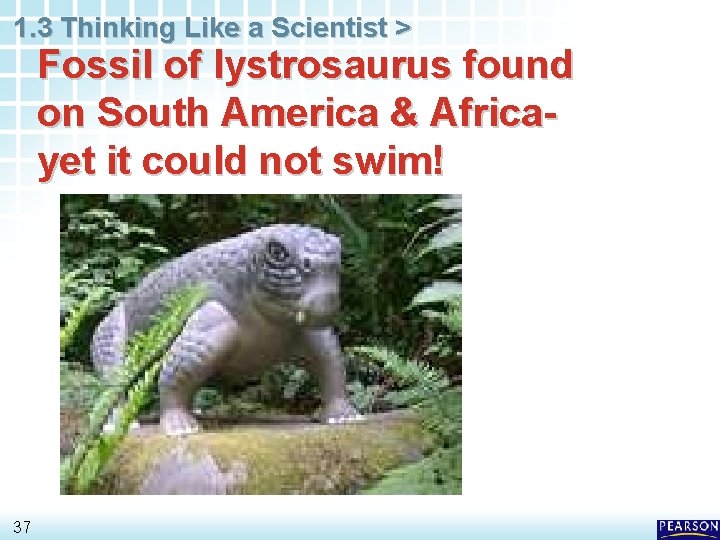
1. 3 Thinking Like a Scientist > Fossil of lystrosaurus found on South America & Africayet it could not swim! 37
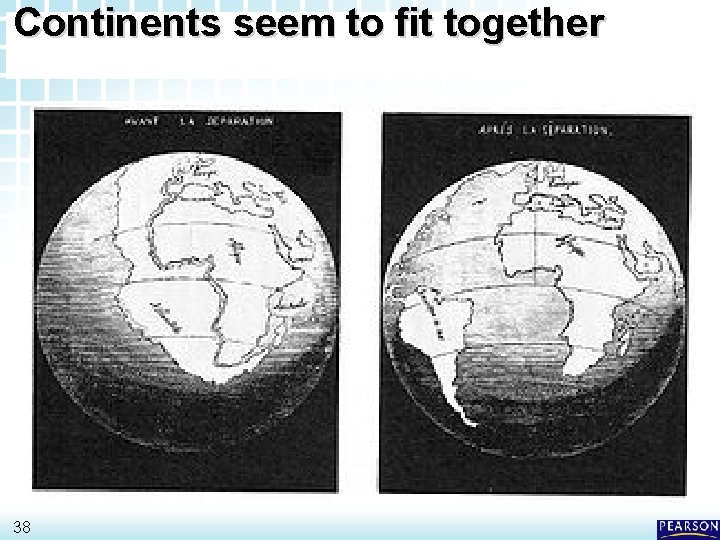
Continents to fit 1. 3 Thinking Likeseem a Scientist > 38 together
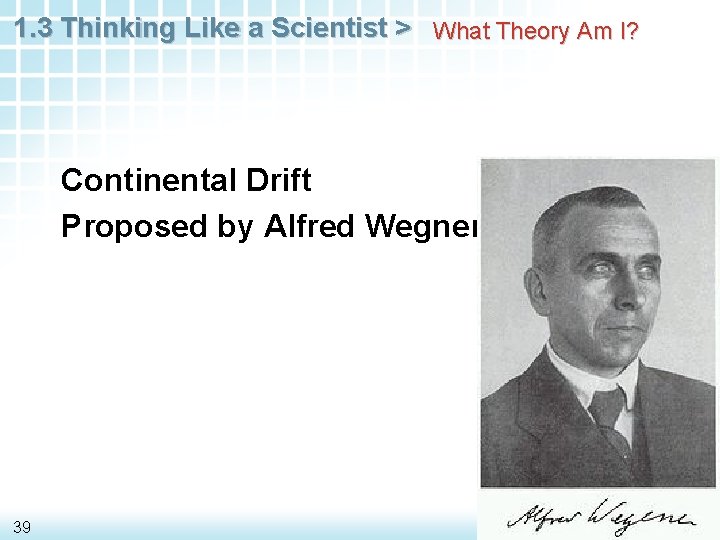
1. 3 Thinking Like a Scientist > What Theory Am I? Continental Drift Proposed by Alfred Wegner 39
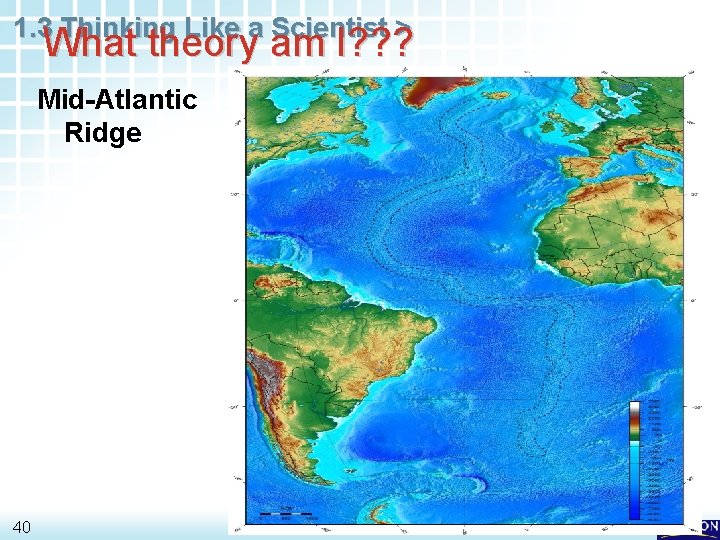
1. 3 Thinking Like a Scientist > What theory am I? ? ? Mid-Atlantic Ridge 40
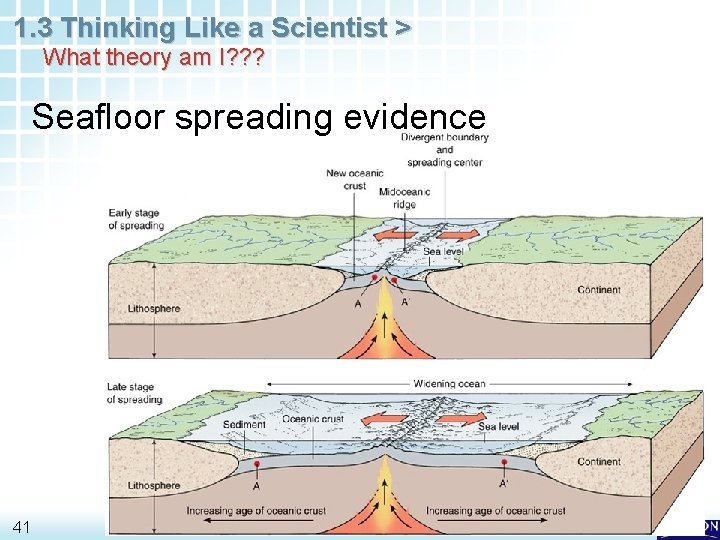
1. 3 Thinking Like a Scientist > What theory am I? ? ? Seafloor spreading evidence 41
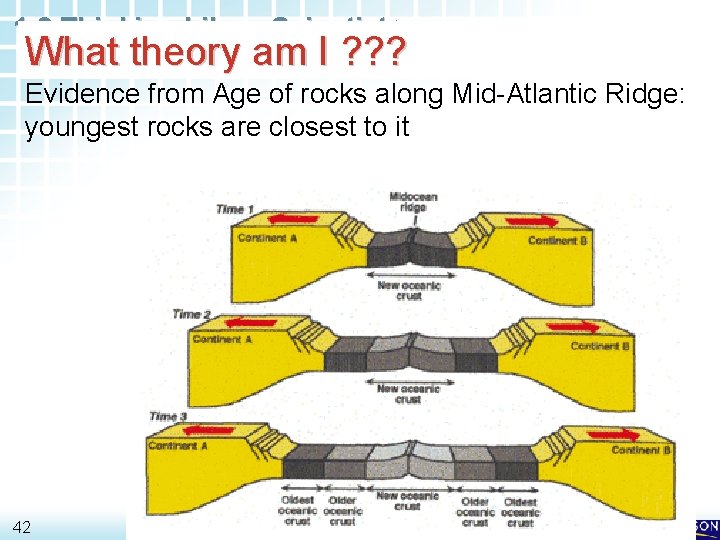
1. 3 Thinking Like a Scientist > What theory am I ? ? ? Evidence from Age of rocks along Mid-Atlantic Ridge: youngest rocks are closest to it 42
1. 3 Thinking Like a Scientist > Put all the clues together fossil evidence Fit of continents Mid-Atlantic Ridge Seafloor spreading Age of rocks along Mid-Atlantic Ridge Magnetic reversals What Theory Am I? 43
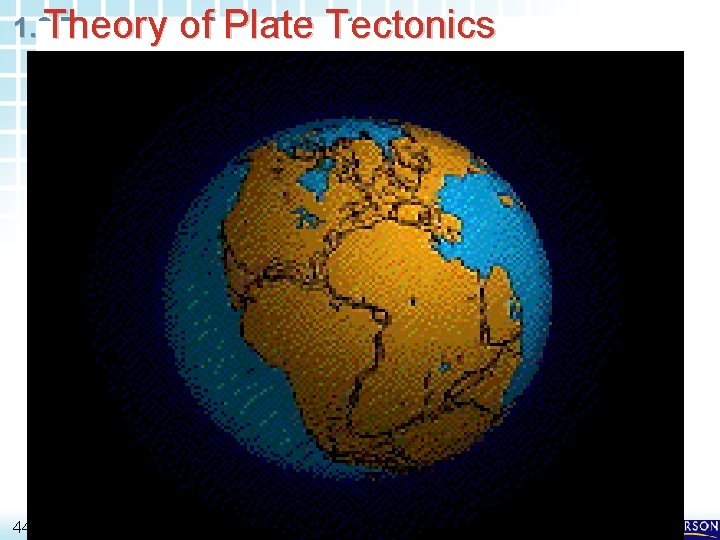
1. 3 Theory of Plate Tectonics Thinking Like a Scientist > 44
1. 3 Thinking Like a Scientist > Section 1. 4 - Steps to Problem Solving 45
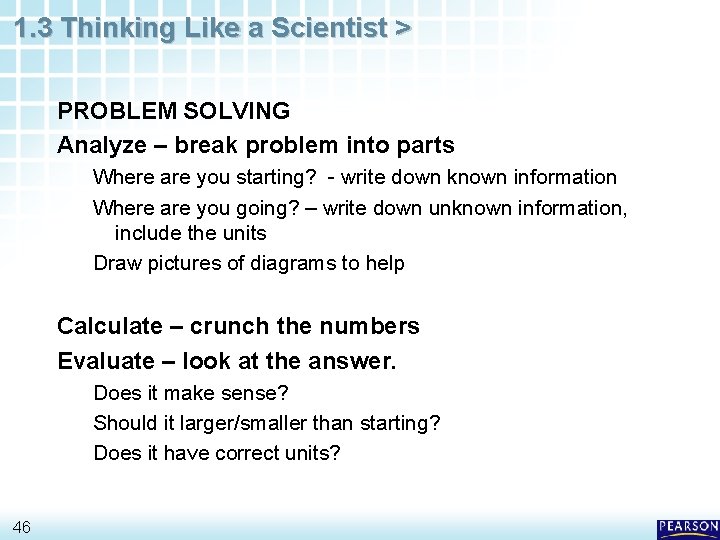
1. 3 Thinking Like a Scientist > PROBLEM SOLVING Analyze – break problem into parts Where are you starting? - write down known information Where are you going? – write down unknown information, include the units Draw pictures of diagrams to help Calculate – crunch the numbers Evaluate – look at the answer. Does it make sense? Should it larger/smaller than starting? Does it have correct units? 46
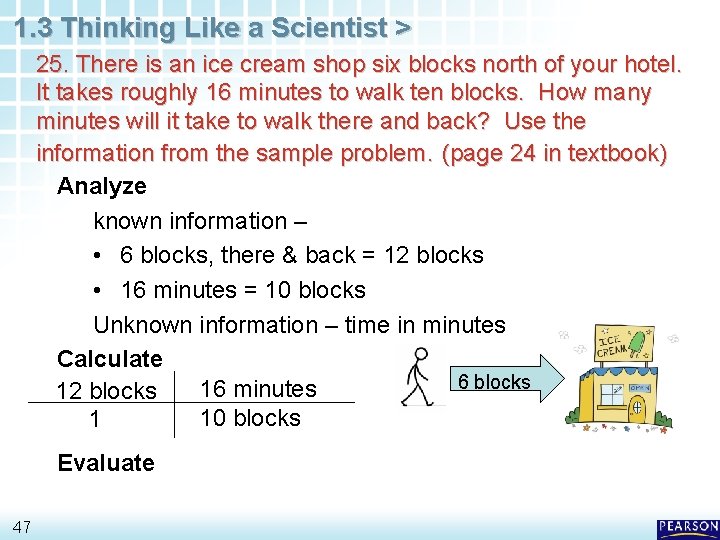
1. 3 Thinking Like a Scientist > 25. There is an ice cream shop six blocks north of your hotel. It takes roughly 16 minutes to walk ten blocks. How many minutes will it take to walk there and back? Use the information from the sample problem. (page 24 in textbook) Analyze known information – • 6 blocks, there & back = 12 blocks • 16 minutes = 10 blocks Unknown information – time in minutes Calculate 6 blocks 16 minutes 12 blocks 10 blocks 1 Evaluate 47
1. 3 Thinking Like a Scientist > END 48 Copyright © Pearson Education, Inc. , or its affiliates. All Rights Reserved.
1. 3 Thinking Like a Scientist > 49 Copyright © Pearson Education, Inc. , or its affiliates. All Rights Reserved.
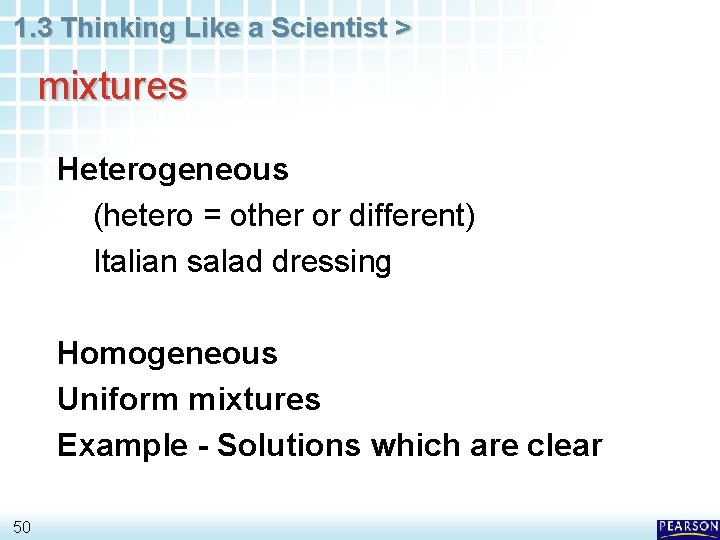
1. 3 Thinking Like a Scientist > mixtures Heterogeneous (hetero = other or different) Italian salad dressing Homogeneous Uniform mixtures Example - Solutions which are clear 50
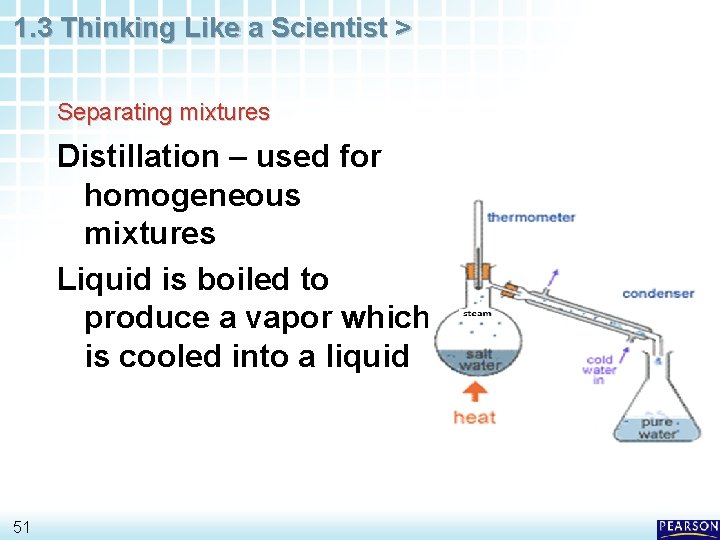
1. 3 Thinking Like a Scientist > Separating mixtures Distillation – used for homogeneous mixtures Liquid is boiled to produce a vapor which is cooled into a liquid 51
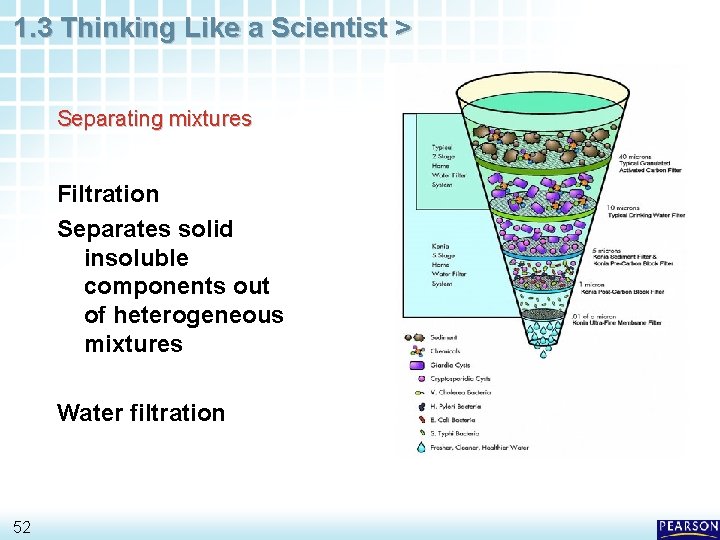
1. 3 Thinking Like a Scientist > Separating mixtures Filtration Separates solid insoluble components out of heterogeneous mixtures Water filtration 52
1. 3 Thinking Like a Scientist > Elements Found on periodic table- 92 in nature Simplest form of matter that has a unique set of properties Can’t be broken down – no longer have elements What information about elements is provided on your periodic table? 53
1. 3 Thinking Like a Scientist > compounds Made from elements that are chemically combined or chemically bonded together Can you name these compounds? CO 2 – H 2 O - CO – Compounds can be broken down by chemical changes (chemical reactions) 54
1. 3 Thinking Like a Scientist > Clues to Chemical reactions (chemical changes) Reactants Products (ARROW POINTS TO PRODUCTS) What are the clues to these chemical reactions? Light match Acid & seashells Litmus paper KI & Pb. NO 3 How do the pictures in Figure 2. 15 indicate chemical changes have occurred? 55
1. 3 Thinking Like a Scientist > Law of Conservation of Mass The law of conservation of mass states that the mass of the reactants before a chemical reaction will be equal to the mass of the products after a chemical reaction. Draw a picture to show the Law of Conservation of Mass How did the seashell and acid reaction show this? 56