
1 2 Basics of Railway Horizontal Curves including
1. 2 Basics of Railway Horizontal Curves including working out speed potential of curves. Periods 5
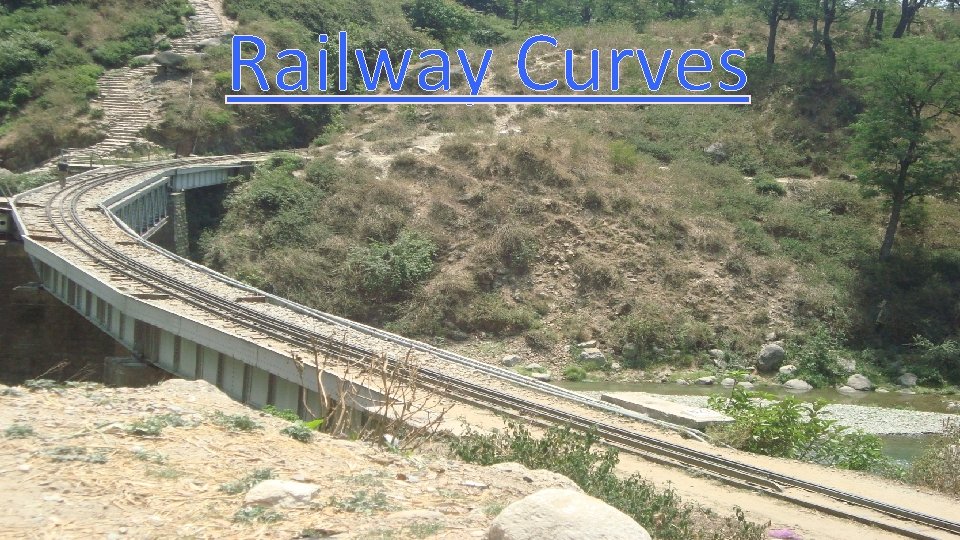
Railway Curves
What is a Curve ? § a line, which is not straight; and § changes direction without angles (No sharp Edges); or § line, which gradually deviates from being straight
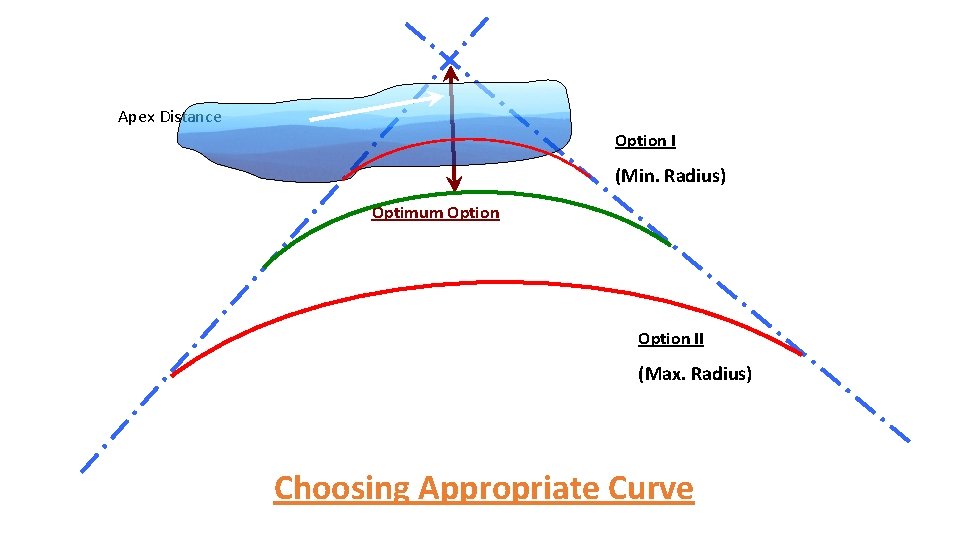
Apex Distance Option I (Min. Radius) Optimum Option II (Max. Radius) Choosing Appropriate Curve
Effects of curve: Centrifugal force • Undesirable Effects • Risk of vehicle overturning • Possible passenger discomfort • Possible displacement of loads • Risk of derailment • Higher Lateral forces on track structure • Higher lateral forces resulting in maintenance problems • Wear of rail & wheel flange

Design Parameters of Curves • Radius, R and Degree of Curve, D • Actual Cant (Super-elevation), Ca • Equilibrium Cant, Ce / Equilibrium Speed, Ve • Cant Deficiency, Cd • Cant Excess, Cex • Rate of Change of Actual Cant, RCa • Rate of Change of Cant Deficiency, RCd • Cant Gradient, i • Length of Transition, L
Curve Designation • On IR: degree of curve for designation • Radii For Calculation
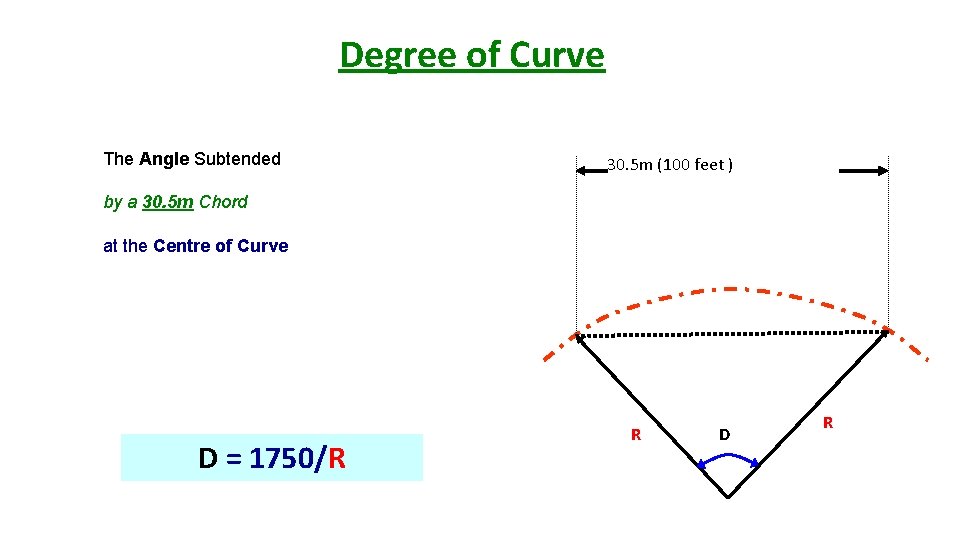
Degree of Curve The Angle Subtended 30. 5 m (100 feet ) by a 30. 5 m Chord at the Centre of Curve D = 1750/R R D R
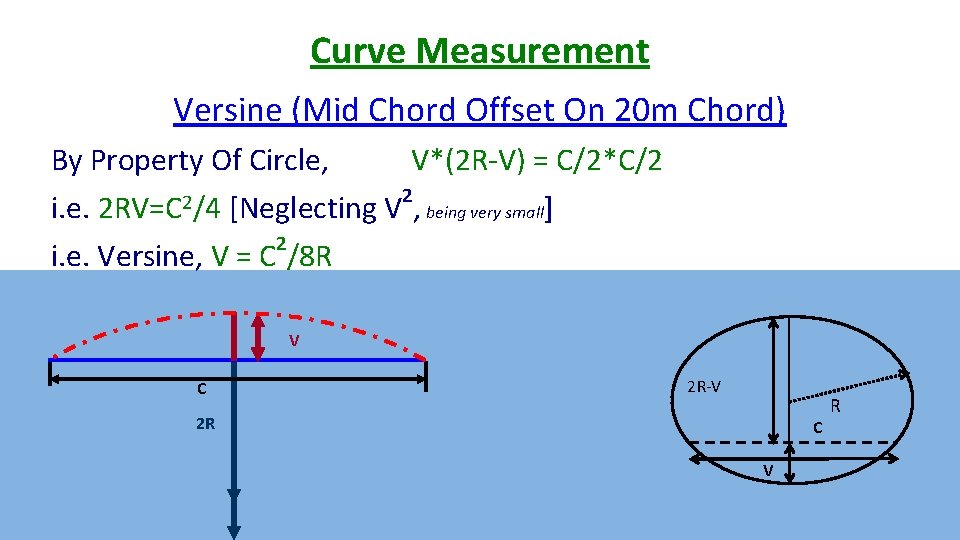
Curve Measurement Versine (Mid Chord Offset On 20 m Chord) By Property Of Circle, V*(2 R-V) = C/2*C/2 2 2 RV=C 2/4 i. e. [Neglecting V , being very small] 2 i. e. Versine, V = C /8 R V C 2 R-V 2 R C V R
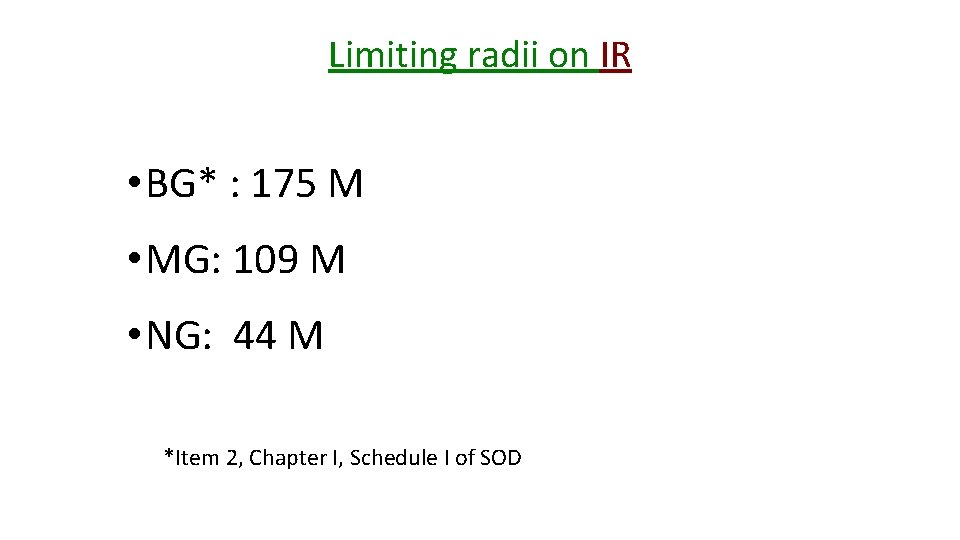
Limiting radii on IR • BG* : 175 M • MG: 109 M • NG: 44 M *Item 2, Chapter I, Schedule I of SOD

Super-elevation/Cant

Super-elevation/Cant • Raising of the outer rail (w. r. t. Inner Rail) to counter the effect of Centrifugal Force (elimination/reduction) is known as Super-elevation/ Cant

Equilibrium Cant/Speed • When on circular motion • If the resultant of Weight & Centrifugal Force is perpendicular to the plane of rail & passes through the centre of track i. e load on both the rails is equal The corresponding speed is known as Equilibrium Speed; and cant is known as Equilibrium Cant

Equilibrium Cant Weight Component = W*sinθ (Along plane joining rail heads) Centrifugal Force Comp. = M*(V 2/R) i. e. W*sinθ = M*(V 2/R) i. e. M*g*SE/G = M*V 2/R i. e. Equilibrium Cant, SE=G*V 2/(g*R) SE=G*V 2/(127*R) Para 406(a) of IRPWM
Considerations of Mixed Traffic • For what speed should the cant be provided ? • Maximum speed ? • Minimum Speed ? • Average Speed?
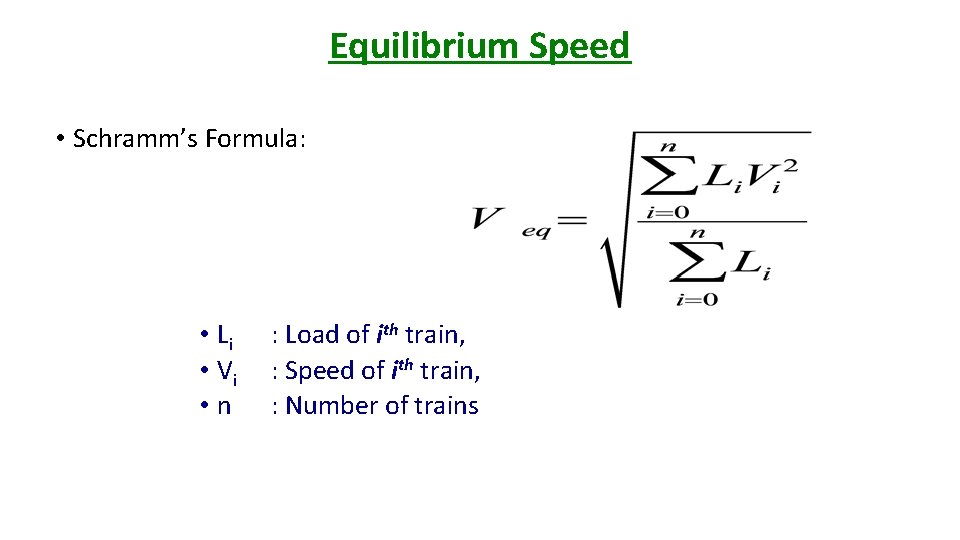
Equilibrium Speed • Schramm’s Formula: • Li • Vi • n : Load of ith train, : Speed of ith train, : Number of trains

Equilibrium Speed • Russian Formula: • • ni Wi Vi m : No of trains of type i, : Weight of such train, : Speed of such train, : Total types of trains
Equilibrium Speed • IRPWM Stipulations (Para 406(b)) Equilibrium speed is to be decided by CE considering • Max. Speeds of fast & slow moving trains (actually attainable) • Proximity to Permanent speed restriction • Junctions • Stopping places • Gradient affecting speed of goods train
Limitations on Maximum value of Actual Cant Ca • Comfort criteria • Maximum discomfort when stopped at Canted Track • No appreciable discomfort upto 180 mm • Limited to 1/8 to 1/10 of Track Gauge
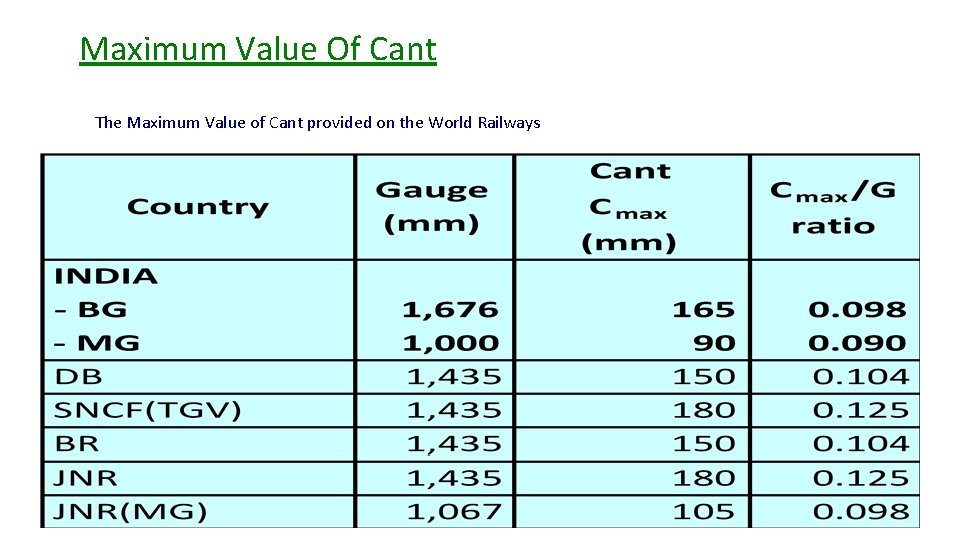
Maximum Value Of Cant The Maximum Value of Cant provided on the World Railways

IRPWM Provisions • Maximum Cant (Para 406(1)(d)(i)) • 165 mm for group A, B and C routes • 185 MM for locating permanent structures on group A routes with speed increase potential (new works and doubling) • 140 mm for group D and E routes
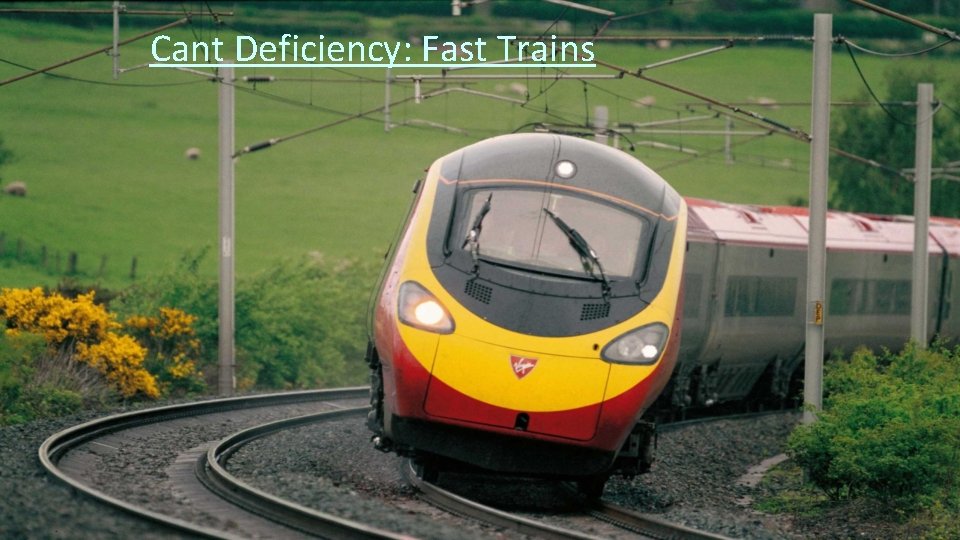
Cant Deficiency: Fast Trains
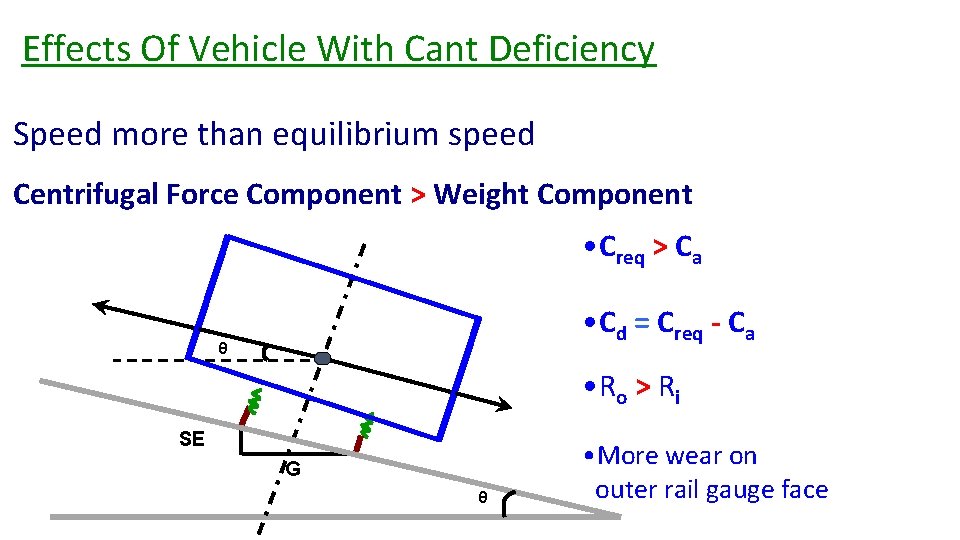
Effects Of Vehicle With Cant Deficiency Speed more than equilibrium speed Centrifugal Force Component > Weight Component • Creq > Ca • Cd = Creq - Ca θ • R o > R i SE G θ • More wear on outer rail gauge face
Criteria for Cant Deficiency Cd • Safety (overturning about the outer Rail) • Larger values can not be permitted – not governing criteria • Comfort criteria* • Discomfort, if Unbalanced Lateral Acceleration is greater than 0. 1 g • UIC recommends 0. 4 m/s 2 to 0. 7 m/s 2 (1. 0 m/s 2 to 1. 5 m/s 2 for fast passenger trains UIC 703 -R) SNCF/TGV adopted 0. 56 m/s 2 (trials 0. 7 • • m/s 2 )

Maximum Value of Cant Deficiency

IRPWM Provisions • Max. Cant Deficiency (Para 406(2)) • On routes • with track maintained to C&M, Vol-I standard; • For Nominated Rolling Stock; • With Permission of PCE : 100 mm • For Other cases : 75 mm

Cant Excess: Slow Trains
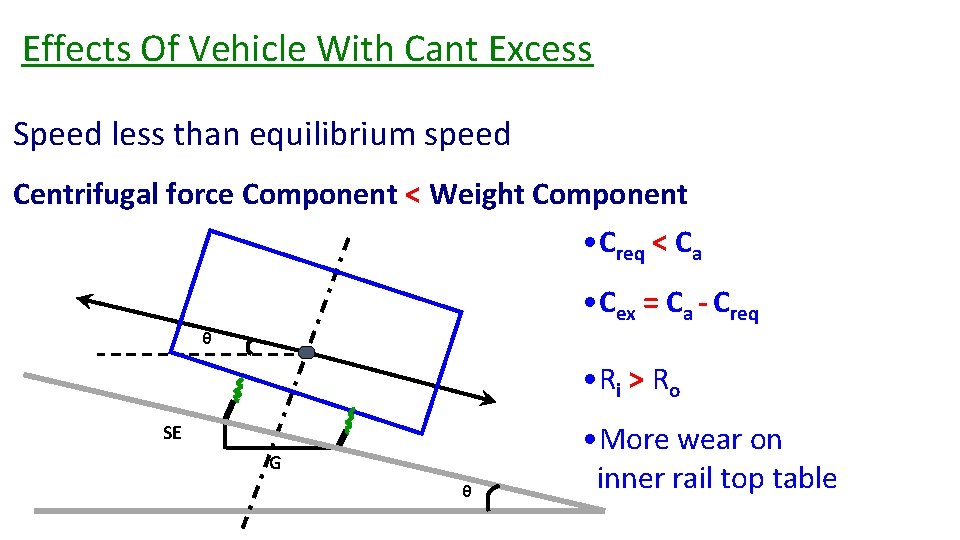
Effects Of Vehicle With Cant Excess Speed less than equilibrium speed Centrifugal force Component < Weight Component • Creq < Ca • Cex = Ca - Creq θ • R i > R o SE G θ • More wear on inner rail top table
IRPWM Provisions • Max. Cant Excess - 75 mm (Para 406(3)) • Sections carrying predominantly goods traffic shall have less cant excess to reduce wear on inner rail • Worked out for booked speed of goods trains.
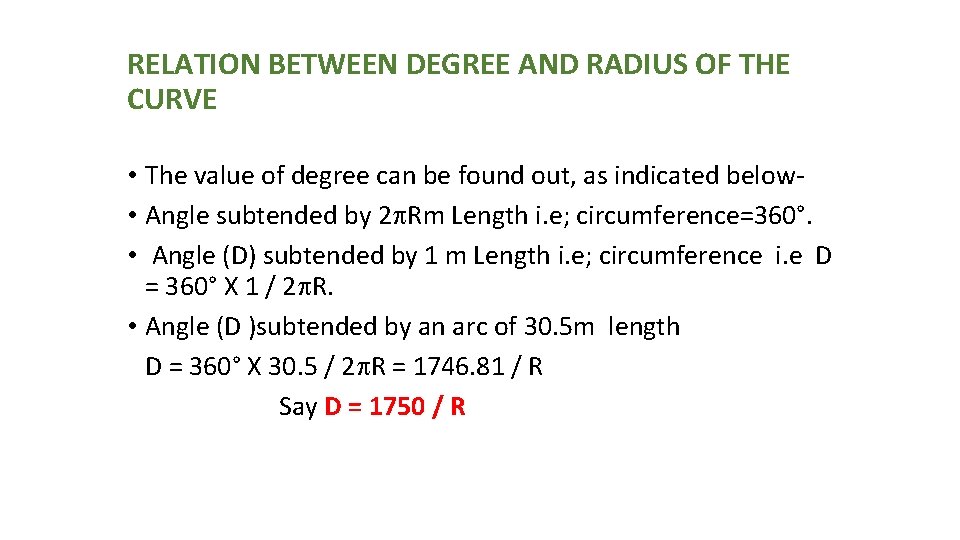
RELATION BETWEEN DEGREE AND RADIUS OF THE CURVE • The value of degree can be found out, as indicated below • Angle subtended by 2 Rm Length i. e; circumference=360°. • Angle (D) subtended by 1 m Length i. e; circumference i. e D = 360° X 1 / 2 R. • Angle (D )subtended by an arc of 30. 5 m length D = 360° X 30. 5 / 2 R = 1746. 81 / R Say D = 1750 / R
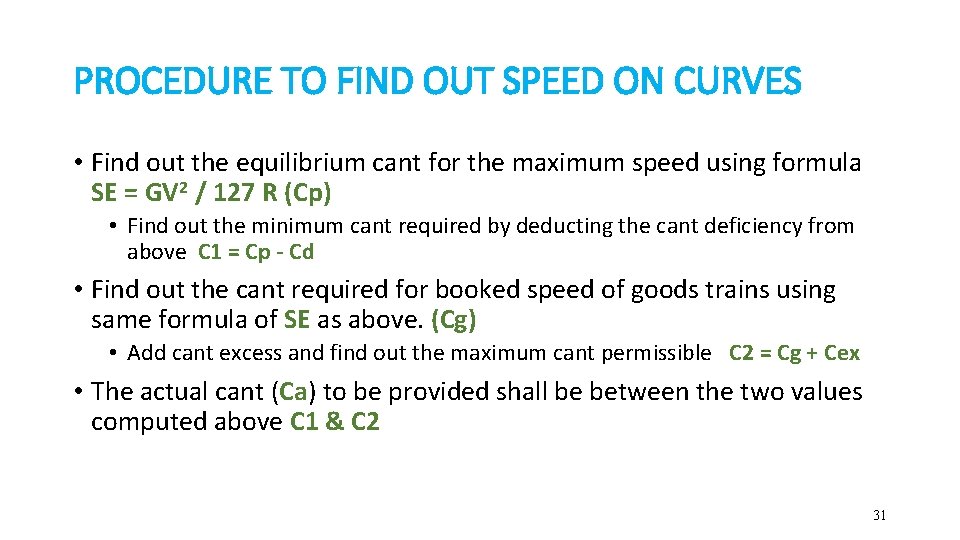
PROCEDURE TO FIND OUT SPEED ON CURVES • Find out the equilibrium cant for the maximum speed using formula SE = GV 2 / 127 R (Cp) • Find out the minimum cant required by deducting the cant deficiency from above C 1 = Cp - Cd • Find out the cant required for booked speed of goods trains using same formula of SE as above. (Cg) • Add cant excess and find out the maximum cant permissible C 2 = Cg + Cex • The actual cant (Ca) to be provided shall be between the two values computed above C 1 & C 2 31
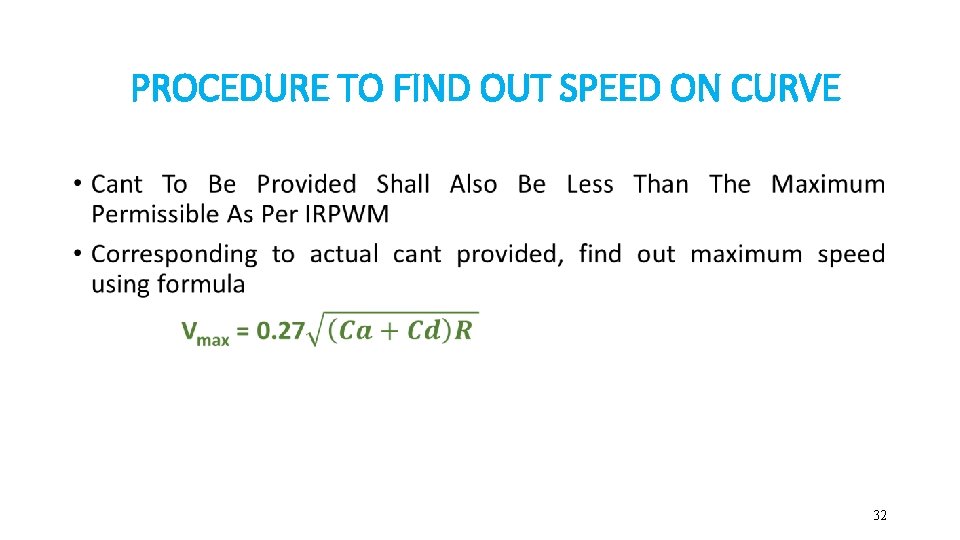
PROCEDURE TO FIND OUT SPEED ON CURVE • 32
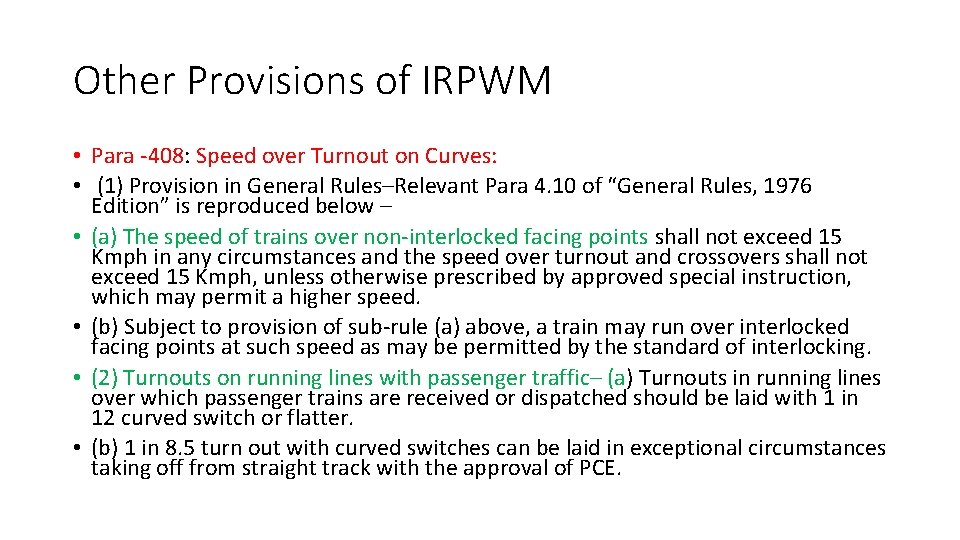
Other Provisions of IRPWM • Para -408: Speed over Turnout on Curves: • (1) Provision in General Rules–Relevant Para 4. 10 of “General Rules, 1976 Edition” is reproduced below – • (a) The speed of trains over non-interlocked facing points shall not exceed 15 Kmph in any circumstances and the speed over turnout and crossovers shall not exceed 15 Kmph, unless otherwise prescribed by approved special instruction, which may permit a higher speed. • (b) Subject to provision of sub-rule (a) above, a train may run over interlocked facing points at such speed as may be permitted by the standard of interlocking. • (2) Turnouts on running lines with passenger traffic– (a) Turnouts in running lines over which passenger trains are received or dispatched should be laid with 1 in 12 curved switch or flatter. • (b) 1 in 8. 5 turn out with curved switches can be laid in exceptional circumstances taking off from straight track with the approval of PCE.
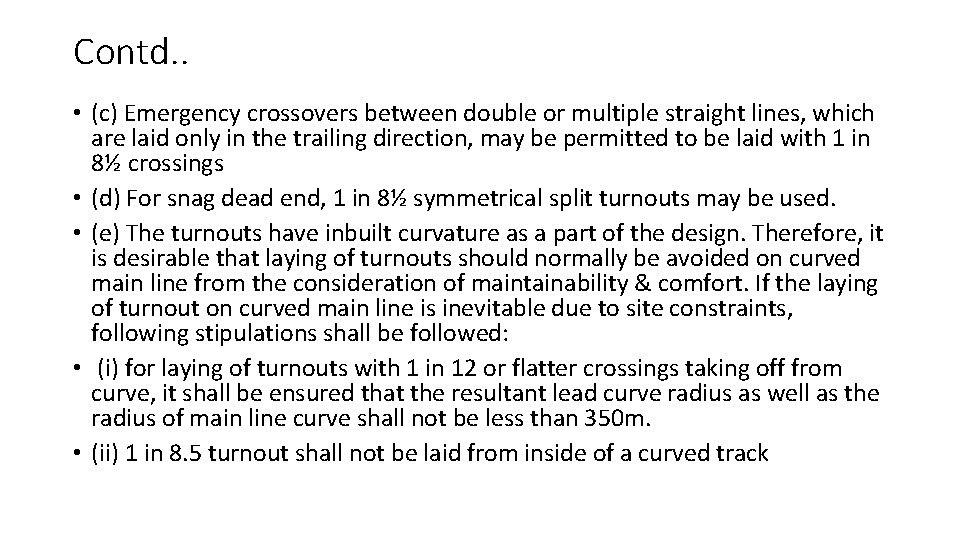
Contd. . • (c) Emergency crossovers between double or multiple straight lines, which are laid only in the trailing direction, may be permitted to be laid with 1 in 8½ crossings • (d) For snag dead end, 1 in 8½ symmetrical split turnouts may be used. • (e) The turnouts have inbuilt curvature as a part of the design. Therefore, it is desirable that laying of turnouts should normally be avoided on curved main line from the consideration of maintainability & comfort. If the laying of turnout on curved main line is inevitable due to site constraints, following stipulations shall be followed: • (i) for laying of turnouts with 1 in 12 or flatter crossings taking off from curve, it shall be ensured that the resultant lead curve radius as well as the radius of main line curve shall not be less than 350 m. • (ii) 1 in 8. 5 turnout shall not be laid from inside of a curved track
Contd… • (iii) 1 in 8½ turnout with curved switches may be laid from outside of a curve up to five degree in exceptional circumstances with the approval of PCE, where due to limitation of room it is not possible to provide 1 in 12 turnout. • Note: The existing turnouts not conforming to the stipulations given in Sub. Para (e) above may continue. However, efforts shall be made to eliminate such layouts in a planned manner. • (f) Radius of turn-in-curve should generally be not less than 350 metre however, where it is not practicable to achieve the radius of curvature of turn-in curves as 350 m on account of existing track centres for the turnout taking off from curves, the turn-in curves may be allowed upto a minimum radius of 220 m subject to the Page 158 of 416 following– • (i) such turn-in curves are provided on PSC sleepers only, with sleeper spacing same as that for the main line. • (ii) full ballast profile, same as that for the main line, is provided.

Contd. . • (3) Speed over interlocked turnouts– (a) Speed in excess of 15 Kmph may be permitted for straights of interlocked turnouts only under approved special instructions in terms of Para 4. 10 of “General Rules, 1976 Edition”. • (b) In the case of 1 in 8½, 1 in 12 and flatter turnouts provided with curved switches, higher speeds as permitted under approved special instructions may be allowed on the turn- out side, provided the turn-in curve is of a standard suitable for such higher speeds. While permitting speed beyond 15 Kmph, provisions of Para 408 (4) below may be kept in view. • (c) The permissible speed on turnouts taking off on the inside of the curve should be determined by taking into consideration the resultant radius of lead curve which will be sharper than the lead curve for turn-outs taking off from the straightin Para 403(1).
(4) Up-gradation of speeds on Turnouts and Loops to 30 Kmph • (a) Length of Section– Up-gradation of speeds on turnout should cover a number of contiguous stations at a time so as to derive a perceptible advantage of the higher speed in train operation. The works described below should cover all the running loops on the stretch of line taken up. • (i) Turnouts– Speed, in excess of 15 Kmph, should be permitted on turnouts laid on PSC sleepers only. All turnouts on the running loops shall be laid with curved switches, with minimum rail section being 52 kg/m. All rail joints on these turnouts should also be welded to the extent possible. For different type of curved switches permissible speed are as under– Sl. No. Type of Turnout Permissible speed 1. 1 in 8½ curved switch 15 Kmph 2. 1 in 8½ symmetrical split with curved switches 30 Kmph 3. 1 in 12 curved switch 30 Kmph Note: The permissible speed for 1 in 12 TWS is 50 Kmph

Contd. . • (ii) Track on running loops– The minimum track structure on the running loops should be 52 Kg/m rails laid as Short Welded Panels, sleeper density 1540 Nos. per km and 150 mm clean ballast cushion. Proper drainage of the area should also be ensured. • (iii) Turn-in curves–Turn-in curves should be laid with the same rail section as on the turnout with PSC sleepers with sleeper spacing being 65 cm centre to centre (maximum). Turn-in curve should conform to Para 408(2) and especially so in respect of curvature of the lead curve. Extra shoulder ballast of 150 mm should be provided on outside of the turn-in curve. The frequency of inspection of turn-in curves should be same as that for main line turnouts.
409 Permissible Speed over Curved Main Line at Turnouts: • Subject to the permissible run through speed governed by the interlocking standard, speed over the main line will be determined taking into consideration the maximum cant that can be provided on the main line and the permissible amount of cant deficiency. • (1) In the case of turnout of similar flexure, the maximum cant that can be provided, on the main line will be the sum of equilibrium cant for the turnout and permissible cant excess. • (2) In the case of turnouts of contrary flexure, the maximum cant on the main line (negative Super-elevation on turnout) will be the difference between the maximum permissible cant deficiency and cant determined for turnout from the formula given in Schedule of Dimensions as indicated in Para 411 below. • (3) In both the cases, the permissible speed on the main line will be worked out by the formula as given
410 No Change of Super-elevation over Turnouts: • There should be no change of cant between points 20 metres outside the toe of the switch and the nose of the crossing except in cases where points and crossings have to be taken off from the transitioned portion of a curve. Normally, turnouts should not be taken off the transitioned portion of a main line curve. • However, in exceptional cases, when such a course is unavoidable a specific relaxation may be given by the Chief Track Engineer of the Railway. In such cases, change of cant and/or curvature may be permitted at the rates specified in Para 405 or such lesser rates as may be prescribed.
411 Curves of Contrary Flexure: • On the main line curve from which a curve of contrary flexure takes off, the cant of the main line (which is the negative Super-elevation on the turnout), should be calculated from the of cant on the turnout may be permitted starting behind the crossing (after the last exit sleeper) and being run out at a rate not steeper than 2. 8 mm per metre and subject to the maximum cant on the main line turnout being limited to 65 mm. • The permissible speed on the main line is then determined from the allowable cantdeficiency and subject to limitations governed by the standard of interlocking and the safe speed limit.

412 Curves of Similar Flexure: • (1) Not followed by reverse curves– On a main line curve from which a curve of similar flexure takes off, not followed immediately by a reverse curve, the turnout curve shall have the same cant as the main line curve. • (2) Followed by reverse curves– A change the turnout should be laid without cant and suitable speed restriction imposed.
413 Curves with Cross Overs: • -On curves on double line connected by cross over road, the speed and the cant for both roads are governed by the inner road to which the cross over road is a curve of contrary flexure. On the outer road, it is a curve of similar flexure. • The permissible speed and the necessary cant on the inner road shall be calculated in accordance with Para 411 above. The same speed and the same cant shall be allowed on the outer road. • The outer track shall be raised so that both roads lie in the same inclined plane in order to avoid change in cross level on the cross over road. • Where this is not possible, both main line andformula given in the Schedule of Dimension and the permissible speed on the main line determined from the allowable cant deficiency and cant on the main line. The speed so determined shall be subject to limitations governed by the standard of interlocking and the sectional speed.

414 Curves with Diamond Crossing: • Normally straight diamond crossings should not be provided in curves as these produce kinks in the curve and uniform curvature cannot be obtained. • However, where provision of such diamonds cannot be avoided or in case where such diamonds already exists in the track, the approach curves of these diamonds should be laid without cant for a distance of at least 20 metres on either side of the diamond crossings. The cant should be uniformly run-out at the rate specified in Para 405 beyond 20 metres.
Contd. . • The speed restrictions on the approach curve shall be decided in each case by the Chief Track Engineer taking into consideration the curvature, cant deficiency and lack of transition; • but shall in no case be more than 65 Kmph. In the case of diamond crossings on a straight track located in the approach of a curve, a straight length of minimum 50 m between the curve and the heel of acute crossing of diamond is necessary for permitting unrestricted speed over the diamond, subject to maximum permissible speed over the curve from considerations of cant deficiency, transition length etc.
415 Extra Clearance on Curves: • On curves, additional lateral clearances, in excess of the fixed dimensions should be provided as laid down in the Schedule of Dimensions– • (1) Between adjacent tracks and • (2) Between curved track and fixed structure
Thanks
- Slides: 47