
1 2 Amerifax Origin United States during the


- Slides: 53
1
2
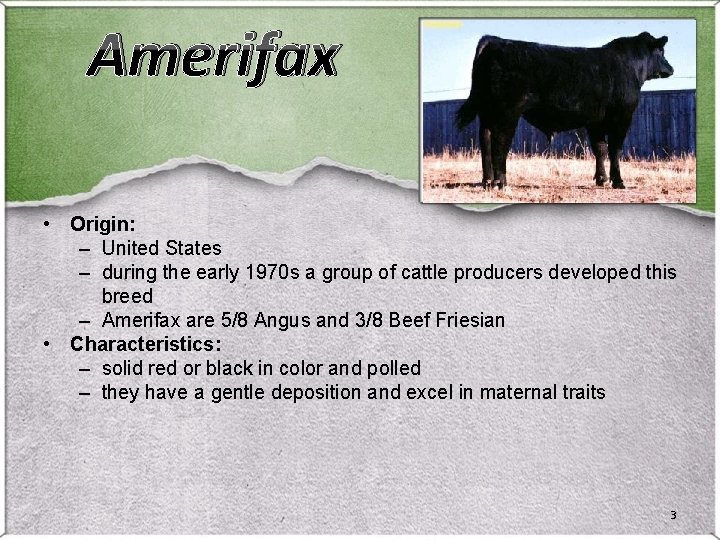
Amerifax • Origin: – United States – during the early 1970 s a group of cattle producers developed this breed – Amerifax are 5/8 Angus and 3/8 Beef Friesian • Characteristics: – solid red or black in color and polled – they have a gentle deposition and excel in maternal traits 3
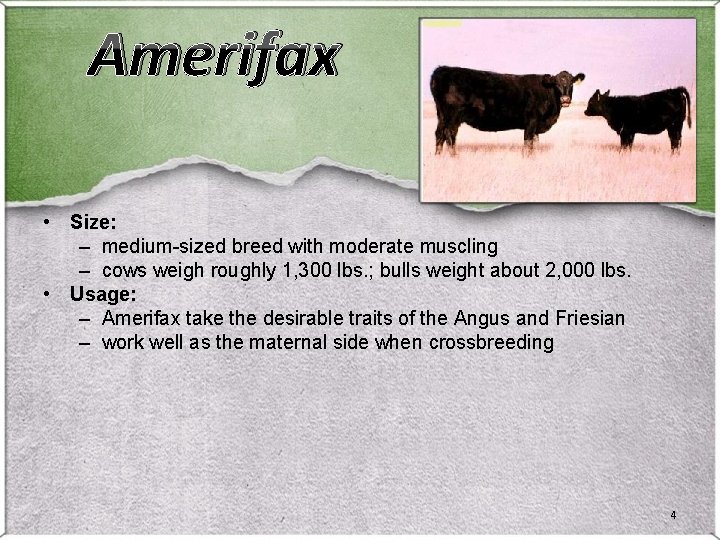
Amerifax • Size: – medium-sized breed with moderate muscling – cows weigh roughly 1, 300 lbs. ; bulls weight about 2, 000 lbs. • Usage: – Amerifax take the desirable traits of the Angus and Friesian – work well as the maternal side when crossbreeding 4
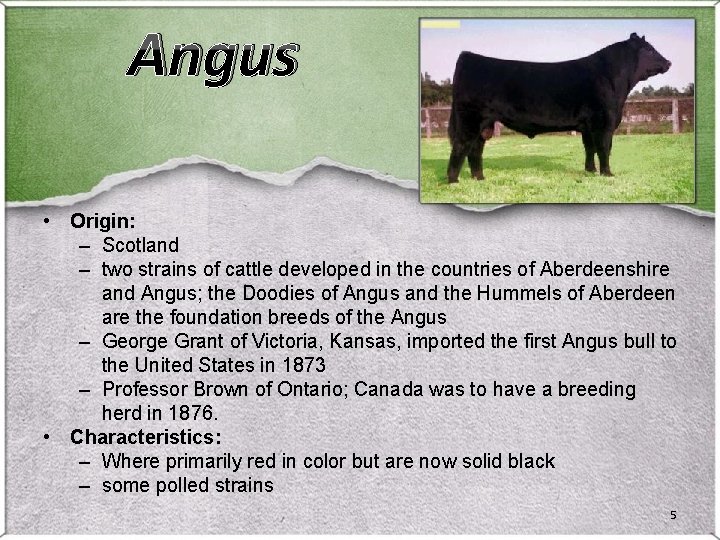
Angus • Origin: – Scotland – two strains of cattle developed in the countries of Aberdeenshire and Angus; the Doodies of Angus and the Hummels of Aberdeen are the foundation breeds of the Angus – George Grant of Victoria, Kansas, imported the first Angus bull to the United States in 1873 – Professor Brown of Ontario; Canada was to have a breeding herd in 1876. • Characteristics: – Where primarily red in color but are now solid black – some polled strains 5
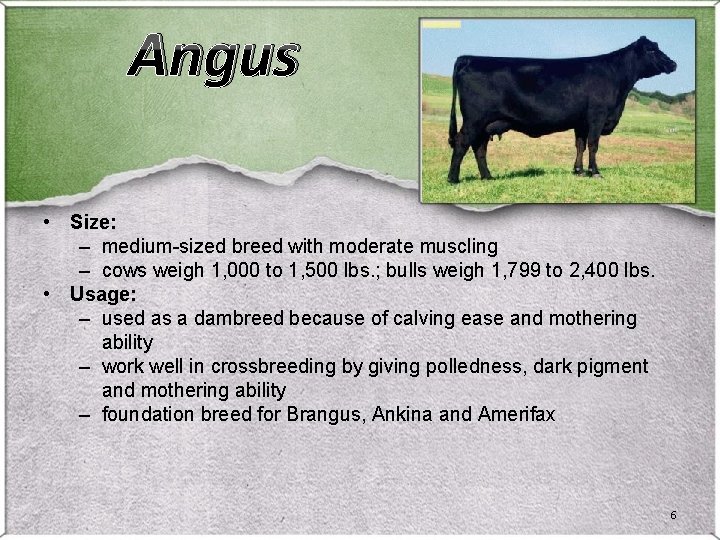
Angus • Size: – medium-sized breed with moderate muscling – cows weigh 1, 000 to 1, 500 lbs. ; bulls weigh 1, 799 to 2, 400 lbs. • Usage: – used as a dambreed because of calving ease and mothering ability – work well in crossbreeding by giving polledness, dark pigment and mothering ability – foundation breed for Brangus, Ankina and Amerifax 6
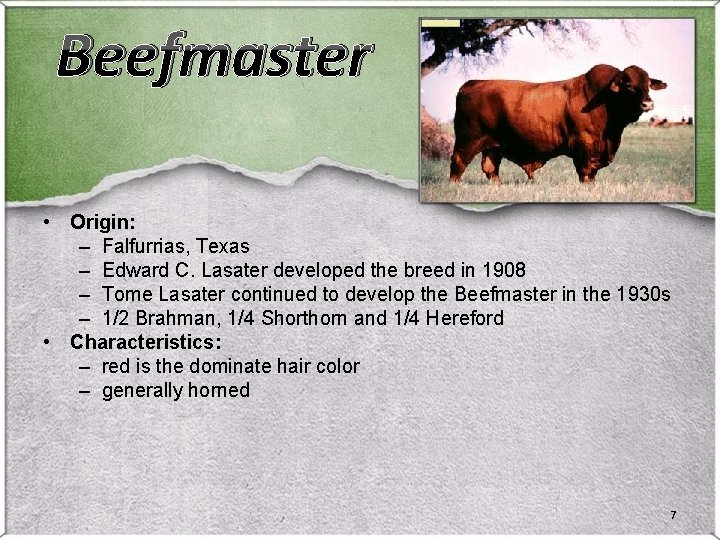
Beefmaster • Origin: – Falfurrias, Texas – Edward C. Lasater developed the breed in 1908 – Tome Lasater continued to develop the Beefmaster in the 1930 s – 1/2 Brahman, 1/4 Shorthorn and 1/4 Hereford • Characteristics: – red is the dominate hair color – generally horned 7
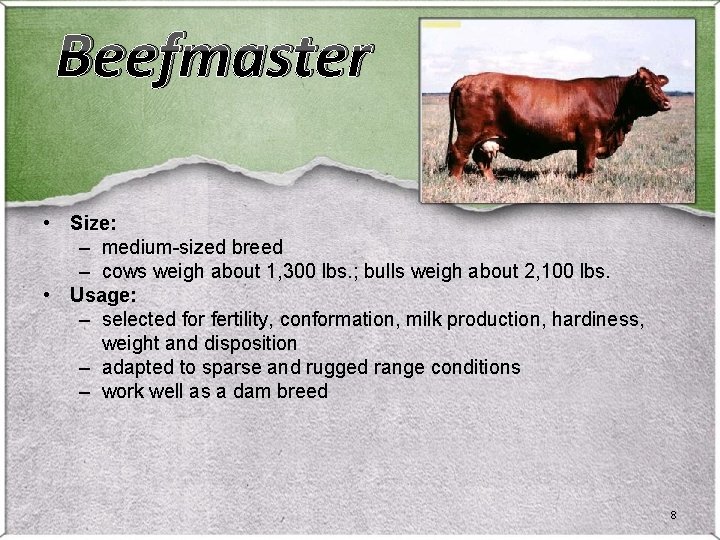
Beefmaster • Size: – medium-sized breed – cows weigh about 1, 300 lbs. ; bulls weigh about 2, 100 lbs. • Usage: – selected for fertility, conformation, milk production, hardiness, weight and disposition – adapted to sparse and rugged range conditions – work well as a dam breed 8
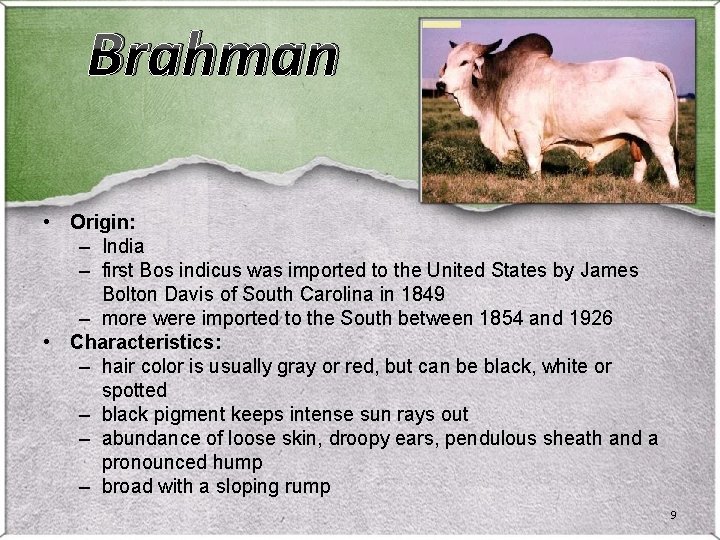
Brahman • Origin: – India – first Bos indicus was imported to the United States by James Bolton Davis of South Carolina in 1849 – more were imported to the South between 1854 and 1926 • Characteristics: – hair color is usually gray or red, but can be black, white or spotted – black pigment keeps intense sun rays out – abundance of loose skin, droopy ears, pendulous sheath and a pronounced hump – broad with a sloping rump 9
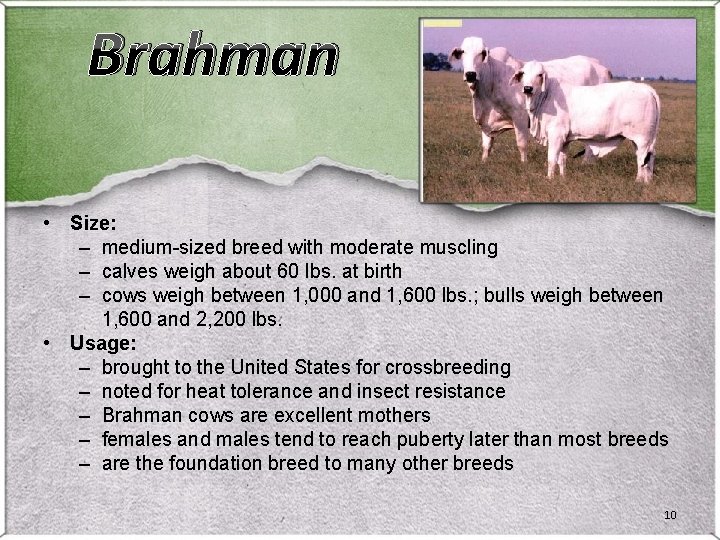
Brahman • Size: – medium-sized breed with moderate muscling – calves weigh about 60 lbs. at birth – cows weigh between 1, 000 and 1, 600 lbs. ; bulls weigh between 1, 600 and 2, 200 lbs. • Usage: – brought to the United States for crossbreeding – noted for heat tolerance and insect resistance – Brahman cows are excellent mothers – females and males tend to reach puberty later than most breeds – are the foundation breed to many other breeds 10
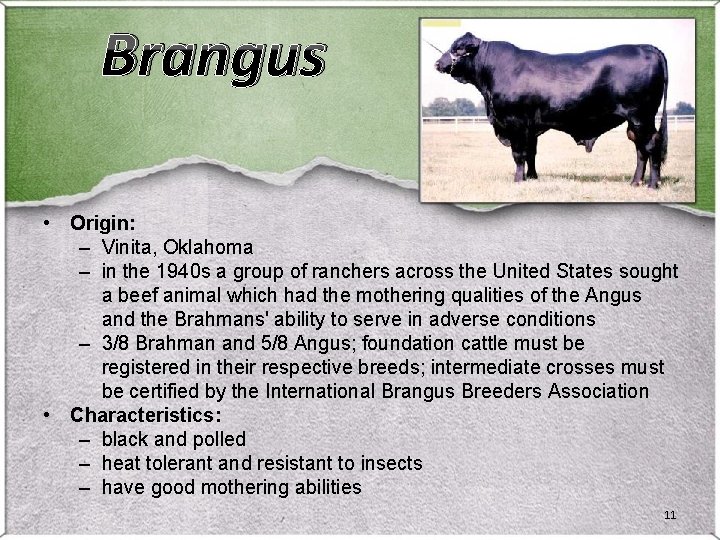
Brangus • Origin: – Vinita, Oklahoma – in the 1940 s a group of ranchers across the United States sought a beef animal which had the mothering qualities of the Angus and the Brahmans' ability to serve in adverse conditions – 3/8 Brahman and 5/8 Angus; foundation cattle must be registered in their respective breeds; intermediate crosses must be certified by the International Brangus Breeders Association • Characteristics: – black and polled – heat tolerant and resistant to insects – have good mothering abilities 11
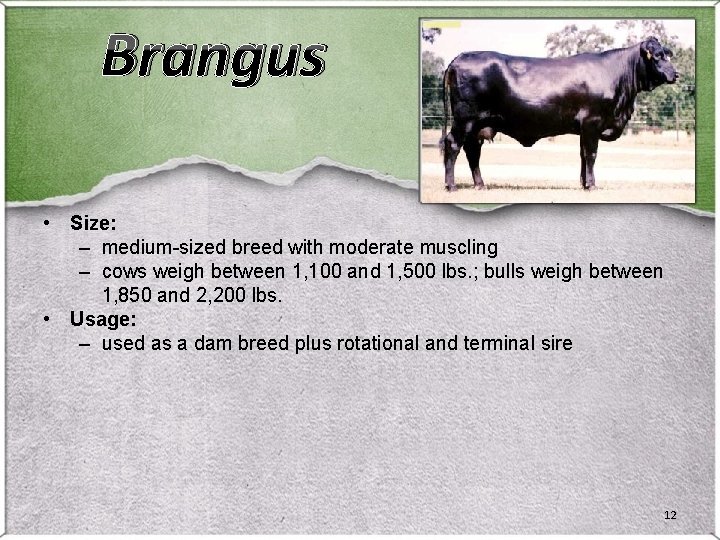
Brangus • Size: – medium-sized breed with moderate muscling – cows weigh between 1, 100 and 1, 500 lbs. ; bulls weigh between 1, 850 and 2, 200 lbs. • Usage: – used as a dam breed plus rotational and terminal sire 12
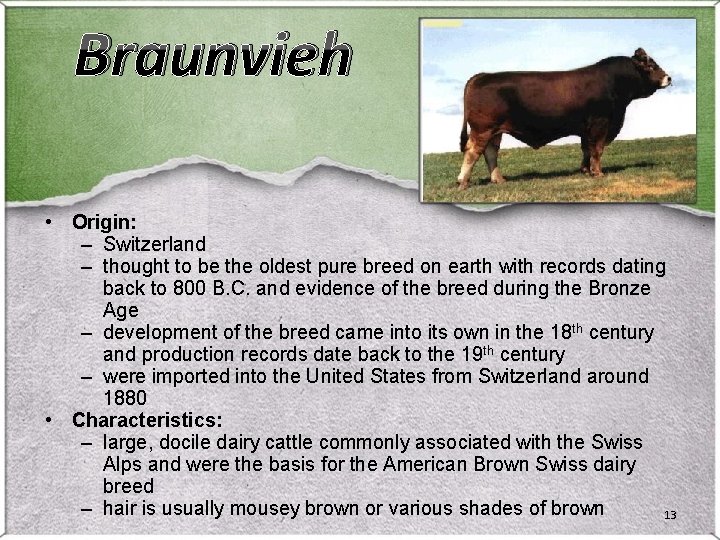
Braunvieh • Origin: – Switzerland – thought to be the oldest pure breed on earth with records dating back to 800 B. C. and evidence of the breed during the Bronze Age – development of the breed came into its own in the 18 th century and production records date back to the 19 th century – were imported into the United States from Switzerland around 1880 • Characteristics: – large, docile dairy cattle commonly associated with the Swiss Alps and were the basis for the American Brown Swiss dairy breed – hair is usually mousey brown or various shades of brown 13
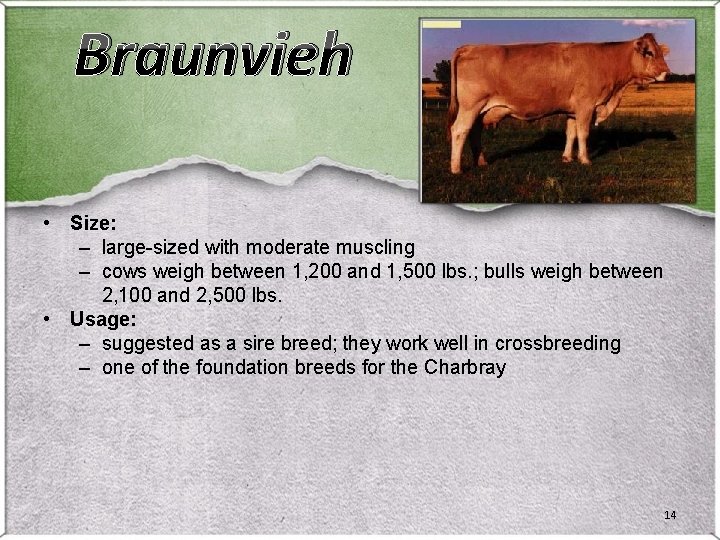
Braunvieh • Size: – large-sized with moderate muscling – cows weigh between 1, 200 and 1, 500 lbs. ; bulls weigh between 2, 100 and 2, 500 lbs. • Usage: – suggested as a sire breed; they work well in crossbreeding – one of the foundation breeds for the Charbray 14
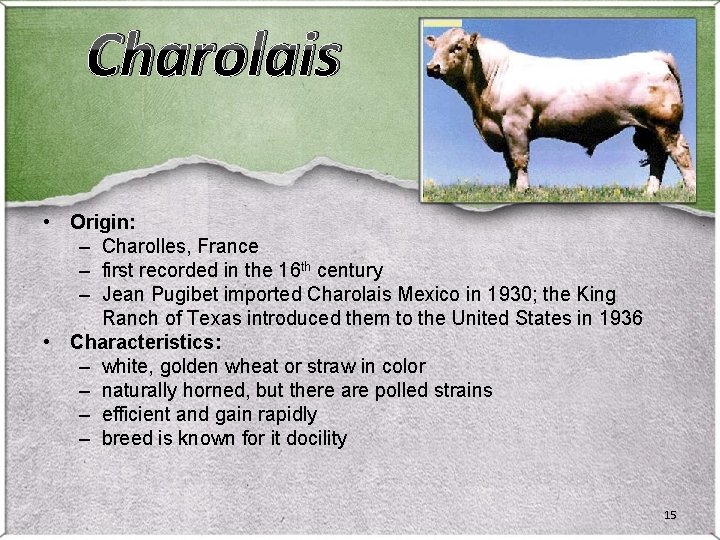
Charolais • Origin: – Charolles, France – first recorded in the 16 th century – Jean Pugibet imported Charolais Mexico in 1930; the King Ranch of Texas introduced them to the United States in 1936 • Characteristics: – white, golden wheat or straw in color – naturally horned, but there are polled strains – efficient and gain rapidly – breed is known for it docility 15
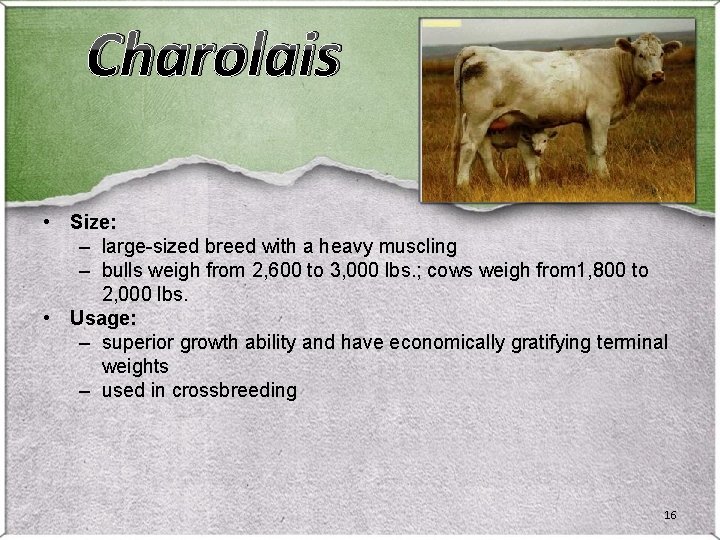
Charolais • Size: – large-sized breed with a heavy muscling – bulls weigh from 2, 600 to 3, 000 lbs. ; cows weigh from 1, 800 to 2, 000 lbs. • Usage: – superior growth ability and have economically gratifying terminal weights – used in crossbreeding 16
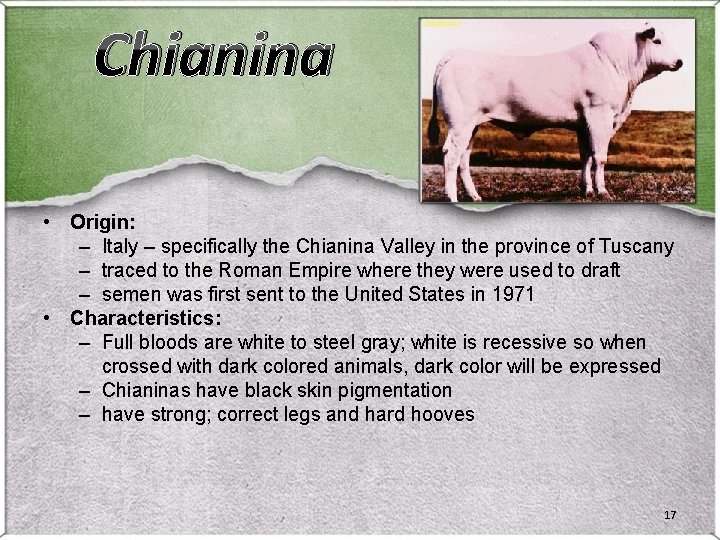
Chianina • Origin: – Italy – specifically the Chianina Valley in the province of Tuscany – traced to the Roman Empire where they were used to draft – semen was first sent to the United States in 1971 • Characteristics: – Full bloods are white to steel gray; white is recessive so when crossed with dark colored animals, dark color will be expressed – Chianinas have black skin pigmentation – have strong; correct legs and hard hooves 17
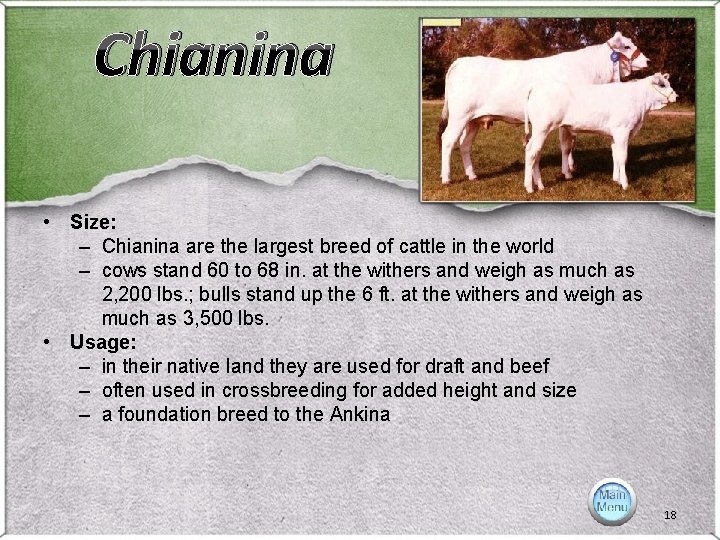
Chianina • Size: – Chianina are the largest breed of cattle in the world – cows stand 60 to 68 in. at the withers and weigh as much as 2, 200 lbs. ; bulls stand up the 6 ft. at the withers and weigh as much as 3, 500 lbs. • Usage: – in their native land they are used for draft and beef – often used in crossbreeding for added height and size – a foundation breed to the Ankina 18
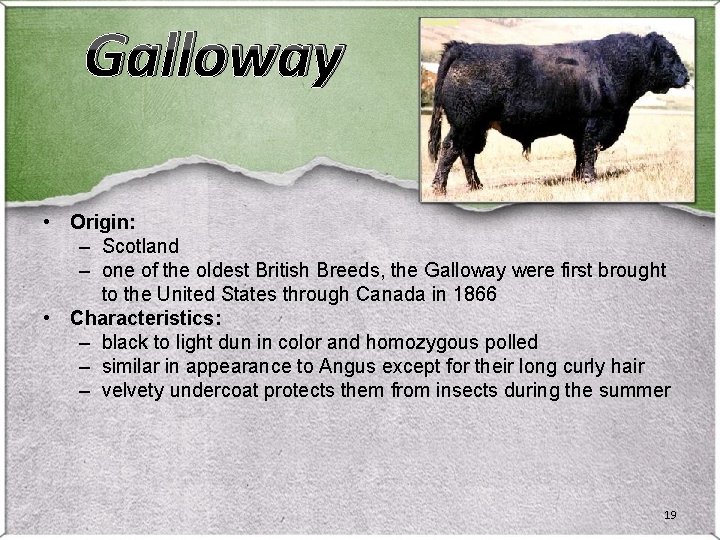
Galloway • Origin: – Scotland – one of the oldest British Breeds, the Galloway were first brought to the United States through Canada in 1866 • Characteristics: – black to light dun in color and homozygous polled – similar in appearance to Angus except for their long curly hair – velvety undercoat protects them from insects during the summer 19
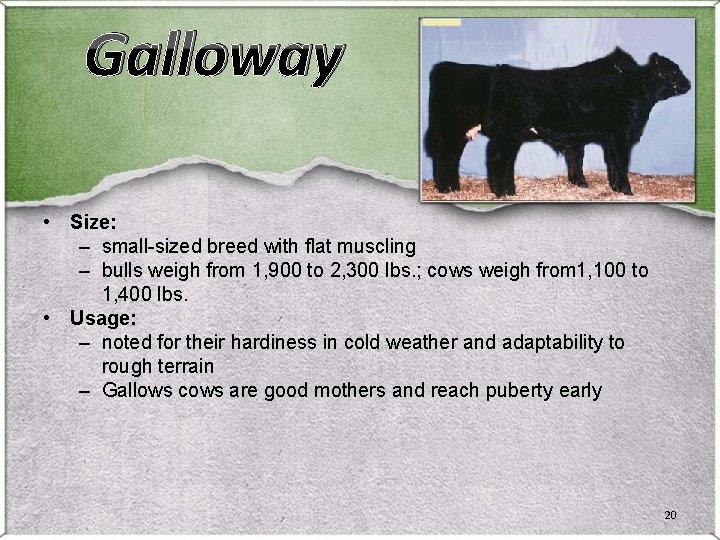
Galloway • Size: – small-sized breed with flat muscling – bulls weigh from 1, 900 to 2, 300 lbs. ; cows weigh from 1, 100 to 1, 400 lbs. • Usage: – noted for their hardiness in cold weather and adaptability to rough terrain – Gallows cows are good mothers and reach puberty early 20
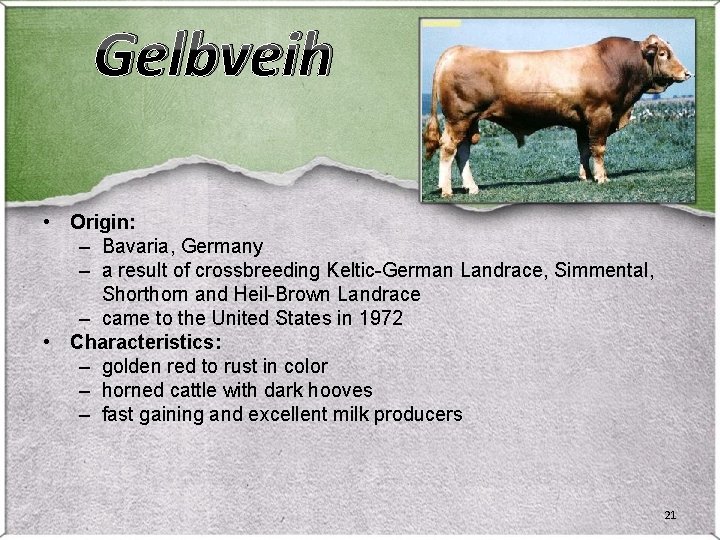
Gelbveih • Origin: – Bavaria, Germany – a result of crossbreeding Keltic-German Landrace, Simmental, Shorthorn and Heil-Brown Landrace – came to the United States in 1972 • Characteristics: – golden red to rust in color – horned cattle with dark hooves – fast gaining and excellent milk producers 21
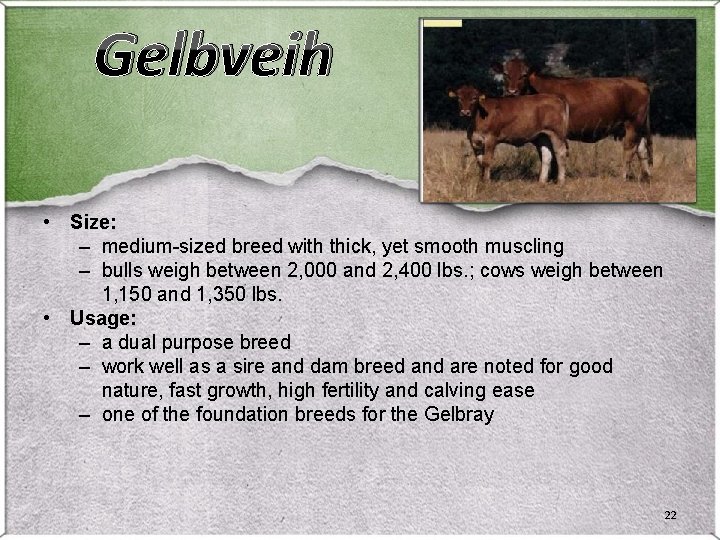
Gelbveih • Size: – medium-sized breed with thick, yet smooth muscling – bulls weigh between 2, 000 and 2, 400 lbs. ; cows weigh between 1, 150 and 1, 350 lbs. • Usage: – a dual purpose breed – work well as a sire and dam breed and are noted for good nature, fast growth, high fertility and calving ease – one of the foundation breeds for the Gelbray 22
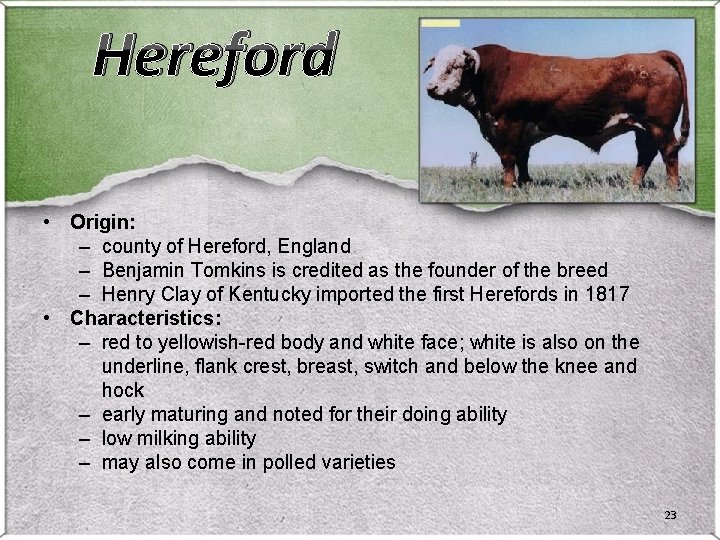
Hereford • Origin: – county of Hereford, England – Benjamin Tomkins is credited as the founder of the breed – Henry Clay of Kentucky imported the first Herefords in 1817 • Characteristics: – red to yellowish-red body and white face; white is also on the underline, flank crest, breast, switch and below the knee and hock – early maturing and noted for their doing ability – low milking ability – may also come in polled varieties 23
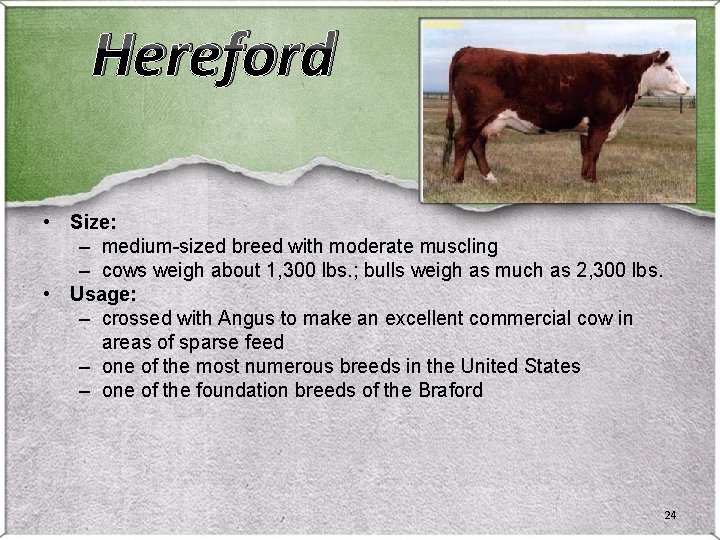
Hereford • Size: – medium-sized breed with moderate muscling – cows weigh about 1, 300 lbs. ; bulls weigh as much as 2, 300 lbs. • Usage: – crossed with Angus to make an excellent commercial cow in areas of sparse feed – one of the most numerous breeds in the United States – one of the foundation breeds of the Braford 24
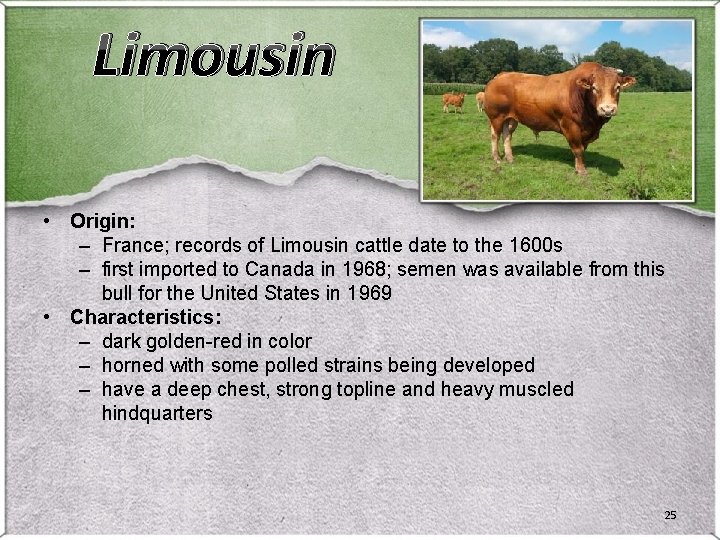
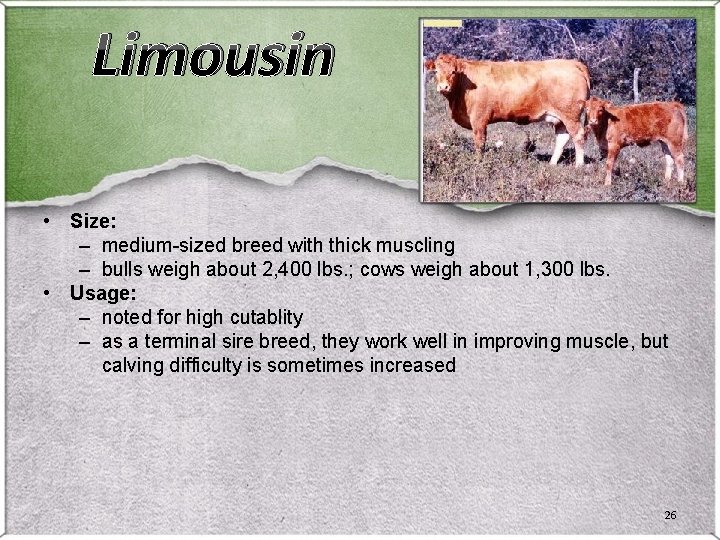
Limousin • Origin: – France; records of Limousin cattle date to the 1600 s – first imported to Canada in 1968; semen was available from this bull for the United States in 1969 • Characteristics: – dark golden-red in color – horned with some polled strains being developed – have a deep chest, strong topline and heavy muscled hindquarters 25
Limousin • Size: – medium-sized breed with thick muscling – bulls weigh about 2, 400 lbs. ; cows weigh about 1, 300 lbs. • Usage: – noted for high cutablity – as a terminal sire breed, they work well in improving muscle, but calving difficulty is sometimes increased 26
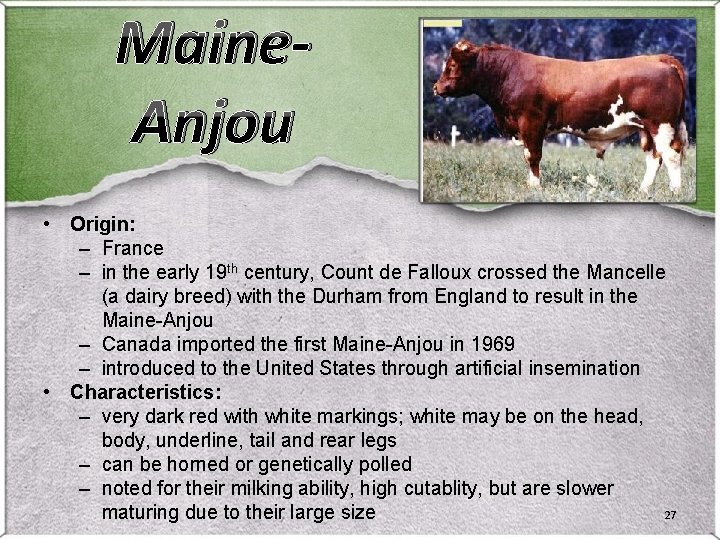
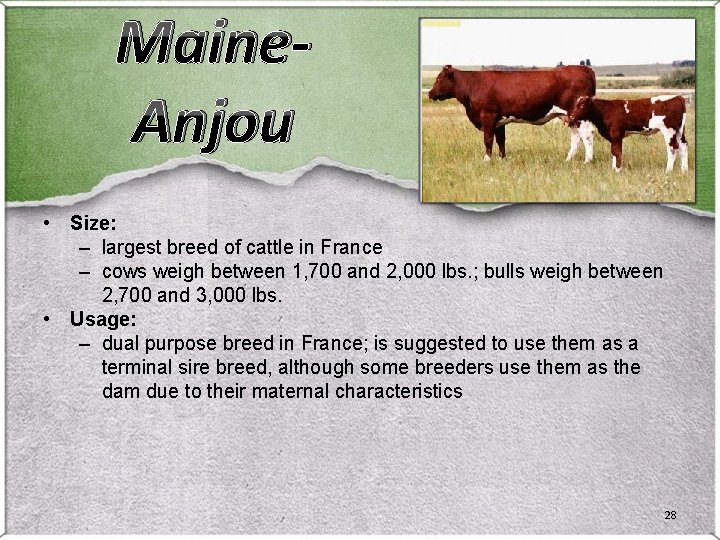
Maine. Anjou • Origin: – France – in the early 19 th century, Count de Falloux crossed the Mancelle (a dairy breed) with the Durham from England to result in the Maine-Anjou – Canada imported the first Maine-Anjou in 1969 – introduced to the United States through artificial insemination • Characteristics: – very dark red with white markings; white may be on the head, body, underline, tail and rear legs – can be horned or genetically polled – noted for their milking ability, high cutablity, but are slower maturing due to their large size 27
Maine. Anjou • Size: – largest breed of cattle in France – cows weigh between 1, 700 and 2, 000 lbs. ; bulls weigh between 2, 700 and 3, 000 lbs. • Usage: – dual purpose breed in France; is suggested to use them as a terminal sire breed, although some breeders use them as the dam due to their maternal characteristics 28
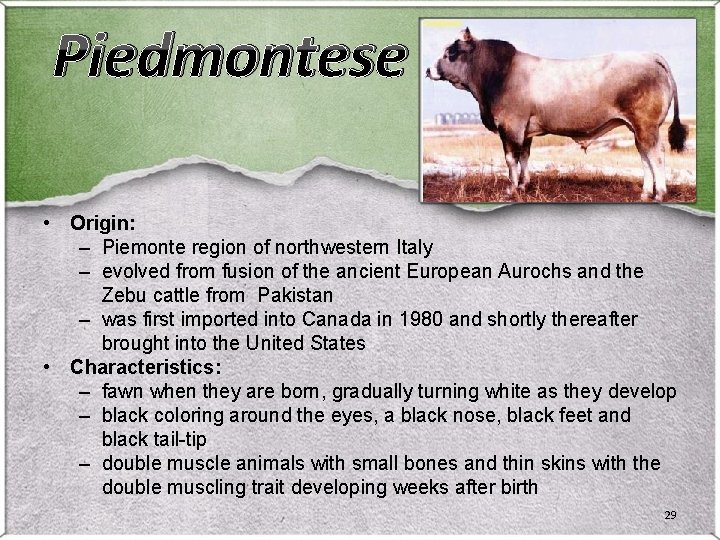
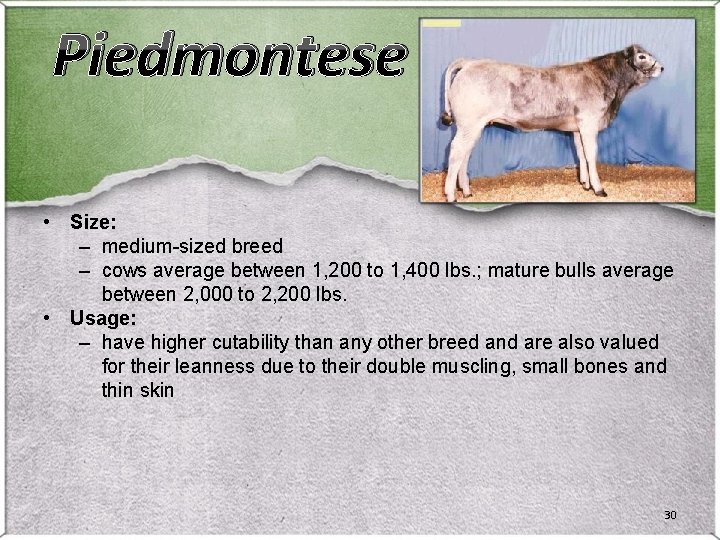
Piedmontese • Origin: – Piemonte region of northwestern Italy – evolved from fusion of the ancient European Aurochs and the Zebu cattle from Pakistan – was first imported into Canada in 1980 and shortly thereafter brought into the United States • Characteristics: – fawn when they are born, gradually turning white as they develop – black coloring around the eyes, a black nose, black feet and black tail-tip – double muscle animals with small bones and thin skins with the double muscling trait developing weeks after birth 29
Piedmontese • Size: – medium-sized breed – cows average between 1, 200 to 1, 400 lbs. ; mature bulls average between 2, 000 to 2, 200 lbs. • Usage: – have higher cutability than any other breed and are also valued for their leanness due to their double muscling, small bones and thin skin 30
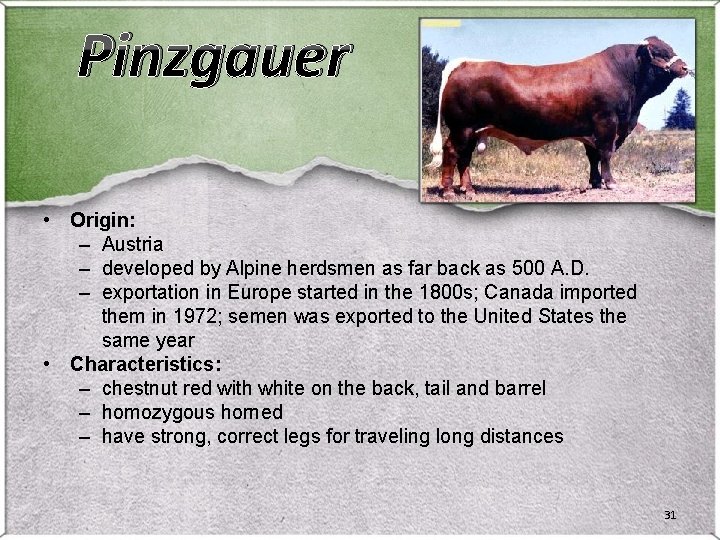
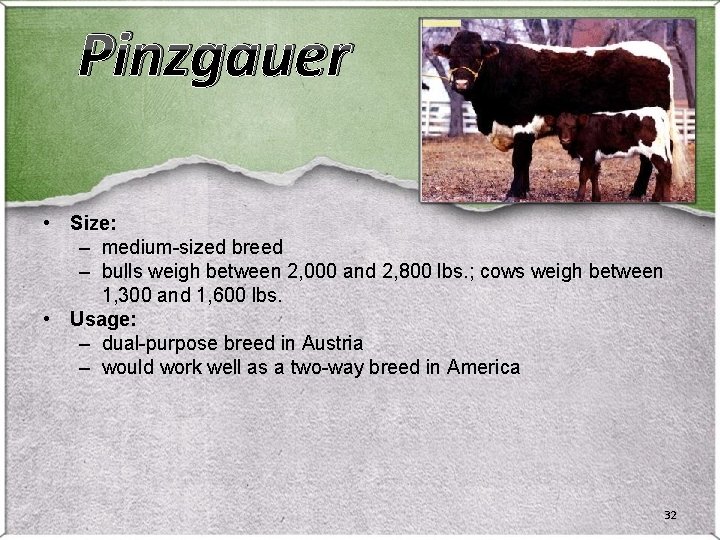
Pinzgauer • Origin: – Austria – developed by Alpine herdsmen as far back as 500 A. D. – exportation in Europe started in the 1800 s; Canada imported them in 1972; semen was exported to the United States the same year • Characteristics: – chestnut red with white on the back, tail and barrel – homozygous horned – have strong, correct legs for traveling long distances 31
Pinzgauer • Size: – medium-sized breed – bulls weigh between 2, 000 and 2, 800 lbs. ; cows weigh between 1, 300 and 1, 600 lbs. • Usage: – dual-purpose breed in Austria – would work well as a two-way breed in America 32
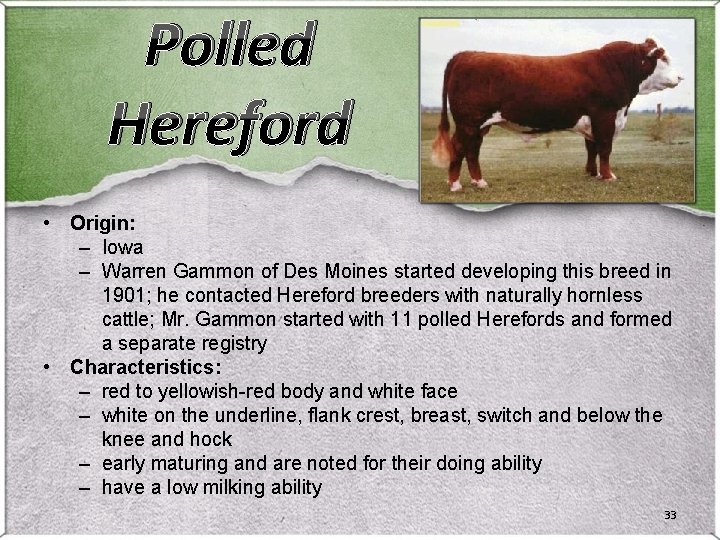
Polled Hereford • Origin: – Iowa – Warren Gammon of Des Moines started developing this breed in 1901; he contacted Hereford breeders with naturally hornless cattle; Mr. Gammon started with 11 polled Herefords and formed a separate registry • Characteristics: – red to yellowish-red body and white face – white on the underline, flank crest, breast, switch and below the knee and hock – early maturing and are noted for their doing ability – have a low milking ability 33
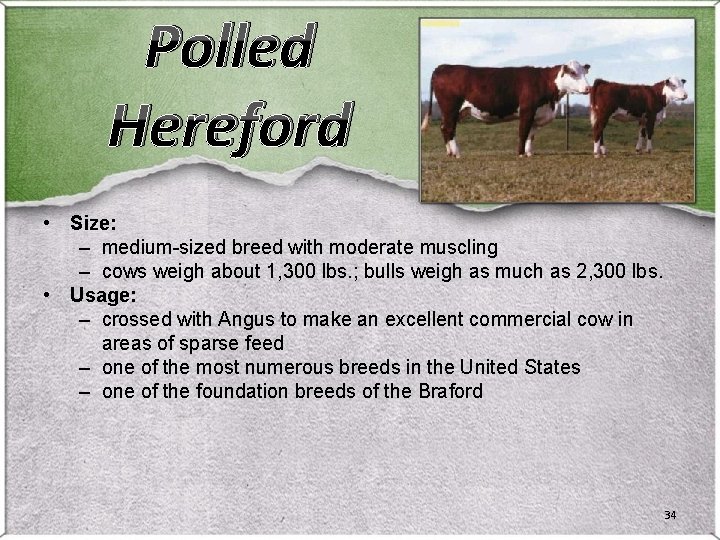
Polled Hereford • Size: – medium-sized breed with moderate muscling – cows weigh about 1, 300 lbs. ; bulls weigh as much as 2, 300 lbs. • Usage: – crossed with Angus to make an excellent commercial cow in areas of sparse feed – one of the most numerous breeds in the United States – one of the foundation breeds of the Braford 34
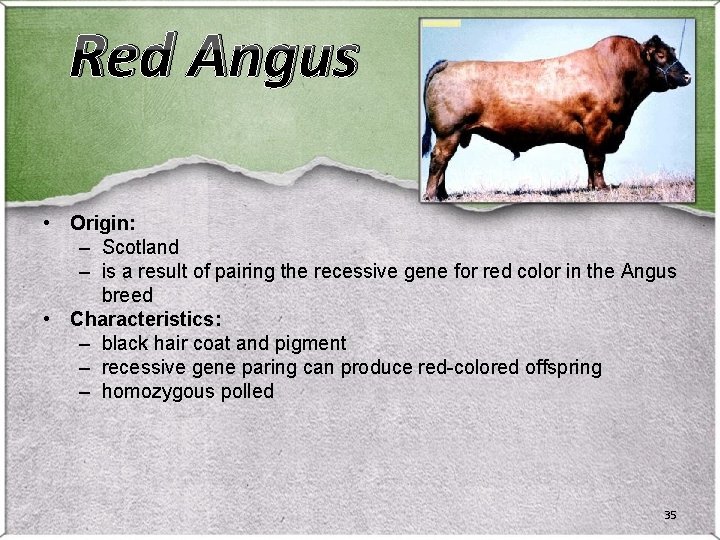
Red Angus • Origin: – Scotland – is a result of pairing the recessive gene for red color in the Angus breed • Characteristics: – black hair coat and pigment – recessive gene paring can produce red-colored offspring – homozygous polled 35
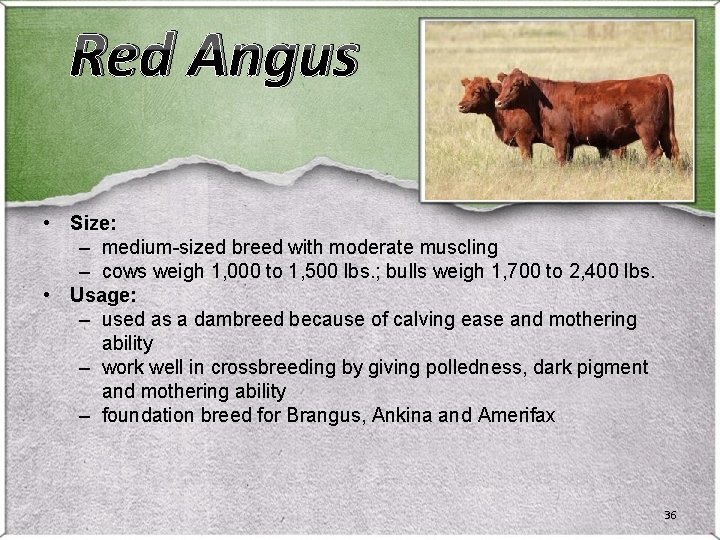
Red Angus • Size: – medium-sized breed with moderate muscling – cows weigh 1, 000 to 1, 500 lbs. ; bulls weigh 1, 700 to 2, 400 lbs. • Usage: – used as a dambreed because of calving ease and mothering ability – work well in crossbreeding by giving polledness, dark pigment and mothering ability – foundation breed for Brangus, Ankina and Amerifax 36
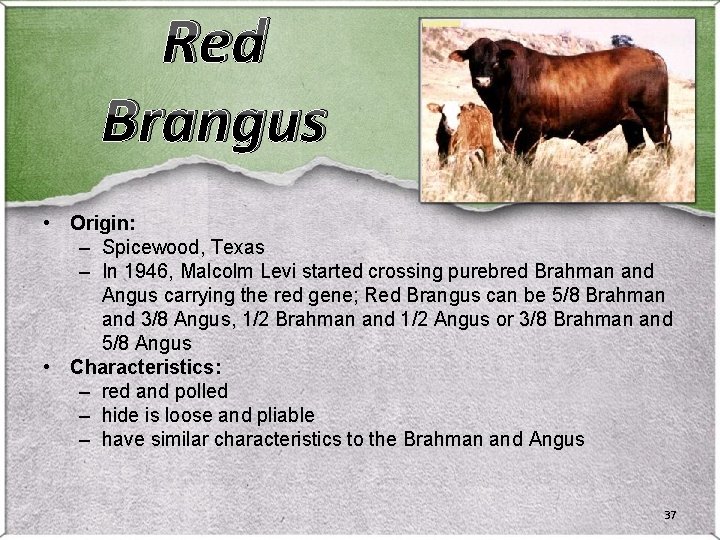
Red Brangus • Origin: – Spicewood, Texas – In 1946, Malcolm Levi started crossing purebred Brahman and Angus carrying the red gene; Red Brangus can be 5/8 Brahman and 3/8 Angus, 1/2 Brahman and 1/2 Angus or 3/8 Brahman and 5/8 Angus • Characteristics: – red and polled – hide is loose and pliable – have similar characteristics to the Brahman and Angus 37
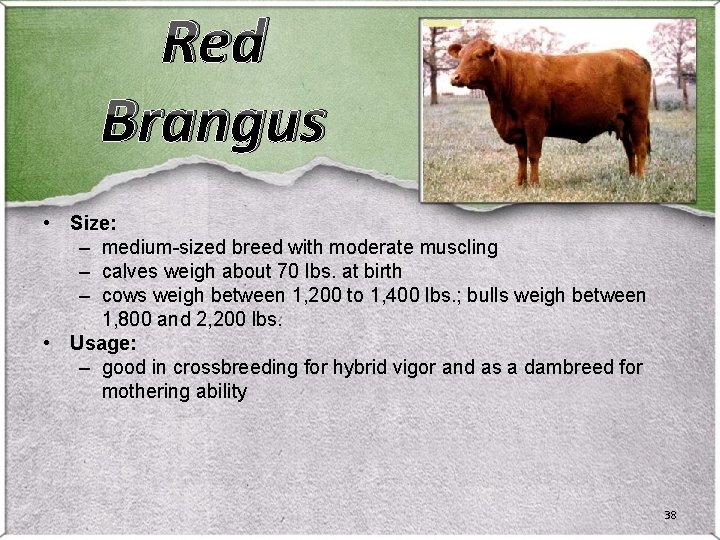
Red Brangus • Size: – medium-sized breed with moderate muscling – calves weigh about 70 lbs. at birth – cows weigh between 1, 200 to 1, 400 lbs. ; bulls weigh between 1, 800 and 2, 200 lbs. • Usage: – good in crossbreeding for hybrid vigor and as a dambreed for mothering ability 38
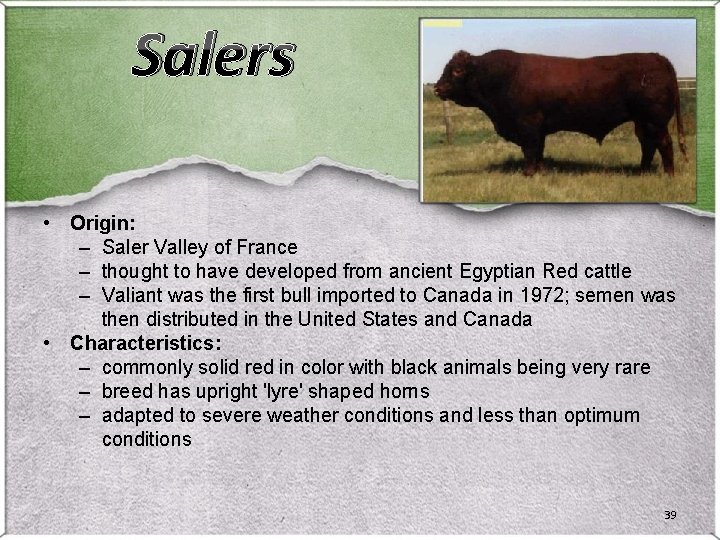
Salers • Origin: – Saler Valley of France – thought to have developed from ancient Egyptian Red cattle – Valiant was the first bull imported to Canada in 1972; semen was then distributed in the United States and Canada • Characteristics: – commonly solid red in color with black animals being very rare – breed has upright 'lyre' shaped horns – adapted to severe weather conditions and less than optimum conditions 39
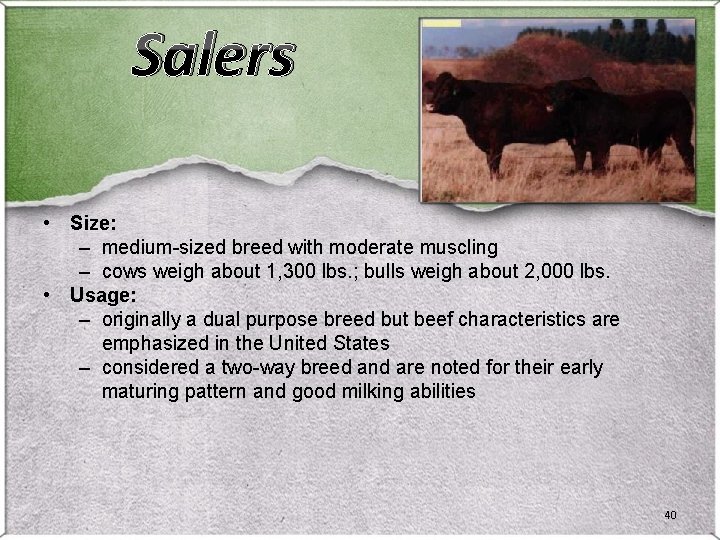
Salers • Size: – medium-sized breed with moderate muscling – cows weigh about 1, 300 lbs. ; bulls weigh about 2, 000 lbs. • Usage: – originally a dual purpose breed but beef characteristics are emphasized in the United States – considered a two-way breed and are noted for their early maturing pattern and good milking abilities 40
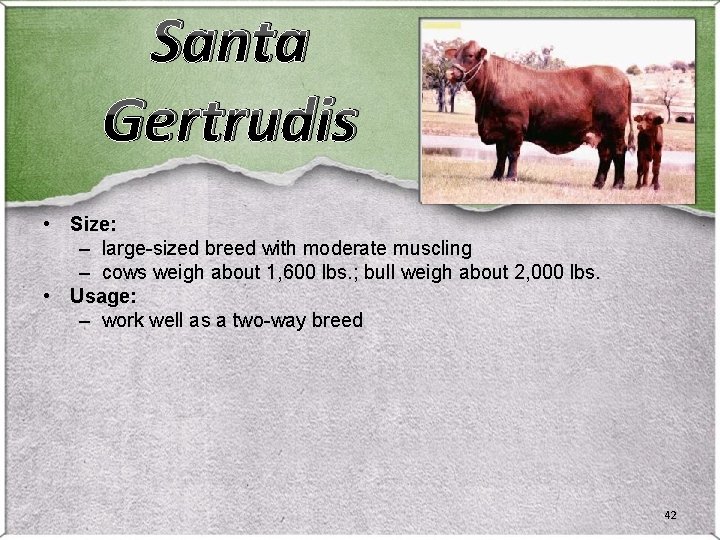
Santa Gertrudis • Origin: – United States – King Ranch in Texas began crossing Shorthorns with Brahman in 1910; they are 5/8 Brahman and 3/8 Shorthorn – by the 1940 s, Santa Gertrudis was considered a breed • Characteristics: – solid cherry red in color and can be polled or horned – have large ears, loose skin and excessive skin in the dewlap 41
Santa Gertrudis • Size: – large-sized breed with moderate muscling – cows weigh about 1, 600 lbs. ; bull weigh about 2, 000 lbs. • Usage: – work well as a two-way breed 42
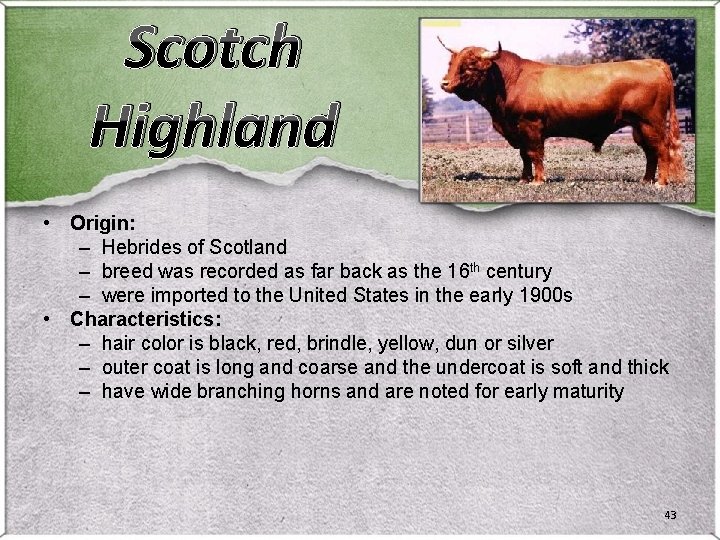
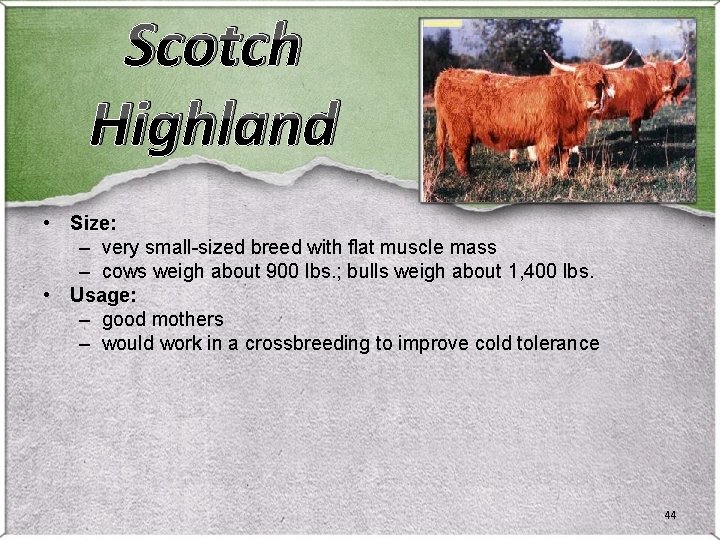
Scotch Highland • Origin: – Hebrides of Scotland – breed was recorded as far back as the 16 th century – were imported to the United States in the early 1900 s • Characteristics: – hair color is black, red, brindle, yellow, dun or silver – outer coat is long and coarse and the undercoat is soft and thick – have wide branching horns and are noted for early maturity 43
Scotch Highland • Size: – very small-sized breed with flat muscle mass – cows weigh about 900 lbs. ; bulls weigh about 1, 400 lbs. • Usage: – good mothers – would work in a crossbreeding to improve cold tolerance 44
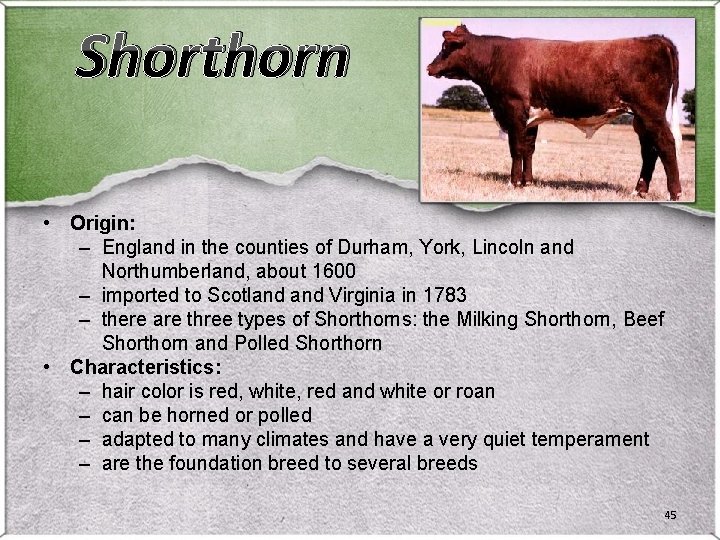
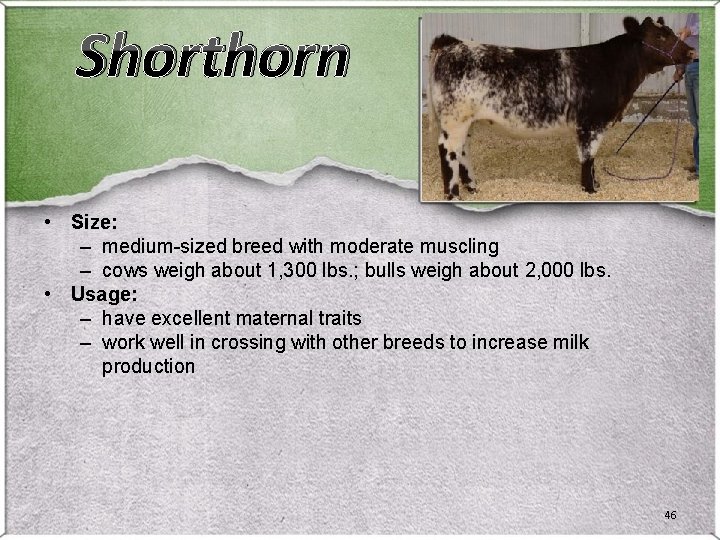
Shorthorn • Origin: – England in the counties of Durham, York, Lincoln and Northumberland, about 1600 – imported to Scotland Virginia in 1783 – there are three types of Shorthorns: the Milking Shorthorn, Beef Shorthorn and Polled Shorthorn • Characteristics: – hair color is red, white, red and white or roan – can be horned or polled – adapted to many climates and have a very quiet temperament – are the foundation breed to several breeds 45
Shorthorn • Size: – medium-sized breed with moderate muscling – cows weigh about 1, 300 lbs. ; bulls weigh about 2, 000 lbs. • Usage: – have excellent maternal traits – work well in crossing with other breeds to increase milk production 46
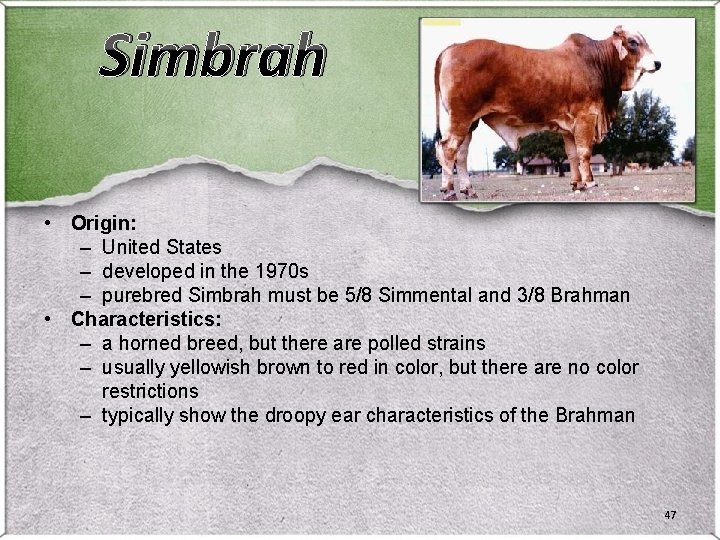
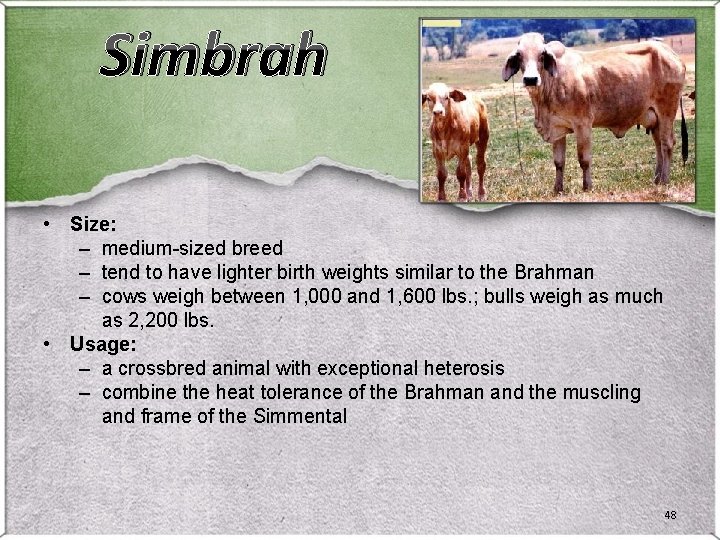
Simbrah • Origin: – United States – developed in the 1970 s – purebred Simbrah must be 5/8 Simmental and 3/8 Brahman • Characteristics: – a horned breed, but there are polled strains – usually yellowish brown to red in color, but there are no color restrictions – typically show the droopy ear characteristics of the Brahman 47
Simbrah • Size: – medium-sized breed – tend to have lighter birth weights similar to the Brahman – cows weigh between 1, 000 and 1, 600 lbs. ; bulls weigh as much as 2, 200 lbs. • Usage: – a crossbred animal with exceptional heterosis – combine the heat tolerance of the Brahman and the muscling and frame of the Simmental 48
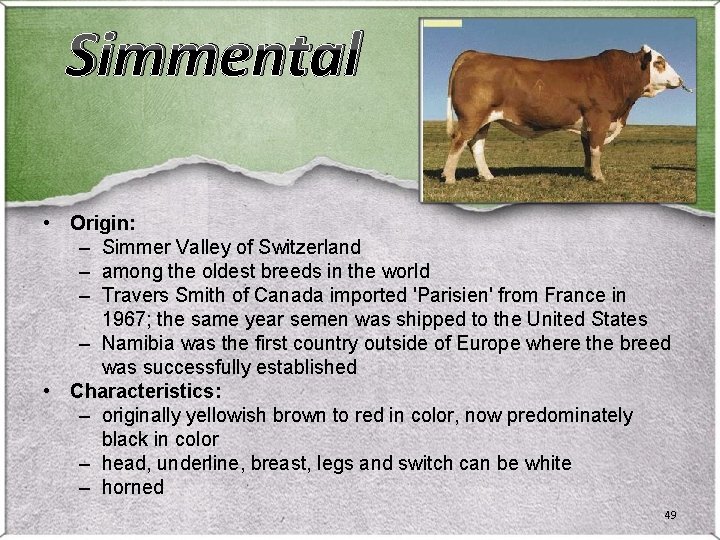
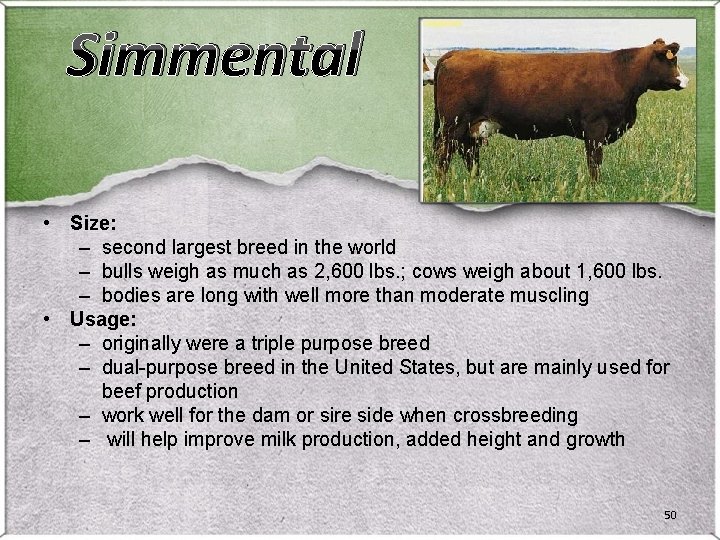
Simmental • Origin: – Simmer Valley of Switzerland – among the oldest breeds in the world – Travers Smith of Canada imported 'Parisien' from France in 1967; the same year semen was shipped to the United States – Namibia was the first country outside of Europe where the breed was successfully established • Characteristics: – originally yellowish brown to red in color, now predominately black in color – head, underline, breast, legs and switch can be white – horned 49
Simmental • Size: – second largest breed in the world – bulls weigh as much as 2, 600 lbs. ; cows weigh about 1, 600 lbs. – bodies are long with well more than moderate muscling • Usage: – originally were a triple purpose breed – dual-purpose breed in the United States, but are mainly used for beef production – work well for the dam or sire side when crossbreeding – will help improve milk production, added height and growth 50
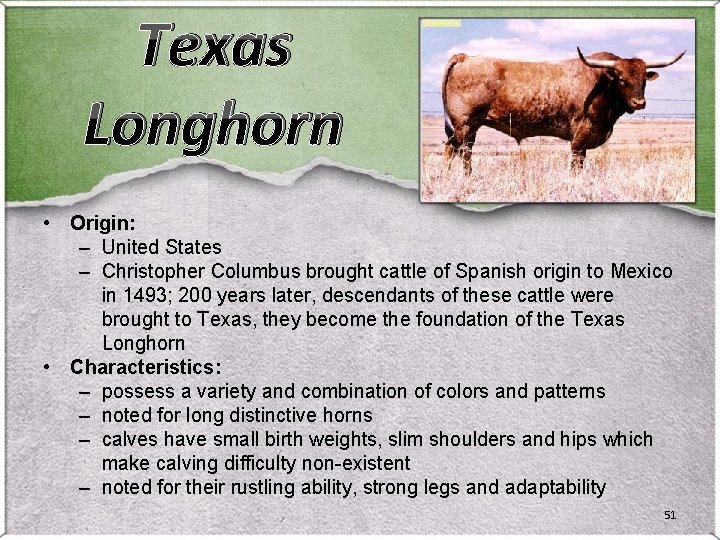
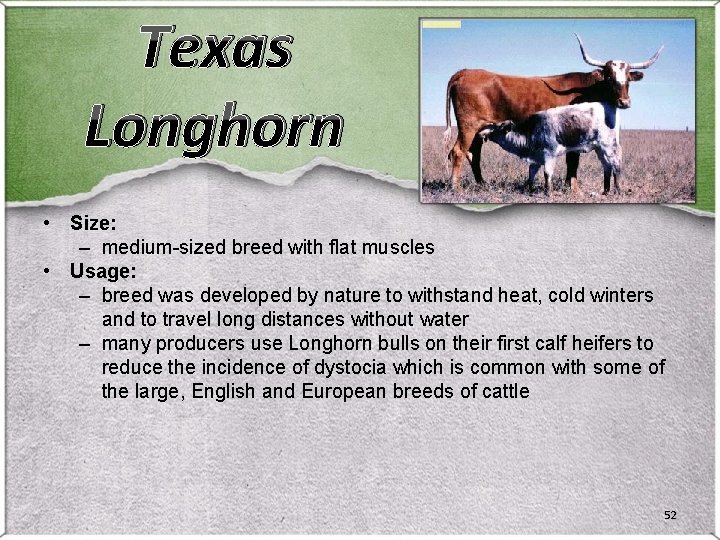
Texas Longhorn • Origin: – United States – Christopher Columbus brought cattle of Spanish origin to Mexico in 1493; 200 years later, descendants of these cattle were brought to Texas, they become the foundation of the Texas Longhorn • Characteristics: – possess a variety and combination of colors and patterns – noted for long distinctive horns – calves have small birth weights, slim shoulders and hips which make calving difficulty non-existent – noted for their rustling ability, strong legs and adaptability 51
Texas Longhorn • Size: – medium-sized breed with flat muscles • Usage: – breed was developed by nature to withstand heat, cold winters and to travel long distances without water – many producers use Longhorn bulls on their first calf heifers to reduce the incidence of dystocia which is common with some of the large, English and European breeds of cattle 52
Acknowledgments Production Coordinators Daniel Johnson Jessica Odom Graphic Designer Daniel Johnson Technical Writer Jessica Odom V. P. of Brand Management Clayton Franklin © MMXIV CEV Multimedia, Ltd. Executive Producer Gordon W. Davis, Ph. D. 53