
1 2 3 4 Hypovolemia Sepsis Heart failure
- Slides: 4
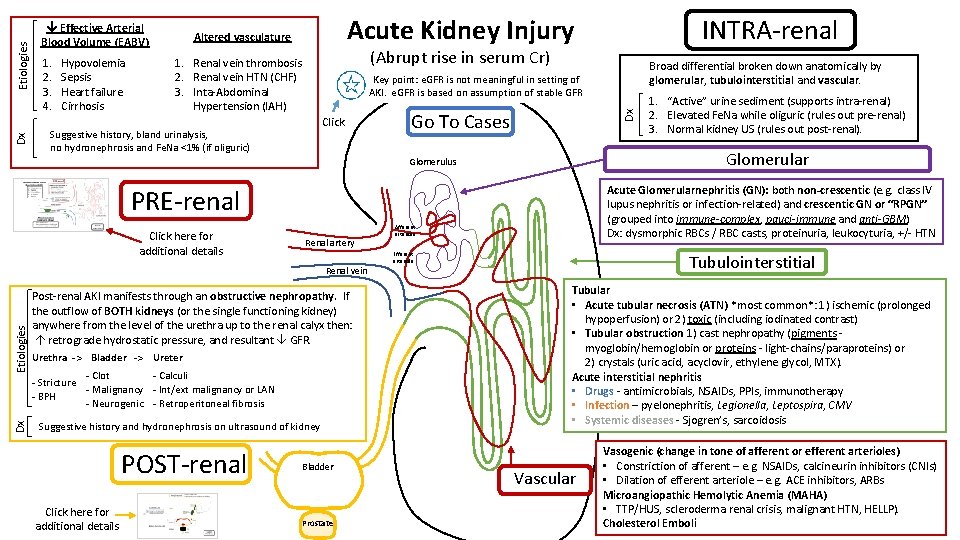
1. 2. 3. 4. Hypovolemia Sepsis Heart failure Cirrhosis Acute Kidney Injury Altered vasculature (Abrupt rise in serum Cr) 1. Renal vein thrombosis 2. Renal vein HTN (CHF) 3. Inta-Abdominal Hypertension (IAH) Click Go To Cases Acute Glomerularnephritis (GN): both non-crescentic (e. g. class IV lupus nephritis or infection-related) and crescentic GN or “RPGN” (grouped into immune-complex, pauci-immune and anti-GBM) Dx: dysmorphic RBCs / RBC casts, proteinuria, leukocyturia, +/- HTN PRE-renal Renal artery Dx Etiologies Renal vein Post-renal AKI manifests through an obstructive nephropathy. If the outflow of BOTH kidneys (or the single functioning kidney) anywhere from the level of the urethra up to the renal calyx then: retrograde hydrostatic pressure, and resultant GFR. Urethra -> Bladder -> Ureter - Clot - Calculi - Stricture - Malignancy - Int/ext malignancy or LAN - BPH - Neurogenic - Retroperitoneal fibrosis Suggestive history and hydronephrosis on ultrasound of kidney Click here for additional details Bladder Prostate 1. “Active” urine sediment (supports intra-renal) 2. Elevated Fe. Na while oliguric (rules out pre-renal) 3. Normal kidney US (rules out post-renal). Glomerular Glomerulus POST-renal Broad differential broken down anatomically by glomerular, tubulointerstitial and vascular. Key point: e. GFR is not meaningful in setting of AKI. e. GFR is based on assumption of stable GFR Suggestive history, bland urinalysis, no hydronephrosis and Fe. Na <1% (if oliguric) Click here for additional details INTRA-renal Dx Etiologies Dx Effective Arterial Blood Volume (EABV) Afferent arteriole Efferent arteriole Tubulointerstitial Tubular • Acute tubular necrosis (ATN) *most common*: 1) ischemic (prolonged hypoperfusion) or 2) toxic (including iodinated contrast) • Tubular obstruction 1) cast nephropathy (pigments myoglobin/hemoglobin or proteins - light-chains/paraproteins) or 2) crystals (uric acid, acyclovir, ethylene glycol, MTX). Acute interstitial nephritis • Drugs - antimicrobials, NSAIDs, PPIs, immunotherapy • Infection – pyelonephritis, Legionella, Leptospira, CMV • Systemic diseases - Sjogren’s, sarcoidosis Vascular Vasogenic (change in tone of afferent or efferent arterioles) • Constriction of afferent – e. g. NSAIDs, calcineurin inhibitors (CNIs) • Dilation of efferent arteriole – e. g. ACE inhibitors, ARBs Microangiopathic Hemolytic Anemia (MAHA) • TTP/HUS, scleroderma renal crisis, malignant HTN, HELLP). Cholesterol Emboli
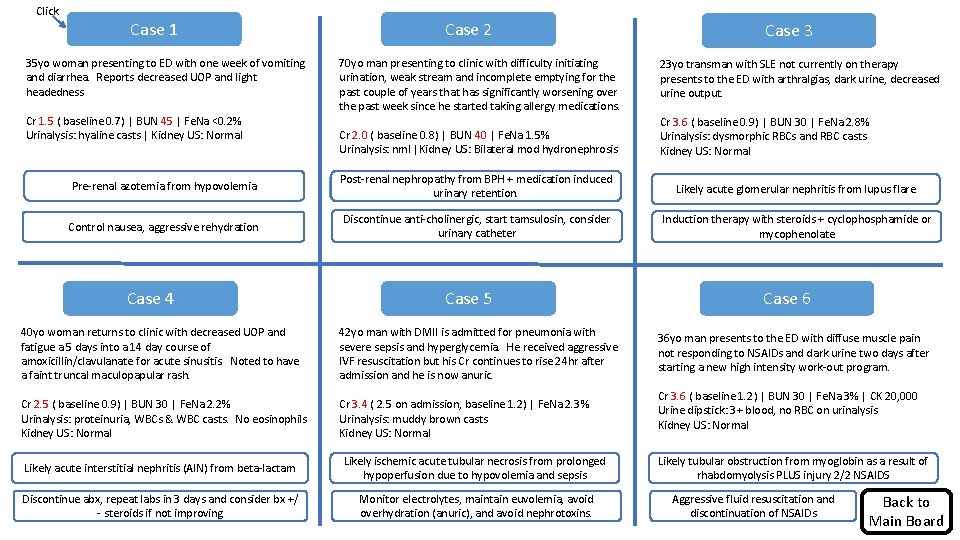
Click Case 1 35 yo woman presenting to ED with one week of vomiting and diarrhea. Reports decreased UOP and light headedness Cr 1. 5 ( baseline 0. 7) | BUN 45 | Fe. Na <0. 2% Urinalysis: hyaline casts | Kidney US: Normal Case 2 Case 3 70 yo man presenting to clinic with difficulty initiating urination, weak stream and incomplete emptying for the past couple of years that has significantly worsening over the past week since he started taking allergy medications. 23 yo transman with SLE not currently on therapy presents to the ED with arthralgias, dark urine, decreased urine output. Cr 2. 0 ( baseline 0. 8) | BUN 40 | Fe. Na 1. 5% Urinalysis: nml |Kidney US: Bilateral mod hydronephrosis Cr 3. 6 ( baseline 0. 9) | BUN 30 | Fe. Na 2. 8% Urinalysis: dysmorphic RBCs and RBC casts Kidney US: Normal from and hypovolemia What. Pre-renal is the azotemia diagnosis etiology? Post-renal nephropathy from BPH + medication induced Diagnosis and etiology? urinary retention. Diagnosis and etiology? Likely acute glomerular nephritis from lupus flare Next nausea, step inaggressive management? Control rehydration Discontinue anti-cholinergic, start tamsulosin, consider Next step in management? urinary catheter Induction therapy with steroids + cyclophosphamide or Next step in management? mycophenolate Case 4 Case 5 40 yo woman returns to clinic with decreased UOP and fatigue a 5 days into a 14 day course of amoxicillin/clavulanate for acute sinusitis. Noted to have a faint truncal maculopapular rash. 42 yo man with DMII is admitted for pneumonia with severe sepsis and hyperglycemia. He received aggressive IVF resuscitation but his Cr continues to rise 24 hr after admission and he is now anuric. Cr 2. 5 ( baseline 0. 9) | BUN 30 | Fe. Na 2. 2% Urinalysis: proteinuria, WBCs & WBC casts. No eosinophils Kidney US: Normal Cr 3. 4 ( 2. 5 on admission, baseline 1. 2) | Fe. Na 2. 3% Urinalysis: muddy brown casts Kidney US: Normal Diagnosis and etiology? Likely acute interstitial nephritis (AIN) from beta-lactam Likely ischemic acute tubular necrosis from prolonged Diagnosis and etiology? hypoperfusion due to hypovolemia and sepsis Discontinue abx, repeat labs in 3 days and consider bx +/ Next- steroids step inifmanagement? not improving Monitor electrolytes, maintain euvolemia, avoid Next step in management? overhydration (anuric), and avoid nephrotoxins. Case 6 36 yo man presents to the ED with diffuse muscle pain not responding to NSAIDs and dark urine two days after starting a new high intensity work-out program. Cr 3. 6 ( baseline 1. 2) | BUN 30 | Fe. Na 3% | CK 20, 000 Urine dipstick: 3+ blood, no RBC on urinalysis Kidney US: Normal Likely tubular obstruction from myoglobin as a result of Diagnosis and etiology? rhabdomyolysis PLUS injury 2/2 NSAIDS Aggressive fluid resuscitation and Nextdiscontinuation step in management? of NSAIDs Back to Main Board
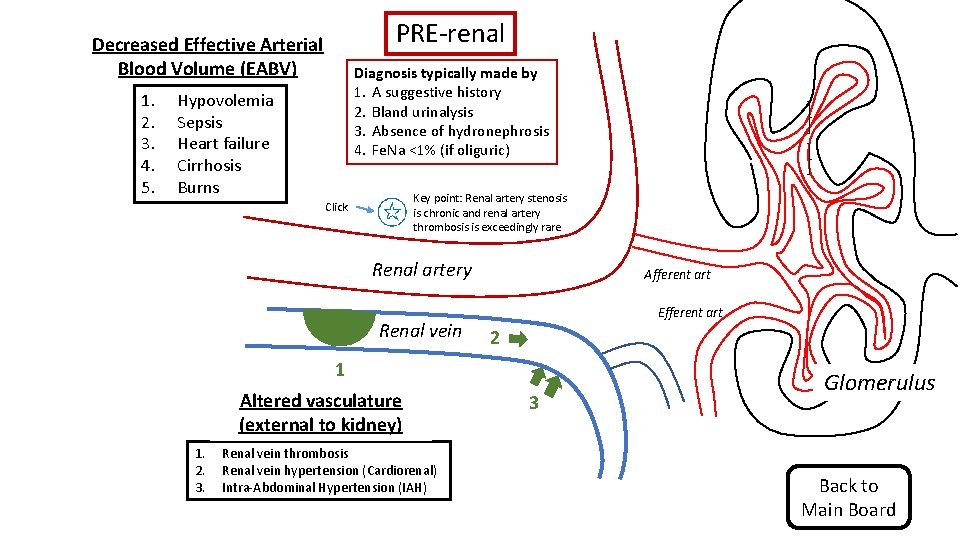
PRE-renal Decreased Effective Arterial Blood Volume (EABV) 1. 2. 3. 4. 5. Diagnosis typically made by 1. A suggestive history 2. Bland urinalysis 3. Absence of hydronephrosis 4. Fe. Na <1% (if oliguric) Hypovolemia Sepsis Heart failure Cirrhosis Burns Key point: Renal artery stenosis is chronic and renal artery thrombosis is exceedingly rare Click Renal artery Renal vein Afferent art Efferent art 2 1 Altered vasculature (external to kidney) 1. 2. 3. Renal vein thrombosis Renal vein hypertension (Cardiorenal) Intra-Abdominal Hypertension (IAH) 3 Glomerulus Back to Main Board
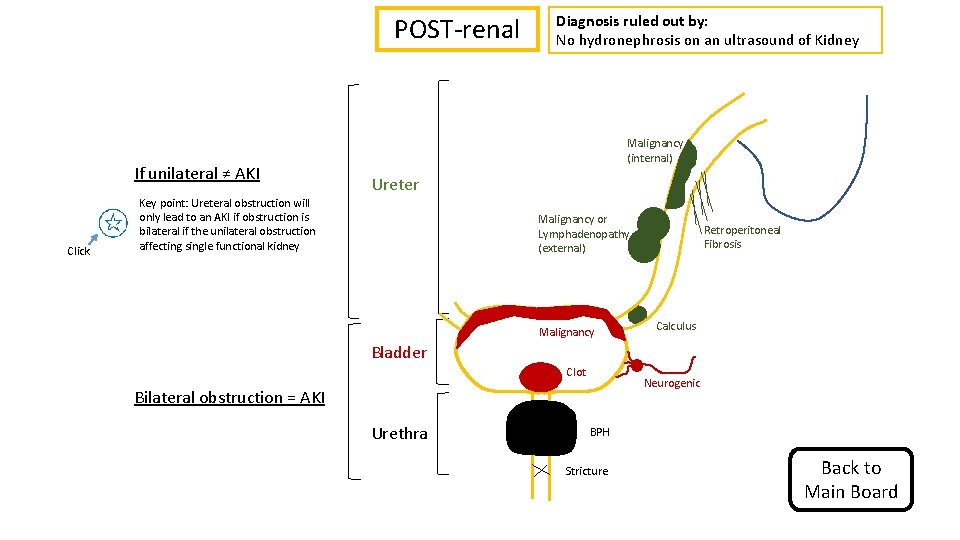
POST-renal If unilateral ≠ AKI Click Key point: Ureteral obstruction will only lead to an AKI if obstruction is bilateral if the unilateral obstruction affecting single functional kidney Diagnosis ruled out by: No hydronephrosis on an ultrasound of Kidney Malignancy (internal) Ureter Malignancy or Lymphadenopathy (external) Malignancy Retroperitoneal Fibrosis Calculus Bladder Clot Neurogenic Bilateral obstruction = AKI Urethra BPH Stricture Back to Main Board