
1 2 3 4 5 Objectives Be able
1. 2. 3. 4. 5. Objectives: Be able to draw an angle in standard position and find the positive and negative rotations. Be able to convert degrees into radians and radians into degrees. Be able to find complementary and supplementary angles in radians and degrees. Be able to find co-terminal angles in radians and degrees Be able to find the arc length and Area of a sector. Critical Vocabulary: Positive Rotation, Negative Rotation, Standard Position, Quadrantal Angle, Co-terminal, Degrees, Radians
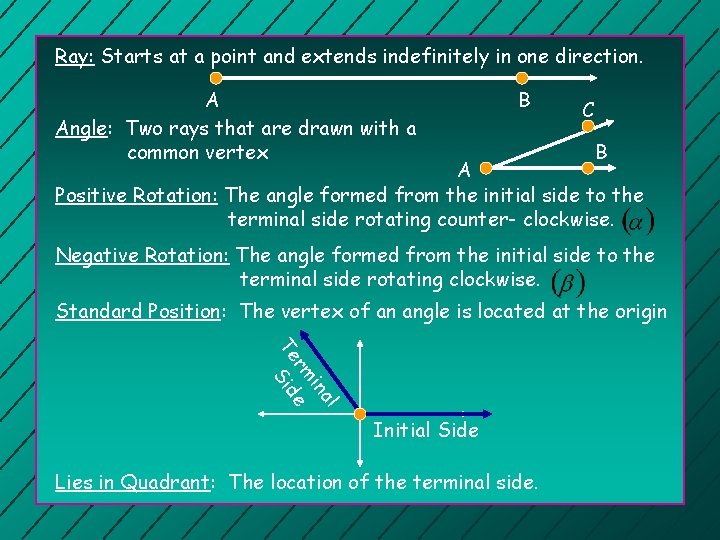
Ray: Starts at a point and extends indefinitely in one direction. A Angle: Two rays that are drawn with a common vertex B C B A Positive Rotation: The angle formed from the initial side to the terminal side rotating counter- clockwise. Negative Rotation: The angle formed from the initial side to the terminal side rotating clockwise. Standard Position: The vertex of an angle is located at the origin al in rm e Te Sid Initial Side Lies in Quadrant: The location of the terminal side.
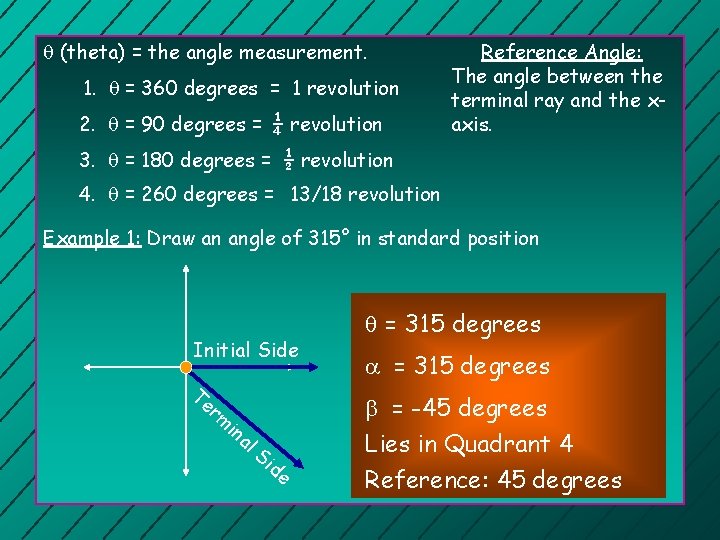
(theta) = the angle measurement. 1. = 360 degrees = 1 revolution 2. = 90 degrees = ¼ revolution Reference Angle: The angle between the terminal ray and the xaxis. 3. = 180 degrees = ½ revolution 4. = 260 degrees = 13/18 revolution Example 1: Draw an angle of 315° in standard position Initial Side Te rm in al Si de = 315 degrees = -45 degrees Lies in Quadrant 4 Reference: 45 degrees
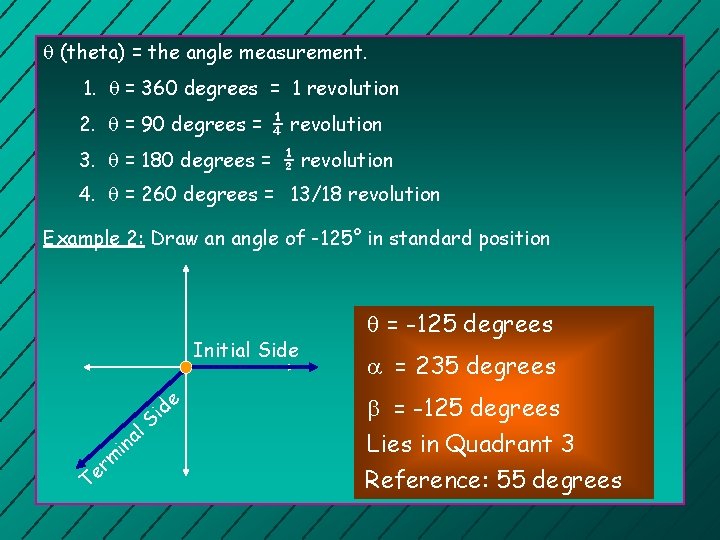
(theta) = the angle measurement. 1. = 360 degrees = 1 revolution 2. = 90 degrees = ¼ revolution 3. = 180 degrees = ½ revolution 4. = 260 degrees = 13/18 revolution Example 2: Draw an angle of -125° in standard position Initial Side r e T m a in l de i S = -125 degrees = 235 degrees = -125 degrees Lies in Quadrant 3 Reference: 55 degrees
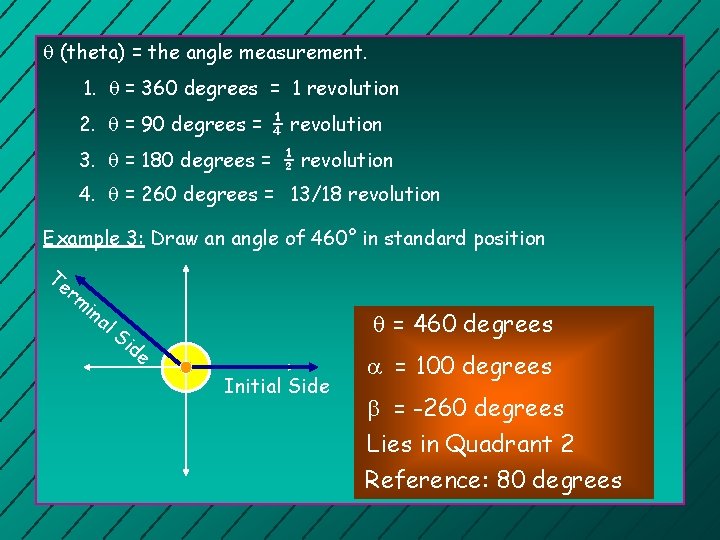
(theta) = the angle measurement. 1. = 360 degrees = 1 revolution 2. = 90 degrees = ¼ revolution 3. = 180 degrees = ½ revolution 4. = 260 degrees = 13/18 revolution Example 3: Draw an angle of 460° in standard position Te rm in al S = 460 degrees id e Initial Side = 100 degrees = -260 degrees Lies in Quadrant 2 Reference: 80 degrees
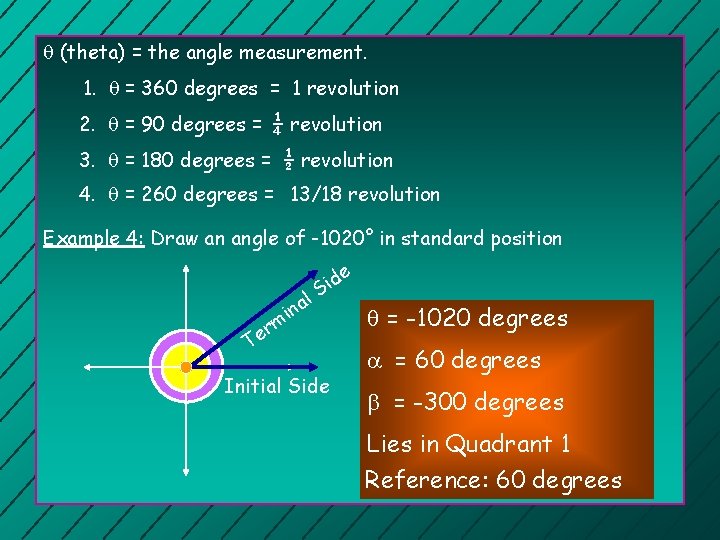
(theta) = the angle measurement. 1. = 360 degrees = 1 revolution 2. = 90 degrees = ¼ revolution 3. = 180 degrees = ½ revolution 4. = 260 degrees = 13/18 revolution Example 4: Draw an angle of -1020° in standard position l ina m er e d Si T Initial Side = -1020 degrees = 60 degrees = -300 degrees Lies in Quadrant 1 Reference: 60 degrees
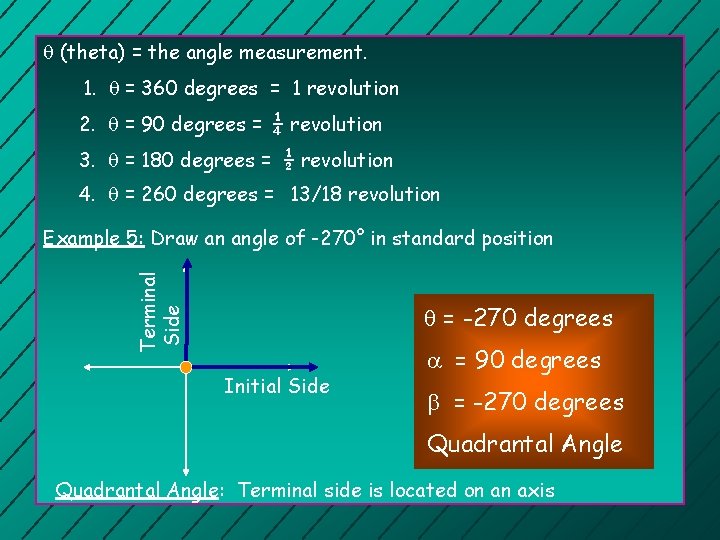
(theta) = the angle measurement. 1. = 360 degrees = 1 revolution 2. = 90 degrees = ¼ revolution 3. = 180 degrees = ½ revolution 4. = 260 degrees = 13/18 revolution Terminal Side Example 5: Draw an angle of -270° in standard position = -270 degrees Initial Side = 90 degrees = -270 degrees Quadrantal Angle: Terminal side is located on an axis
Page 862 -863 #3 -9 all, 14 Directions (#3 -9): 1. 2. 3. 4. 5. Draw the Angle in Standard Position How many complete rotations What are Alpha and Beta What Quadrant does the Angle Lie in What is the Reference Angle

Page 862 -863 #3, 4, 6 -9 all, 14 3. 4. 6. 7. 8. Rotations: 0 Alpha: 120 degrees Beta: -240 degrees Lies in Quadrant II Reference Angle: 60 degrees Rotations: 1 Alpha: 240 degrees Beta: -120 degrees Lies in Quadrant III Reference Angle: 60 degrees Rotations: 0 Alpha: 110 degrees Beta: -250 degrees Lies in Quadrant II Reference Angle: 70 degrees Rotations: 0 Alpha: 350 degrees Beta: -10 degrees Lies in Quadrant IV Reference Angle: 10 degrees Rotations: 1 Alpha: 90 degrees Beta: -270 degrees Quadrantal Angle Reference Angle: None 9. Rotations: 2 Alpha: 180 degrees Beta: -180 degrees Quadrantal Angle Reference Angle: None 14. C
- Slides: 9