
1 2 3 4 5 6 7 8

- Slides: 18
1. 2. 3. 4. 5. 6. 7. 8. Quick test What is the definition of a catalyst? What type of molecule is an enzyme? What is the active site? What is the name of the substance that binds at the active site? What is a synthesis reaction? What does specificity mean in the context of enzymes? What type of enzyme breaks down proteins? Name one process in the body that relies on enzymes
Starter questions on enzymes Enzymes _______ up the rate of chemical ____. Enzymes are ____ because they only work on one substrate. The substrate fits into the ____ site of the surface of the _______. Enzymes can be re-used, so only _______ amounts are needed. To which group of chemical compounds do enzymes belong? _____ Why is an enzyme specific for a particular substrate? _____________________ • Why can an enzyme be used again and again? _____________________ • • •
Starter questions on enzymes Enzymes speed up the rate of chemical reaction Enzymes are specific because they only work on one substrate. The substrate fits into the active site of the surface of the enzyme Enzymes can be re-used, so only small amounts are needed. To which group of chemical compounds do enzymes belong? Proteins • Why is an enzyme specific for a particular substrate? The active site of the enzyme is complementary to one type of substrate only. • Why can an enzyme be used again and again? They are catalysts which means that they allow the reaction to happen at a faster rate, without being used up or changed themselves. • • •
Factors affecting enzyme action Learning objectives Describe and explain the effect of temperature and p. H on the rate of enzyme catalysed reactions Understand that denaturation results in a change to the active site.
Exam technique • DESCRIBE – what does it look like? Imagine someone can’t see the graph/table. Give enough detail so that they can picture exactly what the pattern is. • EXPLAIN – why does it look like that? Use scientific knowledge to account for the pattern described.
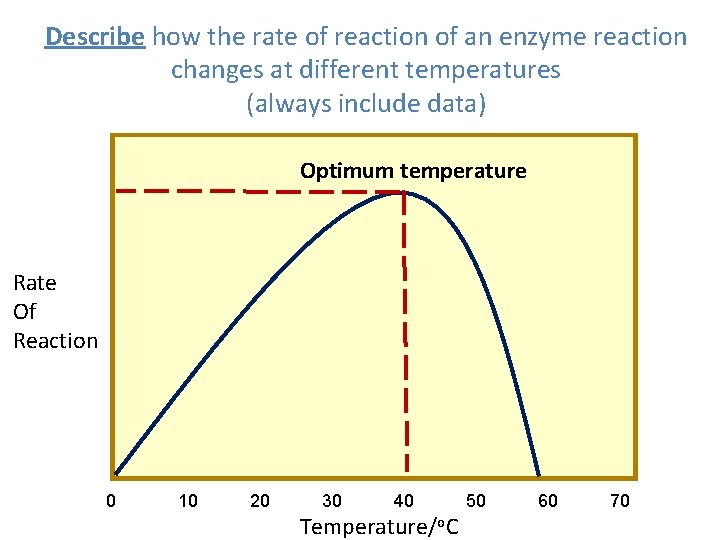
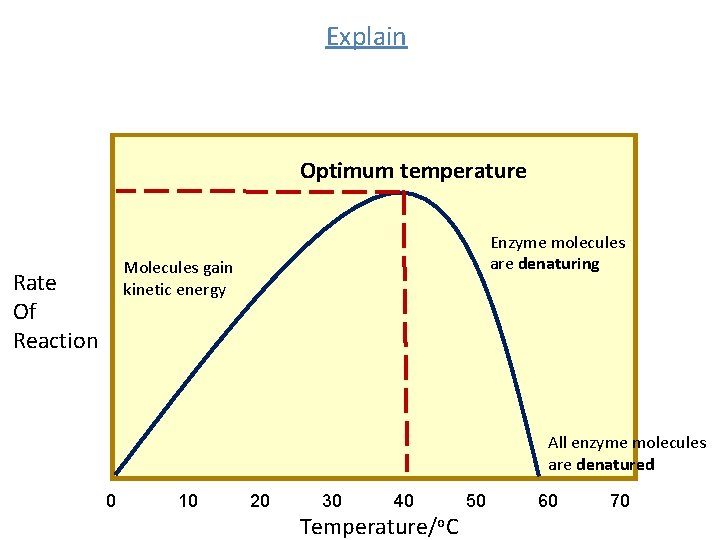
Describe how the rate of reaction of an enzyme reaction changes at different temperatures (always include data) Optimum temperature Rate Of Reaction 0 10 20 30 40 Temperature/o. C 50 60 70
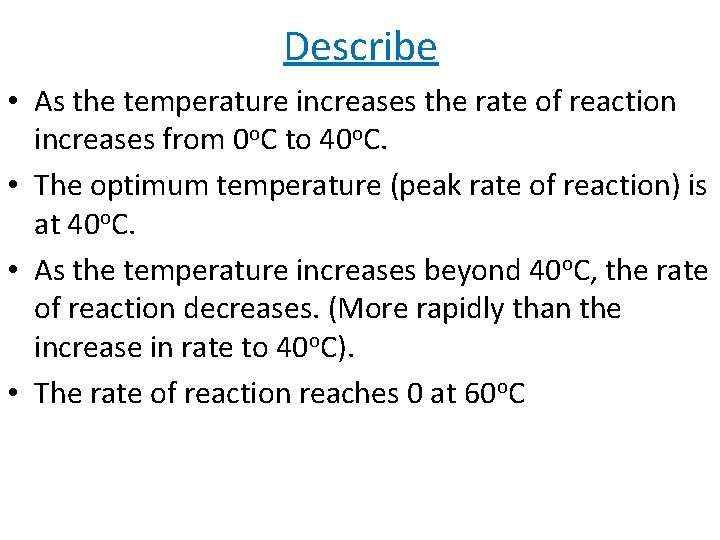
Describe • As the temperature increases the rate of reaction increases from 0 o. C to 40 o. C. • The optimum temperature (peak rate of reaction) is at 40 o. C. • As the temperature increases beyond 40 o. C, the rate of reaction decreases. (More rapidly than the increase in rate to 40 o. C). • The rate of reaction reaches 0 at 60 o. C
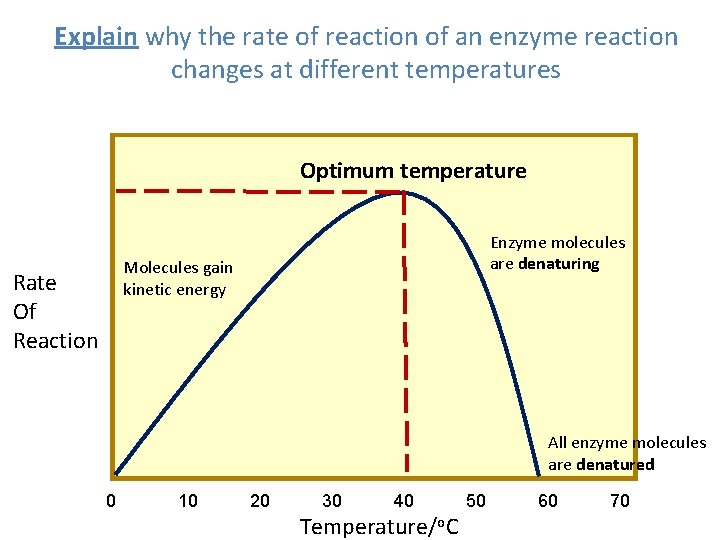
Explain why the rate of reaction of an enzyme reaction changes at different temperatures Optimum temperature Enzyme molecules are denaturing Molecules gain kinetic energy Rate Of Reaction All enzyme molecules are denatured 0 10 20 30 40 Temperature/o. C 50 60 70
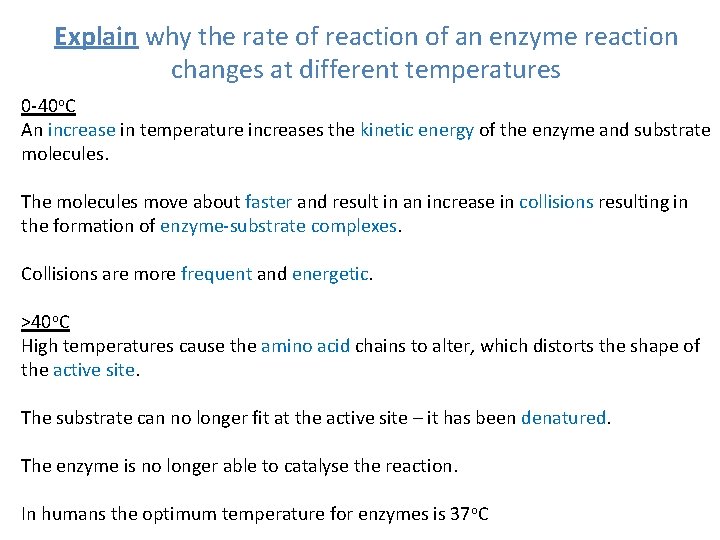
Explain why the rate of reaction of an enzyme reaction changes at different temperatures 0 -40 o. C An increase in temperature increases the kinetic energy of the enzyme and substrate molecules. The molecules move about faster and result in an increase in collisions resulting in the formation of enzyme-substrate complexes. Collisions are more frequent and energetic. >40 o. C High temperatures cause the amino acid chains to alter, which distorts the shape of the active site. The substrate can no longer fit at the active site – it has been denatured. The enzyme is no longer able to catalyse the reaction. In humans the optimum temperature for enzymes is 37 o. C
Explain Optimum temperature Enzyme molecules are denaturing Molecules gain kinetic energy Rate Of Reaction All enzyme molecules are denatured 0 10 20 30 40 Temperature/o. C 50 60 70
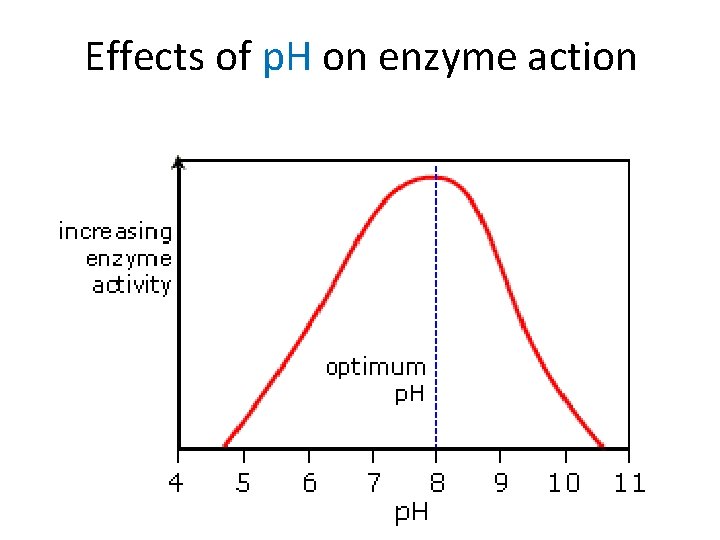
Effects of p. H on enzyme action
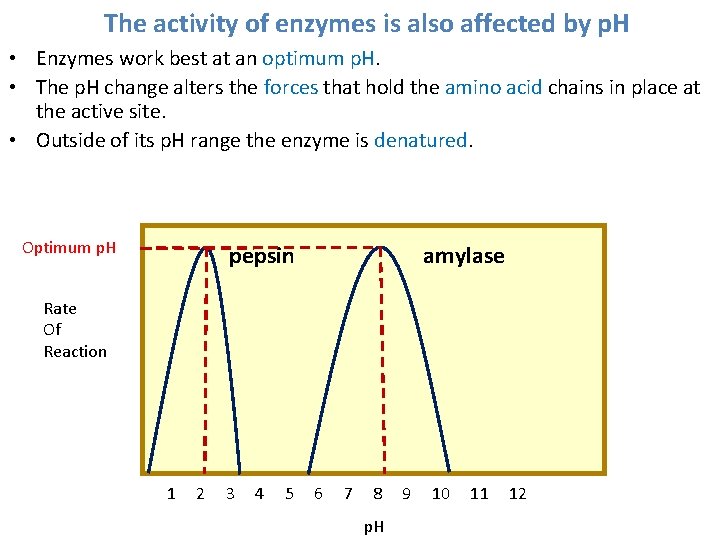
The activity of enzymes is also affected by p. H • Enzymes work best at an optimum p. H. • The p. H change alters the forces that hold the amino acid chains in place at the active site. • Outside of its p. H range the enzyme is denatured. Optimum p. H pepsin amylase Rate Of Reaction 1 2 3 4 5 6 7 8 9 10 11 12 p. H
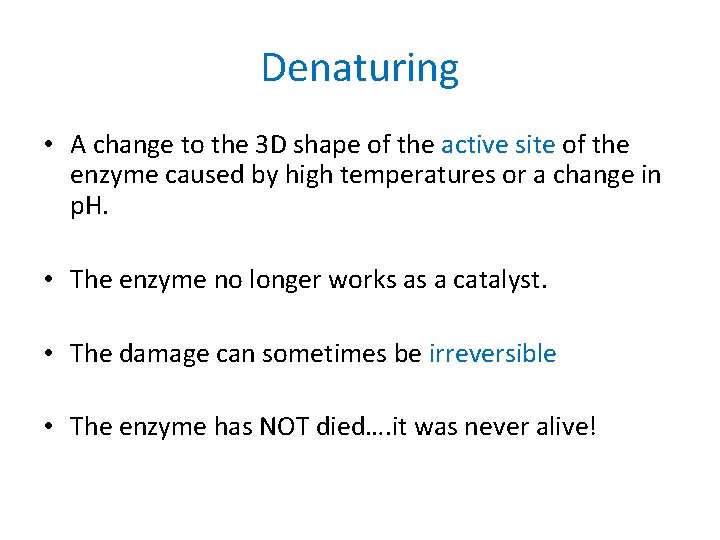
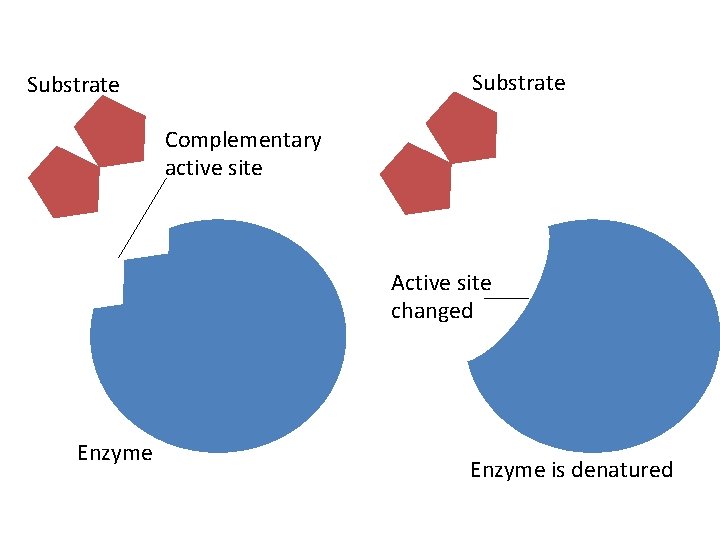
Denaturing • A change to the 3 D shape of the active site of the enzyme caused by high temperatures or a change in p. H. • The enzyme no longer works as a catalyst. • The damage can sometimes be irreversible • The enzyme has NOT died…. it was never alive!
Substrate Complementary active site Active site changed Enzyme is denatured
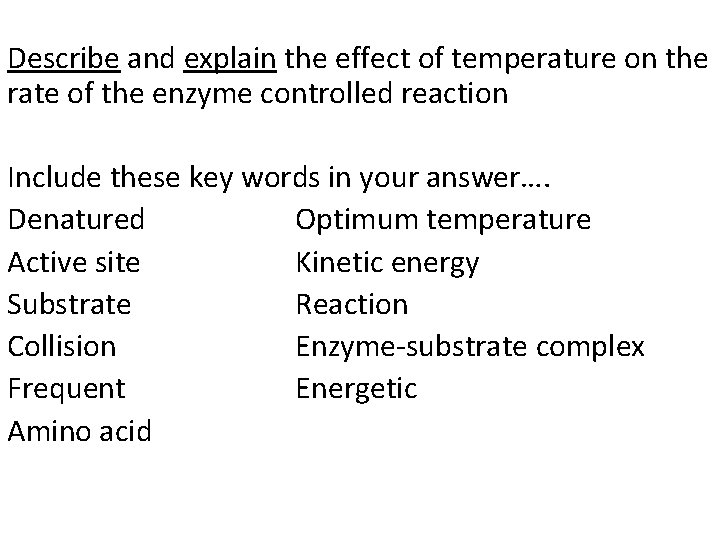
Describe and explain the effect of temperature on the rate of the enzyme controlled reaction Include these key words in your answer…. Denatured Optimum temperature Active site Kinetic energy Substrate Reaction Collision Enzyme-substrate complex Frequent Energetic Amino acid
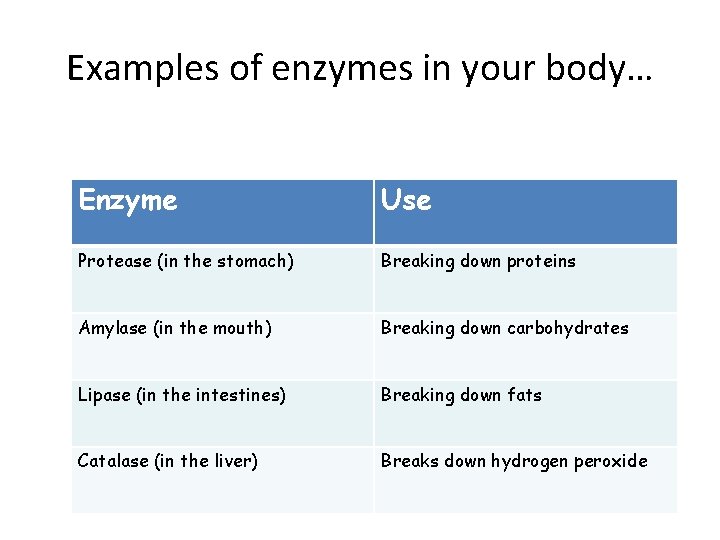
Examples of enzymes in your body… Enzyme Use Protease (in the stomach) Breaking down proteins Amylase (in the mouth) Breaking down carbohydrates Lipase (in the intestines) Breaking down fats Catalase (in the liver) Breaks down hydrogen peroxide
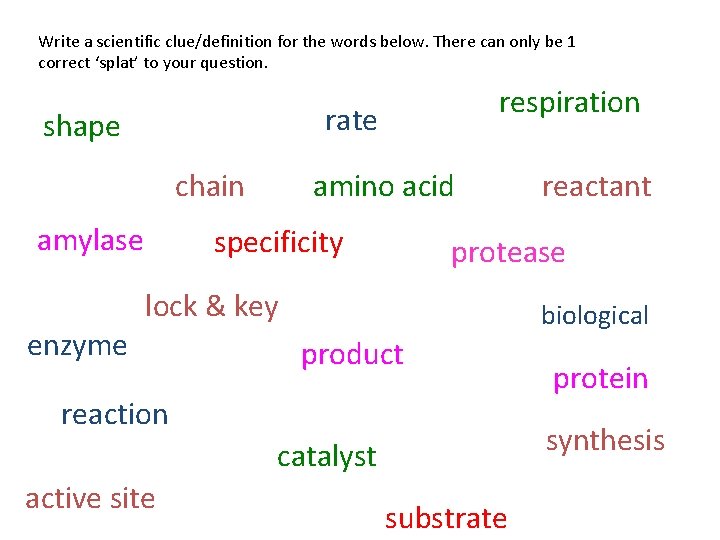
Write a scientific clue/definition for the words below. There can only be 1 correct ‘splat’ to your question. rate shape chain amylase enzyme respiration amino acid specificity protease lock & key biological product reaction protein synthesis catalyst active site reactant substrate
Practical next lesson…… • To investigate the effects of temperature on the activity of pectinase in forming apple juice. (Pectinase degrades pectin in the apples so that juice is produced more readily) Plan a practical Include a step by step method Identify the independent, dependent and control variables Safety points