
1 100 years of General Relativity Susan Cartwright
- Slides: 34
1 100 years of General Relativity Susan Cartwright Luc Viatour
2 Ideas of General Relativity § The Special Theory of Relativity (1905) argued that all observers at rest or in uniform motion observe the same laws of physics § including in particular the same speed of light § The General Theory (1915) postulates that this also applies to observers falling freely in a gravitational field § this is the Principle of Equivalence § The key ingredient here is that all objects experience the same acceleration in a gravitational field § this is reminiscent of the “fictitious forces” introduced to describe motion in accelerated reference frames, e. g. “centrifugal force”
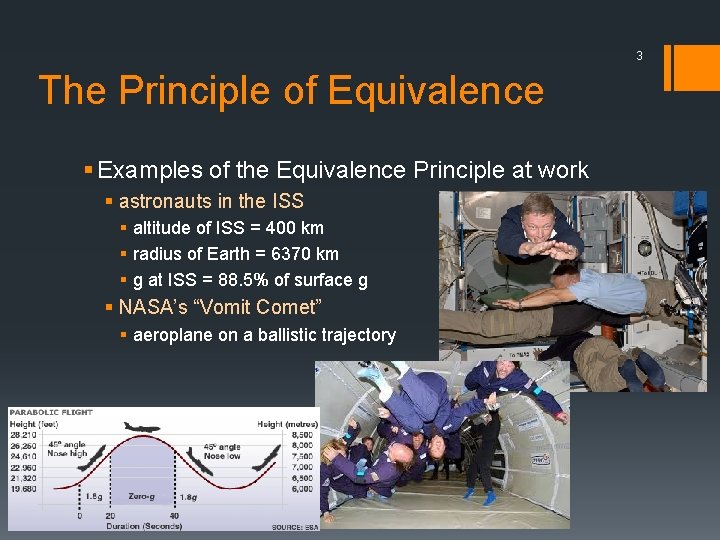
3 The Principle of Equivalence § Examples of the Equivalence Principle at work § astronauts in the ISS § altitude of ISS = 400 km § radius of Earth = 6370 km § g at ISS = 88. 5% of surface g § NASA’s “Vomit Comet” § aeroplane on a ballistic trajectory
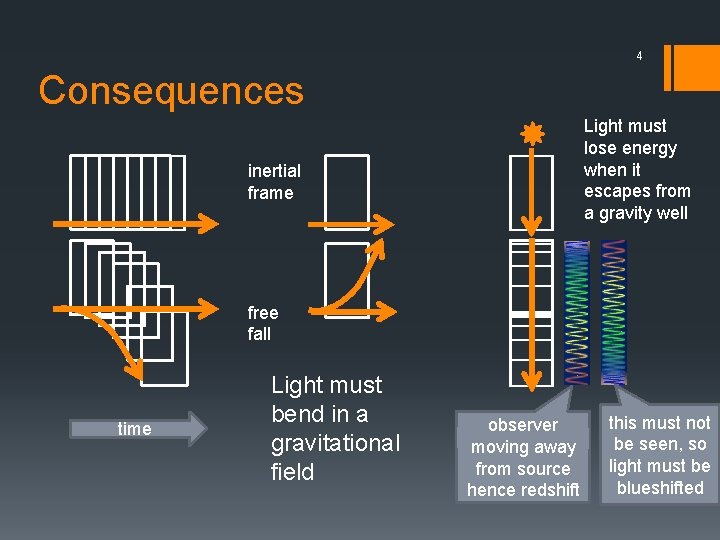
4 Consequences Light must lose energy when it escapes from a gravity well inertial frame free fall time Light must bend in a gravitational field observer moving away from source hence redshift this must not be seen, so light must be blueshifted
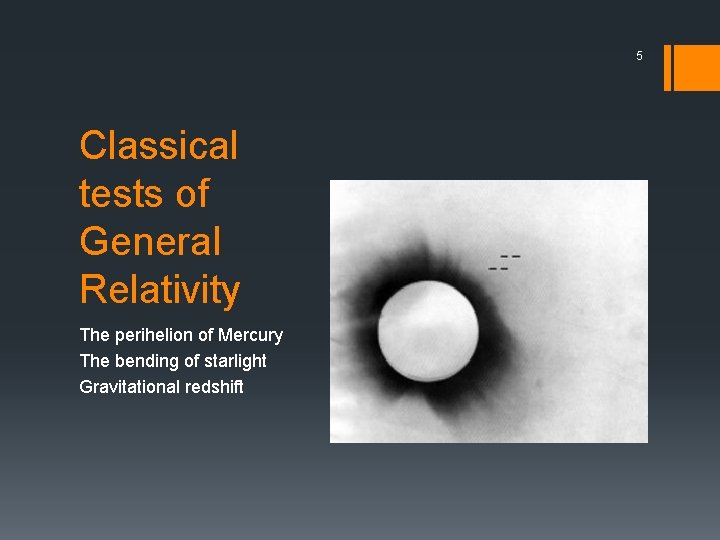
5 Classical tests of General Relativity The perihelion of Mercury The bending of starlight Gravitational redshift
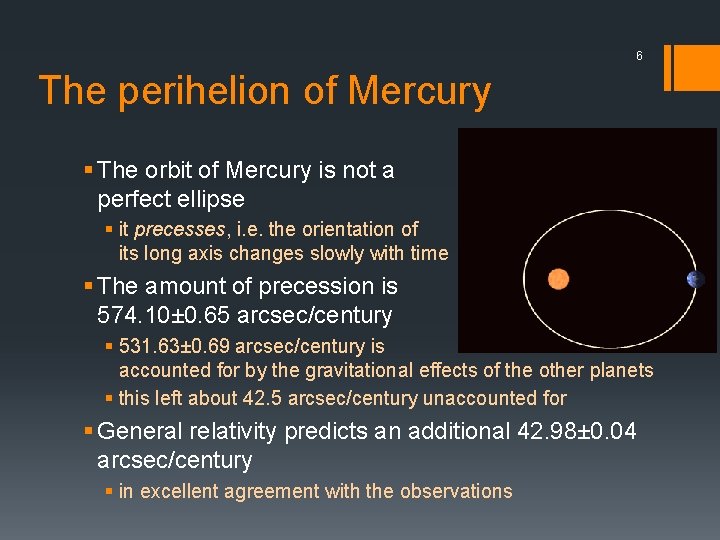
6 The perihelion of Mercury § The orbit of Mercury is not a perfect ellipse § it precesses, i. e. the orientation of its long axis changes slowly with time § The amount of precession is 574. 10± 0. 65 arcsec/century § 531. 63± 0. 69 arcsec/century is accounted for by the gravitational effects of the other planets § this left about 42. 5 arcsec/century unaccounted for § General relativity predicts an additional 42. 98± 0. 04 arcsec/century § in excellent agreement with the observations
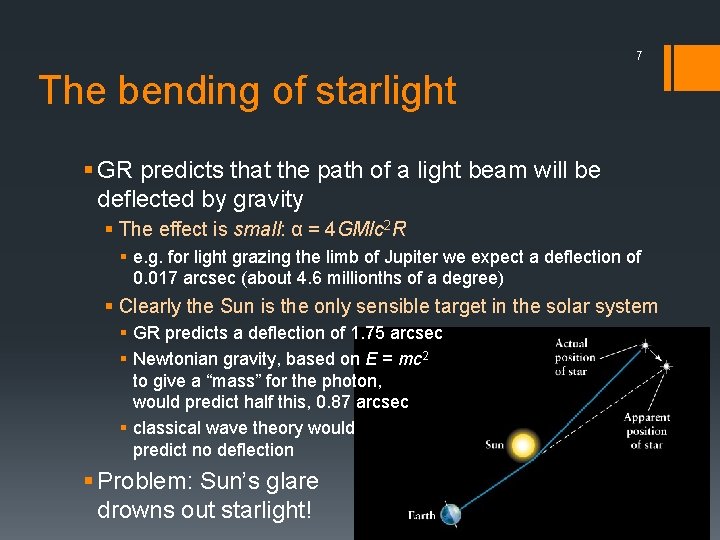
7 The bending of starlight § GR predicts that the path of a light beam will be deflected by gravity § The effect is small: α = 4 GM/c 2 R § e. g. for light grazing the limb of Jupiter we expect a deflection of 0. 017 arcsec (about 4. 6 millionths of a degree) § Clearly the Sun is the only sensible target in the solar system § GR predicts a deflection of 1. 75 arcsec § Newtonian gravity, based on E = mc 2 to give a “mass” for the photon, would predict half this, 0. 87 arcsec § classical wave theory would predict no deflection § Problem: Sun’s glare drowns out starlight!
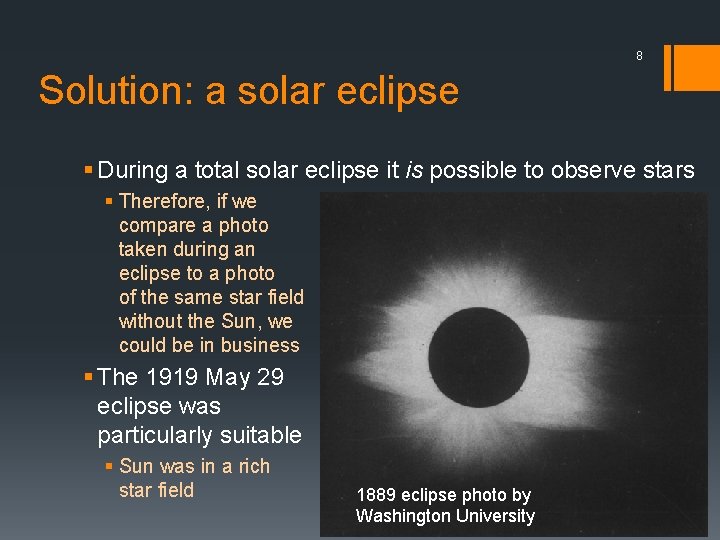
8 Solution: a solar eclipse § During a total solar eclipse it is possible to observe stars § Therefore, if we compare a photo taken during an eclipse to a photo of the same star field without the Sun, we could be in business § The 1919 May 29 eclipse was particularly suitable § Sun was in a rich star field 1889 eclipse photo by Washington University
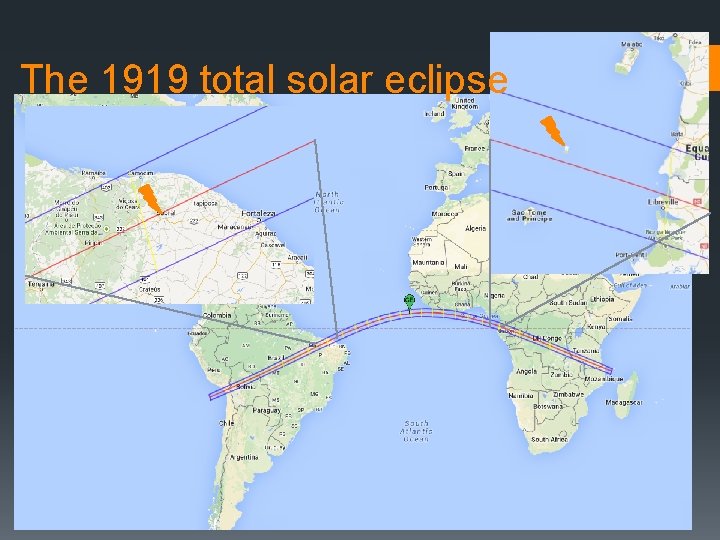
9 The 1919 eclipse expeditions § By November 1917 the Joint Permanent Eclipse Committee of the Royal Society had “decided, if possible, to send expeditions to Sobral in North Brazil, and to the island of Principe” [off the west coast of Africa] § to be organised by Sir Frank Dyson (Astronomer Royal), Prof. Arthur Eddington, Prof. Alfred Fowler and Prof. Herbert Turner § this is a fairly impressive decision considering that the First World War was still raging at the time § Sobral expedition (Crommelin and Davidson) arrived in Sobral on 1919 April 30 and set up on “the race-course of the Jockey Club, which was provided with a covered grand stand” § Principe expedition (Eddington and Cottingham) arrived April 23 and set up in a walled garden belonging to Sr Carneiro, owner of a cocoa plantation, who “had postponed a visit to Europe in order to entertain us”
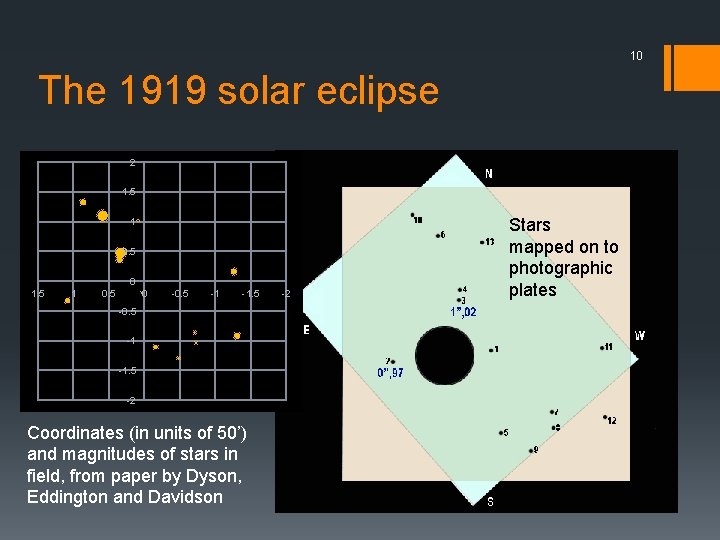
10 The 1919 solar eclipse 2 1. 5 1 0. 5 0 -0. 5 -1 -1. 5 -2 Coordinates (in units of 50’) and magnitudes of stars in field, from paper by Dyson, Eddington and Davidson -2 Stars mapped on to photographic plates
The 1919 total solar eclipse 11
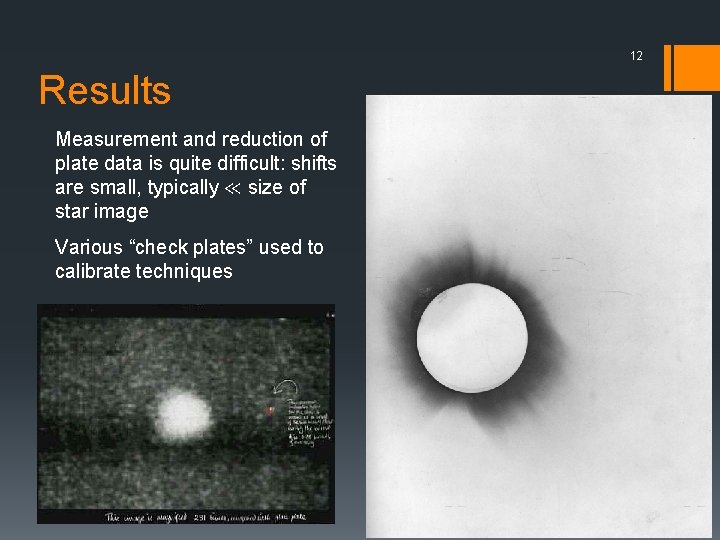
12 Results Measurement and reduction of plate data is quite difficult: shifts are small, typically ≪ size of star image Various “check plates” used to calibrate techniques
13 Results § The Sobral team took 8 plates with a 4 -inch objective and 19 with a 13 -inch astrograph stopped down to 8 in § unfortunately the plates from the astrograph turned out to be “very disappointing. The images were diffused and apparently out of focus” § they suspected that this was due to distortion of the optics as a consequence of use in the heat of the Sun rather than at night § The Principe team took 16 plates using a similar astrograph, also stopped to 8 in § though the first 9 show no star images owing to poor weather § the remaining 7 show between 4 and 6 stars (the Sobral 4 -in plates show seven), but only two were satisfactory as star 5 is needed for accurate alignment of plates
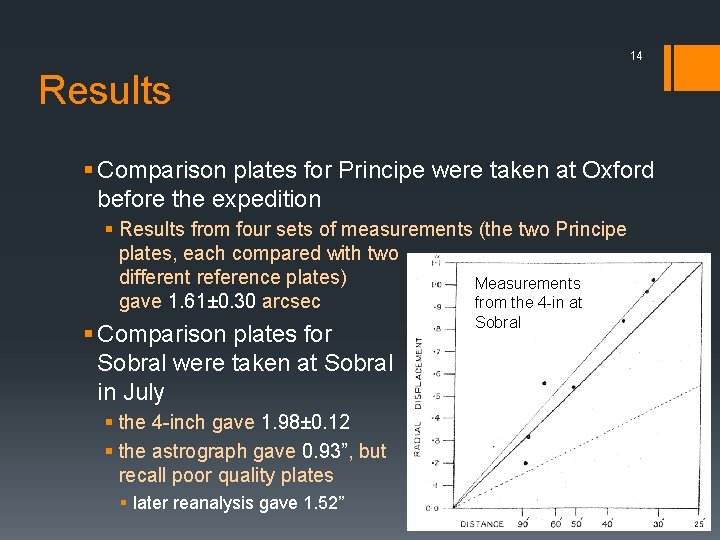
14 Results § Comparison plates for Principe were taken at Oxford before the expedition § Results from four sets of measurements (the two Principe plates, each compared with two different reference plates) Measurements from the 4 -in at gave 1. 61± 0. 30 arcsec § Comparison plates for Sobral were taken at Sobral in July § the 4 -inch gave 1. 98± 0. 12 § the astrograph gave 0. 93”, but recall poor quality plates § later reanalysis gave 1. 52” Sobral
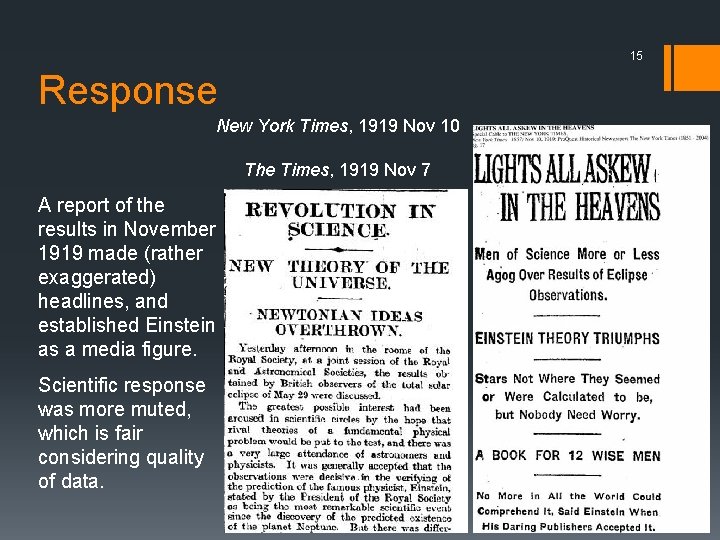
15 Response New York Times, 1919 Nov 10 The Times, 1919 Nov 7 A report of the results in November 1919 made (rather exaggerated) headlines, and established Einstein as a media figure. Scientific response was more muted, which is fair considering quality of data.
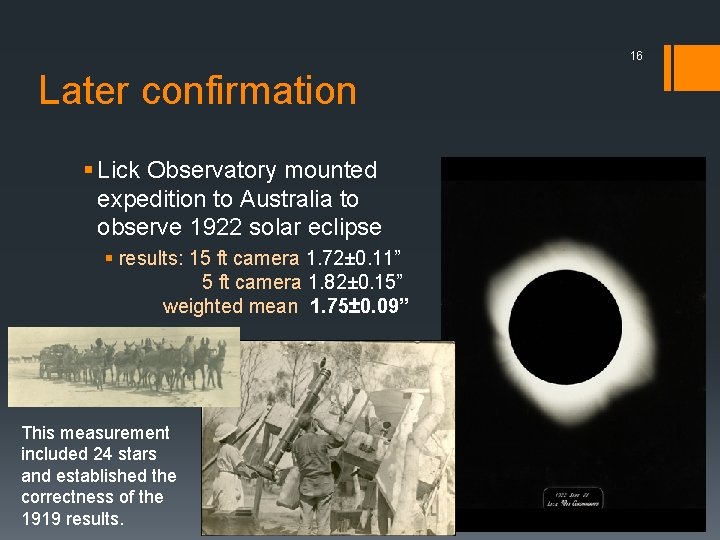
16 Later confirmation § Lick Observatory mounted expedition to Australia to observe 1922 solar eclipse § results: 15 ft camera 1. 72± 0. 11” 5 ft camera 1. 82± 0. 15” weighted mean 1. 75± 0. 09” This measurement included 24 stars and established the correctness of the 1919 results.
17 Gravitational redshift § The predicted gravitational redshift is another small effect—the fractional shift in the wavelength is approximately GM/c 2 R where M is the mass of the body and R is the distance between the centre of mass and the point at which the light is emitted § The obvious test of this is extremely dense astrophysical compact objects § white dwarfs: mass ~0. 5 – 1. 0 solar masses, radius ~10000 km § neutron stars: mass ~1. 5 solar masses, radius ~10 km § Problem: to test Einstein’s prediction, need to know both mass and radius § for most astrophysical objects this is a serious challenge
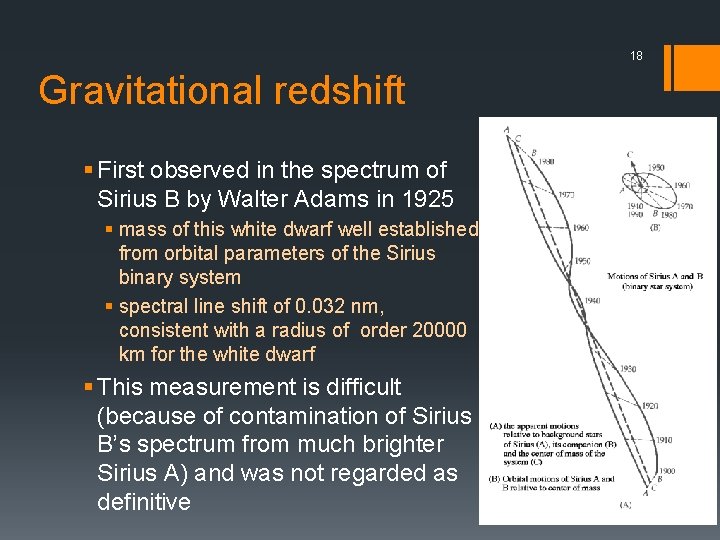
18 Gravitational redshift § First observed in the spectrum of Sirius B by Walter Adams in 1925 § mass of this white dwarf well established from orbital parameters of the Sirius binary system § spectral line shift of 0. 032 nm, consistent with a radius of order 20000 km for the white dwarf § This measurement is difficult (because of contamination of Sirius B’s spectrum from much brighter Sirius A) and was not regarded as definitive
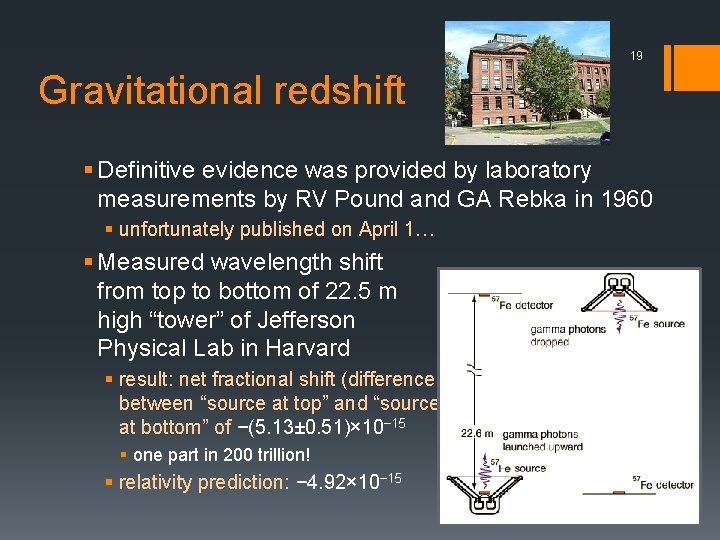
19 Gravitational redshift § Definitive evidence was provided by laboratory measurements by RV Pound and GA Rebka in 1960 § unfortunately published on April 1… § Measured wavelength shift from top to bottom of 22. 5 m high “tower” of Jefferson Physical Lab in Harvard § result: net fractional shift (difference between “source at top” and “source at bottom” of −(5. 13± 0. 51)× 10− 15 § one part in 200 trillion! § relativity prediction: − 4. 92× 10− 15
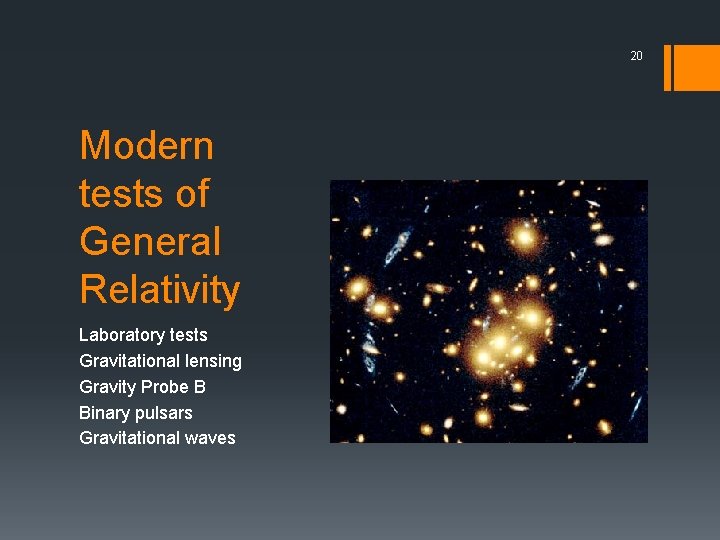
20 Modern tests of General Relativity Laboratory tests Gravitational lensing Gravity Probe B Binary pulsars Gravitational waves
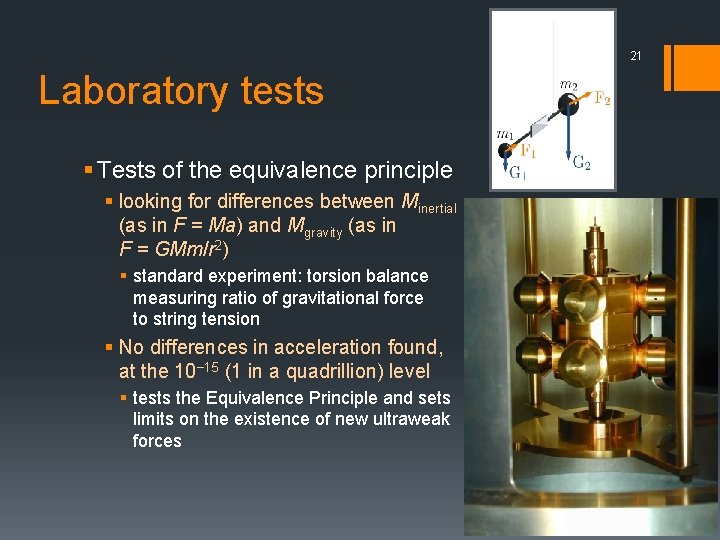
21 Laboratory tests § Tests of the equivalence principle § looking for differences between Minertial (as in F = Ma) and Mgravity (as in F = GMm/r 2) § standard experiment: torsion balance measuring ratio of gravitational force to string tension § No differences in acceleration found, at the 10− 15 (1 in a quadrillion) level § tests the Equivalence Principle and sets limits on the existence of new ultraweak forces
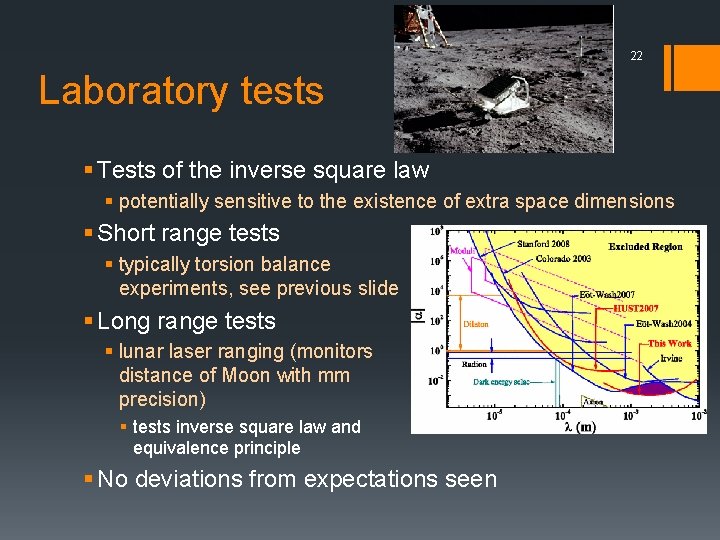
22 Laboratory tests § Tests of the inverse square law § potentially sensitive to the existence of extra space dimensions § Short range tests § typically torsion balance experiments, see previous slide § Long range tests § lunar laser ranging (monitors distance of Moon with mm precision) § tests inverse square law and equivalence principle § No deviations from expectations seen
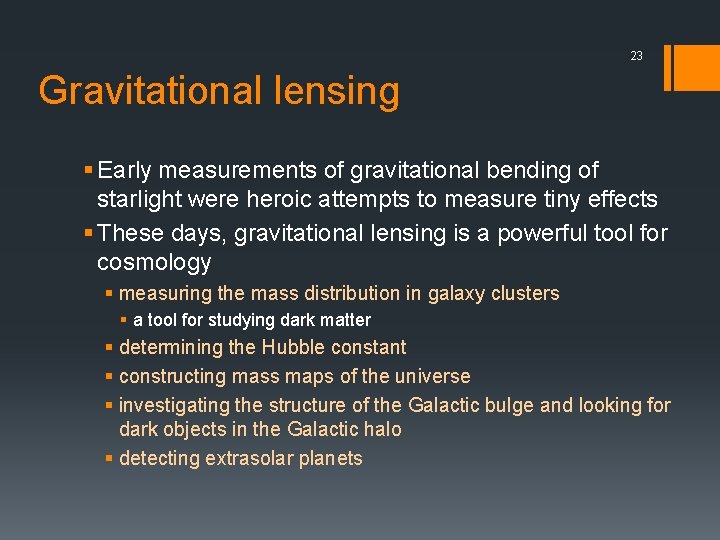
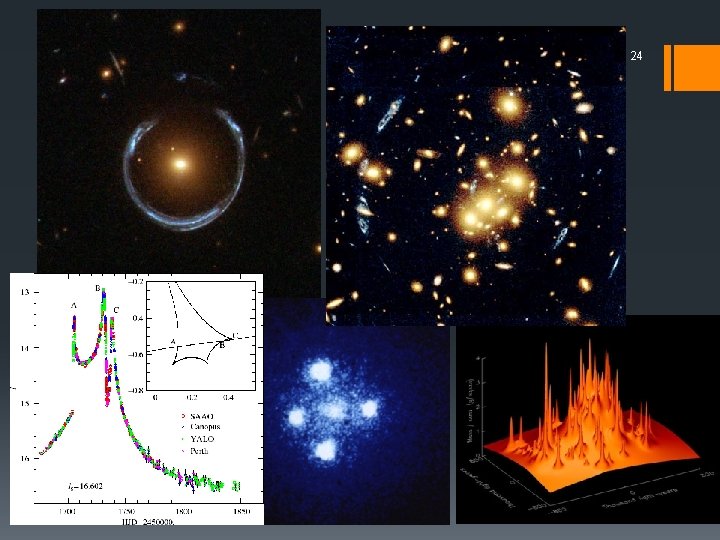
23 Gravitational lensing § Early measurements of gravitational bending of starlight were heroic attempts to measure tiny effects § These days, gravitational lensing is a powerful tool for cosmology § measuring the mass distribution in galaxy clusters § a tool for studying dark matter § determining the Hubble constant § constructing mass maps of the universe § investigating the structure of the Galactic bulge and looking for dark objects in the Galactic halo § detecting extrasolar planets
24
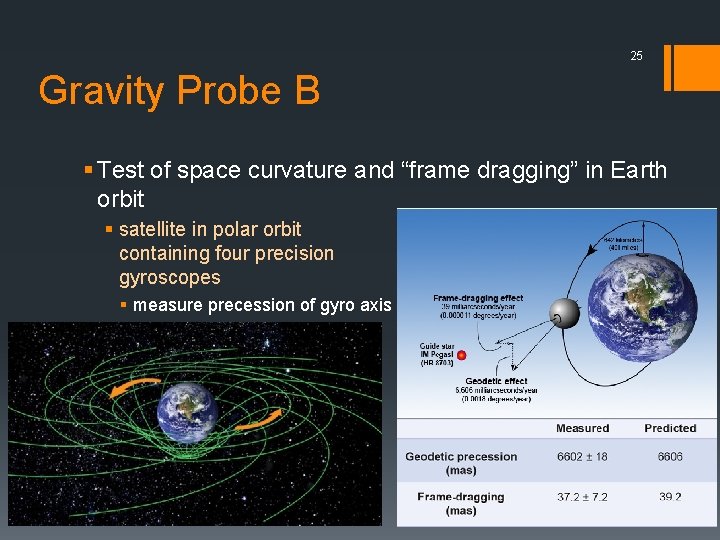
25 Gravity Probe B § Test of space curvature and “frame dragging” in Earth orbit § satellite in polar orbit containing four precision gyroscopes § measure precession of gyro axis
26 Binary pulsars § The ideal test of General Relativity is an accurate clock in a strong gravitational field § Precisely this is provided by pulsars in close binary systems with other compact objects (other neutron stars, white dwarfs, potentially—but not yet observed—black holes) § First example: Hulse-Taylor pulsar, PSR B 1913+16 § system consists of a pulsar and another neutron star (not observed as a pulsar) § Most spectacular example: PSR J 0737− 3039 § a double neutron star system in which both neutron stars are seen as pulsars
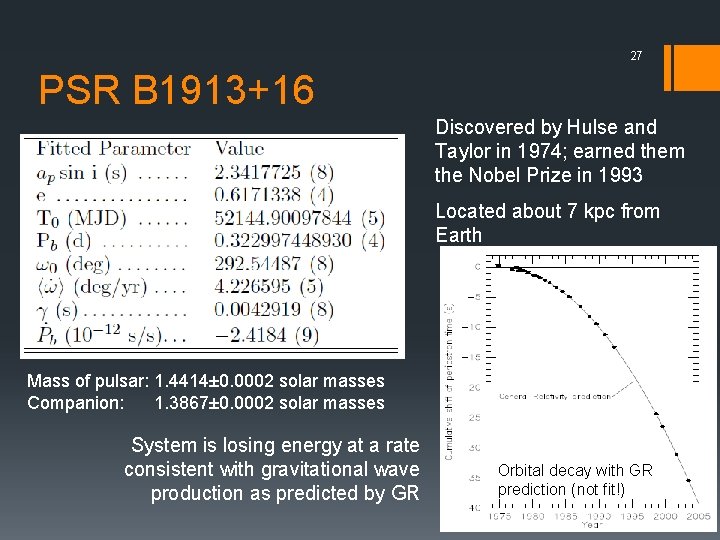
27 PSR B 1913+16 Discovered by Hulse and Taylor in 1974; earned them the Nobel Prize in 1993 Located about 7 kpc from Earth Mass of pulsar: 1. 4414± 0. 0002 solar masses Companion: 1. 3867± 0. 0002 solar masses System is losing energy at a rate consistent with gravitational wave production as predicted by GR Orbital decay with GR prediction (not fit!)
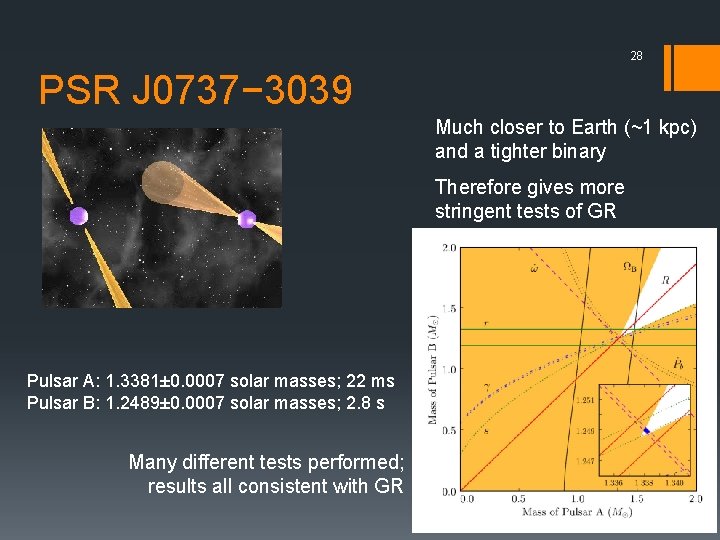
28 PSR J 0737− 3039 Much closer to Earth (~1 kpc) and a tighter binary Therefore gives more stringent tests of GR Pulsar A: 1. 3381± 0. 0007 solar masses; 22 ms Pulsar B: 1. 2489± 0. 0007 solar masses; 2. 8 s Many different tests performed; results all consistent with GR
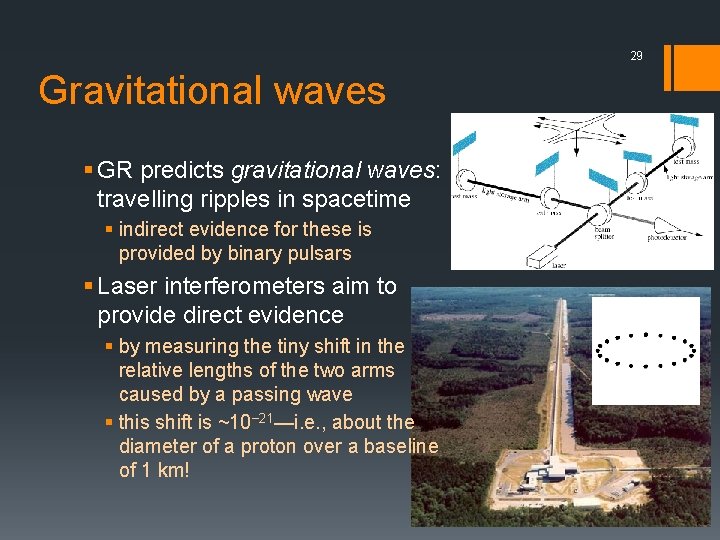
29 Gravitational waves § GR predicts gravitational waves: travelling ripples in spacetime § indirect evidence for these is provided by binary pulsars § Laser interferometers aim to provide direct evidence § by measuring the tiny shift in the relative lengths of the two arms caused by a passing wave § this shift is ~10− 21—i. e. , about the diameter of a proton over a baseline of 1 km!
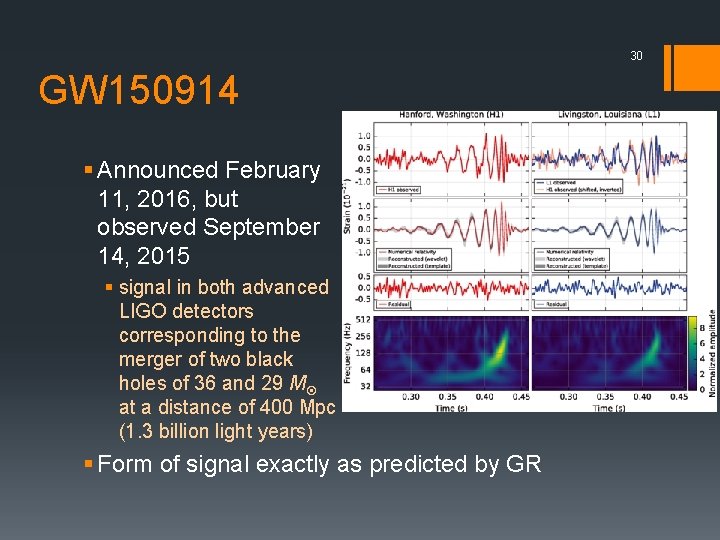
30 GW 150914 § Announced February 11, 2016, but observed September 14, 2015 § signal in both advanced LIGO detectors corresponding to the merger of two black holes of 36 and 29 M at a distance of 400 Mpc (1. 3 billion light years) § Form of signal exactly as predicted by GR
31 General Relativity and You
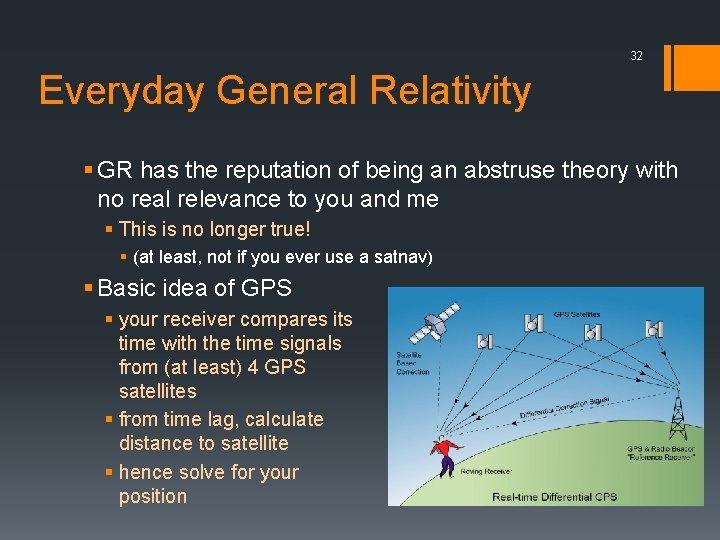
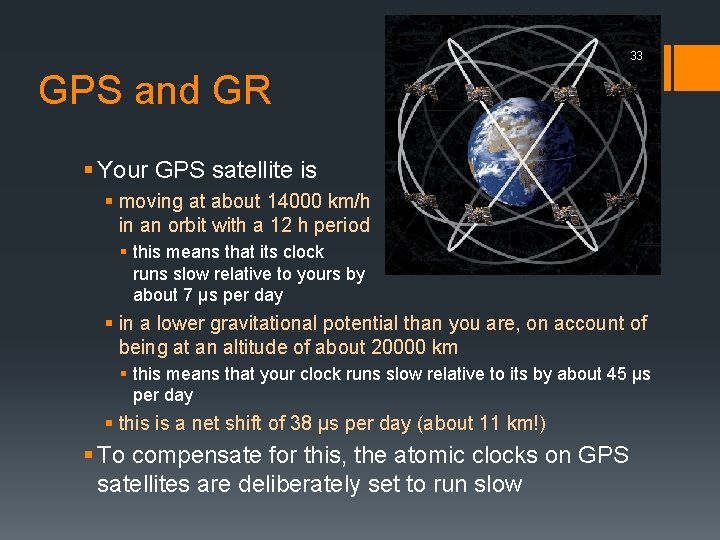
32 Everyday General Relativity § GR has the reputation of being an abstruse theory with no real relevance to you and me § This is no longer true! § (at least, not if you ever use a satnav) § Basic idea of GPS § your receiver compares its time with the time signals from (at least) 4 GPS satellites § from time lag, calculate distance to satellite § hence solve for your position
33 GPS and GR § Your GPS satellite is § moving at about 14000 km/h in an orbit with a 12 h period § this means that its clock runs slow relative to yours by about 7 µs per day § in a lower gravitational potential than you are, on account of being at an altitude of about 20000 km § this means that your clock runs slow relative to its by about 45 µs per day § this is a net shift of 38 µs per day (about 11 km!) § To compensate for this, the atomic clocks on GPS satellites are deliberately set to run slow
34 Summary § Over the last half century or so, General Relativity has become an extremely well-verified theory § owing to a combination of very high precision local measurements and measurements of extreme astrophysical systems § Further advances in experimental General Relativity are likely in the near future § increasing numbers of binary pulsars § further observations of gravitational waves § Happy 100 th birthday, GR!