
1 10 1 The Importance of Nutrition Why
- Slides: 66
1
10. 1 The Importance of Nutrition Why Nutrition Matters? u The food you eat affects your health and quality of life Nutrition-the process by which your body takes in and uses food (refers to the study of the way in which the substances in food affect our health) 2 © 2002 Learning Zone Express
Nutrients u The food you eat is a source of nutrients. Nutrients are defined as the substances found in food that keep your body functioning. u u 3 Why do we study nutrition? Food directly affects your health and quality of life!! Your body needs nutrients to… l Fuel your energy. l Help you grow. l Repair itself. l Maintain basic bodily functions.
Benefits of Healthy Eating during Teen Years Choosing right foods in right amounts provides the body with nutrients needed for: 4 u Proper growth & development u Stay mentally alert u Keeps you looking & feeling good “improves self-esteem” u Prevents the onset of chronic illnesses associated with diet & exercise © 2002 Learning Zone Express
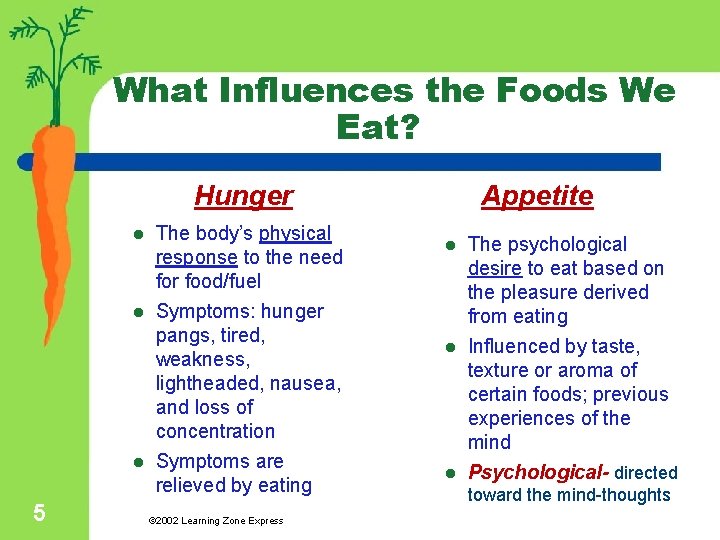
What Influences the Foods We Eat? Hunger l l l 5 The body’s physical response to the need for food/fuel Symptoms: hunger pangs, tired, weakness, lightheaded, nausea, and loss of concentration Symptoms are relieved by eating © 2002 Learning Zone Express Appetite l l l The psychological desire to eat based on the pleasure derived from eating Influenced by taste, texture or aroma of certain foods; previous experiences of the mind Psychological- directed toward the mind-thoughts
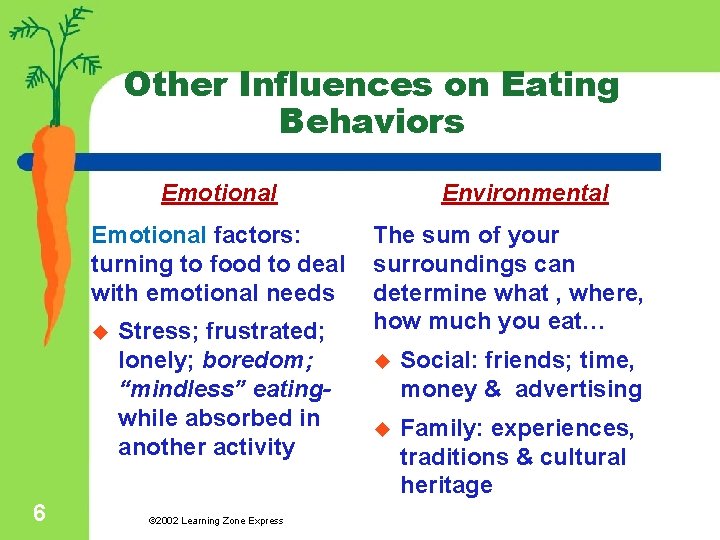
Other Influences on Eating Behaviors Environmental Emotional factors: turning to food to deal with emotional needs u 6 Stress; frustrated; lonely; boredom; “mindless” eatingwhile absorbed in another activity © 2002 Learning Zone Express The sum of your surroundings can determine what , where, how much you eat… u Social: friends; time, money & advertising u Family: experiences, traditions & cultural heritage
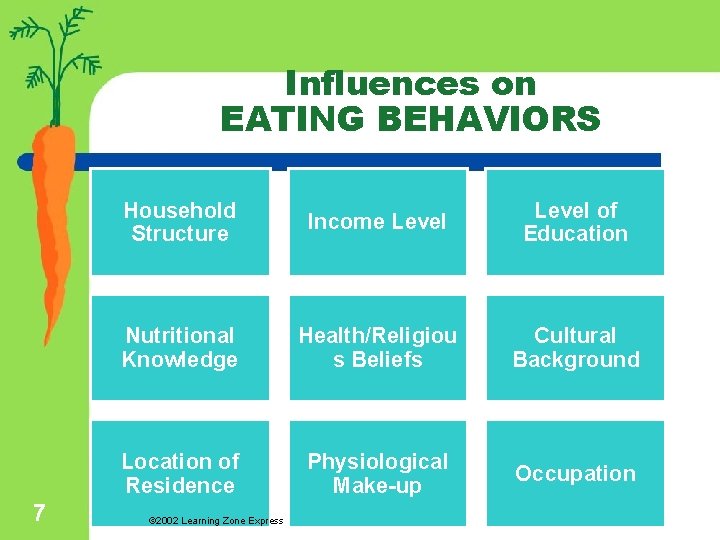
Influences on EATING BEHAVIORS 7 Household Structure Income Level of Education Nutritional Knowledge Health/Religiou s Beliefs Cultural Background Location of Residence Physiological Make-up Occupation © 2002 Learning Zone Express
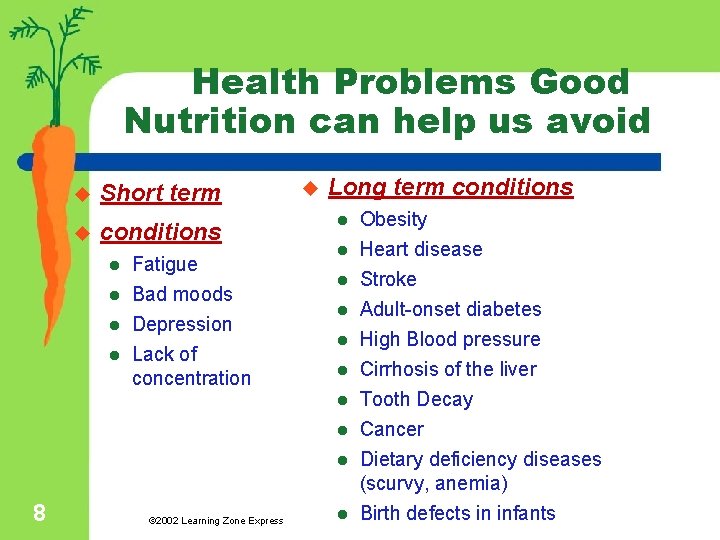
Health Problems Good Nutrition can help us avoid u Short term u conditions l l Fatigue Bad moods Depression Lack of concentration u Long term conditions l Obesity l Heart disease Stroke Adult-onset diabetes High Blood pressure Cirrhosis of the liver Tooth Decay Cancer Dietary deficiency diseases (scurvy, anemia) Birth defects in infants l l l l 8 © 2002 Learning Zone Express l
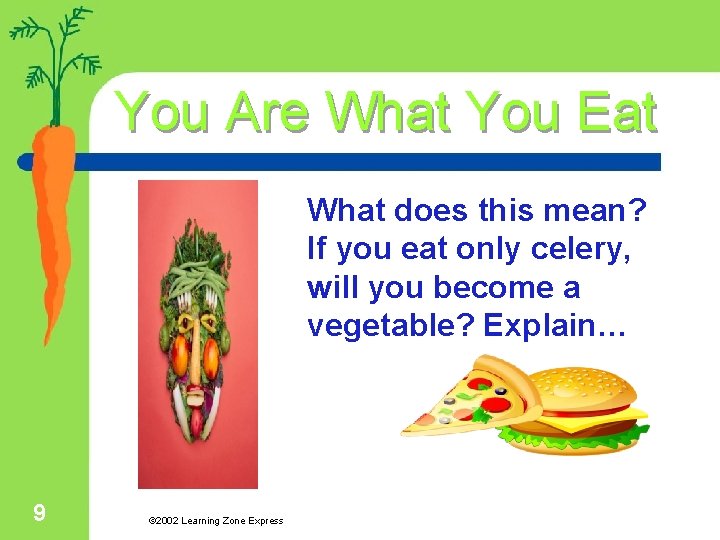
You Are What You Eat What does this mean? If you eat only celery, will you become a vegetable? Explain… 9 © 2002 Learning Zone Express
6 Essential Nutrients u Each nutrient has and important role(s) in keeping the body healthy. u THE 3 GENERAL FUNCTIONS OF ALL ARE: 10 Ø Provide energy Ø Promote Growth & Development Ø Regulate Body Functions © 2002 Learning Zone Express
Relationship between Nutrient & Calorie u Calorie l l l A unit of measurement /it measures the energy content found in food 1 nutrition calorie = 1 kilocalorie 3, 500 calories = 1 lb. u Only 3 out of the 6 essential nutrients provide calories/energy 11 Do you know which ones they are? ? ? Carbohydrates, fats, & proteins © 2002 Learning Zone Express
Balance is Key For years, people held to the idea that there are “bad” nutrients and “good” nutrients when, in fact, all nutrients play a certain role in the body. Even those nutrients once considered “bad” such as fats and carbohydrates perform vital functions in the body and if one consumes too many “good” nutrients such as vitamins or minerals there can be harmful results, as well. These three are the framework of the FDA: 12 u Balance - Eat foods from all groups. u Variety - Eat different foods from each food group. u Moderation – Portion Control
The 6 Essential Nutrients u Water u Carbohydrates u Protein u Fat u Vitamins u Minerals 13
Water u Did you know? l u Functions in the Body: l l l 14 1/2 to 3/4 of the human body consists of water! Water carries nutrients to your cells and carries waste from your body. Regulates body temperature. Dissolves vitamins, minerals, amino acids and other nutrients. Lubricates joints. Water versus sugary drinks!
Dehydration u. A state in which the body has lost more water than it has taken in u Prolonged Dehydration= Kidney Failure= Death u Dr. Travis Stork on the dangers of dehydration and heat stroke 15
Carbohydrates are the body’s main source of energy and provide the body’s need for dietary fiber. 16 u Carbs are our primary energy source that provides about 4 calories u Food Sources: l Pasta, breads, cereals, grains, rice, fruits, milk, yogurt and sweets. u Two types of Carbohydrates: l Starches or Complex Carbohydrates l Simple Carbohydrates
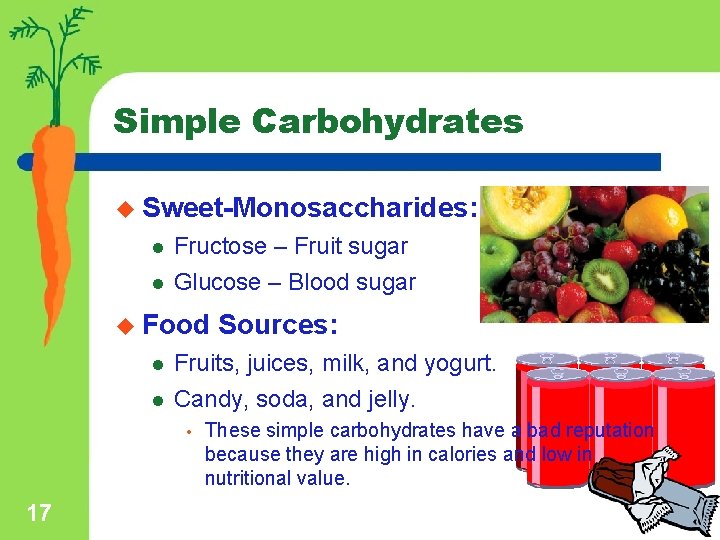
Simple Carbohydrates u Sweet-Monosaccharides: l l Fructose – Fruit sugar Glucose – Blood sugar u Food l l Fruits, juices, milk, and yogurt. Candy, soda, and jelly. • 17 Sources: These simple carbohydrates have a bad reputation because they are high in calories and low in nutritional value.
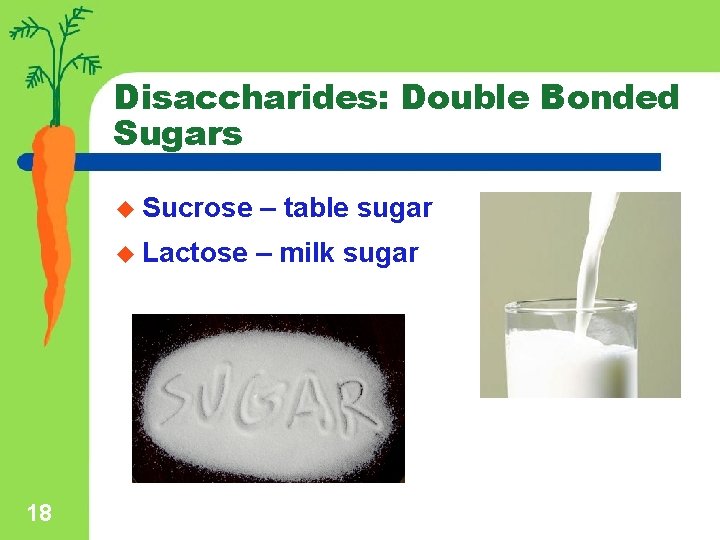
Disaccharides: Double Bonded Sugars 18 u Sucrose – table sugar u Lactose – milk sugar
Starches or Complex Carbohydrates u Polysaccharides: u Food l Sources: Whole grain breads and cereals, pasta, vegetables, rice, tortilla and legumes. u Function 19 Comes from plants in the Body: l An excellent source of fuel (energy) for the body. l Rich in vitamins, minerals and fiber.
Fiber u Fiber is the plant material that doesn’t break down when you digest food. Many, but not all, complex carbohydrates contain fiber. u Food Sources: l u Function in the Body: l l l 20 Oatmeal, fruits, vegetables, whole grains and legumes. Aids in digestion. May reduce the risk of developing some diseases like heart disease, diabetes and obesity, and certain types of cancer. Helps promote regularity.
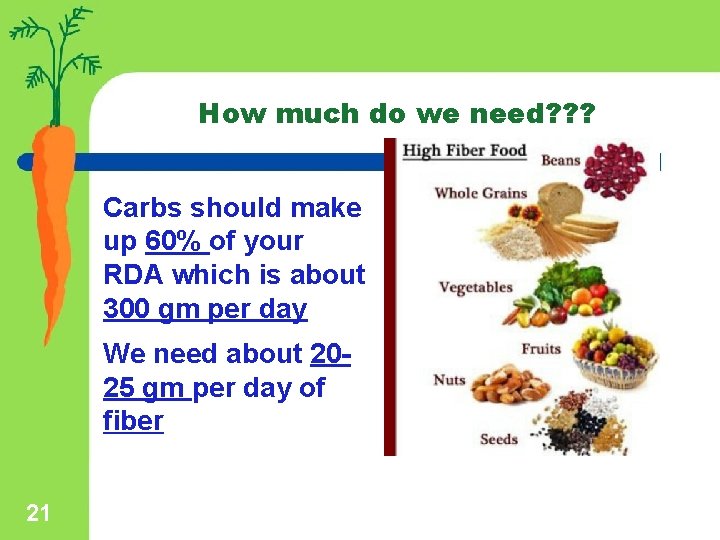
How much do we need? ? ? Carbs should make up 60% of your RDA which is about 300 gm per day We need about 2025 gm per day of fiber 21
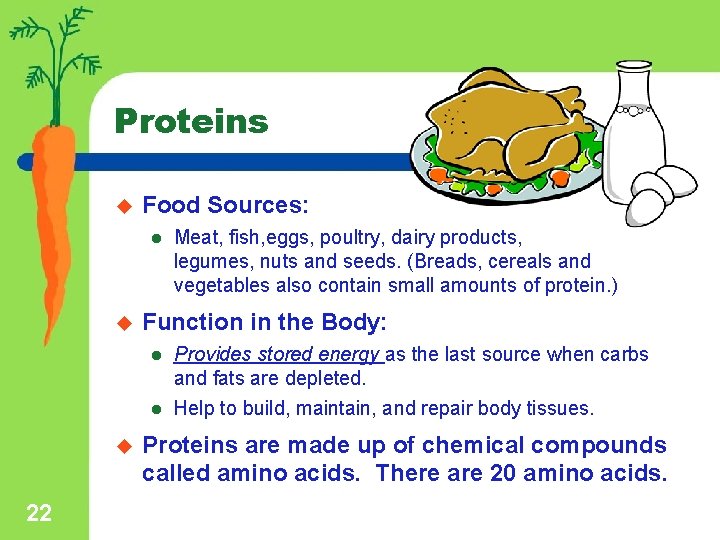
Proteins u Food Sources: l u Function in the Body: l l u 22 Meat, fish, eggs, poultry, dairy products, legumes, nuts and seeds. (Breads, cereals and vegetables also contain small amounts of protein. ) Provides stored energy as the last source when carbs and fats are depleted. Help to build, maintain, and repair body tissues. Proteins are made up of chemical compounds called amino acids. There are 20 amino acids.
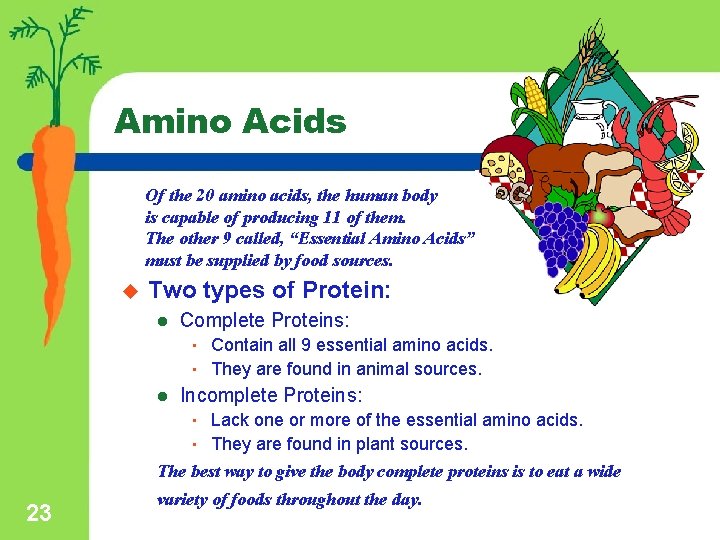
Amino Acids Of the 20 amino acids, the human body is capable of producing 11 of them. The other 9 called, “Essential Amino Acids” must be supplied by food sources. u Two types of Protein: l Complete Proteins: • • l Contain all 9 essential amino acids. They are found in animal sources. Incomplete Proteins: • • Lack one or more of the essential amino acids. They are found in plant sources. The best way to give the body complete proteins is to eat a wide 23 variety of foods throughout the day.
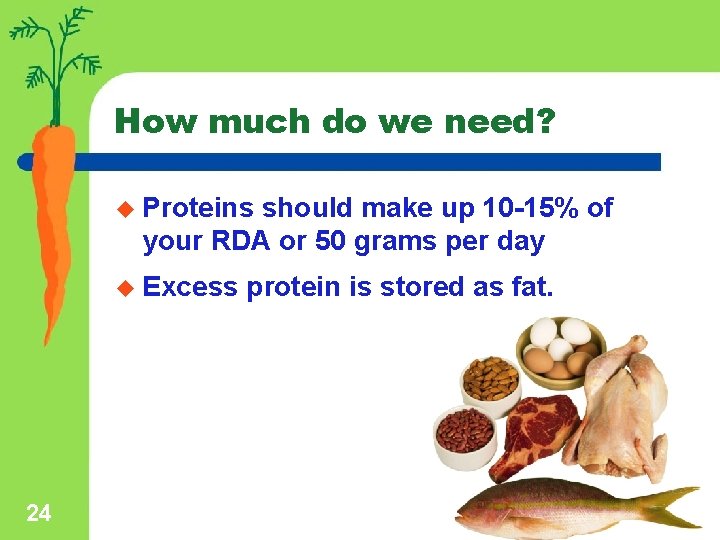
How much do we need? u Proteins should make up 10 -15% of your RDA or 50 grams per day u Excess 24 protein is stored as fat.
Fat Who's Fat? - The most concentrated form of food energy (calories). u Food Sources: l Butter, vegetable oils, salad dressings, nuts and seeds, dairy products made with whole milk or cream, and meats. l u Function in the Body: l l l 25 l Provide substances needed for growth and healthy skin. Enhance the taste and texture of food. Required to carry “fat-soluble” vitamins throughout the body. Provides stored energy 9 cal/gm.
Types of Fat u Saturated Fat: l l l u Fats that are usually solid at room temperature. Food Sources: Animal foods and tropical oils. The type of fat most strongly linked to high cholesterol and increased risk of heart disease. Unsaturated Fat: l l Fats that are liquid at room temperature. Polyunsaturated Fat: • • l Monounsaturated Fat: • 26 Food Sources: Vegetables and fish oils. Provide two essential fatty acids necessary for bodily functions. • Food Sources: Olive oil, canola oil, nuts, seeds. May play a role in reducing the risk of heart disease.
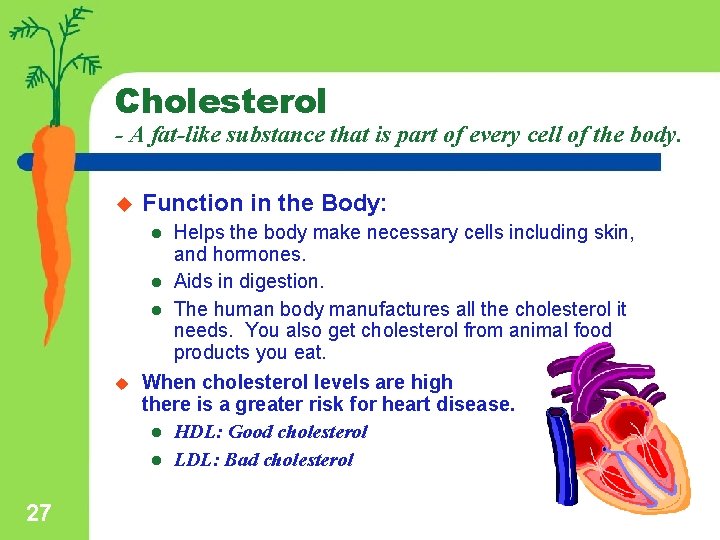
Cholesterol - A fat-like substance that is part of every cell of the body. u Function in the Body: Helps the body make necessary cells including skin, and hormones. l Aids in digestion. l The human body manufactures all the cholesterol it needs. You also get cholesterol from animal food products you eat. When cholesterol levels are high there is a greater risk for heart disease. l HDL: Good cholesterol l LDL: Bad cholesterol l u 27
Fats 28 u Trans Fat: Unlike other fats, trans fat — also called trans-fatty acids — both raises your "bad" (LDL) cholesterol and lowers your "good" (HDL) cholesterol. u Trans fat is made by adding hydrogen to vegetable oil through a process called hydrogenation, which makes the oil less likely to spoil. Using trans fats in the manufacturing of foods helps foods stay fresh longer, have a longer shelf life and have a less greasy feel.
Fatty Info u Trigylcerides: Fats made by the body. The heavier, less active, the more triglycerides; which means an even greater risk of heart disease. u Fats should make up about 30% of your RDA and make sure to limit saturated fats to only 10 gm per day. 29
Vitamins u Food Sources: l u u Unlike carbohydrates, fats, and proteins, vitamins DO NOT provide energy (calories) but are needed for good health and are needed in small amounts. Function in the Body: l l 30 Fruits, vegetables, milk, whole-grain breads, cereals and legumes. l Help regulate the many chemical processes in the body. There are 13 different vitamins known to be required each day for good health. Vitamins are separated into two types: Fat Soluble & Water Soluble Vitamins.
Fat/Water Soluble Vitamins u Fat Soluble Vitamins l l l u Water Soluble Vitamins l l l 31 Vitamins A, D, E, K Require fat for the stomach to allow them to be carried into the blood stream for use (absorption). Can be stored in the body for later use. Vitamins C and B-complex Require water for absorption. Easily absorbed and passed through the body as waste.
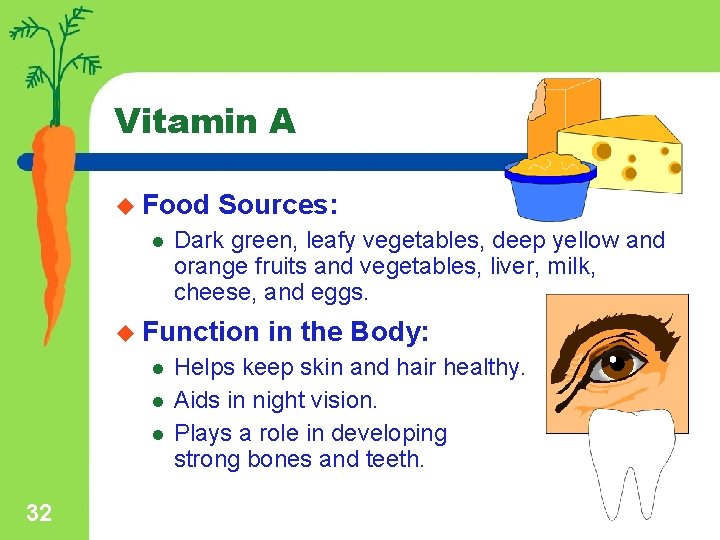
Vitamin A u Food l Sources: Dark green, leafy vegetables, deep yellow and orange fruits and vegetables, liver, milk, cheese, and eggs. u Function l l l 32 in the Body: Helps keep skin and hair healthy. Aids in night vision. Plays a role in developing strong bones and teeth.
Vitamin D u Food l l Sources: Vitamin D fortified milk, egg yolk, salmon, and liver. Nonfood Source: the sun. u Function l l 33 in the Body: Helps the body use calcium and phosphorus. Plays a role in building strong bones and teeth.
Vitamin E u Food l Sources: Whole-grain breads and cereals; dark green, leafy vegetables; dry beans and peas; nuts and seeds; vegetable oils; margarine; liver. u Function l 34 in the Body: Helps form red blood cells, muscles, and other tissues.
Vitamin K u Food l Sources: Dark green and leafy vegetables (such as spinach, lettuce, kale, collard greens), and cabbage. u Function l 35 in the Body: Helps blood to clot.
Vitamin B-complex (water soluble) u Food l Sources: Whole grain and enriched breads and cereals; dry bean and peas; peanut butter; nuts; meat; poultry; fish; eggs; milk. u Function l l 36 in the Body: Helps the body use the energy from the foods we eat. Helps brain, nerves, and muscles function.
Vitamin C u Food l Sources: Citrus fruits, strawberries, kiwi, broccoli, tomatoes, and potatoes. u Function l Helps heal wounds. Helps maintain healthy bones, teeth, and blood vessels. l Helps body fight infection. l 37 in the Body:
Minerals u Food l Sources: Meats, beans, nuts, fruits, vegetables, dairy products, and grains. u Functions l The body depends on minerals for practically every process necessary for life. Minerals actually become part of the body. l Controls body functions/chemical reactions. l 38 in the Body:
Minerals u Calcium u Phosphorus Magnesium Sodium Potassium Iron Others include: u u u l 39 Iodine, Zinc, Copper, Sulfur, Chloride, etc.
Calcium & Phosphorus u Food l Sources: Dairy Products: milk, cheese, ice cream, green leafy vegetables, canned sardines and other processed fish eaten with bones. u Function l l in the Body: Helps build and maintain healthy bones and teeth. Helps heart, nerves, and muscles work properly. u Deficiency 40 (lack) of calcium & phosphorus leads to osteoporosis.
Iron u Food sources l u Function in the Body: l l u 41 Liver, kidney, heart, meat, egg yolk, dried beans and peas, spinach, dried fruit, whole-grain & enriched breads & cereals, nuts. Helps make hemoglobin in red blood cells. Helps cells used oxygen. Deficiency (lack) of iron leads to anemia.
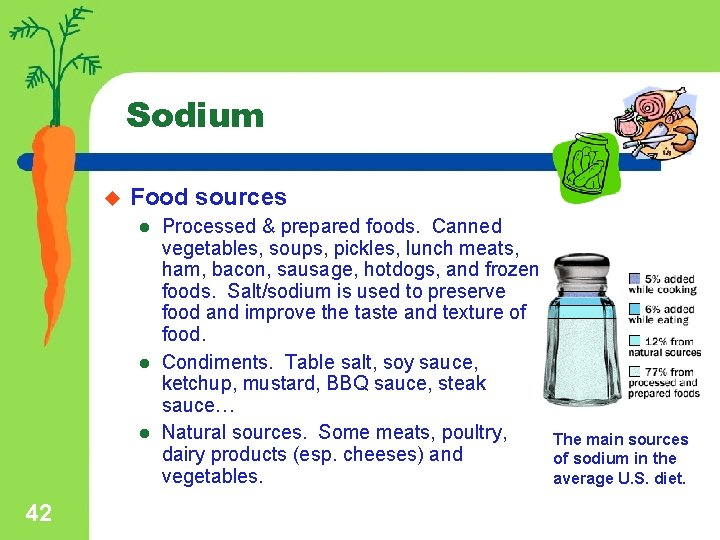
Sodium u Food sources l l l 42 Processed & prepared foods. Canned vegetables, soups, pickles, lunch meats, ham, bacon, sausage, hotdogs, and frozen foods. Salt/sodium is used to preserve food and improve the taste and texture of food. Condiments. Table salt, soy sauce, ketchup, mustard, BBQ sauce, steak sauce… Natural sources. Some meats, poultry, dairy products (esp. cheeses) and vegetables. The main sources of sodium in the average U. S. diet.
Sodium u Function in the Body: l l l u 43 Helps maintain the right balance of fluids in your body. Helps transmit nerve impulses. Influences the contraction and relaxation of muscles. Excess sodium can lead to hypertension (high blood pressure), a condition that can lead to cardiovascular and kidney diseases.
Nutrient Deficiency u u A nutritional deficiency occurs when your body doesn’t get enough nutrients. Symptoms: l l u 44 At first the symptoms may not seem serious. They may include: tiredness, difficulty sleeping or concentrating, frequent colds, and weight loss or gains. However, if the deficiency is not corrected the symptoms may get more serious and effect the skin, eyes, and bones. The best way to avoid a nutrient deficiency is to eat a well balanced diet.
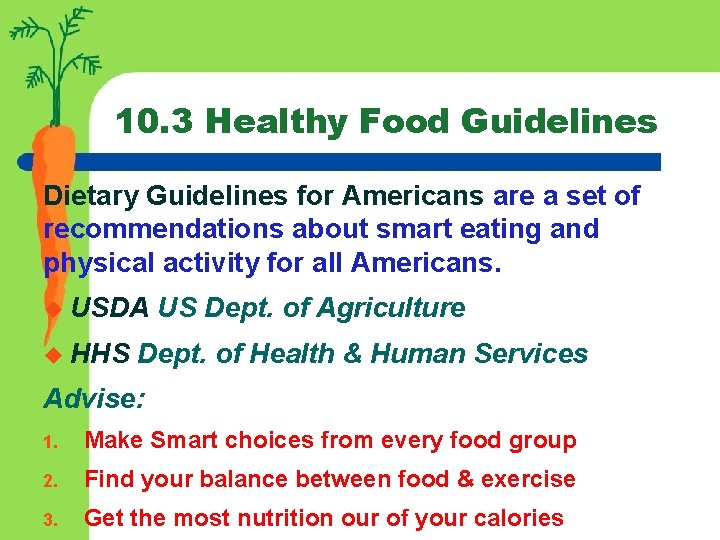
10. 3 Healthy Food Guidelines Dietary Guidelines for Americans are a set of recommendations about smart eating and physical activity for all Americans. u USDA u HHS US Dept. of Agriculture Dept. of Health & Human Services Advise: 1. Make Smart choices from every food group 2. Find your balance between food & exercise 3. Get the most nutrition our of your calories
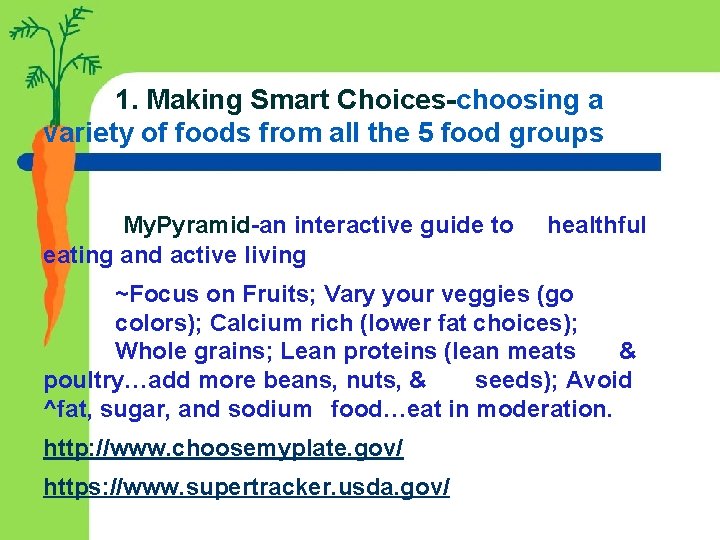
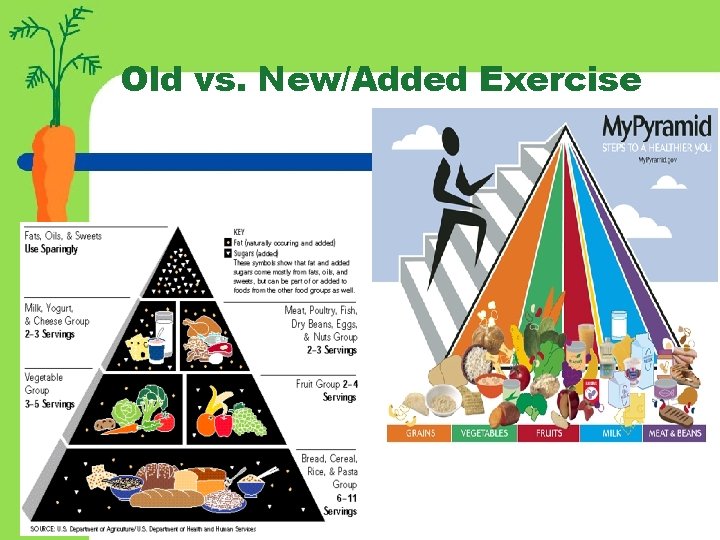
1. Making Smart Choices-choosing a variety of foods from all the 5 food groups My. Pyramid-an interactive guide to eating and active living healthful ~Focus on Fruits; Vary your veggies (go colors); Calcium rich (lower fat choices); Whole grains; Lean proteins (lean meats & poultry…add more beans, nuts, & seeds); Avoid ^fat, sugar, and sodium food…eat in moderation. http: //www. choosemyplate. gov/ https: //www. supertracker. usda. gov/
Old vs. New/Added Exercise
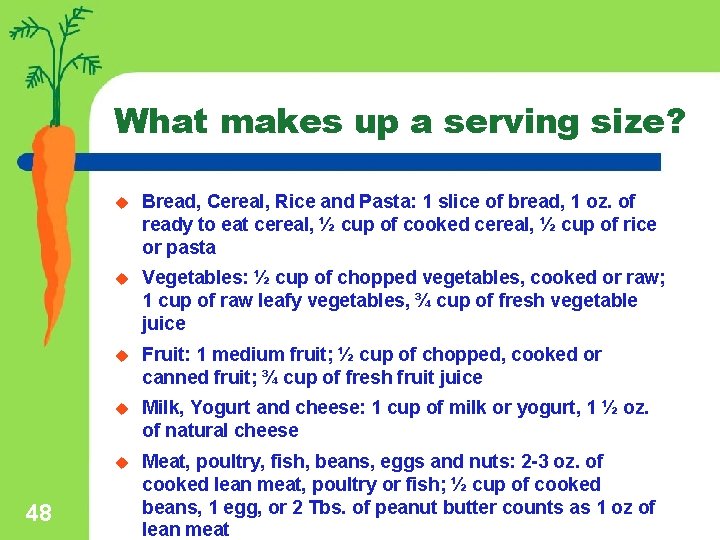
What makes up a serving size? 48 u Bread, Cereal, Rice and Pasta: 1 slice of bread, 1 oz. of ready to eat cereal, ½ cup of cooked cereal, ½ cup of rice or pasta u Vegetables: ½ cup of chopped vegetables, cooked or raw; 1 cup of raw leafy vegetables, ¾ cup of fresh vegetable juice u Fruit: 1 medium fruit; ½ cup of chopped, cooked or canned fruit; ¾ cup of fresh fruit juice u Milk, Yogurt and cheese: 1 cup of milk or yogurt, 1 ½ oz. of natural cheese u Meat, poultry, fish, beans, eggs and nuts: 2 -3 oz. of cooked lean meat, poultry or fish; ½ cup of cooked beans, 1 egg, or 2 Tbs. of peanut butter counts as 1 oz of lean meat
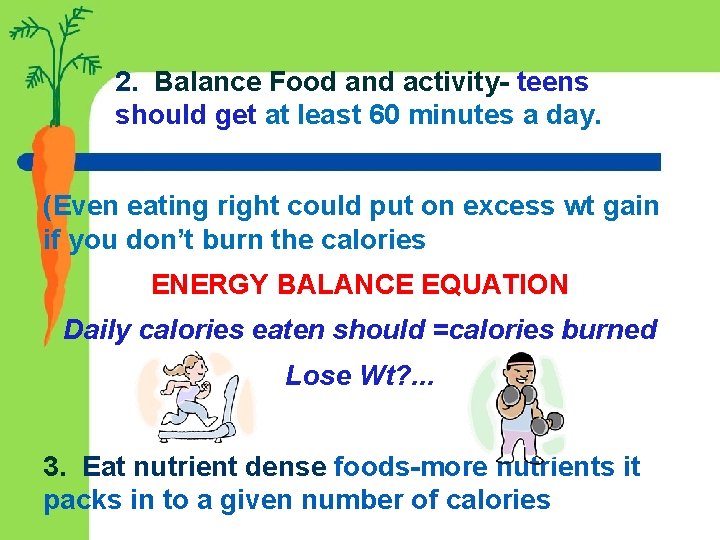
2. Balance Food and activity- teens should get at least 60 minutes a day. (Even eating right could put on excess wt gain if you don’t burn the calories ENERGY BALANCE EQUATION Daily calories eaten should =calories burned Lose Wt? . . . 3. Eat nutrient dense foods-more nutrients it packs in to a given number of calories
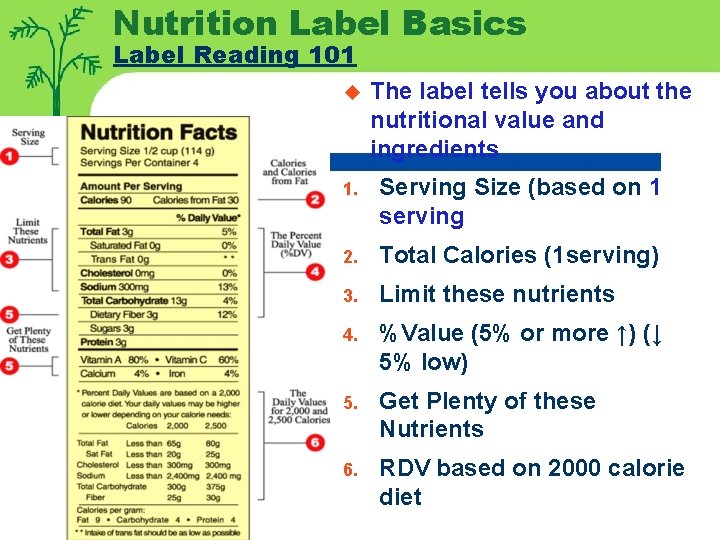
Nutrition Label Basics Label Reading 101 u 50 © 2002 Learning Zone Express The label tells you about the nutritional value and ingredients 1. Serving Size (based on 1 serving 2. Total Calories (1 serving) 3. Limit these nutrients 4. %Value (5% or more ↑) (↓ 5% low) 5. Get Plenty of these Nutrients 6. RDV based on 2000 calorie diet
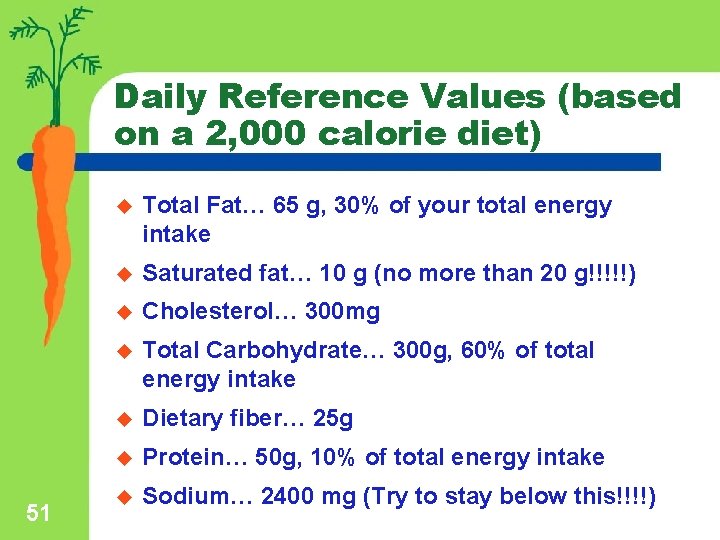
Daily Reference Values (based on a 2, 000 calorie diet) 51 u Total Fat… 65 g, 30% of your total energy intake u Saturated fat… 10 g (no more than 20 g!!!!!) u Cholesterol… 300 mg u Total Carbohydrate… 300 g, 60% of total energy intake u Dietary fiber… 25 g u Protein… 50 g, 10% of total energy intake u Sodium… 2400 mg (Try to stay below this!!!!)
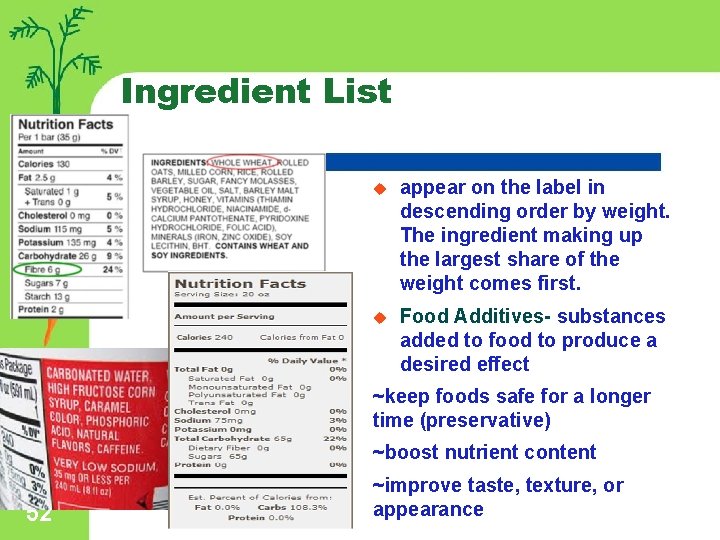
Ingredient List u appear on the label in descending order by weight. The ingredient making up the largest share of the weight comes first. u Food Additives- substances added to food to produce a desired effect ~keep foods safe for a longer time (preservative) ~boost nutrient content 52 ~improve taste, texture, or appearance
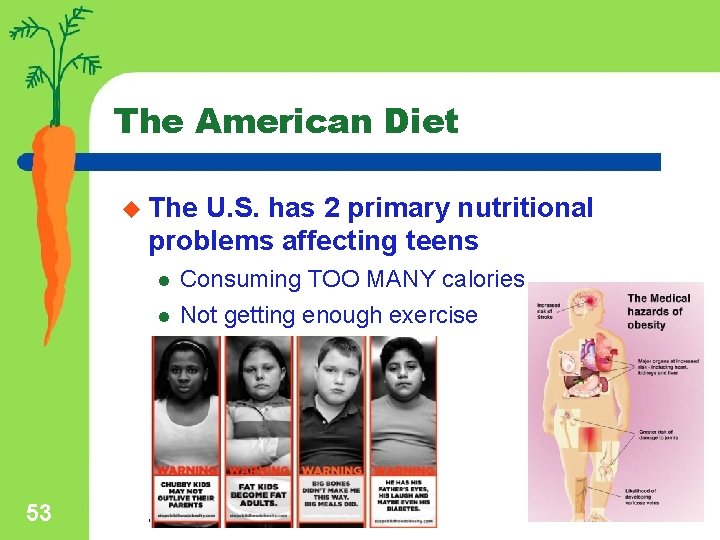
The American Diet u The U. S. has 2 primary nutritional problems affecting teens l l 53 Consuming TOO MANY calories Not getting enough exercise © 2002 Learning Zone Express
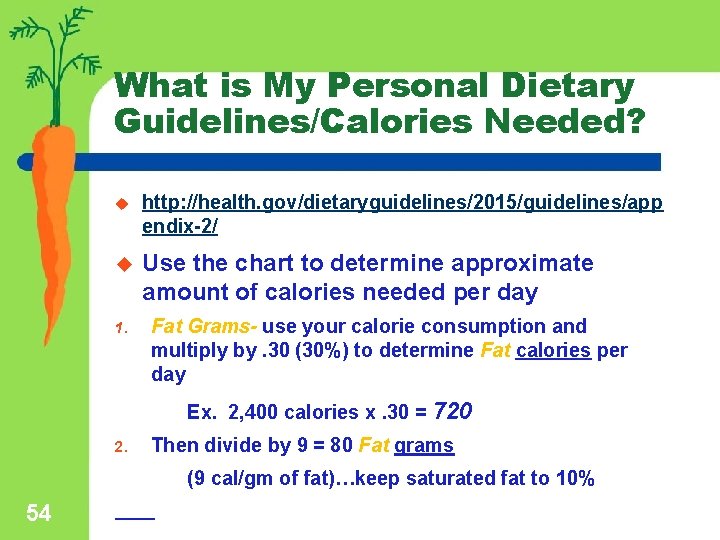
What is My Personal Dietary Guidelines/Calories Needed? u http: //health. gov/dietaryguidelines/2015/guidelines/app endix-2/ u Use the chart to determine approximate amount of calories needed per day 1. Fat Grams- use your calorie consumption and multiply by. 30 (30%) to determine Fat calories per day Ex. 2, 400 calories x. 30 = 2. 720 Then divide by 9 = 80 Fat grams (9 cal/gm of fat)…keep saturated fat to 10% 54
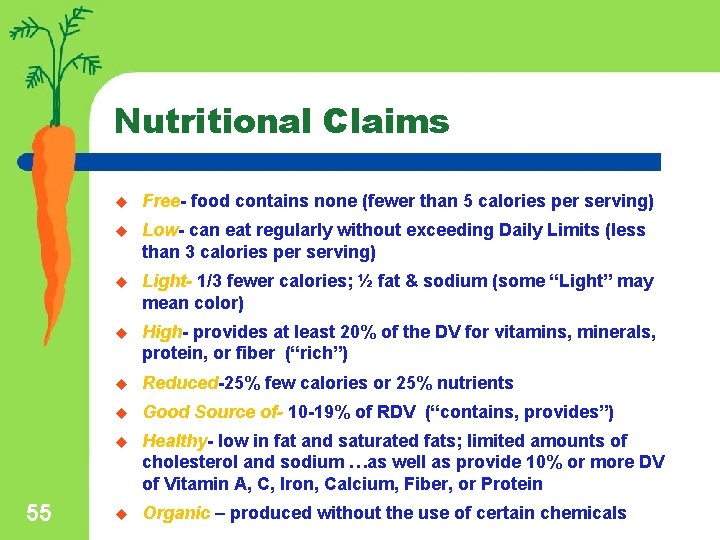
Nutritional Claims 55 u Free- food contains none (fewer than 5 calories per serving) u Low- can eat regularly without exceeding Daily Limits (less than 3 calories per serving) u Light- 1/3 fewer calories; ½ fat & sodium (some “Light” may mean color) u High- provides at least 20% of the DV for vitamins, minerals, protein, or fiber (“rich”) u Reduced-25% few calories or 25% nutrients u Good Source of- 10 -19% of RDV (“contains, provides”) u Healthy- low in fat and saturated fats; limited amounts of cholesterol and sodium …as well as provide 10% or more DV of Vitamin A, C, Iron, Calcium, Fiber, or Protein u Organic – produced without the use of certain chemicals
Sensible Eating 56 u Healthy snacks can keep up u Most menus have your energy and keep you nutrient dense from over eating • Fresh fruits • Cut up veggies • String cheese l • Popcorn l • Yogurt • Bread sticks u http: //www. fitnessmagazine. co m/recipes/healthy-eating/on-thel go/the-30 -worst-fast-foodrestaurant-choices/? page=3 u Water versus sugary drinks! a item…tips to remember l l Watch portion size Pay attention to how they are prepared Add fresh fruit & veggies Go easy on toppings/sauces Don’t drink your calories
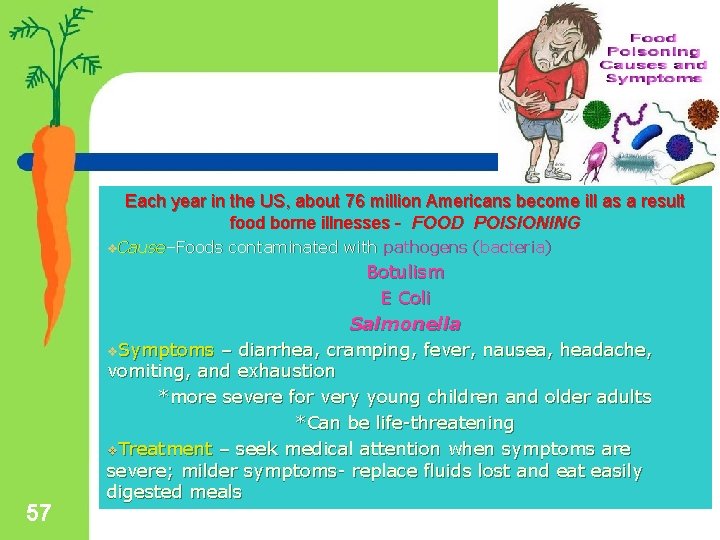
Each year in the US, about 76 million Americans become ill as a result food borne illnesses - FOOD POISIONING v. Cause–Foods 57 contaminated with pathogens (bacteria) Botulism E Coli Salmonella v. Symptoms – diarrhea, cramping, fever, nausea, headache, vomiting, and exhaustion *more severe for very young children and older adults *Can be life-threatening v. Treatment – seek medical attention when symptoms are severe; milder symptoms- replace fluids lost and eat easily digested meals
Clostridium botulinum: Botulism 58 u Found: widely distributed in nature: in soil and water, on plants, and in intestinal tracts of animals and fish. Grows only in little or no oxygen. u Transmission: bacteria produces a toxin that causes illness. Improperly canned foods, garlic in oil, and vacuum-packaged and tightly wrapped food. u Symptoms: toxin affects the nervous system. Symptoms usually appear within 18 to 36 hours, but can sometimes appear within as few as 4 hours or as many as 8 days after eating; double vision, droopy eyelids, trouble speaking and swallowing, and difficulty breathing. Fatal in 3 to 10 days if not treated.
Escherichia coli O 157: H 7 59 u Found: intestinal tracts of some mammals, raw milk, unchlorinated water; one of several strains of E. coli that can cause human illness. u Transmission: contaminated water, raw milk, raw or rare ground beef, unpasteurized apple juice or cider, uncooked fruits and vegetables; person-to-person. u Symptoms: diarrhea or bloody diarrhea, abdominal cramps, nausea, and malaise; can begin 2 to 5 days after food is eaten, lasting about 8 days. Some, especially the very young, have developed Hemolytic Uremic Syndrome (HUS) that causes acute kidney failure. A similar illness, thrombotic thrombocytopenic purpura (TTP), may occur in older adults.
Salmonella (over 1600 types) u Found: intestinal tract and feces of animals; Salmonella enteritidis in raw eggs. u Transmission: raw or undercooked eggs, poultry, and meat; raw milk and dairy products; seafood. u u 60 Symptoms: stomach pain, diarrhea, nausea, chills, fever, and headache usually appear 6 to 48 hours after eating; may last 1 to 2 days.
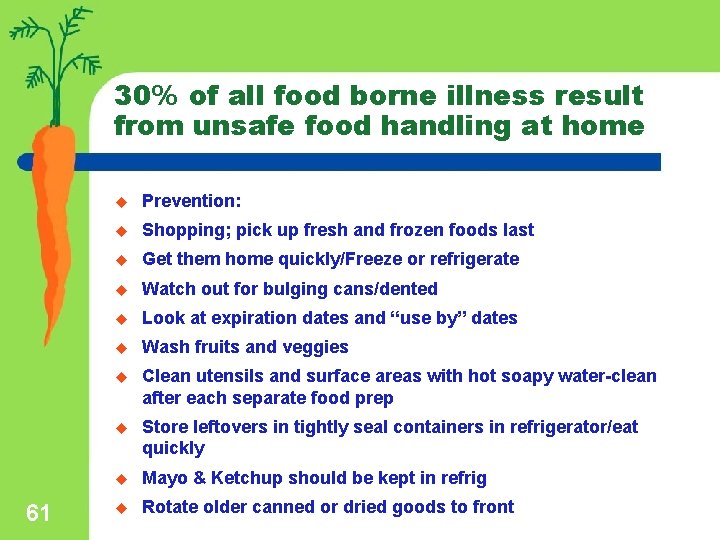
30% of all food borne illness result from unsafe food handling at home 61 u Prevention: u Shopping; pick up fresh and frozen foods last u Get them home quickly/Freeze or refrigerate u Watch out for bulging cans/dented u Look at expiration dates and “use by” dates u Wash fruits and veggies u Clean utensils and surface areas with hot soapy water-clean after each separate food prep u Store leftovers in tightly seal containers in refrigerator/eat quickly u Mayo & Ketchup should be kept in refrig u Rotate older canned or dried goods to front
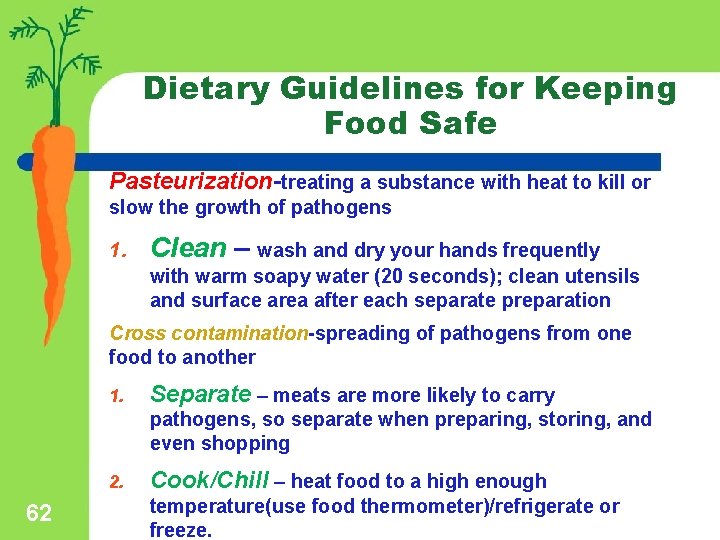
Dietary Guidelines for Keeping Food Safe Pasteurization-treating a substance with heat to kill or slow the growth of pathogens 1. Clean – wash and dry your hands frequently with warm soapy water (20 seconds); clean utensils and surface area after each separate preparation Cross contamination-spreading of pathogens from one food to another 1. Separate – meats are more likely to carry pathogens, so separate when preparing, storing, and even shopping 2. 62 Cook/Chill – heat food to a high enough temperature(use food thermometer)/refrigerate or freeze.
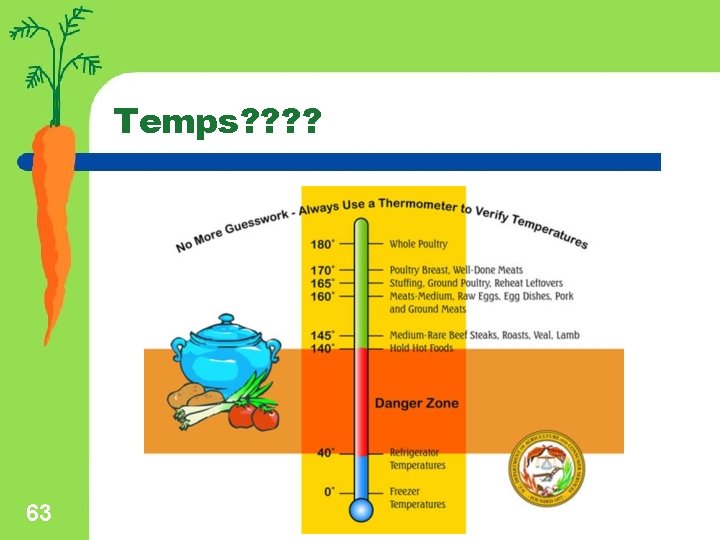
Temps? ? 63 © 2002 Learning Zone Express
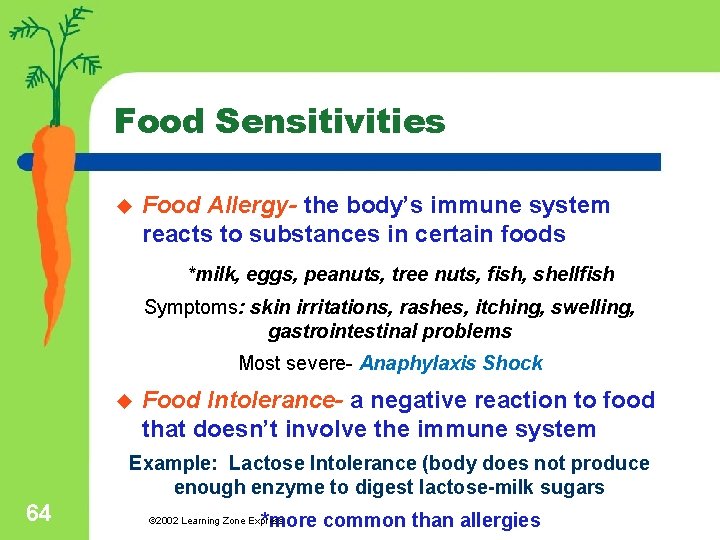
Food Sensitivities u Food Allergy- the body’s immune system reacts to substances in certain foods *milk, eggs, peanuts, tree nuts, fish, shellfish Symptoms: skin irritations, rashes, itching, swelling, gastrointestinal problems Most severe- Anaphylaxis Shock u Food Intolerance- a negative reaction to food that doesn’t involve the immune system Example: Lactose Intolerance (body does not produce enough enzyme to digest lactose-milk sugars 64 *more common than allergies © 2002 Learning Zone Express
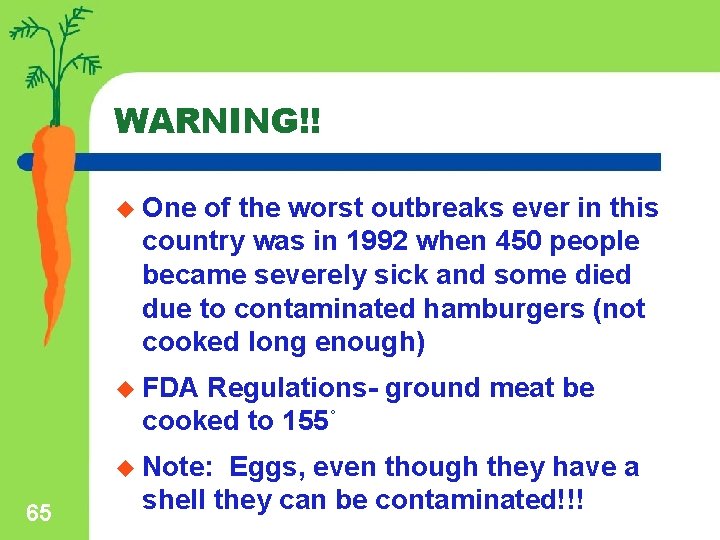
WARNING!! u One of the worst outbreaks ever in this country was in 1992 when 450 people became severely sick and some died due to contaminated hamburgers (not cooked long enough) u FDA Regulations- ground meat be cooked to 155˚ u Note: 65 Eggs, even though they have a shell they can be contaminated!!!
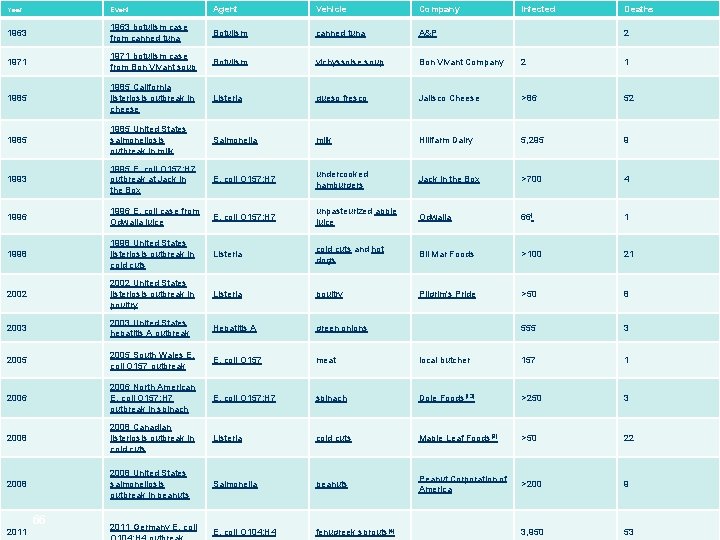
Year Event Agent Vehicle Company 1963 botulism case from canned tuna Botulism canned tuna A&P 1971 botulism case from Bon Vivant soup Botulism vichyssoise soup Bon Vivant Company 2 1 1985 California listeriosis outbreak in cheese Listeria queso fresco Jalisco Cheese >86 52 1985 United States salmonellosis outbreak in milk Salmonella milk Hillfarm Dairy 5, 295 9 1993 1995 E. coli O 157: H 7 outbreak at Jack in the Box E. coli O 157: H 7 undercooked hamburgers Jack in the Box >700 4 1996 E. coli case from Odwalla juice E. coli O 157: H 7 unpasteurized apple juice Odwalla 66] 1 1998 United States listeriosis outbreak in cold cuts Listeria cold cuts and hot dogs Bil Mar Foods >100 21 2002 United States listeriosis outbreak in poultry Listeria poultry Pilgrim's Pride >50 8 2003 United States hepatitis A outbreak Hepatitis A green onions 555 3 2005 South Wales E. coli O 157 outbreak E. coli O 157 meat local butcher 157 1 2006 North American E. coli O 157: H 7 outbreak in spinach E. coli O 157: H 7 spinach Dole Foods[13] >250 3 2008 Canadian listeriosis outbreak in cold cuts Listeria cold cuts Maple Leaf Foods[8] >50 22 2008 United States salmonellosis outbreak in peanuts Salmonella peanuts Peanut Corporation of America >200 9 E. coli O 104: H 4 fenugreek sprouts[4] 3, 950 53 66 2011 Germany E. coli Infected Deaths 2