
1 1 What is the Bill of Rights
1 1 What is the Bill of Rights and What Does it Protect? Lesson 9, Unit 2
1 1 st Amendment 2 “Congress shall make no law respecting an establishment of religion, or prohibiting the free exercise thereof; or abridging the freedom of speech, or of the press; or the right of the people peaceably to assemble, and to petition the government for a redress of grievances. ”
Freedoms in the 1 st Amendment 3 1 Religion has two parts! • Establishment • Free Exercise Congress shall make no law respecting an establishment of religion, or prohibiting the free exercise thereof; or abridging the freedom of speech, or of the press; or the right of the people peaceably to assemble, and to petition the government for a redress of grievances.
Freedom of Religion Turn and Talk: What does it mean to establish a religion? What might the government do to establish a religion? Use your imagination! 1 The Establishment Clause 4
Freedom of Religion Prohibits the government from making any law “respecting an establishment of religion. ” Forbids the government from creating an official religion AND Prohibits government actions that unduly favor one religion over another 1 The Establishment Clause 5
Freedom of Religion Prohibits the government from interfering in people’s ability to believe in a religion of their choice, or no religion at all. While freedom to believe is absolute, freedom to act is limited. 1 The Free Exercise Clause 6
Freedom of Religion 1. Why is there a distinction between beliefs and actions? 2. How does this connect to the fundamental constitutional principle of inalienable rights/social compact? 1 The Free Exercise Clause 7
1 st Amendment: Freedom of Religion 8 1 Establishment Clause: The Government Cannot Establish a Religion Free Exercise Clause: The Government Cannot Prohibit You From Believing in a Particular Religion Question: Why do you think both clauses are needed to protect religious freedom?
1 st Amendment Protects Speech 9 1 The government cannot restrict people’s right to speak freely or express themselves. Stop and Jot Questions: What constitutes speech? (Hint: Think about the ways you share your thoughts and feelings with others). Why is some speech protected (e. g. speaking out against political policy, political candidates, and/or political ideas) and some is not protected (e. g. threatening a candidate with violence)? Again, the right to free speech has limits!
1 st Amendment Protects 10 The government cannot restrict the right to obtain and publish ideas. This amendment protects citizens from overbearing government censorship of written or published ideas. 1 Freedom of the Press

11 11 1 The basis of our government being the opinion of the people, . . . ; and were it left to me to decide whether we should have a government without newspapers, or newspapers without a government, I should not hesitate a moment to prefer the latter. But I should mean that every man should receive those papers and be capable of reading them. -- Thomas Jefferson, Letter to Colonel Edward Carrington, Jan. 16, 1787 Respond on your handout: Thomas Jefferson, Letter to Colonel Edward Carrington (16 January 1787) Lipscomb & Bergh ed. 6: 57. 5. What do these three quotes have in common? Explain.

The First Amendment 12 1 Congress shall make no law respecting an establishment of religion, or prohibiting the free exercise thereof; or abridging the freedom of speech, or of the press; or the right of the people peaceably to assemble, and to petition the government for a redress of grievances. Click Here to see the First Amendment in Action!
1 st Amendment Protects Assembly and Petition 13 1 Government cannot restrict: Congress shall make no law respecting an establishment of religion, or prohibiting the free exercise thereof; or abridging the freedom of speech, or of the press; or the right of the people peaceably to assemble, and to petition the government for a redress of grievances. The right of people to peacefully assemble or join groups (associate) The right of people to ask government to change or do something (petition)
1 st Amendment Freedoms 1 Religion 14 Speech Press Assembly Petition But, all rights have limits!
Write your answer in your notebook! 1 Why is the 1 st Amendment essential to our democracy? 15
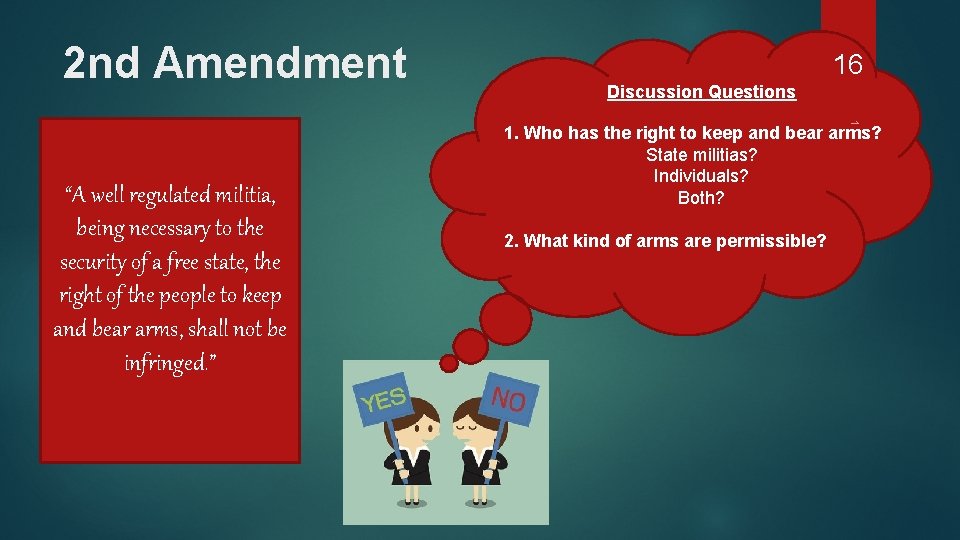
2 nd Amendment 16 Discussion Questions 1 “A well regulated militia, being necessary to the security of a free state, the right of the people to keep and bear arms, shall not be infringed. ” 1. Who has the right to keep and bear arms? State militias? Individuals? Both? 2. What kind of arms are permissible?

3 rd Amendment 17 1 “No soldier shall, in time of peace be quartered in any house, without the consent of the owner, nor in time of war, but in a manner to be prescribed by law. ” Freedom from government forcing people to house and feed soldiers in their dwellings in times of peace.
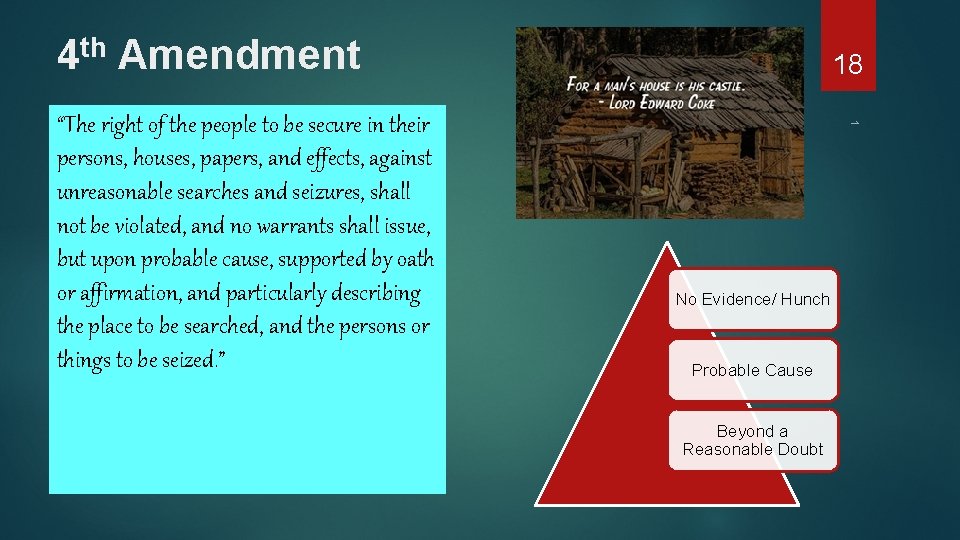
4 th Amendment 1 “The right of the people to be secure in their persons, houses, papers, and effects, against unreasonable searches and seizures, shall not be violated, and no warrants shall issue, but upon probable cause, supported by oath or affirmation, and particularly describing the place to be searched, and the persons or things to be seized. ” 18 No Evidence/ Hunch Probable Cause Beyond a Reasonable Doubt
4 th Amendment 19 1 Protects individual freedom from unreasonable searches and seizures Ø Government warrants require probable cause Ø Warrants must be specific
th 5 Amendment 20 1 No person shall be held to answer for a capital or otherwise infamous crime unless on a presentment or indictment of a grand jury, except in cases arising in the land or naval forces, or in the militia, when in actual service in time of war or public danger; nor shall any person be subject for the same offense to be twice put in jeopardy of life or limb; nor shall be compelled in any criminal case to be a witness against himself, nor be deprived of life, liberty, or property without due process of law; nor shall private property be taken for public use without just compensation.
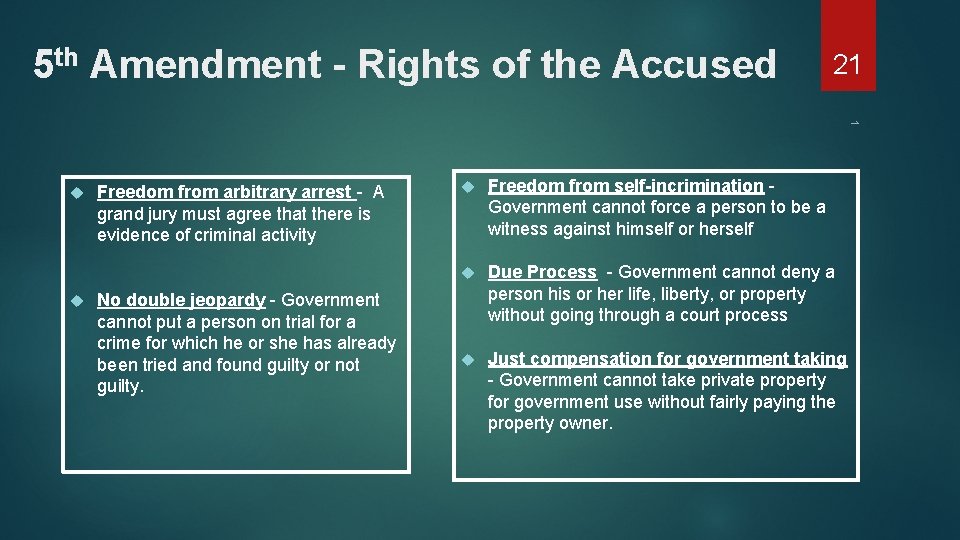
5 th Amendment - Rights of the Accused 21 1 Freedom from arbitrary arrest - A grand jury must agree that there is evidence of criminal activity No double jeopardy - Government cannot put a person on trial for a crime for which he or she has already been tried and found guilty or not guilty. Freedom from self-incrimination - Government cannot force a person to be a witness against himself or herself Due Process - Government cannot deny a person his or her life, liberty, or property without going through a court process Just compensation for government taking - Government cannot take private property for government use without fairly paying the property owner.
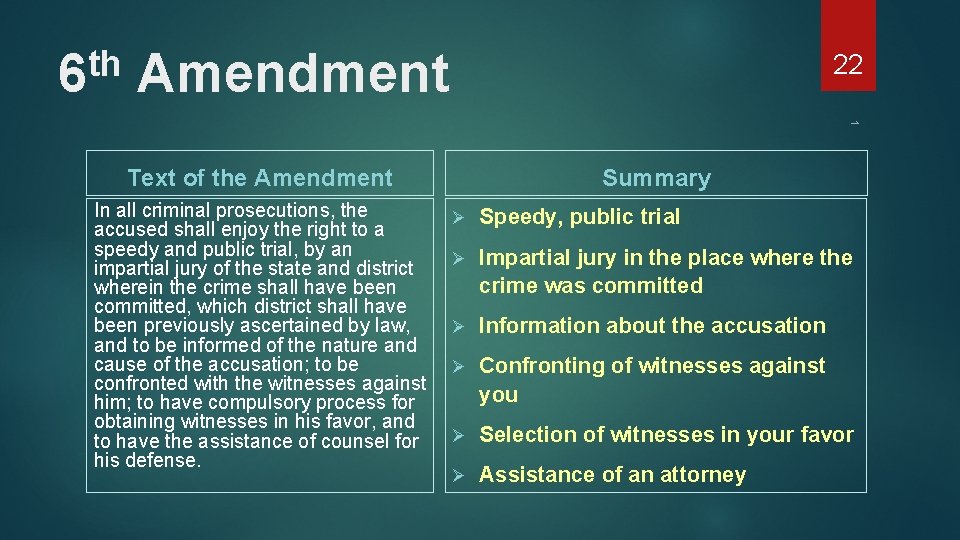
th 6 Amendment 22 1 Text of the Amendment In all criminal prosecutions, the accused shall enjoy the right to a speedy and public trial, by an impartial jury of the state and district wherein the crime shall have been committed, which district shall have been previously ascertained by law, and to be informed of the nature and cause of the accusation; to be confronted with the witnesses against him; to have compulsory process for obtaining witnesses in his favor, and to have the assistance of counsel for his defense. Summary Ø Speedy, public trial Ø Impartial jury in the place where the crime was committed Ø Information about the accusation Ø Confronting of witnesses against you Ø Selection of witnesses in your favor Ø Assistance of an attorney
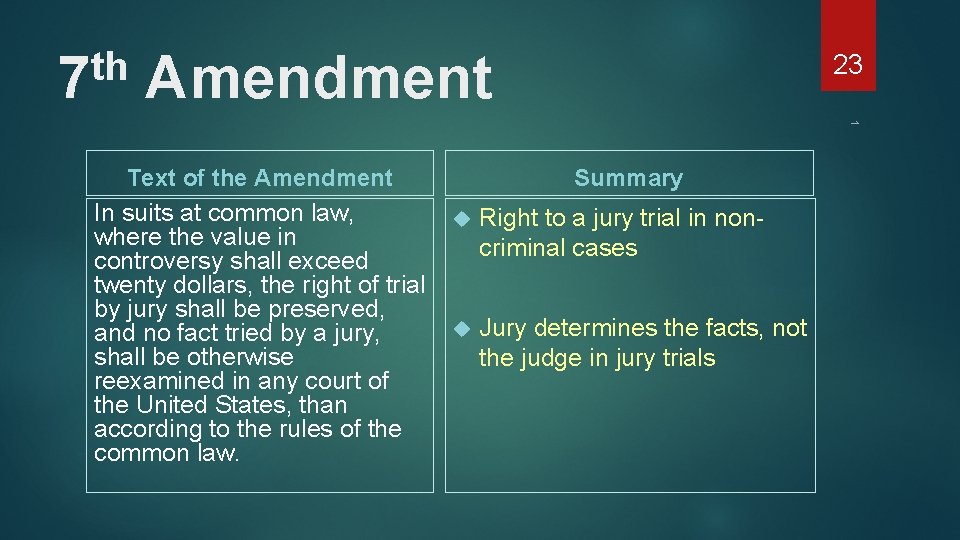
th 7 Amendment 23 1 Text of the Amendment Summary In suits at common law, Right to a jury trial in nonwhere the value in criminal cases controversy shall exceed twenty dollars, the right of trial by jury shall be preserved, Jury determines the facts, not and no fact tried by a jury, shall be otherwise the judge in jury trials reexamined in any court of the United States, than according to the rules of the common law.
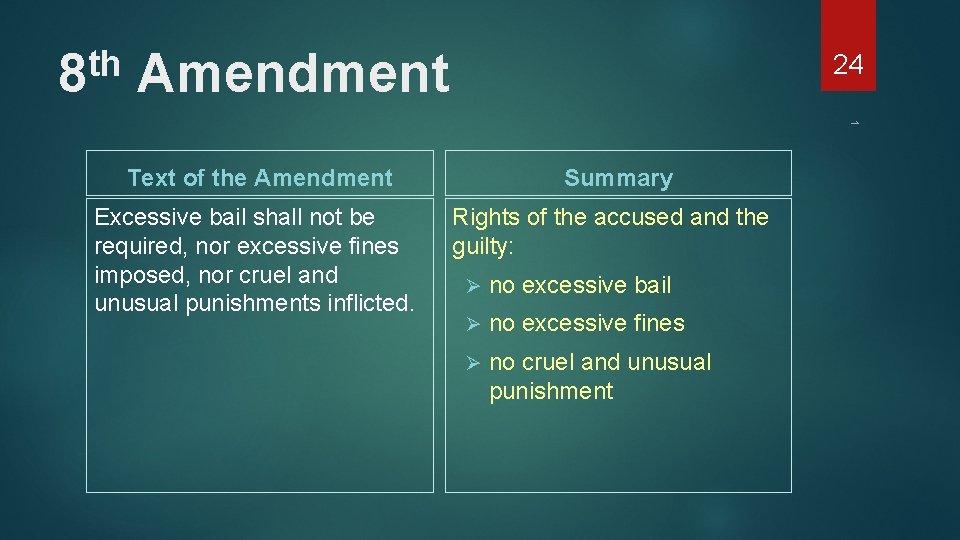
th 8 Amendment 24 1 Text of the Amendment Summary Excessive bail shall not be required, nor excessive fines imposed, nor cruel and unusual punishments inflicted. Rights of the accused and the guilty: Ø no excessive bail Ø no excessive fines Ø no cruel and unusual punishment
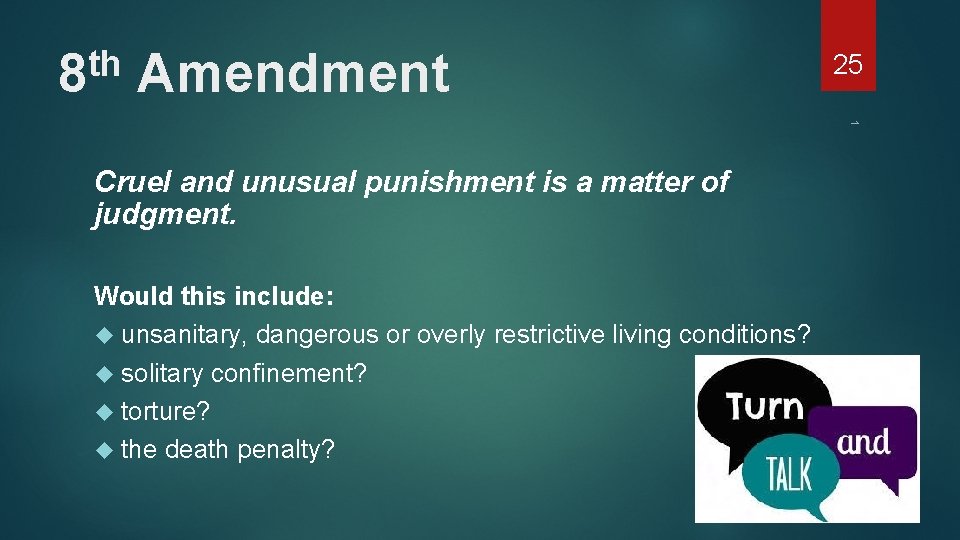
th 8 Amendment 25 1 Cruel and unusual punishment is a matter of judgment. Would this include: unsanitary, dangerous or overly restrictive living conditions? solitary confinement? torture? the death penalty?
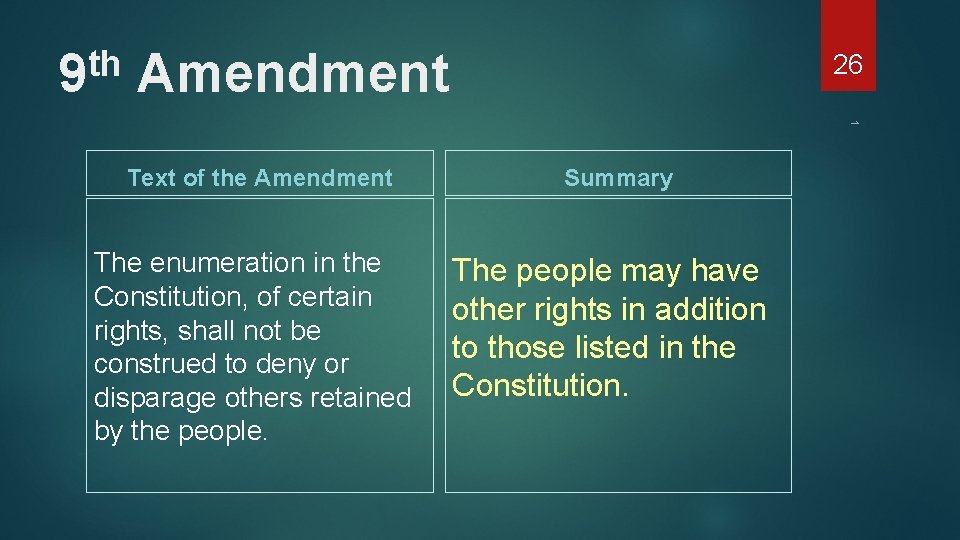
th 9 Amendment 26 1 Text of the Amendment Summary The enumeration in the Constitution, of certain rights, shall not be construed to deny or disparage others retained by the people. The people may have other rights in addition to those listed in the Constitution.
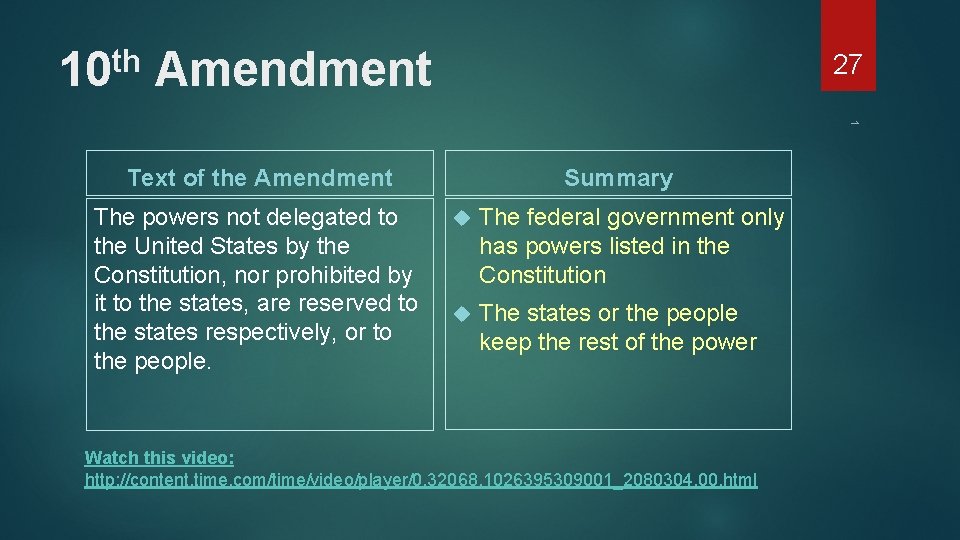
th 10 Amendment 27 1 Text of the Amendment The powers not delegated to the United States by the Constitution, nor prohibited by it to the states, are reserved to the states respectively, or to the people. Summary The federal government only has powers listed in the Constitution The states or the people keep the rest of the power Watch this video: http: //content. time. com/time/video/player/0, 32068, 1026395309001_2080304, 00. html
28 1 The Bill of Rights protects against whose actions? What role does the judicial branch play with respect to the Bill of Rights?
The Bill of Rights Protects Individuals from Government Interference! 29 1 The Bill of Rights protects against STATE ACTION…. NOT your parents or guardians!!!

Role of the Judicial Branch Has constitutional and legal authority over cases and controversies Makes decisions/judgments about what is or is not legal Upholds the Constitution as the supreme law of the land 30
- Slides: 30