
1 1 What is Statistics Vocabulary Statistics a
1. 1 What is Statistics?
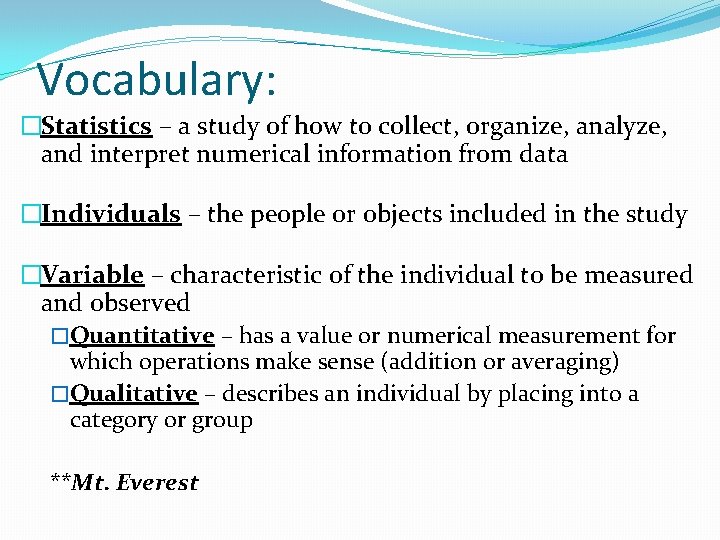
Vocabulary: �Statistics – a study of how to collect, organize, analyze, and interpret numerical information from data �Individuals – the people or objects included in the study �Variable – characteristic of the individual to be measured and observed �Quantitative – has a value or numerical measurement for which operations make sense (addition or averaging) �Qualitative – describes an individual by placing into a category or group **Mt. Everest
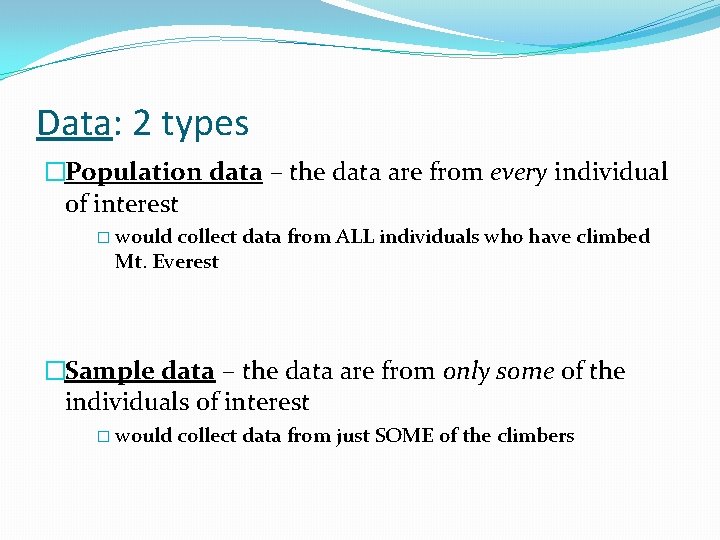
Data: 2 types �Population data – the data are from every individual of interest � would collect data from ALL individuals who have climbed Mt. Everest �Sample data – the data are from only some of the individuals of interest � would collect data from just SOME of the climbers

Example 1: The Hawaiian Department of Tropical Agriculture is conducting a study of ready-to-harvest pineapples in an experimental field. pineapples �individuals? �possible variable? weights – specify units of measure �quantitative or qualitative? quantitative �data type? it depends �another possible variable? �quantitative or qualitative? taste qualitative – place into categories
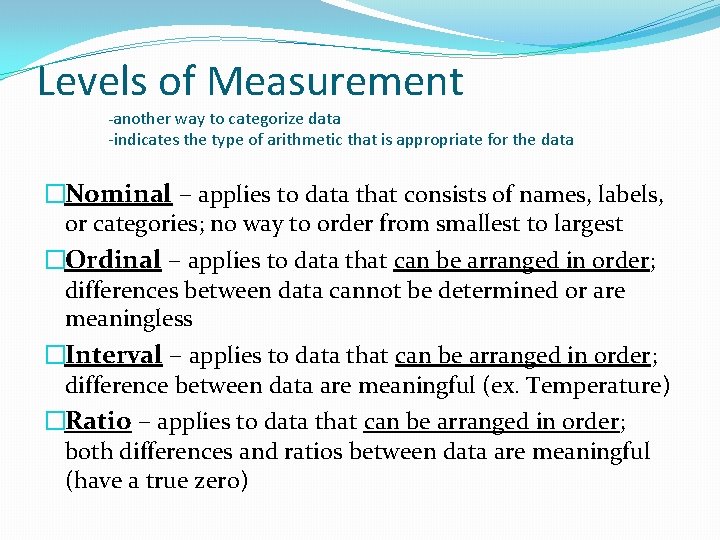
Levels of Measurement -another way to categorize data -indicates the type of arithmetic that is appropriate for the data �Nominal – applies to data that consists of names, labels, or categories; no way to order from smallest to largest �Ordinal – applies to data that can be arranged in order; differences between data cannot be determined or are meaningless �Interval – applies to data that can be arranged in order; difference between data are meaningful (ex. Temperature) �Ratio – applies to data that can be arranged in order; both differences and ratios between data are meaningful (have a true zero)
Example 2: a) Taos, Acoma, Zuni, and Cochiti are the names of four Native American pueblos from the population of names of all Native American pueblos in Arizona and New Mexico � Nominal b) In a high school graduating class of 319 students, Jim ranked 25 th, June ranked 19 th, Walter ranked 10 th, and Julia ranked 4 th, where 1 is the highest rank � Ordinal

Example 2 (cont’d): c) Body temperatures (in degrees Celsius) of trout in the Yellowstone River � Interval (for Celsius-scale temps, there is not an inherent starting point/true zero) d) Length of trout swimming in the Yellowstone River � Ratio (an 18 -in trout is 3 times the length of a 6 -in trout)

Looking ahead… Two branches of statistics: �Descriptive – involves methods of organizing, picturing, and summarizing information from samples or populations �Inferential – involves methods of using information from a sample to draw conclusions regarding the population (useful when the population is too large to measure)
Homework Section 1. 1 Problems p. 10 – 11 #1 – 9 all
- Slides: 9