
1 1 To understand basic swine reproduction 2
1
1. To understand basic swine reproduction 2. To become familiar with common terminology used within the swine industry 3. To learn principles and techniques of several methods of mating 4. To become aware of common swine reproductive diseases 2
artificial insemination (AI)— introduction of semen into the female reproductive tract by a technique other than natural service barrow— male castrated before sexual maturity boar— male that has not been castrated ejaculation— discharge of semen from the male estrous cycle— cycle of events from one heat (estrus) period to the next in females estrus— period during which the female is receptive to the male (will allow mating) 3
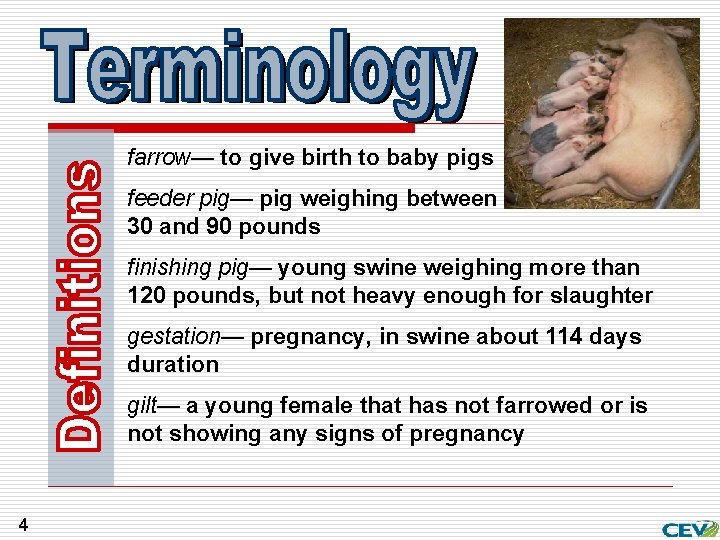
farrow— to give birth to baby pigs feeder pig— pig weighing between 30 and 90 pounds finishing pig— young swine weighing more than 120 pounds, but not heavy enough for slaughter gestation— pregnancy, in swine about 114 days duration gilt— a young female that has not farrowed or is not showing any signs of pregnancy 4
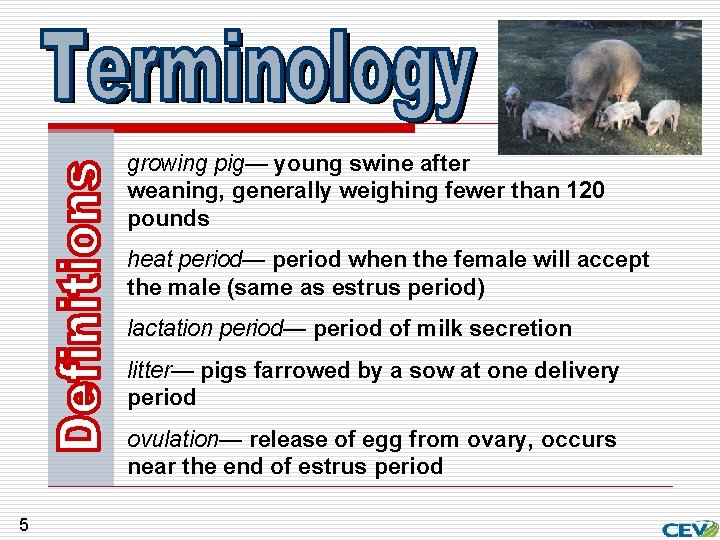
growing pig— young swine after weaning, generally weighing fewer than 120 pounds heat period— period when the female will accept the male (same as estrus period) lactation period— period of milk secretion litter— pigs farrowed by a sow at one delivery period ovulation— release of egg from ovary, occurs near the end of estrus period 5

parturition— process of giving birth piglet— suckling age pig, generally up to a few days old puberty— age at which the reproductive organs become functional and secondary sex characteristics develop sow— a mature female that has farrowed or is showing signs of pregnancy stag— male castrated after secondary sex characteristics develop wean— remove suckling pigs from their mother 6

Development • Reach puberty around six to eight months of age • First used for breeding around seven to eight months of age • Sperm numbers and semen volume increase as boars mature 7
Ejaculation • Three phases 1. pre-sperm ü prepares for passage, lubricant ü lasts first few minutes of ejaculate 2. sperm containing ü contains high sperm count ü lasts 2 -3 minutes 3. post sperm ü contains high sperm content ü serves as cervical plug
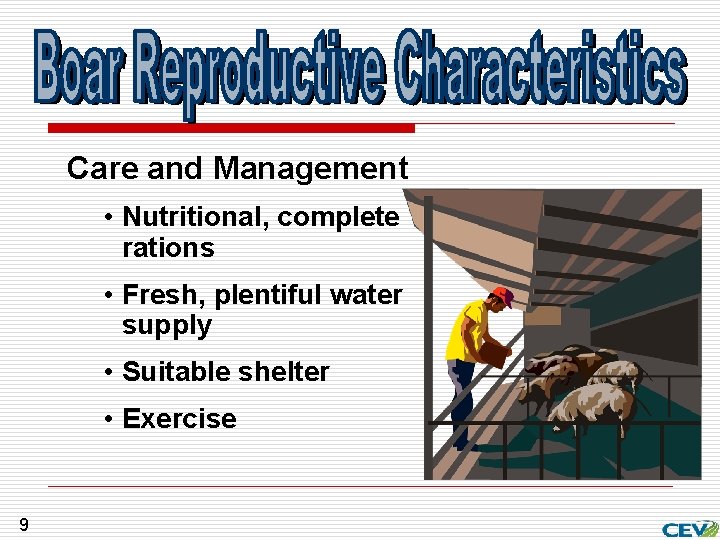
Care and Management • Nutritional, complete rations • Fresh, plentiful water supply • Suitable shelter • Exercise 9
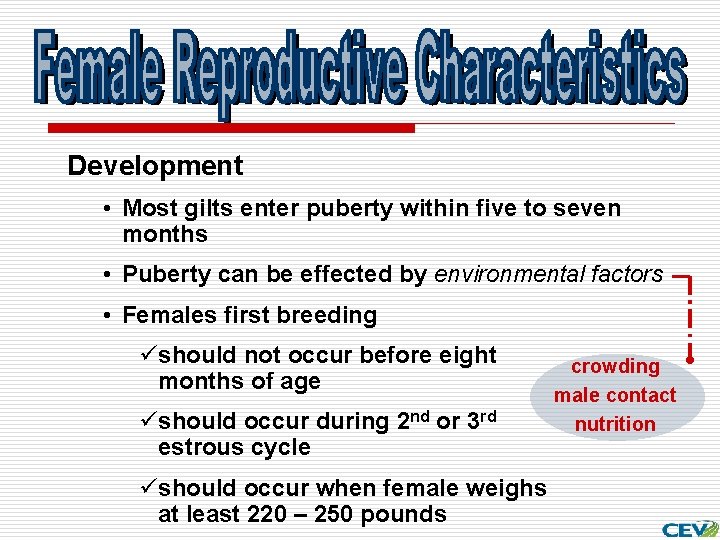
Development • Most gilts enter puberty within five to seven months • Puberty can be effected by environmental factors • Females first breeding üshould not occur before eight months of age üshould occur during 2 nd or 3 rd estrous cycle üshould occur when female weighs at least 220 – 250 pounds crowding male contact nutrition
Estrous Cycle • Occurs after the onset of puberty • Reoccurs and repeats itself as long as the female is not pregnant • Controlled by hormones preparing the reproductive tract for ovulation and pregnancy • 21 day duration on average • Estrus lasts around 40 – 60 hours • Ovulation is generally 38 – 42 hours after the onset of estrus 11
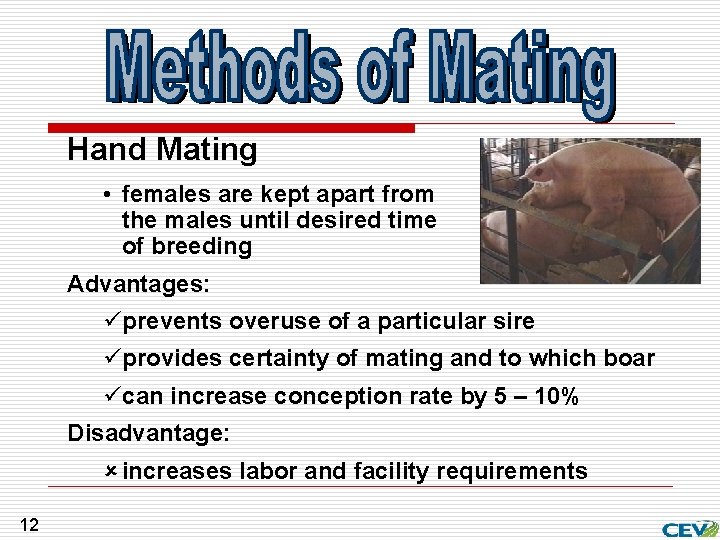
Hand Mating • females are kept apart from the males until desired time of breeding Advantages: üprevents overuse of a particular sire üprovides certainty of mating and to which boar ücan increase conception rate by 5 – 10% Disadvantage: û increases labor and facility requirements 12
Pasture Mating • males and females coexist throughout the breeding season or year round Advantages: üminimum labor üheat detection is boar’s responsibility Disadvantages: û uncertainty of mating and date of conception û uncertainty of infertile sires û hard on young boars; limit to 8 – 10 gilts (yearling or mature boars can handle 15 – 20 sows)
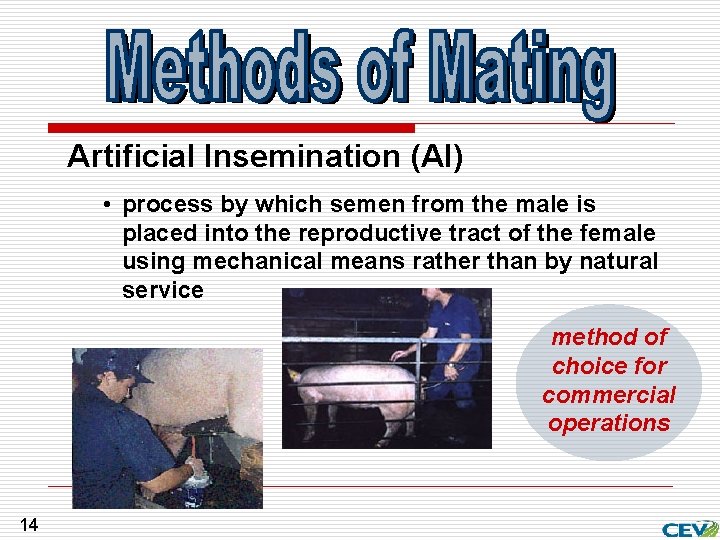
Artificial Insemination (AI) • process by which semen from the male is placed into the reproductive tract of the female using mechanical means rather than by natural service method of choice for commercial operations 14
Artificial Insemination (AI) Advantages: üdecreases spread of disease üincreases the number of offspring from a superior boar üidentifies the fertility of the boar üreduces the number of sires needed 15 one ejaculate can service up to 15 sows
Artificial Insemination (AI) Disadvantages: û requires trained level of management û increases time and supervision of the female herd for estrus detection û boar training û semen handling and special breeding facilities û more costly 16
Semen collection 1. Boar mounts dummy sow for semen collection 2. Semen placed in tube or bottle with extender usually has a life span of 5 - 7 days Semen handling techniques ü May be stored fresh at a temperature of 55 – 60°F or frozen and stored in liquid nitrogen ü Should be protected from direct light and sudden temperature changes ü Should be rotated twice a day to keep sperm and extender mixed
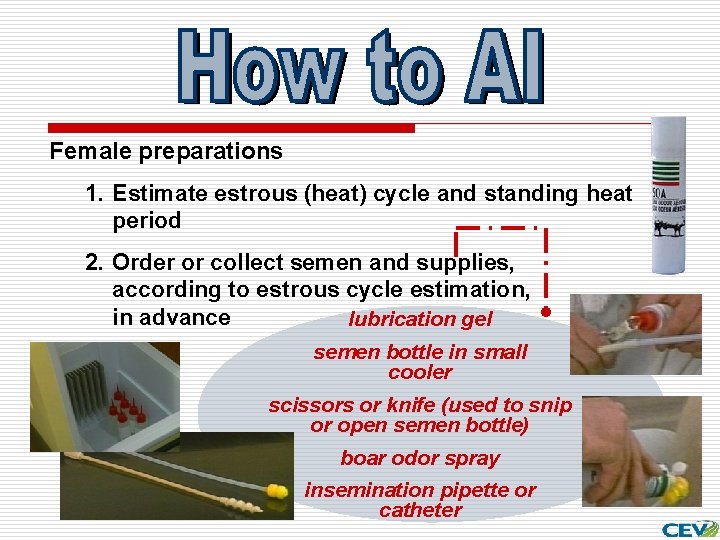
Female preparations 1. Estimate estrous (heat) cycle and standing heat period 2. Order or collect semen and supplies, according to estrous cycle estimation, in advance lubrication gel semen bottle in small cooler scissors or knife (used to snip or open semen bottle) boar odor spray insemination pipette or catheter
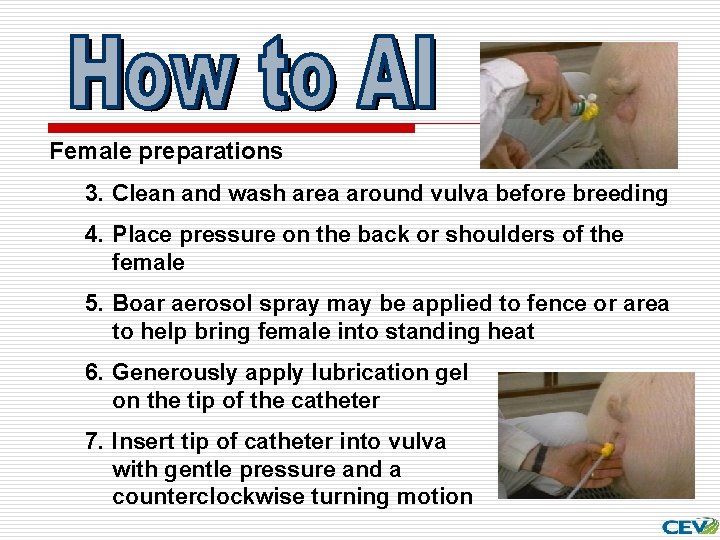
Female preparations 3. Clean and wash area around vulva before breeding 4. Place pressure on the back or shoulders of the female 5. Boar aerosol spray may be applied to fence or area to help bring female into standing heat 6. Generously apply lubrication gel on the tip of the catheter 7. Insert tip of catheter into vulva with gentle pressure and a counterclockwise turning motion
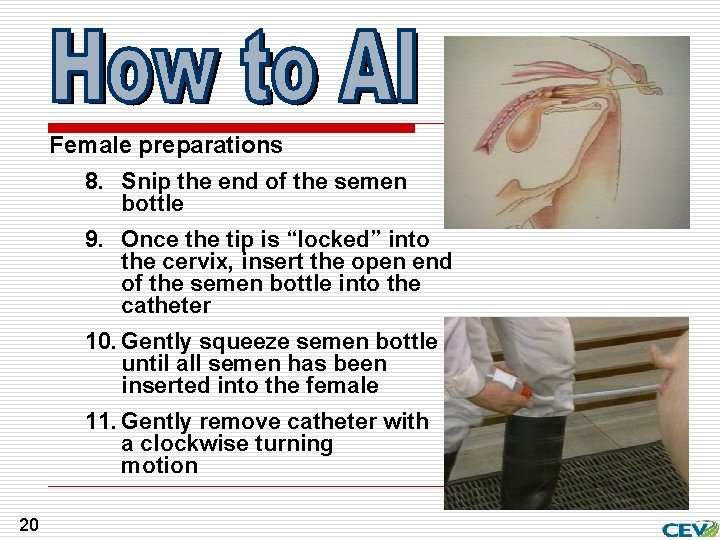
Female preparations 8. Snip the end of the semen bottle 9. Once the tip is “locked” into the cervix, insert the open end of the semen bottle into the catheter 10. Gently squeeze semen bottle until all semen has been inserted into the female 11. Gently remove catheter with a clockwise turning motion 20
Recommended to breed both sows and gilts twice during estrus First breeding • gilts— late first day of estrus • sows— early second day of estrus Second breeding • 12 – 24 hours after first breeding 21
Management should consider • Litters per sow per year • Optimum time of year to market/sell pigs • Climatic conditions • Equipment and labor 22 all of these are deciding factors as to when and how often one breeds females
Conception Rate • Fertilization rate is generally around 85 – 90% for most herds • 5% of litters are lost during gestation • Factors affecting conception rates ü high environmental temperatures ü overfeeding during pregnancy ü excessively fat or thin sows or gilts ü abortive diseases— brucellosis and leptospirosis ü nutritionally incomplete rations ü injuries
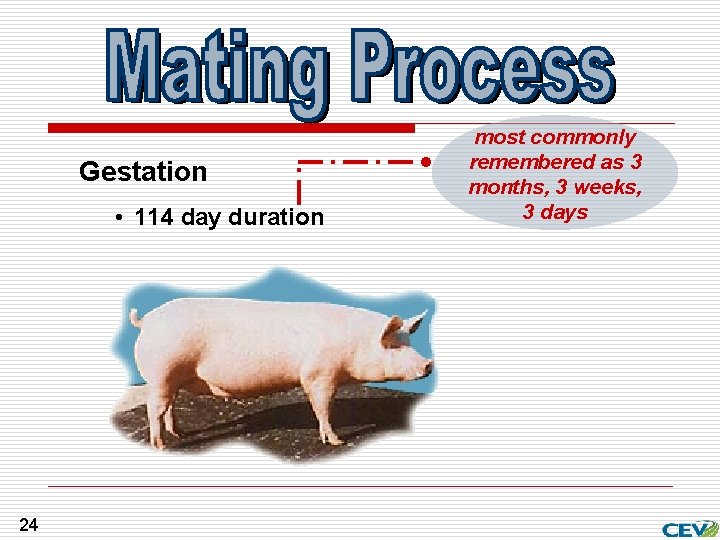
Gestation • 114 day duration 24 most commonly remembered as 3 months, 3 weeks, 3 days
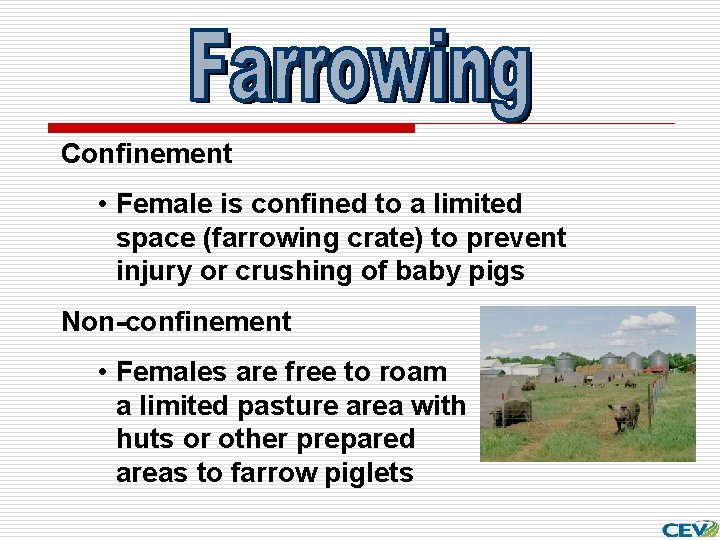
Confinement • Female is confined to a limited space (farrowing crate) to prevent injury or crushing of baby pigs Non-confinement • Females are free to roam a limited pasture area with huts or other prepared areas to farrow piglets
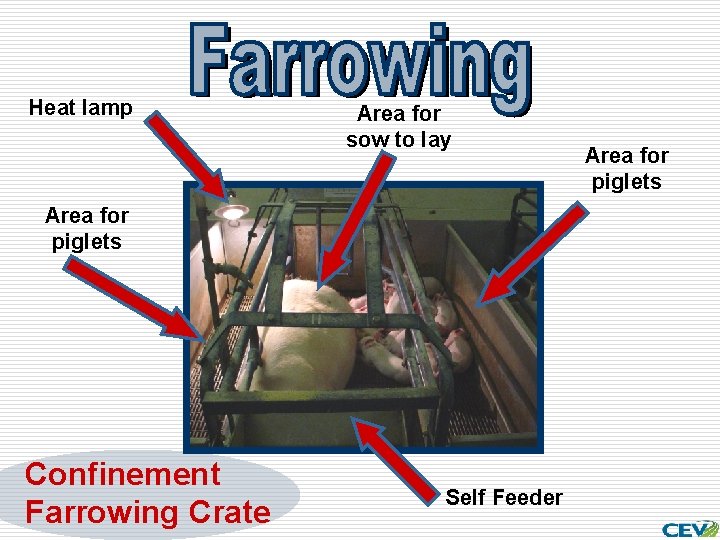
Heat lamp Area for sow to lay Area for piglets Confinement Farrowing Crate Self Feeder Area for piglets
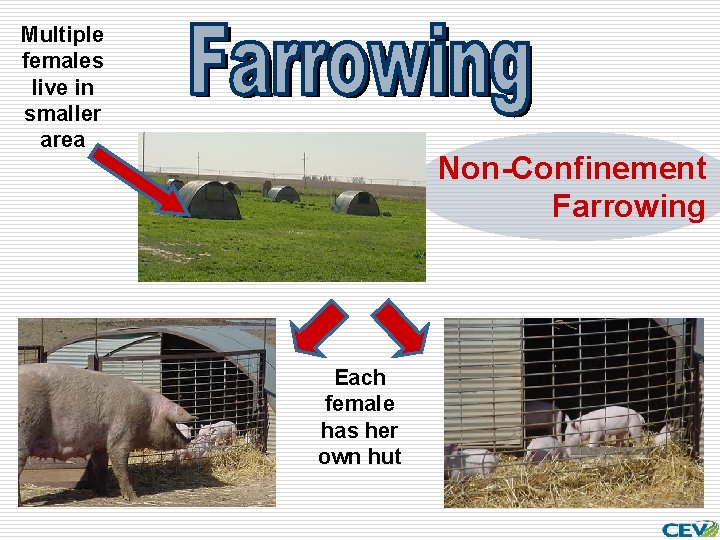
Multiple females live in smaller area Non-Confinement Farrowing Each female has her own hut
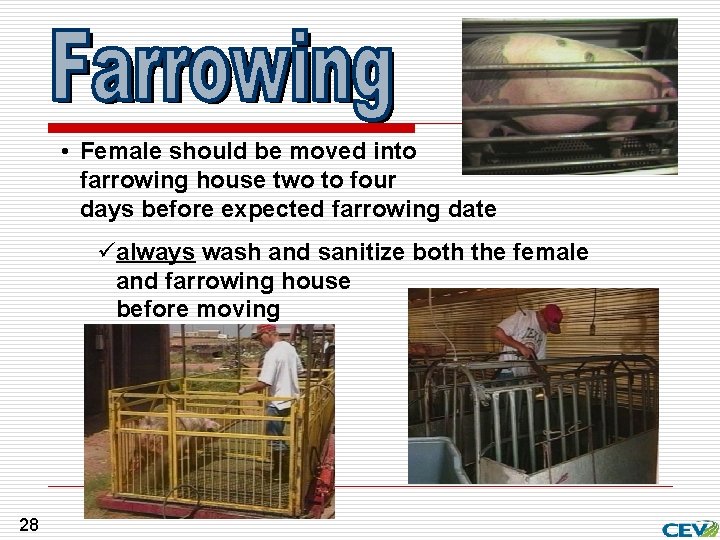
• Female should be moved into farrowing house two to four days before expected farrowing date üalways wash and sanitize both the female and farrowing house before moving 28

• Twenty-four hours prior to farrowing, the female will release her milk for lactation • Prior to farrowing üfemales exhibit restlessness or nesting behavior üfrequent urination, and swelling and reddening of the vulva • Should be present at farrowing if capable 29
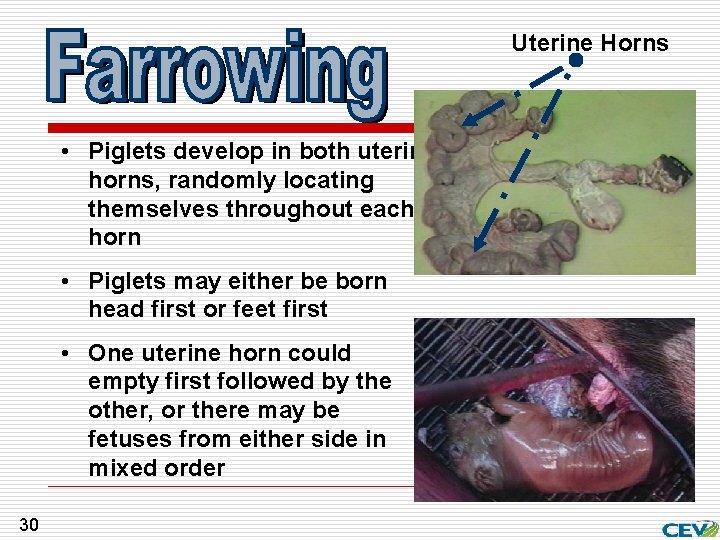
Uterine Horns • Piglets develop in both uterine horns, randomly locating themselves throughout each horn • Piglets may either be born head first or feet first • One uterine horn could empty first followed by the other, or there may be fetuses from either side in mixed order 30
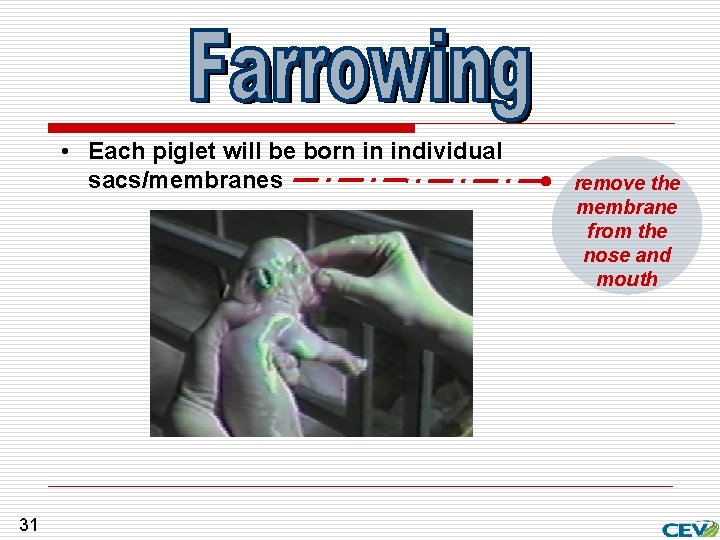
• Each piglet will be born in individual sacs/membranes 31 remove the membrane from the nose and mouth

• Heat lamp should be provided at least the first few days of life to prevent chilling • Piglets should nurse the mother’s first milk, also known as colostrum contains minerals and antibodies necessary for piglets’ health 32 ambient temperature of 93°F is recommended

Important tasks to be performed during the first day 1. Tie off the umbilical cord and dip the cord into iodine solution 2. Clip the “needle teeth” prevents entrance of infectious diseases may irritate sow’s underline during nursing 3. Ear-notch each pig for identification and record keeping purposes 4. Cut off the tail of each pig (tail docking)
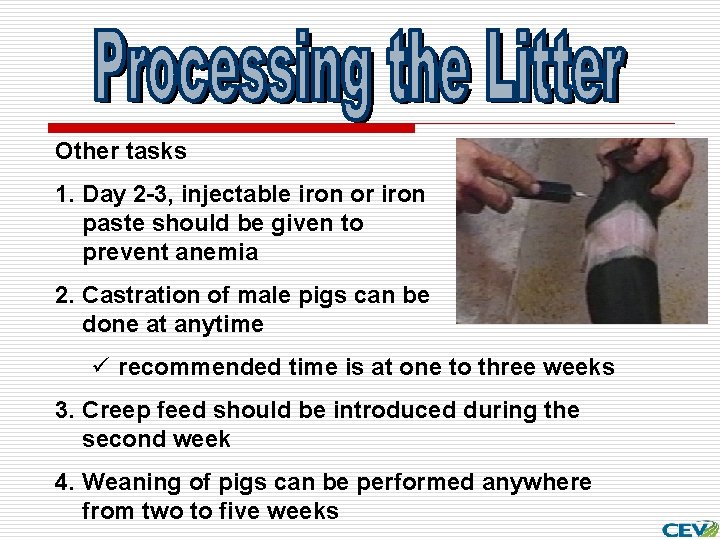
Other tasks 1. Day 2 -3, injectable iron or iron paste should be given to prevent anemia 2. Castration of male pigs can be done at anytime ü recommended time is at one to three weeks 3. Creep feed should be introduced during the second week 4. Weaning of pigs can be performed anywhere from two to five weeks
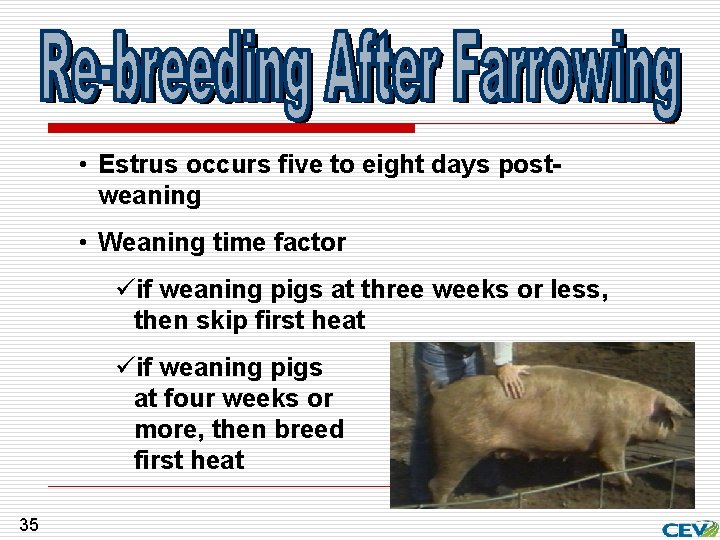
• Estrus occurs five to eight days postweaning • Weaning time factor üif weaning pigs at three weeks or less, then skip first heat üif weaning pigs at four weeks or more, then breed first heat 35

Diseases can cause reproductive failure • Abortions • Stillborns • Mummified pigs • Missed breeding cycles • Lightweight newborn pigs 36
erysipelas— sows and gilts infected may show clinical signs of fever, lethargy, anorexia, stiffness and may abort leptospirosis— causes abortion, dead or weak piglets at birth parvovirus— most prevalent viral agent causing infertility 37
PRRS (porcine reproductive and respiratory syndrome)— causes birth of premature litters, stillborns and increased pre-weaning illness and death pseudorabies— highly contagious disease that can spread from herd to herd; causes abortion; attacks nursery and growing pigs’ immune and nervous systems; causes severe respiratory problems in finishing swine 38
Contributing factors • Facility design • Weaning schedules • Sanitation and management • Exposure to other contaminated animals, including wildlife or other farm animals and pets • Nutrition • Genetics • Gilt development • Mating programs 39
Disease management or prevention • Vaccination programs • Maintain body condition • Proper nutrition • Proper sanitation and management • Prevent exposure to potentially contaminated animals 40
• Producer should set goals for his/her operation reflecting: ü resource availability ü producer’s interests, promotional styles and abilities ü realistic evaluation of present and future markets • Producer should evaluate his/her current swine herd for traits of improvement or emphasis and select future breeding stock accordingly 41
breed— become aware of a breed’s strengths and maintain those strengths reproductive soundness— well developed testicles; free of umbilical or scrotal hernias; aggressive and show a desire to mate type and quality— dependant upon goals set by producer; however, a well mix muscular of desirable traits leanness is preferred sound feet and legs sound underline balanced 42
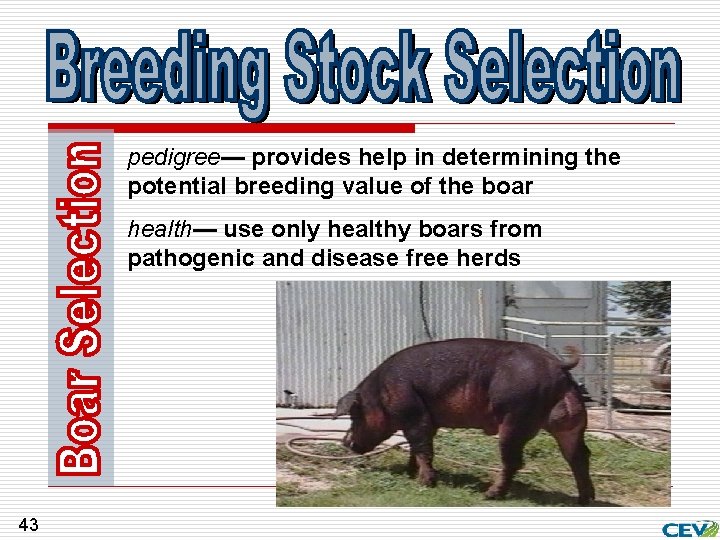
pedigree— provides help in determining the potential breeding value of the boar health— use only healthy boars from pathogenic and disease free herds 43
soundness— should show normal reproductive development; should have at least six functional teats on each side; strong pasterns and sound feet and legs conformation— well mix of traits as with boar selection health— select only healthy females from pathogenic and disease free herds litter size— ability of a female to raise large litters is a direct indication of mothering ability 44

• Accurate records are necessary to: ü determine the breeding age of the animal ü determine estrous/heat cycle ü estimate farrowing date ü analyze performance data of sow, boar and litter ü determine which animals are kept or culled to benefit the breeding program 45

1. What are three environmental factors that can effect puberty? 2. Keeping females and males apart until desired time of breeding is termed as? 3. Most gilts enter puberty at what age? 46
4. Name four advantages of Artificial Insemination (AI)? 5. Fresh semen should be stored at what temperature? 6. What disease is the most prevalent viral agent causing infertility? 47
7. Name two attributes of keeping accurate records? 8. What is the term used to describe the period during which the female is receptive to the male? 48
9. What phase of ejaculation prepares sperm for passage or serves as a lubricant? 10. Boars reach puberty around what age? 49
Dr. Robert Hines. Lecture Notes. Kansas State University “Managing the Sow and Litter. ” Oklahoma State University National Pork Producers Council www. nppc. org Pond, Kevin. , and Wilson Pond. Introduction to Animal Science. New York: John Wiley & Sons, Inc. , 2000. “Porcine Reproductive and Respiratory Syndrome (PRRS)” www. vetsci. sdstate. edu/prrs 4. htm Purdue University www. agriculture. purdue. edu Thompson, Leif H. Managing Swine Reproduction. University of Illinois at Urbana – Champaign “Swine Reproductive Disease. ” Pfizer Animal Health. www. pfizer. com/ah/livestock/pork/58_pork. html Texas Tech University www. asft. ttu. edu United States Department of Agriculture (USDA) www. usda. gov Production Coordinator Clayton Franklin Kristina Harris 50 Production Manager Geoff Scott Executive Producer G. W. Davis ©MMIII, MMIV CEV Multimedia, Ltd.
- Slides: 50