
1 1 S 2 Drawing cell structures as

- Slides: 9
1. 1. S 2 Drawing cell structures as seen with the light microscope
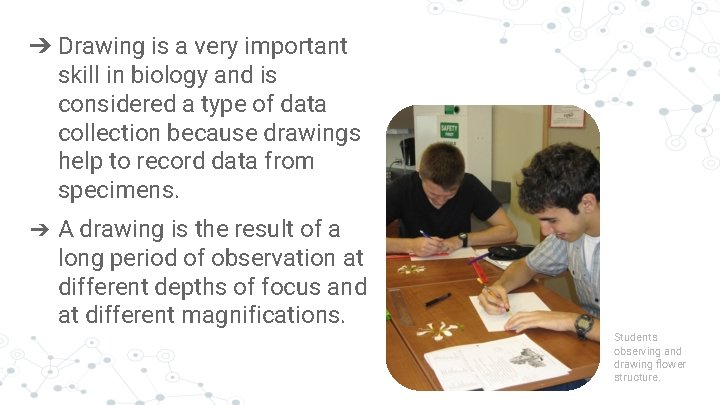
➔ Drawing is a very important skill in biology and is considered a type of data collection because drawings help to record data from specimens. ➔ A drawing is the result of a long period of observation at different depths of focus and at different magnifications. Students observing and drawing flower structure.
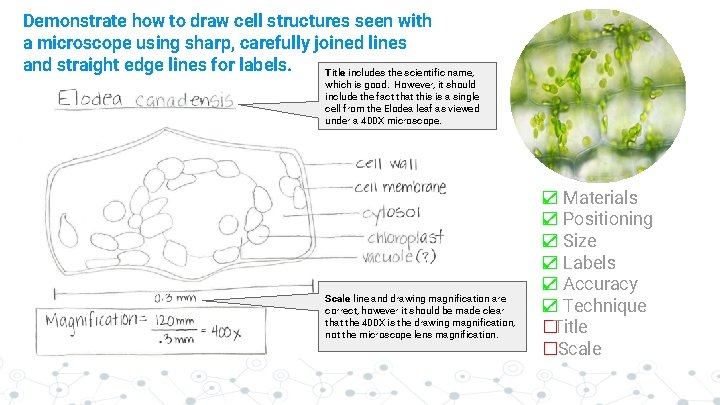
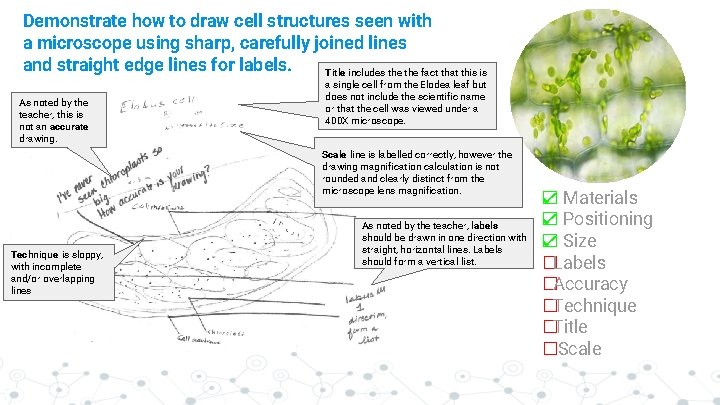
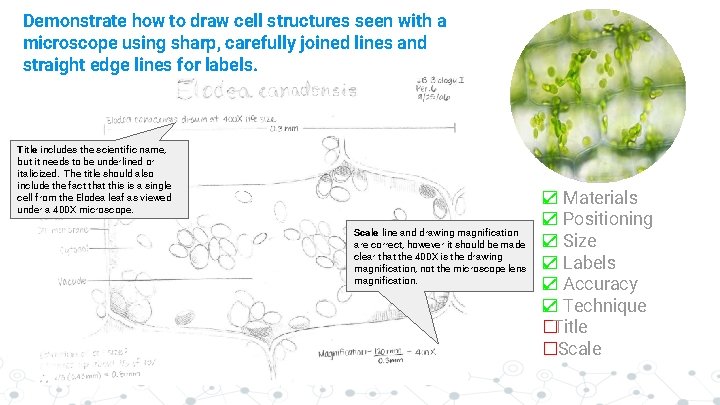
Demonstrate how to draw cell structures seen with a microscope using sharp, carefully joined lines and straight edge lines for labels. Drawing Materials: All drawings should be done with a sharp pencil line on white, unlined paper. Diagrams in pen are unacceptable because they cannot be corrected. Positioning: Center drawing on the page. Do not draw in a corner. This will leave plenty of room for the addition of labels. Size: Make a large, clear drawing; it should occupy at least half a page. Labels: Use a ruler to draw straight, horizontal lines. The labels should form a vertical list. All labels should be printed (not cursive). Technique: Lines are clear and not smudged. Avoid ‘feathery’ pencil lines and gaps. There almost no erasures or stray marks on the paper. Color is used carefully to enhance the drawing. Stippling is used instead of shading.
Demonstrate how to draw cell structures seen with a microscope using sharp, carefully joined lines and straight edge lines for labels. Accuracy: Draw what is seen ; not what should be there. Avoid making “idealized”drawings. Do not necessarily draw everything that is seen in the field of view. Draw only what is asked for. Show only as much as necessary for an understanding of the structure – a small section shown in detail will often suffice. It is time consuming and unnecessary, for example, to reproduce accurately the entire contents of a microscopic field. When drawing low power plans do not draw individual cells. Show only the distribution of tissues. When making high power drawings, draw only a few representative cells; indicate thickness of walls, membranes, etc. Title: The title should state what has been drawn and what lens power it was drawn under (for example, phrased as: drawn as seen through 400 X magnification). Title is informative, centered, and larger than other text. The title should always include the scientific name (which is italicized or underlined).
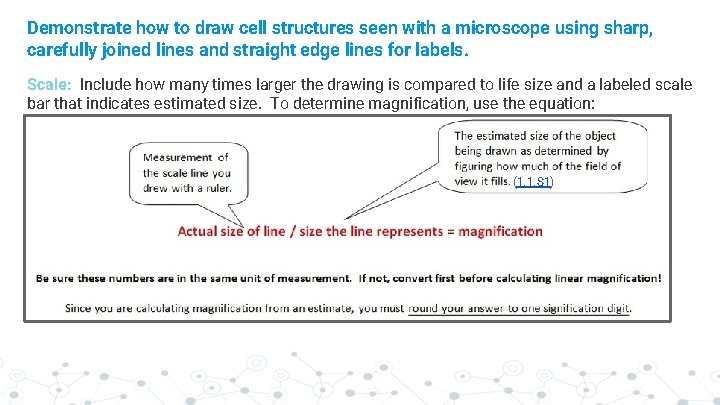
Demonstrate how to draw cell structures seen with a microscope using sharp, carefully joined lines and straight edge lines for labels. Scale: Include how many times larger the drawing is compared to life size and a labeled scale bar that indicates estimated size. To determine magnification, use the equation: (1. 1. S 1)
Demonstrate how to draw cell structures seen with a microscope using sharp, carefully joined lines and straight edge lines for labels. Title includes the scientific name, which is good. However, it should include the fact that this is a single cell from the Elodea leaf as viewed under a 400 X microscope. Scale line and drawing magnification are correct, however it should be made clear that the 400 X is the drawing magnification, not the microscope lens magnification. ☑ Materials ☑ Positioning ☑ Size ☑ Labels ☑ Accuracy ☑ Technique �Title �Scale
Demonstrate how to draw cell structures seen with a microscope using sharp, carefully joined lines and straight edge lines for labels. Title includes the fact that this is As noted by the teacher, this is not an accurate drawing. a single cell from the Elodea leaf but does not include the scientific name or that the cell was viewed under a 400 X microscope. Scale line is labelled correctly, however the drawing magnification calculation is not rounded and clearly distinct from the microscope lens magnification. Technique is sloppy, with incomplete and/or overlapping lines As noted by the teacher, labels should be drawn in one direction with straight, horizontal lines. Labels should form a vertical list. ☑ Materials ☑ Positioning ☑ Size �Labels �Accuracy �Technique �Title �Scale
Demonstrate how to draw cell structures seen with a microscope using sharp, carefully joined lines and straight edge lines for labels. Title includes the scientific name, but it needs to be underlined or italicized. The title should also include the fact that this is a single cell from the Elodea leaf as viewed under a 400 X microscope. Scale line and drawing magnification are correct, however it should be made clear that the 400 X is the drawing magnification, not the microscope lens magnification. ☑ Materials ☑ Positioning ☑ Size ☑ Labels ☑ Accuracy ☑ Technique �Title �Scale
Explore more. . . ◎ Within the scope of the IB Biology course, the other statements that require drawings based on observation are: ○ Drawings of the ultrastructure of prokaryotic cells based on electron micrographs. ○ Drawings of the ultrastructure of eukaryotic cells based on electron micrographs. ○ Drawing the structure of primary xylem vessels in sections of stems based on microscope images. ○ Drawing internal structure of seeds. ○ Drawing of half-views of animal-pollinated flowers.