
1 1 Organisation for Economic Cooperation and Development


- Slides: 26
1 1 Organisation for Economic Co-operation and Development (OECD) Education at a Glance 2007 Key results for Hungary Michael Davidson Senior Analyst, OECD Education Directorate 18 September 2007
2 Quantity and quality challenges Education systems continue to expand at a rapid pace; more and more of the population are educated to the tertiary level Hungary has advanced but not as fast as some other countries Is there scope for further expansion of tertiary education? Is there a risk of over–supply of the highly qualified?
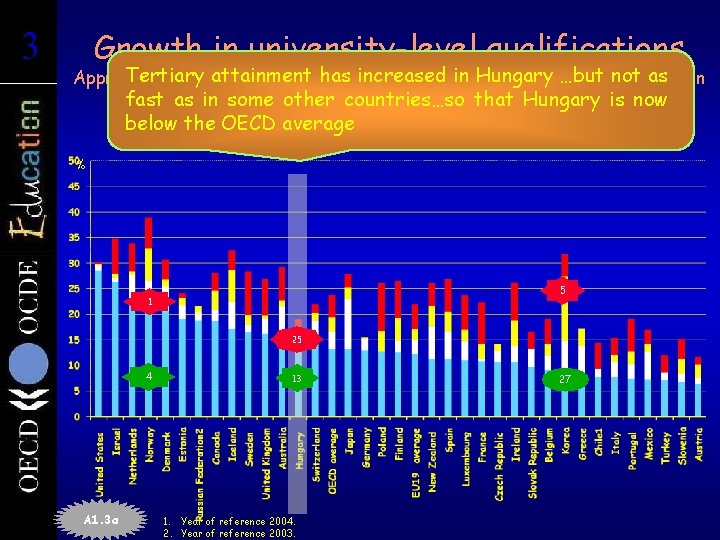
3 3 Growth in university-level qualifications Tertiarybyattainment has of increased in Hungary …butqualification not as Approximated the percentage persons with ISCED 5 A/6 in the age groups shown below fast as inborn some other countries…so that(2005) Hungary is now below the OECD average % 5 1 25 4 A 1. 3 a 13 1. Year of reference 2004. 2. Year of reference 2003. 27
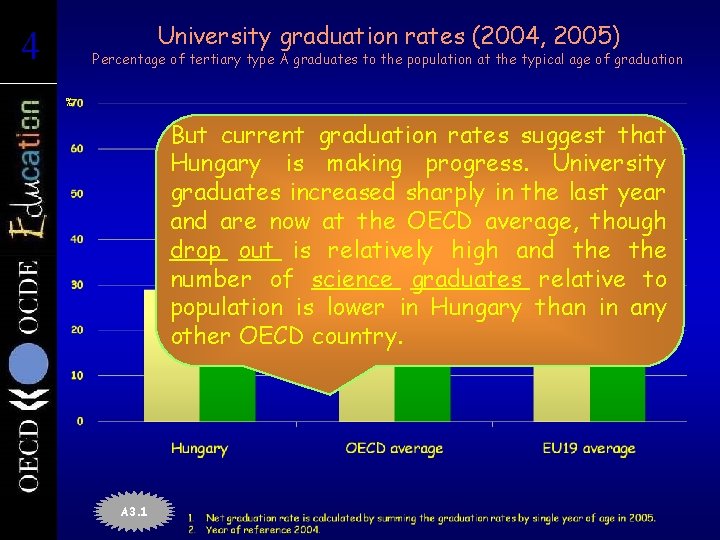
4 4 University graduation rates (2004, 2005) Percentage of tertiary type A graduates to the population at the typical age of graduation % But current graduation rates suggest that Hungary is making progress. University graduates increased sharply in the last year and are now at the OECD average, though drop out is relatively high and the number of science graduates relative to population is lower in Hungary than in any other OECD country. A 3. 1
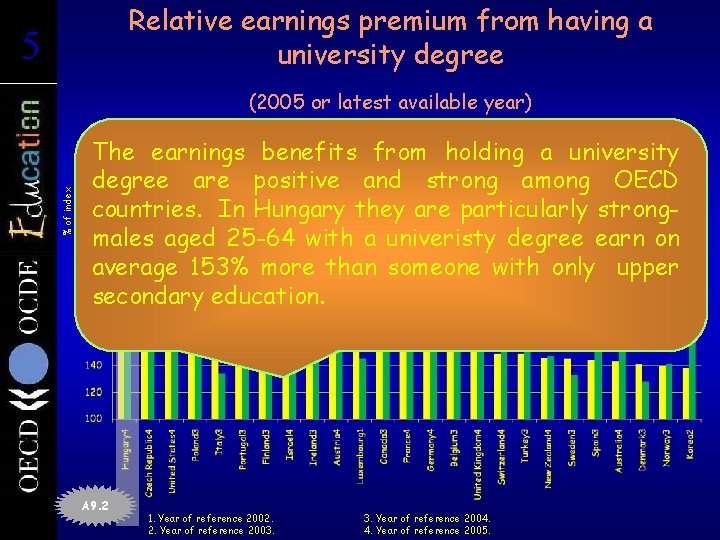
Relative earnings premium from having a university degree 5 5 (2005 or latest available year) % of index For 25 -to-64 -year-olds secondary education= 100). earnings (upper benefits from holding The a university degree are positive and strong among OECD countries. In Hungary they are particularly strongmales aged 25 -64 with a univeristy degree earn on average 153% more than someone with only upper secondary education. A 9. 2 1. Year of reference 2002. 2. Year of reference 2003. 3. Year of reference 2004. 4. Year of reference 2005.
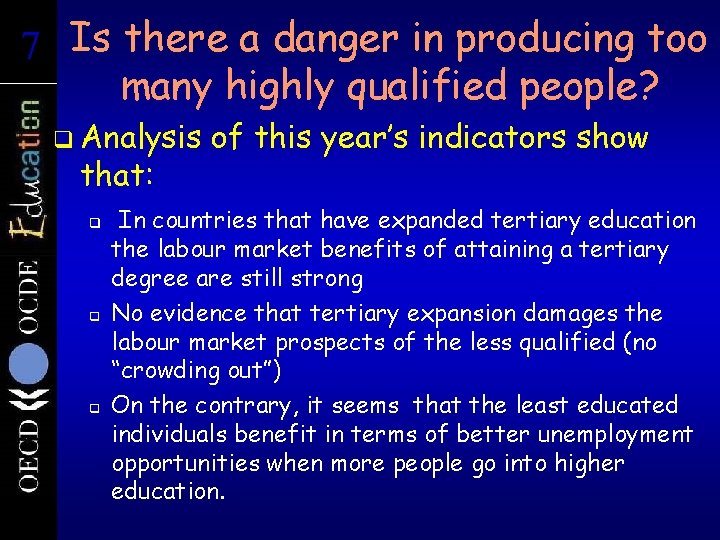
7 7 Is there a danger in producing too many highly qualified people? q Analysis that: q q q of this year’s indicators show In countries that have expanded tertiary education the labour market benefits of attaining a tertiary degree are still strong No evidence that tertiary expansion damages the labour market prospects of the less qualified (no “crowding out”) On the contrary, it seems that the least educated individuals benefit in terms of better unemployment opportunities when more people go into higher education.
8 Equity challenges Achieving strong baseline qualifications is a cornerstone of equity. Strong expansion of secondary education in Hungary But penalties for those who miss out are significant Equity concerns in the Hungarian education system
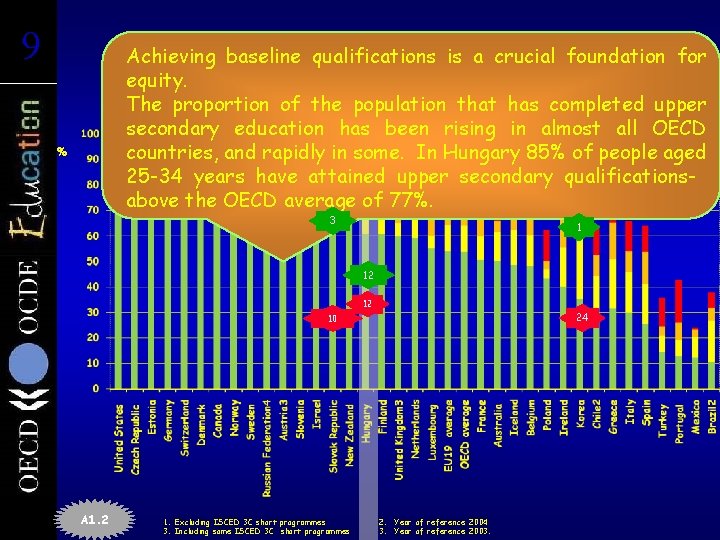
9 9 Population has attained at least Achieving baseline that qualifications is a crucial foundation for equity. upper secondary education (2005) by age group The proportion of. Percentage the population that has completed upper secondary education has been rising in almost all OECD countries, and rapidly in some. In Hungary 85% of people aged 25 -34 years have attained upper secondary qualificationsabove the OECD average of 77%. % 3 1 12 12 24 10 A 1. 2 1. Excluding ISCED 3 C short programmes 3. Including some ISCED 3 C short programmes 2. Year of reference 2004 3. Year of reference 2003.
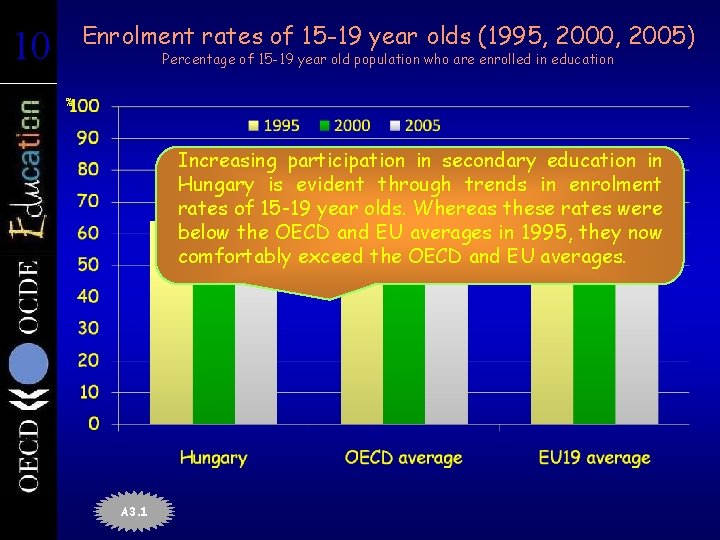
10 10 Enrolment rates of 15 -19 year olds (1995, 2000, 2005) Percentage of 15 -19 year old population who are enrolled in education % Increasing participation in secondary education in Hungary is evident through trends in enrolment rates of 15 -19 year olds. Whereas these rates were below the OECD and EU averages in 1995, they now comfortably exceed the OECD and EU averages. A 3. 1
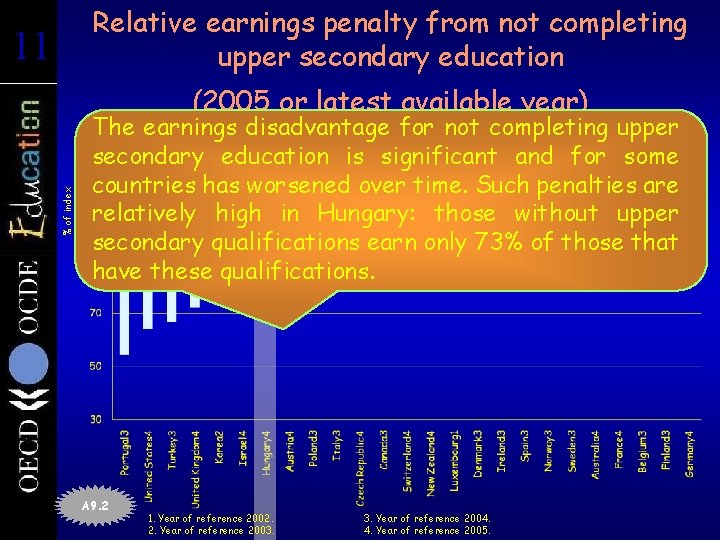
Relative earnings penalty from not completing upper secondary education 11 11 % of index (2005 or latest available year) The earnings disadvantage for not completing upper For 25 -to-64 -year-olds (upper secondary and post-secondary non-tertiary education= 100). secondary education is significant and for some countries has worsened over time. Such penalties are relatively high in Hungary: those without upper secondary qualifications earn only 73% of those that have these qualifications. A 9. 2 1. Year of reference 2002. 2. Year of reference 2003. 3. Year of reference 2004. 4. Year of reference 2005.
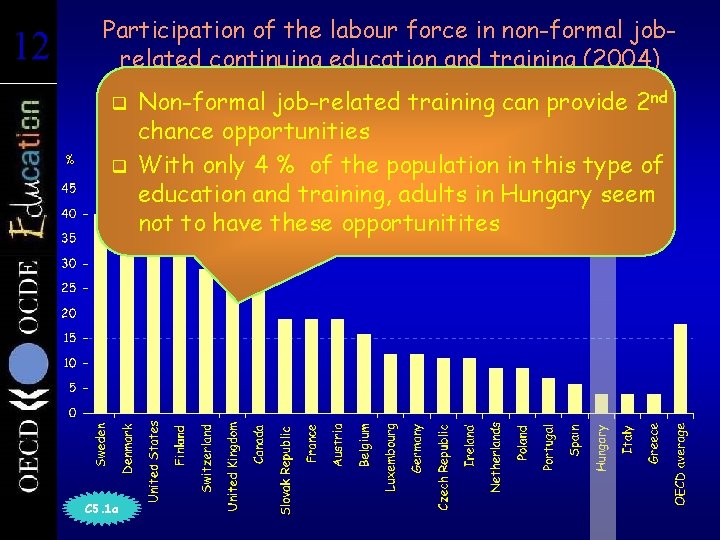
12 12 Participation of the labour force in non-formal jobrelated continuing education and training (2004) q % q C 5. 1 a Non-formal job-related training can provide 2 nd chance opportunities With only 4 % of the population in this type of education and training, adults in Hungary seem not to have these opportunitites
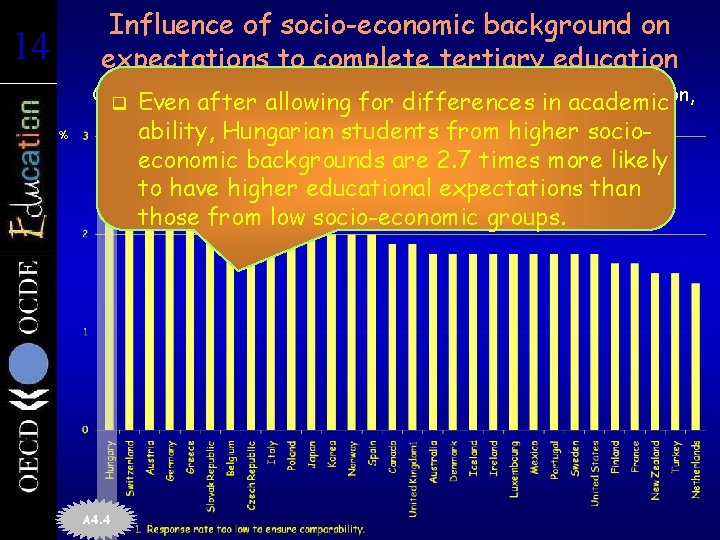
Influence of socio-economic background on expectations to complete tertiary education 14 14 % Odds ratio after that students expect to complete tertiary education, q Even allowing for differences in academic after adjusting for student performance (2003) ability, Hungarian students from higher socioeconomic backgrounds are 2. 7 times more likely to have higher educational expectations than those from low socio-economic groups. A 4. 4
15 Resource and efficiency challenges Trends in educational expenditure Factors affecting spending levels Has expenditure kept pace with expansion of tertiary education? How should further expansion be funded?
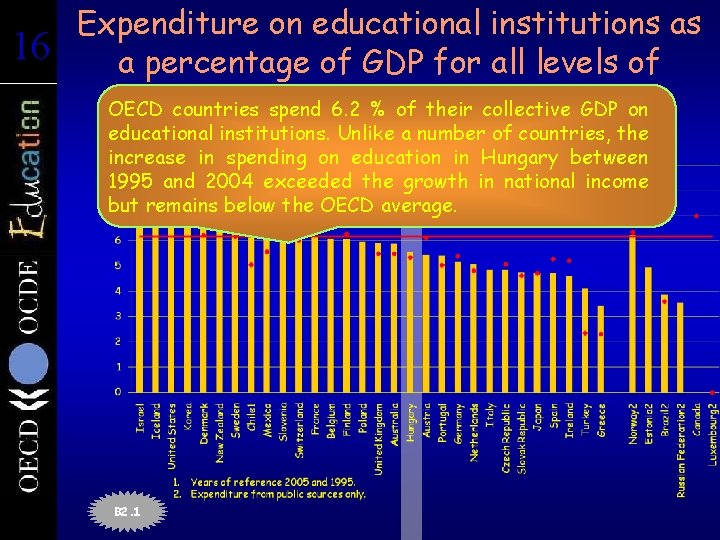
16 16 Expenditure on educational institutions as a percentage of GDP for all levels of education OECD countries spend 6. 2 (1995, % of their 2004) collective GDP on educational institutions. Unlike a number of countries, the increase in spending on education in Hungary between 1995 and 2004 exceeded the growth in national income but remains below the OECD average. B 2. 1
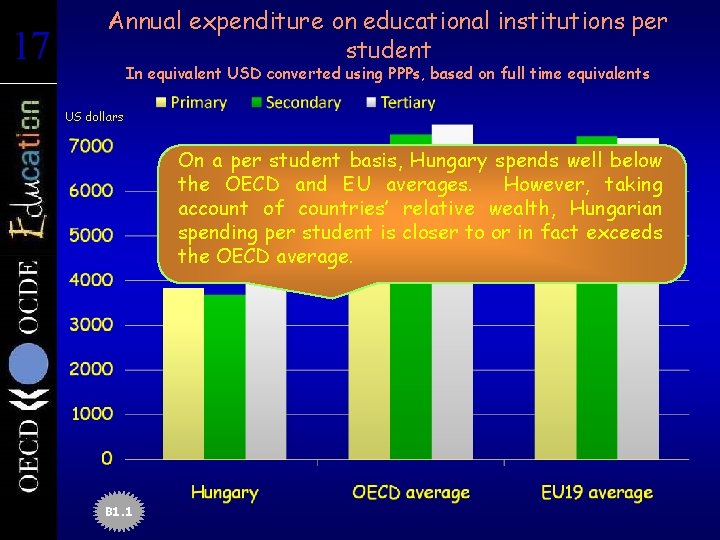
17 17 Annual expenditure on educational institutions per student In equivalent USD converted using PPPs, based on full time equivalents US dollars On a per student basis, Hungary spends well below the OECD and EU averages. However, taking account of countries’ relative wealth, Hungarian spending per student is closer to or in fact exceeds the OECD average. B 1. 1
18 18 Influences on primary and secondary spending
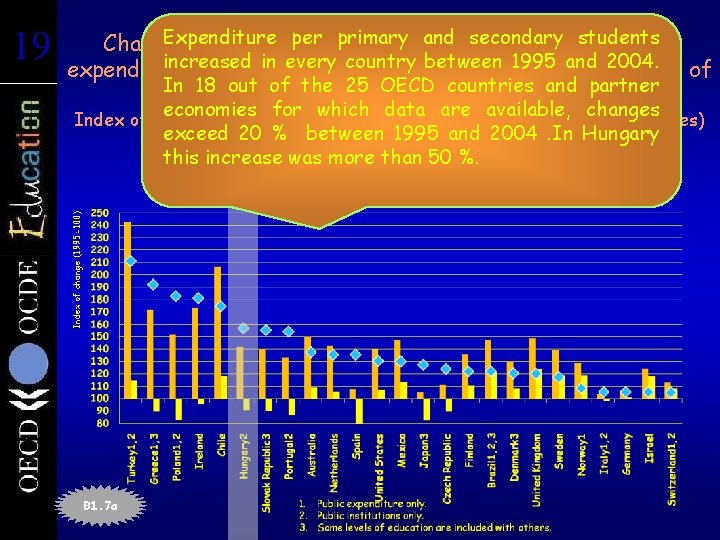
Expenditure per primary and as secondary studentsin Changes in the number of students well as changes increased in every country between and by 2004. expenditure on educational institutions per 1995 student, level of In 18 out of the 25 OECD countries and partner education (1995, 2004) economies for which data are available, changes exceed 20 % between 1995 and 2004. In Hungary this increase was more than 50 %. Index of change between 1995 and 2004 (1995=100, 2004 constant prices) Index of change (1995=100) 19 19 B 1. 7 a
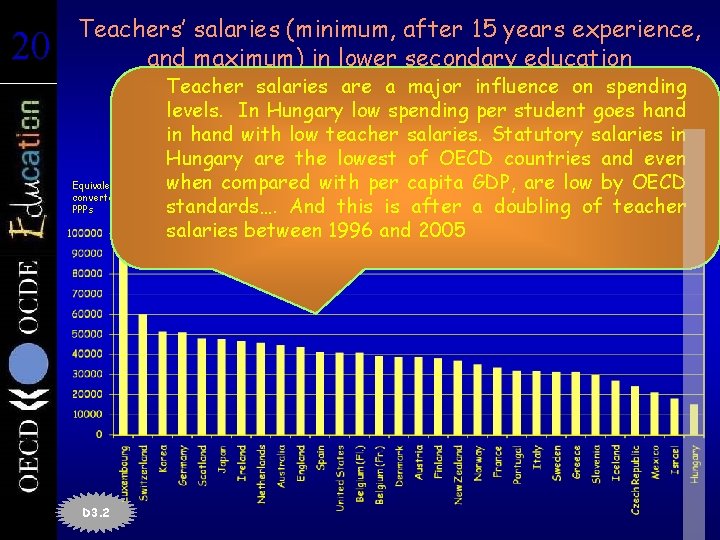
20 20 Teachers’ salaries (minimum, after 15 years experience, and maximum) in lower secondary education Annual statutorysalaries teachers’are salaries in public institutions lower Teacher a major influence on inspending secondary education, in equivalent USD converted using PPs, levels. In Hungary low spending per student goesand hand the ratio of salary years of salaries. experience to GDP persalaries capita in in hand with of low 15 teacher Statutory Equivalent USD converted using PPPs D 3. 2 Hungary are the lowest of OECD countries and even when compared with per capita GDP, are low by OECD standards…. And this is after a doubling of teacher salaries between 1996 and 2005
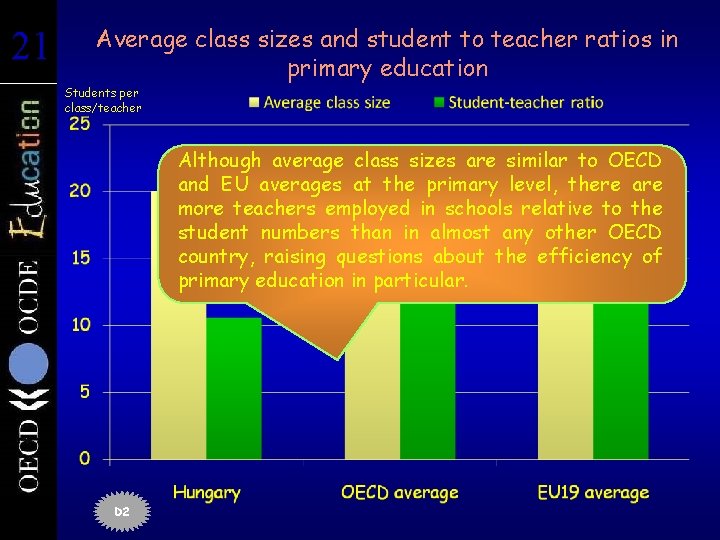
21 21 Average class sizes and student to teacher ratios in primary education Students per class/teacher Although average class sizes are similar to OECD and EU averages at the primary level, there are more teachers employed in schools relative to the student numbers than in almost any other OECD country, raising questions about the efficiency of primary education in particular. D 2
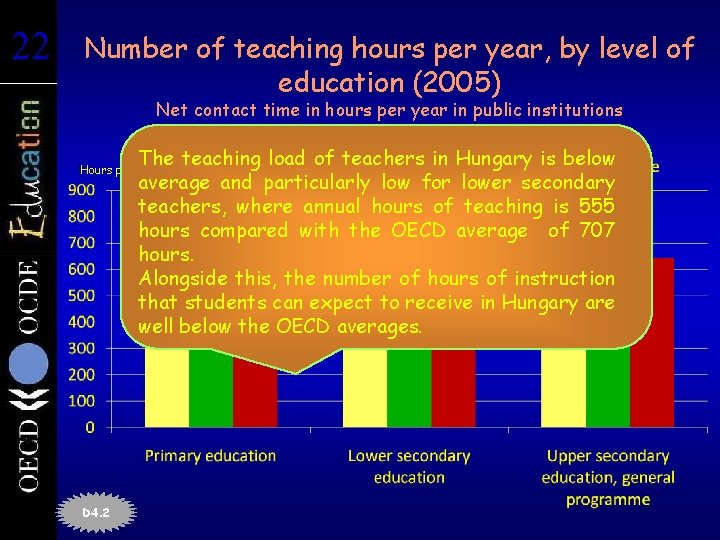
22 22 Number of teaching hours per year, by level of education (2005) Net contact time in hours per year in public institutions The teaching load of teachers in Hungary is below average and particularly low for lower secondary teachers, where annual hours of teaching is 555 hours compared with the OECD average of 707 hours. Alongside this, the number of hours of instruction that students can expect to receive in Hungary are well below the OECD averages. Hours per year D 4. 2
23 23 Influences on tertiary spending
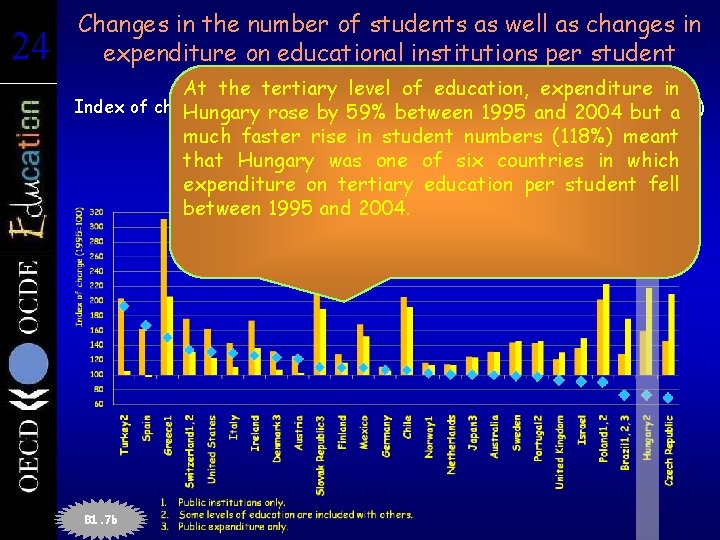
24 24 Changes in the number of students as well as changes in expenditure on educational institutions per student (1995, 2004) At the tertiary level of education, expenditure in Index of change between 1995 2004 (1995=100, prices) Hungary rose byand 59% between 19952004 and constant 2004 but a much faster rise in student numbers (118%) meant that Hungary was one of six countries in which expenditure on tertiary education per student fell between 1995 and 2004. B 1. 7 b
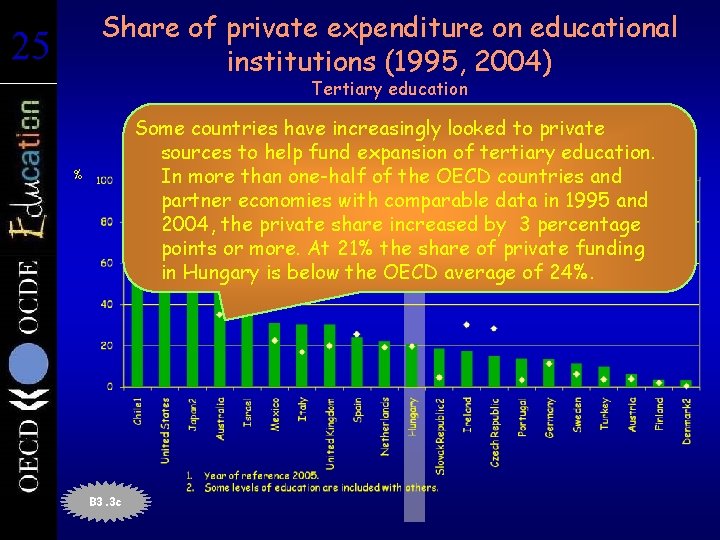
Share of private expenditure on educational institutions (1995, 2004) 25 25 Tertiary education Some countries have increasingly looked to private sources to help fund expansion of tertiary education. In more than one-half of the OECD countries and partner economies with comparable data in 1995 and 2004, the private share increased by 3 percentage points or more. At 21% the share of private funding in Hungary is below the OECD average of 24%. % B 3. 3 c
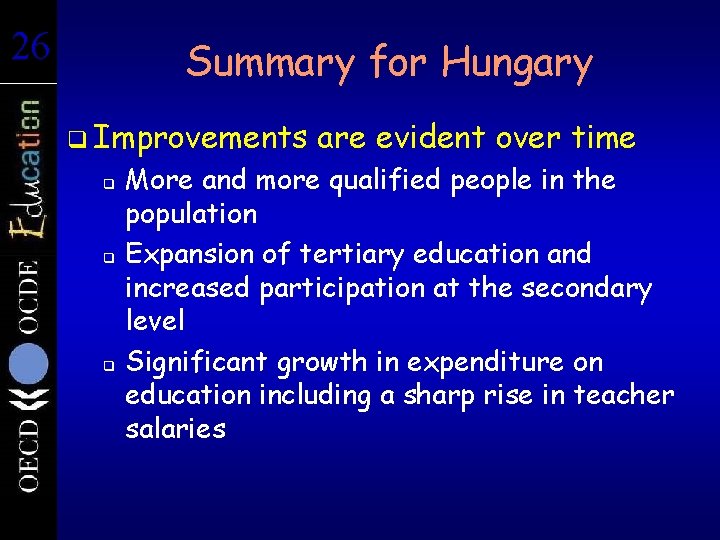
26 26 Summary for Hungary q Improvements q q q are evident over time More and more qualified people in the population Expansion of tertiary education and increased participation at the secondary level Significant growth in expenditure on education including a sharp rise in teacher salaries
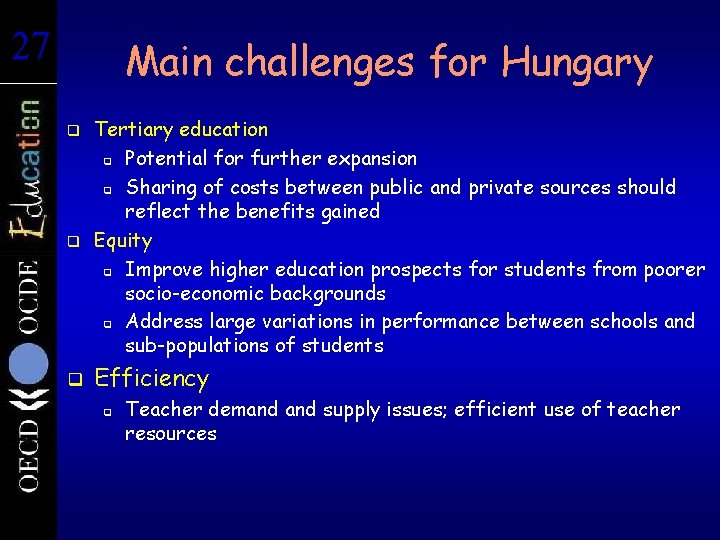
27 27 Main challenges for Hungary q Tertiary education q Potential for further expansion q Sharing of costs between public and private sources should reflect the benefits gained Equity q Improve higher education prospects for students from poorer socio-economic backgrounds q Address large variations in performance between schools and sub-populations of students q Efficiency q q Teacher demand supply issues; efficient use of teacher resources
28 28 Thank you for listening ! l l www. oecd. org/edu/eag 2007 www. pisa. oecd. org – All national and international publications – The complete micro-level database l Michael. Davidson@OECD. org