
1 1 Definition of Construction n Is the

- Slides: 38
1. 1 Definition of Construction:
n Is the process by which material, equipment, machinery are assembled into a permanent facility.
Management: n Process of planning, directing and controlling resources to achieve the desired goal.
Construction Industry Characteristics: n n n It reacts rapidly to external economic pressures, tight money or national recession. Widerange of activities, methods and manufacture. Remote site with changing conditions.
n n n Construction contractor often enjoys high incomes but due to the competitive nature, result in a high bankruptcy rate. Personnel are not permanent and skilled workers earn high wages, but due to interruption of season reduces the annual income of money. Compose of large number of independent suppliers and contractor.
The Construction Contractor: n Is that party who brings together all of the diverse elements and input of the construction process into a single, coordinated effort.
Classification of Contractors: n n a. Prime”General” where he is responsible for construction of the entire project. b. Subcontractor”Speciality”where he is responsible for construction a limited aspect of the project etc. . n Plumbing, Heating, Electrical etc.
Classification of Constuction Industry n n n 1. By Size($) Small Medium Large Mega 5 M 15 M 50 -200 M 2. By Ownership; Private, Public, Military 3. By Use; Residential Commercial Can be expanded to more Industrial Utility 4. By Scope (Preferred)
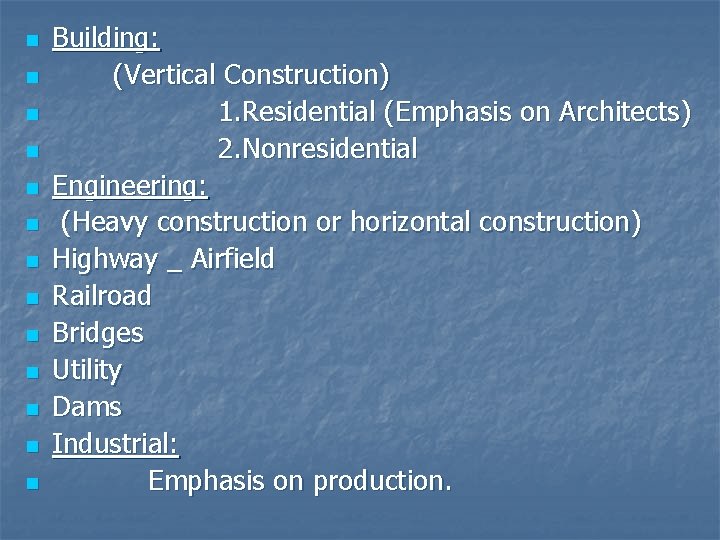
n n n n Building: (Vertical Construction) 1. Residential (Emphasis on Architects) 2. Nonresidential Engineering: (Heavy construction or horizontal construction) Highway _ Airfield Railroad Bridges Utility Dams Industrial: Emphasis on production.
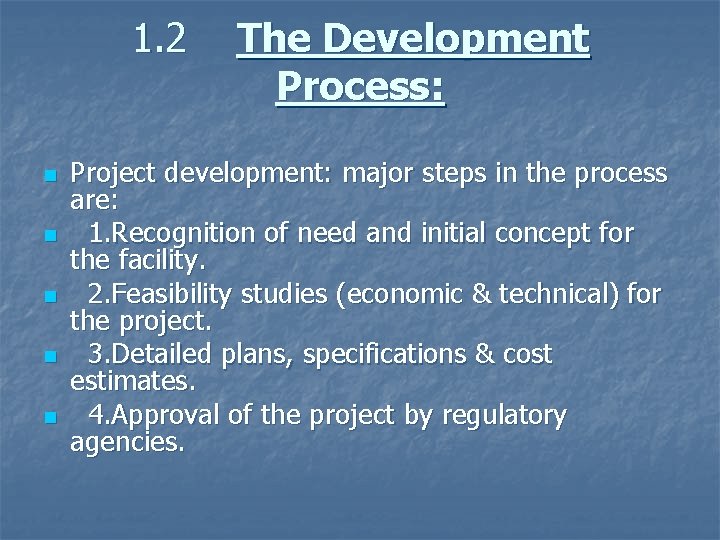
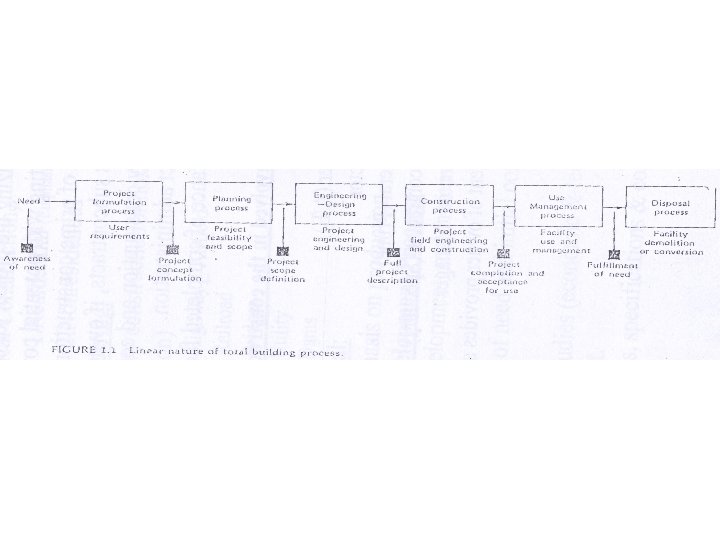
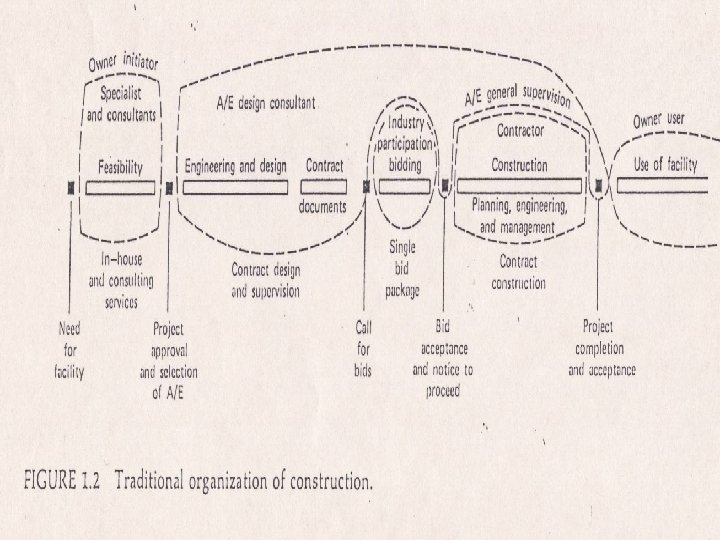
1. 2 n n n The Development Process: Project development: major steps in the process are: 1. Recognition of need and initial concept for the facility. 2. Feasibility studies (economic & technical) for the project. 3. Detailed plans, specifications & cost estimates. 4. Approval of the project by regulatory agencies.
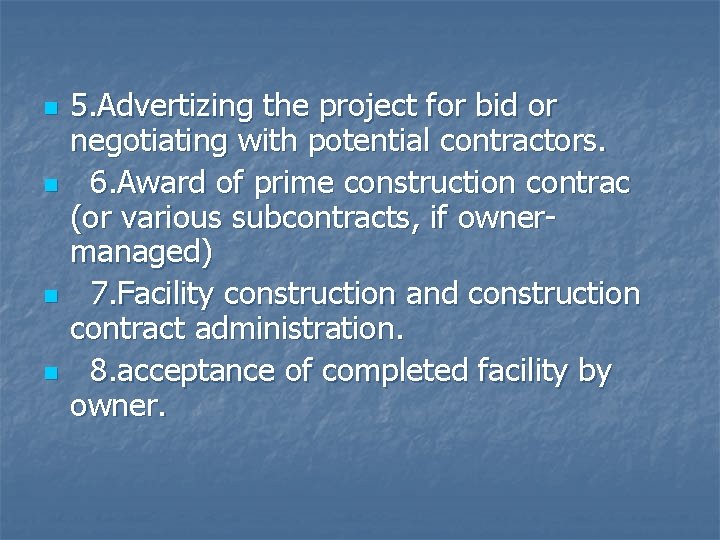
n n 5. Advertizing the project for bid or negotiating with potential contractors. 6. Award of prime construction contrac (or various subcontracts, if ownermanaged) 7. Facility construction and construction contract administration. 8. acceptance of completed facility by owner.
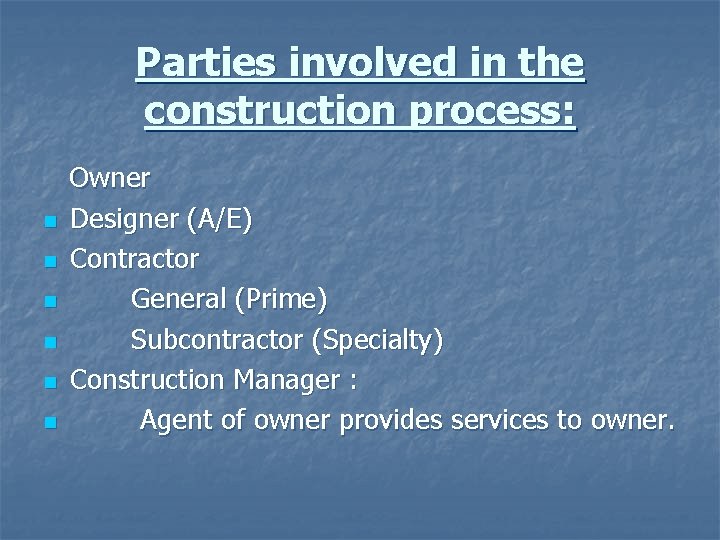
Parties involved in the construction process: n n n Owner Designer (A/E) Contractor General (Prime) Subcontractor (Specialty) Construction Manager : Agent of owner provides services to owner.
How Construction is Accomplished?
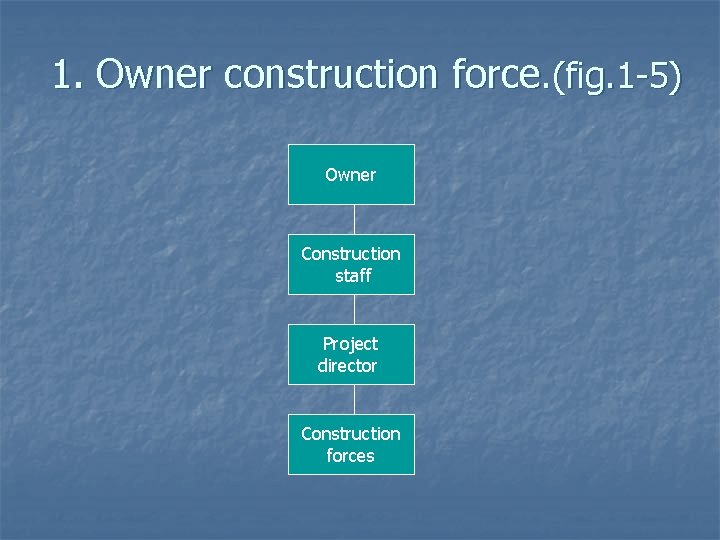
1. Owner construction force. (fig. 1 -5) Owner Construction staff Project director Construction forces
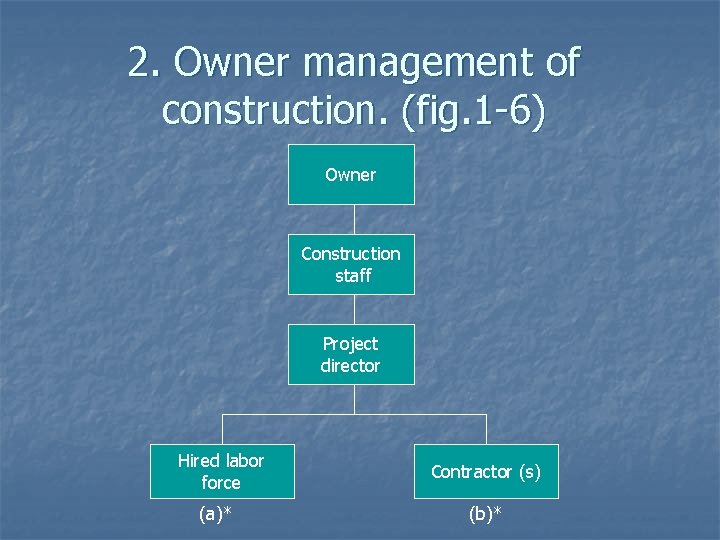
2. Owner management of construction. (fig. 1 -6) Owner Construction staff Project director Hired labor force (a)* Contractor (s) (b)*
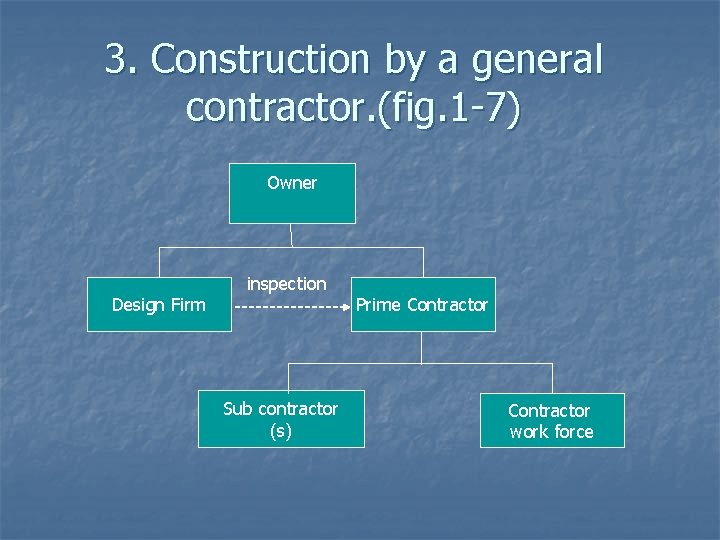
3. Construction by a general contractor. (fig. 1 -7) Owner Design Firm inspection Sub contractor (s) Prime Contractor work force
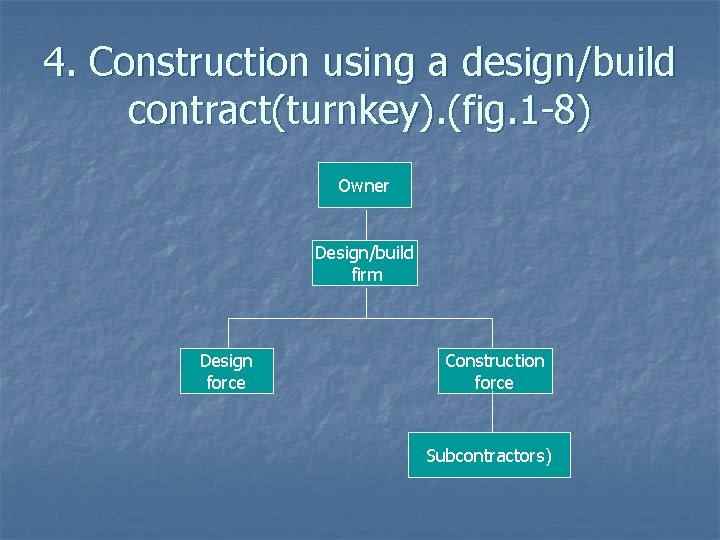
4. Construction using a design/build contract(turnkey). (fig. 1 -8) Owner Design/build firm Design force Construction force Subcontractors)
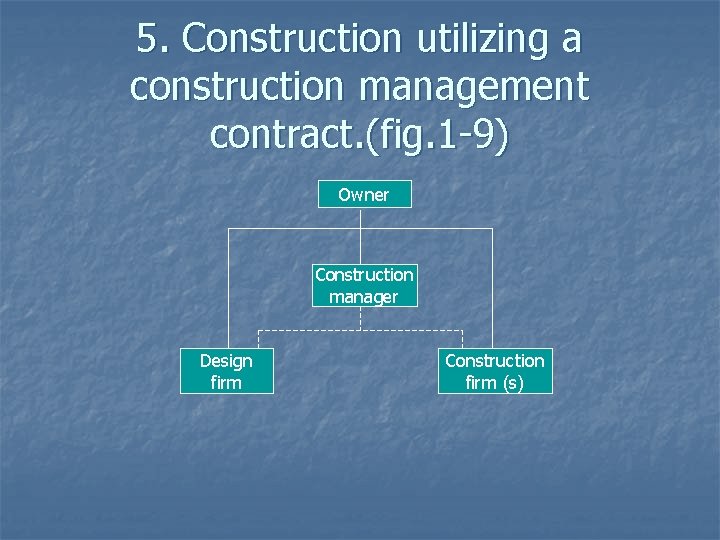
5. Construction utilizing a construction management contract. (fig. 1 -9) Owner Construction Design/build manager firm Design firm Construction firm (s)
Construction Management:
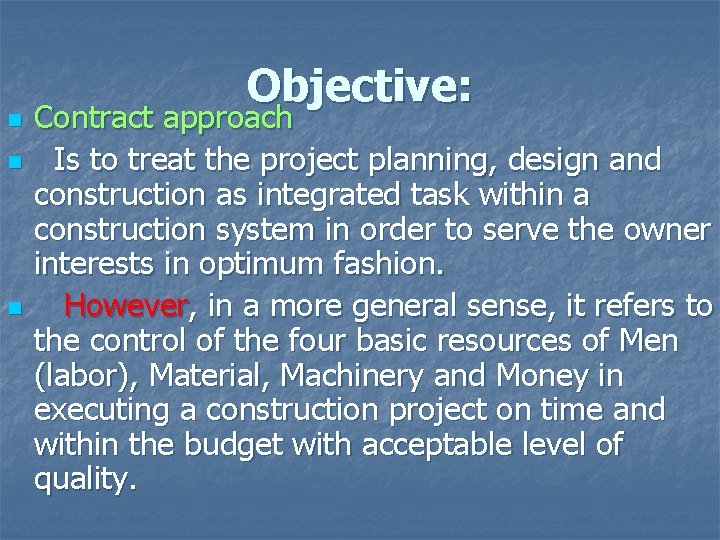
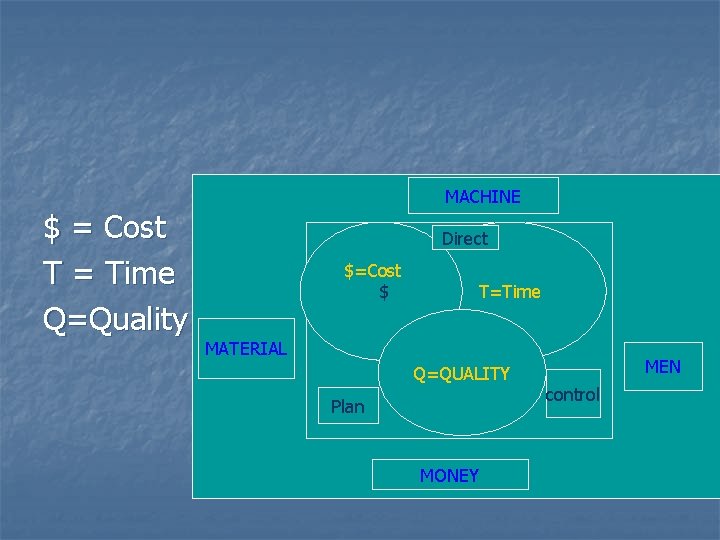
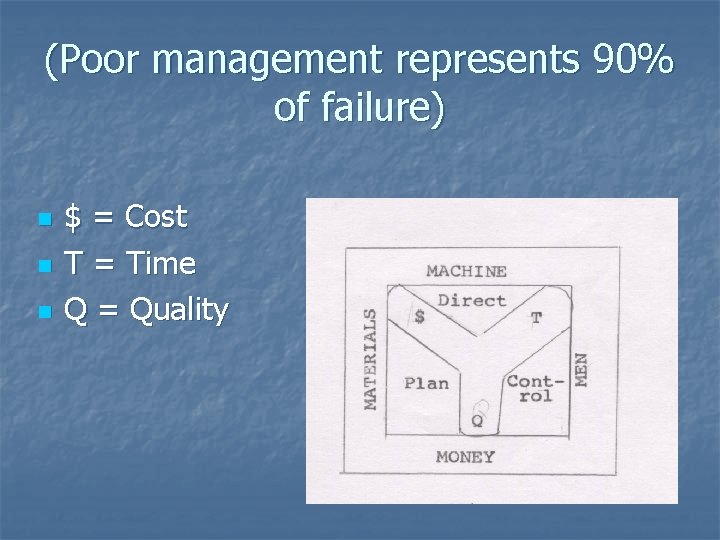
n n n Objective: Contract approach Is to treat the project planning, design and construction as integrated task within a construction system in order to serve the owner interests in optimum fashion. However, in a more general sense, it refers to the control of the four basic resources of Men (labor), Material, Machinery and Money in executing a construction project on time and within the budget with acceptable level of quality.
$ = Cost T = Time Q=Quality MACHINE Direct $=Cost $ T=Time MATERIAL Q=QUALITY Plan MONEY MEN control
Reasons for construction company failure: n n Lack of capital Inadequate cost accounting Poor cost estimating Lack of general management ability
(Poor management represents 90% of failure) n n n $ = Cost T = Time Q = Quality
CONTRACTING METHODS
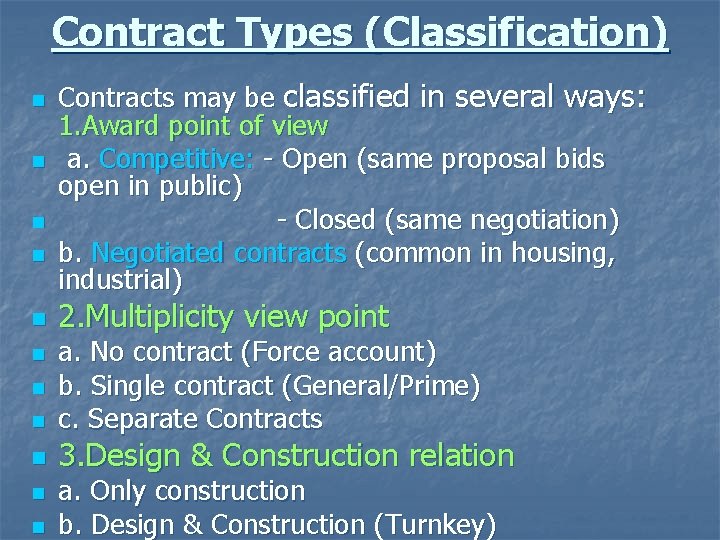
Contract Types (Classification) n n n Contracts may be classified in several ways: 1. Award point of view a. Competitive: - Open (same proposal bids open in public) - Closed (same negotiation) b. Negotiated contracts (common in housing, industrial) 2. Multiplicity view point a. No contract (Force account) b. Single contract (General/Prime) c. Separate Contracts 3. Design & Construction relation a. Only construction b. Design & Construction (Turnkey)
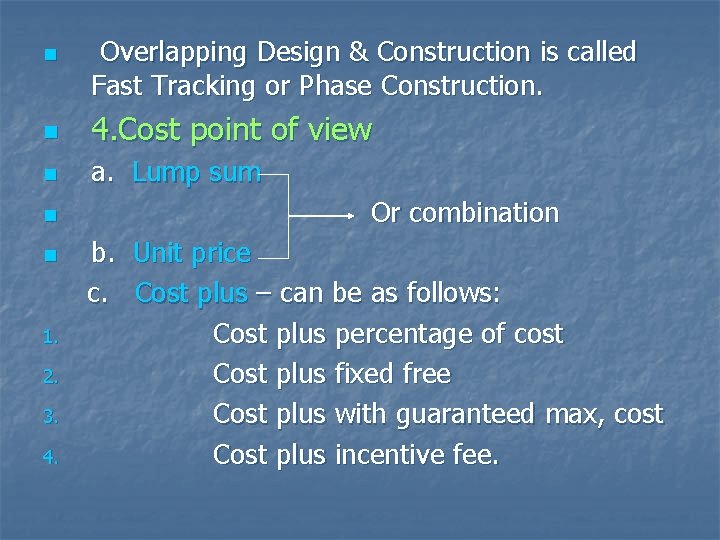
n Overlapping Design & Construction is called Fast Tracking or Phase Construction. n 4. Cost point of view n a. Lump sum n n 1. 2. 3. 4. Or combination b. Unit price c. Cost plus – can be as follows: Cost plus percentage of cost Cost plus fixed free Cost plus with guaranteed max, cost Cost plus incentive fee.
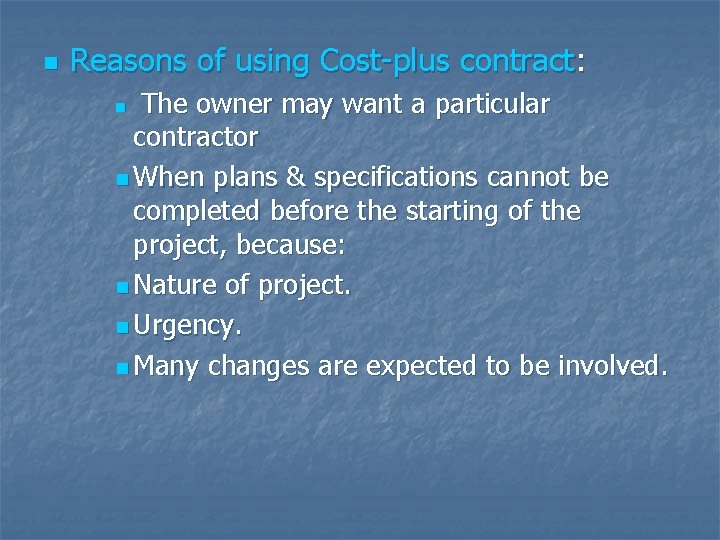
n Reasons of using Cost-plus contract: The owner may want a particular contractor n When plans & specifications cannot be completed before the starting of the project, because: n Nature of project. n Urgency. n Many changes are expected to be involved. n
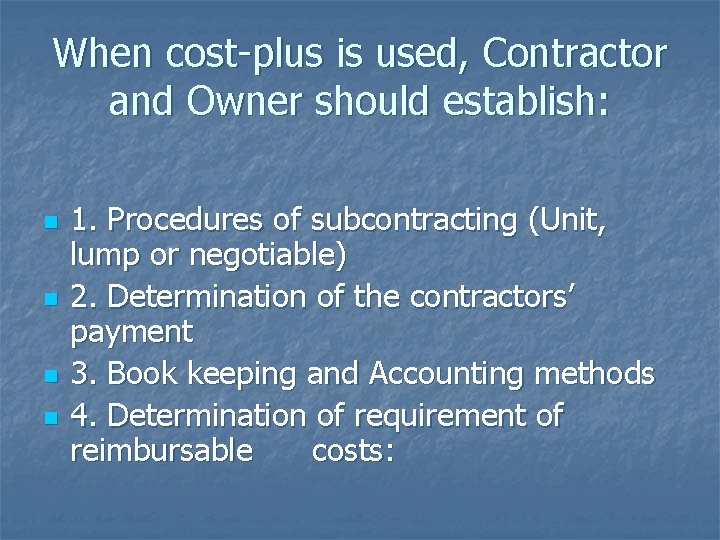
When cost-plus is used, Contractor and Owner should establish: n n 1. Procedures of subcontracting (Unit, lump or negotiable) 2. Determination of the contractors’ payment 3. Book keeping and Accounting methods 4. Determination of requirement of reimbursable costs:
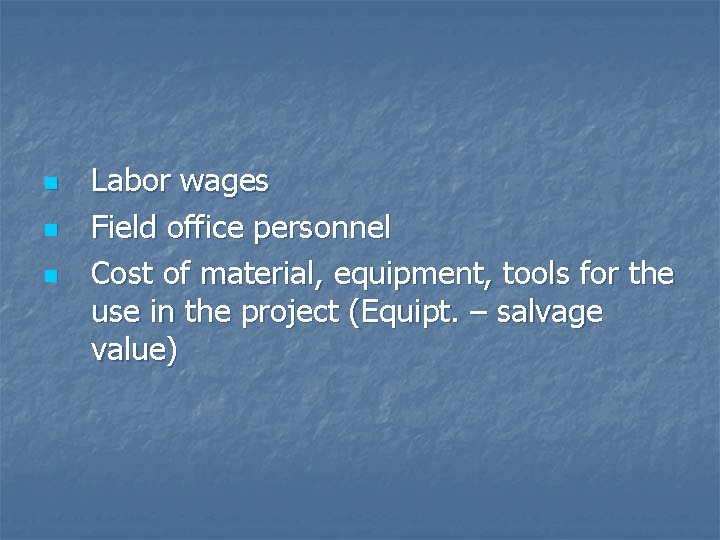
n n n Labor wages Field office personnel Cost of material, equipment, tools for the use in the project (Equipt. – salvage value)
Costs not reimbursed. n n 1. Office overhead (unless the office functions are done in the field office) 2. Cost due to negligence of contractor. (correction of defective work)
1. Cost plus % of cost n n n Used when project is poorly defined or cost is immaterial and the owners desire the best materials and workmanship. Disadvantage : No incentive for cost to go down. (Government agency may not use it)
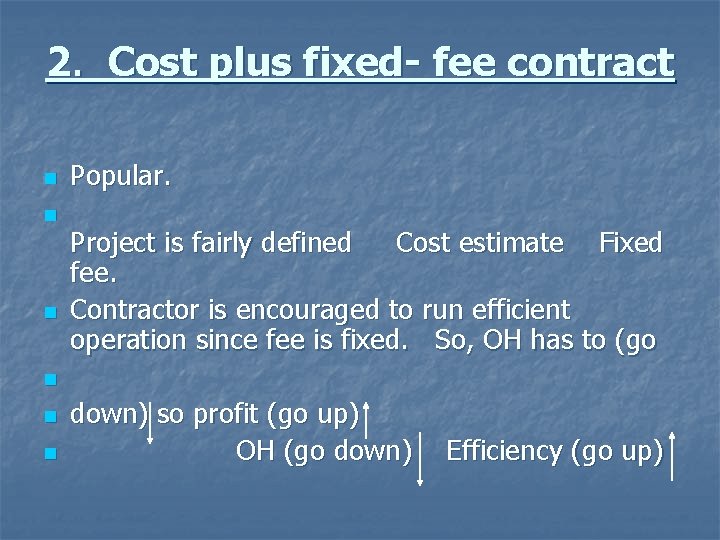
2. Cost plus fixed- fee contract n n n Popular. Project is fairly defined Cost estimate Fixed fee. Contractor is encouraged to run efficient operation since fee is fixed. So, OH has to (go n n n down) so profit (go up) OH (go down) Efficiency (go up)
3. Cost-plus fixed fee with guaranteed max. cost n n n Advantage : Owner knows his maximum cost in advance Only additional costs will be absorbed by contractor profit You need fairly decent plans and specifications.
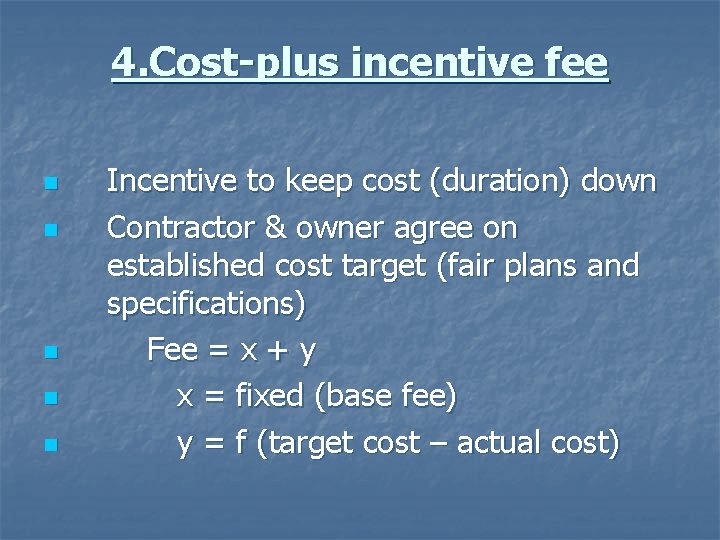
4. Cost-plus incentive fee n n n Incentive to keep cost (duration) down Contractor & owner agree on established cost target (fair plans and specifications) Fee = x + y x = fixed (base fee) y = f (target cost – actual cost)