
1 1 Communication in a Changing World 2006
- Slides: 36
1 -1 Communication in a Changing World, 2006 Edition C H A 1 P T E R Understanding the Process of Communication Bethami A. Dobkin Roger C. Pace Mc. Graw-Hill © 2006 The Mc. Graw-Hill Companies, Inc. All rights reserved.
1 -2 Chapter Summary • • Why Study Communication? Defining Communication as a Discipline Basic Elements in the Communication Process • Dynamic Characteristics of the Communication Process • Communicating Responsibly: Guiding Principles for Communicators Mc. Graw-Hill © 2006 The Mc. Graw-Hill Companies, Inc. All rights reserved.
1 -3 Why Study Communication? • Communication has the potential to shape identities, relationships, environments, and cultures Mc. Graw-Hill © 2006 The Mc. Graw-Hill Companies, Inc. All rights reserved.
1 -4 Why Study Communication? • Communication in Relationships – Humans rely on communication as the basis of relationships • Satisfaction with relationships, living arrangements, classroom performance, and working environments hinge on ability to communicate • Use to learn about people we interact with • Utilize as a tool to express ourselves and instruct, inspire, and motivate others Mc. Graw-Hill © 2006 The Mc. Graw-Hill Companies, Inc. All rights reserved.
1 -5 Why Study Communication? • Communication and Society – Key to establishing identities, communities, and systems of shared governance – Communicate sense of self through clothing, possessions, and style of speech – Necessary for a healthy democracy Mc. Graw-Hill © 2006 The Mc. Graw-Hill Companies, Inc. All rights reserved.
1 -6 Why Study Communication? • Communication and Changing Technology – New technologies and the demands of global markets create the expectation that everyone has good interpersonal and presentational skills • Communication in a Diverse Workplace – Working with diverse groups of people requires skills in collaboration and relationship building Mc. Graw-Hill © 2006 The Mc. Graw-Hill Companies, Inc. All rights reserved.
1 -7 Defining Communication the process of creating and sharing meaning through the use of symbols • Partly an art, and a form of expression • Also a science, open for study and rigorous examination Mc. Graw-Hill © 2006 The Mc. Graw-Hill Companies, Inc. All rights reserved.
1 -8 Defining Communication • Four facets of Communication 1. Communication Is a Process – We are always engaged in some form of communication – Communication continues even as we stop to think about what might be happening Mc. Graw-Hill © 2006 The Mc. Graw-Hill Companies, Inc. All rights reserved.
1 -9 Defining Communication 2. We Create and Share Meaning through Communication – Create meaning whenever we think about our actions, interact with others, or even engage in an internal dialog with ourselves – Assume that if we say something clearly enough, we have conveyed or shared meaning with others • Our attempts at sharing meaning can fall short of creating mutual understanding Mc. Graw-Hill © 2006 The Mc. Graw-Hill Companies, Inc. All rights reserved.
1 -10 Defining Communication 3. Communication Is Largely Intentional – Creating and sharing meaning places particular importance on those behaviors that are intentional • Although intent can be difficult to determine, we make assumptions about it all the time – We can make conscious choices about intentional communication and work to improve our skills as communicators Mc. Graw-Hill © 2006 The Mc. Graw-Hill Companies, Inc. All rights reserved.
1 -11 Defining Communication 4. Communication Is Symbolic – Communication depends on the use of symbols, which includes all the words, images, gestures, and expressions that we use to represent out thoughts, ideas, beliefs Mc. Graw-Hill © 2006 The Mc. Graw-Hill Companies, Inc. All rights reserved.
1 -12 Communication as a Discipline • Communication as a Discipline – Understanding how people communicate can be traced back to the ancient Greek study of rhetoric (Brummet 1991) – Rhetorical tradition has been complemented by social scientific approaches to studying communications (Griffin 1991) – More recent approaches to communication and influence focus on understanding how communication contributes to social change Mc. Graw-Hill © 2006 The Mc. Graw-Hill Companies, Inc. All rights reserved.
1 -13 Communication as a Discipline • Communication as a Discipline (continued) – From its inception, the study of communication has included • A focus on the initiation and interpretation of messages • A concern about: – How people see the world – How they should behave – The role of interaction in making the world a better place Mc. Graw-Hill © 2006 The Mc. Graw-Hill Companies, Inc. All rights reserved.
1 -14 Basic Elements in the Communication Process • Activity Mc. Graw-Hill © 2006 The Mc. Graw-Hill Companies, Inc. All rights reserved.
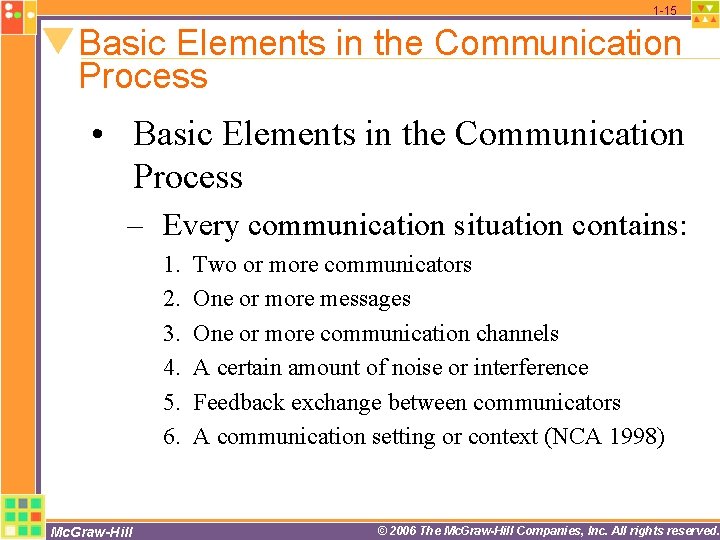
1 -15 Basic Elements in the Communication Process • Basic Elements in the Communication Process – Every communication situation contains: 1. 2. 3. 4. 5. 6. Mc. Graw-Hill Two or more communicators One or more messages One or more communication channels A certain amount of noise or interference Feedback exchange between communicators A communication setting or context (NCA 1998) © 2006 The Mc. Graw-Hill Companies, Inc. All rights reserved.
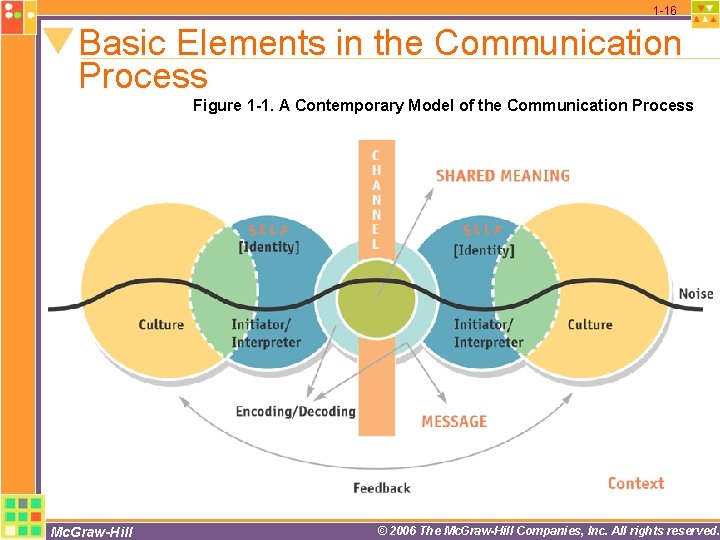
1 -16 Basic Elements in the Communication Process Figure 1 -1. A Contemporary Model of the Communication Process Mc. Graw-Hill © 2006 The Mc. Graw-Hill Companies, Inc. All rights reserved.
1 -17 Basic Elements in the Communication Process • Communicators – Initiators and Interpreters • Initiator starts or advances the communication process by generating a message • Interpreter perceives and attempts to understand a message Mc. Graw-Hill © 2006 The Mc. Graw-Hill Companies, Inc. All rights reserved.
1 -18 Basic Elements in the Communication Process • Communicators (continued) – Encoding and Decoding • Encoding occurs as a communicator translates ideas, thoughts, and feelings into symbols • Decoding occurs as a communicator interprets a message by deciphering the symbols into understandable and meaningful ideas, thoughts, and feelings – The Self is the total composite of a person’s personality, experiences, and identity • Messages in the communication process must pass through the “self” Mc. Graw-Hill © 2006 The Mc. Graw-Hill Companies, Inc. All rights reserved.
1 -19 Basic Elements in the Communication Process • Messages—symbolic expressions of ideas, thoughts, and feelings – Verbal or nonverbal or both • Verbal messages are expressed through a formal language suing oral, written, or signed words • Nonverbal messages use symbols other than words – Written or oral • Oral communication usually less formal and more personal, more interactive, and more transient than writing Mc. Graw-Hill © 2006 The Mc. Graw-Hill Companies, Inc. All rights reserved.
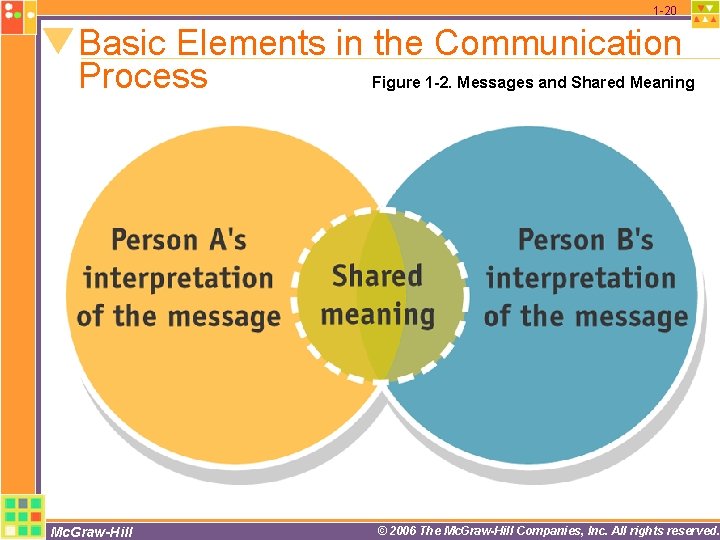
1 -20 Basic Elements in the Communication Process Figure 1 -2. Messages and Shared Meaning Mc. Graw-Hill © 2006 The Mc. Graw-Hill Companies, Inc. All rights reserved.
1 -21 Basic Elements in the Communication Process • Channels – Mediums used to carry messages between communicators are called channels • Influence the message and alters the intent, substance, or result of the message – Three dimensions of mediation [that]can alter message: • Specificity—ability of a channel to focus or customize the message for particular individuals • Richness—the number of verbal and nonverbal clues or modes of communication that a channel carries • Interactivity—the interactive quality of the channel Mc. Graw-Hill © 2006 The Mc. Graw-Hill Companies, Inc. All rights reserved.
1 -22 Basic Elements in the Communication Process • Noise – Anything that interferes with the creation of shared meaning between or among communicators • Internal Noise—occurs when physiological or psychological characteristics interfere in the communication process • External Noise—created by interference in the environment, such as sounds that compete for attention Mc. Graw-Hill © 2006 The Mc. Graw-Hill Companies, Inc. All rights reserved.
1 -23 Basic Elements in the Communication Process • Feedback – Feedback is a response or reaction to a message • Tells if messages are being interpreted as intended • Used to adjust and clarify messages Mc. Graw-Hill © 2006 The Mc. Graw-Hill Companies, Inc. All rights reserved.
1 -24 Basic Elements in the Communication Process • Context – The environment surrounding the communication process • Physical Setting—includes time of day, proximity of communicators, and occasion Mc. Graw-Hill © 2006 The Mc. Graw-Hill Companies, Inc. All rights reserved.
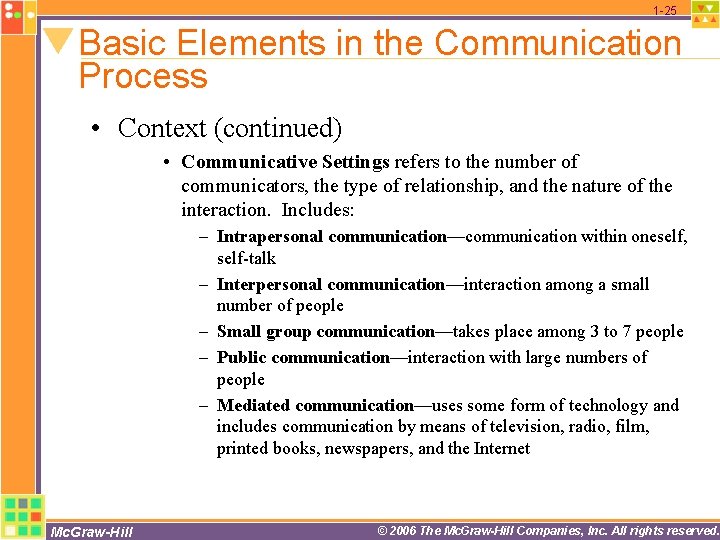
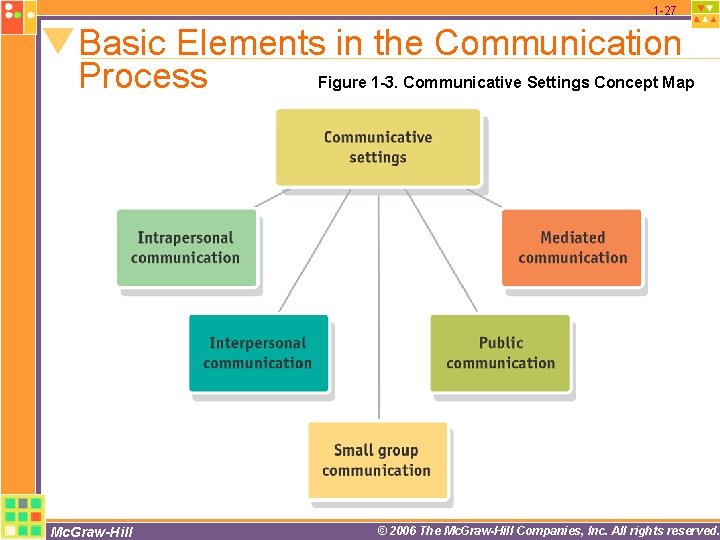
1 -25 Basic Elements in the Communication Process • Context (continued) • Communicative Settings refers to the number of communicators, the type of relationship, and the nature of the interaction. Includes: – Intrapersonal communication—communication within oneself, self-talk – Interpersonal communication—interaction among a small number of people – Small group communication—takes place among 3 to 7 people – Public communication—interaction with large numbers of people – Mediated communication—uses some form of technology and includes communication by means of television, radio, film, printed books, newspapers, and the Internet Mc. Graw-Hill © 2006 The Mc. Graw-Hill Companies, Inc. All rights reserved.
1 -26 Basic Elements in the Communication Process “Not a sentence or a word is independent of the circumstances under which it is uttered. ” —Alfred North Whitehead, English philosopher Mc. Graw-Hill © 2006 The Mc. Graw-Hill Companies, Inc. All rights reserved.
1 -27 Basic Elements in the Communication Process Figure 1 -3. Communicative Settings Concept Map Mc. Graw-Hill © 2006 The Mc. Graw-Hill Companies, Inc. All rights reserved.
1 -28 Basic Elements in the Communication Process • Exploring Communication Concepts – Self-Talk • When are you most likely to engage in self-talk? • How might self-talk help you prepare for future interactions with others? Mc. Graw-Hill © 2006 The Mc. Graw-Hill Companies, Inc. All rights reserved.
1 -29 Basic Elements in the Communication Process • Culture – Culture is everything that makes up one’s way of life, including: – – – Mc. Graw-Hill Shared values Knowledge Behaviors Symbolic expression Co-cultures—cultures within a culture © 2006 The Mc. Graw-Hill Companies, Inc. All rights reserved.
1 -30 Dynamic Characteristics of the Communication Process • Communication is Transactional – Activity • Communication is Irreversible Mc. Graw-Hill © 2006 The Mc. Graw-Hill Companies, Inc. All rights reserved.
1 -31 Dynamic Characteristics of the Communication Process “Every once and awhile, you let a word or phrase out and you want to catch it and bring it back. You can’t do that. It’s gone, gone forever. ” —Dan Quayle, former Vice President of the United States Mc. Graw-Hill © 2006 The Mc. Graw-Hill Companies, Inc. All rights reserved.
1 -32 Communicating Responsibly: Guiding Principles for Communicators • Communicating with Civility – Accepting others as equal partners in reaching common goals – Calls for communicating clearly, effectively, and appropriately • Valuing Diversity – Understanding the process by which difference becomes meaningful and developing the ability to live, learn, and work within many cultures Mc. Graw-Hill © 2006 The Mc. Graw-Hill Companies, Inc. All rights reserved.
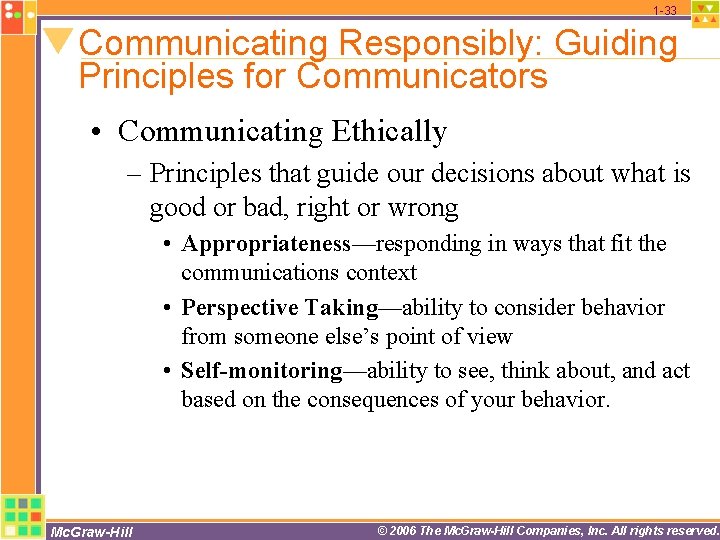
1 -33 Communicating Responsibly: Guiding Principles for Communicators • Communicating Ethically – Principles that guide our decisions about what is good or bad, right or wrong • Appropriateness—responding in ways that fit the communications context • Perspective Taking—ability to consider behavior from someone else’s point of view • Self-monitoring—ability to see, think about, and act based on the consequences of your behavior. Mc. Graw-Hill © 2006 The Mc. Graw-Hill Companies, Inc. All rights reserved.
1 -34 Communicating Responsibly: Guiding Principles for Communicators “To the extent that we protect other people’s religion, speech, freedom to learn and participate in the political process, we preserve our own. ” —John Frohnmayer, Chair, National Endowment for the Arts Mc. Graw-Hill © 2006 The Mc. Graw-Hill Companies, Inc. All rights reserved.
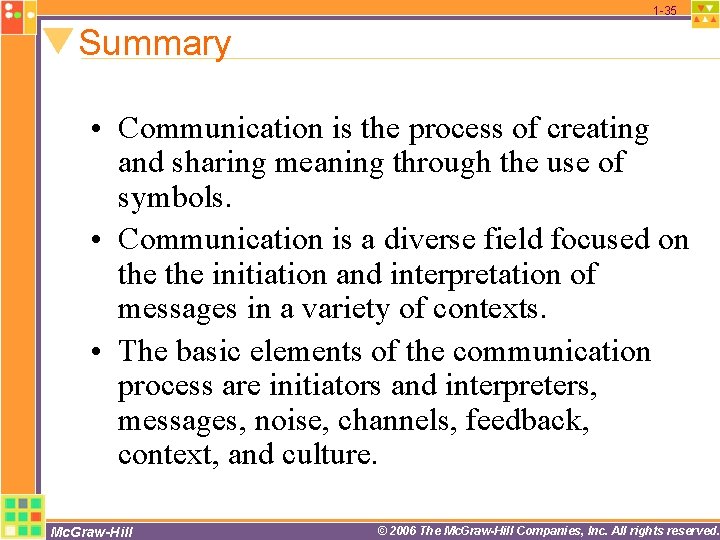
1 -35 Summary • Communication is the process of creating and sharing meaning through the use of symbols. • Communication is a diverse field focused on the initiation and interpretation of messages in a variety of contexts. • The basic elements of the communication process are initiators and interpreters, messages, noise, channels, feedback, context, and culture. Mc. Graw-Hill © 2006 The Mc. Graw-Hill Companies, Inc. All rights reserved.
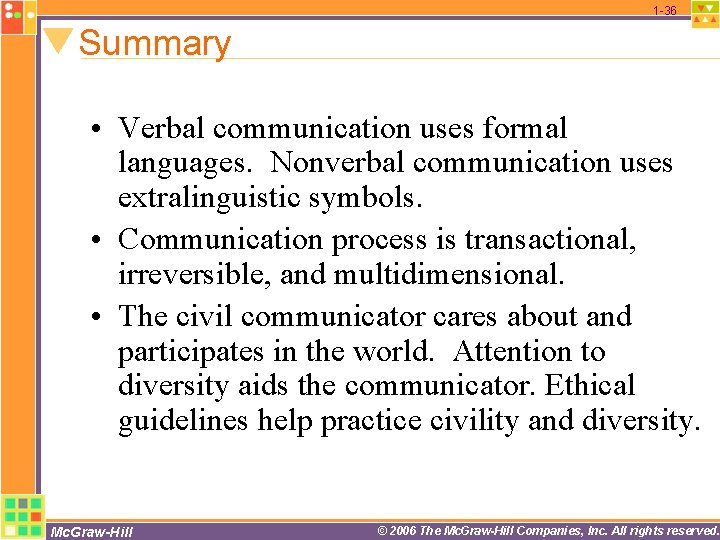
1 -36 Summary • Verbal communication uses formal languages. Nonverbal communication uses extralinguistic symbols. • Communication process is transactional, irreversible, and multidimensional. • The civil communicator cares about and participates in the world. Attention to diversity aids the communicator. Ethical guidelines help practice civility and diversity. Mc. Graw-Hill © 2006 The Mc. Graw-Hill Companies, Inc. All rights reserved.