
1 1 Chapter 1 MANAGING AND LEADING TODAY
- Slides: 28
1– 1 Chapter 1 MANAGING AND LEADING TODAY Copyright © 2014 Pearson Education, Inc. Publishing as Prentice Hall.
Chapter 1: Managing and Leading Today 1– 2 1. Describe why managers must also be leaders. 2. Differentiate between managers and leaders. 3. Explain what is meant by the “other side” of the leadership coin. 4. Summarize HR’s role in managing and leading. 5. Describe what we can do to become excellent managers, leaders, and followers. Copyright © 2014 Pearson Education, Inc. Publishing as Prentice Hall.
1. Why Do Managers Have to Be Leaders? 1– 3 Today, Everyone Needs to Be a Leader Huge Challenges Balance of Power Human Population Open Education Resources Globalization Copyright © 2014 Pearson Education, Inc. Publishing as Prentice Hall.
1. Why Do Managers Have to Be Leaders? 1– 5 What Being a Leader Means for You Appropriate Responses Know Your Own Values Know Your Organization’s Ethical Code Think Analytically (logically) Copyright © 2014 Pearson Education, Inc. Publishing as Prentice Hall.
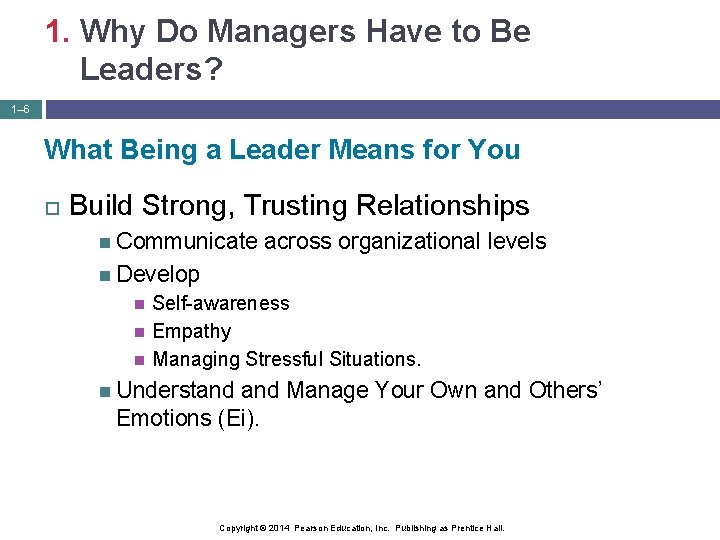
1. Why Do Managers Have to Be Leaders? 1– 6 What Being a Leader Means for You Build Strong, Trusting Relationships Communicate across organizational levels Develop Self-awareness Empathy Managing Stressful Situations. Understand Manage Your Own and Others’ Emotions (Ei). Copyright © 2014 Pearson Education, Inc. Publishing as Prentice Hall.
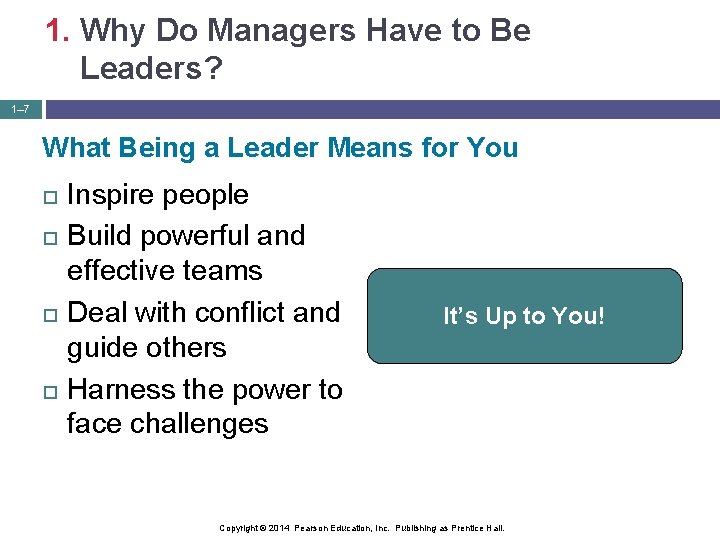
1. Why Do Managers Have to Be Leaders? 1– 7 What Being a Leader Means for You Inspire people Build powerful and effective teams Deal with conflict and guide others Harness the power to face challenges It’s Up to You! Copyright © 2014 Pearson Education, Inc. Publishing as Prentice Hall.
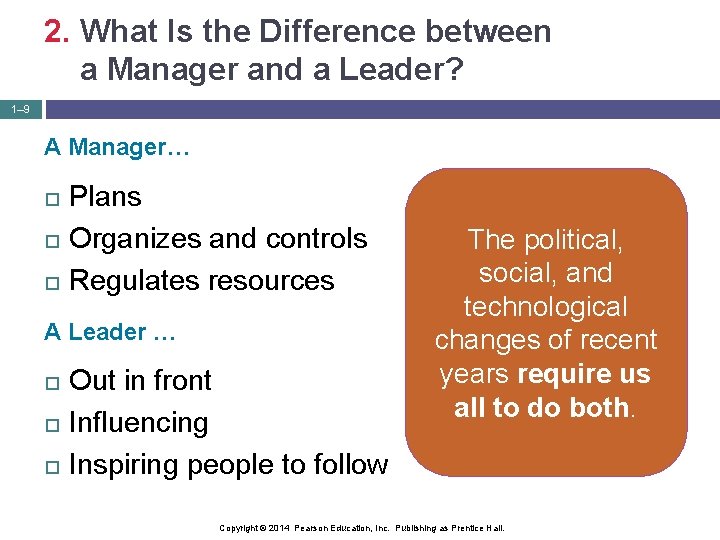
2. What Is the Difference between a Manager and a Leader? 1– 9 A Manager… Plans Organizes and controls Regulates resources A Leader … Out in front Influencing Inspiring people to follow The political, social, and technological changes of recent years require us all to do both. Copyright © 2014 Pearson Education, Inc. Publishing as Prentice Hall.
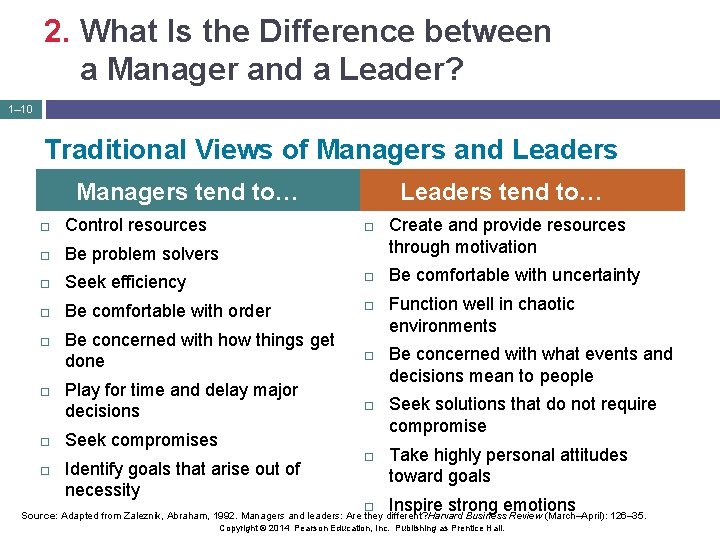
2. What Is the Difference between a Manager and a Leader? 1– 10 Traditional Views of Managers and Leaders Managers tend to… Leaders tend to… Control resources Be problem solvers Seek efficiency Be comfortable with order Be concerned with how things get done Play for time and delay major decisions Seek compromises Identify goals that arise out of necessity Create and provide resources through motivation Be comfortable with uncertainty Function well in chaotic environments Be concerned with what events and decisions mean to people Seek solutions that do not require compromise Take highly personal attitudes toward goals Inspire strong emotions Source: Adapted from Zaleznik, Abraham, 1992. Managers and leaders: Are they different? Harvard Business Review (March–April): 126– 35. Copyright © 2014 Pearson Education, Inc. Publishing as Prentice Hall.
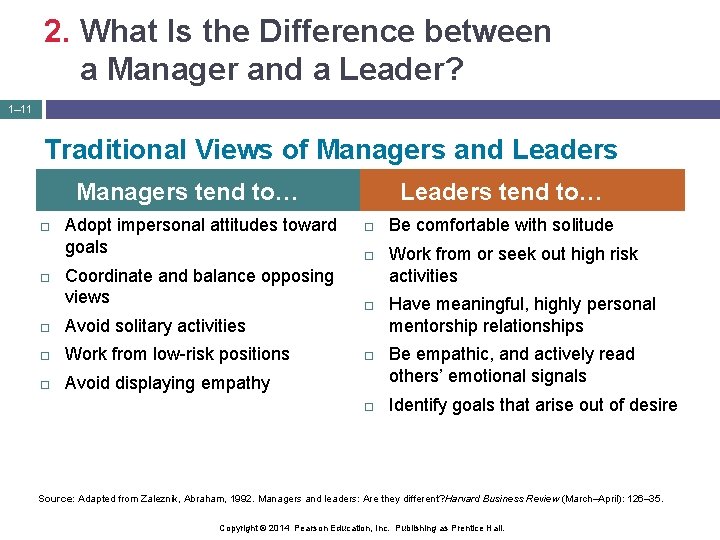
2. What Is the Difference between a Manager and a Leader? 1– 11 Traditional Views of Managers and Leaders Managers tend to… Adopt impersonal attitudes toward goals Coordinate and balance opposing views Avoid solitary activities Work from low-risk positions Avoid displaying empathy Leaders tend to… Be comfortable with solitude Work from or seek out high risk activities Have meaningful, highly personal mentorship relationships Be empathic, and actively read others’ emotional signals Identify goals that arise out of desire Source: Adapted from Zaleznik, Abraham, 1992. Managers and leaders: Are they different? Harvard Business Review (March–April): 126– 35. Copyright © 2014 Pearson Education, Inc. Publishing as Prentice Hall.
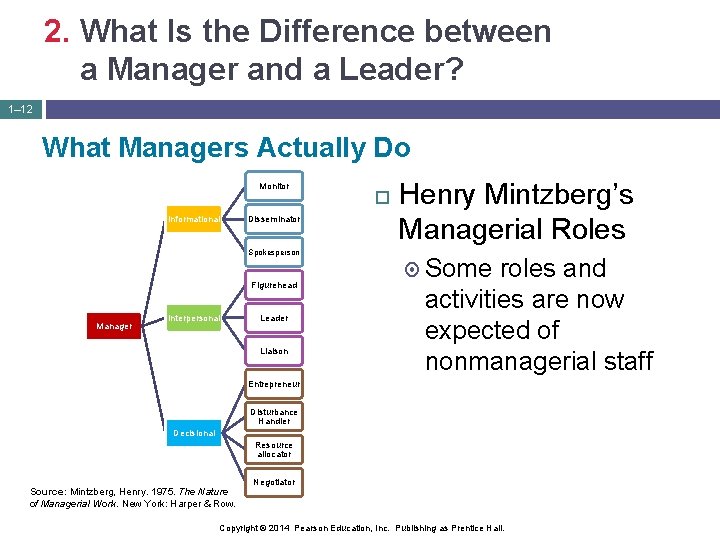
2. What Is the Difference between a Manager and a Leader? 1– 12 What Managers Actually Do Monitor Informational Disseminator Spokesperson Figurehead Manager Interpersonal Leader Liaison Henry Mintzberg’s Managerial Roles Some roles and activities are now expected of nonmanagerial staff Entrepreneur Disturbance Handler Decisional Resource allocator Source: Mintzberg, Henry. 1975. The Nature of Managerial Work. New York: Harper & Row. Negotiator Copyright © 2014 Pearson Education, Inc. Publishing as Prentice Hall.
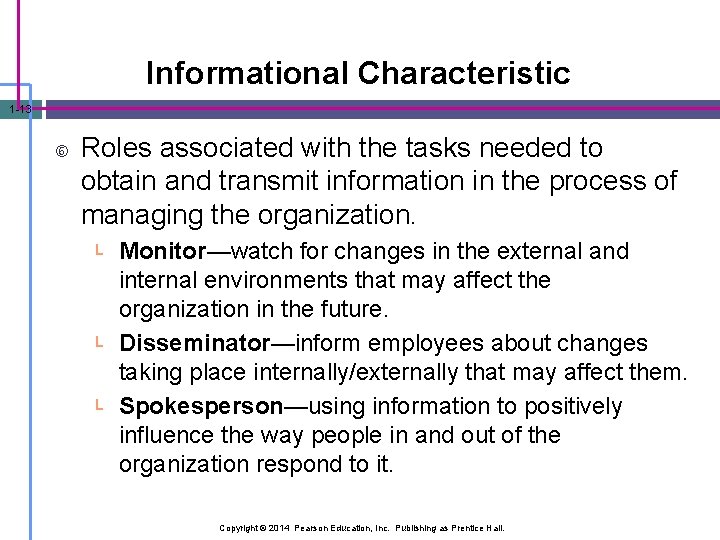
Informational Roles Characteristic Informational 1 -13 Roles associated with the tasks needed to obtain and transmit information in the process of managing the organization. └ └ └ Monitor—watch for changes in the external and internal environments that may affect the organization in the future. Disseminator—inform employees about changes taking place internally/externally that may affect them. Spokesperson—using information to positively influence the way people in and out of the organization respond to it. Copyright © 2014 Pearson Education, Inc. Publishing as Prentice Hall.
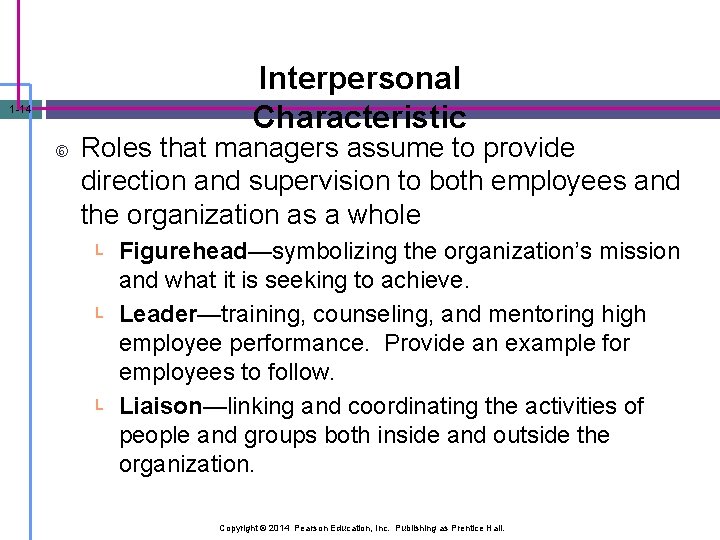
1 -14 Interpersonal Roles Interpersonal Characteristic Roles that managers assume to provide direction and supervision to both employees and the organization as a whole └ └ └ Figurehead—symbolizing the organization’s mission and what it is seeking to achieve. Leader—training, counseling, and mentoring high employee performance. Provide an example for employees to follow. Liaison—linking and coordinating the activities of people and groups both inside and outside the organization. Copyright © 2014 Pearson Education, Inc. Publishing as Prentice Hall.
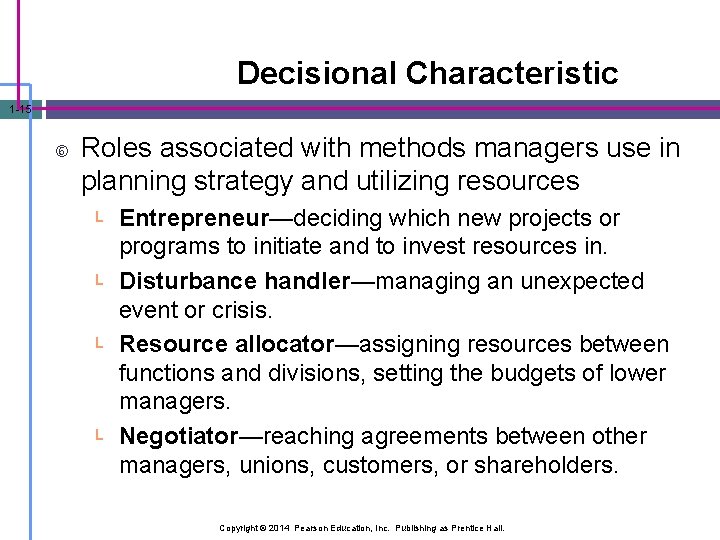
Decisional Roles Decisional Characteristic 1 -15 Roles associated with methods managers use in planning strategy and utilizing resources └ └ Entrepreneur—deciding which new projects or programs to initiate and to invest resources in. Disturbance handler—managing an unexpected event or crisis. Resource allocator—assigning resources between functions and divisions, setting the budgets of lower managers. Negotiator—reaching agreements between other managers, unions, customers, or shareholders. Copyright © 2014 Pearson Education, Inc. Publishing as Prentice Hall.
2. What Is the Difference between a Manager and a Leader? 1– 17 Discussion Questions Consider Mintzberg’s managerial roles. Which of these roles are easy for you to play, or come naturally? Which roles do you think you need to learn more about, or learn how to do better? Consider Henry Moniz’s words “…if you aren’t authentic and you don’t have a vision, you won’t go anywhere. ” What does this mean to you? Copyright © 2014 Pearson Education, Inc. Publishing as Prentice Hall.
3. What Is the Other Side of the Leadership Coin? 1– 18 Without Followers, There Are No Leaders Negative connotations to being a “follower” Even the CEO is a follower Characteristics of a good follower Supporting leaders Setting an example Being involved Managing up Copyright © 2014 Pearson Education, Inc. Publishing as Prentice Hall.
3. What Is the Other Side of the Leadership Coin? 1– 19 Today Everyone Also Needs to Be an Effective Follower Actively support good leaders Respond appropriately to bad leaders (unethical behavior by leader) Empowerment is culturally dependent We all need to learn effective followership tools managing up and effective resistance. Copyright © 2014 Pearson Education, Inc. Publishing as Prentice Hall.
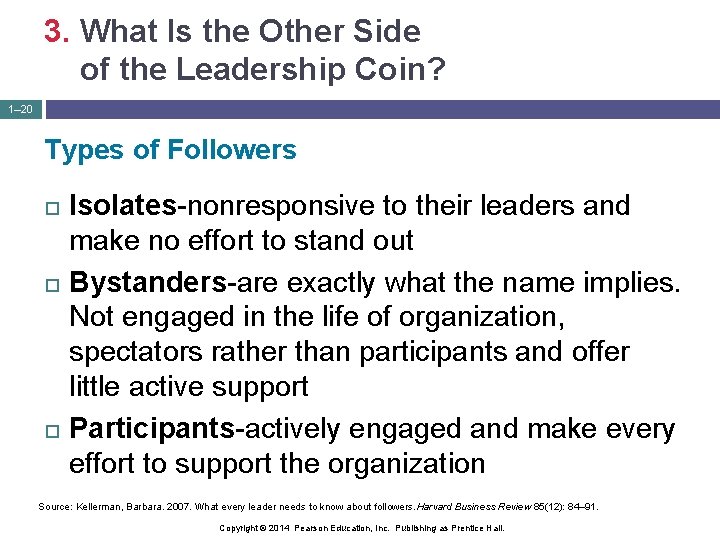
3. What Is the Other Side of the Leadership Coin? 1– 20 Types of Followers Isolates-nonresponsive to their leaders and make no effort to stand out Bystanders-are exactly what the name implies. Not engaged in the life of organization, spectators rather than participants and offer little active support Participants-actively engaged and make every effort to support the organization Source: Kellerman, Barbara. 2007. What every leader needs to know about followers. Harvard Business Review 85(12): 84– 91. Copyright © 2014 Pearson Education, Inc. Publishing as Prentice Hall.
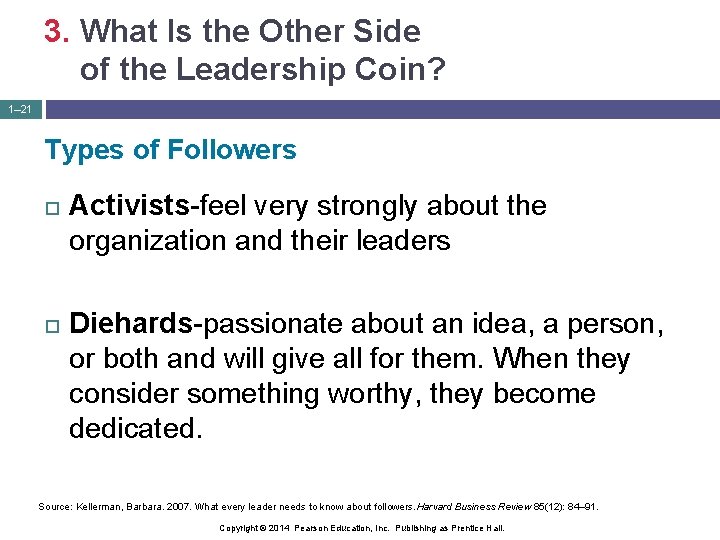
3. What Is the Other Side of the Leadership Coin? 1– 21 Types of Followers Activists-feel very strongly about the organization and their leaders Diehards-passionate about an idea, a person, or both and will give all for them. When they consider something worthy, they become dedicated. Source: Kellerman, Barbara. 2007. What every leader needs to know about followers. Harvard Business Review 85(12): 84– 91. Copyright © 2014 Pearson Education, Inc. Publishing as Prentice Hall.
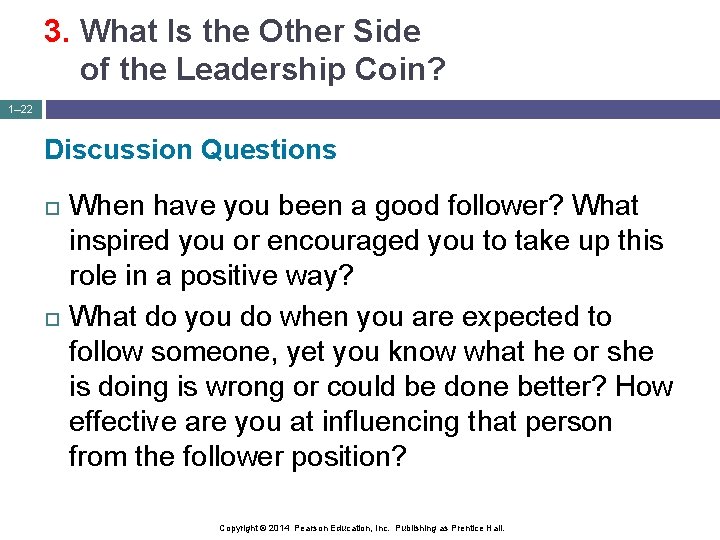
3. What Is the Other Side of the Leadership Coin? 1– 22 Discussion Questions When have you been a good follower? What inspired you or encouraged you to take up this role in a positive way? What do you do when you are expected to follow someone, yet you know what he or she is doing is wrong or could be done better? How effective are you at influencing that person from the follower position? Copyright © 2014 Pearson Education, Inc. Publishing as Prentice Hall.
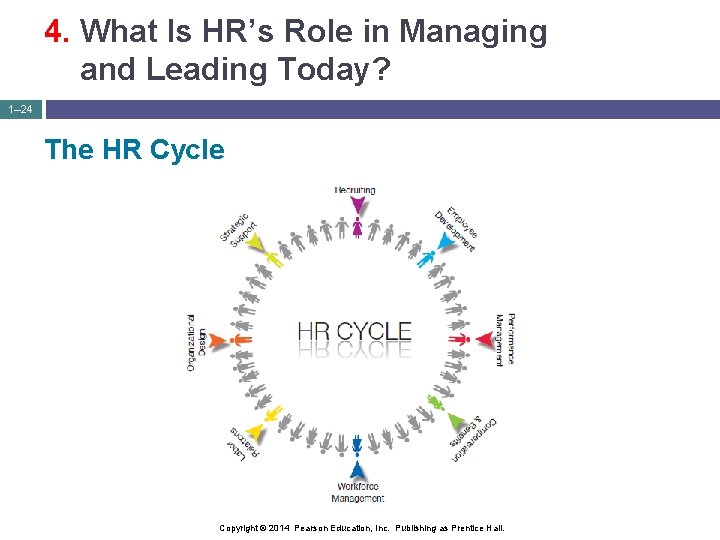
4. What Is HR’s Role in Managing and Leading Today? 1– 24 The HR Cycle Copyright © 2014 Pearson Education, Inc. Publishing as Prentice Hall.
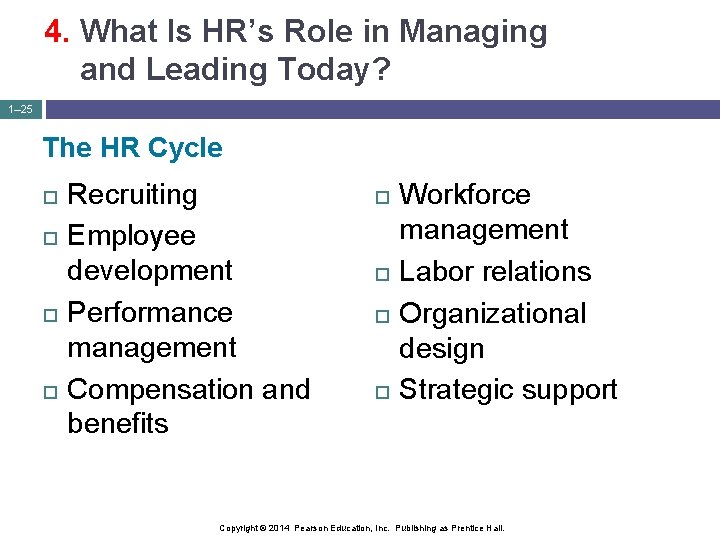
4. What Is HR’s Role in Managing and Leading Today? 1– 25 The HR Cycle Recruiting Employee development Performance management Compensation and benefits Workforce management Labor relations Organizational design Strategic support Copyright © 2014 Pearson Education, Inc. Publishing as Prentice Hall.
4. What Is HR’s Role in Managing and Leading Today? 1– 26 Discussion Questions Look at the eight roles within the HR Cycle. In your opinion, are some of these roles more important than others? If so, which ones, and why? Leaders of many organizations have said the now famous phrase: “People are our greatest asset. ” What do you think this means? Copyright © 2014 Pearson Education, Inc. Publishing as Prentice Hall.
5. What Can We Do to Become Excellent Managers, Leaders, and Followers? 1– 27 Great Leadership Does Not Happen by Accident Professional and Personal Growth Are Dependent on One Another Copyright © 2014 Pearson Education, Inc. Publishing as Prentice Hall.
5. What Can We Do to Become Excellent Managers, Leaders, and Followers? 1– 28 To be an Effective Leader, Manager and Follower, You Need to Work At It Start by Creating a Personal Vision What is your highest purpose in life? If I had all the money in the world… In 10 years, what would your ideal life include? Copyright © 2014 Pearson Education, Inc. Publishing as Prentice Hall.
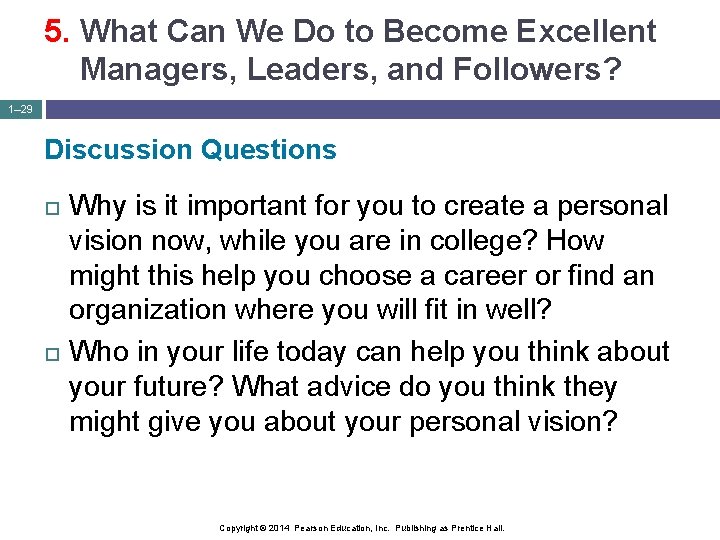
5. What Can We Do to Become Excellent Managers, Leaders, and Followers? 1– 29 Discussion Questions Why is it important for you to create a personal vision now, while you are in college? How might this help you choose a career or find an organization where you will fit in well? Who in your life today can help you think about your future? What advice do you think they might give you about your personal vision? Copyright © 2014 Pearson Education, Inc. Publishing as Prentice Hall.
6. Final Word: Changing World, Changing Expectations of Managers and Leaders 1– 30 Recap The World Needs Good Leaders Good Managers Good Followers Copyright © 2014 Pearson Education, Inc. Publishing as Prentice Hall.
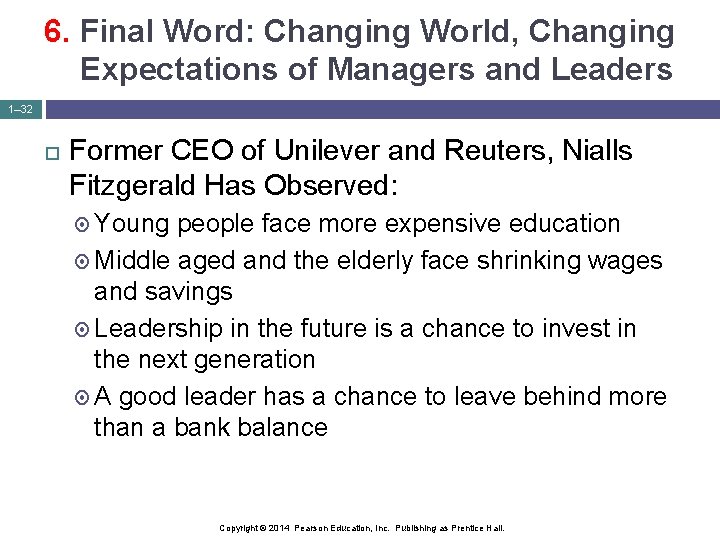
6. Final Word: Changing World, Changing Expectations of Managers and Leaders 1– 32 Former CEO of Unilever and Reuters, Nialls Fitzgerald Has Observed: Young people face more expensive education Middle aged and the elderly face shrinking wages and savings Leadership in the future is a chance to invest in the next generation A good leader has a chance to leave behind more than a bank balance Copyright © 2014 Pearson Education, Inc. Publishing as Prentice Hall.
1– 33 Copyright © 2014 Pearson Education, Inc. Publishing as Prentice Hall.