
1 00 Lecture 20 More on root finding
![Using the Methods public static void main(String[] args) { // Simple example with just](https://slidetodoc.com/presentation_image_h2/4e720a4308cc0f08b236811359652594/image-24.jpg "Using the Methods public static void main(String[] args) { // Simple example with just")
- Slides: 27
1. 00 Lecture 20 More on root finding Numerical lntegration
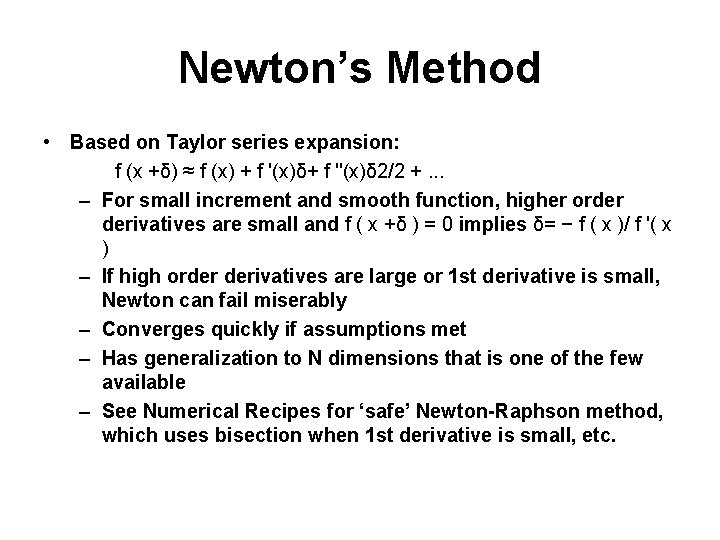
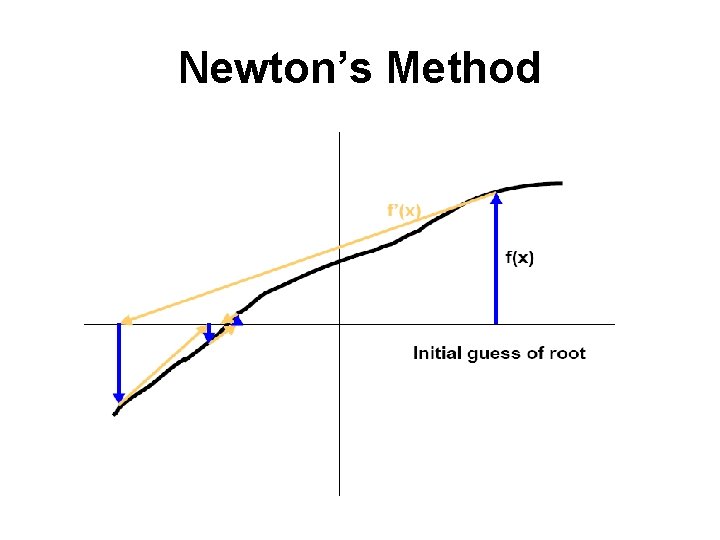
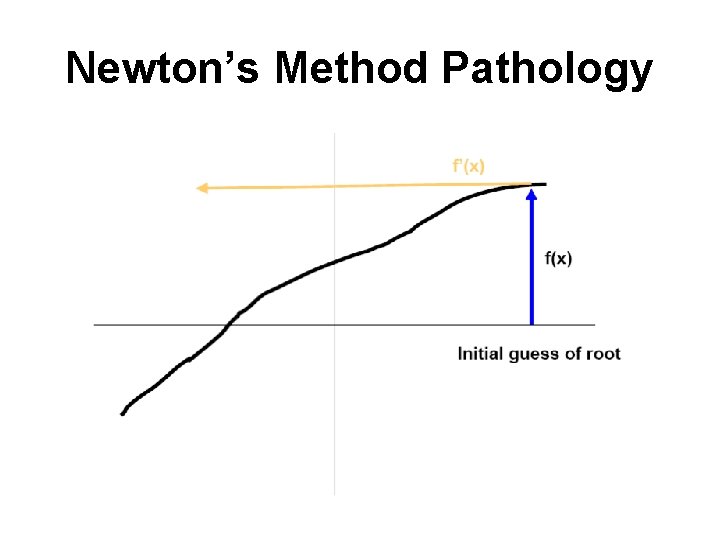
Newton’s Method • Based on Taylor series expansion: f (x +δ) ≈ f (x) + f '(x)δ+ f ''(x)δ 2/2 +. . . – For small increment and smooth function, higher order derivatives are small and f ( x +δ ) = 0 implies δ= − f ( x )/ f '( x ) – If high order derivatives are large or 1 st derivative is small, Newton can fail miserably – Converges quickly if assumptions met – Has generalization to N dimensions that is one of the few available – See Numerical Recipes for ‘safe’ Newton-Raphson method, which uses bisection when 1 st derivative is small, etc.
Newton’s Method
Newton’s Method Pathology
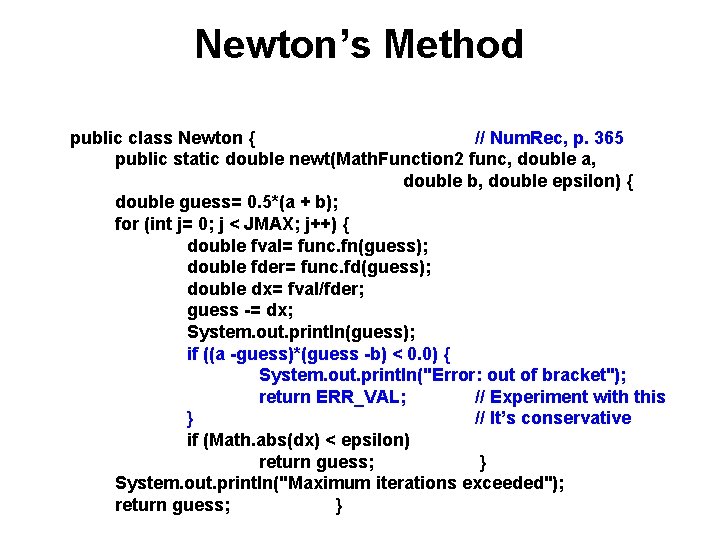
Newton’s Method public class Newton { // Num. Rec, p. 365 public static double newt(Math. Function 2 func, double a, double b, double epsilon) { double guess= 0. 5*(a + b); for (int j= 0; j < JMAX; j++) { double fval= func. fn(guess); double fder= func. fd(guess); double dx= fval/fder; guess -= dx; System. out. println(guess); if ((a -guess)*(guess -b) < 0. 0) { System. out. println("Error: out of bracket"); return ERR_VAL; // Experiment with this } // It’s conservative if (Math. abs(dx) < epsilon) return guess; } System. out. println("Maximum iterations exceeded"); return guess; }
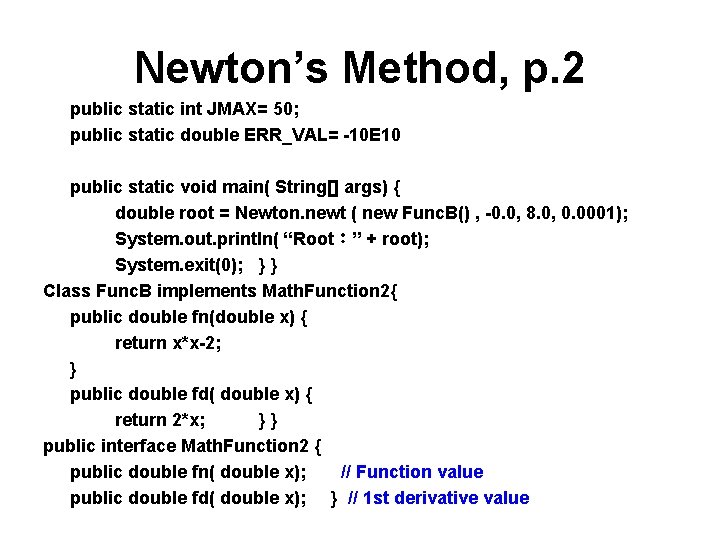
Newton’s Method, p. 2 public static int JMAX= 50; public static double ERR_VAL= -10 E 10 public static void main( String[] args) { double root = Newton. newt ( new Func. B() , -0. 0, 8. 0, 0. 0001); System. out. println( “Root:” + root); System. exit(0); } } Class Func. B implements Math. Function 2{ public double fn(double x) { return x*x-2; } public double fd( double x) { return 2*x; }} public interface Math. Function 2 { public double fn( double x); // Function value public double fd( double x); } // 1 st derivative value
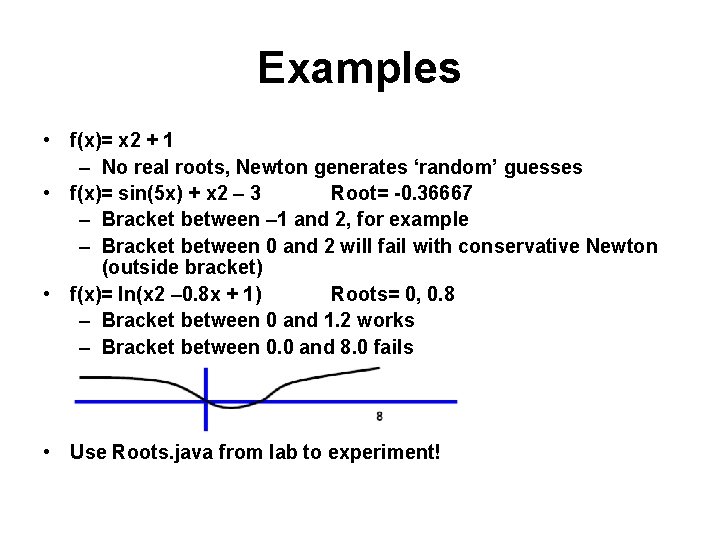
Examples • f(x)= x 2 + 1 – No real roots, Newton generates ‘random’ guesses • f(x)= sin(5 x) + x 2 – 3 Root= -0. 36667 – Bracket between – 1 and 2, for example – Bracket between 0 and 2 will fail with conservative Newton (outside bracket) • f(x)= ln(x 2 – 0. 8 x + 1) Roots= 0, 0. 8 – Bracket between 0 and 1. 2 works – Bracket between 0. 0 and 8. 0 fails • Use Roots. java from lab to experiment!
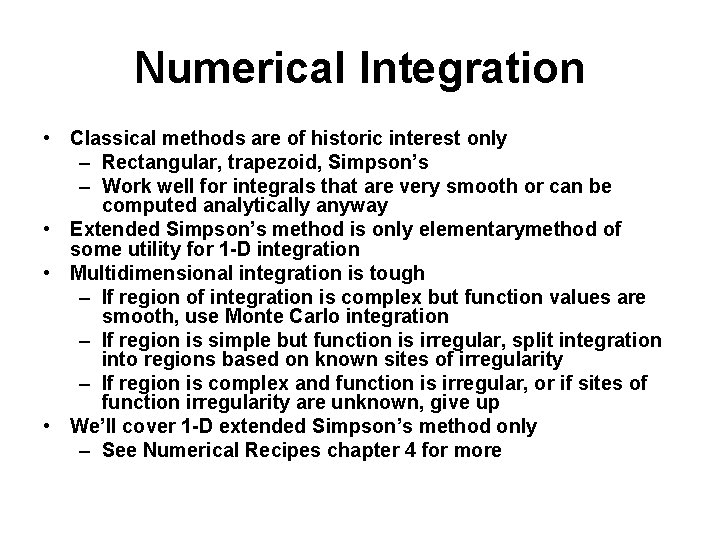
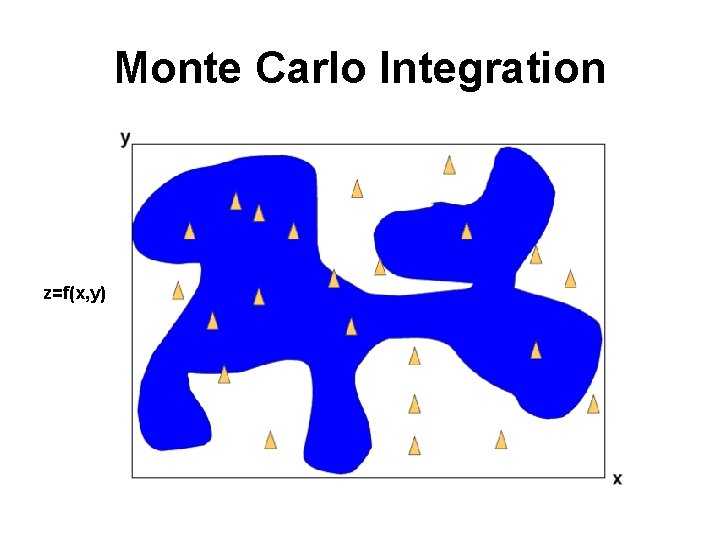
Numerical Integration • Classical methods are of historic interest only – Rectangular, trapezoid, Simpson’s – Work well for integrals that are very smooth or can be computed analytically anyway • Extended Simpson’s method is only elementarymethod of some utility for 1 -D integration • Multidimensional integration is tough – If region of integration is complex but function values are smooth, use Monte Carlo integration – If region is simple but function is irregular, split integration into regions based on known sites of irregularity – If region is complex and function is irregular, or if sites of function irregularity are unknown, give up • We’ll cover 1 -D extended Simpson’s method only – See Numerical Recipes chapter 4 for more
Monte Carlo Integration z=f(x, y)
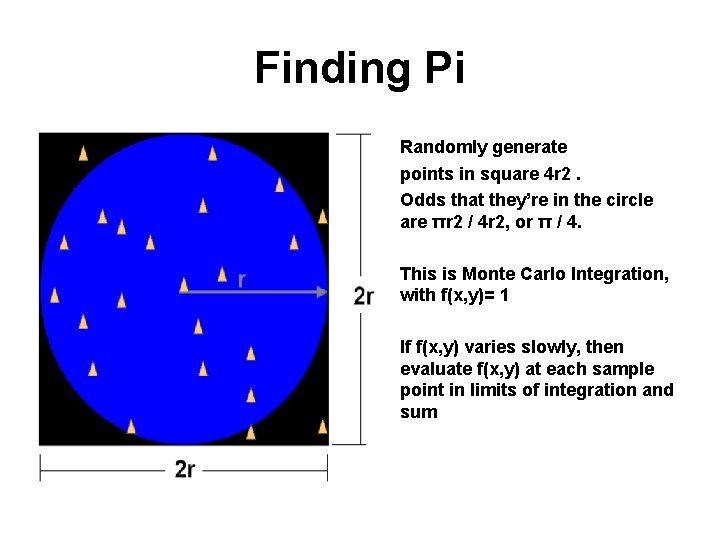
Finding Pi Randomly generate points in square 4 r 2. Odds that they’re in the circle are πr 2 / 4 r 2, or π / 4. This is Monte Carlo Integration, with f(x, y)= 1 If f(x, y) varies slowly, then evaluate f(x, y) at each sample point in limits of integration and sum
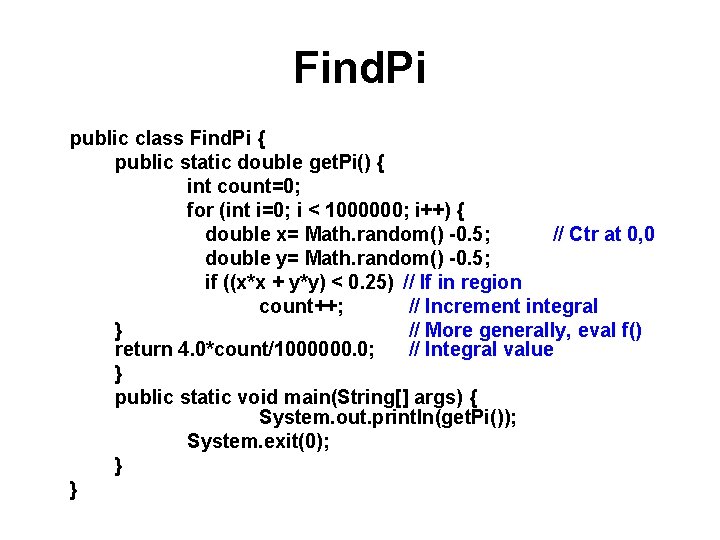
Find. Pi public class Find. Pi { public static double get. Pi() { int count=0; for (int i=0; i < 1000000; i++) { double x= Math. random() -0. 5; // Ctr at 0, 0 double y= Math. random() -0. 5; if ((x*x + y*y) < 0. 25) // If in region count++; // Increment integral } // More generally, eval f() return 4. 0*count/1000000. 0; // Integral value } public static void main(String[] args) { System. out. println(get. Pi()); System. exit(0); } }
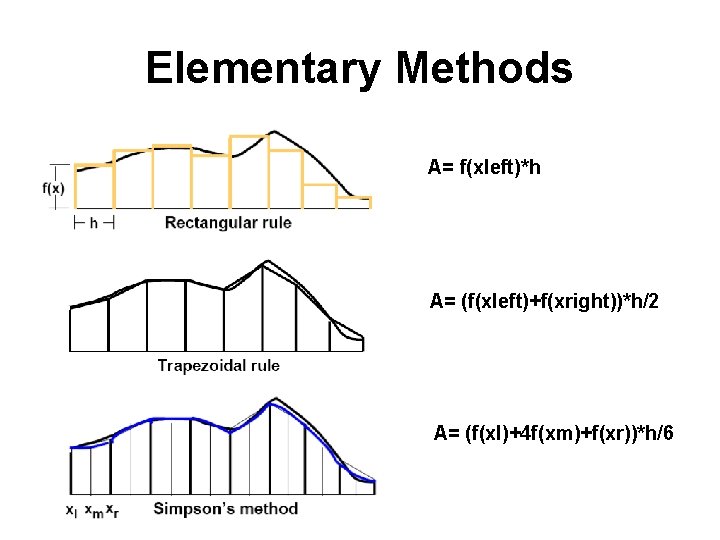
Elementary Methods A= f(xleft)*h A= (f(xleft)+f(xright))*h/2 A= (f(xl)+4 f(xm)+f(xr))*h/6
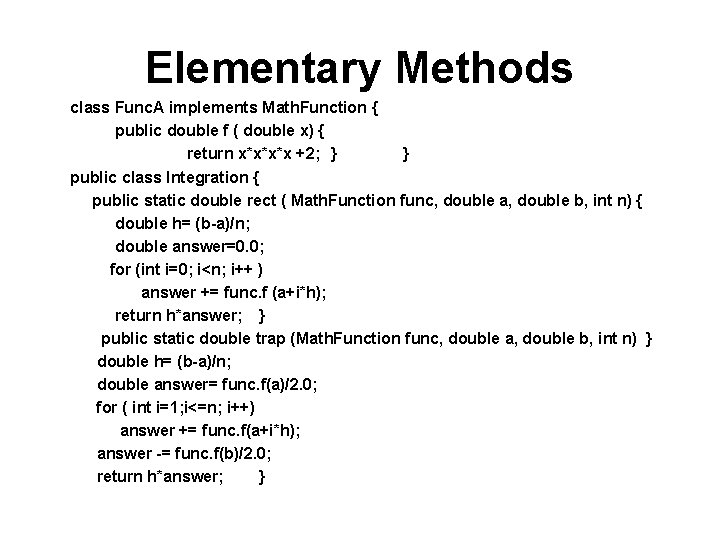
Elementary Methods class Func. A implements Math. Function { public double f ( double x) { return x*x*x*x +2; } } public class Integration { public static double rect ( Math. Function func, double a, double b, int n) { double h= (b-a)/n; double answer=0. 0; for (int i=0; i<n; i++ ) answer += func. f (a+i*h); return h*answer; } public static double trap (Math. Function func, double a, double b, int n) } double h= (b-a)/n; double answer= func. f(a)/2. 0; for ( int i=1; i<=n; i++) answer += func. f(a+i*h); answer -= func. f(b)/2. 0; return h*answer; }
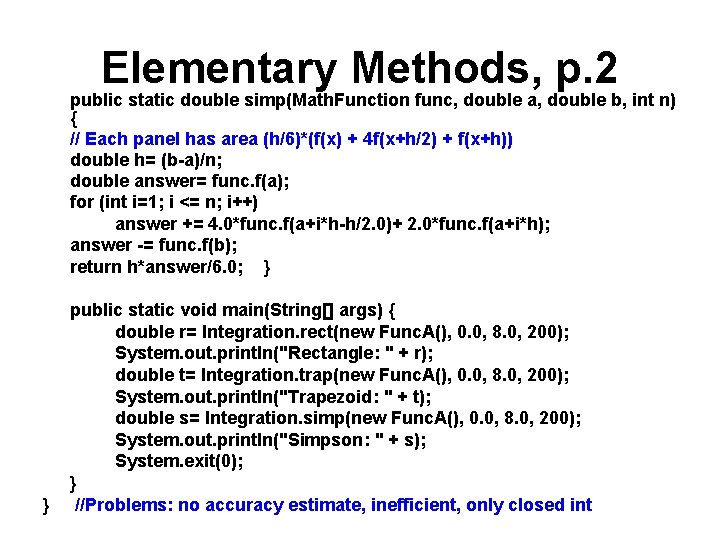
Elementary Methods, p. 2 public static double simp(Math. Function func, double a, double b, int n) { // Each panel has area (h/6)*(f(x) + 4 f(x+h/2) + f(x+h)) double h= (b-a)/n; double answer= func. f(a); for (int i=1; i <= n; i++) answer += 4. 0*func. f(a+i*h-h/2. 0)+ 2. 0*func. f(a+i*h); answer -= func. f(b); return h*answer/6. 0; } } public static void main(String[] args) { double r= Integration. rect(new Func. A(), 0. 0, 8. 0, 200); System. out. println("Rectangle: " + r); double t= Integration. trap(new Func. A(), 0. 0, 8. 0, 200); System. out. println("Trapezoid: " + t); double s= Integration. simp(new Func. A(), 0. 0, 8. 0, 200); System. out. println("Simpson: " + s); System. exit(0); } //Problems: no accuracy estimate, inefficient, only closed int
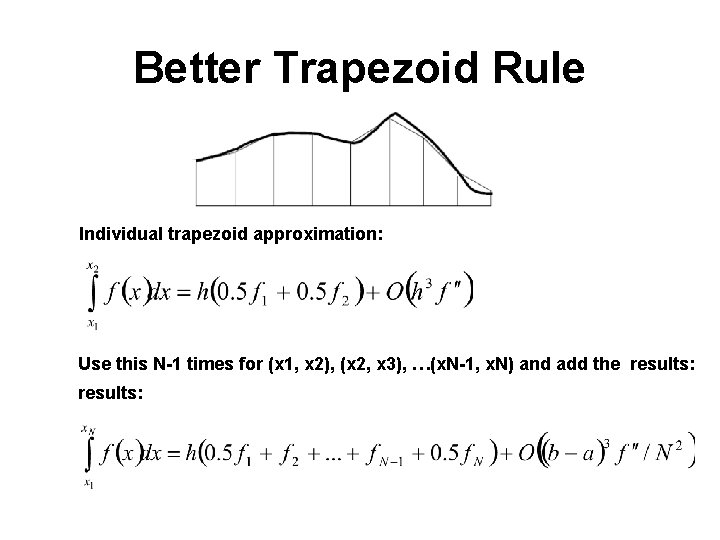
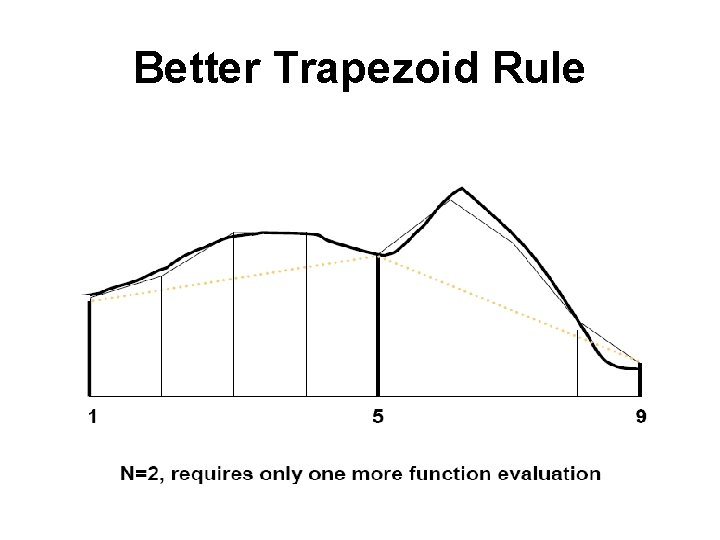
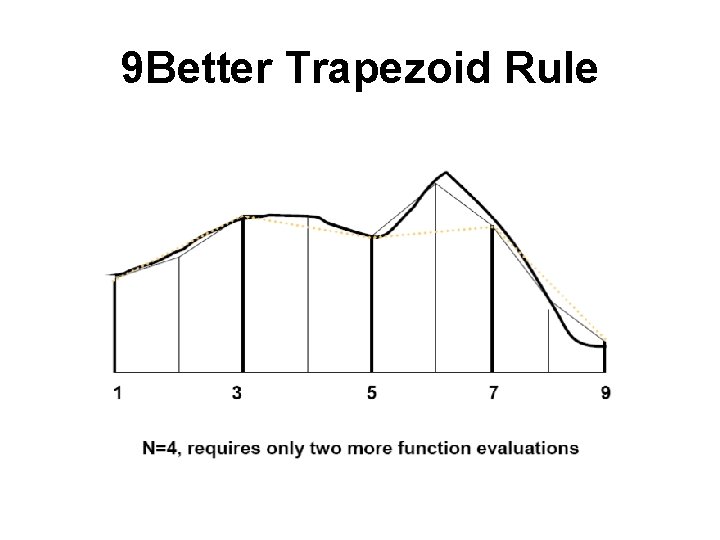
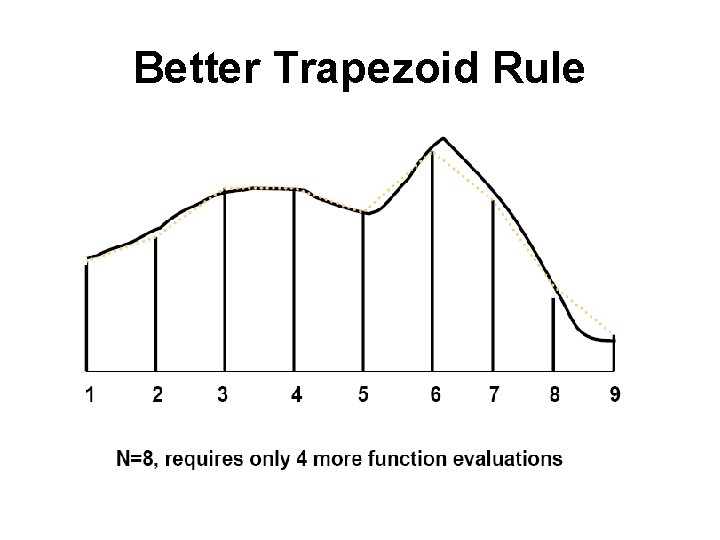
Better Trapezoid Rule Individual trapezoid approximation: Use this N-1 times for (x 1, x 2), (x 2, x 3), …(x. N-1, x. N) and add the results:
Better Trapezoid Rule
Better Trapezoid Rule
9 Better Trapezoid Rule
Better Trapezoid Rule
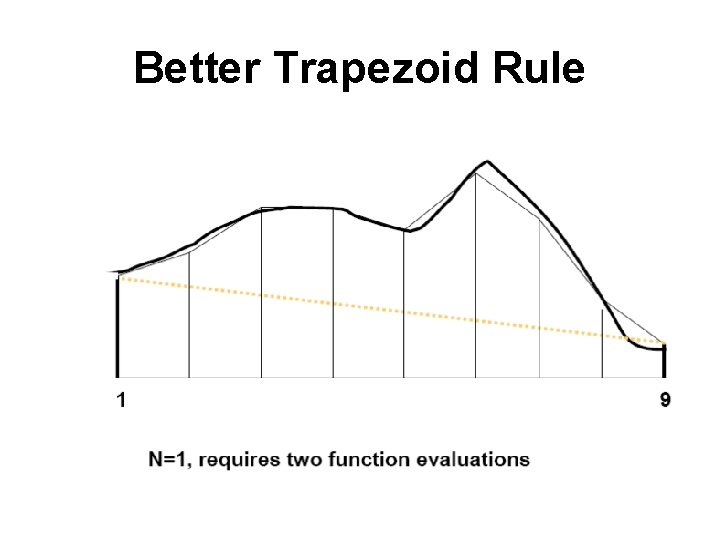
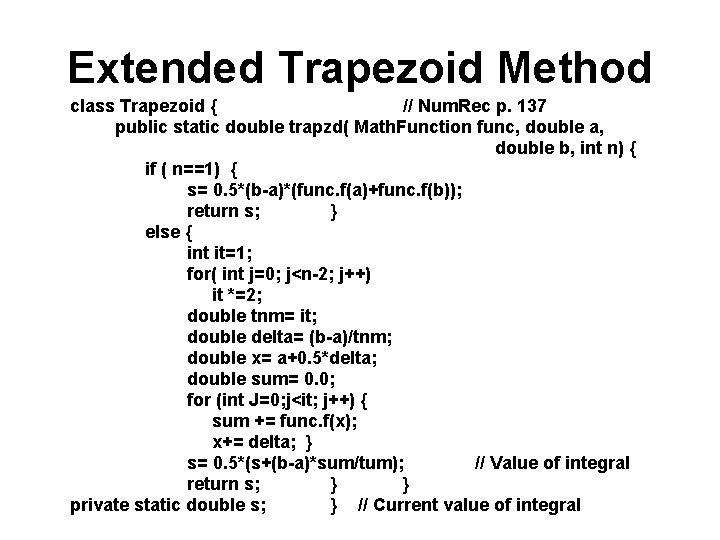
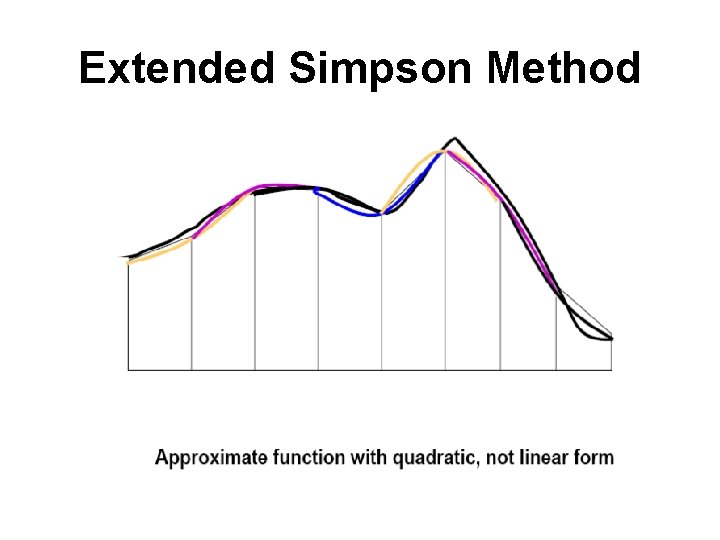
Using Trapezoidal Rule • Keep cutting intervals in half until desired accuracy met – Estimate accuracy by change from previousestimate – Each halving requires relatively little work because past work is retained • By using a quadratic interpolation (Simpson’srule) to function values instead of linear (trapezoidal rule), we get better error behavior – By good fortune, errors cancel well with quadratic approximation used in Simpson’s rule – Computation same as trapezoid, but uses different weighting for function values in sum
Extended Trapezoid Method class Trapezoid { // Num. Rec p. 137 public static double trapzd( Math. Function func, double a, double b, int n) { if ( n==1) { s= 0. 5*(b-a)*(func. f(a)+func. f(b)); return s; } else { int it=1; for( int j=0; j<n-2; j++) it *=2; double tnm= it; double delta= (b-a)/tnm; double x= a+0. 5*delta; double sum= 0. 0; for (int J=0; j<it; j++) { sum += func. f(x); x+= delta; } s= 0. 5*(s+(b-a)*sum/tum); // Value of integral return s; } } private static double s; } // Current value of integral
Extended Simpson Method
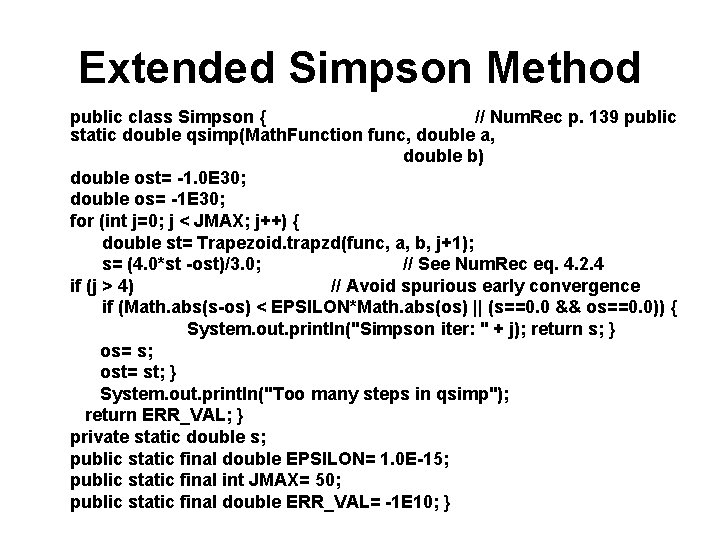
Extended Simpson Method public class Simpson { // Num. Rec p. 139 public static double qsimp(Math. Function func, double a, double b) double ost= -1. 0 E 30; double os= -1 E 30; for (int j=0; j < JMAX; j++) { double st= Trapezoid. trapzd(func, a, b, j+1); s= (4. 0*st -ost)/3. 0; // See Num. Rec eq. 4. 2. 4 if (j > 4) // Avoid spurious early convergence if (Math. abs(s-os) < EPSILON*Math. abs(os) || (s==0. 0 && os==0. 0)) { System. out. println("Simpson iter: " + j); return s; } os= s; ost= st; } System. out. println("Too many steps in qsimp"); return ERR_VAL; } private static double s; public static final double EPSILON= 1. 0 E-15; public static final int JMAX= 50; public static final double ERR_VAL= -1 E 10; }
Using the Methods public static void main(String[] args) { // Simple example with just trapzd (see Num. Rec p. 137) System. out. println("Simple trapezoid use"); int m= 20; // Want 2^m+1 steps int j= m+1; double ans= 0. 0; for (j=0; j <=m; j++) { // Must use Trapzd in loop! ans= Trapezoid. trapzd(new Func. C(), 0. 0, 8. 0, j+1); System. out. println("Iteration: " + (j+1) + “ Integral: " + ans); } System. out. println("Integral: " + ans); // Example using extended Simpson method System. out. println("Simpson use"); ans= qsimp(new Func. C(), 0. 0, 8. 0); System. out. println("Integral: " + ans); System. exit(0); } } class Func. C implements Math. Fuction { public double f ( double x) { return x*x*x*x + 2; } } // End Simpson class
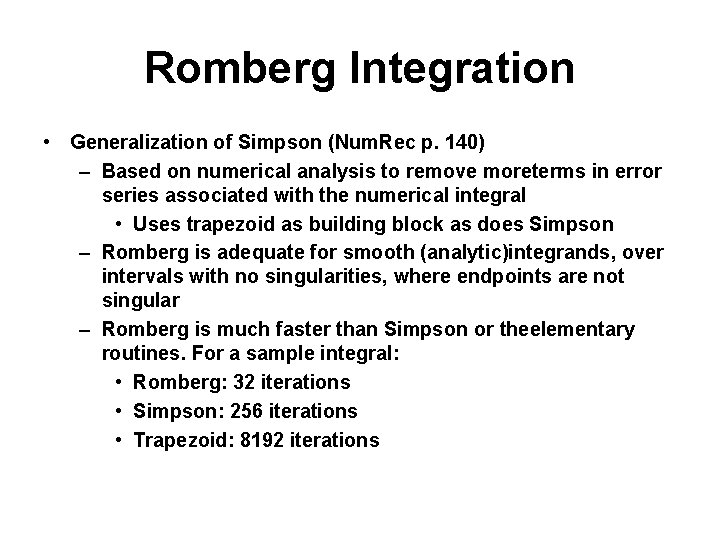
Romberg Integration • Generalization of Simpson (Num. Rec p. 140) – Based on numerical analysis to remove moreterms in error series associated with the numerical integral • Uses trapezoid as building block as does Simpson – Romberg is adequate for smooth (analytic)integrands, over intervals with no singularities, where endpoints are not singular – Romberg is much faster than Simpson or theelementary routines. For a sample integral: • Romberg: 32 iterations • Simpson: 256 iterations • Trapezoid: 8192 iterations
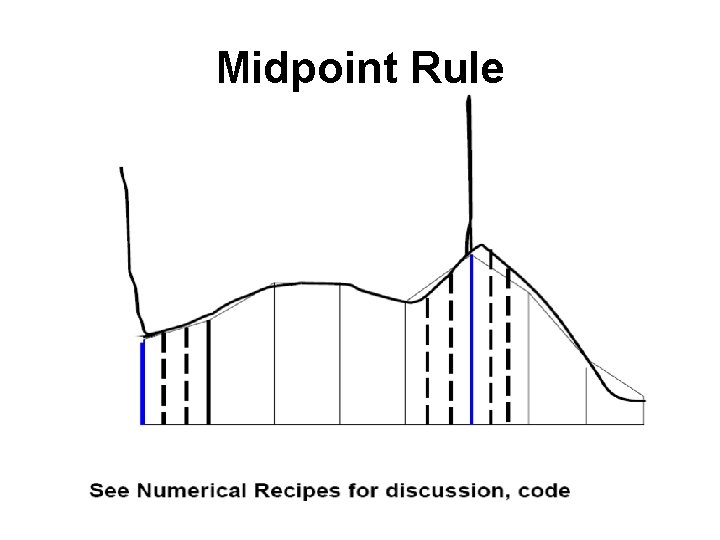
Improper Integrals • Improper integral defined as havingintegrable singularity or approachinginfinity at limit of integration – Use extended midpoint rule instead of trapezoid rule to avoid function evaluations at singularities or infinities • Must know where singularities or infinities are – Use change of variables: often replace x with 1/t to convert an infinity to a zero • Done implicitly in many routines • Last improvement: Gaussian quadrature – In Simpson, Romberg, etc. the x values areevenly spaced. By relaxing this, we can getbetter efficiency and often better accuracy
Midpoint Rule