
1 0 What is Science Day 2 Warm

- Slides: 61
1. 0 What is Science?
Day 2 Warm up n In your notebooks, write a paragraph telling me what you think science is. What science classes have you taken? Tell which was your favorite and why.
What is Science n n n Science is a continuous stream of ideas that are constantly being reshaped, added to, subtracted from and built upon. Science is always evolving and changing! Science is about predictability! It gives us the ability to predict certain things about the world around us.
How to Think Like a Scientist n n Be Curious- look around ask questions. Be Skeptical- Don’t always believe the first thing you hear or read. Be Flexible- Even if you have found one explanation, look for another one. These three brain exercises add up to what is called Critical Thinking
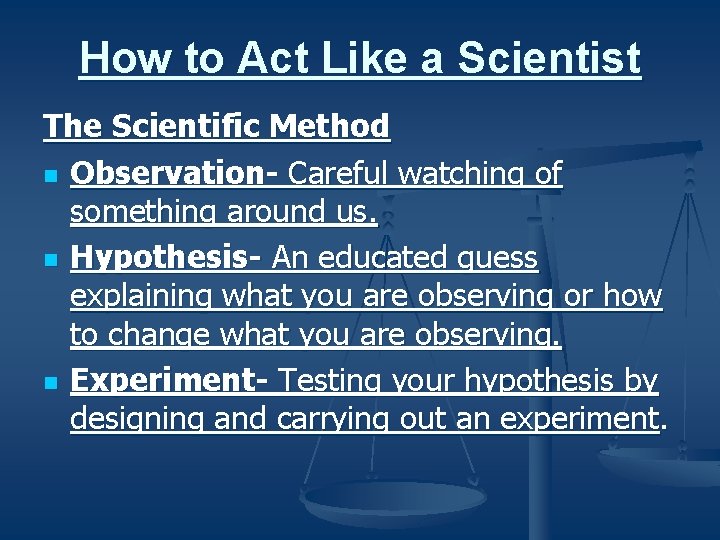
How to Act Like a Scientist The Scientific Method n Observation- Careful watching of something around us. n Hypothesis- An educated guess explaining what you are observing or how to change what you are observing. n Experiment- Testing your hypothesis by designing and carrying out an experiment.
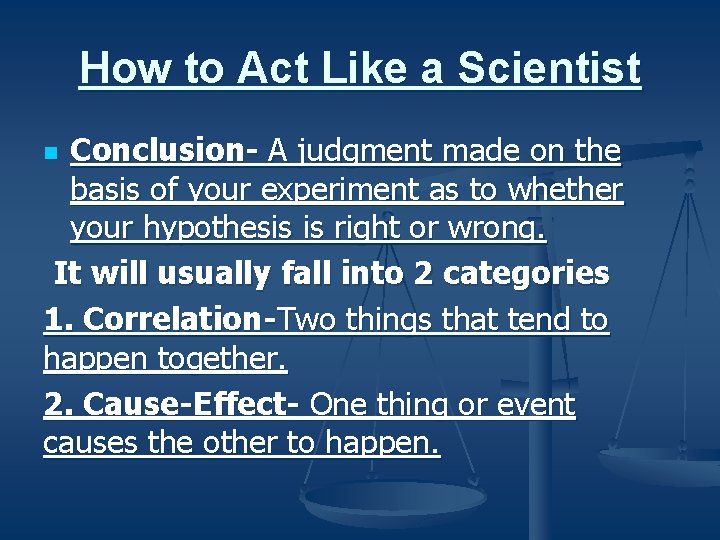
How to Act Like a Scientist Conclusion- A judgment made on the basis of your experiment as to whether your hypothesis is right or wrong. It will usually fall into 2 categories 1. Correlation-Two things that tend to happen together. 2. Cause-Effect- One thing or event causes the other to happen. n
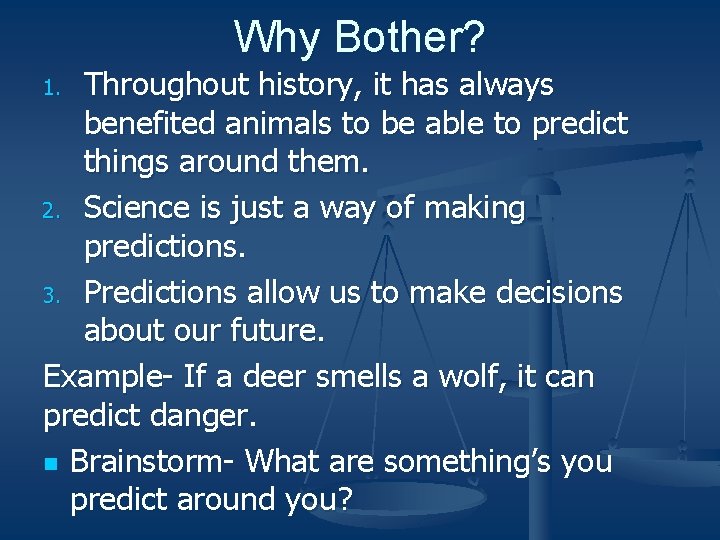
Why Bother? Throughout history, it has always benefited animals to be able to predict things around them. 2. Science is just a way of making predictions. 3. Predictions allow us to make decisions about our future. Example- If a deer smells a wolf, it can predict danger. n Brainstorm- What are something’s you predict around you? 1.
Videos Processing What is a scientist? https: //www. youtube. com/watch? v=5 AZ 9 ov. AHpm 4 On Becoming a Scientist https: //www. youtube. com/watch? v=-Gu. Jl. Qqj 4 BA https: //www. youtube. com/watch? v=da. XVef. QAUh. U https: //www. youtube. com/watch? v=NZEa. Ku 63 DQc https: //www. youtube. com/watch? v=n 4 p 1 Inev. Td. A https: //www. youtube. com/watch? v=FZPs. TNt. Cp 1 c
Processing Activity n n How Observant Are You? Processing Questions 1 - What is Science? - Day 2 What is Science? n How can you think like a scientist? n What are three steps to the scientific method? n What is Correlation? n What is cause and effect?
1. 01 Types of Biomedical Research Biomedical Technology I
Day 3 Warm up n n n http: //www. youtube. com/watch? v=Dm. Ern fmcn-Y http: //www. youtube. com/watch? v=2 Xrp. Yq. XEM 4 http: //www. youtube. com/watch? v=ho. CDl _x 6 r. Dk&feature=related http: //www. youtube. com/watch? v=KRnih 5 o. Z 49 g http: //www. youtube. com/watch? v=xl. YIex 2 TF 5 g
Purpose of Biomedical Research It involves the work done by scientists from many fields to improve the health and well being of humans and animals.
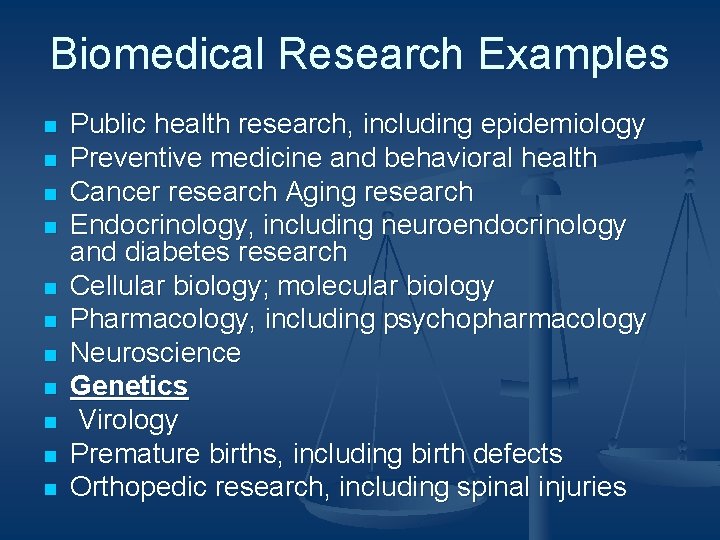
Biomedical Research Examples n n n Public health research, including epidemiology Preventive medicine and behavioral health Cancer research Aging research Endocrinology, including neuroendocrinology and diabetes research Cellular biology; molecular biology Pharmacology, including psychopharmacology Neuroscience Genetics Virology Premature births, including birth defects Orthopedic research, including spinal injuries
Types of Research n. Basic Research n. Applied Research n. Clinical Research
Basic Biomedical Research n n Not directed toward solving any particular problem Research conducted to increase fundamental knowledge and understanding of the physical, chemical and functional mechanisms of life processes and disease When you write a research paper it is considered Basic Research. Building blocks for other types of research
Basic Biomedical Research n n n Seeks to answer questions not necessarily focused on any specific disease or disorder Example- if a new disease emerges in Africa and the CDC begins researching it here in the U. S. , that is considered basic research. Seeks to explain how processes in living organisms develop and function- ex. genetic diseases
Applied Research n Directed toward specific objectives Ex. -Development of a new drug, treatment, or surgical procedure n Conducted with animals, non-animal methods and humans n Ex. - Computer models n It is most often conducted using animals. n Why do they use animals? n
Applied Research n Examples of applied cancer research n n Synthesis of new anti-cancer drugs Studies of human growth factors leading both to diagnostic and therapeutic applications Production of monoclonal antibodies for potential use in the diagnosis and treatment of human cancer n Stem Cell research. n
Clinical Research n n n Used when other forms of research have already taken place This is the last stage of research Humans are almost always used for this type of research. Used to test potential drugs and treatments in humans Builds on what is done in basic and applied stages
Clinical Research n Broad variety of activities and areas of study n n n Human clinical trials Psychosocial and behavioral research. Ex. Study habits of high school students. Disease control research
Clinical Research n n Takes place in hospital/clinical healthcare setting and directly applies to the prevention, diagnosis or treatment of a specific disease or rehabilitation of a patient These can be advertised on TV, newspapers, radio or magazines to get potential patients to participate.
Processing n n n http: //www. youtube. com/watch? v=SGy 1 Q HPyvt. M&list=PL 56 E 1766 BE 5 E 2 CF 22 http: //www. youtube. com/watch? v=vcs. CLo g 2 u 9 M Types of Biomedical Research WS- get answers from notes.
Biomedical Research 1. 02 Biomedical Research Methods
Day 5 Warm up n n Diabeteshttp: //www. youtube. com/watch? v=Tn. RYb Zu. U 2 PM Depressionhttp: //www. youtube. com/watch? v=Gc. U 3 Qv. Oo 20&feature=relmfu Alzheimers- https: //www. youtube. com/watch? v=l 5 DSS Upf. Dyg Fluhttp: //www. youtube. com/watch? v=6 jd. Yv. K g. Ps. VY
Day 5 Warm up n Review Processing Questions
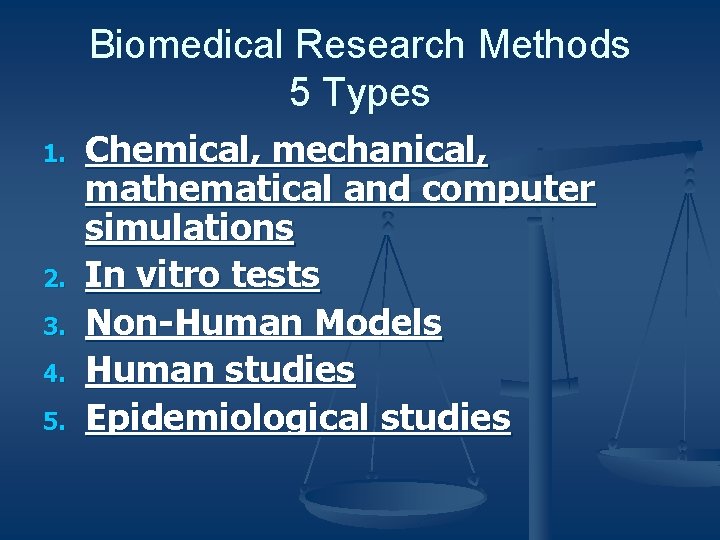
Biomedical Research Methods 5 Types 1. 2. 3. 4. 5. Chemical, mechanical, mathematical and computer simulations In vitro tests Non-Human Models Human studies Epidemiological studies
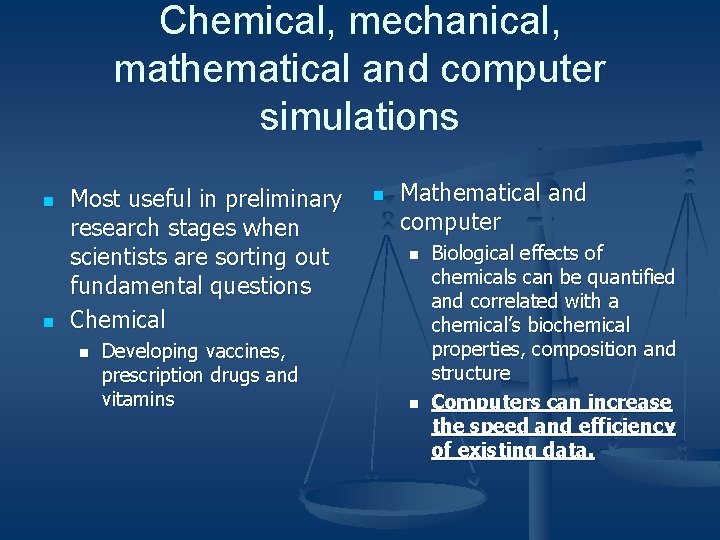
Chemical, mechanical, mathematical and computer simulations n n Most useful in preliminary research stages when scientists are sorting out fundamental questions Chemical n Developing vaccines, prescription drugs and vitamins n Mathematical and computer n n Biological effects of chemicals can be quantified and correlated with a chemical’s biochemical properties, composition and structure Computers can increase the speed and efficiency of existing data.
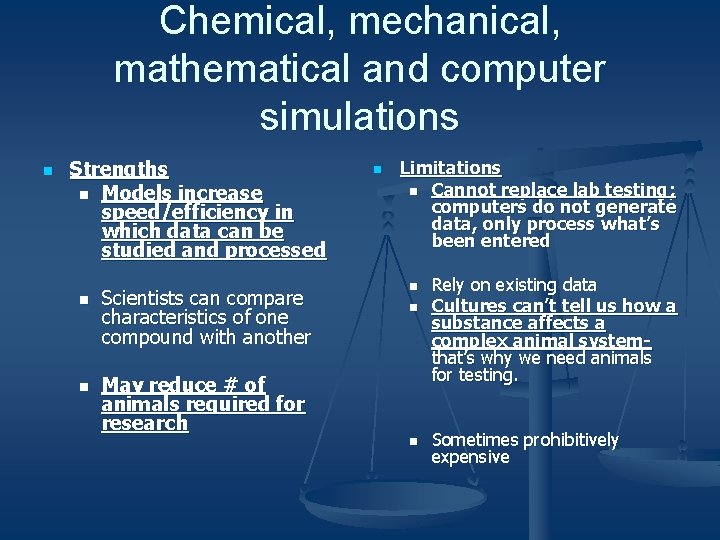
Chemical, mechanical, mathematical and computer simulations n Strengths n Models increase speed/efficiency in which data can be studied and processed n n Scientists can compare characteristics of one compound with another n Limitations n Cannot replace lab testing; computers do not generate data, only process what’s been entered n n May reduce # of animals required for research n Rely on existing data Cultures can’t tell us how a substance affects a complex animal systemthat’s why we need animals for testing. Sometimes prohibitively expensive
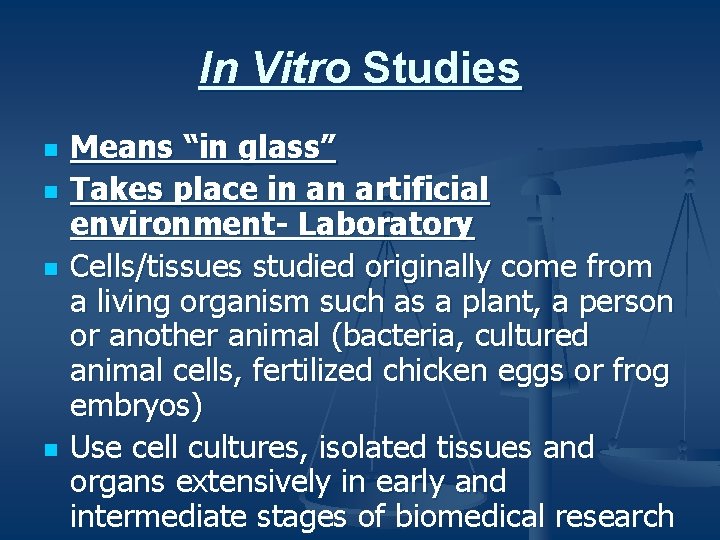
In Vitro Studies n n Means “in glass” Takes place in an artificial environment- Laboratory Cells/tissues studied originally come from a living organism such as a plant, a person or another animal (bacteria, cultured animal cells, fertilized chicken eggs or frog embryos) Use cell cultures, isolated tissues and organs extensively in early and intermediate stages of biomedical research
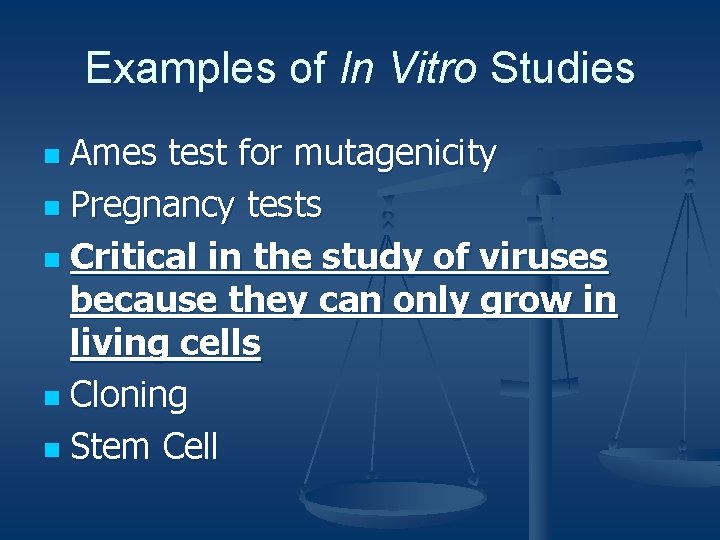
Examples of In Vitro Studies Ames test for mutagenicity n Pregnancy tests n Critical in the study of viruses because they can only grow in living cells n Cloning n Stem Cell n
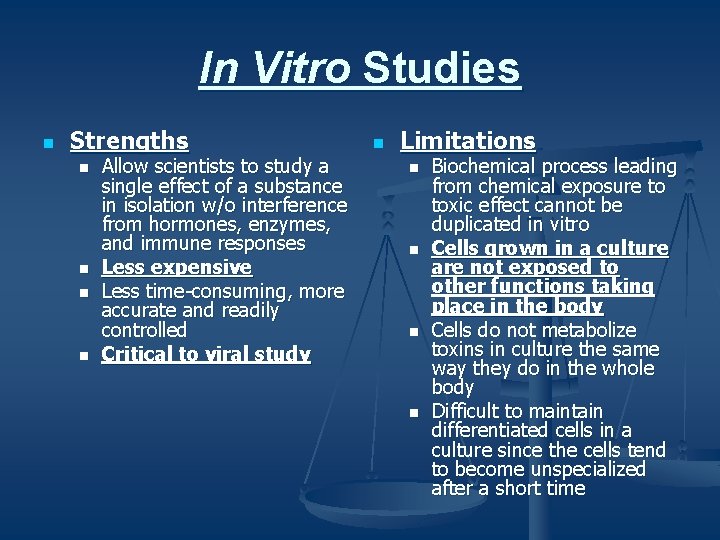
In Vitro Studies n Strengths n n Allow scientists to study a single effect of a substance in isolation w/o interference from hormones, enzymes, and immune responses Less expensive Less time-consuming, more accurate and readily controlled Critical to viral study n Limitations n n Biochemical process leading from chemical exposure to toxic effect cannot be duplicated in vitro Cells grown in a culture are not exposed to other functions taking place in the body Cells do not metabolize toxins in culture the same way they do in the whole body Difficult to maintain differentiated cells in a culture since the cells tend to become unspecialized after a short time
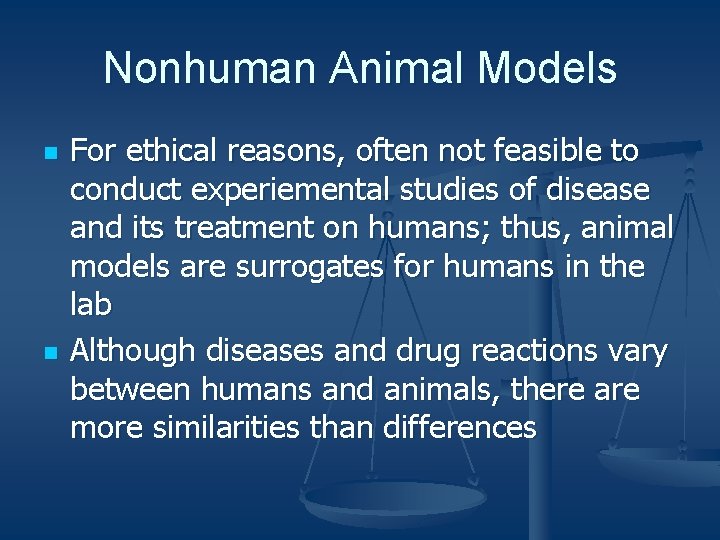
Nonhuman Animal Models n n For ethical reasons, often not feasible to conduct experiemental studies of disease and its treatment on humans; thus, animal models are surrogates for humans in the lab Although diseases and drug reactions vary between humans and animals, there are more similarities than differences
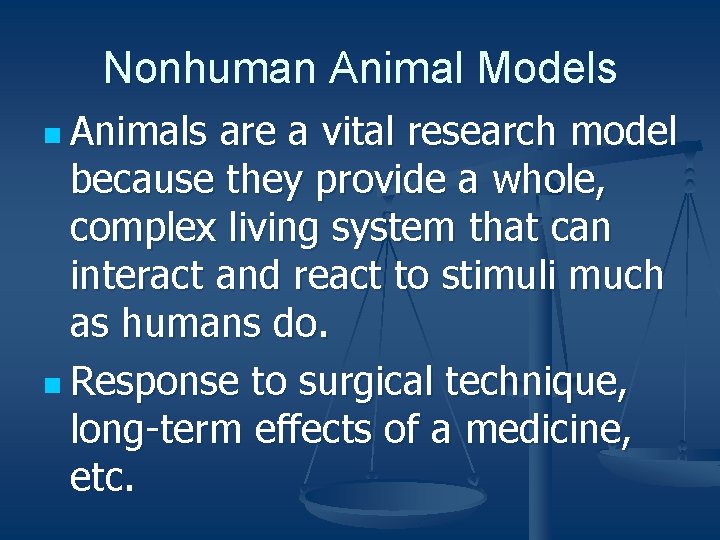
Nonhuman Animal Models n Animals are a vital research model because they provide a whole, complex living system that can interact and react to stimuli much as humans do. n Response to surgical technique, long-term effects of a medicine, etc.
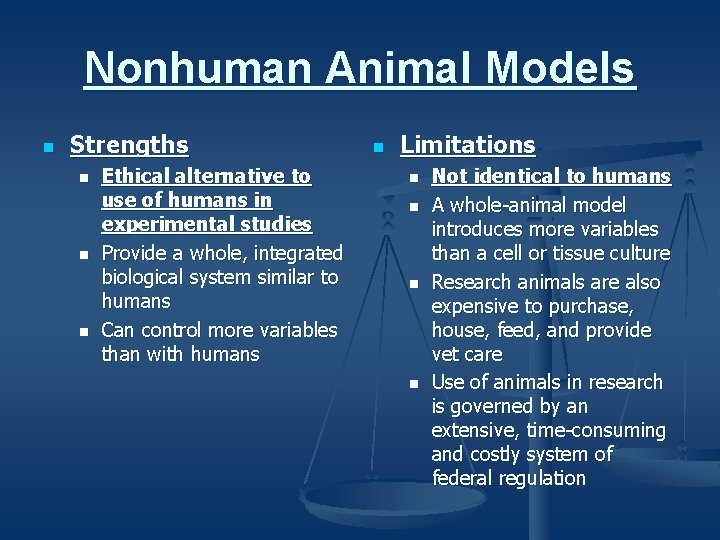
Nonhuman Animal Models n Strengths n n n Ethical alternative to use of humans in experimental studies Provide a whole, integrated biological system similar to humans Can control more variables than with humans n Limitations n n Not identical to humans A whole-animal model introduces more variables than a cell or tissue culture Research animals are also expensive to purchase, house, feed, and provide vet care Use of animals in research is governed by an extensive, time-consuming and costly system of federal regulation
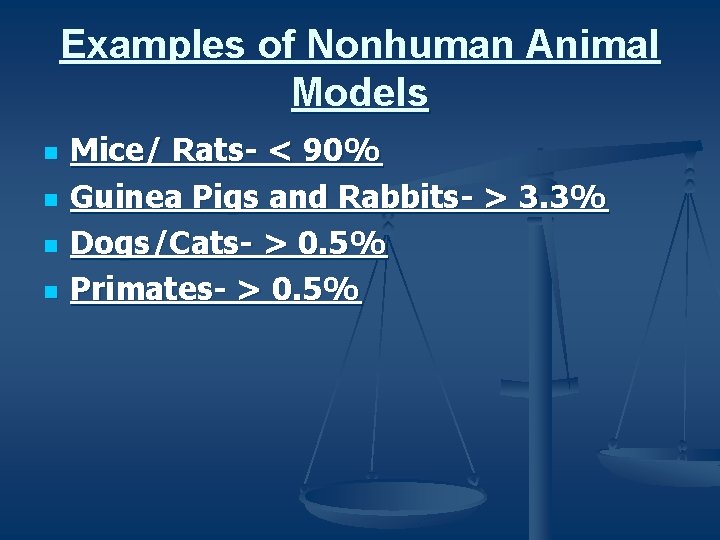
Examples of Nonhuman Animal Models n n Mice/ Rats- < 90% Guinea Pigs and Rabbits- > 3. 3% Dogs/Cats- > 0. 5% Primates- > 0. 5%
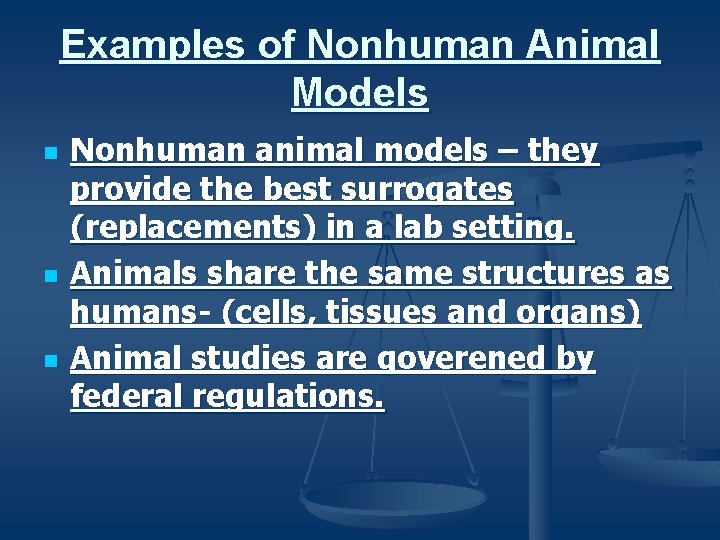
Examples of Nonhuman Animal Models n n n Nonhuman animal models – they provide the best surrogates (replacements) in a lab setting. Animals share the same structures as humans- (cells, tissues and organs) Animal studies are goverened by federal regulations.
Processing Biomedical Research Methods WS Flemming- https: //www. youtube. com/watch? v=Pd. Wh Vwi. JWa. U Medical Discoveries- https: //www. youtube. com/watch? v=7 ES 7 7 XYm. Fz. Y n
Biomedical Resaerch 1. 03 Benefits of Biomedical Research- Part 1 Clinical Trials
Day 7 Warm up n n n http: //www. youtube. com/watch? v=dm 5 ET e. X 8 e. NM http: //www. youtube. com/watch? v=Dhx. D 6 s. VQEYc&feature=related http: //www. youtube. com/watch? v=Zxw. Kg g. J 2 ACs&feature=related
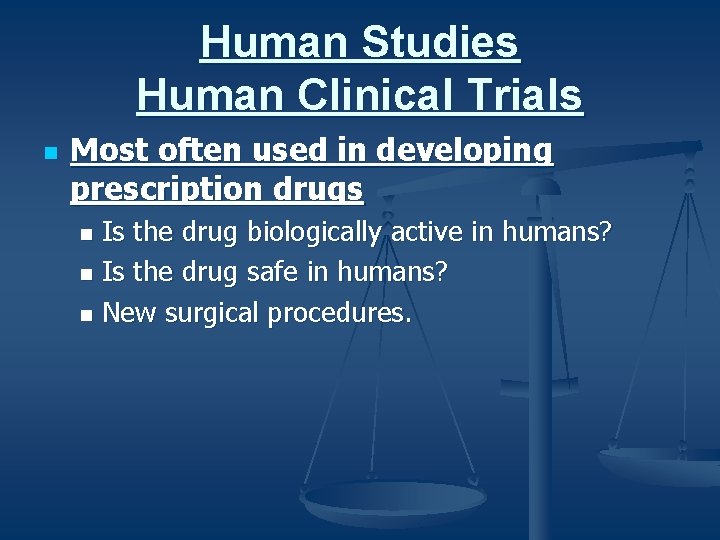
Human Studies Human Clinical Trials n Most often used in developing prescription drugs Is the drug biologically active in humans? n Is the drug safe in humans? n New surgical procedures. n
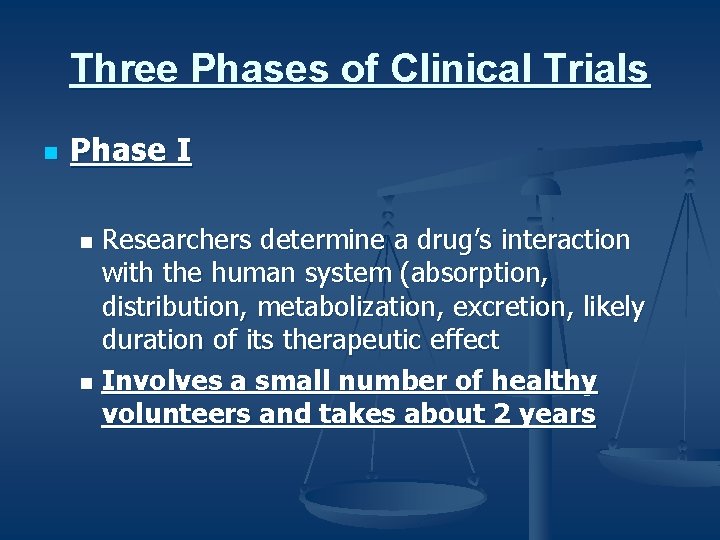
Three Phases of Clinical Trials n Phase I Researchers determine a drug’s interaction with the human system (absorption, distribution, metabolization, excretion, likely duration of its therapeutic effect n Involves a small number of healthy volunteers and takes about 2 years n
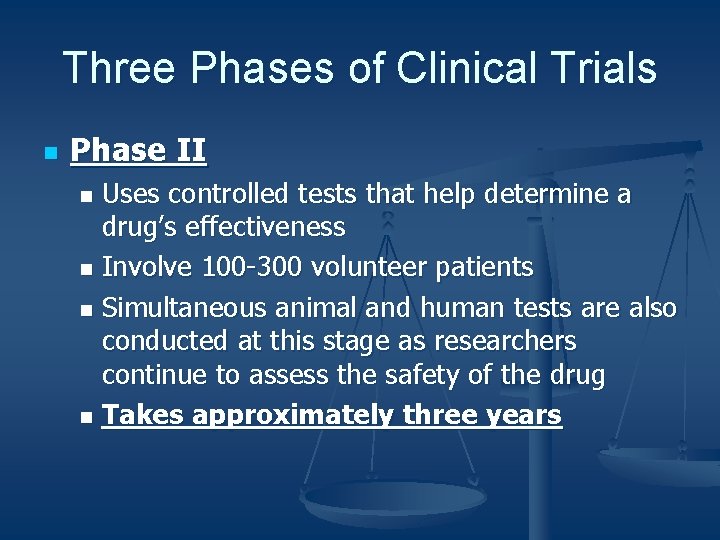
Three Phases of Clinical Trials n Phase II Uses controlled tests that help determine a drug’s effectiveness n Involve 100 -300 volunteer patients n Simultaneous animal and human tests are also conducted at this stage as researchers continue to assess the safety of the drug n Takes approximately three years n
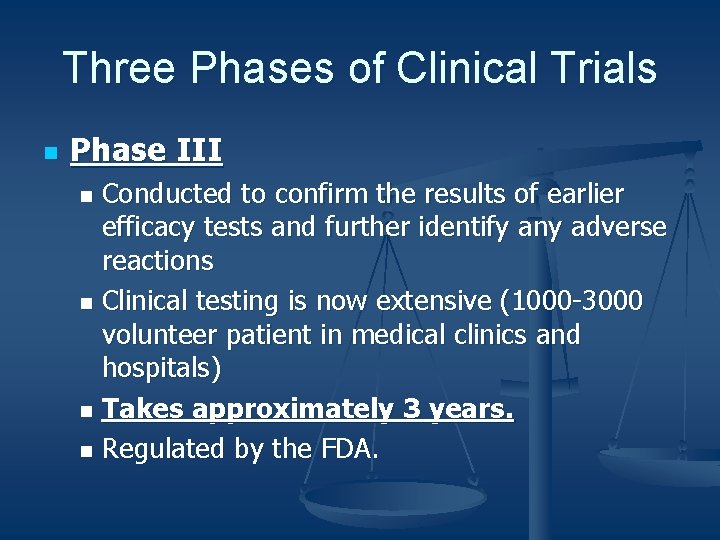
Three Phases of Clinical Trials n Phase III Conducted to confirm the results of earlier efficacy tests and further identify any adverse reactions n Clinical testing is now extensive (1000 -3000 volunteer patient in medical clinics and hospitals) n Takes approximately 3 years. n Regulated by the FDA. n
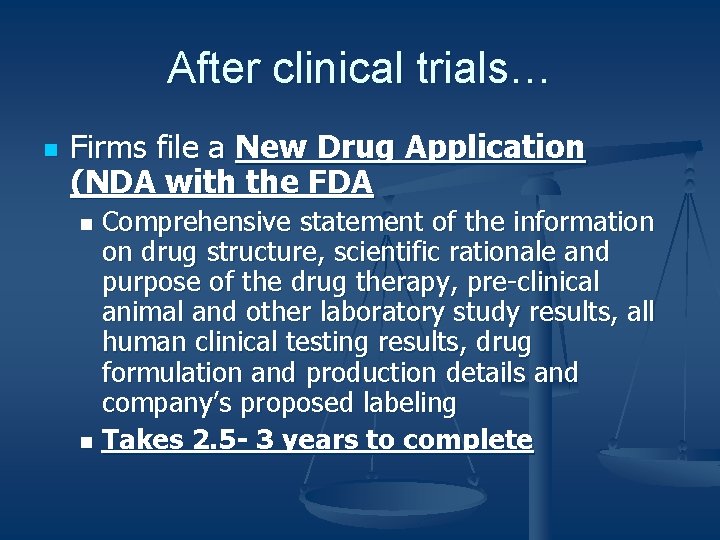
After clinical trials… n Firms file a New Drug Application (NDA with the FDA Comprehensive statement of the information on drug structure, scientific rationale and purpose of the drug therapy, pre-clinical animal and other laboratory study results, all human clinical testing results, drug formulation and production details and company’s proposed labeling n Takes 2. 5 - 3 years to complete n
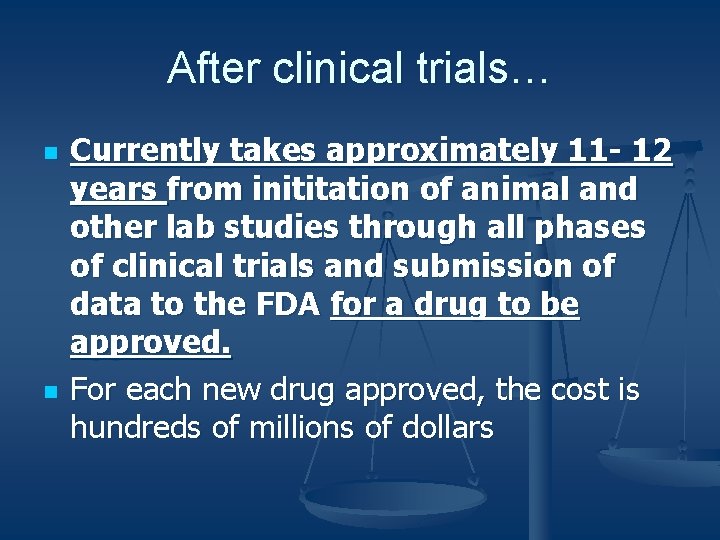
After clinical trials… n n Currently takes approximately 11 - 12 years from inititation of animal and other lab studies through all phases of clinical trials and submission of data to the FDA for a drug to be approved. For each new drug approved, the cost is hundreds of millions of dollars
Processing n n Activity- You Choose the Test! Clinical Trial Matching
1. 03 Benefits of Biomedical Research- Part 2
Day 8 Warm up n Activity- Who Can Cure Our Mystery Disease?
Vaccines n n n Polio Vaccine- Dr. Albert Sabin developed in 1954. Made from a live polio virus that was weakened or attenuated, but not killed. Is given orally. Eradication of diseases such as Smallpox by the World Health Organization. Hepatitis B Vaccine- the first anticancer vaccine developed
Vaccines n n n Chicken Pox- Vaccine became available in 1995 to give to children 12 months or older. Diphtheria- vaccine developed in 1921. Bacterial infection that is rare in the U. S. Mumps- this is the next disease that is hoped to be eradicated by vaccines by the WHO.
Benefits of Biomedical Research n n n Public awareness for people who smoke about the dangers of lung cancer. Profound impact on childhood cancers- Leukemia. Biomedical Research on tooth decay lead to the addition of fluoride to drinking water.
Benefits of Biomedical Research Continuing research of cancer- the disease that is researched the most in the world. After decades of working with animal models, a heart-lung machine was developed in the 1950’s for open heart surgery.
Benefits of Biomedical Research n n n The discovery of penicillin the first antibiotic by Sir Alexander Flemming 1935 - Invention of the electron microscope. Gave scientist to study the smallest life forms- they proved the existence of viruses. Cyclosporine- the first drug discovered to help transplant patients with organ rejection. The most difficult organ to transplant is the liver
Benefits of Biomedical Research n n n Diabetes tx- New blood sugar monitoring equipment that use less blood used to check blood sugars. Development of bacteria to produce human insulin for diabetics. With the development of corneal transplants, it can now prevent the most common cause of blindness in the world, corneal disease.
AIDS Research continues… n n n Began in early 1980’s Caused by a virus- Retrovirus Changes the DNA in our cells to their DNA Can be dormant for 7 -10 years before you get symptoms. HIV progresses to AIDS when immune system is impaired and individual becomes susceptible to opportunistic infection n n Animals important part of AIDS research Anti-HIV drugs available # of possible vaccines have been developed and are being tested in humans Common sense preventive measures bets way to prevent AIDS NO CURE AT THE PRESENT TIME!
Multiple Benefits to Animal Health n Disease treatment and prevention n New surgical procedures. n Vaccines- rabies, heartworm feline leukemia n Artificial Joints for dogs with hip dysplasia n Nutrition research for pet food n ASPCA- Behavior Modification Research
Some of the Health Problems Share by Animals and Humans n n n n Allergies Anemia Arthritis Cancer Cataracts Diabetes Heart Disease High Blood Pressure n n n n Influenza Kidney Disease Leukemia Rabies Tetanus Tooth and Gum Disease Skin Diseases
Processing n n What a Difference Biomedical Research Makes- group activity Processing Questions- Day 8
Day 10 Warm up n n Review- Benefits of Biomedical Research Activity- Did you or will you ever?
Assignment n n Read the article- What a Difference Biomedical Research Makes. Answer the questions on the worksheet.
Processing n Study for Exam Tomorrow!