
1 0 Introduction to Finance 1 1 The

- Slides: 46
1. 0 Introduction to Finance
1. 1 The topics covered in this chapter l An introduction to finance l The financial management process l Financial Management Decisions l The finance function l The agency issue l Financial and Non-financial Performance Indicators
1. 2 Learning Objectives By the end of this chapter you should be able to; v l l Identify the scope of Finance Explain the role and goal of financial management in a modern business enterprise Appreciate three main decision areas of financial strategy. Understand the conflicts of interest that can arise between owners and managers Know financial and non-financial indicators.
1. 3 Basic Areas Of Finance Business finance • Investments • Financial institutions • International finance •
1. 4 Business Finance l Financial Management “the ways and means of managing money” l Formal definition –”the determination , acquisition, allocation, and utilisation of financial resources”, usually with the aim of achieving some particular goals or objectives. l Management of Financial resources
1. 5 Investments Work with financial assets such as stocks and bonds • Value of financial assets, risk versus return and asset allocation • Job opportunities • • Stockbroker or financial advisor • Portfolio manager • Security analyst
1. 6 Financial Institutions l Companies that specialize in financial matters – Banks – commercial and investment, credit unions, savings and loans – Insurance companies – Brokerage firms l Job opportunities
1. 7 International Finance This is an area of specialization among all of the areas discussed so far l It may allow you to work in other countries or at least travel on a regular basis l Need to be familiar with exchange rates and political risk l Need to understand the customs of other countries and speaking a foreign language fluently is also helpful l
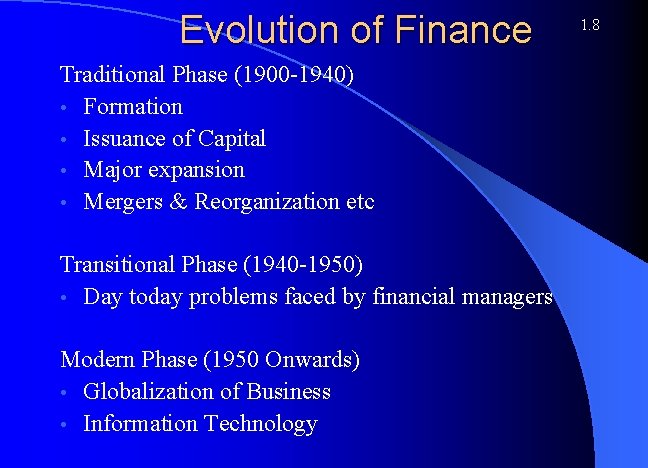
Evolution of Finance Traditional Phase (1900 -1940) • Formation • Issuance of Capital • Major expansion • Mergers & Reorganization etc Transitional Phase (1940 -1950) • Day today problems faced by financial managers Modern Phase (1950 Onwards) • Globalization of Business • Information Technology 1. 8
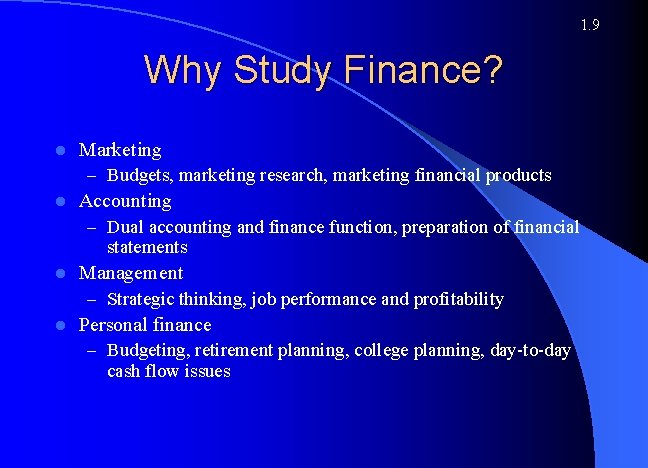
1. 9 Why Study Finance? l Marketing – Budgets, marketing research, marketing financial products l Accounting – Dual accounting and finance function, preparation of financial statements l Management – Strategic thinking, job performance and profitability l Personal finance – Budgeting, retirement planning, college planning, day-to-day cash flow issues
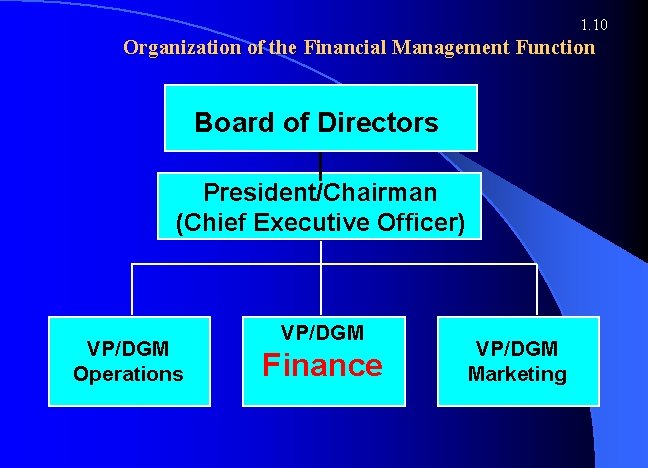
1. 10 Organization of the Financial Management Function Board of Directors President/Chairman (Chief Executive Officer) VP/DGM Operations VP/DGM Finance VP/DGM Marketing
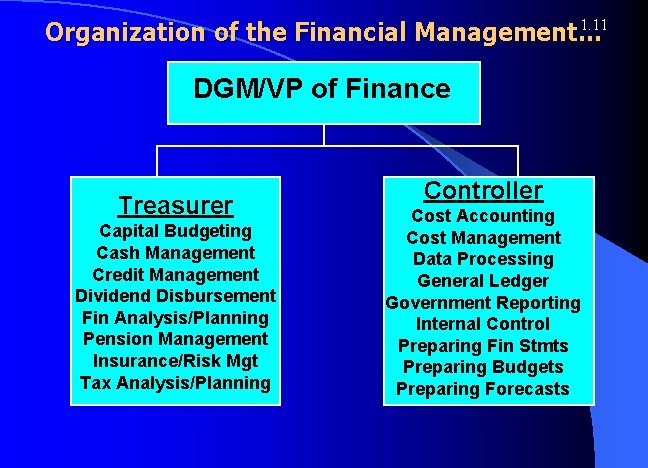
1. 11 Organization of the Financial Management… DGM/VP of Finance Treasurer Capital Budgeting Cash Management Credit Management Dividend Disbursement Fin Analysis/Planning Pension Management Insurance/Risk Mgt Tax Analysis/Planning Controller Cost Accounting Cost Management Data Processing General Ledger Government Reporting Internal Control Preparing Fin Stmts Preparing Budgets Preparing Forecasts
1. 12 Roles of Financial Mangers Controller’s Activities l l Financial accounting Cost accounting Taxes Data processing
1. 13 Roles of Financial Mangers Treasurer’s Activities l l l Management of cash and marketable securities Capital budgeting Financial planning Credit analysis Investors relations Pension fund management
1. 14 Issues faced by Financial manager l Some important questions that are answered using finance – What long-term investments should the firm take on? – Where will we get the long-term financing to pay for the investment? – How will we manage the everyday financial activities of the firm?
1. 15 Financial Management Decisions l Capital budgeting or investment decisions – What long-term investments or projects should the business take on? l Capital structure or financing decisions – How should we pay for our assets? – Should we use debt or equity? l Working capital or liquidity decisions – How do we manage the day-to-day finances of the firm? Dividend or payout policy decisions = Do we retain profit or distribute as dividends
1. 16 Financial Management Process l Financial Analysis l Financial Decision Making l Financial Planning; and l Financial Control.
1. 17 Objectives of the firm Firm financial structure should facilitate to reach its overall objectives. Overall objective guides business decision making. Economic approach for the firm’s objective Maximization of the owner’s welfare. How?
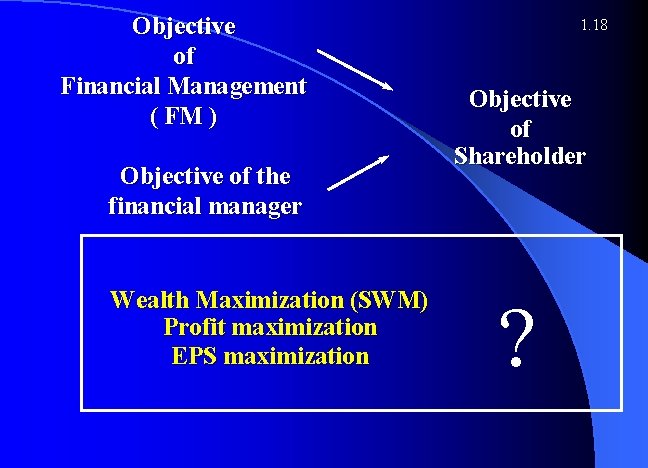
Objective of Financial Management ( FM ) Objective of the financial manager Wealth Maximization (SWM) Profit maximization EPS maximization 1. 18 Objective of Shareholder ?
1. 19 Objectives of the firm Maximization of welfare Whose? How? Alternative objectives Maximization of profits? Maximization of earning per share? Maximization of wealth?
1. 20 Objective of the firm Maximization of profits Accounting measure The problem of definition Timing consideration Quality aspects
1. 21 Objective of the firm Maximization of wealth? Wealth? How can it determine? Market Value? Book Value? Liquidation value? Example; You have purchased 1, 000 of a listed company from the open market. To purchase the shares you have paid Rs. 23. 50. The other information about the share as follows. par value Rs. 10. 00 each Book value is 17. 50 each Current market price 22. 75. Your wealth?
Objective of Financial Management ( FM ) Objective of the financial manager 1. 22 Shareholder Wealth Maximization (SWM) NOT profit maximization Does not consider time value of money
1. 23 Shareholder Wealth Maximizing is a Market Concept and Results in Maximizing PV of E(R) Measured by Market Value of C/S
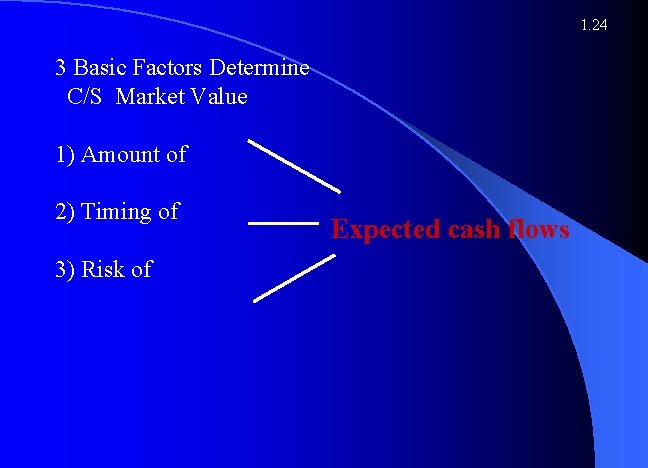
1. 24 3 Basic Factors Determine C/S Market Value 1) Amount of 2) Timing of 3) Risk of Expected cash flows
1. 25 Objective of the firm Maximization of wealth(SWM) Wealth maximization objective concern timing and risk of the benefits Has a conceptual foundation An impersonal objective Avoid high level of risk Encourage to pay dividend Growth oriented Focus on share market price Concerned for social responsibility
1. 26 Objective of the firm Maximization of wealth? This principle assume that wealth is created lawfully and ethically The objective include a goal of social responsibility which is generally defined as a consciousness for the good of all people in society and a respect for the environment It explicitly seeks to incorporate the entire future stream of cash flows that will generate by a decisions
1. 27 Stock Price Maximization & Social Welfare If a firm attempts to maximize its stock price , is it good or bad for society? l To a large extent, the owners of stock are society. l Consumers benefit Stock price maximization requires efficient low cost business that produce high quality goods and services at the lowest possible cost l Employees benefit Company’s ability to attract , develop and retain talented people. l
Business Ethics & Social Responsibility l Is 1. 28 the goal of maximizing stock prices consistent or inconsistent with high standards of ethical behavior and social responsibility? l Many socially responsible firms have created enormous value for their owners and many unethical firms now are bankrupt.
1. 29 Business Ethics Definition ‘set of moral principles or moral values held by individuals or groups’ or ‘standards of conduct or moral behavior’ l Business ethics can be thought of as a company’s attitude and conduct toward its employees, customers, community and stockholders. l High standards of ethical behavior demand that a firm treat each party that it deals with in a fair and honest manner. l
1. 30 Common Ethical Issues In Business l l l Giving out misleading, but not deceptive, information about a company’s product and services. Not disclosing relevant information to the public in relation to its products. The firm’s employment policies and practices How the firm deals with environmental matters How the company carries on business in foreign countries The giving and receiving of gifts by the firm’s personnel
1. 31 Social Responsibility Firms have an ethical responsibility to provide a safe working environment, to avoid polluting the air or water, and to produce safe products. However socially responsible actions have costs. l Many socially responsible actions must be mandated by government, in resent years numerous firms have voluntarily taken much actions, especially in the area of environmental protection. l
1. 32 Social Responsibility l Ethical issues will constantly confront financial managers as they achieve the goal of the firm ( SWM ). Managers Must u. Avoid personal conflicts u. Maintain confidentiality u. Be objective u. Act fairly
1. 33 Agency Consideration in Financial Management Agents; A persons who performs activities for another person , called principal. Managers are the agents of the firm Principal; An individual who establishes a compensation scheme to motivate an agent to choose activities to the principal. Shareholders are the principals of the firm
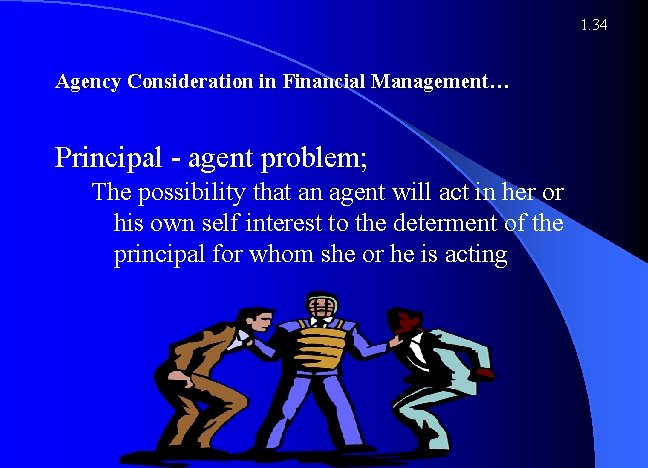
1. 34 Agency Consideration in Financial Management… Principal - agent problem; The possibility that an agent will act in her or his own self interest to the determent of the principal for whom she or he is acting
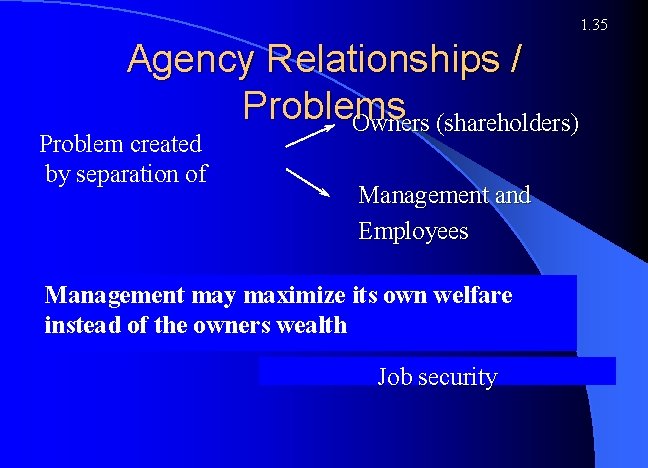
1. 35 Agency Relationships / Problems Owners (shareholders) Problem created by separation of Management and Employees Management may maximize its own welfare instead of the owners wealth Job security
1. 36 Job Security l Management decisions based on retaining management rather than SWM – Example–A decision to retain suppliers rather than selecting new suppliers providing higher quality or lower cost – Why–If the transition is mishandled management will be scrutinized but if no change is made the issue will be ignored
1. 37 Agency Costs Management incentives l Monitor performance l Owners protection l Complex organization structures l Recent Trends To flatten organization structures to cut costs
1. 38 Financial and Non-financial performance indicators l Financial o o Performance Indicators Cash Generation Value Added Profitability Return on Assets
1. 39 Financial and Non-financial performance indicators • Non-Financial Performance Indicators Market Share o Customer Satisfaction o Competitive Position o Risk Exposure o
1. 40 Risk Return Trade Off
1. 41 Professional Organizations l Financial Executive Institute l Institute of Chartered Financial Analysts l Financial Management Association l Institute of Management Accounting
1. 42 Exciting Career Opportunities in Finance VP of Finance l Director Investor Relations l Assistant Treasurer l Tax Manager l Financial Analyst l Account Executive Security Broker l Mortgage Analyst l Banking l
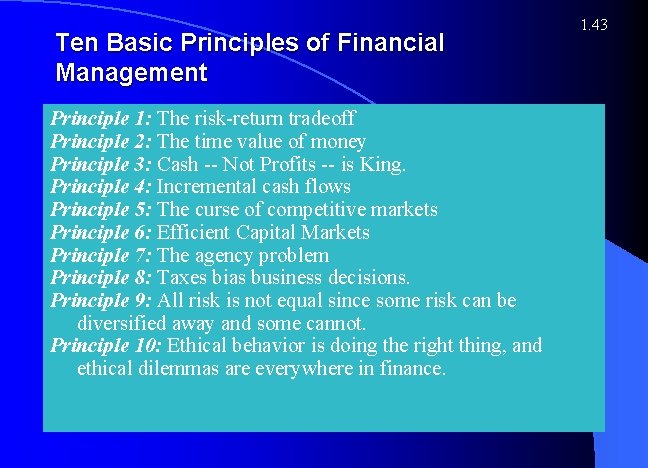
Ten Basic Principles of Financial Management Principle 1: The risk-return tradeoff Principle 2: The time value of money Principle 3: Cash -- Not Profits -- is King. Principle 4: Incremental cash flows Principle 5: The curse of competitive markets Principle 6: Efficient Capital Markets Principle 7: The agency problem Principle 8: Taxes bias business decisions. Principle 9: All risk is not equal since some risk can be diversified away and some cannot. Principle 10: Ethical behavior is doing the right thing, and ethical dilemmas are everywhere in finance. 1. 43
1. 44 Practical Project Obtain a copy of the most recent annual report and accounts for a company listed in Colombo Stock Exchange. l Evaluate the report with reference to the information they provide about the following; treasury management policies shareholders and other stakeholders ethics executive pay corporate governance environmental and or social issue l
1. 45 THANK YOU