
1 0 0 Analysis of Financial Statements Ratio
- Slides: 20
1 -0 0 Analysis of Financial Statements: Ratio Analysis Ratio analysis allows • for comparison of a company performance through time • for comparison among companies Ratio analysis can be used both within a firm (by insiders) or by outsiders. 0
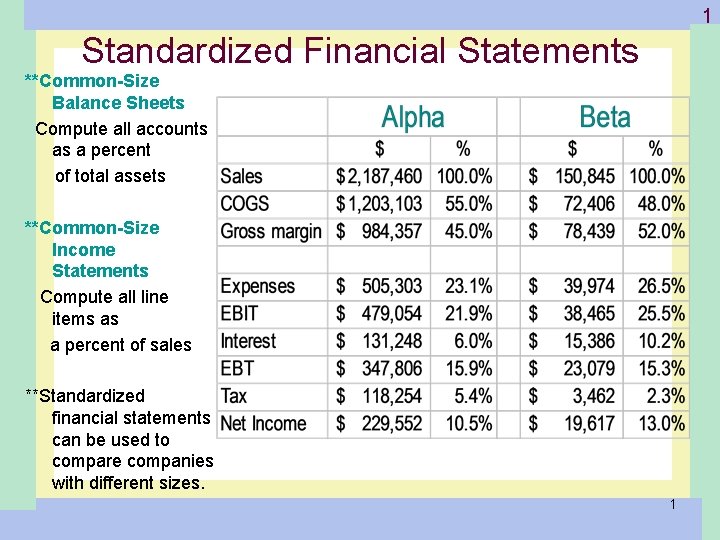
1 -1 Standardized Financial Statements **Common-Size Balance Sheets Compute all accounts as a percent of total assets **Common-Size Income Statements Compute all line items as a percent of sales **Standardized financial statements can be used to compare companies with different sizes. 1 1
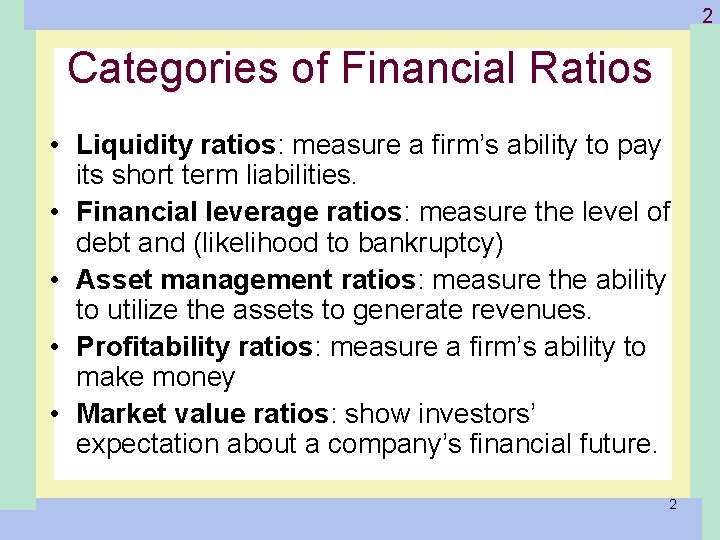
1 -2 Categories of Financial Ratios • Liquidity ratios: measure a firm’s ability to pay its short term liabilities. • Financial leverage ratios: measure the level of debt and (likelihood to bankruptcy) • Asset management ratios: measure the ability to utilize the assets to generate revenues. • Profitability ratios: measure a firm’s ability to make money • Market value ratios: show investors’ expectation about a company’s financial future. 2 2
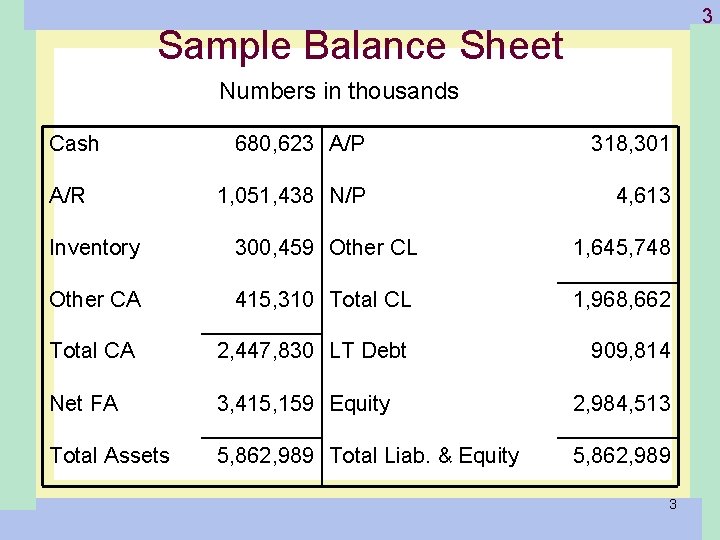
Sample Balance Sheet 1 -3 Numbers in thousands Cash A/R 680, 623 A/P 318, 301 1, 051, 438 N/P 4, 613 Inventory 300, 459 Other CL 1, 645, 748 Other CA 415, 310 Total CL 1, 968, 662 Total CA 2, 447, 830 LT Debt 909, 814 Net FA 3, 415, 159 Equity 2, 984, 513 Total Assets 5, 862, 989 Total Liab. & Equity 5, 862, 989 3 3
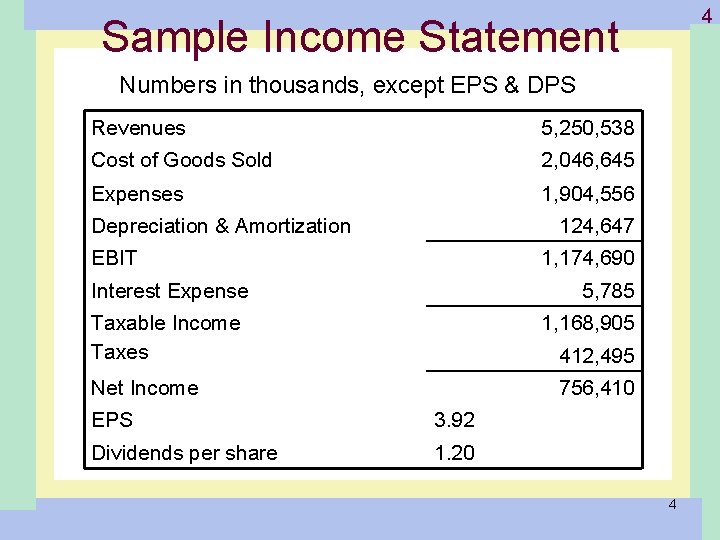
Sample Income Statement 1 -4 Numbers in thousands, except EPS & DPS Revenues 5, 250, 538 Cost of Goods Sold 2, 046, 645 Expenses 1, 904, 556 Depreciation & Amortization 124, 647 EBIT 1, 174, 690 Interest Expense 5, 785 Taxable Income Taxes 1, 168, 905 412, 495 Net Income 756, 410 EPS 3. 92 Dividends per share 1. 20 4 4
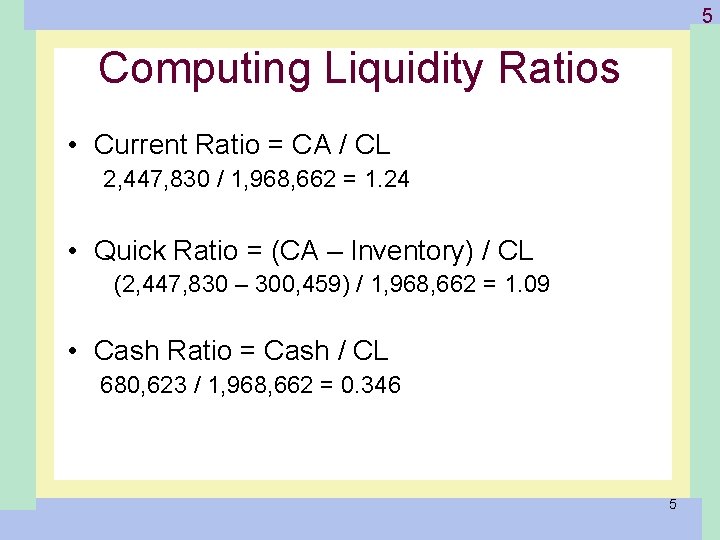
1 -5 Computing Liquidity Ratios • Current Ratio = CA / CL 2, 447, 830 / 1, 968, 662 = 1. 24 • Quick Ratio = (CA – Inventory) / CL (2, 447, 830 – 300, 459) / 1, 968, 662 = 1. 09 • Cash Ratio = Cash / CL 680, 623 / 1, 968, 662 = 0. 346 5 5
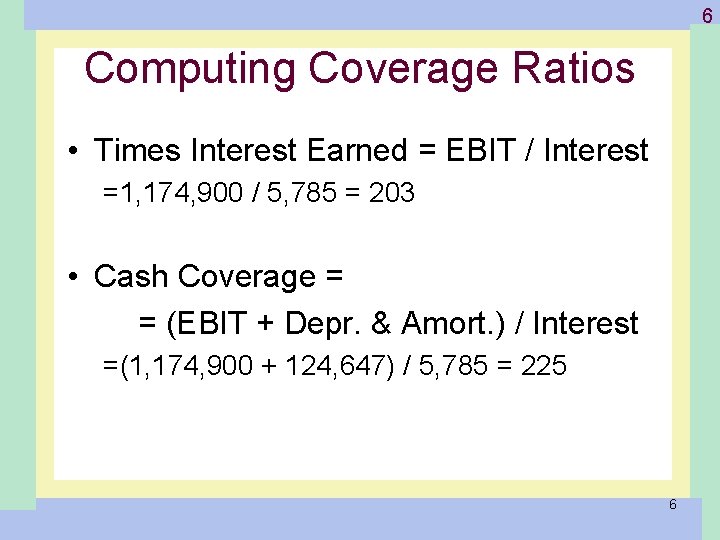
1 -6 Computing Coverage Ratios • Times Interest Earned = EBIT / Interest =1, 174, 900 / 5, 785 = 203 • Cash Coverage = = (EBIT + Depr. & Amort. ) / Interest =(1, 174, 900 + 124, 647) / 5, 785 = 225 6 6
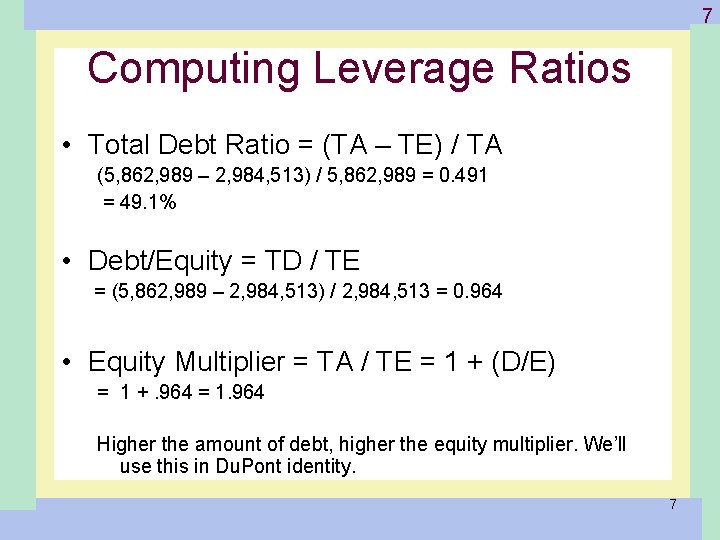
1 -7 Computing Leverage Ratios • Total Debt Ratio = (TA – TE) / TA (5, 862, 989 – 2, 984, 513) / 5, 862, 989 = 0. 491 = 49. 1% • Debt/Equity = TD / TE = (5, 862, 989 – 2, 984, 513) / 2, 984, 513 = 0. 964 • Equity Multiplier = TA / TE = 1 + (D/E) = 1 +. 964 = 1. 964 Higher the amount of debt, higher the equity multiplier. We’ll use this in Du. Pont identity. 7 7
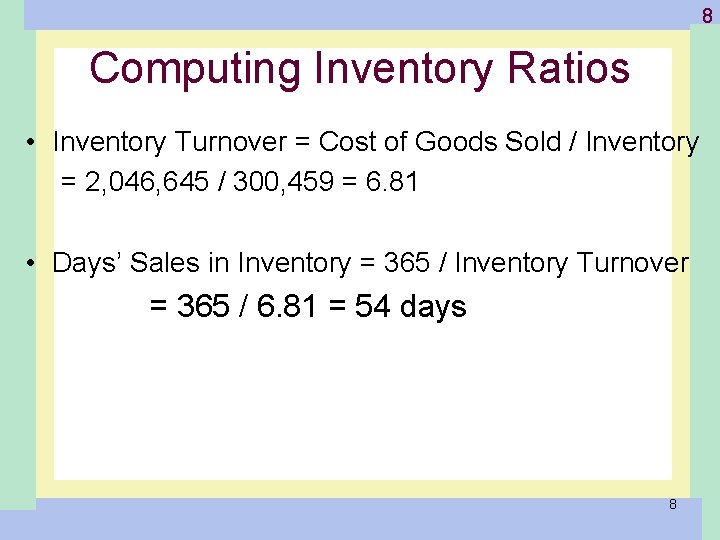
1 -8 Computing Inventory Ratios • Inventory Turnover = Cost of Goods Sold / Inventory = 2, 046, 645 / 300, 459 = 6. 81 • Days’ Sales in Inventory = 365 / Inventory Turnover = 365 / 6. 81 = 54 days 8 8
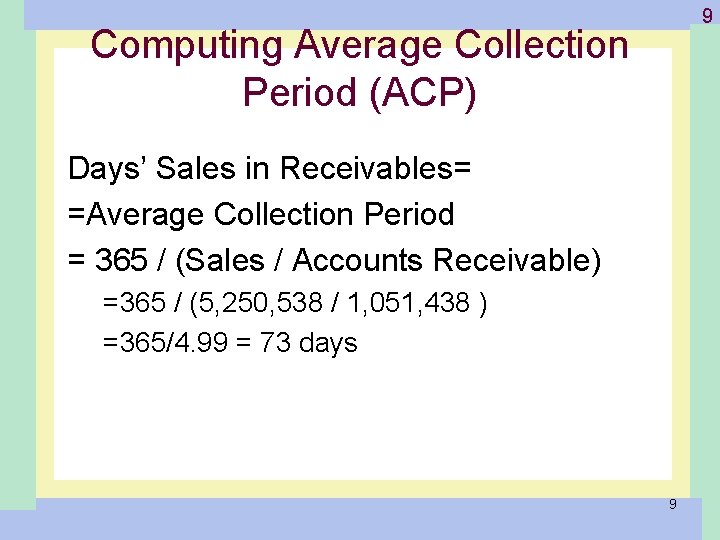
Computing Average Collection Period (ACP) 1 -9 Days’ Sales in Receivables= =Average Collection Period = 365 / (Sales / Accounts Receivable) =365 / (5, 250, 538 / 1, 051, 438 ) =365/4. 99 = 73 days 9 9
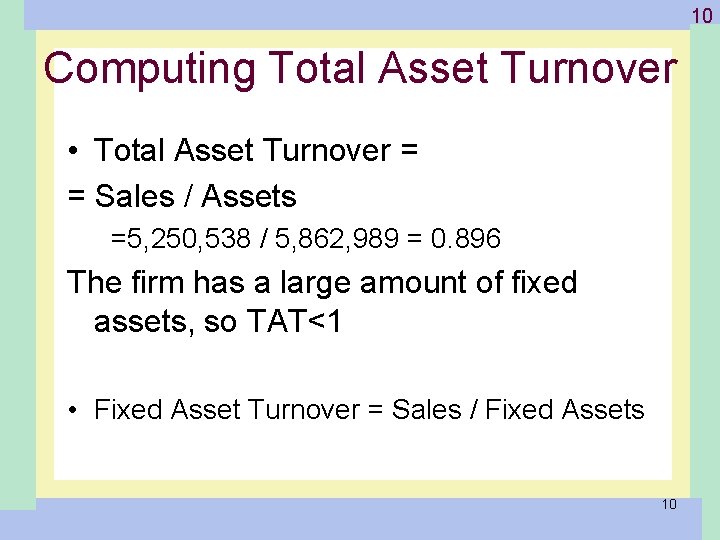
1 -10 10 Computing Total Asset Turnover • Total Asset Turnover = = Sales / Assets =5, 250, 538 / 5, 862, 989 = 0. 896 The firm has a large amount of fixed assets, so TAT<1 • Fixed Asset Turnover = Sales / Fixed Assets 10
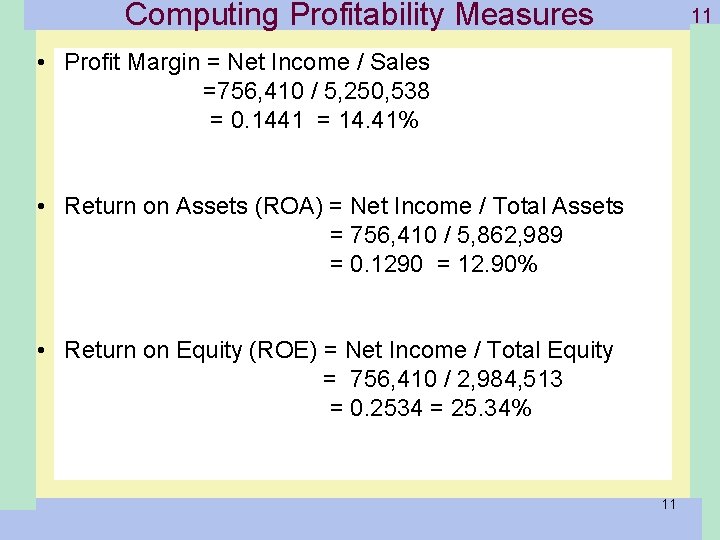
Computing Profitability Measures 1 -11 11 • Profit Margin = Net Income / Sales =756, 410 / 5, 250, 538 = 0. 1441 = 14. 41% • Return on Assets (ROA) = Net Income / Total Assets = 756, 410 / 5, 862, 989 = 0. 1290 = 12. 90% • Return on Equity (ROE) = Net Income / Total Equity = 756, 410 / 2, 984, 513 = 0. 2534 = 25. 34% 11
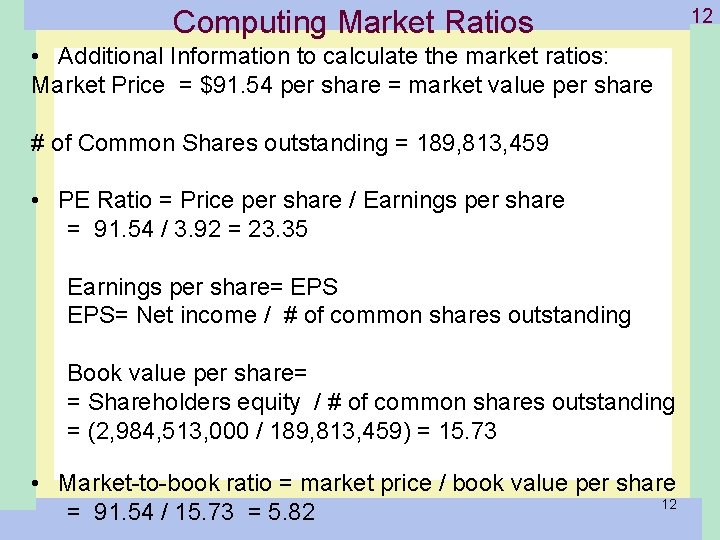
Computing Market Ratios 1 -12 12 • Additional Information to calculate the market ratios: Market Price = $91. 54 per share = market value per share # of Common Shares outstanding = 189, 813, 459 • PE Ratio = Price per share / Earnings per share = 91. 54 / 3. 92 = 23. 35 Earnings per share= EPS= Net income / # of common shares outstanding Book value per share= = Shareholders equity / # of common shares outstanding = (2, 984, 513, 000 / 189, 813, 459) = 15. 73 • Market-to-book ratio = market price / book value per share 12 = 91. 54 / 15. 73 = 5. 82
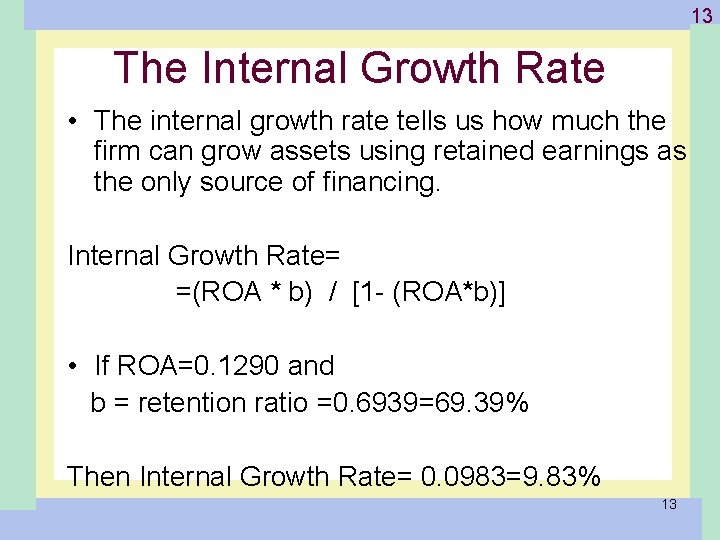
1 -13 13 The Internal Growth Rate • The internal growth rate tells us how much the firm can grow assets using retained earnings as the only source of financing. Internal Growth Rate= =(ROA * b) / [1 - (ROA*b)] • If ROA=0. 1290 and b = retention ratio =0. 6939=69. 39% Then Internal Growth Rate= 0. 0983=9. 83% 13
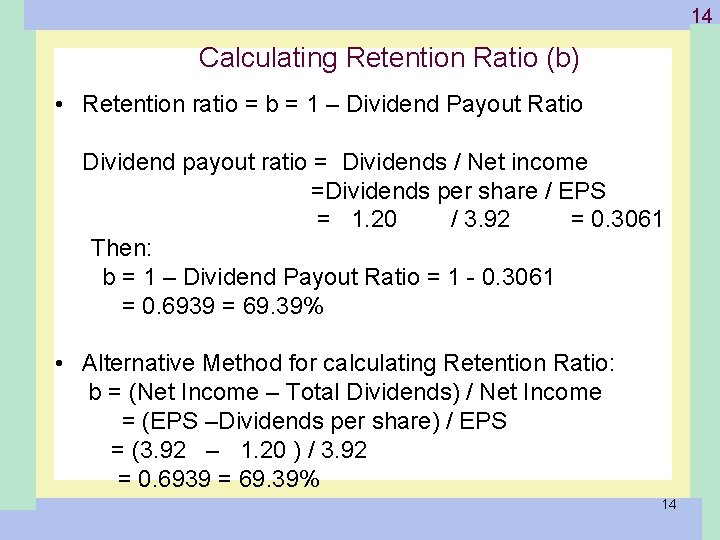
1 -14 14 Calculating Retention Ratio (b) • Retention ratio = b = 1 – Dividend Payout Ratio Dividend payout ratio = Dividends / Net income =Dividends per share / EPS = 1. 20 / 3. 92 = 0. 3061 Then: b = 1 – Dividend Payout Ratio = 1 - 0. 3061 = 0. 6939 = 69. 39% • Alternative Method for calculating Retention Ratio: b = (Net Income – Total Dividends) / Net Income = (EPS –Dividends per share) / EPS = (3. 92 – 1. 20 ) / 3. 92 = 0. 6939 = 69. 39% 14
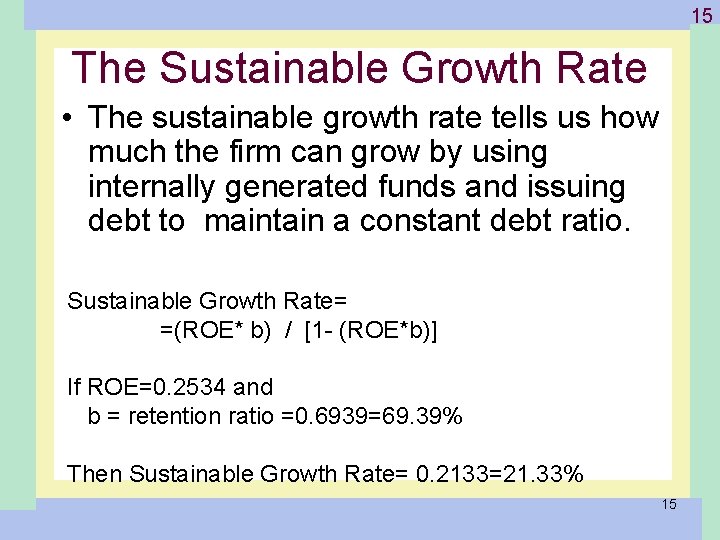
1 -15 15 The Sustainable Growth Rate • The sustainable growth rate tells us how much the firm can grow by using internally generated funds and issuing debt to maintain a constant debt ratio. Sustainable Growth Rate= =(ROE* b) / [1 - (ROE*b)] If ROE=0. 2534 and b = retention ratio =0. 6939=69. 39% Then Sustainable Growth Rate= 0. 2133=21. 33% 15
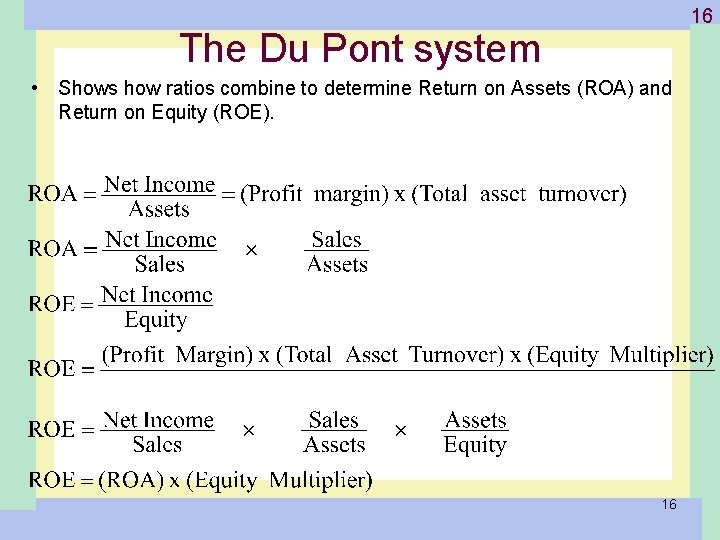
The Du Pont system 1 -16 16 • Shows how ratios combine to determine Return on Assets (ROA) and Return on Equity (ROE). 16
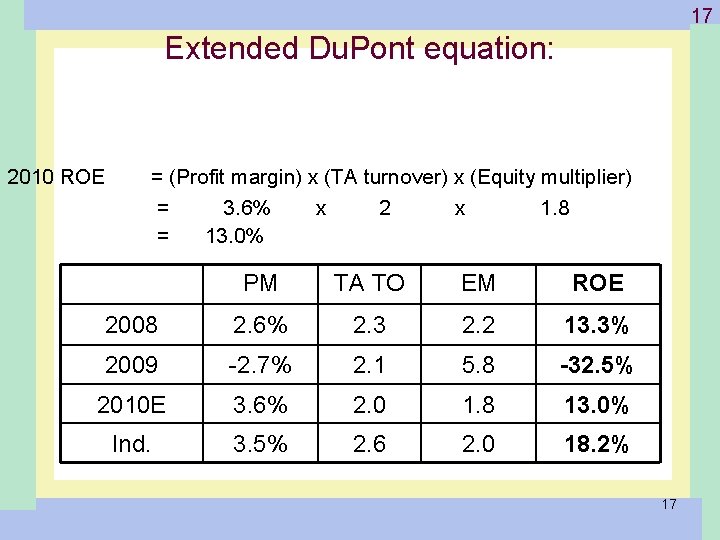
1 -17 17 Extended Du. Pont equation: 2010 ROE = (Profit margin) x (TA turnover) x (Equity multiplier) = 3. 6% x 2 x 1. 8 = 13. 0% PM TA TO EM ROE 2008 2. 6% 2. 3 2. 2 13. 3% 2009 -2. 7% 2. 1 5. 8 -32. 5% 2010 E 3. 6% 2. 0 1. 8 13. 0% Ind. 3. 5% 2. 6 2. 0 18. 2% 17
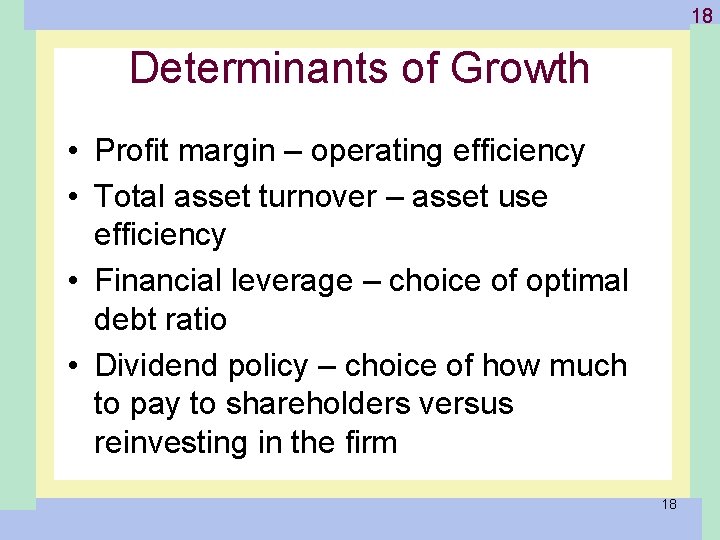
1 -18 18 Determinants of Growth • Profit margin – operating efficiency • Total asset turnover – asset use efficiency • Financial leverage – choice of optimal debt ratio • Dividend policy – choice of how much to pay to shareholders versus reinvesting in the firm 18
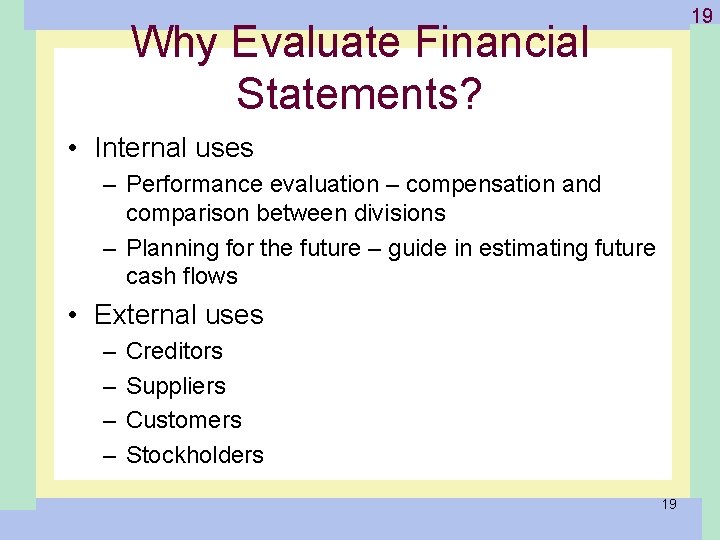
Why Evaluate Financial Statements? 1 -19 19 • Internal uses – Performance evaluation – compensation and comparison between divisions – Planning for the future – guide in estimating future cash flows • External uses – – Creditors Suppliers Customers Stockholders 19