
0708 ppt American Conservation Philosophy and its Critique
- Slides: 34
07_08. ppt American Conservation Philosophy and its Critique Professor Bob Sandmeyer bob. sandmeyer@uky. edu https: //www. uky. edu/~rsand 1/
Review Conservation Philosophies I Muir – Conservation as preservation Pinchot – Conservation as sustainable development https: //www. uky. edu/~rsand 1/
Unit Two: Conservation Philosophies I Three Important Figures 1. Theodore Roosevelt (1858 -1919) • 26 th POTUS (President of the United States) – 1901 -1909 • The Conservation President • Protected 93 million hectares – primarily in the American West, established numerous reserves, parks, and forests, and fostered great irrigation projects machismo: strong or aggressive masculine pride. • Exemplified an American machismo • "I preach to you, then, my countrymen, that our country calls not for the life of ease but for the life of strenuous endeavor. " – "The Strenuous Life, " April 1899 https: //www. uky. edu/~rsand 1/
Unit Two: Conservation Philosophies I Three Important Figures 2. John Muir (1838 -1914) • Private citizen: writer, naturalist • Sought to protect the most unique and important American wild areas, especially in the Sierras, from private commercialization and utilitarian governmental exploitation • Preservationist conservation ethic • "It is impossible to overestimate the value of wild mountains and mountain temples as places for people to grow in, recreation grounds for soul and body. They are the greatest of our natural resources, God's best gifts, but none, however high and holy, is beyond reach of the spoiler" - The Hetchy Valley, 1908. https: //www. uky. edu/~rsand 1/
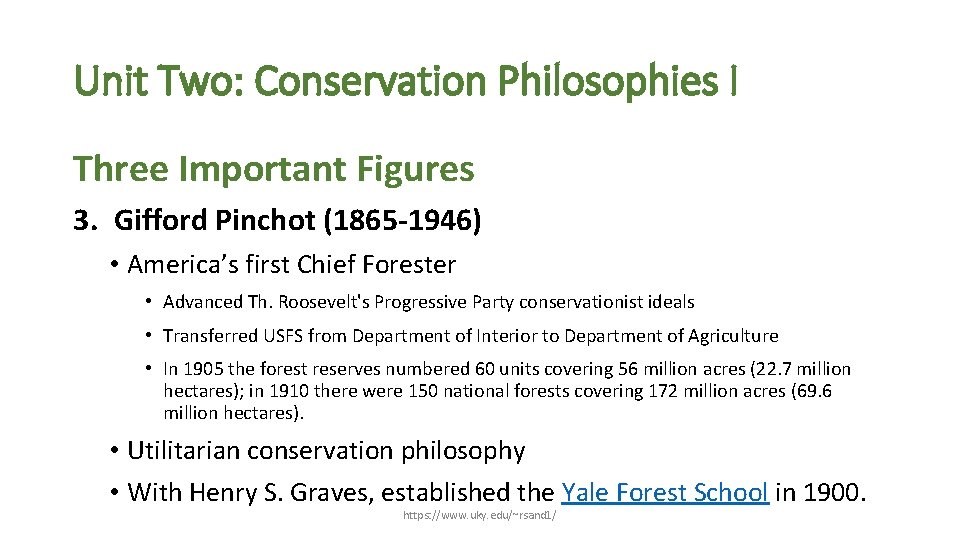
Unit Two: Conservation Philosophies I Three Important Figures 3. Gifford Pinchot (1865 -1946) • America’s first Chief Forester • Advanced Th. Roosevelt's Progressive Party conservationist ideals • Transferred USFS from Department of Interior to Department of Agriculture • In 1905 the forest reserves numbered 60 units covering 56 million acres (22. 7 million hectares); in 1910 there were 150 national forests covering 172 million acres (69. 6 million hectares). • Utilitarian conservation philosophy • With Henry S. Graves, established the Yale Forest School in 1900. https: //www. uky. edu/~rsand 1/
Unit Two: Conservation Philosophies I John Muir – Selected Readings • What is the Hetchy, and why does Muir want to protect it? • Is Muir a mystic in regard to nature? Gifford Pinchot – The Fight for Conservation, excerpted • How does Pinchot's conception of the first duty of the human race differ from John Muir's conception of the human relation to nature? • What does conservation mean to Pinchot? https: //www. uky. edu/~rsand 1/
Conservation Philosophies II Aldo Leopold and the idea of a land (i. e. , an ecological) ethic https: //www. uky. edu/~rsand 1/
Unit Two: Conservation Philosophies II Aldo Leopold – The Land Ethic • What is land according to Leopold? • By what criteria does Leopold consider a thing (i. e. , an act or a policy) right? Leopold – Collaborative Conservation • What lesson does the Coon Valley Cooperative teach? • What does conservation mean to Leopold? https: //www. uky. edu/~rsand 1/
Unit Two: Conservation Philosophies II Aldo Leopold (1887 -1948) • Important Writings • Game Management (1933) • A Sand County Almanac, and Sketches Here and There (1949) • Completed the “Great Possessions” in 1948 • 7 days before his death, Leopold received notification from Oxford University Press of the acceptance of his manuscript for publication – aka A Sand County Almanac (1949) • final editing overseen by his oldest son, Luna B. Leopold https: //www. uky. edu/~rsand 1/
Unit Two: Conservation Philosophies II Aldo Leopold (1887 -1948) • Graduated Yale Forest School 1909 • first job in newly formed US Forest Service in the Arizona and New Mexico territories • Became supervisor of Carson National Forest in New Mexico in 1912 • Assigned game and fish management duties in US Forest Service in 1915 • Recommended (1922) that Gila region of New Mexico be set aside as a wilderness preserve • Gila National Wilderness Area established in 1924 • National Wilderness Act established in 1964, 40 years later https: //www. uky. edu/~rsand 1/
Unit Two: Conservation Philosophies II Aldo Leopold (1887 -1948) • 1924: transferred to Wisconsin in 1924 to work at the Forest Products Laboratory • 1928: leaves Forest Products Lab to conduct game surveys of Midwestern states, funded by the Sporting Arms and Ammunition Manufacturers' Institute • 1933: Appointed chair of game management at University of Wisconsin – Madison in the Agricultural Economics Department https: //www. uky. edu/~rsand 1/
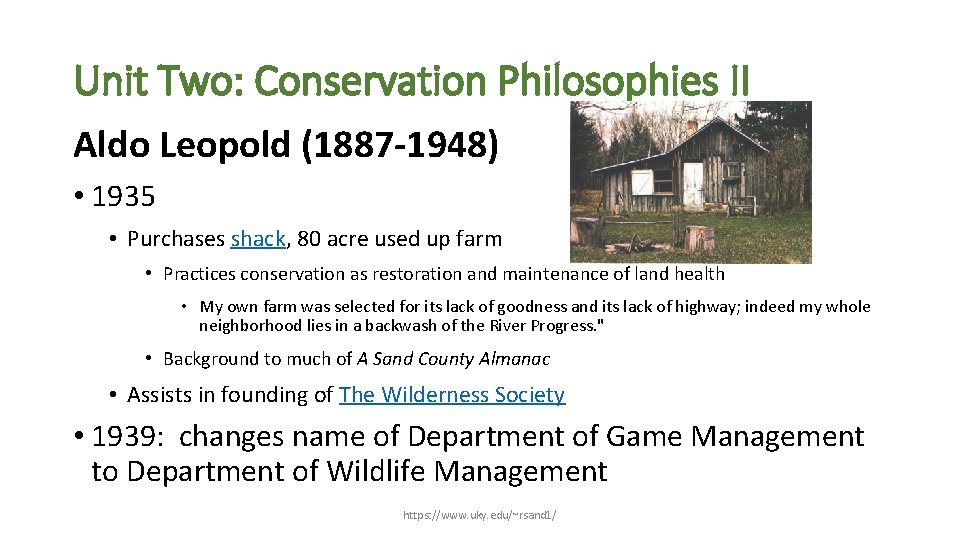
Unit Two: Conservation Philosophies II Aldo Leopold (1887 -1948) • 1935 • Purchases shack, 80 acre used up farm • Practices conservation as restoration and maintenance of land health • My own farm was selected for its lack of goodness and its lack of highway; indeed my whole neighborhood lies in a backwash of the River Progress. " • Background to much of A Sand County Almanac • Assists in founding of The Wilderness Society • 1939: changes name of Department of Game Management to Department of Wildlife Management https: //www. uky. edu/~rsand 1/
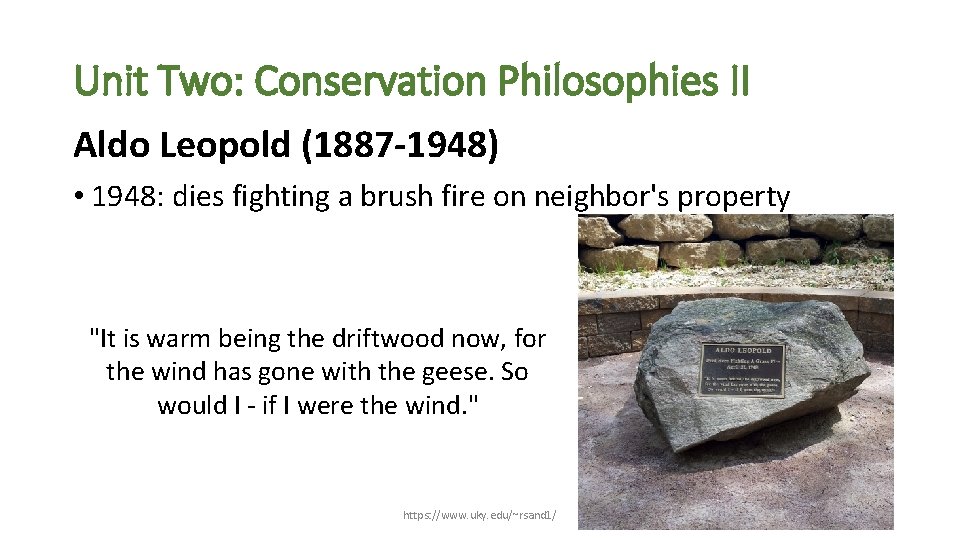
Unit Two: Conservation Philosophies II Aldo Leopold (1887 -1948) • 1948: dies fighting a brush fire on neighbor's property "It is warm being the driftwood now, for the wind has gone with the geese. So would I - if I were the wind. " https: //www. uky. edu/~rsand 1/
Unit Two: Conservation Philosophies II Aldo Leopold (1887 -1948) n, o i t a v r e s n o "C ety, r i t n e s t i n i viewed d n a w o l s e is th ding l o f n u s u o i r labo p i h s n o i t a l e r of a new and e l p o e p n e betwe land. ” Conservation best defined not with a pen but with an axe. "A conservationist is one who is humbly aware tha t with each stroke he is writing his si gnature on the face of the land. " https: //www. uky. edu/~rsand 1/
"The Land Ethic" "The land ethic simply enlarges the boundaries of the community to include soils, waters, plants, and animals; or collectively: the land. " (204)
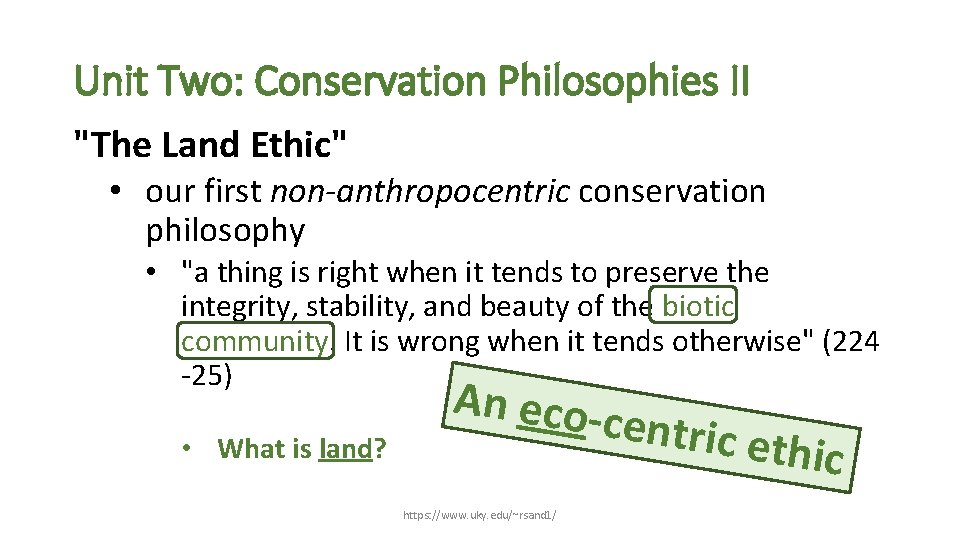
Unit Two: Conservation Philosophies II "The Land Ethic" • our first non-anthropocentric conservation philosophy • "a thing is right when it tends to preserve the integrity, stability, and beauty of the biotic community. It is wrong when it tends otherwise" (224 -25) • What is land? https: //www. uky. edu/~rsand 1/
Unit Two: Conservation Philosophies II "The Land Ethic" • our first non-anthropocentric conservation philosophy • "a thing is right when it tends to preserve the integrity, stability, and beauty of the biotic community. It is wrong when it tends otherwise" (224 -25) • What is land? An eco- centric e https: //www. uky. edu/~rsand 1/ thic
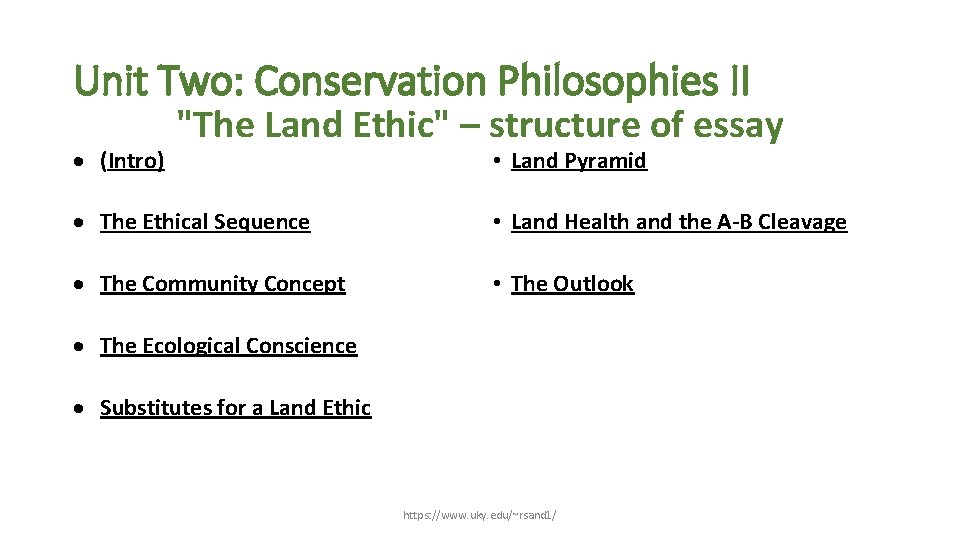
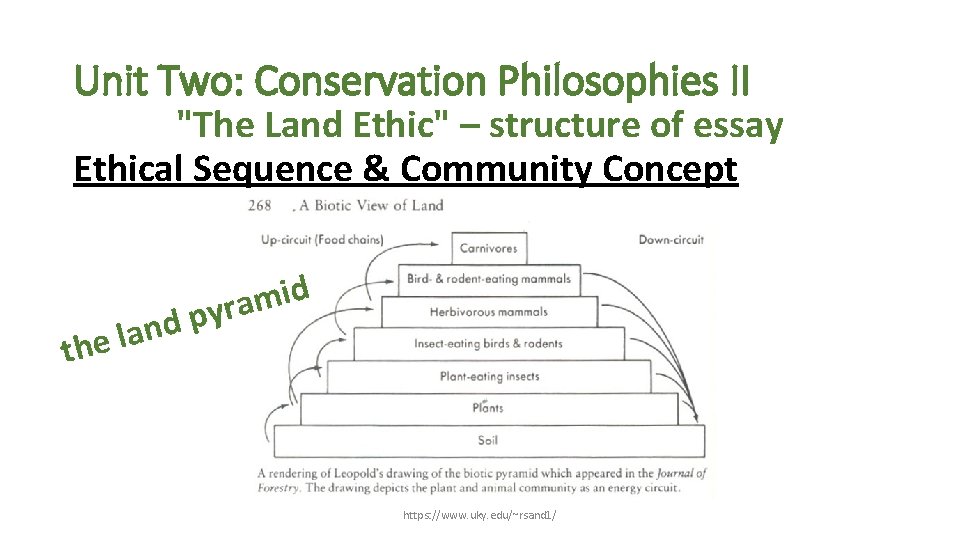
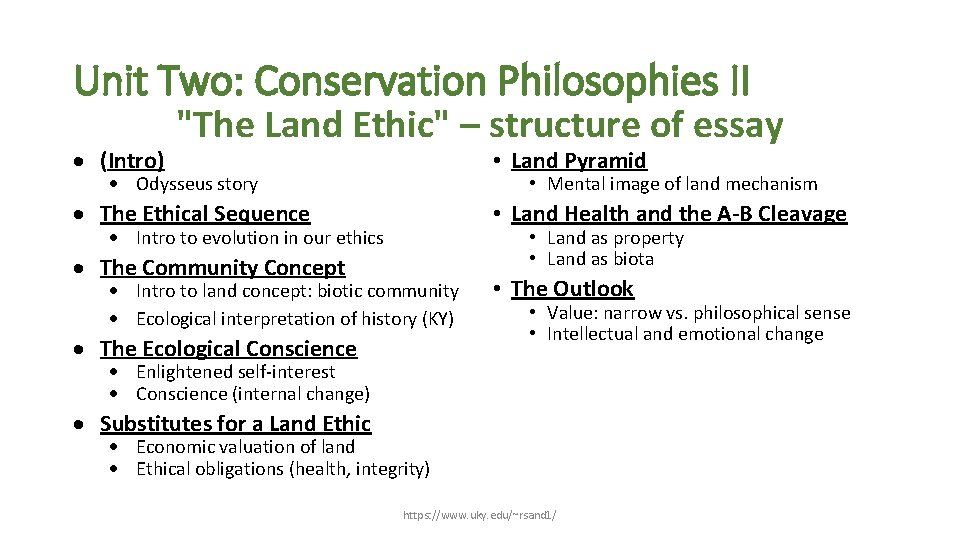
Unit Two: Conservation Philosophies II (Intro) "The Land Ethic" – structure of essay • Land Pyramid The Ethical Sequence • Land Health and the A-B Cleavage The Community Concept • The Outlook The Ecological Conscience Substitutes for a Land Ethic https: //www. uky. edu/~rsand 1/
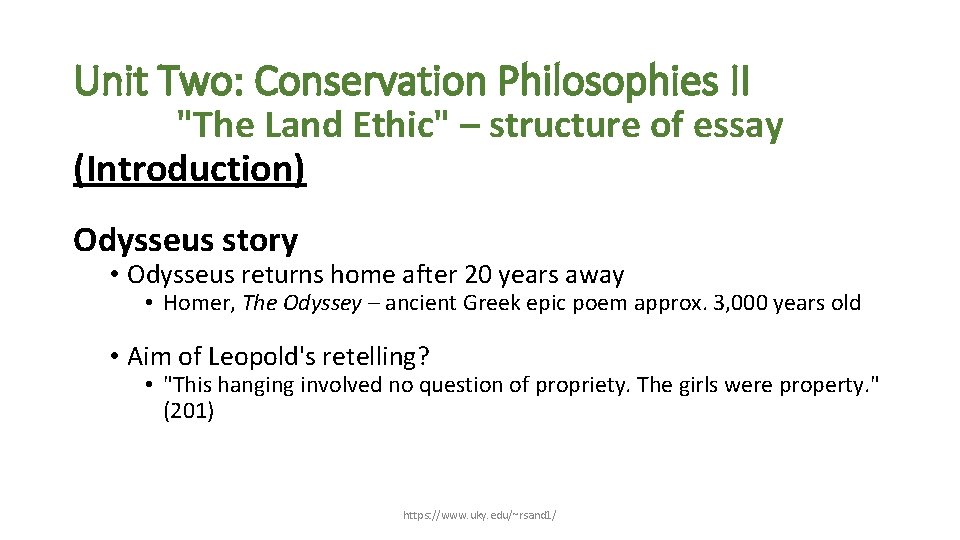
Unit Two: Conservation Philosophies II "The Land Ethic" – structure of essay (Introduction) Odysseus story • Odysseus returns home after 20 years away • Homer, The Odyssey – ancient Greek epic poem approx. 3, 000 years old • Aim of Leopold's retelling? • "This hanging involved no question of propriety. The girls were property. " (201) https: //www. uky. edu/~rsand 1/
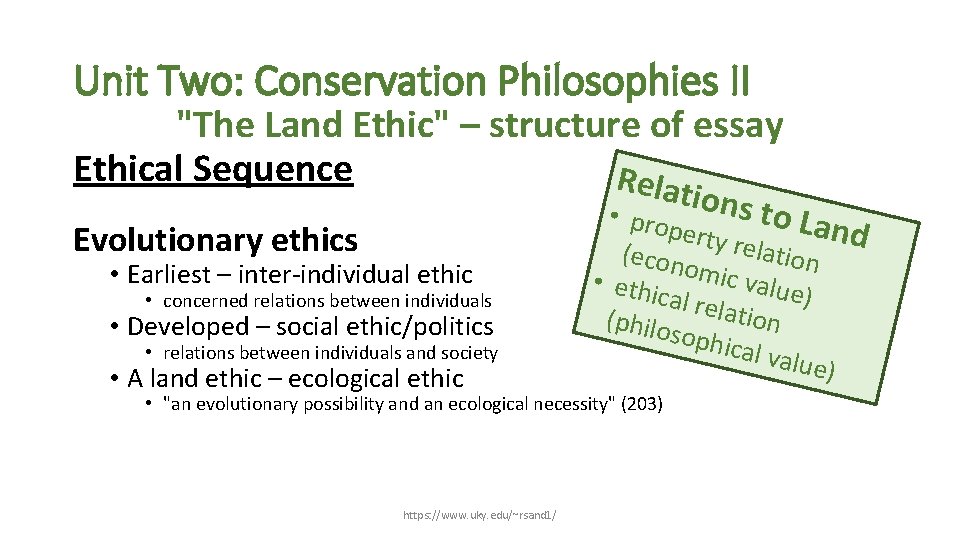
Unit Two: Conservation Philosophies II "The Land Ethic" – structure of essay Ethical Sequence Rela tions Evolutionary ethics • Earliest – inter-individual ethic • concerned relations between individuals • Developed – social ethic/politics • relations between individuals and society • A land ethic – ecological ethic t • pro o Lan perty d r e l ation (econ • ethi omic value cal re ) l ation (philo sophi cal va lue) • "an evolutionary possibility and an ecological necessity" (203) https: //www. uky. edu/~rsand 1/
Unit Two: Conservation Philosophies II "The Land Ethic" – structure of essay The Community Concept Abrahamic ethics, Genesis 1: 26 -28 (26) "And God said, 'Let us make man in our image, after our likeness, and they shall rule over the fish of the sea and over the fowl of the heaven an dover the animals and over all the earth and over all the creeping things that creep upon the earth. (27) And God created man in His image; in the image of God He created him; male and female He created them. " https: //www. uky. edu/~rsand 1/
Unit Two: Conservation Philosophies II "The Land Ethic" – structure of essay The Community Concept Abrahamic ethics, Genesis 1: 26 -28 (28) "And God blessed them, and God said to them, 'Be fruitful and multiply and fill the earth and subdue it, and rule over the fish of the sea and over the fowl of the sky an dover the beasts that tread upon the earth. " https: //www. uky. edu/~rsand 1/
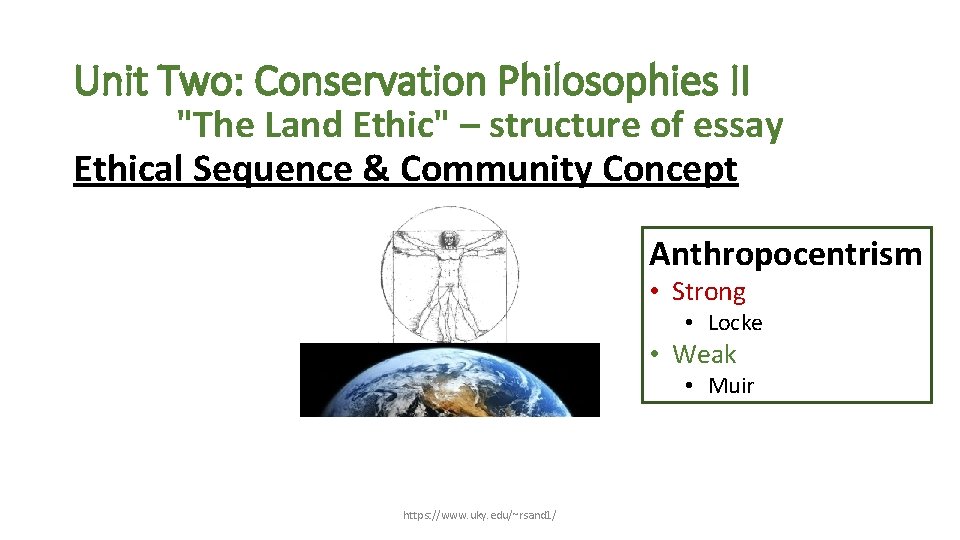
Unit Two: Conservation Philosophies II "The Land Ethic" – structure of essay Ethical Sequence & Community Concept Anthropocentrism • Strong • Locke • Weak • Muir https: //www. uky. edu/~rsand 1/
Unit Two: Conservation Philosophies II "The Land Ethic" – structure of essay Ethical Sequence & Community Concept d i m pyra d n a l the https: //www. uky. edu/~rsand 1/
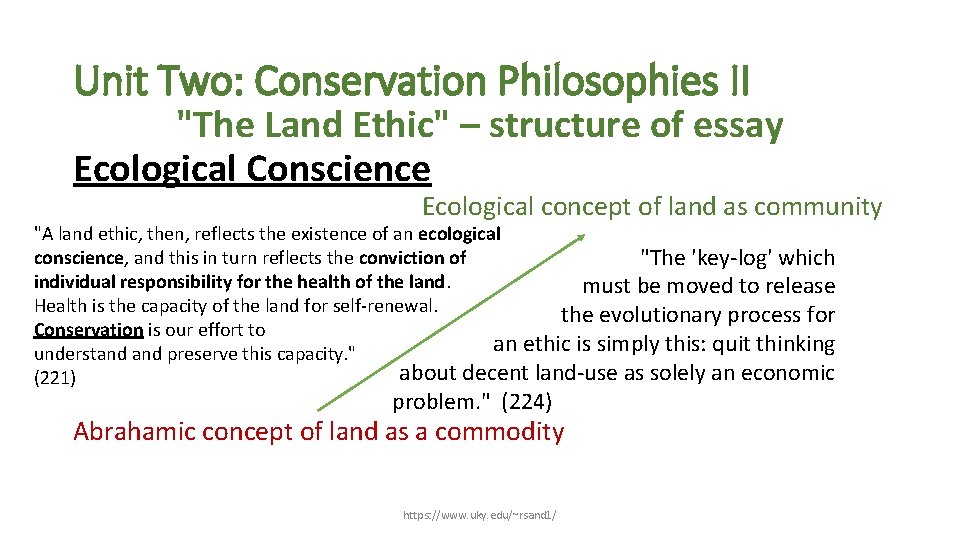
Unit Two: Conservation Philosophies II "The Land Ethic" – structure of essay Ecological Conscience Ecological concept of land as community "A land ethic, then, reflects the existence of an ecological conscience, and this in turn reflects the conviction of "The 'key-log' which individual responsibility for the health of the land. must be moved to release Health is the capacity of the land for self-renewal. the evolutionary process for Conservation is our effort to an ethic is simply this: quit thinking understand preserve this capacity. " about decent land-use as solely an economic (221) problem. " (224) Abrahamic concept of land as a commodity https: //www. uky. edu/~rsand 1/
Unit Two: Conservation Philosophies II (Intro) "The Land Ethic" – structure of essay • Land Pyramid Odysseus story • Mental image of land mechanism The Ethical Sequence • Land Health and the A-B Cleavage Intro to evolution in our ethics • Land as property • Land as biota The Community Concept Intro to land concept: biotic community Ecological interpretation of history (KY) The Ecological Conscience • The Outlook • Value: narrow vs. philosophical sense • Intellectual and emotional change Enlightened self-interest Conscience (internal change) Substitutes for a Land Ethic Economic valuation of land Ethical obligations (health, integrity) https: //www. uky. edu/~rsand 1/
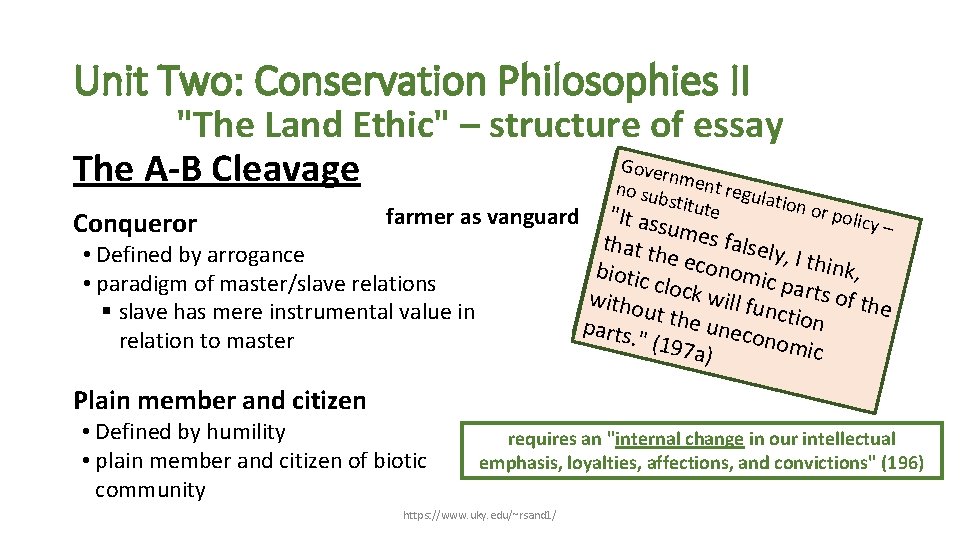
Unit Two: Conservation Philosophies II "The Land Ethic" – structure of essay Gover The A-B Cleavage nmen t reg n. Roe s la Conqueror farmer as vanguard (ecthoeneco lalyt, io. I nthin iaclupar k, • bioettihc iclocokmnicom v witho cal rewill fu e) ts of the ut the lationction ( p n u partsh i n l o e c s o. " (19 ophic nom 7 a) al va ic lue) • Defined by arrogance • paradigm of master/slave relations slave has mere instrumental value in relation to master Plain member and citizen • Defined by humility • plain member and citizen of biotic community ulatio t i o u n t • "Itparsosu e s to n. Loar policy – n eretsyfarls d that pm ee ubstit requires an "internal change in our intellectual emphasis, loyalties, affections, and convictions" (196) https: //www. uky. edu/~rsand 1/
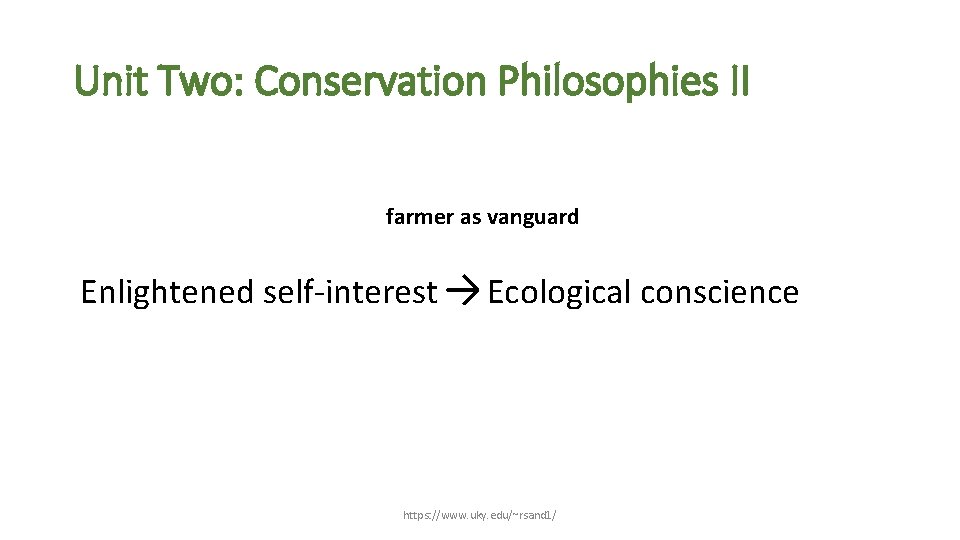
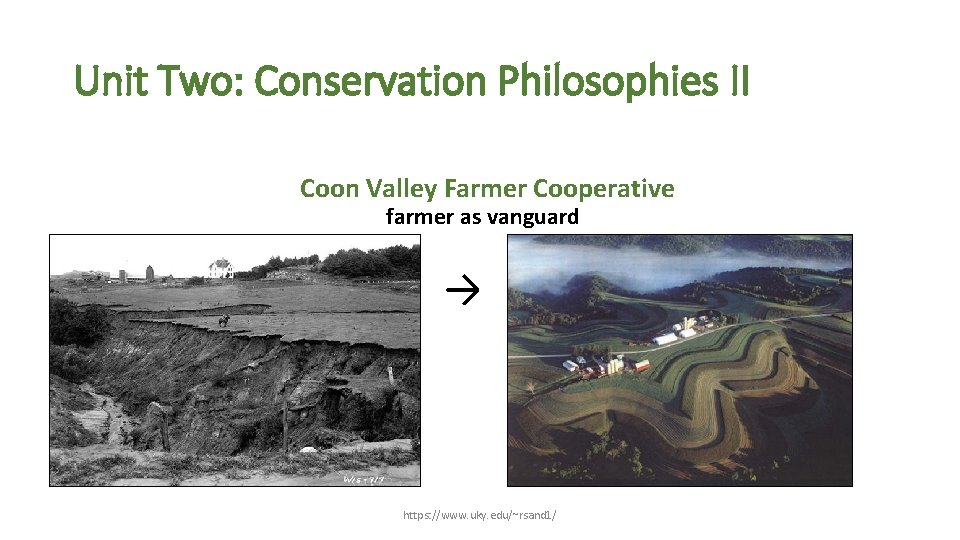
Unit Two: Conservation Philosophies II farmer as vanguard Enlightened self-interest → Ecological conscience https: //www. uky. edu/~rsand 1/
Unit Two: Conservation Philosophies II Coon Valley Farmer Cooperative farmer as vanguard Enlightened self-interest → Ecological conscience https: //www. uky. edu/~rsand 1/
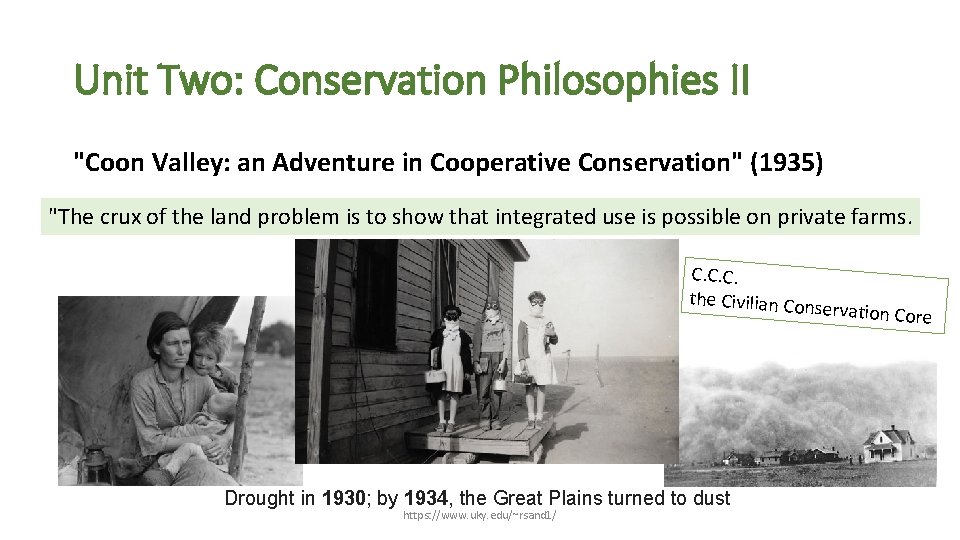
Unit Two: Conservation Philosophies II "Coon Valley: an Adventure in Cooperative Conservation" (1935) "The crux of the land problem is tofarmer as vanguard show that integrated use is possible on private farms. C. C. C. the Civilian Con s ervation Core Drought in 1930; by 1934, the Great Plains turned to dust https: //www. uky. edu/~rsand 1/
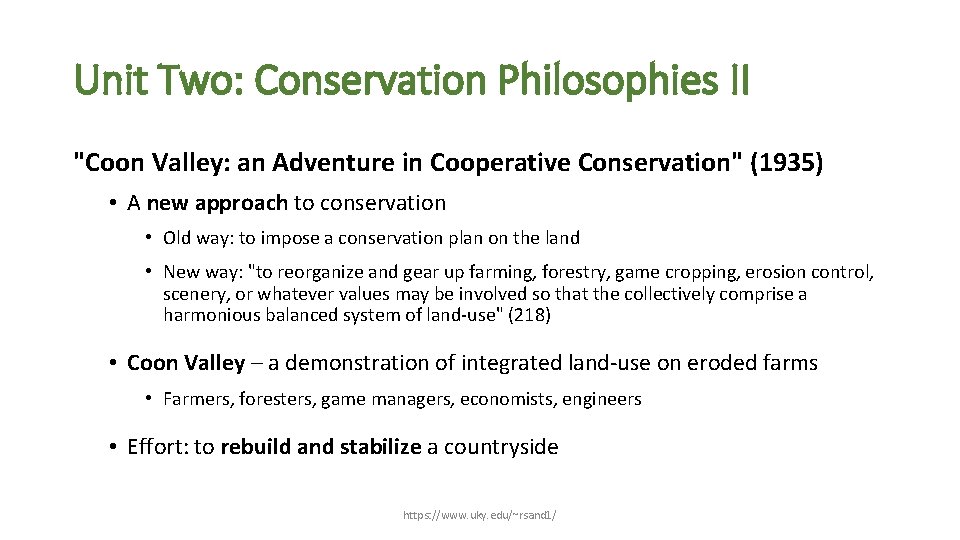
Unit Two: Conservation Philosophies II "Coon Valley: an Adventure in Cooperative Conservation" (1935) • A new approach to conservation • Old way: to impose a conservation plan on the land • New way: "to reorganize and gear up farming, forestry, game cropping, erosion control, scenery, or whatever values may be involved so that the collectively comprise a harmonious balanced system of land-use" (218) • Coon Valley – a demonstration of integrated land-use on eroded farms • Farmers, foresters, game managers, economists, engineers • Effort: to rebuild and stabilize a countryside https: //www. uky. edu/~rsand 1/
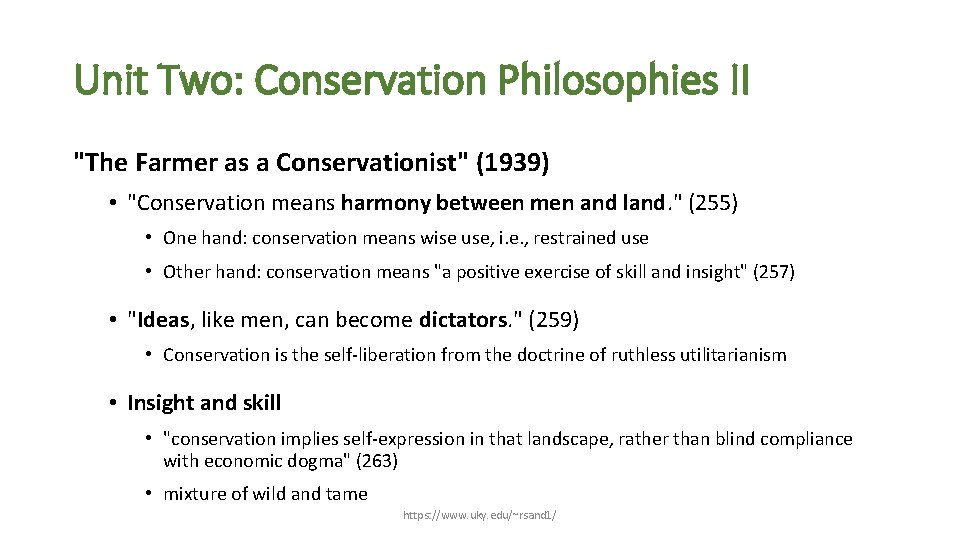
Unit Two: Conservation Philosophies II "The Farmer as a Conservationist" (1939) • "Conservation means harmony between men and land. " (255) • One hand: conservation means wise use, i. e. , restrained use • Other hand: conservation means "a positive exercise of skill and insight" (257) • "Ideas, like men, can become dictators. " (259) • Conservation is the self-liberation from the doctrine of ruthless utilitarianism • Insight and skill • "conservation implies self-expression in that landscape, rather than blind compliance with economic dogma" (263) • mixture of wild and tame https: //www. uky. edu/~rsand 1/
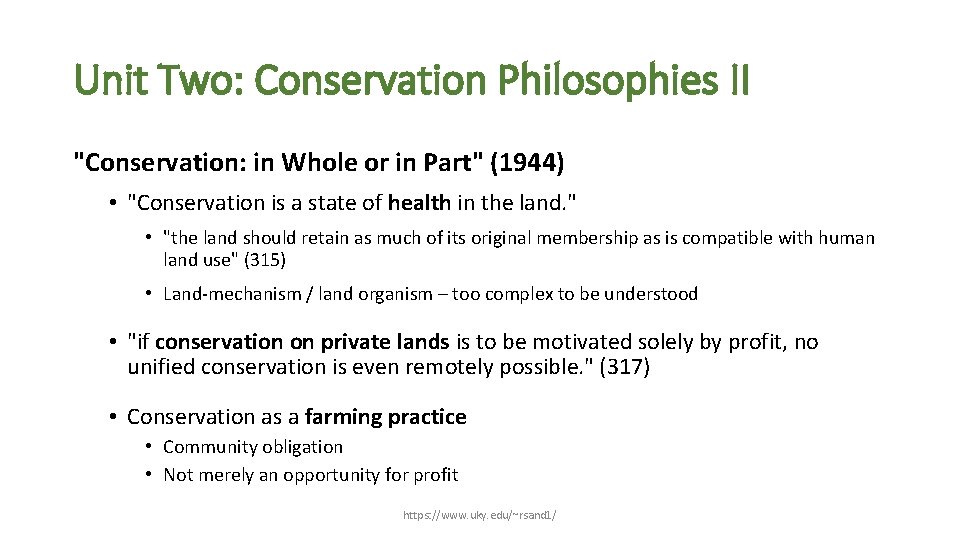
Unit Two: Conservation Philosophies II "Conservation: in Whole or in Part" (1944) • "Conservation is a state of health in the land. " • "the land should retain as much of its original membership as is compatible with human land use" (315) • Land-mechanism / land organism – too complex to be understood • "if conservation on private lands is to be motivated solely by profit, no unified conservation is even remotely possible. " (317) • Conservation as a farming practice • Community obligation • Not merely an opportunity for profit https: //www. uky. edu/~rsand 1/
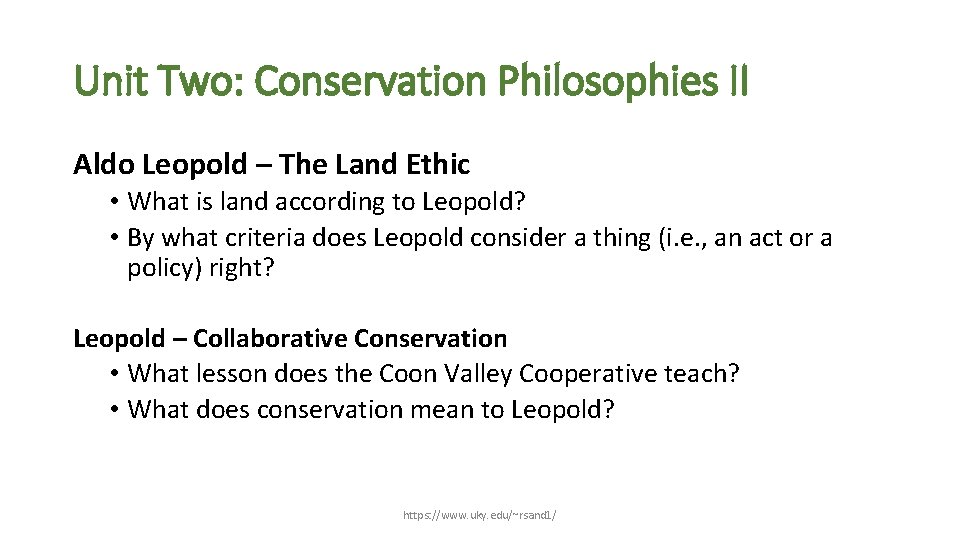
Unit Two: Conservation Philosophies II Aldo Leopold – The Land Ethic • What is land according to Leopold? • By what criteria does Leopold consider a thing (i. e. , an act or a policy) right? Leopold – Collaborative Conservation • What lesson does the Coon Valley Cooperative teach? • What does conservation mean to Leopold? https: //www. uky. edu/~rsand 1/